Japan Hydrogen Fuel Cell Aircraft Market Size & Growth Rate
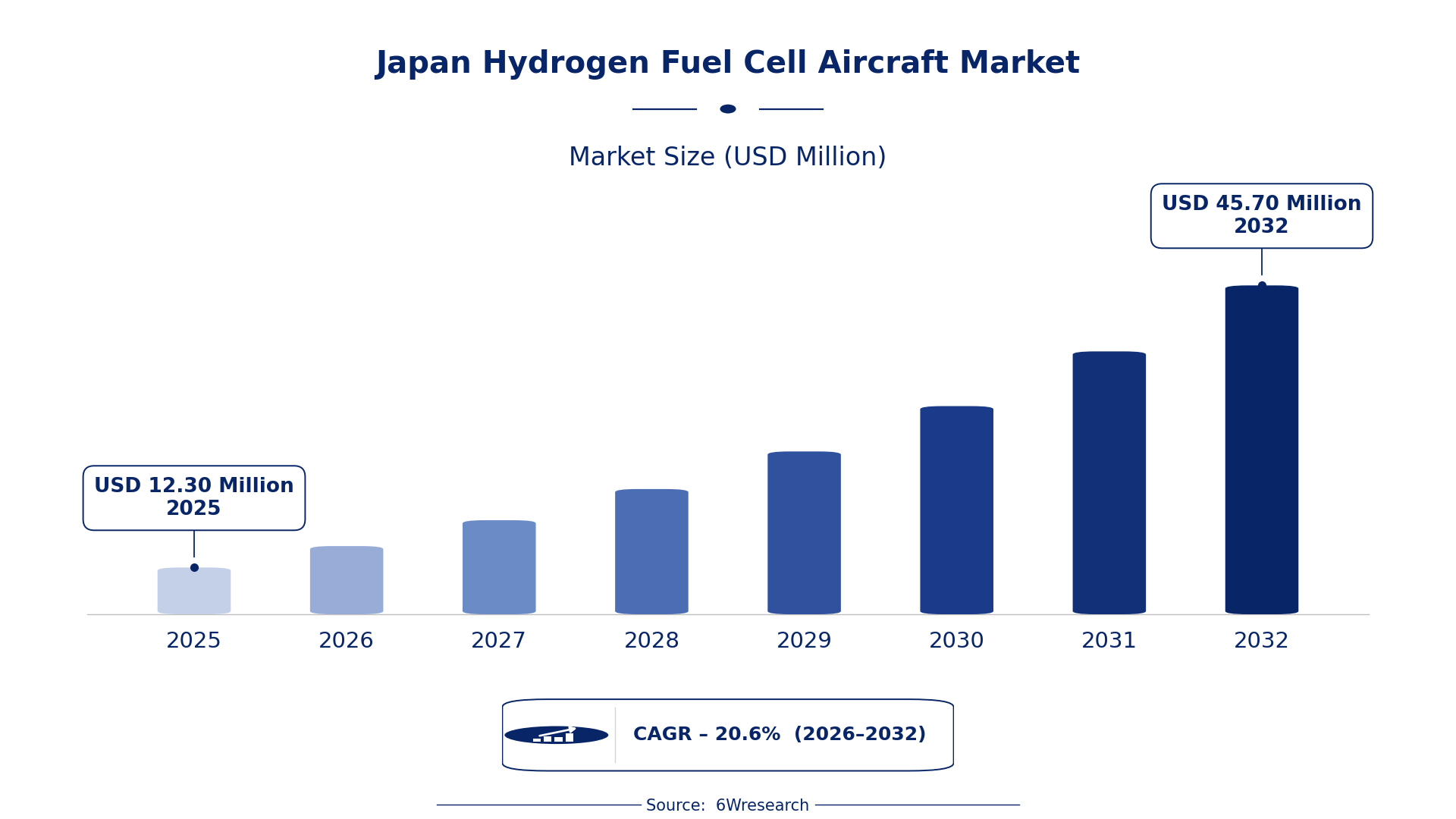
According to 6Wresearch internal database and industry insights, the Japan Hydrogen Fuel Cell Aircraft Market was valued at USD 12.30 Million in 2025 and is projected to reach USD 45.70 Million by 2032, growing at a CAGR of approximately 20.6% during 2026–2032.
Japan Hydrogen Fuel Cell Aircraft Market Highlights
| Report Metric | Details |
| Report Name | Japan Hydrogen Fuel Cell Aircraft Market (2026-2032) |
| Market Size 2025 | USD 12.30 Million |
| Market Size 2032 | USD 45.70 Million |
| Absolute Growth 2025–2032 | USD 33.40 Million |
| CAGR 2026–2032 | 20.6% |
| Peak Annual Growth | 23.1% in 2027 |
| Forecast Period | 2026–2032 |
| Historical Data | 2022–2025 |
| Base Year | 2025 |
| Leading Aircraft Type, 2025 | Regional Aircraft (44% share) |
| Leading Fuel Cell Type, 2025 | PEM Fuel Cell (47% share) |
| Leading Application Use, 2025 | Short-Haul Travel (41% share) |
| Leading End User, 2025 | Regional Airline Operators (47% share) |
| Fastest-Growing Aircraft Type | Drones/UAVs (23.0% CAGR) |
| Fastest-Growing Fuel Cell Type | Solid Oxide Fuel Cell (22.5% CAGR) |
| Fastest-Growing Application Use | Surveillance (23.0% CAGR) |
| Fastest-Growing End User | Defense Sector (27.3% CAGR) |
| Growing Sector | Surveillance |
| Key End Users | Short-Haul Travel, Surveillance, Urban Air Mobility, Long-Range Planning |
Japan Hydrogen Fuel Cell Aircraft Market Year-wise Growth Rate and Key Drivers (2022–2032)
This graph illustrates the annual growth rates of the market from 2022 to 2032, highlighting a steady upward trajectory and projected market expansion over the forecast period.
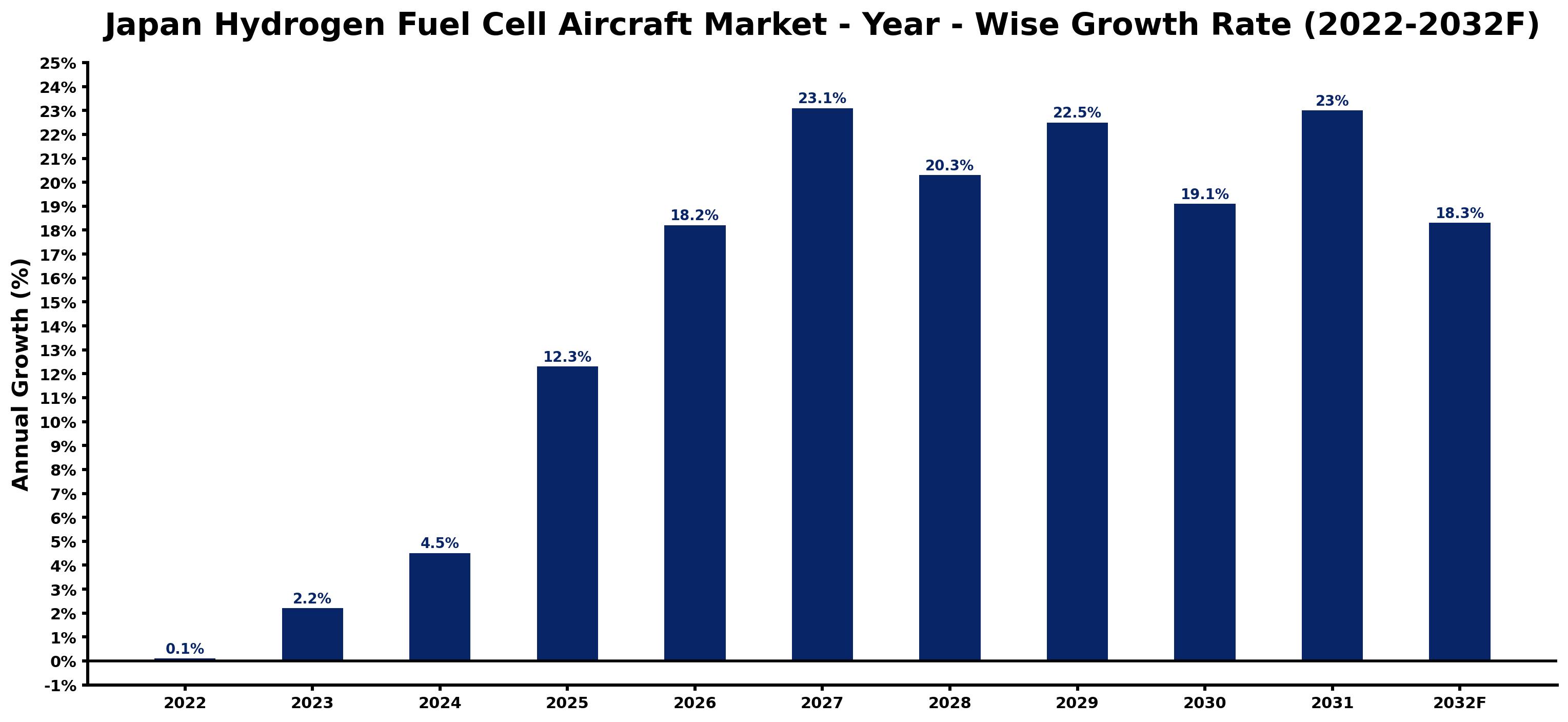
Year by year, the estimates below pair each growth rate with the development that shaped it.
| Year | Estimated Annual Growth (%) | Market Rationale |
| 2022 | 0.1 | The market experienced minimal activity with initial testing of prototypes. |
| 2023 | 2.2 | Growth accelerated as interest in hydrogen aviation increased among stakeholders. |
| 2024 | 4.5 | Investment in hydrogen infrastructure began to rise, boosting market confidence. |
| 2025 | 12.3 | Prototypes became operational, driving growth in regional applications. |
| 2026 | 18.2 | Demand surged as technology advancements improved fuel cell efficiency. |
| 2027 | 23.1 | The market peaked due to increased investments in urban air mobility. |
| 2028 | 20.3 | Growth slowed as the market began to stabilise. |
| 2029 | 22.5 | Adoption of hydrogen solutions in surveillance applications drove growth. |
| 2030 | 19.1 | Market growth decelerated as saturation among early adopters occurred. |
| 2031 | 23.0 | Demand rebounded with renewed focus on regional airline operations. |
| 2032 | 18.3 | Growth slowed again as the market reached a stable phase. |
Note: Market size estimations and growth projections presented in this report are based on 6Wresearch's proprietary forecasting methodology, utilizing the latest available industry data, government publications, and primary research inputs.
Japan Hydrogen Fuel Cell Aircraft Market Synopsis
Hydrogen fuel cell aircraft generate electricity using hydrogen, producing only water as a byproduct. Japan aims to have prototypes operational by 2025, with investments in green technologies. The Japan Hydrogen Fuel Cell Aircraft Market is expanding due to rising urban mobility needs and government support for hydrogen infrastructure, including the establishment of hydrogen refueling stations by 2025. This growth is driven by regional airline operators and urban air mobility initiatives.
Market Dynamics Impact Analysis (2026–2032)
| Factor | Type | Impact | Primary Segment Affected |
| Increasing investments in hydrogen infrastructure | Driver | High | Regional Aircraft |
| Growing urban air mobility initiatives | Driver | High | eVTOL Aircraft |
| Emerging demand for surveillance applications | Opportunity | Medium | Drones/UAVs |
| Prototypes operational by 2025 | Opportunity | High | Commercial Prototypes |
| Limited awareness of hydrogen technology | Restraint | Medium | Regional Aircraft |
| High initial investment costs for infrastructure | Restraint | High | eVTOL Aircraft |
| Technological challenges in fuel cell efficiency | Challenge | High | Drones/UAVs |
| Competition from alternative propulsion technologies | Challenge | Medium | Commercial Prototypes |
Evaluation of Drivers in Japan Hydrogen Fuel Cell Aircraft Market (2026–2032)
Key forces behind demand, with the segment each one moves most, are listed below.
| Drivers | Primary Segment Affected | Why It Matters (Evidence) |
| Rising urban mobility needs | eVTOL Aircraft | Japan's population of approximately 126 million drives demand for efficient transport solutions. |
| Investment in hydrogen technology | Regional Aircraft | The Ministry of Economy, Trade and Industry is investing ¥2 billion in hydrogen aviation. |
| Showcasing hydrogen's viability | Commercial Prototypes | The Tokyo 2020 Olympic Games highlighted hydrogen fuel cell technology in transport. |
| Support from local governments for hydrogen infrastructure | Drones/UAVs | The Tokyo Metropolitan Government promotes urban air mobility projects. |
| Collaborations among stakeholders in hydrogen sector | eVTOL Aircraft | The Japan Hydrogen Association facilitates partnerships to advance hydrogen technology. |
What keeps demand rising is the increasing need for urban mobility solutions, particularly in densely populated areas like Tokyo, where the population exceeds 9 million. Investments in hydrogen technology, amounting to ¥2 billion, are driving advancements in fuel cell efficiency. The showcase of hydrogen fuel cells during the Tokyo 2020 Olympic Games led to heightened interest from regional airline operators. The establishment of 200 hydrogen refueling stations by 2025 further stimulates demand, while collaborations among stakeholders in the hydrogen sector promote technology adoption.
Evaluation of Restraints in Japan Hydrogen Fuel Cell Aircraft Market
Below are the constraints most often cited by buyers and suppliers, with the segment each affects.
| Market Restraint | Primary Segment Affected | Why It Matters (Evidence) |
| Regulatory hurdles delaying prototype approvals | Commercial Prototypes | Compliance with the ISO 14687 standard can delay approvals by up to two years. |
| Skills shortages in hydrogen technology | Regional Aircraft | Limited workforce availability causes delays in project execution for suppliers. |
| Increased competition from alternative technologies | Drones/UAVs | Pressure to innovate rapidly leads to higher R&D costs for producers. |
| Technology limitations in fuel cell efficiency | eVTOL Aircraft | Hindered operational range restricts usage for airlines and increases costs. |
| Market saturation among early adopters | Surveillance | Slower growth occurs as initial demand stabilises. |
Japan Hydrogen Fuel Cell Aircraft Market Challenges
Japan's hydrogen fuel cell aircraft market faces regulatory hurdles, as compliance with the ISO 14687 standard can delay prototype approvals by up to two years, impacting manufacturers' timelines. Skills shortages in hydrogen technology limit the available workforce for development, causing project execution delays for suppliers. Increased competition from alternative green technologies pressures producers to innovate rapidly, raising R&D costs that can reduce profit margins by around 10%. Technology limitations in fuel cell efficiency hinder operational range, restricting usage for airlines and increasing operational costs by approximately 15%.
Trends in the Japan Hydrogen Fuel Cell Aircraft Market
Buyers and suppliers in the Japan Hydrogen Fuel Cell Aircraft Market are adjusting to the following trends.
- Shift Towards Urban Air Mobility Solutions: Regional airline operators are increasingly adopting hydrogen fuel cell aircraft for urban air mobility. The Tokyo Metropolitan Government's pilot project for eVTOL aircraft aims for operational testing by 2025.
- Emergence of Collaborative Hydrogen Initiatives: The Japan Hydrogen Association is building partnerships to advance hydrogen technology. This collaboration is crucial for achieving the target of 200 hydrogen refueling stations by 2025.
- Focus on Hydrogen Infrastructure Development: The establishment of hydrogen refueling stations is gaining momentum across Japan. The government aims for 200 stations by 2025, improving accessibility for hydrogen fuel cell aircraft.
- Advancements in Fuel Cell Technology: Ongoing research is improving fuel cell efficiency, making hydrogen aircraft more viable. The Aerospace Research and Development Agency allocated ¥2 billion for hydrogen technology research in 2023.
Investment Opportunities in the Japan Hydrogen Fuel Cell Aircraft Market
Where to invest in the Japan Hydrogen Fuel Cell Aircraft Market: the main openings are set out below.
- Investment in Hydrogen Refueling Stations: With a target of 200 stations by 2025, there is a strong opportunity for infrastructure investment. Regional airline operators can partner with local governments to facilitate this expansion.
- Development of eVTOL Aircraft: The growing demand for urban air mobility solutions presents an opportunity for suppliers to invest in eVTOL aircraft technology. The Tokyo Metropolitan Government's pilot project is a key area for development.
- Research and Development in Fuel Cell Technology: The ¥2 billion allocated for hydrogen technology research in 2023 provides a chance for innovation. Aerospace R&D agencies are key players in advancing fuel cell applications.
- Collaboration in Hydrogen Sector: The Japan Hydrogen Association's initiatives create openings for partnerships in hydrogen technology. Engaging with stakeholders can improve market entry strategies.
Government Initiatives in the Japan Hydrogen Fuel Cell Aircraft Market
The Hydrogen Society Promotion Act of 2024 supports low-carbon hydrogen supply chains with price-gap support. This legislation aims to reduce greenhouse gas emissions by 46% from fiscal 2013 levels by 2030, promoting hydrogen as a sustainable energy source for aviation and its buyers.
The Ministry of Economy, Trade and Industry approves funding for hydrogen technology projects. It has allocated ¥2 billion to support research and development in hydrogen aviation, boosting the industry's growth potential.
Future Insight of the Japan Hydrogen Fuel Cell Aircraft Market
The upcoming hydrogen refueling stations by 2025 will facilitate the operation of hydrogen fuel cell aircraft, improving their viability. Ongoing investments in hydrogen technology by the Ministry of Economy, Trade and Industry will drive advancements in aircraft efficiency. The Tokyo Metropolitan Government's pilot projects for eVTOL aircraft will create new market opportunities for suppliers. By 2032, Japan's commitment to cutting greenhouse gas emissions will further establish hydrogen as a cornerstone of sustainable aviation.
Market Segmentation Analysis
Japan Hydrogen Fuel Cell Aircraft Market report covers a detailed analysis of the following market segments:
By Aircraft Type – Regional Aircraft Leads, Drones/UAVs Expected to Grow Fastest
According to Saurav Kr Singh, Senior Research Analyst at 6Wresearch, Regional Aircraft took 44% of aircraft type revenue in 2025, more than any other category. Regional aircraft maintain a dominant position due to their essential function in short-haul travel, catering to a large segment of Japan's population. This segment benefits from substantial investments in green technologies, aligning with national sustainability goals. Drones/UAVs are projected to grow fastest, at a CAGR of 23.0% during 2026–2032. Drones and UAVs are experiencing rapid growth as they are increasingly utilised for surveillance and logistics applications, reflecting the need for advanced technology in various sectors. The rise of urban mobility initiatives further fuels this demand, making drones a key focus area for future development. Suppliers should prioritise innovations in regional aircraft and UAV technologies to align with market demands.
By Fuel Cell Type – PEM Fuel Cell Leads, Solid Oxide Fuel Cell Expected to Grow Fastest
In 2025, PEM Fuel Cell led the fuel cell type split with a 47% share. PEM fuel cells dominate the market due to their efficiency and reliability, making them essential for hydrogen fuel cell aircraft. Their widespread use in aviation applications supports Japan's commitment to sustainable air travel. Over 2026–2032, Solid Oxide Fuel Cell is expected to post the fastest growth, at a CAGR of 22.5%. Solid oxide fuel cells are beginning to attract interest for specific applications, although their size and weight pose challenges in aircraft. As research advances, their potential for niche markets may lead to increased adoption. Suppliers should prioritise PEM fuel cells while monitoring the evolving landscape for solid oxide fuel cells.
By Application Use – Short-Haul Travel Leads, Surveillance Expected to Grow Fastest
Short-Haul Travel held 41% of the Japan Hydrogen Fuel Cell Aircraft Market by application use in 2025. Short-haul travel serves as the primary application for hydrogen fuel cell aircraft, reflecting Japan's emphasis on regional connectivity and sustainable transport. Government initiatives promoting hydrogen technology further reinforce this segment's significance. The quickest growth will come from Surveillance, forecast to expand at a CAGR of 23.0% between 2026 and 2032. Surveillance applications are experiencing rapid growth, especially in UAV operations, driven by the increasing demand for advanced monitoring solutions. The integration of hydrogen technology in these systems is poised for substantial expansion. Suppliers must focus on developing solutions tailored to the rising demand for short-haul travel and surveillance applications.
By End User – Regional Airline Operators Lead, Defense Sector Expected to Grow Fastest
Regional Airline Operators accounted for 47% of the market by end user in 2025. Regional airline operators are the main users of hydrogen fuel cell technology, actively seeking sustainable practices in their operations. Their pivotal role in the aviation market positions them as key contributors to the shift towards hydrogen-powered aircraft. Defense Sector is set to record the highest CAGR in this split, 27.3% over 2026–2032. The defense sector is rapidly emerging as a significant end user, with potential applications for hydrogen fuel cell technology in military UAVs. This sector's specific needs for advanced technology may accelerate further innovation and adoption. Buyers in the aviation sector should collaborate with regional airline operators and the defense sector to explore partnership opportunities.
Key Attractiveness of the Report
- 10 Years of Market Numbers
- Historical Data Starting from 2022 to 2025
- Base Year 2025
- Forecast Data until 2032
- Key Performance Indicators Impacting the Market
- Major Upcoming Developments and Projects
Key Highlights of the Report:
- Japan Hydrogen Fuel Cell Aircraft Market Outlook
- Market Size of Japan Hydrogen Fuel Cell Aircraft Market, 2025
- Forecast of Japan Hydrogen Fuel Cell Aircraft Market, 2032
- Historical Data and Forecast of Japan Hydrogen Fuel Cell Aircraft Revenues & Volume for the Period 2022-2032F
- Japan Hydrogen Fuel Cell Aircraft Market Trend Evolution
- Japan Hydrogen Fuel Cell Aircraft Market Drivers and Challenges
- Japan Hydrogen Fuel Cell Aircraft Price Trends
- Japan Hydrogen Fuel Cell Aircraft Porter's Five Forces
- Japan Hydrogen Fuel Cell Aircraft Industry Life Cycle
- Historical Data and Forecast of Japan Hydrogen Fuel Cell Aircraft Market Revenues & Volume By Aircraft Type for the Period 2022-2032F
- Historical Data and Forecast of Japan Hydrogen Fuel Cell Aircraft Market Revenues & Volume By Regional Aircraft for the Period 2022-2032F
- Historical Data and Forecast of Japan Hydrogen Fuel Cell Aircraft Market Revenues & Volume By Drones/UAVs for the Period 2022-2032F
- Historical Data and Forecast of Japan Hydrogen Fuel Cell Aircraft Market Revenues & Volume By eVTOL Aircraft for the Period 2022-2032F
- Historical Data and Forecast of Japan Hydrogen Fuel Cell Aircraft Market Revenues & Volume By Commercial Prototypes for the Period 2022-2032F
- Historical Data and Forecast of Japan Hydrogen Fuel Cell Aircraft Market Revenues & Volume By Fuel Cell Type for the Period 2022-2032F
- Historical Data and Forecast of Japan Hydrogen Fuel Cell Aircraft Market Revenues & Volume By PEM Fuel Cell for the Period 2022-2032F
- Historical Data and Forecast of Japan Hydrogen Fuel Cell Aircraft Market Revenues & Volume By Solid Oxide Fuel Cell for the Period 2022-2032F
- Historical Data and Forecast of Japan Hydrogen Fuel Cell Aircraft Market Revenues & Volume By Alkaline Fuel Cell for the Period 2022-2032F
- Historical Data and Forecast of Japan Hydrogen Fuel Cell Aircraft Market Revenues & Volume By Hybrid Systems for the Period 2022-2032F
- Historical Data and Forecast of Japan Hydrogen Fuel Cell Aircraft Market Revenues & Volume By Application Use for the Period 2022-2032F
- Historical Data and Forecast of Japan Hydrogen Fuel Cell Aircraft Market Revenues & Volume By Short-Haul Travel for the Period 2022-2032F
- Historical Data and Forecast of Japan Hydrogen Fuel Cell Aircraft Market Revenues & Volume By Surveillance for the Period 2022-2032F
- Historical Data and Forecast of Japan Hydrogen Fuel Cell Aircraft Market Revenues & Volume By Urban Air Mobility for the Period 2022-2032F
- Historical Data and Forecast of Japan Hydrogen Fuel Cell Aircraft Market Revenues & Volume By Long-Range Planning for the Period 2022-2032F
- Historical Data and Forecast of Japan Hydrogen Fuel Cell Aircraft Market Revenues & Volume By End User for the Period 2022-2032F
- Historical Data and Forecast of Japan Hydrogen Fuel Cell Aircraft Market Revenues & Volume By Regional Airline Operators for the Period 2022-2032F
- Historical Data and Forecast of Japan Hydrogen Fuel Cell Aircraft Market Revenues & Volume By Defense Sector for the Period 2022-2032F
- Historical Data and Forecast of Japan Hydrogen Fuel Cell Aircraft Market Revenues & Volume By Air Taxi Startups for the Period 2022-2032F
- Historical Data and Forecast of Japan Hydrogen Fuel Cell Aircraft Market Revenues & Volume By Aerospace R&D Agencies for the Period 2022-2032F
- Japan Hydrogen Fuel Cell Aircraft Import Export Trade Statistics
- Market Opportunity Assessment By Aircraft Type
- Market Opportunity Assessment By Fuel Cell Type
- Market Opportunity Assessment By Application Use
- Market Opportunity Assessment By End User
- Japan Hydrogen Fuel Cell Aircraft Top Companies Market Share
- Japan Hydrogen Fuel Cell Aircraft Competitive Benchmarking By Technical and Operational Parameters
- Japan Hydrogen Fuel Cell Aircraft Company Profiles
- Japan Hydrogen Fuel Cell Aircraft Key Strategic Recommendations
Market Covered
The report covers the following segments.
By Aircraft Type
- Regional Aircraft
- Drones/UAVs
- eVTOL Aircraft
- Commercial Prototypes
By Fuel Cell Type
- PEM Fuel Cell
- Solid Oxide Fuel Cell
- Alkaline Fuel Cell
- Hybrid Systems
By Application Use
- Short-Haul Travel
- Surveillance
- Urban Air Mobility
- Long-Range Planning
By End User
- Regional Airline Operators
- Defense Sector
- Air Taxi Startups
- Aerospace R&D Agencies































