Japan Hydrogen Fuel Market Size & Growth Rate
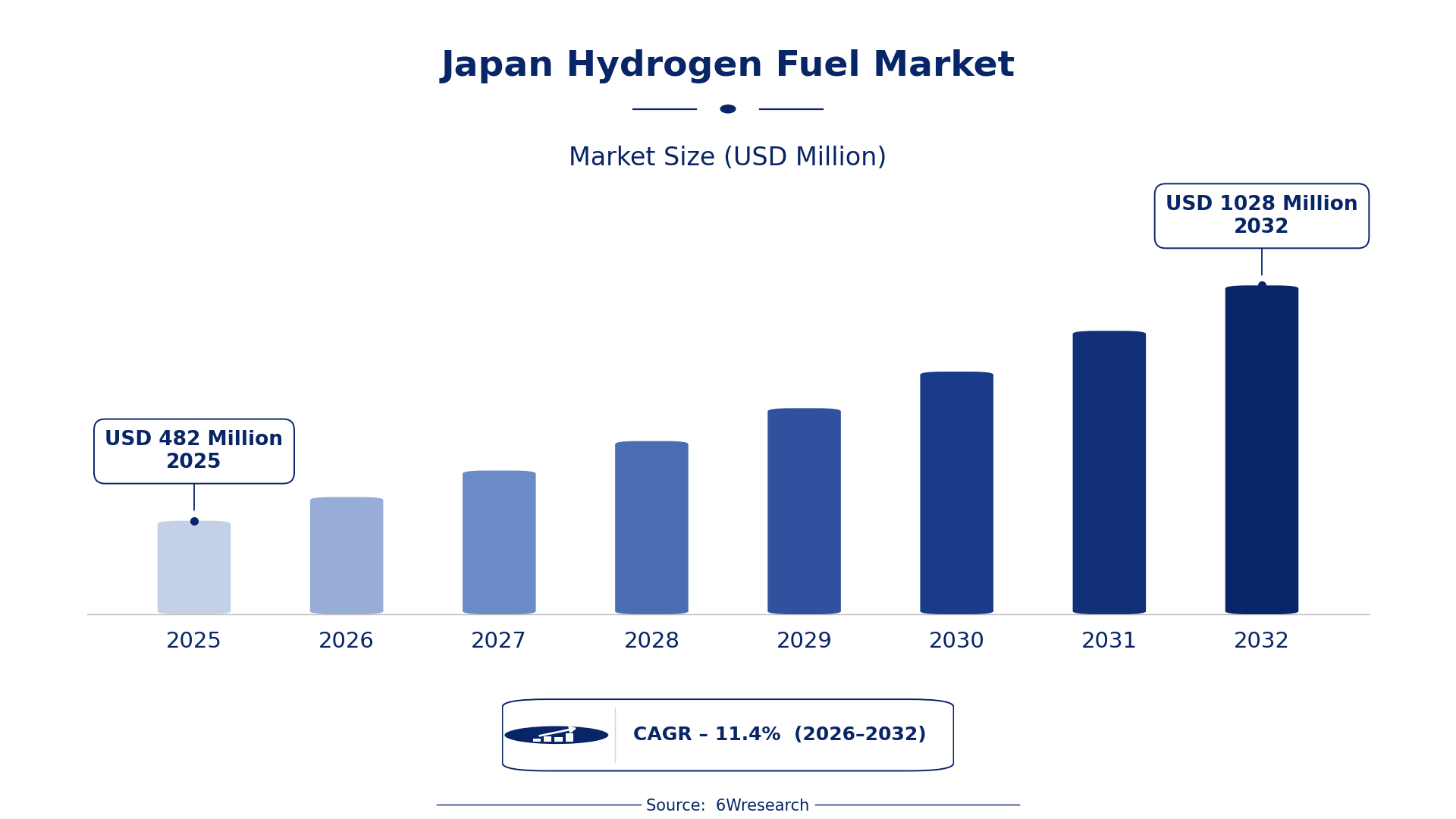
According to 6Wresearch internal database and industry insights, the Japan Hydrogen Fuel Market was valued at USD 482 Million in 2025 and is projected to reach USD 1,028 Million by 2032, growing at a CAGR of approximately 11.4% during 2026–2032.
Japan Hydrogen Fuel Market Highlights
| Report Metric | Details |
| Report Name | Japan Hydrogen Fuel Market (2026-2032) |
| Market Size 2025 | USD 482 Million |
| Market Size 2032 | USD 1,028 Million |
| Absolute Growth 2025–2032 | USD 546 Million |
| CAGR 2026–2032 | 11.4% |
| Peak Annual Growth | 12.4% in 2028 |
| Forecast Period | 2026–2032 |
| Historical Data | 2022–2025 |
| Base Year | 2025 |
| Leading Fuel Type, 2025 | Green Hydrogen (42% share) |
| Leading Production Method, 2025 | Electrolysis (Renewables) (49% share) |
| Leading Application Sector, 2025 | Mobility/Transport (42% share) |
| Leading End User, 2025 | Hydrogen Refueling Stations (34% share) |
| Fastest-Growing Fuel Type | Blue Hydrogen (16.5% CAGR) |
| Fastest-Growing Production Method | Steam Methane Reforming (15.7% CAGR) |
| Fastest-Growing Application Sector | Power Generation (15.0% CAGR) |
| Fastest-Growing End User | Utilities (14.5% CAGR) |
| Growing Sector | Mobility/Transport |
| Key End Users | Utilities, Industrial Manufacturers, Transportation Sector, Energy Providers |
Japan Hydrogen Fuel Market Year-wise Growth Rate and Key Drivers (2022–2032)
This graph illustrates the annual growth rates of the market from 2022 to 2032, highlighting a steady upward trajectory and projected market expansion over the forecast period.
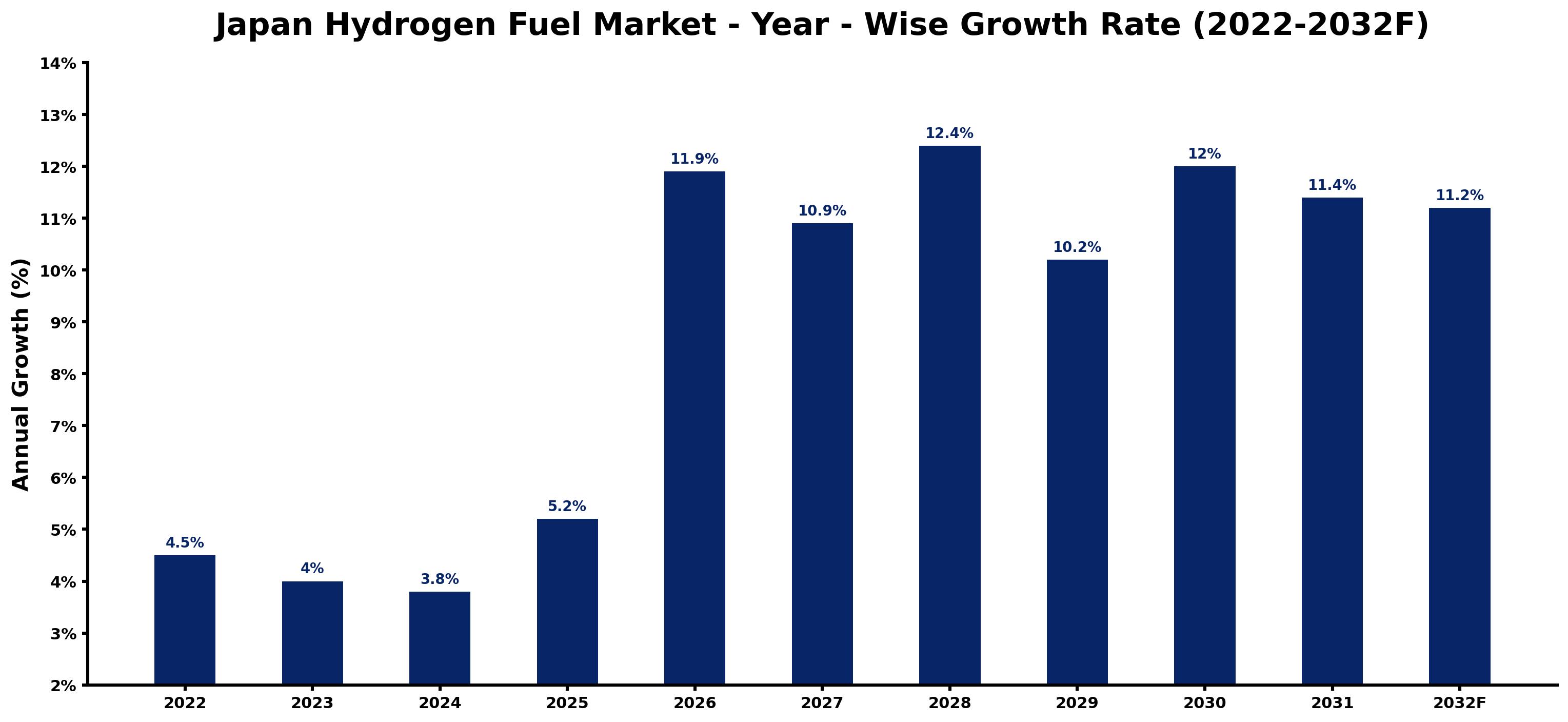
The yearly estimates that follow link every growth rate to its principal driver, so readers can see why the pace changed in each period.
| Year | Estimated Annual Growth (%) | Market Rationale |
| 2022 | 4.5 | Domestic demand for hydrogen fuel continued to rise, driven by the mobility sector. |
| 2023 | 4.0 | Growth slowed as the market adjusted to increased production capacities and infrastructure. |
| 2024 | 3.8 | Growth slowed as infrastructure development continued, maintaining positive market activity. |
| 2025 | 5.2 | The market experienced a boost from government initiatives supporting hydrogen adoption. |
| 2026 | 11.9 | Demand is expected to surge as investments in hydrogen infrastructure begin to materialise. |
| 2027 | 10.9 | Growth is projected to slow as the market stabilises following rapid investments in previous years. |
| 2028 | 12.4 | The peak growth will be driven by increased adoption of hydrogen in transport applications. |
| 2029 | 10.2 | Growth is expected to decelerate slightly as the market begins to mature and stabilise. |
| 2030 | 12.0 | Demand will continue to rise as hydrogen is projected to contribute to 10% of the energy mix. |
| 2031 | 11.4 | A slowdown is expected as the market adjusts to the established infrastructure and production methods. |
| 2032 | 11.2 | Growth will moderate as the market reaches a more sustainable pace with established demand. |
Note: Market size estimations and growth projections presented in this report are based on 6Wresearch's proprietary forecasting methodology, utilizing the latest available industry data, government publications, and primary research inputs.
Japan Hydrogen Fuel Market Synopsis
Hydrogen fuel serves as a clean energy carrier, primarily produced through electrolysis and steam methane reforming. It finds applications in transportation, power generation, and industrial heating. The Japan Hydrogen Fuel Market is expanding due to strong domestic demand from the mobility and industrial sectors, supported by government initiatives and infrastructure investments. With a target of 3 million tons of hydrogen production by 2030, the market is set for growth, driven by increasing imports and technological advancements in production methods.
Market Dynamics Impact Analysis (2026–2032)
| Factor | Type | Impact | Primary Segment Affected |
| Government initiatives to promote hydrogen adoption | Driver | High | Mobility/Transport |
| Investment in hydrogen infrastructure development | Driver | High | Hydrogen Refueling Stations |
| Growing industrial demand for clean energy solutions | Opportunity | High | Steel/Ammonia Industry |
| Emerging technologies in hydrogen production | Opportunity | Medium | Electrolysis (Renewables) |
| High production costs of green hydrogen | Restraint | High | Green Hydrogen |
| Limited infrastructure for hydrogen distribution | Restraint | Medium | Hydrogen Refueling Stations |
| Competition from alternative energy sources | Challenge | High | Utilities |
| Technological barriers in hydrogen production methods | Challenge | Medium | Steam Methane Reforming |
Evaluation of Drivers in Japan Hydrogen Fuel Market (2026–2032)
Demand rests on the following drivers, each shown with the segment it touches most.
| Drivers | Primary Segment Affected | Why It Matters (Evidence) |
| Strong government support for hydrogen initiatives | Mobility/Transport | Japan's aim for 200,000 fuel cell vehicles by 2025 drives demand for hydrogen fuel. |
| Investment in hydrogen refueling stations | Hydrogen Refueling Stations | The Tokyo metropolitan area has over 80 refueling stations, increasing accessibility for consumers. |
| Rising industrial demand for hydrogen in steel production | Steel/Ammonia Industry | Japan's steel industry is exploring hydrogen as a reducing agent by 2030, boosting demand. |
| Technological advancements in hydrogen production | Electrolysis (Renewables) | Production facilities are being established in regions like Hokkaido and Fukushima, increasing output. |
| Growing focus on clean energy solutions | Utilities | Hydrogen is expected to contribute to 10% of Japan's energy mix by 2030, expanding its use. |
The Tokyo metropolitan area has over 80 hydrogen refueling stations, increasing consumer access. Industrial demand, particularly in the steel sector, is driving exploration of hydrogen as a reducing agent by 2030. Technological advancements in production methods are increasing green hydrogen production. Hydrogen is projected to contribute to 10% of Japan's energy mix by 2030, further increasing demand from utilities.
Evaluation of Restraints in Japan Hydrogen Fuel Market
Several factors work against faster growth; the main ones are summarised below.
| Market Restraint | Primary Segment Affected | Why It Matters (Evidence) |
| High production costs of green hydrogen | Green Hydrogen | Production costs remain elevated, limiting widespread adoption among consumers and industries. |
| Limited infrastructure for hydrogen distribution | Hydrogen Refueling Stations | The current number of refueling stations is insufficient to meet growing demand in urban areas. |
| Competition from alternative energy sources | Utilities | Renewable energy sources are increasingly favoured over hydrogen, impacting its market share. |
| Technological barriers in hydrogen production methods | Steam Methane Reforming | Challenges in scaling up production technologies hinder growth in the hydrogen sector. |
| Regulatory hurdles in hydrogen project approvals | Electrolysis (Renewables) | Complex approval processes delay the establishment of new hydrogen production facilities. |
Japan Hydrogen Fuel Market Challenges
High production costs strain buyers, as Japan's goal of 3 million tons by 2030 demands extensive infrastructure investments, potentially increasing prices by 15% for end-users. Competition from alternative energy sources forces producers to lower prices, risking profit margins and threatening sustainability. A shortage of skilled workers limits importers' ability to execute hydrogen projects effectively, leading to delays that can extend timelines by up to 12 months. Technological gaps in production methods, particularly in the Chubu region, hinder efficient practices, causing distributors to face supply chain disruptions and increased operational costs.
Trends in the Japan Hydrogen Fuel Market
Buyers and suppliers in the Japan Hydrogen Fuel Market are adjusting to the following trends.
- Shift towards Green Hydrogen Production: Japan is increasingly focusing on green hydrogen production, with facilities in Hokkaido and Fukushima leading the way. By 2030, green hydrogen is projected to play a key role in the energy mix, contributing to Japan's emissions reduction targets.
- Expansion of Hydrogen Refuelling Infrastructure: The number of hydrogen refuelling stations is growing, particularly in urban areas like Tokyo. As of 2023, there are over 80 stations, enabling greater adoption of fuel cell vehicles and improving consumer accessibility.
- Increased Industrial Adoption of Hydrogen: Industries, particularly steel manufacturing, are exploring hydrogen as a cleaner alternative. By 2030, Japan's steel industry aims to integrate hydrogen as a reducing agent, significantly impacting production processes.
- Emergence of New Hydrogen Technologies: New production methods, such as methane pyrolysis, are beginning to gain traction. These technologies are projected to diversify hydrogen production and reduce reliance on traditional methods.
Investment Opportunities in the Japan Hydrogen Fuel Market
The openings below show where demand in the Japan Hydrogen Fuel Market is visible and how suppliers can enter.
- Investment in Hydrogen Infrastructure: With Japan allocating ¥200 billion for hydrogen infrastructure development, there is a notable opportunity to invest in refuelling stations and distribution networks, particularly in urban areas like Tokyo.
- Growth in Hydrogen for Industrial Applications: As industries seek cleaner energy solutions, there is a rising demand for hydrogen in sectors like steel manufacturing, presenting opportunities for suppliers to meet this need.
- Development of Green Hydrogen Facilities: The focus on green hydrogen production creates opportunities for investment in facilities, especially in regions like Hokkaido and Fukushima, where renewable energy integration is strong.
- Technological Advancements in Hydrogen Production: Investing in emerging technologies for hydrogen production, such as electrolysis, can position suppliers to meet future demand as the market evolves.
Government Initiatives in the Japan Hydrogen Fuel Market
The Hydrogen Society Promotion Act, enacted in 2024, is essential for hydrogen producers and buyers, providing support for low-carbon hydrogen supply chains. This act includes price-gap support, encouraging investment in hydrogen infrastructure and production methods. The GX Basic Policy, adopted in 2023, aims for JPY 150 trillion in public-private decarbonisation investment over the next decade, further promoting hydrogen initiatives.
The Agency for Natural Resources and Energy oversees the implementation of hydrogen policies and approves projects related to hydrogen production and infrastructure development. In 2023, the agency allocated ¥200 billion to support hydrogen initiatives, ensuring that projects align with national decarbonisation goals.
Future Insight of the Japan Hydrogen Fuel Market
Japan's policy-driven shift towards hydrogen will reshape the energy sector, with substantial investments aimed at improving supply capabilities. By 2032, advancements in production methods will enhance efficiency across the hydrogen supply chain, benefiting both buyers and suppliers. The expansion of hydrogen refuelling stations will support the growing fleet of fuel cell vehicles, projected to reach 200,000 on the roads by 2025. Collaborative efforts outlined in the Hydrogen Roadmap will drive the integration of hydrogen technologies into diverse sectors, promoting a more sustainable energy future.
Market Segmentation Analysis
Japan Hydrogen Fuel Market report covers a detailed analysis of the following market segments:
By Fuel Type – Green Hydrogen Leads, Blue Hydrogen Expected to Grow Fastest
According to Saurav Kr Singh, Senior Research Analyst at 6Wresearch, Green Hydrogen took 42% of fuel type revenue in 2025, more than any other category. Green hydrogen holds the largest share in Japan due to its application in transport and power generation, aligning with national emissions targets. The Tokyo 2020 Olympics showcased its use, increasing public awareness and acceptance of this clean energy source. The quickest growth will come from Blue Hydrogen, forecast to expand at a CAGR of 16.5% between 2026 and 2032. Blue hydrogen is experiencing rapid growth as industries, particularly steel manufacturing, seek cleaner production methods. The steel sector's exploration of hydrogen as a reducing agent by 2030 is a key driver for this segment. Suppliers should focus on expanding green hydrogen capabilities while utilities may need to adapt to the increasing demand for blue hydrogen.
By Production Method – Electrolysis (Renewables) Leads, Steam Methane Reforming Expected to Grow Fastest
In 2025, Electrolysis (Renewables) led the production method split with a 49% share. Electrolysis using renewables serves as the primary method for producing green hydrogen, essential for achieving Japan's target of 3 million tons by 2030. The government's support for renewable energy initiatives bolsters this method's prominence in the hydrogen production landscape. Steam Methane Reforming is projected to grow fastest, at a CAGR of 15.7% during 2026–2032. Steam methane reforming is still widely utilised, particularly as industries transition to cleaner alternatives, making it a necessary step for many companies aiming for lower emissions. Its established presence ensures ongoing demand as the market shifts towards greener solutions. Suppliers must invest in electrolysis technology while users should consider the reliability of steam methane reforming during the transition to greener methods.
By Application Sector – Mobility/Transport Leads, Power Generation Expected to Grow Fastest
The largest application sector category in 2025 was Mobility/Transport, at 42% of revenue. Mobility and transport represent the largest application area for hydrogen fuel, driven by the government's target of 200,000 fuel cell vehicles on the road by 2025. This focus on clean transportation has led to substantial infrastructure investments, particularly in urban areas. Over 2026–2032, Power Generation is expected to post the fastest growth, at a CAGR of 15.0%. Power generation is rapidly growing as a sector for hydrogen, with increasing recognition of its potential as a clean energy source. The ambition for hydrogen to contribute to 10% of Japan's energy mix by 2030 propels this growth. Suppliers should prioritise mobility solutions while buyers in the power sector must prepare for the integration of hydrogen into their energy portfolios.
By End User – Hydrogen Refueling Stations Lead, Utilities Expected to Grow Fastest
With 34% of end user revenue in 2025, Hydrogen Refueling Stations was the largest category. Hydrogen refueling stations are the leading end user segment, essential for supporting the growing number of hydrogen vehicles. The Tokyo metropolitan area alone has over 80 refueling stations, facilitating widespread adoption of hydrogen fuel. Utilities are set to record the highest CAGR in this split, 14.5% over 2026–2032. Utilities are increasingly integrating hydrogen into their energy supply, driven by government initiatives and the need for cleaner energy sources. This trend is expected to accelerate as infrastructure develops further. Suppliers should focus on enhancing refueling infrastructure while utilities must strategically plan for hydrogen integration in their operations.
Key Attractiveness of the Report
- 10 Years of Market Numbers
- Historical Data Starting from 2022 to 2025
- Base Year 2025
- Forecast Data until 2032
- Key Performance Indicators Impacting the Market
- Major Upcoming Developments and Projects
Key Highlights of the Report:
- Japan Hydrogen Fuel Market Outlook
- Market Size of Japan Hydrogen Fuel Market, 2025
- Forecast of Japan Hydrogen Fuel Market, 2032
- Historical Data and Forecast of Japan Hydrogen Fuel Revenues & Volume for the Period 2022-2032F
- Japan Hydrogen Fuel Market Trend Evolution
- Japan Hydrogen Fuel Market Drivers and Challenges
- Japan Hydrogen Fuel Price Trends
- Japan Hydrogen Fuel Porter's Five Forces
- Japan Hydrogen Fuel Industry Life Cycle
- Historical Data and Forecast of Japan Hydrogen Fuel Market Revenues & Volume By Fuel Type for the Period 2022-2032F
- Historical Data and Forecast of Japan Hydrogen Fuel Market Revenues & Volume By Green Hydrogen for the Period 2022-2032F
- Historical Data and Forecast of Japan Hydrogen Fuel Market Revenues & Volume By Blue Hydrogen for the Period 2022-2032F
- Historical Data and Forecast of Japan Hydrogen Fuel Market Revenues & Volume By Grey Hydrogen for the Period 2022-2032F
- Historical Data and Forecast of Japan Hydrogen Fuel Market Revenues & Volume By Turquoise Hydrogen for the Period 2022-2032F
- Historical Data and Forecast of Japan Hydrogen Fuel Market Revenues & Volume By Production Method for the Period 2022-2032F
- Historical Data and Forecast of Japan Hydrogen Fuel Market Revenues & Volume By Electrolysis (Renewables) for the Period 2022-2032F
- Historical Data and Forecast of Japan Hydrogen Fuel Market Revenues & Volume By Steam Methane Reforming for the Period 2022-2032F
- Historical Data and Forecast of Japan Hydrogen Fuel Market Revenues & Volume By Natural Gas Reforming for the Period 2022-2032F
- Historical Data and Forecast of Japan Hydrogen Fuel Market Revenues & Volume By Methane Pyrolysis for the Period 2022-2032F
- Historical Data and Forecast of Japan Hydrogen Fuel Market Revenues & Volume By Application Sector for the Period 2022-2032F
- Historical Data and Forecast of Japan Hydrogen Fuel Market Revenues & Volume By Mobility/Transport for the Period 2022-2032F
- Historical Data and Forecast of Japan Hydrogen Fuel Market Revenues & Volume By Power Generation for the Period 2022-2032F
- Historical Data and Forecast of Japan Hydrogen Fuel Market Revenues & Volume By Industrial Heating for the Period 2022-2032F
- Historical Data and Forecast of Japan Hydrogen Fuel Market Revenues & Volume By Steel/Ammonia Industry for the Period 2022-2032F
- Historical Data and Forecast of Japan Hydrogen Fuel Market Revenues & Volume By End User for the Period 2022-2032F
- Historical Data and Forecast of Japan Hydrogen Fuel Market Revenues & Volume By Hydrogen Refueling Stations for the Period 2022-2032F
- Historical Data and Forecast of Japan Hydrogen Fuel Market Revenues & Volume By Utilities for the Period 2022-2032F
- Historical Data and Forecast of Japan Hydrogen Fuel Market Revenues & Volume By Petrochemical Plants for the Period 2022-2032F
- Historical Data and Forecast of Japan Hydrogen Fuel Market Revenues & Volume By Energy Transition Projects for the Period 2022-2032F
- Japan Hydrogen Fuel Import Export Trade Statistics
- Market Opportunity Assessment By Fuel Type
- Market Opportunity Assessment By Production Method
- Market Opportunity Assessment By Application Sector
- Market Opportunity Assessment By End User
- Japan Hydrogen Fuel Top Companies Market Share
- Japan Hydrogen Fuel Competitive Benchmarking By Technical and Operational Parameters
- Japan Hydrogen Fuel Company Profiles
- Japan Hydrogen Fuel Key Strategic Recommendations
Market Covered
Coverage by segment is as follows.
By Fuel Type
- Green Hydrogen
- Blue Hydrogen
- Grey Hydrogen
- Turquoise Hydrogen
By Production Method
- Electrolysis (Renewables)
- Steam Methane Reforming
- Natural Gas Reforming
- Methane Pyrolysis
By Application Sector
- Mobility/Transport
- Power Generation
- Industrial Heating
- Steel/Ammonia Industry
By End User
- Hydrogen Refueling Stations
- Utilities
- Petrochemical Plants
- Energy Transition Projects































