Japan Hydrogen Production Market Size & Growth Rate
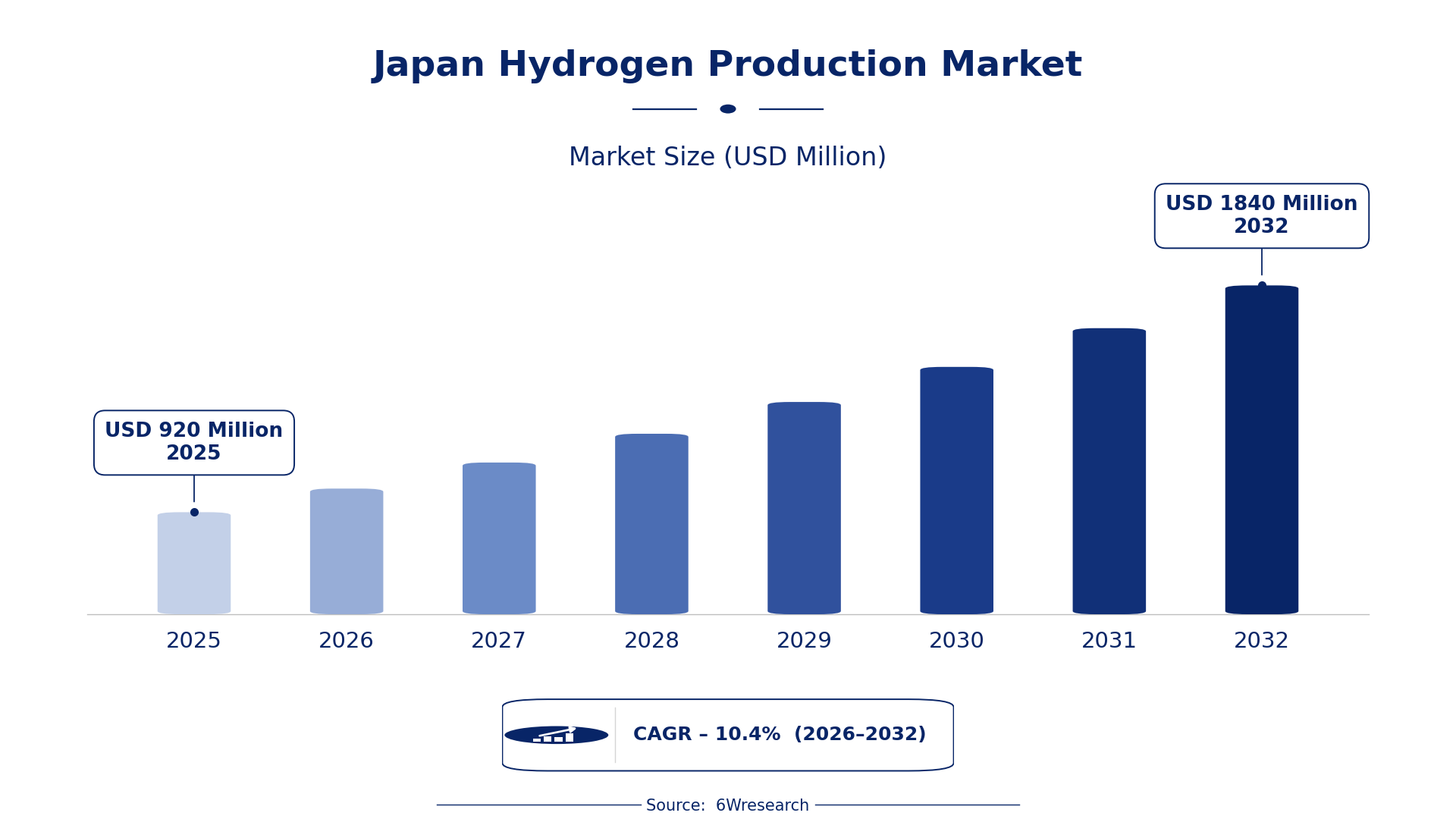
According to 6Wresearch internal database and industry insights, the Japan Hydrogen Production Market was valued at USD 920 Million in 2025 and is projected to reach USD 1,840 Million by 2032, growing at a CAGR of approximately 10.4% during 2026–2032.
Japan Hydrogen Production Market Highlights
| Report Metric | Details |
| Report Name | Japan Hydrogen Production Market (2026-2032) |
| Market Size 2025 | USD 920 Million |
| Market Size 2032 | USD 1,840 Million |
| Absolute Growth 2025–2032 | USD 920 Million |
| CAGR 2026–2032 | 10.4% |
| Peak Annual Growth | 11.9% in 2027 |
| Forecast Period | 2026–2032 |
| Historical Data | 2022–2025 |
| Base Year | 2025 |
| Leading Production Method, 2025 | Electrolysis (52% share) |
| Leading Energy Source, 2025 | Renewable Energy (47% share) |
| Leading Output Purity, 2025 | High Purity (47% share) |
| Leading End User, 2025 | Fuel Cell Suppliers (52% share) |
| Fastest-Growing Production Method | Steam Methane Reforming (14.9% CAGR) |
| Fastest-Growing Energy Source | Natural Gas (15.4% CAGR) |
| Fastest-Growing Output Purity | Medium Purity (14.6% CAGR) |
| Fastest-Growing End User | Industrial Users (13.7% CAGR) |
| Growing Sector | Industrial Users |
| Key End Users | Fuel Cell Suppliers, Industrial Users, Decentralized Producers, Green Energy Providers |
Japan Hydrogen Production Market Year-wise Growth Rate and Key Drivers (2022–2032)
This graph illustrates the annual growth rates of the market from 2022 to 2032, highlighting a steady upward trajectory and projected market expansion over the forecast period.
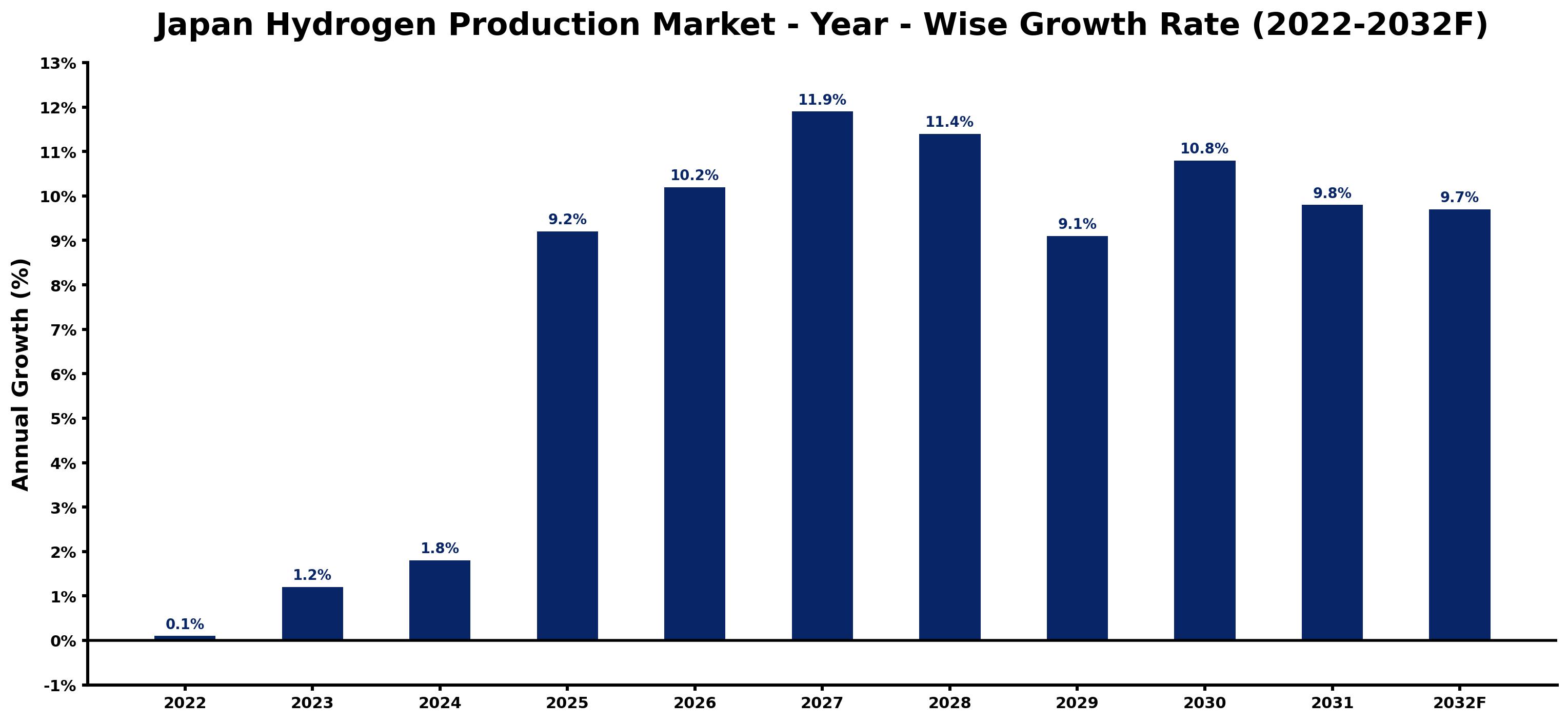
Annual growth estimates for each year appear below with the principal reason behind them, explaining the shifts that set the pace of the market.
| Year | Estimated Annual Growth (%) | Market Rationale |
| 2022 | 0.1 | Hydrogen production was stable but limited, reflecting ongoing development efforts. |
| 2023 | 1.2 | Growth accelerated as investments in hydrogen technology began to materialise. |
| 2024 | 1.8 | Increased production methods were adopted, which is expected to improve overall hydrogen output. |
| 2025 | 9.2 | Demand surged due to the Hydrogen Roadmap Japan's initiatives and targets. |
| 2026 | 10.2 | Investment in renewable energy sources for hydrogen production is projected to expand significantly. |
| 2027 | 11.9 | The market peaked as major projects and facilities came online, driving demand. |
| 2028 | 11.4 | Growth is expected to slow slightly, reflecting a maturation of the market and technology. |
| 2029 | 9.1 | Demand will continue to rise, albeit at a reduced pace, as new applications emerge. |
| 2030 | 10.8 | Production targets are set to increase, aligning with national energy goals. |
| 2031 | 9.8 | Market growth is projected to decelerate as production stabilises and competition intensifies. |
| 2032 | 9.7 | Demand will remain strong, supported by ongoing investments in hydrogen infrastructure. |
Note: Market size estimations and growth projections presented in this report are based on 6Wresearch's proprietary forecasting methodology, utilizing the latest available industry data, government publications, and primary research inputs.
Japan Hydrogen Production Market Synopsis
Hydrogen production in Japan primarily utilises electrolysis and steam methane reforming, producing hydrogen for fuel cell vehicles, industrial applications, and energy storage. The Japan Hydrogen Production Market is expanding, driven by the government's aim for 3 million tons of hydrogen production by 2030 and the Hydrogen Roadmap Japan, which outlines strategies for adoption by 2025. Investment in renewable energy sources and technological advancements are propelling this growth, particularly in the Tokyo metropolitan area, a key hub for hydrogen fuel cell vehicles.
Market Dynamics Impact Analysis (2026–2032)
| Factor | Type | Impact | Primary Segment Affected |
| Government initiatives to support low-carbon hydrogen production | Driver | High | Electrolysis |
| Investment in renewable energy technologies for hydrogen production | Driver | High | Renewable Energy |
| Growing demand for hydrogen in fuel cell applications | Opportunity | High | Fuel Cell Suppliers |
| Expansion of hydrogen production facilities in key regions | Opportunity | Medium | Electrolysis |
| High production costs associated with green hydrogen | Restraint | High | Electrolysis |
| Limited infrastructure for hydrogen distribution and storage | Restraint | Medium | Fuel Cell Suppliers |
| Competition from alternative energy sources | Challenge | High | Industrial Users |
| Technological challenges in scaling production processes | Challenge | Medium | Electrolysis |
Evaluation of Drivers in Japan Hydrogen Production Market (2026–2032)
These are the developments adding the most demand over the forecast period.
| Drivers | Primary Segment Affected | Why It Matters (Evidence) |
| Government support for low-carbon hydrogen initiatives | Electrolysis | The Hydrogen Society Promotion Act encourages investment in low-carbon hydrogen, targeting 3 million tons by 2030. |
| Investment in renewable energy technologies | Renewable Energy | Increased funding for renewable energy projects is driving the production of green hydrogen, with 47% sourced from renewable methods by 2025. |
| Rising demand for fuel cell vehicles | Fuel Cell Suppliers | The Tokyo metropolitan area is a major hub for hydrogen fuel cell vehicles, increasing consumption by 1.3 million tons in 2022. |
| Expansion of production facilities in the Chubu region | Electrolysis | The region is becoming a key area for hydrogen production, attracting investment and infrastructure development, with a budget of $100 million for initiatives. |
| Technological advancements in hydrogen production methods | Steam Methane Reforming | Steam methane reforming is gaining traction due to its efficiency and lower costs, driving production growth by 9.2% in 2025. |
In 2022, Japan produced 1.3 million tons of hydrogen, with substantial growth in production methods. Investment in renewable energy technologies is driving the production of green hydrogen, with 47% sourced from renewable methods by 2025. The Chubu region is experiencing expansion in hydrogen production facilities, attracting both domestic and foreign investment, which is boosting overall supply and increasing the market's capacity.
Evaluation of Restraints in Japan Hydrogen Production Market
The key brakes on demand, and where they bite hardest, are shown below.
| Market Restraint | Primary Segment Affected | Why It Matters (Evidence) |
| High production costs of green hydrogen | Electrolysis | Production costs remain high, limiting competitiveness against fossil fuel alternatives, affecting buyers' decisions. |
| Insufficient infrastructure for hydrogen distribution | Fuel Cell Suppliers | Limited distribution networks hinder the growth of hydrogen fuel cell vehicles, affecting market penetration. |
| Regulatory hurdles in hydrogen production | Steam Methane Reforming | Compliance with environmental regulations can delay project approvals, impacting supply timelines. |
| Dependence on natural gas prices | Natural Gas | Fluctuating natural gas prices can affect production costs, influencing market stability for hydrogen. |
| Limited applications for medium purity hydrogen | Medium Purity | Medium purity hydrogen is used in less critical applications, reducing overall demand and investment. |
Japan Hydrogen Production Market Challenges
Producers encounter a skills shortage, as the hydrogen sector lacks trained professionals, which delays project timelines and raises costs for production facilities. Technology adoption is hindered by high initial investments, deterring investment in new methods and limiting output for buyers. Competition from natural gas exerts pressure on hydrogen pricing, making it difficult for producers to sustain profit margins. Regulatory compliance complicates operations, as evolving standards like JIS B 8390 necessitate constant updates, resulting in production delays for suppliers.
Trends in the Japan Hydrogen Production Market
The following changes are redrawing the Japan Hydrogen Production Market.
- Shift Towards Renewable Energy Sources: Fuel cell suppliers are increasingly adopting renewable energy for hydrogen production, with 47% of hydrogen sourced from renewable methods by 2025. This trend reflects a growing commitment to sustainability in Japan.
- Emergence of Hydrogen Supply Chain Initiatives: In 2023, Japan launched a hydrogen supply chain initiative with a budget of $100 million, aiming to improve hydrogen distribution networks and support production growth across regions.
- Increasing Focus on High Purity Hydrogen: High purity hydrogen is becoming essential for semiconductor manufacturing, with 47% market share in 2025, driving demand from industrial users in Japan's tech sector.
- Expansion of Hydrogen Production Facilities: The Chubu region is developing as a key area for hydrogen production facilities, supporting the government's goal for 3 million tons by 2030, indicating a strategic investment in infrastructure.
Investment Opportunities in the Japan Hydrogen Production Market
The following opportunities in the Japan Hydrogen Production Market pair current demand with a clear way in.
- Fuel Cell Suppliers Seeking Reliable Hydrogen Sources: With the government targeting 3 million tons of hydrogen production by 2030, fuel cell suppliers are looking for reliable hydrogen sources. Investment in production facilities in the Chubu region can facilitate this need.
- Chubu Region as a Hub for Hydrogen Production: The Chubu region is a key area for hydrogen production facilities, with significant investments expected. This presents opportunities for suppliers to establish partnerships and expand operations.
- Green Hydrogen Production Facilities: As the demand for green hydrogen increases, there is a need for new production facilities. Investment in electrolysis technology can meet this demand, particularly in urban areas like Tokyo.
- Investment in Hydrogen Infrastructure: With ongoing government support, there is a pressing need for infrastructure development. Collaborating with local authorities in regions like Chubu can facilitate entry into the hydrogen market.
Government Initiatives in the Japan Hydrogen Production Market
The Hydrogen Society Promotion Act, enacted in 2024, supports low-carbon hydrogen and ammonia supply chains with price-gap support. This law aims to improve production and distribution, targeting 3 million tons by 2030. The PRTR Law, established in 1999, requires businesses to report emissions and ensure environmental compliance in hydrogen production, promoting sustainable practices.
The Ministry of the Environment oversees funding for hydrogen technology development, approving projects that align with national energy goals. The Hydrogen Roadmap Japan outlines strategies for achieving carbon neutrality, with a budget of $100 million allocated for hydrogen supply chain projects in 2023.
Future Insight of the Japan Hydrogen Production Market
By 2032, advancements in technology will significantly alter hydrogen demand, driven by the Hydrogen Roadmap Japan that outlines strategies for enhanced production. The hydrogen supply chain initiative will improve infrastructure, enabling broader distribution. Increased funding from the Green Innovation Fund will support projects that enhance efficiency in production facilities. The HESC project will create international trade routes, expanding market access for suppliers and ensuring a reliable supply for buyers.
Market Segmentation Analysis
Japan Hydrogen Production Market report covers a detailed analysis of the following market segments:
By Production Method – Electrolysis Leads, Steam Methane Reforming Expected to Grow Fastest
According to Saurav Kr Singh, Senior Research Analyst at 6Wresearch, with 52% of production method revenue in 2025, Electrolysis was the largest category. Electrolysis is the leading method due to its ability to produce green hydrogen from renewable sources, which aligns with Japan's sustainability goals. The government's Hydrogen Roadmap Japan, aiming for increased adoption by 2025, reinforces this method's significance. Over 2026–2032, Steam Methane Reforming is expected to post the fastest growth, at a CAGR of 14.9%. Steam Methane Reforming is experiencing rapid growth as it remains the primary method for hydrogen production from natural gas, a vital energy source in Japan. The push for more efficient hydrogen production techniques is driving this segment's expansion. Suppliers should focus on enhancing electrolysis technologies to meet the growing demand for green hydrogen.
By Energy Source – Renewable Energy Leads, Natural Gas Expected to Grow Fastest
The largest energy source category in 2025 was Renewable Energy, at 47% of revenue. Renewable Energy leads the market as the primary source for green hydrogen production, reflecting Japan's commitment to sustainable energy solutions. The government's initiatives and funding for renewable projects further solidify its dominant position. Natural Gas are projected to grow fastest, at a CAGR of 15.4% during 2026–2032. Natural Gas is the fastest-growing source due to its status as a major feedstock for hydrogen production, catering to immediate energy needs while transitioning to greener alternatives. This trend is likely to continue as the industry seeks efficient production methods. Buyers should consider diversifying their energy sources to include both renewable and natural gas options.
By Output Purity – High Purity Leads, Medium Purity Expected to Grow Fastest
High Purity took 47% of output purity revenue in 2025, more than any other category. High Purity hydrogen is essential for fuel cells and industrial applications, making it the leading segment in the market. Its critical role in sectors such as semiconductor manufacturing ensures sustained demand. Medium Purity is set to record the highest CAGR in this split, 14.6% over 2026–2032. Medium Purity hydrogen is growing rapidly as it finds applications in less critical processes, appealing to a broader range of industrial users. This growth reflects a shift towards utilising hydrogen in various capacities beyond high-purity applications. Suppliers may need to adjust their production strategies to cater to the increasing demand for medium purity hydrogen.
By End User – Fuel Cell Suppliers Lead, Industrial Users Expected to Grow Fastest
Fuel Cell Suppliers accounted for 52% of the market by end user in 2025. Fuel Cell Suppliers dominate the market as they are the principal consumers of hydrogen for fuel cells, crucial for Japan's transportation and energy sectors. The high concentration of hydrogen fuel cell vehicles in the Tokyo metropolitan area further strengthens this segment's position. The quickest growth will come from Industrial Users, forecast to expand at a CAGR of 13.7% between 2026 and 2032. Industrial Users represent the fastest-growing segment as they require large volumes of hydrogen for various processes, indicating a shift towards more efficient energy solutions. This trend reflects a broader acceptance of hydrogen in multiple industrial applications. Suppliers should cultivate stronger relationships with industrial users to capitalise on the rising demand for hydrogen across different sectors.
Key Attractiveness of the Report
- 10 Years of Market Numbers
- Historical Data Starting from 2022 to 2025
- Base Year 2025
- Forecast Data until 2032
- Key Performance Indicators Impacting the Market
- Major Upcoming Developments and Projects
Key Highlights of the Report:
- Japan Hydrogen Production Market Outlook
- Market Size of Japan Hydrogen Production Market, 2025
- Forecast of Japan Hydrogen Production Market, 2032
- Historical Data and Forecast of Japan Hydrogen Production Revenues & Volume for the Period 2022-2032F
- Japan Hydrogen Production Market Trend Evolution
- Japan Hydrogen Production Market Drivers and Challenges
- Japan Hydrogen Production Price Trends
- Japan Hydrogen Production Porter's Five Forces
- Japan Hydrogen Production Industry Life Cycle
- Historical Data and Forecast of Japan Hydrogen Production Market Revenues & Volume By Production Method for the Period 2022-2032F
- Historical Data and Forecast of Japan Hydrogen Production Market Revenues & Volume By Electrolysis for the Period 2022-2032F
- Historical Data and Forecast of Japan Hydrogen Production Market Revenues & Volume By Steam Methane Reforming for the Period 2022-2032F
- Historical Data and Forecast of Japan Hydrogen Production Market Revenues & Volume By Biomass Gasification for the Period 2022-2032F
- Historical Data and Forecast of Japan Hydrogen Production Market Revenues & Volume By Solar Thermochemical for the Period 2022-2032F
- Historical Data and Forecast of Japan Hydrogen Production Market Revenues & Volume By Energy Source for the Period 2022-2032F
- Historical Data and Forecast of Japan Hydrogen Production Market Revenues & Volume By Renewable Energy for the Period 2022-2032F
- Historical Data and Forecast of Japan Hydrogen Production Market Revenues & Volume By Natural Gas for the Period 2022-2032F
- Historical Data and Forecast of Japan Hydrogen Production Market Revenues & Volume By Agricultural Waste for the Period 2022-2032F
- Historical Data and Forecast of Japan Hydrogen Production Market Revenues & Volume By Solar Heat for the Period 2022-2032F
- Historical Data and Forecast of Japan Hydrogen Production Market Revenues & Volume By Output Purity for the Period 2022-2032F
- Historical Data and Forecast of Japan Hydrogen Production Market Revenues & Volume By High Purity for the Period 2022-2032F
- Historical Data and Forecast of Japan Hydrogen Production Market Revenues & Volume By Medium Purity for the Period 2022-2032F
- Historical Data and Forecast of Japan Hydrogen Production Market Revenues & Volume By Syngas-Derived Hydrogen for the Period 2022-2032F
- Historical Data and Forecast of Japan Hydrogen Production Market Revenues & Volume By Green Hydrogen for the Period 2022-2032F
- Historical Data and Forecast of Japan Hydrogen Production Market Revenues & Volume By End User for the Period 2022-2032F
- Historical Data and Forecast of Japan Hydrogen Production Market Revenues & Volume By Fuel Cell Suppliers for the Period 2022-2032F
- Historical Data and Forecast of Japan Hydrogen Production Market Revenues & Volume By Industrial Users for the Period 2022-2032F
- Historical Data and Forecast of Japan Hydrogen Production Market Revenues & Volume By Decentralized Producers for the Period 2022-2032F
- Historical Data and Forecast of Japan Hydrogen Production Market Revenues & Volume By Green Energy Providers for the Period 2022-2032F
- Japan Hydrogen Production Import Export Trade Statistics
- Market Opportunity Assessment By Production Method
- Market Opportunity Assessment By Energy Source
- Market Opportunity Assessment By Output Purity
- Market Opportunity Assessment By End User
- Japan Hydrogen Production Top Companies Market Share
- Japan Hydrogen Production Competitive Benchmarking By Technical and Operational Parameters
- Japan Hydrogen Production Company Profiles
- Japan Hydrogen Production Key Strategic Recommendations
Market Covered
Coverage by segment is as follows.
By Production Method
- Electrolysis
- Steam Methane Reforming
- Biomass Gasification
- Solar Thermochemical
By Energy Source
- Renewable Energy
- Natural Gas
- Agricultural Waste
- Solar Heat
By Output Purity
- High Purity
- Medium Purity
- Syngas-Derived Hydrogen
- Green Hydrogen
By End User
- Fuel Cell Suppliers
- Industrial Users
- Decentralized Producers
- Green Energy Providers































