Japan Hydroponic Nutrition Market Size & Growth Rate
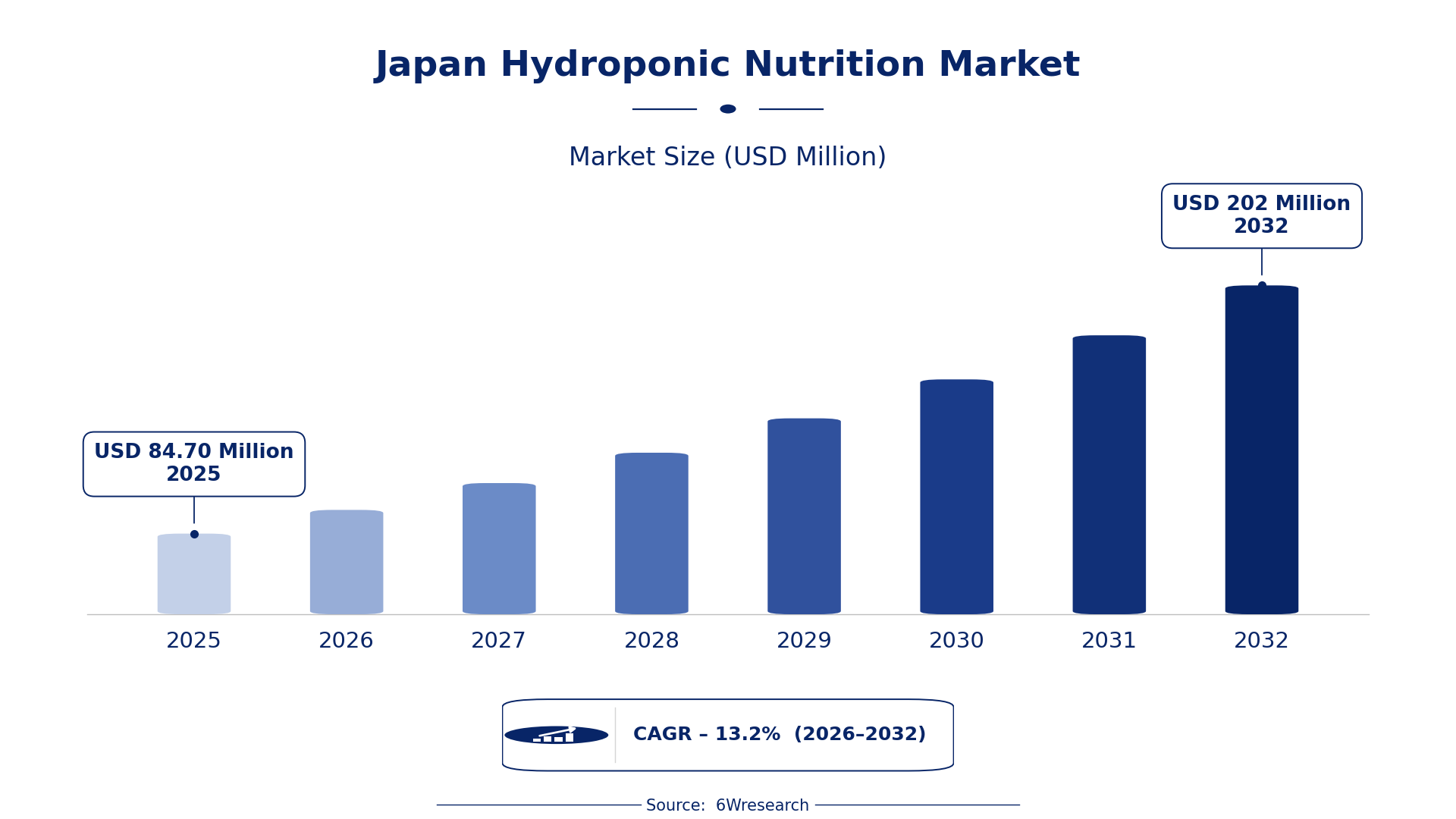
According to 6Wresearch internal database and industry insights, the Japan Hydroponic Nutrition Market was valued at USD 84.70 Million in 2025 and is projected to reach USD 202 Million by 2032, growing at a CAGR of approximately 13.2% during 2026–2032.
Japan Hydroponic Nutrition Market Highlights
| Report Metric | Details |
| Report Name | Japan Hydroponic Nutrition Market (2026-2032) |
| Market Size 2025 | USD 84.70 Million |
| Market Size 2032 | USD 202 Million |
| Absolute Growth 2025–2032 | USD 117.30 Million |
| CAGR 2026–2032 | 13.2% |
| Peak Annual Growth | 14.1% in 2026 |
| Forecast Period | 2026–2032 |
| Historical Data | 2022–2025 |
| Base Year | 2025 |
| Leading Nutrient Type, 2025 | Macronutrients (40% share) |
| Leading Crop Type, 2025 | Leafy Greens (38% share) |
| Leading Solution Delivery Method, 2025 | NFT (Nutrient Film) (54% share) |
| Leading End User, 2025 | Vertical Farmers (45% share) |
| Fastest-Growing Nutrient Type | Micronutrients (18.9% CAGR) |
| Fastest-Growing Crop Type | Tomatoes/Peppers (18.6% CAGR) |
| Fastest-Growing Solution Delivery Method | Drip Irrigation (18.1% CAGR) |
| Fastest-Growing End User | Hydroponic Greenhouses (17.2% CAGR) |
| Growing Sector | Hydroponic Greenhouses |
| Key End Users | Vertical Farmers, Hydroponic Greenhouses, Urban Agri Startups, Indoor Growers |
Japan Hydroponic Nutrition Market Year-wise Growth Rate and Key Drivers (2022–2032)
This graph illustrates the annual growth rates of the market from 2022 to 2032, highlighting a steady upward trajectory and projected market expansion over the forecast period.
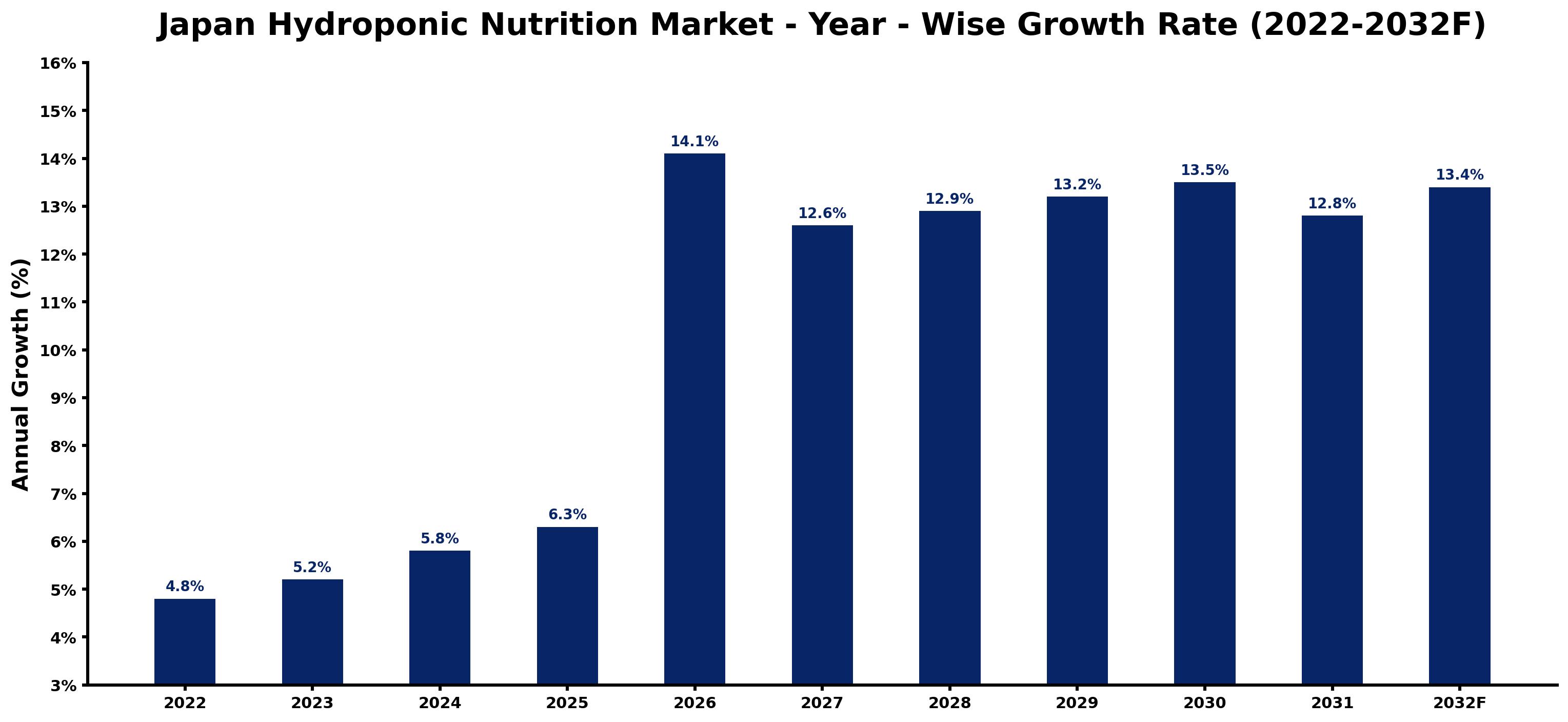
For each year, the table pairs the estimated growth rate with the leading influence on demand, showing how the drivers changed across the period.
| Year | Estimated Annual Growth (%) | Market Rationale |
| 2022 | 4.8 | The market showed steady growth, reflecting increasing interest in sustainable farming practices. |
| 2023 | 5.2 | Demand continued to rise as urban agriculture initiatives gained traction in major cities. |
| 2024 | 5.8 | Growth accelerated due to heightened awareness of food security and local produce. |
| 2025 | 6.3 | The market peaked as hydroponic systems became more popular among urban farmers. |
| 2026 | 14.1 | Rapid growth is expected to occur as technological advancements improve hydroponic efficiency. |
| 2027 | 12.6 | Growth is projected to slow slightly as market maturity begins to set in after rapid expansion. |
| 2028 | 12.9 | A slight increase in growth is anticipated as consumer preferences shift towards local produce. |
| 2029 | 13.2 | Demand is expected to rise further as more urban areas adopt hydroponic solutions for food production. |
| 2030 | 13.5 | Growth will continue as innovations in hydroponic technology improve yield and efficiency. |
| 2031 | 12.8 | The market is projected to experience a slowdown as competition intensifies and market saturation approaches. |
| 2032 | 13.4 | Growth is expected to pick up again as new applications for hydroponic systems emerge in urban settings. |
Note: Market size estimations and growth projections presented in this report are based on 6Wresearch's proprietary forecasting methodology, utilizing the latest available industry data, government publications, and primary research inputs.
Japan Hydroponic Nutrition Market Synopsis
Hydroponic nutrition refers to nutrient solutions used in soilless farming systems, essential for supporting crop growth in controlled environments. The Japan Hydroponic Nutrition Market is expanding due to urban agriculture initiatives in cities like Tokyo and Osaka, increased interest in locally grown produce, and advancements in hydroponic technology. Projections indicate that the market will grow by 2025, driven by government support and rising consumer demand for fresh produce.
Market Dynamics Impact Analysis (2026–2032)
| Factor | Type | Impact | Primary Segment Affected |
| Increasing adoption of hydroponic systems in urban agriculture | Driver | High | Hydroponic Greenhouses |
| Rising consumer demand for locally grown produce | Driver | High | Vertical Farmers |
| Emerging interest in organic certification among growers | Opportunity | Medium | Organic Nutrients |
| Growing investment in urban agriculture technology | Opportunity | Medium | Urban Agri Startups |
| High initial investment costs for hydroponic systems | Restraint | High | Hydroponic Greenhouses |
| Limited awareness of hydroponic benefits among traditional farmers | Restraint | Medium | Vertical Farmers |
| Competition from traditional farming methods | Challenge | High | Hydroponic Greenhouses |
| Technological challenges in system maintenance and operation | Challenge | Medium | Urban Agri Startups |
Evaluation of Drivers in Japan Hydroponic Nutrition Market (2026–2032)
The following drivers explain most of the expected growth.
| Drivers | Primary Segment Affected | Why It Matters (Evidence) |
| Urban agriculture initiatives | Hydroponic Greenhouses | Urban agriculture initiatives in Tokyo have increased interest in hydroponic systems, leading to higher demand for nutrient solutions. |
| Consumer preference for fresh produce | Vertical Farmers | The interest in locally sourced produce among the Japanese population has prompted vertical farmers to adopt hydroponic systems. |
| Rising food security concerns | Tomatoes/Peppers | Food security issues have led to increased cultivation of hydroponic tomatoes, as they can be grown year-round. |
| Supportive government policies | Urban Agri Startups | Government support for urban agriculture has encouraged startups to explore hydroponic solutions, increasing market demand. |
| Technological advancements in hydroponics | NFT (Nutrient Film) | Innovations in nutrient film technology have improved efficiency, prompting more growers to invest in hydroponic systems. |
The consumer preference for locally sourced produce has encouraged farmers to adopt these systems, increasing demand for nutrient solutions. Concerns over food security have also led to the year-round cultivation of hydroponic tomatoes, boosting local food production. Developments in nutrient film technology have improved efficiency, motivating more growers to invest in hydroponics.
Evaluation of Restraints in Japan Hydroponic Nutrition Market
These are the pressures that could keep growth below its potential.
| Market Restraint | Primary Segment Affected | Why It Matters (Evidence) |
| High initial investment costs for hydroponic systems | Hydroponic Greenhouses | The average setup cost for hydroponic systems can exceed 10 million yen, deterring some potential growers from entering the market. |
| Limited awareness of hydroponic benefits among traditional farmers | Vertical Farmers | Many traditional farmers are unaware of the advantages of hydroponic systems, limiting their adoption. |
| Regulatory hurdles in urban farming | Hydroponic Greenhouses | Strict regulations surrounding urban farming can complicate the establishment of new hydroponic facilities. |
| Competition from traditional farming methods | Hydroponic Greenhouses | Traditional farming methods remain popular, making it difficult for hydroponics to capture a larger market share. |
| Technological challenges in system maintenance and operation | Urban Agri Startups | Startups often face difficulties in maintaining and operating complex hydroponic systems, impacting their growth. |
Japan Hydroponic Nutrition Market Challenges
High costs of hydroponic systems hinder adoption, with initial investments often exceeding 10 million yen, making it difficult for small-scale producers to enter the market. Competition from traditional farming methods remains fierce, as established farmers can produce crops at lower costs, delaying the shift to hydroponics for many buyers. A shortage of skilled workers in urban agriculture limits growth potential, with the average age of farmers increasing, complicating training and innovation efforts. Technological advancements are slow to penetrate the market, resulting in inefficiencies that can lead to 20% lower yields for producers compared to more advanced regions.
Trends in the Japan Hydroponic Nutrition Market
The trends below show where the Japan Hydroponic Nutrition Market is heading.
- Shift Towards Vertical Farming: Vertical farming is gaining traction in urban areas like Tokyo, where space is at a premium. In 2023, urban agriculture initiatives supported by the Tokyo Metropolitan Government have resulted in a 30% increase in vertical farms, enabling producers to maximise yield.
- Growing Interest in Organic Hydroponics: Demand for organic hydroponic produce is on the rise, with 25% of urban farmers expected to adopt organic practices by 2025. This trend is driven by consumer preferences for sustainably grown food, particularly in metropolitan regions.
- Integration of LED Lighting: The use of LED lighting in hydroponic systems is increasing, with a projected rise of 40% by 2025. This technology boosts energy efficiency and supports year-round crop production in urban settings.
- Expansion of Hydroponic Greenhouses: Hydroponic greenhouses are rapidly expanding, particularly in regions like Osaka. By 2025, the number of hydroponic greenhouses is anticipated to increase by 50%, facilitating year-round crop production and improving food security.
Investment Opportunities in the Japan Hydroponic Nutrition Market
The openings below show where demand in the Japan Hydroponic Nutrition Market is visible and how suppliers can enter.
- Partnerships with Urban Agri Startups: Investing in partnerships with urban agri startups can ease market entry, especially as the demand for hydroponic solutions rises. In 2023, urban agriculture initiatives in Tokyo are projected to grow by 30%.
- Supply of Organic Nutrients: With 25% of urban farmers expected to adopt organic practices by 2025, supplying organic nutrients presents a promising opportunity. Entering this market requires local partnerships and adherence to organic certification standards.
- Investment in Hydroponic Greenhouses: The growing interest in hydroponic greenhouses, anticipated to increase by 50% by 2025, offers a chance to invest in this segment. Collaborating with local producers can strengthen market presence.
- Development of Advanced Hydroponic Technologies: As technological advancements in hydroponics progress, developing advanced systems can satisfy rising demand. Focusing on regions like Osaka, where urban farming is expanding, can yield substantial returns.
Government Initiatives in the Japan Hydroponic Nutrition Market
The 2023 programme to enhance urban farming capabilities complements existing laws like the Water Supply Act and Sewerage Act, promoting efficient water usage and sustainable practices in hydroponic nutrition. This combination of measures aims to support urban agriculture, ensuring that producers meet quality standards while optimising resource use.
In 2023, the Ministry of Agriculture initiated a programme with a funding target of 5 billion yen to support urban agriculture initiatives. This initiative seeks to enhance the capabilities of hydroponic systems, ensuring compliance with safety standards and promoting innovative farming technologies.
Future Insight of the Japan Hydroponic Nutrition Market
Suppliers will adjust to evolving buyer preferences by 2032, as urban agriculture initiatives gain momentum. The integration of LED lighting will improve energy efficiency, making operations more sustainable. As food safety standards like ISO 22000 become more widespread, suppliers must ensure compliance to meet buyer expectations. Vertical farming will optimise space in urban areas, allowing producers to maximise yield and respond to the growing demand for locally sourced produce, with hydroponic systems capable of reducing water usage by up to 90% compared to traditional methods.
Market Segmentation Analysis
Japan Hydroponic Nutrition Market report covers a detailed analysis of the following market segments:
By Nutrient Type – Macronutrients Lead, Micronutrients Expected to Grow Fastest
According to Saurav Kr Singh, Senior Research Analyst at 6Wresearch, the largest nutrient type category in 2025 was Macronutrients, at 40% of revenue. Macronutrients are essential for plant growth, making them a primary choice in hydroponic systems. Their widespread use in urban farming initiatives, particularly in Tokyo, reinforces their dominant market position. Micronutrients are projected to grow fastest, at a CAGR of 18.9% during 2026–2032. The rising emphasis on micronutrients stems from their crucial role in enhancing plant health, especially as urban farmers seek to elevate crop quality. Recent trends indicate a significant uptick in the adoption of these nutrients among producers. Suppliers must focus on developing micronutrient solutions to cater to the increasing needs of urban agriculture.
By Crop Type – Leafy Greens Lead, Tomatoes/Peppers Expected to Grow Fastest
Leafy Greens accounted for 38% of the market by crop type in 2025. Leafy greens are in high demand within urban farming due to their quick growth cycles and popularity among consumers. Their prevalence in local markets, especially in metropolitan areas, solidifies their leading position in the hydroponic sector. Tomatoes/Peppers are set to record the highest CAGR in this split, 18.6% over 2026–2032. Tomatoes and peppers are gaining traction as they are among the most sought-after crops in hydroponic systems, driven by consumer preferences for fresh produce. The increasing cultivation of these crops in controlled environments is indicative of their rising popularity. Buyers should consider diversifying their crop offerings to include tomatoes and peppers to meet market demand.
By Solution Delivery Method – NFT (Nutrient Film) Leads, Drip Irrigation Expected to Grow Fastest
With 54% of solution delivery method revenue in 2025, NFT (Nutrient Film) was the largest category. NFT (Nutrient Film Technique) is widely adopted in hydroponics due to its efficiency in nutrient delivery and water conservation. Its common use among vertical farmers highlights its effectiveness in maximising crop yields. The quickest growth will come from Drip Irrigation, forecast to expand at a CAGR of 18.1% between 2026 and 2032. Drip irrigation is experiencing rapid growth as it optimises water usage, making it ideal for hydroponic applications. The increasing emphasis on sustainable practices in agriculture is propelling its adoption among growers. Suppliers may benefit from investing in drip irrigation technologies to align with sustainability trends in the market.
By End User – Vertical Farmers Lead, Hydroponic Greenhouses Expected to Grow Fastest
Vertical Farmers took 45% of end user revenue in 2025, more than any other category. Vertical farmers represent the largest segment of hydroponic system users, capitalising on the advantages of soilless cultivation in urban areas. Their significant role in food production initiatives underscores their substantial market share. Over 2026–2032, Hydroponic Greenhouses are expected to post the fastest growth, at a CAGR of 17.2%. Hydroponic greenhouses are swiftly gaining popularity due to their ability to provide controlled environments for year-round crop production. The growing focus on food security in urban regions is driving this segment's rapid expansion. Suppliers should prioritise hydroponic greenhouses as a critical area for future product development.
Key Attractiveness of the Report
- 10 Years of Market Numbers
- Historical Data Starting from 2022 to 2025
- Base Year 2025
- Forecast Data until 2032
- Key Performance Indicators Impacting the Market
- Major Upcoming Developments and Projects
Key Highlights of the Report:
- Japan Hydroponic Nutrition Market Outlook
- Market Size of Japan Hydroponic Nutrition Market, 2025
- Forecast of Japan Hydroponic Nutrition Market, 2032
- Historical Data and Forecast of Japan Hydroponic Nutrition Revenues & Volume for the Period 2022-2032F
- Japan Hydroponic Nutrition Market Trend Evolution
- Japan Hydroponic Nutrition Market Drivers and Challenges
- Japan Hydroponic Nutrition Price Trends
- Japan Hydroponic Nutrition Porter's Five Forces
- Japan Hydroponic Nutrition Industry Life Cycle
- Historical Data and Forecast of Japan Hydroponic Nutrition Market Revenues & Volume By Nutrient Type for the Period 2022-2032F
- Historical Data and Forecast of Japan Hydroponic Nutrition Market Revenues & Volume By Macronutrients for the Period 2022-2032F
- Historical Data and Forecast of Japan Hydroponic Nutrition Market Revenues & Volume By Micronutrients for the Period 2022-2032F
- Historical Data and Forecast of Japan Hydroponic Nutrition Market Revenues & Volume By Organic Nutrients for the Period 2022-2032F
- Historical Data and Forecast of Japan Hydroponic Nutrition Market Revenues & Volume By Chelated Minerals for the Period 2022-2032F
- Historical Data and Forecast of Japan Hydroponic Nutrition Market Revenues & Volume By Crop Type for the Period 2022-2032F
- Historical Data and Forecast of Japan Hydroponic Nutrition Market Revenues & Volume By Leafy Greens for the Period 2022-2032F
- Historical Data and Forecast of Japan Hydroponic Nutrition Market Revenues & Volume By Tomatoes/Peppers for the Period 2022-2032F
- Historical Data and Forecast of Japan Hydroponic Nutrition Market Revenues & Volume By Strawberries for the Period 2022-2032F
- Historical Data and Forecast of Japan Hydroponic Nutrition Market Revenues & Volume By Herbs for the Period 2022-2032F
- Historical Data and Forecast of Japan Hydroponic Nutrition Market Revenues & Volume By Solution Delivery Method for the Period 2022-2032F
- Historical Data and Forecast of Japan Hydroponic Nutrition Market Revenues & Volume By NFT (Nutrient Film) for the Period 2022-2032F
- Historical Data and Forecast of Japan Hydroponic Nutrition Market Revenues & Volume By Drip Irrigation for the Period 2022-2032F
- Historical Data and Forecast of Japan Hydroponic Nutrition Market Revenues & Volume By Deep Water Culture for the Period 2022-2032F
- Historical Data and Forecast of Japan Hydroponic Nutrition Market Revenues & Volume By Aeroponic Misting for the Period 2022-2032F
- Historical Data and Forecast of Japan Hydroponic Nutrition Market Revenues & Volume By End User for the Period 2022-2032F
- Historical Data and Forecast of Japan Hydroponic Nutrition Market Revenues & Volume By Vertical Farmers for the Period 2022-2032F
- Historical Data and Forecast of Japan Hydroponic Nutrition Market Revenues & Volume By Hydroponic Greenhouses for the Period 2022-2032F
- Historical Data and Forecast of Japan Hydroponic Nutrition Market Revenues & Volume By Urban Agri Startups for the Period 2022-2032F
- Historical Data and Forecast of Japan Hydroponic Nutrition Market Revenues & Volume By Indoor Growers for the Period 2022-2032F
- Japan Hydroponic Nutrition Import Export Trade Statistics
- Market Opportunity Assessment By Nutrient Type
- Market Opportunity Assessment By Crop Type
- Market Opportunity Assessment By Solution Delivery Method
- Market Opportunity Assessment By End User
- Japan Hydroponic Nutrition Top Companies Market Share
- Japan Hydroponic Nutrition Competitive Benchmarking By Technical and Operational Parameters
- Japan Hydroponic Nutrition Company Profiles
- Japan Hydroponic Nutrition Key Strategic Recommendations
Market Covered
Segments analysed in this report are listed below.
By Nutrient Type
- Macronutrients
- Micronutrients
- Organic Nutrients
- Chelated Minerals
By Crop Type
- Leafy Greens
- Tomatoes/Peppers
- Strawberries
- Herbs
By Solution Delivery Method
- NFT (Nutrient Film)
- Drip Irrigation
- Deep Water Culture
- Aeroponic Misting
By End User
- Vertical Farmers
- Hydroponic Greenhouses
- Urban Agri Startups
- Indoor Growers































