Japan Hydroponics Substrate Market Size & Growth Rate
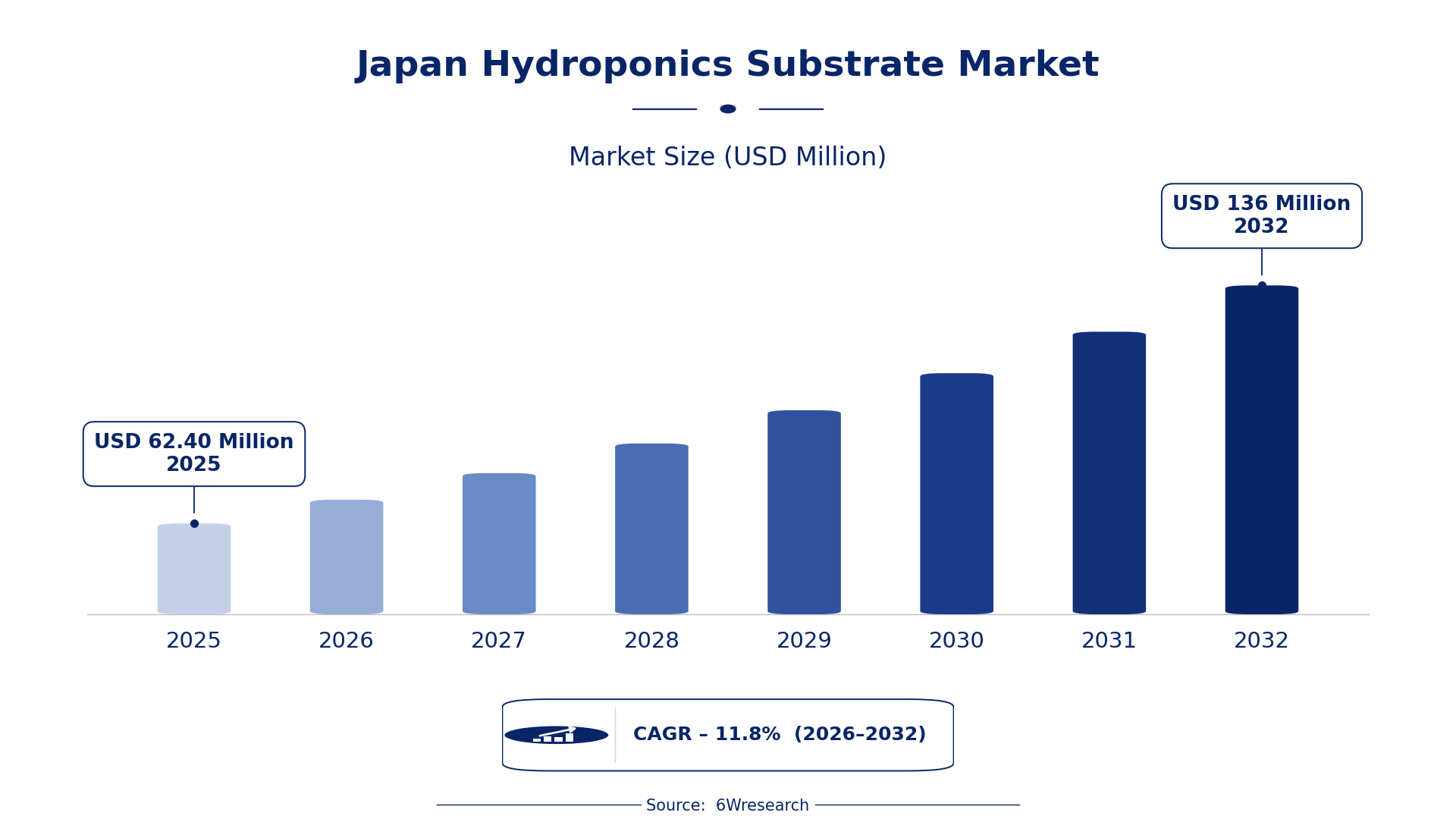
According to 6Wresearch internal database and industry insights, the Japan Hydroponics Substrate Market was valued at USD 62.40 Million in 2025 and is projected to reach USD 136 Million by 2032, growing at a CAGR of approximately 11.8% during 2026–2032.
Japan Hydroponics Substrate Market Highlights
| Report Metric | Details |
| Report Name | Japan Hydroponics Substrate Market (2026-2032) |
| Market Size 2025 | USD 62.40 Million |
| Market Size 2032 | USD 136 Million |
| Absolute Growth 2025–2032 | USD 73.60 Million |
| CAGR 2026–2032 | 11.8% |
| Peak Annual Growth | 12.8% in 2026 |
| Forecast Period | 2026–2032 |
| Historical Data | 2022–2025 |
| Base Year | 2025 |
| Leading Substrate Type, 2025 | Coco Coir (44% share) |
| Leading Material Composition, 2025 | Coconut Husk Fiber (40% share) |
| Leading Reusability Factor, 2025 | High (44% share) |
| Leading End User, 2025 | Sustainable Growers (52% share) |
| Fastest-Growing Substrate Type | Rockwool (16.2% CAGR) |
| Fastest-Growing Material Composition | Mineral Fiber (16.6% CAGR) |
| Fastest-Growing Reusability Factor | Medium (15.0% CAGR) |
| Fastest-Growing End User | Commercial Greenhouses (15.3% CAGR) |
| Growing Sector | sustainable agriculture |
| Key End Users | sustainable growers, commercial greenhouses, DIY indoor growers |
Japan Hydroponics Substrate Market Year-wise Growth Rate and Key Drivers (2022–2032)
This graph illustrates the annual growth rates of the market from 2022 to 2032, highlighting a steady upward trajectory and projected market expansion over the forecast period.
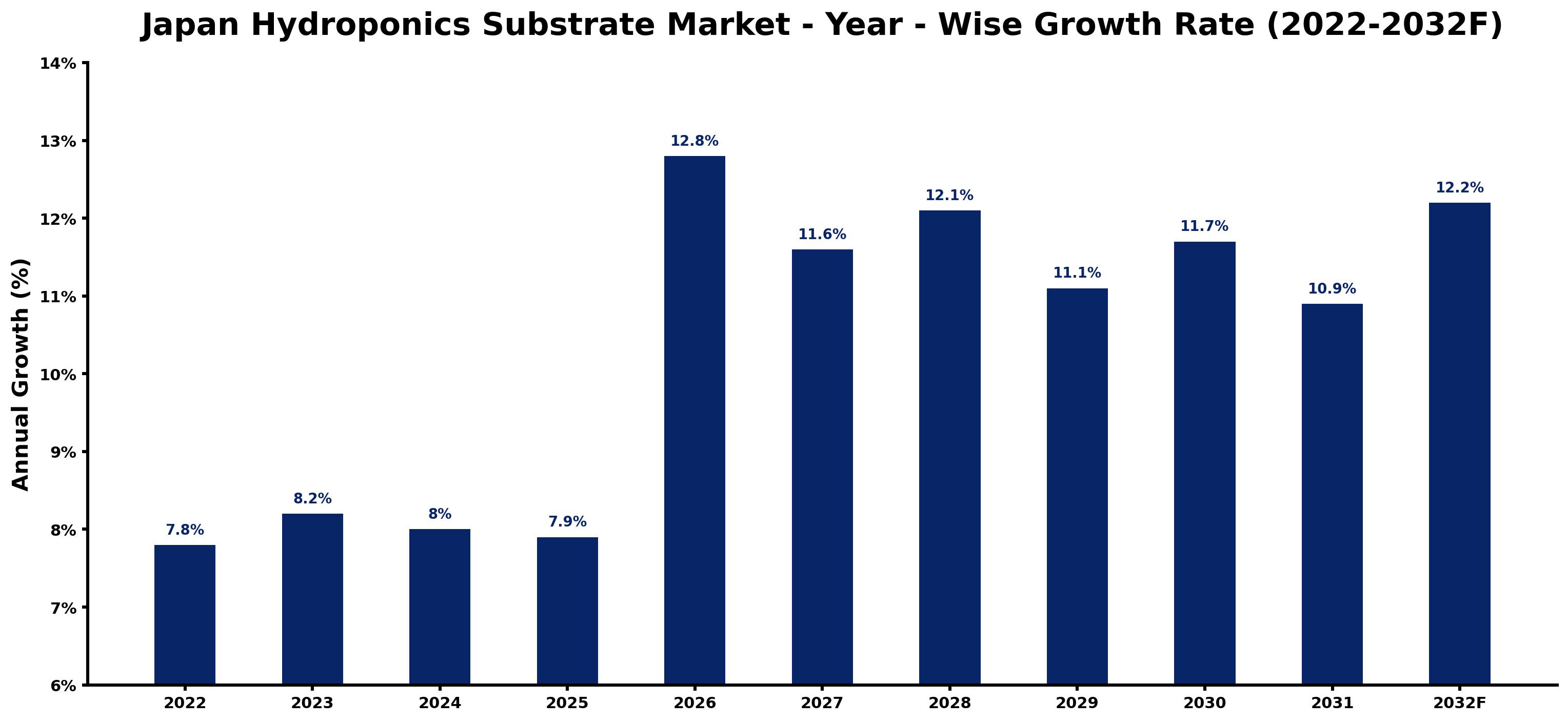
For each year, the table pairs the estimated growth rate with the leading influence on demand, showing how the drivers changed across the period.
| Year | Estimated Annual Growth (%) | Market Rationale |
| 2022 | 7.8 | The market showed steady growth as hydroponic practices gained traction among growers. |
| 2023 | 8.2 | Growth accelerated due to increased interest in sustainable agriculture and urban farming initiatives. |
| 2024 | 8.0 | Growth slowed slightly as market conditions stabilised following the previous year's surge. |
| 2025 | 7.9 | The market continued to grow, albeit at a slower pace, reflecting ongoing adoption of hydroponic systems. |
| 2026 | 12.8 | Growth surged as commercial greenhouses expanded their hydroponic operations. |
| 2027 | 11.6 | Growth is expected to decelerate as the market begins to normalise after the peak in 2026. |
| 2028 | 12.1 | The market is projected to see renewed growth as technological advancements in hydroponics emerge. |
| 2029 | 11.1 | Growth is expected to slow again, reflecting a maturing market with established players. |
| 2030 | 11.7 | A slight uptick in growth is anticipated as urban agriculture initiatives gain momentum. |
| 2031 | 10.9 | Growth will continue to slow as the market reaches a more stable phase of development. |
| 2032 | 12.2 | The market is projected to experience a resurgence as new innovations in substrates are introduced. |
Note: Market size estimations and growth projections presented in this report are based on 6Wresearch's proprietary forecasting methodology, utilizing the latest available industry data, government publications, and primary research inputs.
Japan Hydroponics Substrate Market Synopsis
Hydroponics substrates are essential materials used in soilless agriculture to support plant growth, typically made from organic or inorganic materials such as coconut coir and rockwool. The Japan Hydroponics Substrate Market is expanding due to rising demand from around 2 million registered sustainable growers and commercial greenhouses, driven by urban agriculture initiatives and sustainable practices. Government support through subsidies and standards further fuels this growth, indicating a strong future for hydroponics in Japan.
Market Dynamics Impact Analysis (2026–2032)
| Factor | Type | Impact | Primary Segment Affected |
| Increasing adoption of hydroponic systems in commercial greenhouses | Driver | High | Rockwool |
| Growing interest in sustainable agriculture practices among consumers | Driver | High | Coco Coir |
| Expansion of urban agriculture initiatives in metropolitan areas | Opportunity | High | Coconut Husk Fiber |
| Rising demand for eco-friendly growing solutions | Opportunity | Medium | Mineral Fiber |
| Limited availability of high-quality substrates | Restraint | High | Perlite |
| High initial investment costs for hydroponic setups | Restraint | Medium | Clay Pellets |
| Aging workforce in commercial greenhouses | Challenge | High | Rockwool |
| Competition from traditional soil-based agriculture | Challenge | Medium | Coco Coir |
Evaluation of Drivers in Japan Hydroponics Substrate Market (2026–2032)
Below are the drivers that matter most for revenue growth, with supporting evidence.
| Drivers | Primary Segment Affected | Why It Matters (Evidence) |
| Rising number of sustainable growers adopting hydroponics | Coco Coir | In 2022, there were around 1.2 million registered sustainable growers, increasing demand for effective substrates. |
| Growing commercial greenhouse sector in urban areas | Rockwool | Commercial greenhouses in the Kanto region are increasingly utilising rockwool for its water retention properties. |
| Government initiatives promoting urban agriculture | Coconut Husk Fiber | The government aims to increase urban agriculture by 20% by 2023, boosting substrate demand. |
| Increased consumer preference for organic produce | Mineral Fiber | The popularity of organic vegetables is driving commercial growers to seek high-quality substrates. |
| Technological advancements in hydroponic systems | Perlite | Innovations in hydroponic technologies improve efficiency, resulting in higher substrate usage. |
Spending rises because the number of sustainable growers in Japan has reached approximately 2 million, driving demand for effective hydroponics substrates. In urban areas, commercial greenhouses are increasingly adopting rockwool, which is essential for its excellent water retention properties. The rising consumer preference for organic produce encourages commercial growers to invest in high-quality mineral fiber substrates. Technological advancements in hydroponic systems improve substrate efficiency, resulting in increased purchases across the sector.
Evaluation of Restraints in Japan Hydroponics Substrate Market
Below are the constraints most often cited by buyers and suppliers, with the segment each affects.
| Market Restraint | Primary Segment Affected | Why It Matters (Evidence) |
| Limited availability of high-quality substrates for hydroponics | Perlite | The demand for high-quality substrates often exceeds supply, causing delays in production. |
| High initial investment costs for hydroponic systems | Clay Pellets | The upfront costs deter some potential growers from adopting hydroponic methods. |
| Aging workforce in commercial greenhouses | Rockwool | Many operators are around 50 years old, which may lead to potential labour shortages in the sector. |
| Competition from traditional soil-based agriculture | Coco Coir | Soil-based methods remain prevalent, making it challenging for hydroponics to capture market share. |
| Regulatory hurdles in substrate production | Mineral Fiber | Compliance with standards such as JIS complicates production processes and increases costs. |
Japan Hydroponics Substrate Market Challenges
In 2022, 1.2 million registered sustainable growers faced challenges with outdated technology, raising operational costs and limiting productivity for buyers. Suppliers in urban areas encounter fierce competition, forcing them to lower prices and reducing profit margins for producers. Stricter adherence to ISO 14001 standards complicates operations for suppliers, causing delays in product availability and increasing costs for buyers. A skills gap exists among commercial greenhouse operators, with an average age of 50, leading to slower adoption of modern hydroponic techniques and hindering growth potential for the sector.
Trends in the Japan Hydroponics Substrate Market
These developments are changing demand patterns in the Japan Hydroponics Substrate Market.
- Shift towards Sustainable Growing Practices: Sustainable growers are increasingly prioritising eco-friendly substrates, with coconut husk fiber gaining prominence. In 2023, the government launched initiatives to promote such practices, reflecting a growing trend in the market.
- Transition from Traditional to Hydroponic Systems: The hydroponics industry is evolving as commercial greenhouses adopt advanced systems. In 2022, the number of registered sustainable growers reached 1.2 million, indicating a notable change in cultivation methods.
- Emergence of High Reusability Substrates: High reusability substrates are becoming more popular among growers. In 2023, the government allocated funds for research into sustainable practices, highlighting the trend towards more environmentally friendly options.
- Increased Adoption of Urban Agriculture: Urban agriculture is gaining traction, particularly in metropolitan areas. The government aims to increase urban farming by 20% by 2023, showcasing the growing focus on local food production.
Investment Opportunities in the Japan Hydroponics Substrate Market
Where to invest in the Japan Hydroponics Substrate Market: the main openings are set out below.
- Commercial Greenhouses in Kanto Region: Commercial greenhouses in the Kanto region are expanding their hydroponic operations, with a market gap of approximately USD 62.40 million by 2025. Collaborating with local growers can facilitate entry into this expanding market.
- Urban Farming Initiatives in Tokyo: With a target of a 20% increase in urban agriculture by 2023, there is an opportunity to supply innovative substrates. Engaging with urban growers can enhance market presence.
- Sustainable Substrate Supply for Eco-Friendly Growers: The demand for eco-friendly substrates presents a valuable opportunity. Suppliers can focus on sustainable materials to cater to the 1.2 million sustainable growers registered in Japan.
- Research into Advanced Hydroponic Practices: The government allocated funds for research into sustainable hydroponic practices, creating opportunities for suppliers of advanced substrates. Collaborating with research institutions can lead to new product developments.
Government Initiatives in the Japan Hydroponics Substrate Market
The Economic Security Promotion Act, enacted in 2022, supports supply-chain resilience for critical products, including hydroponics substrates. This measure encourages producers to improve their offerings and ensures buyers have access to reliable materials, promoting overall market stability. The Act aims to support the hydroponics sector by ensuring a steady supply of essential substrates, which is crucial for sustainable agriculture.
In 2023, the government allocated funds for urban agriculture initiatives, administered by the Ministry of Agriculture, Forestry and Fisheries. This funding supports projects aimed at increasing urban farming and improving substrate quality, benefiting both producers and buyers. The initiative includes financial support for research and development, enhancing the overall quality and availability of hydroponics substrates.
Future Insight of the Japan Hydroponics Substrate Market
Investment in urban agriculture will increase significantly, creating a surge in demand for hydroponic substrates. This trend will encourage suppliers to adopt advanced technologies, improving production efficiency. Ongoing research into sustainable practices will introduce new substrate materials, offering buyers enhanced options. The implementation of the JIS standard for hydroponic substrates will ensure quality and safety, boosting consumer confidence and broadening market access.
Market Segmentation Analysis
Japan Hydroponics Substrate Market report covers a detailed analysis of the following market segments:
By Substrate Type – Coco Coir Leads, Rockwool Expected to Grow Fastest
According to Saurav Kr Singh, Senior Research Analyst at 6Wresearch, the largest substrate type category in 2025 was Coco Coir, at 44% of revenue. Coco coir commands a substantial share in Japan's hydroponics market due to its direct application for moisture retention and aeration. Its popularity is evident among the 1.2 million registered sustainable growers who favour organic materials for their hydroponic systems. Rockwool is set to record the highest CAGR in this split, 16.2% over 2026–2032. Rockwool is witnessing rapid growth owing to its excellent water retention and aeration properties, which are vital for commercial greenhouse operations. The increasing adoption of hydroponic systems in the Kanto region is a key factor driving this trend. Suppliers should prioritise the availability of coco coir and rockwool to align with the rising demand in the hydroponics market.
By Material Composition – Coconut Husk Fiber Leads, Mineral Fiber Expected to Grow Fastest
Coconut Husk Fiber took 40% of material composition revenue in 2025, more than any other category. Coconut husk fiber dominates the market as it is valued for its organic composition and effective water retention capabilities. This material is preferred by sustainable growers who are committed to eco-friendly practices in hydroponics. Mineral Fiber is projected to grow fastest, at a CAGR of 16.6% during 2026–2032. Mineral fiber is the fastest-growing segment due to its importance in providing structural support and moisture retention in hydroponic systems. The rise in commercial greenhouse usage drives this trend as growers seek reliable materials. Buyers should consider sourcing coconut husk fiber and mineral fiber to optimise their hydroponic cultivation practices.
By Reusability Factor – High Leads, Medium Expected to Grow Fastest
With 44% of reusability factor revenue in 2025, High was the largest category. High reusability substrates lead the market as they reflect a significant level of sustainability and cost-effectiveness for growers. This characteristic is particularly appealing to the estimated 2 million hydroponic growers in Japan who seek to minimise waste. The quickest growth will come from Medium, forecast to expand at a CAGR of 15.0% between 2026 and 2032. Medium reusability substrates are on the rise as they offer a practical balance between performance and cost, attracting a broader user base. This trend indicates a shift towards more accessible solutions in hydroponic systems, especially among urban growers. Suppliers need to create and promote substrates with various reusability factors to meet the diverse preferences of users.
By End User – Sustainable Growers Lead, Commercial Greenhouses Expected to Grow Fastest
In 2025, Sustainable Growers led the end user split with a 52% share. Sustainable growers represent the largest segment as they are the primary users of hydroponic systems focused on eco-friendly practices. The total population of hydroponic growers in Japan supports this leading position. Over 2026–2032, Commercial Greenhouses are expected to post the fastest growth, at a CAGR of 15.3%. Commercial greenhouses are the fastest-growing end user group, propelled by their adoption of hydroponic systems for vegetable production. The government's support for urban agriculture initiatives further accelerates this growth, indicating a strong market potential. Market players should target sustainable growers and commercial greenhouses to align with the evolving demands of the hydroponics market.
Key Attractiveness of the Report
- 10 Years of Market Numbers
- Historical Data Starting from 2022 to 2025
- Base Year 2025
- Forecast Data until 2032
- Key Performance Indicators Impacting the Market
- Major Upcoming Developments and Projects
Key Highlights of the Report:
- Japan Hydroponics Substrate Market Outlook
- Market Size of Japan Hydroponics Substrate Market, 2025
- Forecast of Japan Hydroponics Substrate Market, 2032
- Historical Data and Forecast of Japan Hydroponics Substrate Revenues & Volume for the Period 2022-2032F
- Japan Hydroponics Substrate Market Trend Evolution
- Japan Hydroponics Substrate Market Drivers and Challenges
- Japan Hydroponics Substrate Price Trends
- Japan Hydroponics Substrate Porter's Five Forces
- Japan Hydroponics Substrate Industry Life Cycle
- Historical Data and Forecast of Japan Hydroponics Substrate Market Revenues & Volume By Substrate Type for the Period 2022-2032F
- Historical Data and Forecast of Japan Hydroponics Substrate Market Revenues & Volume By Coco Coir for the Period 2022-2032F
- Historical Data and Forecast of Japan Hydroponics Substrate Market Revenues & Volume By Rockwool for the Period 2022-2032F
- Historical Data and Forecast of Japan Hydroponics Substrate Market Revenues & Volume By Perlite for the Period 2022-2032F
- Historical Data and Forecast of Japan Hydroponics Substrate Market Revenues & Volume By Clay Pellets for the Period 2022-2032F
- Historical Data and Forecast of Japan Hydroponics Substrate Market Revenues & Volume By Material Composition for the Period 2022-2032F
- Historical Data and Forecast of Japan Hydroponics Substrate Market Revenues & Volume By Coconut Husk Fiber for the Period 2022-2032F
- Historical Data and Forecast of Japan Hydroponics Substrate Market Revenues & Volume By Mineral Fiber for the Period 2022-2032F
- Historical Data and Forecast of Japan Hydroponics Substrate Market Revenues & Volume By Volcanic Glass for the Period 2022-2032F
- Historical Data and Forecast of Japan Hydroponics Substrate Market Revenues & Volume By Expanded Clay Aggregate for the Period 2022-2032F
- Historical Data and Forecast of Japan Hydroponics Substrate Market Revenues & Volume By Reusability Factor for the Period 2022-2032F
- Historical Data and Forecast of Japan Hydroponics Substrate Market Revenues & Volume By High for the Period 2022-2032F
- Historical Data and Forecast of Japan Hydroponics Substrate Market Revenues & Volume By Medium for the Period 2022-2032F
- Historical Data and Forecast of Japan Hydroponics Substrate Market Revenues & Volume By High for the Period 2022-2032F
- Historical Data and Forecast of Japan Hydroponics Substrate Market Revenues & Volume By Reusable for the Period 2022-2032F
- Historical Data and Forecast of Japan Hydroponics Substrate Market Revenues & Volume By End User for the Period 2022-2032F
- Historical Data and Forecast of Japan Hydroponics Substrate Market Revenues & Volume By Sustainable Growers for the Period 2022-2032F
- Historical Data and Forecast of Japan Hydroponics Substrate Market Revenues & Volume By Commercial Greenhouses for the Period 2022-2032F
- Historical Data and Forecast of Japan Hydroponics Substrate Market Revenues & Volume By DIY Indoor Growers for the Period 2022-2032F
- Historical Data and Forecast of Japan Hydroponics Substrate Market Revenues & Volume By Hydroponic Equipment Retail for the Period 2022-2032F
- Japan Hydroponics Substrate Import Export Trade Statistics
- Market Opportunity Assessment By Substrate Type
- Market Opportunity Assessment By Material Composition
- Market Opportunity Assessment By Reusability Factor
- Market Opportunity Assessment By End User
- Japan Hydroponics Substrate Top Companies Market Share
- Japan Hydroponics Substrate Competitive Benchmarking By Technical and Operational Parameters
- Japan Hydroponics Substrate Company Profiles
- Japan Hydroponics Substrate Key Strategic Recommendations
Market Covered
Segments analysed in this report are listed below.
By Substrate Type
- Coco Coir
- Rockwool
- Perlite
- Clay Pellets
By Material Composition
- Coconut Husk Fiber
- Mineral Fiber
- Volcanic Glass
- Expanded Clay Aggregate
By Reusability Factor
- High
- Medium
- Reusable
By End User
- Sustainable Growers
- Commercial Greenhouses
- DIY Indoor Growers
- Hydroponic Equipment Retail































