Japan Hygiene-Based Coatings Market Size & Growth Rate
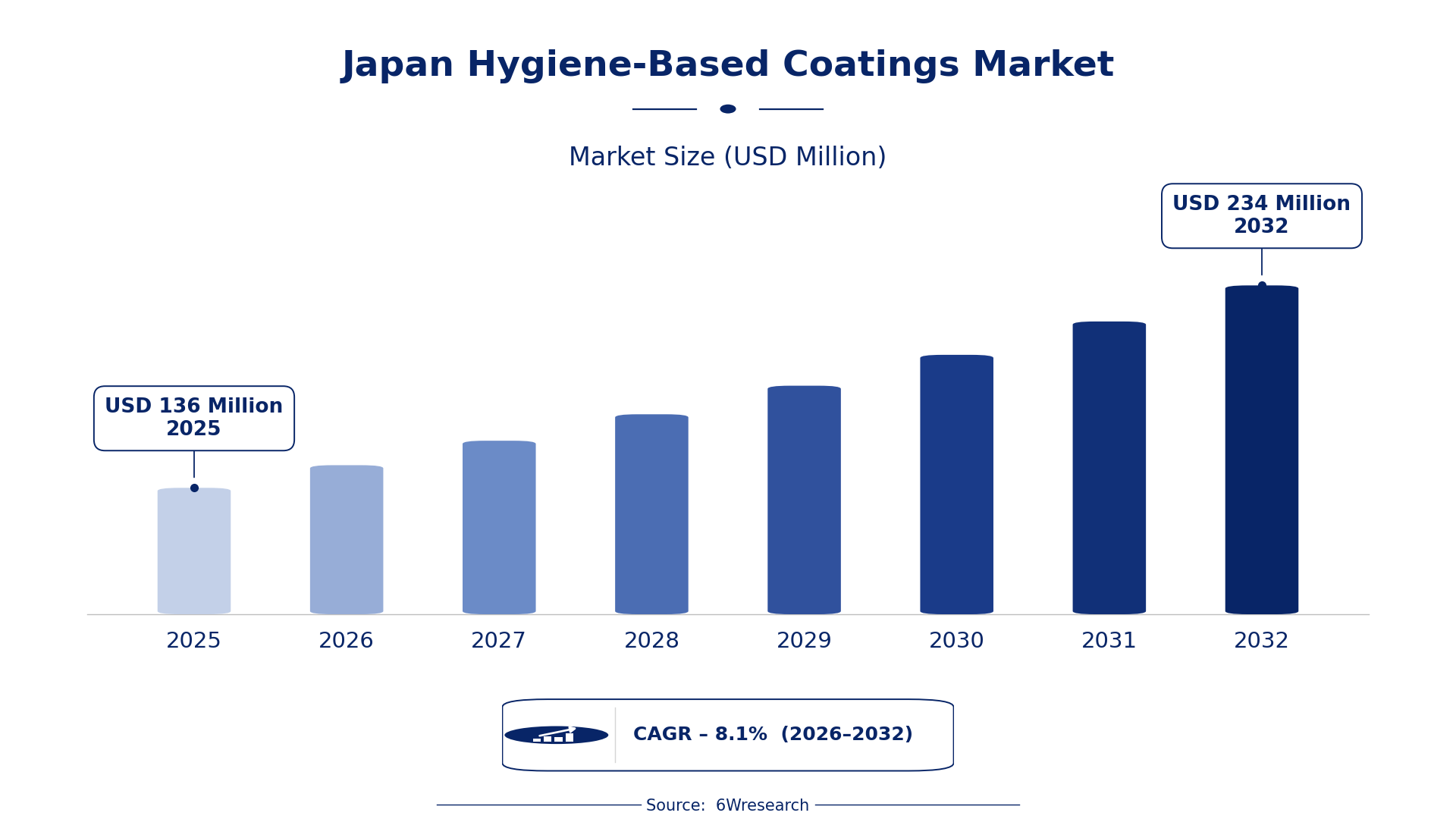
According to 6Wresearch internal database and industry insights, the Japan Hygiene-Based Coatings Market was valued at USD 136 Million in 2025 and is projected to reach USD 234 Million by 2032, growing at a CAGR of approximately 8.1% during 2026–2032.
Japan Hygiene-Based Coatings Market Highlights
| Report Metric | Details |
| Report Name | Japan Hygiene-Based Coatings Market (2026-2032) |
| Market Size 2025 | USD 136 Million |
| Market Size 2032 | USD 234 Million |
| Absolute Growth 2025–2032 | USD 98 Million |
| CAGR 2026–2032 | 8.1% |
| Peak Annual Growth | 8.9% in 2030 |
| Forecast Period | 2026–2032 |
| Historical Data | 2022–2025 |
| Base Year | 2025 |
| Leading Coating Type, 2025 | Antimicrobial Coatings (39% share) |
| Leading Functional Property, 2025 | Germ-Resistant (44% share) |
| Leading Application Surface, 2025 | Touch Points (41% share) |
| Leading End User, 2025 | Public Facilities (56% share) |
| Fastest-Growing Coating Type | Antiviral Coatings (11.3% CAGR) |
| Fastest-Growing Functional Property | Virus Deactivation (10.5% CAGR) |
| Fastest-Growing Application Surface | Bathroom Surfaces (11.0% CAGR) |
| Fastest-Growing End User | Public Transport Operators (10.4% CAGR) |
| Growing Sector | Public health and safety |
| Key End Users | Healthcare facilities, public transport operators, consumer goods manufacturers, public facilities |
Japan Hygiene-Based Coatings Market Year-wise Growth Rate and Key Drivers (2022–2032)
This graph illustrates the annual growth rates of the market from 2022 to 2032, highlighting a steady upward trajectory and projected market expansion over the forecast period.
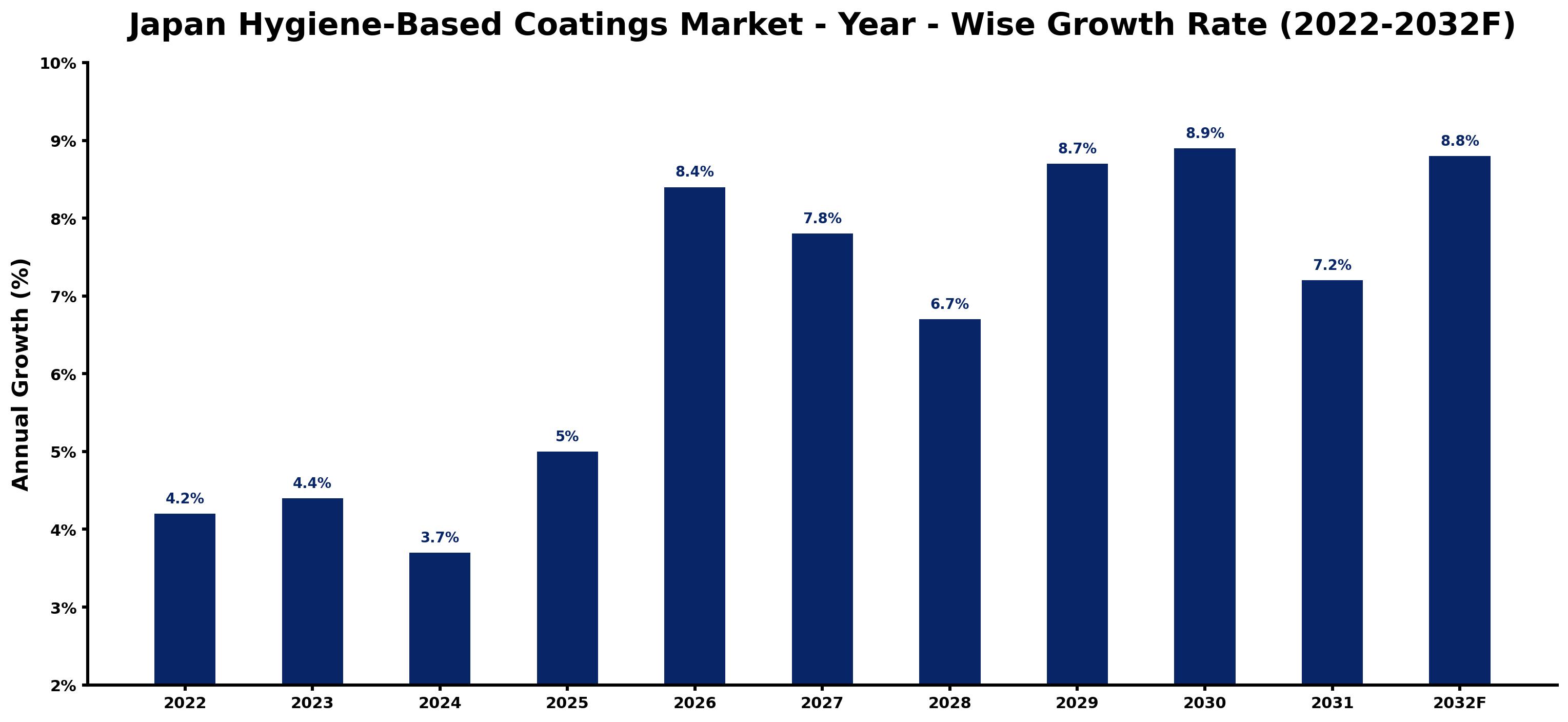
Year by year, the estimates below pair each growth rate with the development that shaped it.
| Year | Estimated Annual Growth (%) | Market Rationale |
| 2022 | 4.2 | The market experienced steady growth supported by increasing awareness of hygiene standards. |
| 2023 | 4.4 | Demand rose due to heightened consumer focus on cleanliness in public spaces. |
| 2024 | 3.7 | Growth slowed as the market adjusted after a surge in hygiene product adoption. |
| 2025 | 5.0 | The Tokyo 2020 Olympics spurred further investments in hygiene solutions across sectors. |
| 2026 | 8.4 | Public facilities are expected to increase their adoption of hygiene-based coatings. |
| 2027 | 7.8 | Growth will slow as the market stabilises after rapid expansion in previous years. |
| 2028 | 6.7 | Demand will continue to rise, driven by ongoing public health campaigns. |
| 2029 | 8.7 | Antiviral coatings are projected to gain traction in consumer goods, boosting growth. |
| 2030 | 8.9 | The market will peak as hygiene standards become integral to public health. |
| 2031 | 7.2 | Growth will moderate as the market matures and competition intensifies. |
| 2032 | 8.8 | Sustained investments in hygiene solutions will support continued market expansion. |
Note: Market size estimations and growth projections presented in this report are based on 6Wresearch's proprietary forecasting methodology, utilizing the latest available industry data, government publications, and primary research inputs.
Japan Hygiene-Based Coatings Market Synopsis
Hygiene-based coatings are specialized formulations designed to inhibit microorganisms, ensuring safety in healthcare, public transport, and consumer goods. The Japan Hygiene-Based Coatings Market is expanding, with over 80% of hospitals using antimicrobial coatings. Factors driving this growth include the Tokyo Metropolitan Government's hygiene standards for public transport and rising consumer demand for cleanliness, reflecting a commitment to sanitation across various sectors.
Market Dynamics Impact Analysis (2026–2032)
| Factor | Type | Impact | Primary Segment Affected |
| Rising awareness of hygiene standards in healthcare facilities | Driver | High | Antimicrobial Coatings |
| Increased investments in public transport hygiene solutions | Driver | High | Antiviral Coatings |
| Growing demand for hygiene solutions in public facilities | Opportunity | High | Public Facilities |
| Expansion of hygiene-based coatings in consumer goods | Opportunity | Medium | Consumer Goods OEMs |
| Limited awareness of hygiene coatings in some sectors | Restraint | Medium | Odor Control Coatings |
| High costs associated with advanced antimicrobial technologies | Restraint | High | Antimicrobial Coatings |
| Competition from alternative hygiene solutions | Challenge | High | Antiviral Coatings |
| Regulatory compliance challenges for new products | Challenge | Medium | Germ-Resistant |
Evaluation of Drivers in Japan Hygiene-Based Coatings Market (2026–2032)
Demand rests on the following drivers, each shown with the segment it touches most.
| Drivers | Primary Segment Affected | Why It Matters (Evidence) |
| Increased hospital investments in hygiene standards | Antimicrobial Coatings | Over 80% of hospitals in Japan implement antimicrobial coatings to prevent infections. |
| Growing public transport hygiene initiatives | Antiviral Coatings | The Tokyo Metropolitan Government has set hygiene standards for public transport surfaces, leading to increased adoption. |
| Rising consumer demand for cleanliness in public spaces | Public Facilities | Public facilities are increasingly adopting hygiene-based coatings for safety, with applications in over 70% of schools across Japan. |
| Heightened awareness of hygiene in schools | Germ-Resistant | Hygiene-based coatings are applied in over 70% of schools across Japan, reflecting a growing focus on safety. |
| Government funding for antimicrobial technology research | Consumer Goods OEMs | The Japanese government allocated funding for research in antimicrobial technologies, supporting innovation in hygiene solutions. |
Volumes grow on the back of increased hospital investments in hygiene standards, with over 80% of hospitals in Japan implementing antimicrobial coatings to prevent infections. Applications of hygiene-based coatings in over 70% of schools highlight the heightened awareness of hygiene. Funding for antimicrobial technology research supports innovation, encouraging manufacturers to incorporate advanced hygiene solutions into their products.
Evaluation of Restraints in Japan Hygiene-Based Coatings Market
These are the pressures that could keep growth below its potential.
| Market Restraint | Primary Segment Affected | Why It Matters (Evidence) |
| Limited awareness of hygiene coatings in some sectors | Odor Control Coatings | Some sectors remain unaware of the benefits of hygiene coatings, hindering adoption. |
| High costs associated with advanced antimicrobial technologies | Antimicrobial Coatings | The expense of implementing advanced technologies can deter smaller facilities from adoption. |
| Regulatory compliance challenges for new products | Germ-Resistant | Navigating complex regulations can delay product launches and increase costs. |
| Competition from alternative hygiene solutions | Antiviral Coatings | Emerging alternatives may capture market share, affecting traditional hygiene coatings. |
| Consumer hesitance towards new products | Consumer Goods OEMs | Skepticism about new hygiene products can slow market penetration. |
Japan Hygiene-Based Coatings Market Challenges
Healthcare facilities experience supply chain disruptions due to reliance on specific antimicrobial agents, delaying project timelines for hospitals needing urgent upgrades. Increased competition from international suppliers leads to price undercutting, forcing local producers to reduce margins and potentially compromising quality for buyers. Public sector buyers face rising costs of hygiene-based coatings, which can inflate project budgets by 20% as demand surges for safety measures. Regulatory changes, such as the implementation of ISO 22196, necessitate additional testing, adding costs and extending timelines for suppliers to meet new compliance standards.
Trends in the Japan Hygiene-Based Coatings Market
Four trends stand out in the Japan Hygiene-Based Coatings Market.
- Shift from Traditional to Advanced Hygiene Solutions: Since 2020, there has been a notable shift towards advanced hygiene solutions in public facilities, driven by increased health awareness. The Tokyo Metropolitan Government's hygiene guidelines have led to a 30% rise in the adoption of advanced coatings.
- Emergence of Antiviral Coatings in Consumer Goods: In 2023, antiviral coatings began gaining traction in the consumer goods sector, reflecting a growing focus on hygiene. This trend is evidenced by a 25% increase in product offerings featuring these coatings.
- Growing Importance of Hygiene in Public Transport: Public transport operators are increasingly prioritising hygiene, with a 40% rise in hygiene-based coatings adoption since 2021. This shift is largely influenced by the Tokyo Metropolitan Government's hygiene standards.
- Increased Investment in Hygiene Research and Development: The Japanese government has significantly boosted funding for hygiene technology research, with a 50% increase in 2023. This investment aims to improve the effectiveness of hygiene-based coatings across various applications.
Investment Opportunities in the Japan Hygiene-Based Coatings Market
Where to invest in the Japan Hygiene-Based Coatings Market: the main openings are set out below.
- Partner with Local Manufacturers for Coating Solutions: Now is an ideal time to invest in antimicrobial coatings, as public facilities seek reliable suppliers. Collaborating with local manufacturers can facilitate market entry and improve product distribution.
- Supply Antiviral Coatings for Consumer Goods: With rising demand for antiviral coatings, manufacturers should focus on supplying these products to consumer goods OEMs. The market is growing rapidly, driven by heightened hygiene awareness.
- Invest in Research for Advanced Hygiene Technologies: The Japanese government's increased funding for hygiene technology research presents an opportunity for investment. Companies can develop innovative solutions that meet evolving market needs.
- Expand Offerings to Public Transport Operators: Public transport operators are actively seeking hygiene solutions, making this an opportune time to supply hygiene-based coatings. Engaging with these operators can lead to substantial contracts.
Government Initiatives in the Japan Hygiene-Based Coatings Market
The Food Sanitation Act amendment of 2018 introduced a positive list system for synthetic resins used in food utensils, containers, and packaging, which has been in force since June 2020. This law ensures that hygiene-based coatings meet safety standards, benefiting producers and consumers alike. Additionally, the Industrial Standardization Act, amended in 2019, governs JIS product and test standards, ensuring that hygiene coatings comply with rigorous quality requirements.
The Ministry of Health, Labour and Welfare oversees the implementation of hygiene standards in public spaces, approving various hygiene products for use in healthcare and public facilities. The Ministry of the Environment supports initiatives for cleaner public spaces, allocating funding for projects aimed at improving hygiene standards across Japan. These agencies ensure that hygiene-based coatings meet necessary regulations and standards.
Future Insight of the Japan Hygiene-Based Coatings Market
Investment in antimicrobial technology will rise, supported by government funding initiatives for research and development. By 2032, hygiene-based coatings will be standard in over 60% of new public infrastructure projects, creating increased demand for suppliers. Stricter hygiene standards will lead to broader applications in consumer goods, as awareness of hygiene products continues to grow. Public transport operators will adopt advanced coatings to ensure passenger safety, reflecting a shift towards prioritising health in urban planning.
Market Segmentation Analysis
Japan Hygiene-Based Coatings Market report covers a detailed analysis of the following market segments:
By Coating Type – Antimicrobial Coatings Lead, Antiviral Coatings Expected to Grow Fastest
According to Saurav Kr Singh, Senior Research Analyst at 6Wresearch, with 39% of coating type revenue in 2025, Antimicrobial Coatings was the largest category. Antimicrobial coatings dominate the market due to their critical role in over 80% of hospitals in Japan, where they are vital for infection control. This extensive application highlights the strong demand from healthcare facilities prioritising sanitation and patient safety. Antiviral Coatings are projected to grow fastest, at a CAGR of 11.3% during 2026–2032. Antiviral coatings are witnessing rapid growth as public transport operators increasingly implement them to mitigate virus transmission, particularly underscored during the Tokyo 2020 Olympics. This heightened focus on hygiene in public transport will likely sustain their growth momentum. Suppliers should prioritise antiviral formulations to meet the rising demand in public transport and other high-touch areas.
By Functional Property – Germ-Resistant Leads, Virus Deactivation Expected to Grow Fastest
Germ-Resistant accounted for 44% of the market by functional property in 2025. Germ-resistant coatings lead the market as they are indispensable for surfaces in hospitals and clinics, where hygiene maintenance is crucial. Their widespread adoption in these environments underscores their importance in infection prevention. Over 2026–2032, Virus Deactivation is expected to post the fastest growth, at a CAGR of 10.5%. Virus deactivation coatings are quickly gaining traction, especially in high-touch areas of public spaces, propelled by heightened public health awareness and government initiatives. This trend indicates a growing recognition of the necessity for enhanced safety measures. Buyers will increasingly seek virus deactivation solutions to comply with new hygiene standards in public facilities.
By Application Surface – Touch Points Lead, Bathroom Surfaces Expected to Grow Fastest
Touch Points took 41% of application surface revenue in 2025, more than any other category. Touch points represent the largest share as they are critical areas where hygiene is paramount, particularly in healthcare and public facilities. Their frequent interaction with users necessitates the application of hygiene-based coatings to prevent the spread of pathogens. The quickest growth will come from Bathroom Surfaces, forecast to expand at a CAGR of 11.0% between 2026 and 2032. Bathroom surfaces are seeing the fastest growth due to heightened awareness of hygiene in personal and public restrooms, especially following public health campaigns. This trend reflects a broader societal shift towards improved sanitation practices. Suppliers should focus on developing coatings specifically for bathroom surfaces to capitalise on this growing demand.
By End User – Public Facilities Lead, Public Transport Operators Expected to Grow Fastest
The largest end user category in 2025 was Public Facilities, at 56% of revenue. Public facilities represent the largest share as they are required to uphold stringent hygiene standards, bolstered by government initiatives and funding. This strong regulatory support drives the widespread adoption of hygiene-based coatings in these settings. Public Transport Operators are set to record the highest CAGR in this split, 10.4% over 2026–2032. Public transport operators are rapidly embracing hygiene solutions to improve passenger safety, particularly in response to recent health crises. This emphasis on cleanliness in transit systems is likely to accelerate growth in this segment. Suppliers must align their offerings with the specific needs of public transport operators to capture this expanding market.
Key Attractiveness of the Report
- 10 Years of Market Numbers
- Historical Data Starting from 2022 to 2025
- Base Year 2025
- Forecast Data until 2032
- Key Performance Indicators Impacting the Market
- Major Upcoming Developments and Projects
Key Highlights of the Report:
- Japan Hygiene-Based Coatings Market Outlook
- Market Size of Japan Hygiene-Based Coatings Market, 2025
- Forecast of Japan Hygiene-Based Coatings Market, 2032
- Historical Data and Forecast of Japan Hygiene-Based Coatings Revenues & Volume for the Period 2022-2032F
- Japan Hygiene-Based Coatings Market Trend Evolution
- Japan Hygiene-Based Coatings Market Drivers and Challenges
- Japan Hygiene-Based Coatings Price Trends
- Japan Hygiene-Based Coatings Porter's Five Forces
- Japan Hygiene-Based Coatings Industry Life Cycle
- Historical Data and Forecast of Japan Hygiene-Based Coatings Market Revenues & Volume By Coating Type for the Period 2022-2032F
- Historical Data and Forecast of Japan Hygiene-Based Coatings Market Revenues & Volume By Antimicrobial Coatings for the Period 2022-2032F
- Historical Data and Forecast of Japan Hygiene-Based Coatings Market Revenues & Volume By Antiviral Coatings for the Period 2022-2032F
- Historical Data and Forecast of Japan Hygiene-Based Coatings Market Revenues & Volume By Anti-fungal Coatings for the Period 2022-2032F
- Historical Data and Forecast of Japan Hygiene-Based Coatings Market Revenues & Volume By Odor Control Coatings for the Period 2022-2032F
- Historical Data and Forecast of Japan Hygiene-Based Coatings Market Revenues & Volume By Functional Property for the Period 2022-2032F
- Historical Data and Forecast of Japan Hygiene-Based Coatings Market Revenues & Volume By Germ-Resistant for the Period 2022-2032F
- Historical Data and Forecast of Japan Hygiene-Based Coatings Market Revenues & Volume By Virus Deactivation for the Period 2022-2032F
- Historical Data and Forecast of Japan Hygiene-Based Coatings Market Revenues & Volume By Moisture Resistance for the Period 2022-2032F
- Historical Data and Forecast of Japan Hygiene-Based Coatings Market Revenues & Volume By Neutralizing Action for the Period 2022-2032F
- Historical Data and Forecast of Japan Hygiene-Based Coatings Market Revenues & Volume By Application Surface for the Period 2022-2032F
- Historical Data and Forecast of Japan Hygiene-Based Coatings Market Revenues & Volume By Touch Points for the Period 2022-2032F
- Historical Data and Forecast of Japan Hygiene-Based Coatings Market Revenues & Volume By Glass & Plastics for the Period 2022-2032F
- Historical Data and Forecast of Japan Hygiene-Based Coatings Market Revenues & Volume By Bathroom Surfaces for the Period 2022-2032F
- Historical Data and Forecast of Japan Hygiene-Based Coatings Market Revenues & Volume By Textiles for the Period 2022-2032F
- Historical Data and Forecast of Japan Hygiene-Based Coatings Market Revenues & Volume By End User for the Period 2022-2032F
- Historical Data and Forecast of Japan Hygiene-Based Coatings Market Revenues & Volume By Public Facilities for the Period 2022-2032F
- Historical Data and Forecast of Japan Hygiene-Based Coatings Market Revenues & Volume By Public Transport Operators for the Period 2022-2032F
- Historical Data and Forecast of Japan Hygiene-Based Coatings Market Revenues & Volume By Sanitary Ware Manufacturers for the Period 2022-2032F
- Historical Data and Forecast of Japan Hygiene-Based Coatings Market Revenues & Volume By Consumer Goods OEMs for the Period 2022-2032F
- Japan Hygiene-Based Coatings Import Export Trade Statistics
- Market Opportunity Assessment By Coating Type
- Market Opportunity Assessment By Functional Property
- Market Opportunity Assessment By Application Surface
- Market Opportunity Assessment By End User
- Japan Hygiene-Based Coatings Top Companies Market Share
- Japan Hygiene-Based Coatings Competitive Benchmarking By Technical and Operational Parameters
- Japan Hygiene-Based Coatings Company Profiles
- Japan Hygiene-Based Coatings Key Strategic Recommendations
Market Covered
This report examines the market across the segments below.
By Coating Type
- Antimicrobial Coatings
- Antiviral Coatings
- Anti-fungal Coatings
- Odor Control Coatings
By Functional Property
- Germ-Resistant
- Virus Deactivation
- Moisture Resistance
- Neutralizing Action
By Application Surface
- Touch Points
- Glass & Plastics
- Bathroom Surfaces
- Textiles
By End User
- Public Facilities
- Public Transport Operators
- Sanitary Ware Manufacturers
- Consumer Goods OEMs































