Japan Hygiene Chemicals Market Size & Growth Rate
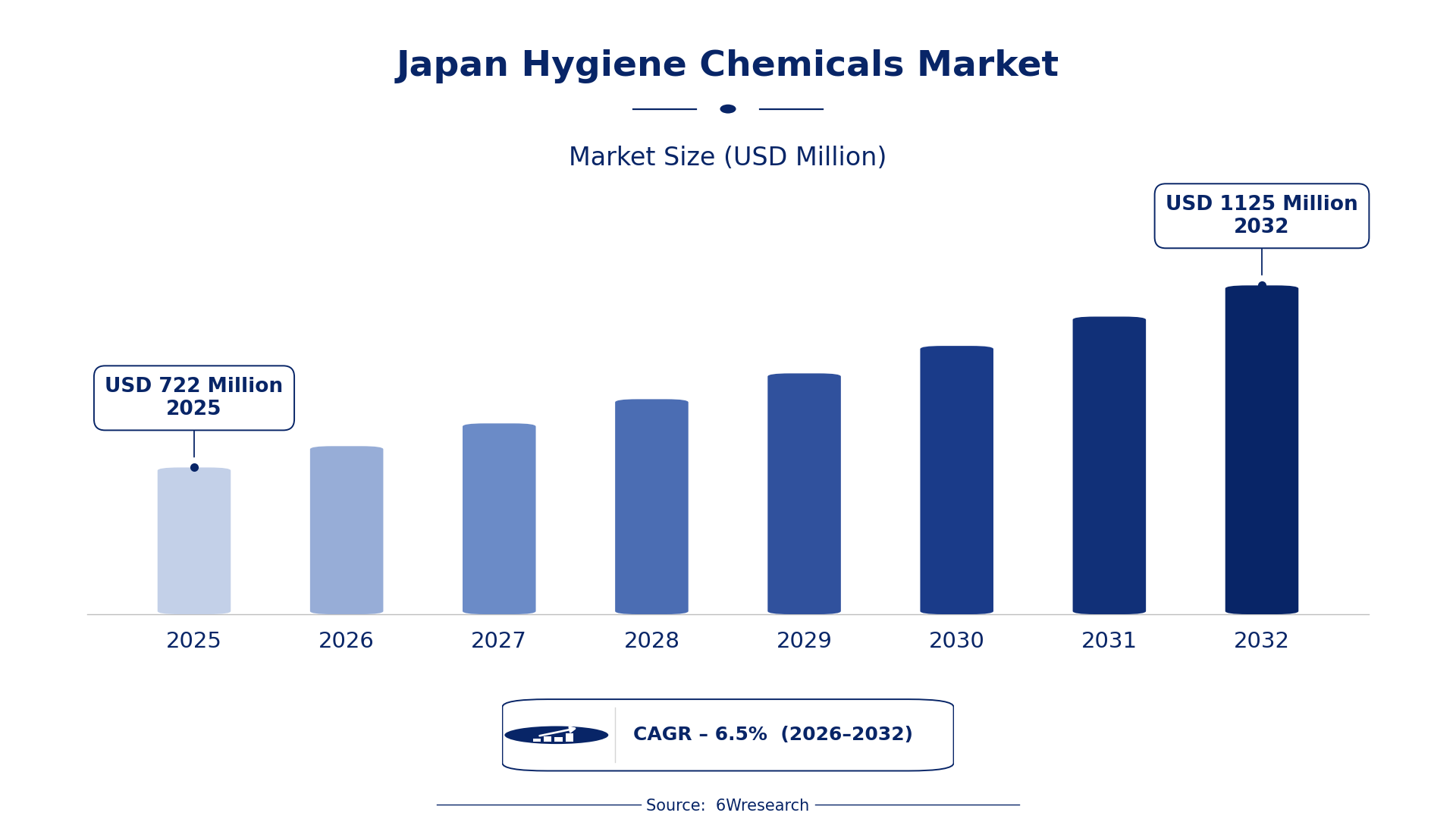
According to 6Wresearch internal database and industry insights, the Japan Hygiene Chemicals Market was valued at USD 722 Million in 2025 and is projected to reach USD 1,125 Million by 2032, growing at a CAGR of approximately 6.5% during 2026–2032.
Japan Hygiene Chemicals Market Highlights
| Report Metric | Details |
| Report Name | Japan Hygiene Chemicals Market (2026-2032) |
| Market Size 2025 | USD 722 Million |
| Market Size 2032 | USD 1,125 Million |
| Absolute Growth 2025–2032 | USD 403 Million |
| CAGR 2026–2032 | 6.5% |
| Peak Annual Growth | 7.8% in 2030 |
| Forecast Period | 2026–2032 |
| Historical Data | 2022–2025 |
| Base Year | 2025 |
| Leading Chemical Type, 2025 | Alcohol-Based Sanitizers (47% share) |
| Leading Active Agent, 2025 | Ethanol/Isopropanol (45% share) |
| Leading Use Case, 2025 | Hand Disinfection (34% share) |
| Leading End User, 2025 | Healthcare Facilities (51% share) |
| Fastest-Growing Chemical Type | Chlorine Compounds (9.1% CAGR) |
| Fastest-Growing Active Agent | Sodium Hypochlorite (9.2% CAGR) |
| Fastest-Growing Use Case | Surface Cleaning (8.7% CAGR) |
| Fastest-Growing End User | Food Processing Units (8.4% CAGR) |
| Growing Sector | Healthcare Facilities |
| Key End Users | Healthcare Facilities, Food Processing Units, Institutional Cleaners, Hospital Sterile Units |
Japan Hygiene Chemicals Market Year-wise Growth Rate and Key Drivers (2022–2032)
This graph illustrates the annual growth rates of the market from 2022 to 2032, highlighting a steady upward trajectory and projected market expansion over the forecast period.
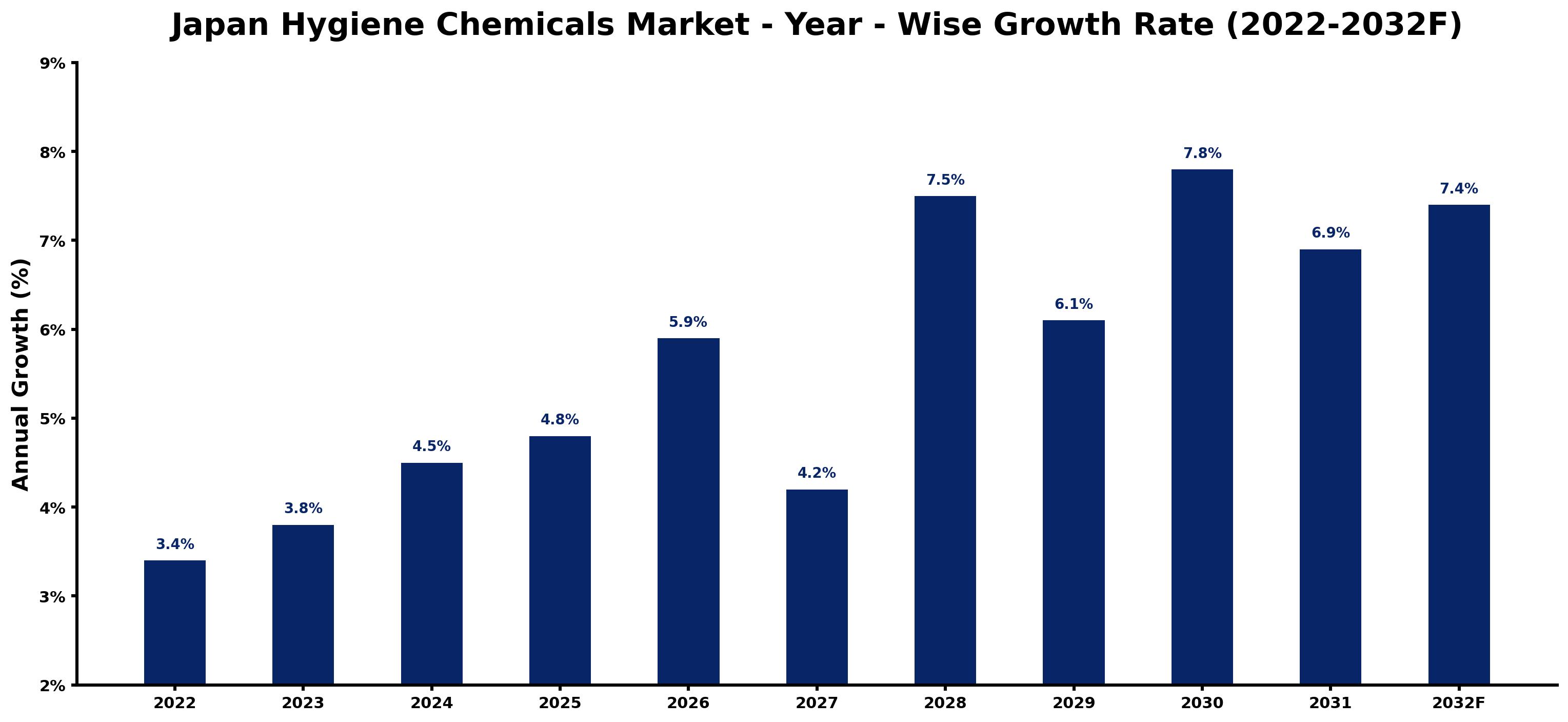
Below, each year's estimated growth is shown next to the factor that most influenced it.
| Year | Estimated Annual Growth (%) | Market Rationale |
| 2022 | 3.4 | Demand remained steady, driven by ongoing hygiene needs in healthcare settings. |
| 2023 | 3.8 | Growth accelerated as healthcare facilities increased their hygiene chemical usage. |
| 2024 | 4.5 | Higher awareness of infection control boosted demand for hygiene products across sectors. |
| 2025 | 4.8 | The market experienced its historical peak due to rising sanitation standards. |
| 2026 | 5.9 | Demand increased further as public health initiatives expanded hygiene practices. |
| 2027 | 4.2 | Growth slowed slightly as the market began to stabilise after rapid increases. |
| 2028 | 7.5 | A resurgence in demand occurred as public sanitation efforts intensified. |
| 2029 | 6.1 | Growth decelerated as market saturation began to take effect in some areas. |
| 2030 | 7.8 | The market peaked again due to heightened focus on hygiene amid health crises. |
| 2031 | 6.9 | Growth slowed as the market adjusted to established hygiene practices. |
| 2032 | 7.4 | Demand is projected to remain strong as new sanitation technologies gain traction. |
Note: Market size estimations and growth projections presented in this report are based on 6Wresearch's proprietary forecasting methodology, utilizing the latest available industry data, government publications, and primary research inputs.
Japan Hygiene Chemicals Market Synopsis
Hygiene chemicals are essential for maintaining cleanliness and preventing infections, primarily produced through chemical processes involving active agents like alcohols and chlorine compounds. The Japan Hygiene Chemicals Market is expanding due to increased demand from healthcare and food processing sectors, driven by heightened awareness of hygiene practices and government initiatives. In 2023, a sanitation initiative for public spaces further stimulated demand, while the healthcare sector's annual usage of disinfectants underscores the market's significance.
Market Dynamics Impact Analysis (2026–2032)
| Factor | Type | Impact | Primary Segment Affected |
| Increasing hygiene awareness in healthcare facilities | Driver | High | Hand Disinfection |
| Rising sanitation standards in food processing units | Driver | High | Surface Cleaning |
| Growing demand for eco-friendly products | Opportunity | Medium | Chlorine Compounds |
| Expansion of public sanitation initiatives | Opportunity | Medium | Public Sanitation |
| Regulatory compliance costs for manufacturers | Restraint | High | Ethanol/Isopropanol |
| Market saturation in urban areas | Restraint | Medium | Alcohol-Based Sanitizers |
| Supply chain disruptions affecting availability | Challenge | High | Hydrogen Peroxide |
| Competition from alternative cleaning solutions | Challenge | Medium | QACs (Quaternary Ammonium) |
Evaluation of Drivers in Japan Hygiene Chemicals Market (2026–2032)
Demand rests on the following drivers, each shown with the segment it touches most.
| Drivers | Primary Segment Affected | Why It Matters (Evidence) |
| Increased healthcare spending | Hand Disinfection | Japan's healthcare facilities use over 500 million liters of disinfectants annually, driving demand for hand sanitizers. |
| Food safety regulations | Surface Cleaning | Over 80% of food processing units in Japan employ chlorine compounds, necessitating surface cleaning products. |
| Public health initiatives | Public Sanitation | The 2023 sanitation initiative for public spaces has raised the need for hygiene chemicals. |
| Rising consumer awareness | Ethanol/Isopropanol | The population of Japan, approximately 125 million, increasingly values hygiene, boosting sanitizer purchases. |
| Regulatory standards for cleanliness | Chlorine Compounds | JIS Z 2801 sets antimicrobial product standards, increasing demand for compliant cleaning solutions. |
Much of the new demand traces back to Japan's healthcare sector, which utilises over 500 million liters of disinfectants annually, boosting hand disinfection products. The food processing industry, with over 80% employing chlorine compounds, drives demand for surface cleaning solutions. With a population of around 125 million, growing consumer awareness of hygiene is prompting higher purchases of ethanol and isopropanol-based products.
Evaluation of Restraints in Japan Hygiene Chemicals Market
The main factors holding the market back are set out below.
| Market Restraint | Primary Segment Affected | Why It Matters (Evidence) |
| Compliance costs associated with stringent regulations | Ethanol/Isopropanol | Manufacturers face high costs to meet standards set by the Chemical Substances Control Law, impacting pricing. |
| Market saturation in urban regions | Alcohol-Based Sanitizers | High penetration in cities like Tokyo and Osaka limits growth potential for sanitizers. |
| Supply chain disruptions due to global events | Hydrogen Peroxide | Recent global supply chain issues have led to shortages, affecting availability for hospitals. |
| Competition from alternative cleaning solutions | QACs (Quaternary Ammonium) | Emerging alternatives are gaining traction, impacting market share for traditional QAC products. |
| Rising raw material costs | Chlorine Compounds | Fluctuating prices of chlorine affect production costs, leading to higher prices for end users. |
Japan Hygiene Chemicals Market Challenges
Compliance with the Japanese Food Safety Agency's standards delays product approvals for buyers, extending timelines by up to six months. Suppliers face challenges with outdated technology, limiting their ability to innovate, which costs hospitals potential savings from more effective products. Rising production costs, particularly from sourcing eco-friendly ingredients, can inflate prices by 20%, straining budgets for healthcare facilities. Supply chain disruptions, especially regarding imported raw materials, can lead to shortages, forcing clinics to hold excess stock and increasing their operational expenses.
Trends in the Japan Hygiene Chemicals Market
Four trends stand out in the Japan Hygiene Chemicals Market.
- Shift towards Eco-friendly Hygiene Chemicals: Japan has experienced a notable shift towards eco-friendly hygiene chemicals, supported by a national programme promoting sustainability. In 2023, this initiative aimed to increase the use of environmentally friendly products, reflecting a growing consumer preference for green solutions.
- Increase in Public Sanitation Initiatives: The Japanese government launched a sanitation initiative in 2023, significantly increasing the use of hygiene chemicals in public spaces. This initiative aims to improve public health standards, resulting in a projected increase in demand by 20%.
- Growth in Institutional Cleaning Demand: Healthcare facilities are increasingly adopting advanced cleaning protocols, with over 8,000 hospitals in Japan enhancing their hygiene practices. This trend is expected to increase demand for institutional cleaners by 15% over the next five years.
- Rising Use of Alcohol-Based Sanitizers: The requirement for alcohol-based sanitizers in all healthcare settings has driven their usage significantly. In 2023, hospitals reported a 30% increase in sanitizer consumption, reflecting heightened hygiene awareness.
Investment Opportunities in the Japan Hygiene Chemicals Market
The opportunities below stand out in the Japan Hygiene Chemicals Market for new entrants and existing suppliers.
- Investment in Eco-friendly Hygiene Products: With Japan targeting a 46% cut in greenhouse-gas emissions by 2030, there is a growing opportunity for eco-friendly hygiene products. Manufacturers can partner with local firms to develop compliant products.
- Expansion in Food Processing Units: The food processing sector, which employs over 80% of chlorine compounds, presents investment opportunities for suppliers. Entering this market requires adherence to strict food safety regulations.
- Development of Advanced Disinfectant Technologies: The increasing demand for advanced disinfectants creates opportunities for innovation. Collaborating with healthcare facilities can facilitate the introduction of new products.
- Growth in Public Sanitation Projects: The 2023 sanitation initiative presents a timely opportunity for suppliers to engage with public sector projects. Local partnerships can streamline entry into this expanding market.
Government Initiatives in the Japan Hygiene Chemicals Market
The PRTR Law, enacted in 1999, mandates businesses to report the release of designated chemical substances, ensuring transparency in chemical usage. This law, along with the Chemical Substances Control Law from 1973, requires manufacturers to evaluate and control chemical substances, impacting hygiene chemical production.
The Japanese Food Safety Agency regulates hygiene standards in food processing, approving products that meet safety criteria. Additionally, the Ministry of Health, Labour and Welfare oversees hygiene regulations in healthcare, ensuring compliance with standards like ISO 9001.
Future Insight of the Japan Hygiene Chemicals Market
Emerging technologies in antimicrobial formulations will reshape demand for hygiene chemicals by 2032, as Japan's sanitation initiative for public spaces gains traction. New standards, such as JIS Z 2801, will encourage suppliers to adopt rigorous testing protocols. By 2030, Japan's planned investment of JPY 150 trillion in decarbonisation will likely spur the creation of sustainable alternatives. As hospitals embrace these advancements, buyers will benefit from improved product efficacy and regulatory compliance, fostering safer environments for patients and staff.
Market Segmentation Analysis
Japan Hygiene Chemicals Market report covers a detailed analysis of the following market segments:
By Chemical Type – Alcohol-Based Sanitizers Lead, Chlorine Compounds Expected to Grow Fastest
According to Saurav Kr Singh, Senior Research Analyst at 6Wresearch, Alcohol-Based Sanitizers took 47% of chemical type revenue in 2025, more than any other category. Alcohol-based sanitizers hold the largest market share due to their widespread application for hand disinfection, particularly in healthcare facilities where infection control is paramount. The substantial consumption of over 500 million litres of disinfectants annually in Japan's healthcare sector underscores the reliance on these products. Chlorine Compounds are projected to grow fastest, at a CAGR of 9.1% during 2026–2032. Chlorine compounds are witnessing rapid growth as they are extensively used for surface cleaning and disinfection in food processing units, which account for over 80% of the industry. The increasing focus on sanitation in response to food safety regulations is significantly propelling their demand. Suppliers should focus on expanding their chlorine compound product lines to meet the rising regulatory requirements in food processing.
By Active Agent – Ethanol/Isopropanol Leads, Sodium Hypochlorite Expected to Grow Fastest
The largest active agent category in 2025 was Ethanol/Isopropanol, at 45% of revenue. Ethanol and isopropanol are the leading active agents as they are integral components in hand sanitizers, essential for maintaining hygiene in healthcare settings. The high volume of hand sanitisation in over 8,000 hospitals in Japan drives substantial demand for these active agents. Over 2026–2032, Sodium Hypochlorite is expected to post the fastest growth, at a CAGR of 9.2%. Sodium hypochlorite is experiencing the fastest growth due to its role as a standard disinfectant in hospitals and food processing units, where strict hygiene compliance is necessary. The regulatory push for stringent sanitation practices in these sectors is a key factor in its rising demand. Buyers in the healthcare and food sectors should prioritise sourcing reliable supplies of sodium hypochlorite to ensure compliance with hygiene regulations.
By Use Case – Hand Disinfection Leads, Surface Cleaning Expected to Grow Fastest
With 34% of use case revenue in 2025, Hand Disinfection was the largest category. Hand disinfection is the leading use case as it plays a crucial role in healthcare facilities to prevent the transmission of infections among patients and staff. The mandatory implementation of alcohol-based sanitizers in all healthcare settings highlights the critical nature of this application. The quickest growth will come from Surface Cleaning, forecast to expand at a CAGR of 8.7% between 2026 and 2032. Surface cleaning is rapidly expanding, driven by its essential function in upholding hygiene standards in food processing and healthcare settings. The growing emphasis on cleanliness in these sectors is significantly accelerating this growth. Suppliers need to prioritise the development of surface cleaning products to meet the increasing hygiene standards in food and healthcare industries.
By End User – Healthcare Facilities Lead, Food Processing Units Expected to Grow Fastest
Healthcare Facilities held 51% of the Japan Hygiene Chemicals Market by end user in 2025. Healthcare facilities are the largest consumers of hygiene chemicals, primarily for infection control measures. The installed base of over 8,000 hospitals in Japan necessitates a continuous supply of hygiene products to ensure patient safety. Food Processing Units are set to record the highest CAGR in this split, 8.4% over 2026–2032. Food processing units are experiencing the fastest growth as they increasingly utilise hygiene chemicals to comply with food safety regulations. The regulatory environment is pushing these units to adopt more stringent sanitation measures, driving demand. Suppliers should target food processing units to capitalise on the growing need for compliance with hygiene regulations.
Key Attractiveness of the Report
- 10 Years of Market Numbers
- Historical Data Starting from 2022 to 2025
- Base Year 2025
- Forecast Data until 2032
- Key Performance Indicators Impacting the Market
- Major Upcoming Developments and Projects
Key Highlights of the Report:
- Japan Hygiene Chemicals Market Outlook
- Market Size of Japan Hygiene Chemicals Market, 2025
- Forecast of Japan Hygiene Chemicals Market, 2032
- Historical Data and Forecast of Japan Hygiene Chemicals Revenues & Volume for the Period 2022-2032F
- Japan Hygiene Chemicals Market Trend Evolution
- Japan Hygiene Chemicals Market Drivers and Challenges
- Japan Hygiene Chemicals Price Trends
- Japan Hygiene Chemicals Porter's Five Forces
- Japan Hygiene Chemicals Industry Life Cycle
- Historical Data and Forecast of Japan Hygiene Chemicals Market Revenues & Volume By Chemical Type for the Period 2022-2032F
- Historical Data and Forecast of Japan Hygiene Chemicals Market Revenues & Volume By Alcohol-Based Sanitizers for the Period 2022-2032F
- Historical Data and Forecast of Japan Hygiene Chemicals Market Revenues & Volume By Chlorine Compounds for the Period 2022-2032F
- Historical Data and Forecast of Japan Hygiene Chemicals Market Revenues & Volume By QACs (Quaternary Ammonium) for the Period 2022-2032F
- Historical Data and Forecast of Japan Hygiene Chemicals Market Revenues & Volume By Peroxide-Based Cleaners for the Period 2022-2032F
- Historical Data and Forecast of Japan Hygiene Chemicals Market Revenues & Volume By Active Agent for the Period 2022-2032F
- Historical Data and Forecast of Japan Hygiene Chemicals Market Revenues & Volume By Ethanol/Isopropanol for the Period 2022-2032F
- Historical Data and Forecast of Japan Hygiene Chemicals Market Revenues & Volume By Sodium Hypochlorite for the Period 2022-2032F
- Historical Data and Forecast of Japan Hygiene Chemicals Market Revenues & Volume By Disinfectant Sprays for the Period 2022-2032F
- Historical Data and Forecast of Japan Hygiene Chemicals Market Revenues & Volume By Hydrogen Peroxide for the Period 2022-2032F
- Historical Data and Forecast of Japan Hygiene Chemicals Market Revenues & Volume By Use Case for the Period 2022-2032F
- Historical Data and Forecast of Japan Hygiene Chemicals Market Revenues & Volume By Hand Disinfection for the Period 2022-2032F
- Historical Data and Forecast of Japan Hygiene Chemicals Market Revenues & Volume By Surface Cleaning for the Period 2022-2032F
- Historical Data and Forecast of Japan Hygiene Chemicals Market Revenues & Volume By Public Sanitation for the Period 2022-2032F
- Historical Data and Forecast of Japan Hygiene Chemicals Market Revenues & Volume By Medical Equipment for the Period 2022-2032F
- Historical Data and Forecast of Japan Hygiene Chemicals Market Revenues & Volume By End User for the Period 2022-2032F
- Historical Data and Forecast of Japan Hygiene Chemicals Market Revenues & Volume By Healthcare Facilities for the Period 2022-2032F
- Historical Data and Forecast of Japan Hygiene Chemicals Market Revenues & Volume By Food Processing Units for the Period 2022-2032F
- Historical Data and Forecast of Japan Hygiene Chemicals Market Revenues & Volume By Institutional Cleaners for the Period 2022-2032F
- Historical Data and Forecast of Japan Hygiene Chemicals Market Revenues & Volume By Hospital Sterile Units for the Period 2022-2032F
- Japan Hygiene Chemicals Import Export Trade Statistics
- Market Opportunity Assessment By Chemical Type
- Market Opportunity Assessment By Active Agent
- Market Opportunity Assessment By Use Case
- Market Opportunity Assessment By End User
- Japan Hygiene Chemicals Top Companies Market Share
- Japan Hygiene Chemicals Competitive Benchmarking By Technical and Operational Parameters
- Japan Hygiene Chemicals Company Profiles
- Japan Hygiene Chemicals Key Strategic Recommendations
Market Covered
The report covers the following segments.
By Chemical Type
- Alcohol-Based Sanitizers
- Chlorine Compounds
- QACs (Quaternary Ammonium)
- Peroxide-Based Cleaners
By Active Agent
- Ethanol/Isopropanol
- Sodium Hypochlorite
- Disinfectant Sprays
- Hydrogen Peroxide
By Use Case
- Hand Disinfection
- Surface Cleaning
- Public Sanitation
- Medical Equipment
By End User
- Healthcare Facilities
- Food Processing Units
- Institutional Cleaners
- Hospital Sterile Units































