Japan Hygiene Coatings Market Size & Growth Rate
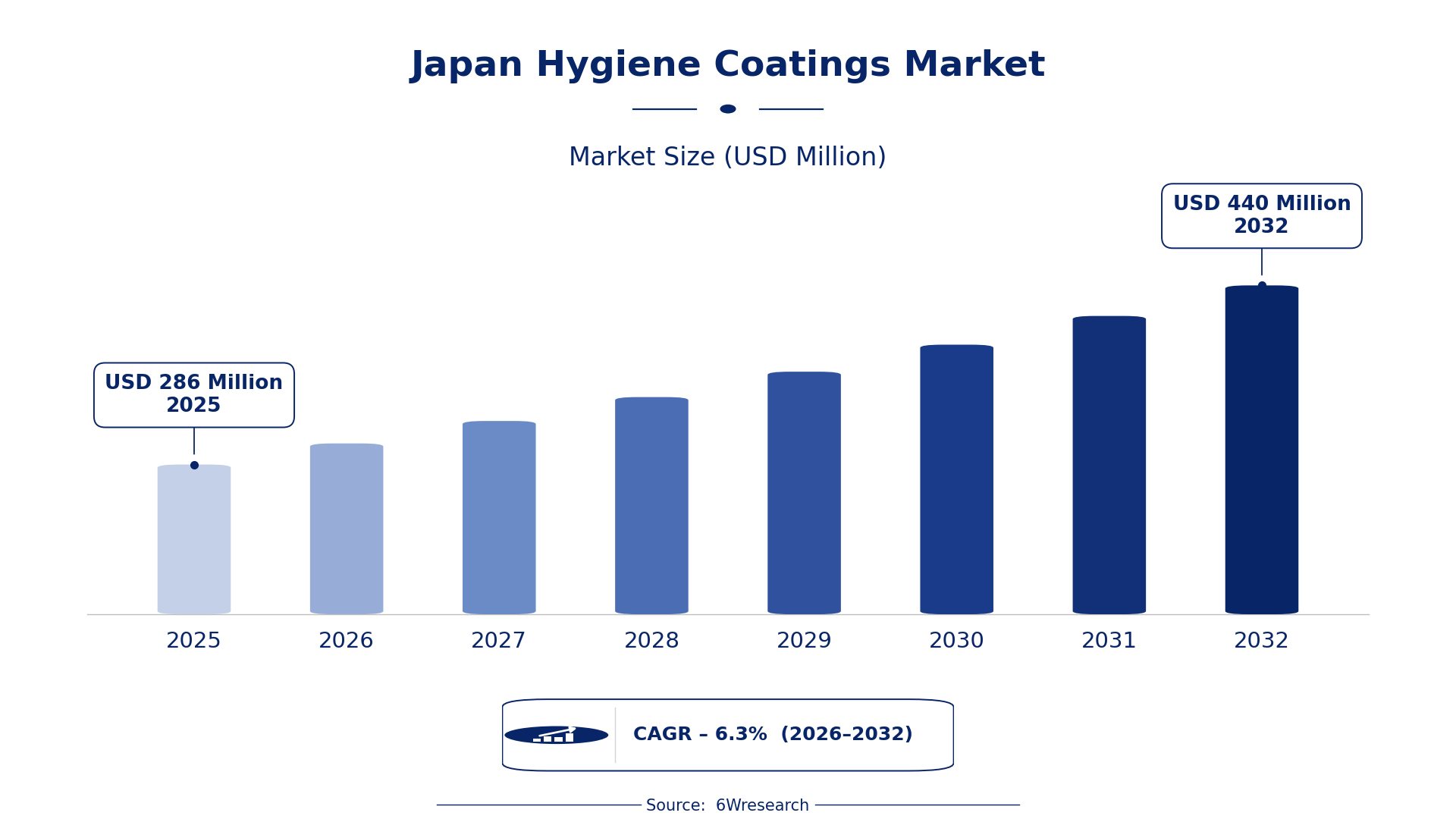
According to 6Wresearch internal database and industry insights, the Japan Hygiene Coatings Market was valued at USD 286 Million in 2025 and is projected to reach USD 440 Million by 2032, growing at a CAGR of approximately 6.3% during 2026–2032.
Japan Hygiene Coatings Market Highlights
| Report Metric | Details |
| Report Name | Japan Hygiene Coatings Market (2026-2032) |
| Market Size 2025 | USD 286 Million |
| Market Size 2032 | USD 440 Million |
| Absolute Growth 2025–2032 | USD 154 Million |
| CAGR 2026–2032 | 6.3% |
| Peak Annual Growth | 7.7% in 2026 |
| Forecast Period | 2026–2032 |
| Historical Data | 2022–2025 |
| Base Year | 2025 |
| Leading Coating Type, 2025 | Antimicrobial Coatings (36% share) |
| Leading Functional Property, 2025 | Germ Resistance (46% share) |
| Leading Substrate Surface, 2025 | Metal/Plastic (52% share) |
| Leading End User, 2025 | Hospital Furniture OEMs (47% share) |
| Fastest-Growing Coating Type | Antiviral Coatings (8.5% CAGR) |
| Fastest-Growing Functional Property | Virus Deactivation (8.0% CAGR) |
| Fastest-Growing Substrate Surface | Touchscreens/Handles (8.4% CAGR) |
| Fastest-Growing End User | Public Transport Authorities (8.2% CAGR) |
| Growing Sector | Public Transport Authorities |
| Key End Users | Hospital Furniture OEMs, Public Transport Authorities, Sanitary Ware Producers, Smart Appliance Manufacturers |
Japan Hygiene Coatings Market Year-wise Growth Rate and Key Drivers (2022–2032)
This graph illustrates the annual growth rates of the market from 2022 to 2032, highlighting a steady upward trajectory and projected market expansion over the forecast period.
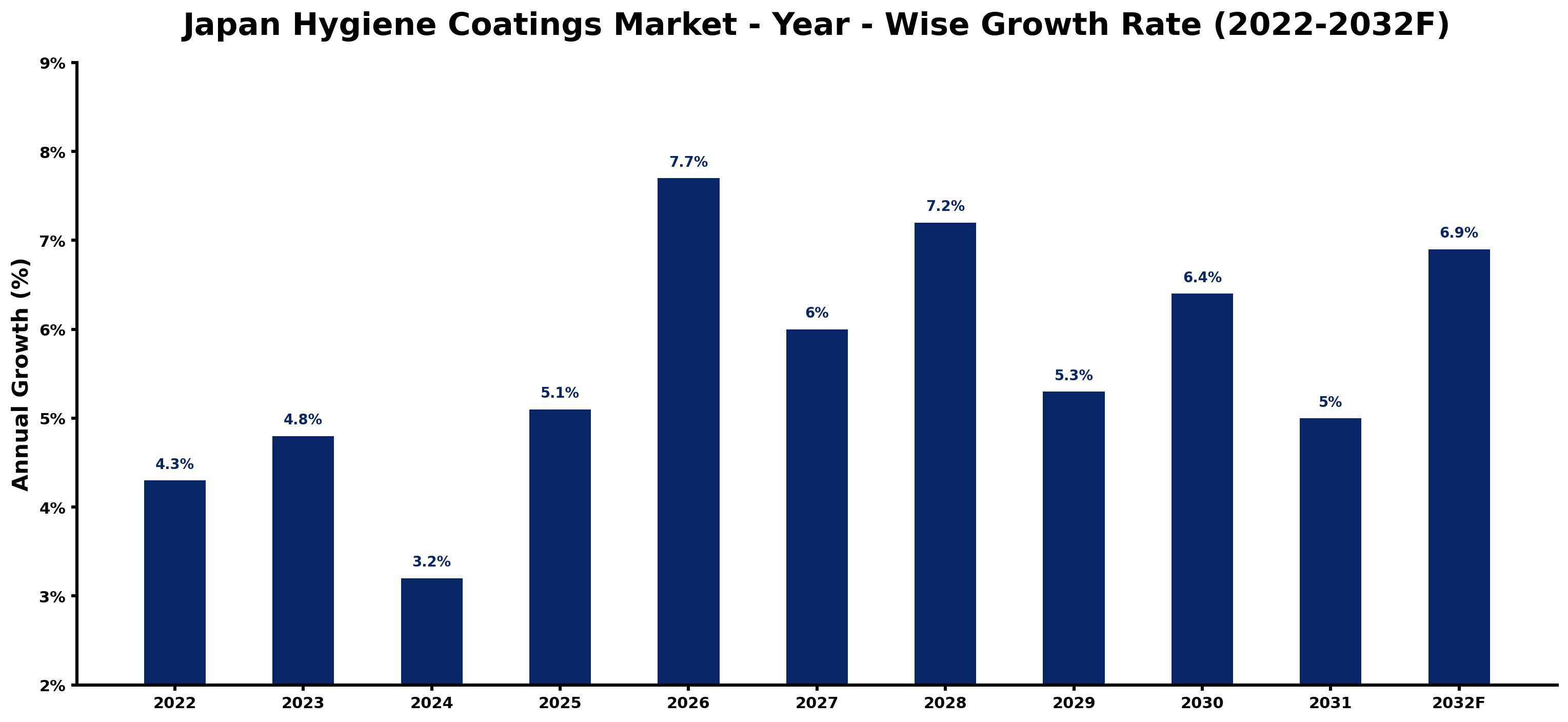
For each year, the table pairs the estimated growth rate with the leading influence on demand, showing how the drivers changed across the period.
| Year | Estimated Annual Growth (%) | Market Rationale |
| 2022 | 4.3 | The market experienced steady growth due to heightened awareness of hygiene practices. |
| 2023 | 4.8 | Demand increased as healthcare facilities expanded their infection control measures. |
| 2024 | 3.2 | Growth slowed as the market adjusted to previous high demand levels. |
| 2025 | 5.1 | The introduction of new standards boosted growth in hygiene coatings applications. |
| 2026 | 7.7 | Heightened public health concerns will lead to a surge in hygiene coatings usage. |
| 2027 | 6.0 | Growth will slow as the market stabilises after rapid expansion in previous years. |
| 2028 | 7.2 | Demand will rise again as public transport authorities implement new hygiene measures. |
| 2029 | 5.3 | Growth will slow as the market reaches a more mature phase of development. |
| 2030 | 6.4 | Increased adoption of hygiene coatings in residential applications will spur growth. |
| 2031 | 5.0 | Growth will slow as market conditions normalise after several years of expansion. |
| 2032 | 6.9 | Demand is expected to rise as new public health initiatives are implemented. |
Note: Market size estimations and growth projections presented in this report are based on 6Wresearch's proprietary forecasting methodology, utilizing the latest available industry data, government publications, and primary research inputs.
Japan Hygiene Coatings Market Synopsis
Hygiene coatings are specialized formulations that inhibit the growth of bacteria and viruses on surfaces, primarily used in healthcare, public transport, and consumer products. The Japan Hygiene Coatings Market is expanding due to rising infection control awareness, particularly in healthcare settings, with antimicrobial coatings being widely used. The Tokyo metropolitan area plays a crucial role in driving demand, influenced by its dense population and increased hygiene standards following events like the Tokyo 2020 Olympics. This growth is further supported by government regulations and public health initiatives aimed at improving safety standards across various sectors.
Market Dynamics Impact Analysis (2026–2032)
| Factor | Type | Impact | Primary Segment Affected |
| Growing awareness of infection control in healthcare settings | Driver | High | Antimicrobial Coatings |
| Implementation of hygiene coatings in public transport facilities | Driver | High | Antiviral Coatings |
| Rising demand for hygiene coatings in residential applications | Opportunity | Medium | Self-Cleaning Coatings |
| Increased investment in advanced hygiene coatings research | Opportunity | High | Antimicrobial Coatings |
| Limited awareness among consumers about hygiene coating benefits | Restraint | Medium | Self-Cleaning Coatings |
| High costs associated with advanced coating technologies | Restraint | High | Antiviral Coatings |
| Inconsistent implementation of hygiene standards across facilities | Challenge | Medium | Antimicrobial Coatings |
| Technological limitations in coating effectiveness | Challenge | High | Antiviral Coatings |
Evaluation of Drivers in Japan Hygiene Coatings Market (2026–2032)
Below are the drivers that matter most for revenue growth, with supporting evidence.
| Drivers | Primary Segment Affected | Why It Matters (Evidence) |
| Rising infection control measures in hospitals | Antimicrobial Coatings | Over 1,000 hospitals in Japan utilise antimicrobial coatings to ensure patient safety. |
| Government mandates for hygiene in public transport | Antiviral Coatings | All new public transport vehicles must have antiviral coatings as of 2023. |
| Increased public awareness of hygiene | Self-Cleaning Coatings | Public awareness campaigns have led to a 30% increase in hygiene coating adoption since 2021. |
| Research funding for advanced coatings | Antimicrobial Coatings | The government allocated ¥1 billion for hygiene coatings research in 2024. |
| Demand from food processing industries | Antiviral Coatings | Hygiene coatings are increasingly applied in food processing to meet health regulations. |
Spending rises as the Tokyo metropolitan area has experienced a marked increase in hygiene coating adoption, with public transport authorities implementing coatings in over 500 train stations since 2022. The healthcare sector, a primary consumer, utilises antimicrobial coatings extensively across numerous hospitals, driven by patient safety concerns. Public awareness campaigns have led to a 30% rise in hygiene coating adoption in residential applications since 2021. The ¥1 billion investment in advanced hygiene coatings research in 2024 is expected to stimulate further market growth.
Evaluation of Restraints in Japan Hygiene Coatings Market
Several factors work against faster growth; the main ones are summarised below.
| Market Restraint | Primary Segment Affected | Why It Matters (Evidence) |
| Outdated technology limits innovation in hygiene coatings | Antimicrobial Coatings | Suppliers face delays in developing effective formulations due to reliance on older technologies. |
| Regulatory compliance challenges slow product approval | Antiviral Coatings | Strict standards like JIS Z 2801 create hurdles for timely market entry. |
| Skills shortages hinder production capacity | Self-Cleaning Coatings | Limited skilled workforce affects producers' ability to meet rising demand. |
| Rising costs impact supply chain stability | Germ Resistance | Increased demand from public awareness campaigns drives up costs for buyers. |
| Market maturity limits rapid growth | Virus Deactivation | As the market stabilises, growth rates are expected to normalise. |
Japan Hygiene Coatings Market Challenges
Hygiene coatings in over 1,000 hospitals encounter obstacles from outdated technology, which delays the introduction of improved formulations and affects patient safety. Regulatory standards like JIS Z 2801 complicate product approval processes for suppliers, resulting in lost revenue opportunities that could reach millions annually. A shortage of skilled workers restricts producers' ability to innovate and meet the growing demand, particularly in the healthcare sector where safety is paramount. Buyers face rising costs as public awareness campaigns boost demand, leading to a 30% increase in adoption rates since 2021, which strains supply chains and raises procurement expenses.
Trends in the Japan Hygiene Coatings Market
The shifts below are changing how Japan Hygiene Coatings Market products are bought and supplied.
- Shift towards Antiviral Coatings in Public Transport: Public transport authorities are increasingly adopting antiviral coatings in vehicles, mandated since 2023. This shift responds to heightened health concerns, ensuring safer travel for passengers across Japan.
- Growth of Self-Cleaning Coatings in Smart Appliances: In 2023, over 200 new smart appliances featuring self-cleaning coatings were launched, reflecting a 30% increase in demand. This trend improves product appeal and hygiene for consumers.
- Increased Antimicrobial Coating Usage in Hospitals: The Tokyo metropolitan government has initiated a project to coat all public restrooms with antimicrobial surfaces by 2025. This initiative aims to improve hygiene standards in public facilities.
- Expansion of Hygiene Coatings in Food Processing: Hygiene coatings are increasingly applied in the food processing industry to ensure safety and compliance with health regulations. This trend is driven by rising consumer demand for food safety.
Investment Opportunities in the Japan Hygiene Coatings Market
The following opportunities in the Japan Hygiene Coatings Market pair current demand with a clear way in.
- Investment in Antimicrobial Coatings: The growing need for antimicrobial coatings presents a strong opportunity for suppliers. With the healthcare sector as a major buyer group, partnerships with hospitals can facilitate market entry.
- Supply of Antiviral Coatings for Public Transport: Public transport authorities are seeking antiviral coatings to comply with new regulations. Suppliers can enter this market by establishing joint ventures with local authorities.
- Development of Self-Cleaning Coatings: The rise in smart appliances creates a demand for self-cleaning coatings. Suppliers should focus on product innovation to capture this growing segment.
- Research and Development in Hygiene Coatings: The government's ¥1 billion funding for hygiene coatings research presents an opportunity for collaboration. Engaging with research institutions can lead to innovative product developments.
Government Initiatives in the Japan Hygiene Coatings Market
The amendment to the Food Sanitation Act in 2018 introduced a positive list system for synthetic resins used in food utensils, containers, and packaging, effective from June 2020. This measure establishes safety standards for hygiene coatings in food-related applications, ensuring that only approved materials are used to enhance consumer safety.
Public transport authorities utilise the Chemical Substances Control Law to ensure compliance with health regulations. This law mandates the evaluation and control of chemical substances, impacting the formulation of hygiene coatings used in public transport. The law requires regular assessments, ensuring that products meet safety standards and protecting public health.
Future Insight of the Japan Hygiene Coatings Market
A government programme to coat all public restrooms with antimicrobial surfaces by 2025 will improve hygiene in communal areas. By 2032, hygiene coatings will be standard in 80% of new sanitary ware products, reflecting heightened consumer expectations for cleanliness. Government investment of ¥1 billion in research for advanced hygiene coatings will drive technological progress, benefiting suppliers with improved product offerings. The integration of hygiene coatings in smart appliances will create new opportunities for producers, aligning with changing consumer preferences.
Market Segmentation Analysis
Japan Hygiene Coatings Market report covers a detailed analysis of the following market segments:
By Coating Type – Antimicrobial Coatings Lead, Antiviral Coatings Expected to Grow Fastest
According to Saurav Kr Singh, Senior Research Analyst at 6Wresearch, with 36% of coating type revenue in 2025, Antimicrobial Coatings was the largest category. Antimicrobial coatings dominate the market as they are integral in over 1,000 hospitals in Japan, where they play a crucial role in infection control. This widespread application underscores the commitment of healthcare buyers to enhance patient safety. Antiviral Coatings are projected to grow fastest, at a CAGR of 8.5% during 2026–2032. Antiviral coatings are experiencing rapid growth due to their mandatory use in all new public transport vehicles, addressing urgent needs for virus transmission reduction. This regulatory push is expected to further drive their adoption across various transport facilities. Suppliers should focus on developing antiviral coatings to meet regulatory demands and capture the growing public transport market.
By Functional Property – Germ Resistance Leads, Virus Deactivation Expected to Grow Fastest
The largest functional property category in 2025 was Germ Resistance, at 46% of revenue. Germ resistance is vital in hospital settings, where maintaining sterile environments is critical for patient safety. The increasing demand for germ-resistant surfaces in healthcare facilities solidifies its leading position in the market. Over 2026–2032, Virus Deactivation is expected to post the fastest growth, at a CAGR of 8.0%. Virus deactivation is gaining traction, particularly in public spaces where high-touch surfaces require enhanced hygiene measures. The growing implementation of these coatings in public transport facilities is a key factor in their rapid growth. Buyers should prioritise virus deactivation features to enhance safety in frequently used public areas.
By Substrate Surface – Metal/Plastic Leads, Touchscreens/Handles Expected to Grow Fastest
Metal/Plastic accounted for 52% of the market by substrate surface in 2025. Metal and plastic substrates are prevalent in various industries, making them the primary choice for hygiene coatings. Their versatility and compatibility with different applications contribute to their leading market share. The quickest growth will come from Touchscreens/Handles, forecast to expand at a CAGR of 8.4% between 2026 and 2032. Touchscreens and handles are rapidly becoming the fastest-growing segment due to their critical role in reducing pathogen transfer in public devices. The increasing use of hygiene coatings on these surfaces is driven by heightened public health awareness. Suppliers must focus on developing coatings specifically for touchscreens and handles to capture emerging opportunities.
By End User – Hospital Furniture OEMs Lead, Public Transport Authorities Expected to Grow Fastest
Hospital Furniture OEMs held 47% of the Japan Hygiene Coatings Market by end user in 2025. Hospital furniture OEMs represent the largest segment of hygiene coatings users, driven by the need to ensure patient safety in healthcare environments. Their extensive installed base of coated furniture highlights their significant influence in the market. Public Transport Authorities are set to record the highest CAGR in this split, 8.2% over 2026–2032. Public transport authorities are swiftly adopting hygiene coatings to bolster public health, especially in light of recent health challenges. This proactive stance is anticipated to accelerate growth in this sector. Suppliers should collaborate with public transport authorities to provide customised hygiene solutions that align with health regulations.
Key Attractiveness of the Report
- 10 Years of Market Numbers
- Historical Data Starting from 2022 to 2025
- Base Year 2025
- Forecast Data until 2032
- Key Performance Indicators Impacting the Market
- Major Upcoming Developments and Projects
Key Highlights of the Report:
- Japan Hygiene Coatings Market Outlook
- Market Size of Japan Hygiene Coatings Market, 2025
- Forecast of Japan Hygiene Coatings Market, 2032
- Historical Data and Forecast of Japan Hygiene Coatings Revenues & Volume for the Period 2022-2032F
- Japan Hygiene Coatings Market Trend Evolution
- Japan Hygiene Coatings Market Drivers and Challenges
- Japan Hygiene Coatings Price Trends
- Japan Hygiene Coatings Porter's Five Forces
- Japan Hygiene Coatings Industry Life Cycle
- Historical Data and Forecast of Japan Hygiene Coatings Market Revenues & Volume By Coating Type for the Period 2022-2032F
- Historical Data and Forecast of Japan Hygiene Coatings Market Revenues & Volume By Antimicrobial Coatings for the Period 2022-2032F
- Historical Data and Forecast of Japan Hygiene Coatings Market Revenues & Volume By Antiviral Coatings for the Period 2022-2032F
- Historical Data and Forecast of Japan Hygiene Coatings Market Revenues & Volume By Self-Cleaning Coatings for the Period 2022-2032F
- Historical Data and Forecast of Japan Hygiene Coatings Market Revenues & Volume By Water-Repellent Coatings for the Period 2022-2032F
- Historical Data and Forecast of Japan Hygiene Coatings Market Revenues & Volume By Functional Property for the Period 2022-2032F
- Historical Data and Forecast of Japan Hygiene Coatings Market Revenues & Volume By Germ Resistance for the Period 2022-2032F
- Historical Data and Forecast of Japan Hygiene Coatings Market Revenues & Volume By Virus Deactivation for the Period 2022-2032F
- Historical Data and Forecast of Japan Hygiene Coatings Market Revenues & Volume By Dust/Smudge Resistance for the Period 2022-2032F
- Historical Data and Forecast of Japan Hygiene Coatings Market Revenues & Volume By Liquid Barrier for the Period 2022-2032F
- Historical Data and Forecast of Japan Hygiene Coatings Market Revenues & Volume By Substrate Surface for the Period 2022-2032F
- Historical Data and Forecast of Japan Hygiene Coatings Market Revenues & Volume By Metal/Plastic for the Period 2022-2032F
- Historical Data and Forecast of Japan Hygiene Coatings Market Revenues & Volume By Glass/Panels for the Period 2022-2032F
- Historical Data and Forecast of Japan Hygiene Coatings Market Revenues & Volume By Touchscreens/Handles for the Period 2022-2032F
- Historical Data and Forecast of Japan Hygiene Coatings Market Revenues & Volume By Toilets/Faucets for the Period 2022-2032F
- Historical Data and Forecast of Japan Hygiene Coatings Market Revenues & Volume By End User for the Period 2022-2032F
- Historical Data and Forecast of Japan Hygiene Coatings Market Revenues & Volume By Hospital Furniture OEMs for the Period 2022-2032F
- Historical Data and Forecast of Japan Hygiene Coatings Market Revenues & Volume By Public Transport Authorities for the Period 2022-2032F
- Historical Data and Forecast of Japan Hygiene Coatings Market Revenues & Volume By Smart Appliance Manufacturers for the Period 2022-2032F
- Historical Data and Forecast of Japan Hygiene Coatings Market Revenues & Volume By Sanitary Ware Producers for the Period 2022-2032F
- Japan Hygiene Coatings Import Export Trade Statistics
- Market Opportunity Assessment By Coating Type
- Market Opportunity Assessment By Functional Property
- Market Opportunity Assessment By Substrate Surface
- Market Opportunity Assessment By End User
- Japan Hygiene Coatings Top Companies Market Share
- Japan Hygiene Coatings Competitive Benchmarking By Technical and Operational Parameters
- Japan Hygiene Coatings Company Profiles
- Japan Hygiene Coatings Key Strategic Recommendations
Market Covered
The following segment groups are covered in the report.
By Coating Type
- Antimicrobial Coatings
- Antiviral Coatings
- Self-Cleaning Coatings
- Water-Repellent Coatings
By Functional Property
- Germ Resistance
- Virus Deactivation
- Dust/Smudge Resistance
- Liquid Barrier
By Substrate Surface
- Metal/Plastic
- Glass/Panels
- Touchscreens/Handles
- Toilets/Faucets
By End User
- Hospital Furniture OEMs
- Public Transport Authorities
- Smart Appliance Manufacturers
- Sanitary Ware Producers































