Japan Hygiene Product Machinery Market Size & Growth Rate
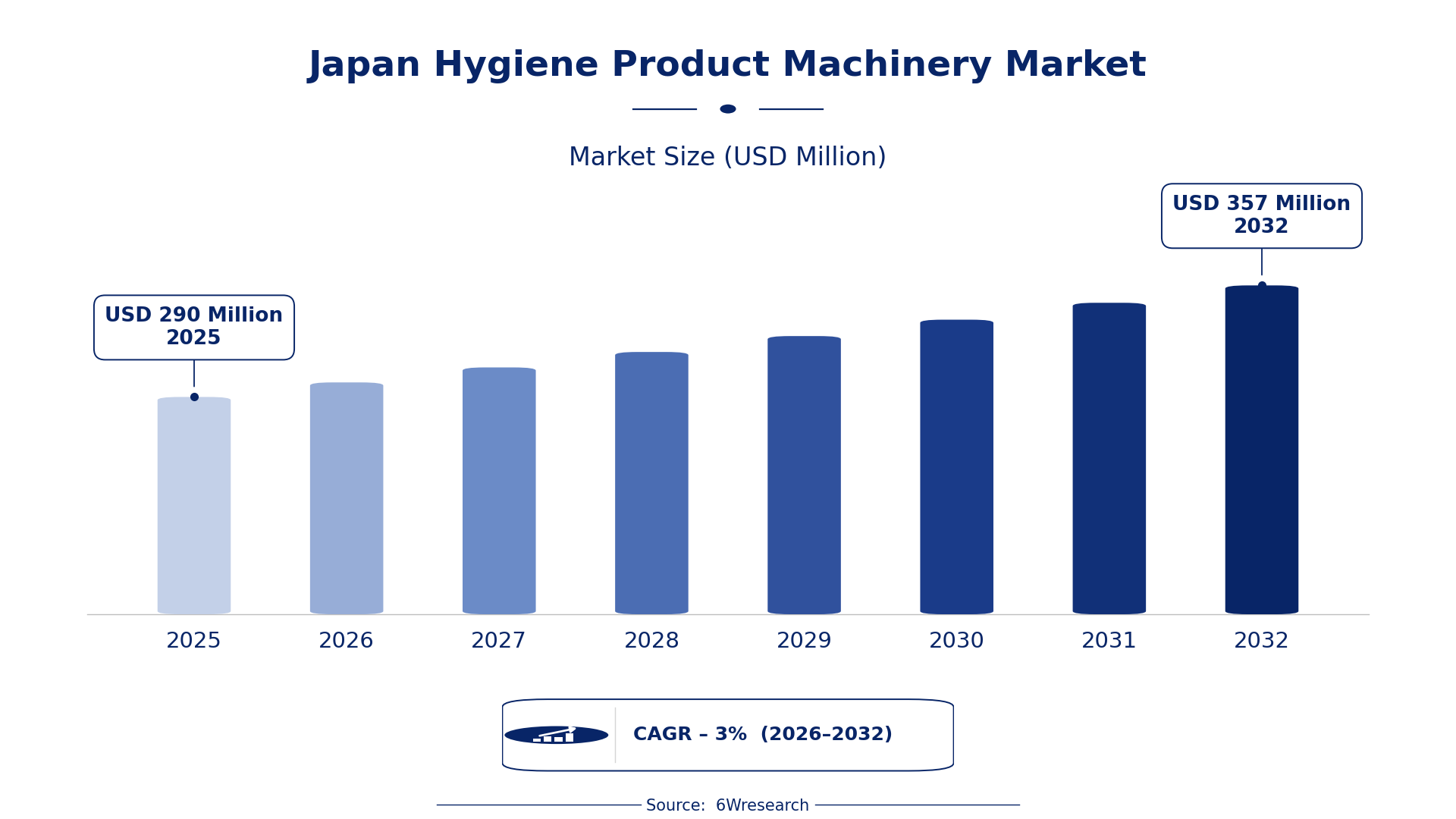
According to 6Wresearch internal database and industry insights, the Japan Hygiene Product Machinery Market was valued at USD 290 Million in 2025 and is projected to reach USD 357 Million by 2032, growing at a CAGR of approximately 3% during 2026–2032.
Japan Hygiene Product Machinery Market Highlights
| Report Metric | Details |
| Report Name | Japan Hygiene Product Machinery Market (2026-2032) |
| Market Size 2025 | USD 290 Million |
| Market Size 2032 | USD 357 Million |
| Absolute Growth 2025–2032 | USD 67 Million |
| CAGR 2026–2032 | 3% |
| Peak Annual Growth | 3.4% in 2029 |
| Forecast Period | 2026–2032 |
| Historical Data | 2022–2025 |
| Base Year | 2025 |
| Leading Machine Type, 2025 | Diaper Making Machines (40% share) |
| Leading Product Handled, 2025 | Baby/Adult Diapers (34% share) |
| Leading Operation Type, 2025 | Automatic/Servo (45% share) |
| Leading End User, 2025 | Personal Care Manufacturers (40% share) |
| Fastest-Growing Machine Type | Sanitary Napkin Machines (4.2% CAGR) |
| Fastest-Growing Product Handled | Feminine Hygiene Products (4.4% CAGR) |
| Fastest-Growing Operation Type | Semi-Automatic (4.9% CAGR) |
| Fastest-Growing End User | Hygiene Product Startups (4.0% CAGR) |
| Growing Sector | Hygiene Product Startups |
| Key End Users | Personal Care Manufacturers, Hygiene Product Startups, Pulp & Paper Companies, Contract Manufacturers |
Japan Hygiene Product Machinery Market Year-wise Growth Rate and Key Drivers (2022–2032)
This graph illustrates the annual growth rates of the market from 2022 to 2032, highlighting a steady upward trajectory and projected market expansion over the forecast period.
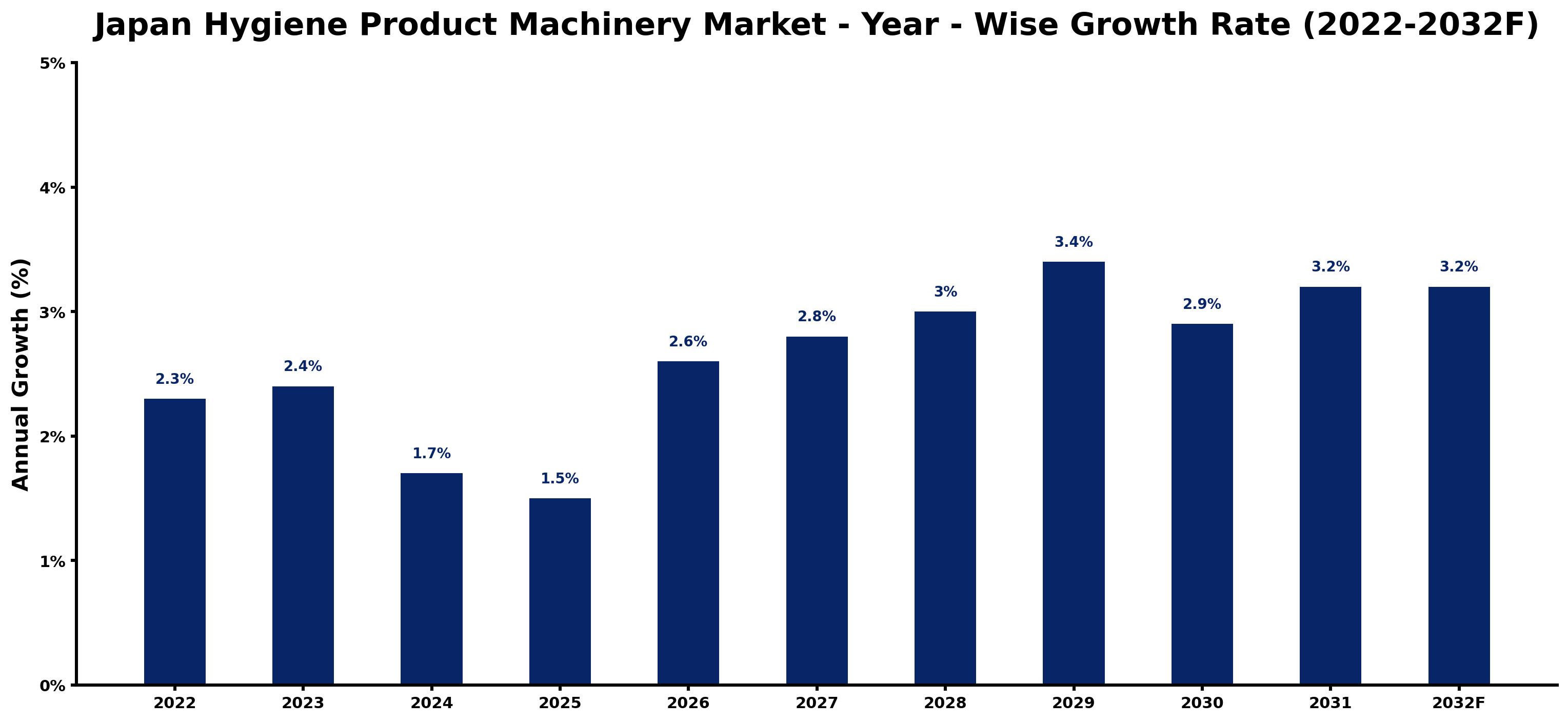
Each row of the following table gives one year's estimated growth and the event or demand shift that explains it.
| Year | Estimated Annual Growth (%) | Market Rationale |
| 2022 | 2.3 | The market showed steady growth due to stable demand for hygiene products. |
| 2023 | 2.4 | Growth accelerated as awareness of personal hygiene increased across the population. |
| 2024 | 1.7 | A slowdown occurred as production capacity adjustments took place in the industry. |
| 2025 | 1.5 | The market continued to grow, albeit at a slower rate due to market saturation. |
| 2026 | 2.6 | Growth is expected to increase as new technologies are adopted in manufacturing processes. |
| 2027 | 2.8 | Demand is projected to rise further with the expansion of personal care manufacturers in key regions. |
| 2028 | 3.0 | The market is expected to experience increased growth driven by rising disposable income levels. |
| 2029 | 3.4 | A peak in growth is projected as innovation in hygiene product machinery takes off. |
| 2030 | 2.9 | Growth will slow slightly as the market stabilises after rapid technological advancements. |
| 2031 | 3.2 | Demand is expected to surge again as sustainability practices gain traction in production. |
| 2032 | 3.2 | Growth is projected to remain steady as consumer preferences shift towards eco-friendly products. |
Note: Market size estimations and growth projections presented in this report are based on 6Wresearch's proprietary forecasting methodology, utilizing the latest available industry data, government publications, and primary research inputs.
Japan Hygiene Product Machinery Market Synopsis
Hygiene Product Machinery includes equipment for producing items such as diapers, sanitary napkins, and tissue paper. The Japan Hygiene Product Machinery Market is growing due to a population of approximately 125 million and increased awareness of personal hygiene. Key industrial regions like Tokyo and Osaka serve as major demand sources, while initiatives promote hygiene awareness and innovation, further stimulating market growth.
Market Dynamics Impact Analysis (2026–2032)
| Factor | Type | Impact | Primary Segment Affected |
| Rising population and awareness of hygiene products | Driver | High | Diaper Making Machines |
| Technological advancements in machinery | Driver | High | Sanitary Napkin Machines |
| Emerging hygiene product startups seeking innovative solutions | Opportunity | Medium | Hygiene Product Startups |
| Growing demand for eco-friendly hygiene products | Opportunity | Medium | Feminine Hygiene Products |
| High production costs for advanced machinery | Restraint | High | Tissue Paper Converters |
| Strict regulatory standards for manufacturing | Restraint | High | Wet Wipe Packing Machines |
| Limited availability of skilled workforce | Challenge | High | Diaper Making Machines |
| Long lead times for machinery upgrades | Challenge | Medium | Sanitary Napkin Machines |
Evaluation of Drivers in Japan Hygiene Product Machinery Market (2026–2032)
The following drivers explain most of the expected growth.
| Drivers | Primary Segment Affected | Why It Matters (Evidence) |
| Increasing consumption of disposable hygiene products | Diaper Making Machines | The average annual consumption of diapers in Japan is around 1 billion units, driving demand for high-capacity machinery. |
| Adoption of advanced manufacturing technologies | Sanitary Napkin Machines | Technological improvements are driving production efficiency, attracting manufacturers to upgrade their machinery. |
| Government support for hygiene product innovation | Hygiene Product Startups | Government funding encourages startups to invest in advanced machinery, expanding the market for hygiene products. |
| Rising disposable income levels | Feminine Hygiene Products | As disposable incomes increase, consumers are more likely to purchase premium hygiene products, boosting demand for efficient production. |
| Expansion of industrial regions | Tissue Paper Converters | Key industrial hubs increase the concentration of hygiene product manufacturers and machinery demand. |
Purchasing is picking up as the average annual consumption of diapers in Japan reaches around 1 billion units, driving demand for high-capacity diaper making machines. The adoption of advanced manufacturing technologies is improving production efficiency, attracting personal care manufacturers to upgrade their machinery. Rising disposable income levels lead consumers to purchase premium feminine hygiene products, boosting demand for efficient production. The concentration of hygiene product manufacturers in key regions increases the demand for tissue paper converters.
Evaluation of Restraints in Japan Hygiene Product Machinery Market
These restraints slow adoption and weigh on supplier margins.
| Market Restraint | Primary Segment Affected | Why It Matters (Evidence) |
| High production costs for advanced machinery | Tissue Paper Converters | The average production capacity of diaper making machines is around 30 million units per year, leading to substantial investment requirements. |
| Strict regulatory standards for manufacturing | Wet Wipe Packing Machines | Compliance with JIS standards for manufacturing quality raises operational costs for manufacturers. |
| Limited availability of skilled workforce | Diaper Making Machines | The high demand for skilled technicians in machinery operation impacts production efficiency. |
| Long lead times for machinery upgrades | Sanitary Napkin Machines | The average lifespan of hygiene product machinery is around 10-15 years, necessitating timely upgrades. |
| Market saturation in key segments | Feminine Hygiene Products | As the market matures, growth in certain segments slows due to heightened competition. |
Japan Hygiene Product Machinery Market Challenges
Producers face a skills gap as the workforce lacks specialised training in advanced machinery, delaying production timelines and increasing costs for manufacturers. Regulatory hurdles from the Ministry of Health, Labour and Welfare impose strict compliance measures, which can extend product development cycles for suppliers. Rising operational costs arise from Japan's national minimum wage reaching JPY 1,055 per hour, squeezing margins for producers and leading to higher prices for buyers. Supply chain issues stem from dependence on key industrial regions like Tokyo and Osaka, causing potential delays and increased logistics costs for all stakeholders.
Trends in the Japan Hygiene Product Machinery Market
Several trends are reshaping the Japan Hygiene Product Machinery Market; the most important are set out below.
- Shift from Manual to Automated Production: In Tokyo, a shift towards automated production lines in hygiene product manufacturing is taking place, with over 45% of machines now being automatic or servo-operated, improving efficiency.
- Emergence of Eco-Friendly Hygiene Products: Since 2023, there has been a notable increase in the production of eco-friendly hygiene products, with manufacturers adopting sustainable practices to meet consumer demand for greener options.
- Growth in Hygiene Product Startups: In 2023, the number of hygiene product startups in Japan increased significantly, with government support promoting innovation and new product development in the sector.
- Expansion of Wet Wipe Markets: The wet wipe market is projected to expand in 2023, driven by rising demand for convenience, with production facilities increasing output to meet consumer preferences.
Investment Opportunities in the Japan Hygiene Product Machinery Market
Several openings in the Japan Hygiene Product Machinery Market merit attention from investors.
- Partner with Local Startups: Now is an opportune time to collaborate with hygiene product startups in Japan, as government support for innovation is increasing, with hundreds of millions of yen allocated for assistance.
- Invest in Eco-Friendly Machinery: Personal care manufacturers are seeking eco-friendly machinery solutions, creating opportunities for suppliers to provide sustainable options in the growing market for feminine hygiene products.
- Expand in Key Industrial Regions: Tokyo and Osaka are major hubs for hygiene product manufacturing, offering opportunities for investment in production facilities to meet increasing demand.
- Utilise Government Support: With government initiatives promoting hygiene awareness, suppliers can enter the market by aligning with public health campaigns and standards to gain approval.
Government Initiatives in the Japan Hygiene Product Machinery Market
The New Robot Strategy (2015) promotes the use of robots in manufacturing, improving productivity within the hygiene product machinery sector. This complements the Industrial Safety and Health Act (1972), which mandates safety standards in production processes, ensuring compliance and safety in manufacturing hygiene products.
In 2023, the Japanese government allocated approximately JPY 1 billion for promoting hygiene awareness through public health campaigns, overseen by the Ministry of Health, Labour and Welfare. This funding supports initiatives that improve the quality and safety of hygiene products in the market.
Future Insight of the Japan Hygiene Product Machinery Market
The introduction of advanced manufacturing facilities will transform hygiene product production by 2032, streamlining processes for suppliers. Government initiatives promoting sustainable practices will drive the adoption of eco-friendly machinery, appealing to buyers prioritising environmental responsibility. Enhanced JIS standards will ensure consistent quality, benefiting all participants in the market. With annual investments in hygiene product machinery expected to reach hundreds of millions of yen, ongoing technological advancements will improve efficiency and reduce operational costs for producers.
Market Segmentation Analysis
Japan Hygiene Product Machinery Market report covers a detailed analysis of the following market segments:
By Machine Type – Diaper Making Machines Lead, Sanitary Napkin Machines Expected to Grow Fastest
According to Saurav Kr Singh, Senior Research Analyst at 6Wresearch, with 40% of machine type revenue in 2025, Diaper Making Machines was the largest category. Diaper making machines dominate the market as they are vital for producing around 1 billion units of diapers each year. This substantial demand highlights their importance for manufacturers in key regions like Tokyo and Osaka. Sanitary Napkin Machines are projected to grow fastest, at a CAGR of 4.2% during 2026–2032. Sanitary napkin machines are experiencing rapid growth due to the rising market for feminine hygiene products and heightened consumer awareness. The support from government initiatives promoting hygiene awareness further fuels this segment's expansion. Suppliers should focus on enhancing their sanitary napkin machine offerings to leverage the growing market demand.
By Product Handled – Baby/Adult Diapers Lead, Feminine Hygiene Products Expected to Grow Fastest
The largest product handled category in 2025 was Baby/Adult Diapers, at 34% of revenue. Baby and adult diapers are the primary product type manufactured, representing a substantial share of the hygiene product market in Japan. The annual consumption of around 1 billion units highlights the significance of this category within the industry. The quickest growth will come from Feminine Hygiene Products, forecast to expand at a CAGR of 4.4% between 2026 and 2032. Feminine hygiene products are anticipated to experience notable growth in 2023, driven by rising awareness and shifting consumer preferences. This trend reflects a broader movement towards personal care and hygiene in Japan, indicating a growing market opportunity. Manufacturers should consider diversifying their product lines to include feminine hygiene products to align with changing consumer demands.
By Operation Type – Automatic/Servo Leads, Semi-Automatic Expected to Grow Fastest
Automatic/Servo held 45% of the Japan Hygiene Product Machinery Market by operation type in 2025. Automatic and servo machines lead the market because they significantly improve production efficiency and speed, essential for meeting the high demands of hygiene product manufacturing. Their prevalent use among large manufacturers underscores their critical role in optimising production output. Semi-Automatic is set to record the highest CAGR in this split, 4.9% over 2026–2032. Semi-automatic machines are gaining traction, especially in smaller production setups that require flexibility and cost-effectiveness. The growth of this segment indicates a shift towards adaptable manufacturing solutions that cater to diverse production requirements. Suppliers should consider investing in semi-automatic technology to address the needs of smaller manufacturers entering the market.
By End User – Personal Care Manufacturers Lead, Hygiene Product Startups Expected to Grow Fastest
Personal Care Manufacturers took 40% of end user revenue in 2025, more than any other category. Personal care manufacturers are the primary end users of hygiene machinery, driving demand through their substantial production of hygiene products. Their established market presence ensures a consistent need for advanced machinery to support ongoing operations. Over 2026–2032, Hygiene Product Startups are expected to post the fastest growth, at a CAGR of 4.0%. Hygiene product startups are rapidly emerging, supported by government subsidies and initiatives that encourage innovation. This swift growth reflects a rising interest in the hygiene sector, creating new opportunities for suppliers to engage with these new entrants. Suppliers should adapt their marketing strategies to attract hygiene product startups, which represent a growing segment of the market.
Key Attractiveness of the Report
- 10 Years of Market Numbers
- Historical Data Starting from 2022 to 2025
- Base Year 2025
- Forecast Data until 2032
- Key Performance Indicators Impacting the Market
- Major Upcoming Developments and Projects
Key Highlights of the Report:
- Japan Hygiene Product Machinery Market Outlook
- Market Size of Japan Hygiene Product Machinery Market, 2025
- Forecast of Japan Hygiene Product Machinery Market, 2032
- Historical Data and Forecast of Japan Hygiene Product Machinery Revenues & Volume for the Period 2022-2032F
- Japan Hygiene Product Machinery Market Trend Evolution
- Japan Hygiene Product Machinery Market Drivers and Challenges
- Japan Hygiene Product Machinery Price Trends
- Japan Hygiene Product Machinery Porter's Five Forces
- Japan Hygiene Product Machinery Industry Life Cycle
- Historical Data and Forecast of Japan Hygiene Product Machinery Market Revenues & Volume By Machine Type for the Period 2022-2032F
- Historical Data and Forecast of Japan Hygiene Product Machinery Market Revenues & Volume By Diaper Making Machines for the Period 2022-2032F
- Historical Data and Forecast of Japan Hygiene Product Machinery Market Revenues & Volume By Sanitary Napkin Machines for the Period 2022-2032F
- Historical Data and Forecast of Japan Hygiene Product Machinery Market Revenues & Volume By Tissue Paper Converters for the Period 2022-2032F
- Historical Data and Forecast of Japan Hygiene Product Machinery Market Revenues & Volume By Wet Wipe Packing Machines for the Period 2022-2032F
- Historical Data and Forecast of Japan Hygiene Product Machinery Market Revenues & Volume By Product Handled for the Period 2022-2032F
- Historical Data and Forecast of Japan Hygiene Product Machinery Market Revenues & Volume By Baby/Adult Diapers for the Period 2022-2032F
- Historical Data and Forecast of Japan Hygiene Product Machinery Market Revenues & Volume By Feminine Hygiene Products for the Period 2022-2032F
- Historical Data and Forecast of Japan Hygiene Product Machinery Market Revenues & Volume By Toilet & Facial Tissue for the Period 2022-2032F
- Historical Data and Forecast of Japan Hygiene Product Machinery Market Revenues & Volume By Disposables for the Period 2022-2032F
- Historical Data and Forecast of Japan Hygiene Product Machinery Market Revenues & Volume By Operation Type for the Period 2022-2032F
- Historical Data and Forecast of Japan Hygiene Product Machinery Market Revenues & Volume By Automatic/Servo for the Period 2022-2032F
- Historical Data and Forecast of Japan Hygiene Product Machinery Market Revenues & Volume By Semi-Automatic for the Period 2022-2032F
- Historical Data and Forecast of Japan Hygiene Product Machinery Market Revenues & Volume By High-Speed Rollers for the Period 2022-2032F
- Historical Data and Forecast of Japan Hygiene Product Machinery Market Revenues & Volume By Multi-Lane for the Period 2022-2032F
- Historical Data and Forecast of Japan Hygiene Product Machinery Market Revenues & Volume By End User for the Period 2022-2032F
- Historical Data and Forecast of Japan Hygiene Product Machinery Market Revenues & Volume By Personal Care Manufacturers for the Period 2022-2032F
- Historical Data and Forecast of Japan Hygiene Product Machinery Market Revenues & Volume By Hygiene Product Startups for the Period 2022-2032F
- Historical Data and Forecast of Japan Hygiene Product Machinery Market Revenues & Volume By Pulp & Paper Companies for the Period 2022-2032F
- Historical Data and Forecast of Japan Hygiene Product Machinery Market Revenues & Volume By Contract Manufacturers for the Period 2022-2032F
- Japan Hygiene Product Machinery Import Export Trade Statistics
- Market Opportunity Assessment By Machine Type
- Market Opportunity Assessment By Product Handled
- Market Opportunity Assessment By Operation Type
- Market Opportunity Assessment By End User
- Japan Hygiene Product Machinery Top Companies Market Share
- Japan Hygiene Product Machinery Competitive Benchmarking By Technical and Operational Parameters
- Japan Hygiene Product Machinery Company Profiles
- Japan Hygiene Product Machinery Key Strategic Recommendations
Market Covered
Segments analysed in this report are listed below.
By Machine Type
- Diaper Making Machines
- Sanitary Napkin Machines
- Tissue Paper Converters
- Wet Wipe Packing Machines
By Product Handled
- Baby/Adult Diapers
- Feminine Hygiene Products
- Toilet & Facial Tissue
- Disposables
By Operation Type
- Automatic/Servo
- Semi-Automatic
- High-Speed Rollers
- Multi-Lane
By End User
- Personal Care Manufacturers
- Hygiene Product Startups
- Pulp & Paper Companies
- Contract Manufacturers































