Japan Hygiene Product Material Market Size & Growth Rate
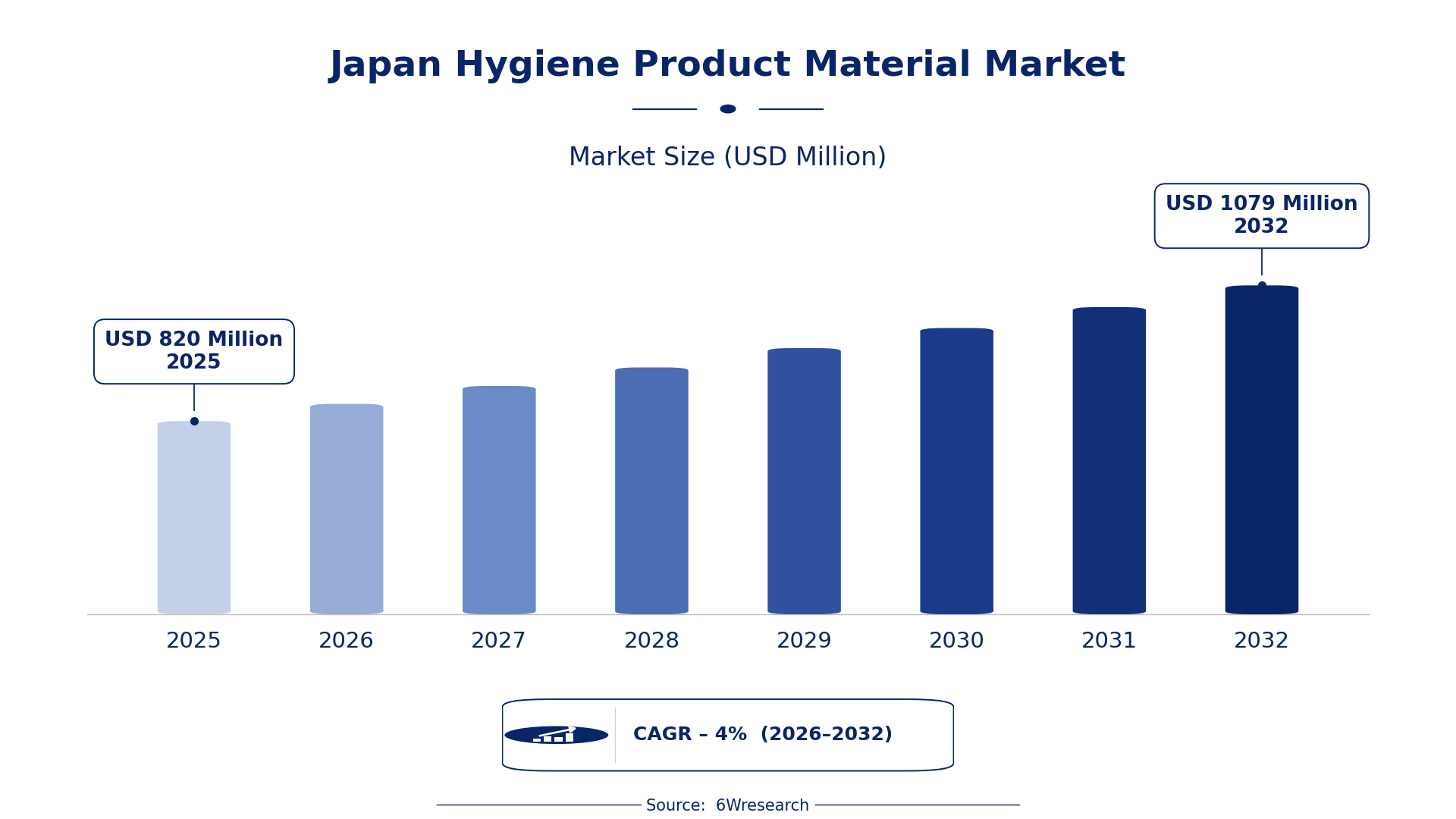
According to 6Wresearch internal database and industry insights, the Japan Hygiene Product Material Market was valued at USD 820 Million in 2025 and is projected to reach USD 1,079 Million by 2032, growing at a CAGR of approximately 4% during 2026–2032.
Japan Hygiene Product Material Market Highlights
| Report Metric | Details |
| Report Name | Japan Hygiene Product Material Market (2026-2032) |
| Market Size 2025 | USD 820 Million |
| Market Size 2032 | USD 1,079 Million |
| Absolute Growth 2025–2032 | USD 259 Million |
| CAGR 2026–2032 | 4% |
| Peak Annual Growth | 4.5% in 2026 |
| Forecast Period | 2026–2032 |
| Historical Data | 2022–2025 |
| Base Year | 2025 |
| Leading Material Type, 2025 | Super Absorbent Polymers (41% share) |
| Leading Product Application, 2025 | Diapers & Pads (41% share) |
| Leading Biodegradability Factor, 2025 | Low (47% share) |
| Leading End User, 2025 | Mass Production Companies (42% share) |
| Fastest-Growing Material Type | Nonwoven Fabrics (5.6% CAGR) |
| Fastest-Growing Product Application | Sanitary Napkins/Wipes (5.8% CAGR) |
| Fastest-Growing Biodegradability Factor | Medium (5.5% CAGR) |
| Fastest-Growing End User | Hygiene OEMs (5.7% CAGR) |
| Growing Sector | sustainable hygiene products |
| Key End Users | mass production companies, hygiene OEMs, eco-friendly brands, sustainable product makers |
Japan Hygiene Product Material Market Year-wise Growth Rate and Key Drivers (2022–2032)
This graph illustrates the annual growth rates of the market from 2022 to 2032, highlighting a steady upward trajectory and projected market expansion over the forecast period.
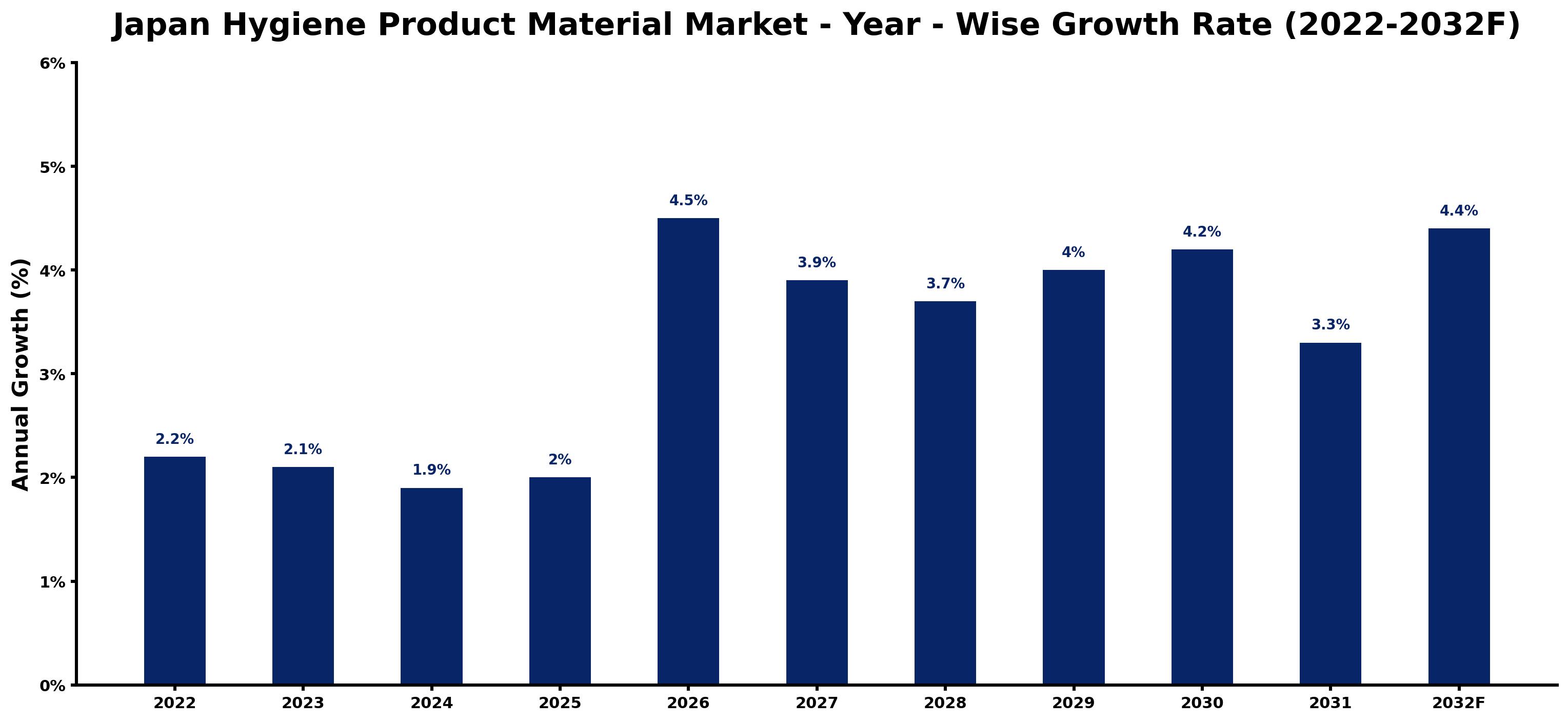
The yearly estimates that follow link every growth rate to its principal driver, so readers can see why the pace changed in each period.
| Year | Estimated Annual Growth (%) | Market Rationale |
| 2022 | 2.2 | The market experienced steady demand from mass production companies and eco-friendly brands. |
| 2023 | 2.1 | Growth slowed slightly as manufacturers adjusted to evolving consumer preferences. |
| 2024 | 1.9 | Demand continued to rise, albeit at a slower pace due to market saturation. |
| 2025 | 2.0 | The market saw a resurgence in growth as local manufacturers invested in biodegradable materials. |
| 2026 | 4.5 | Rapid growth is expected as biodegradable product demand surges among eco-conscious consumers. |
| 2027 | 3.9 | Growth is projected to slow as manufacturers face challenges in sourcing sustainable materials. |
| 2028 | 3.7 | Demand is anticipated to remain stable, with a focus on improving product quality and sustainability. |
| 2029 | 4.0 | A rebound in growth is expected as new eco-friendly products gain popularity. |
| 2030 | 4.2 | Continued growth will be driven by rising awareness of environmental issues among consumers. |
| 2031 | 3.3 | The market is projected to experience a slowdown as competition intensifies among manufacturers. |
| 2032 | 4.4 | Growth is expected to accelerate again due to increased investment in biodegradable materials. |
Note: Market size estimations and growth projections presented in this report are based on 6Wresearch's proprietary forecasting methodology, utilizing the latest available industry data, government publications, and primary research inputs.
Japan Hygiene Product Material Market Synopsis
Hygiene Product Material consists of super absorbent polymers, nonwoven fabrics, fluff pulp, and SAP-free natural materials, primarily used in personal hygiene products such as diapers and sanitary napkins. The Japan Hygiene Product Material Market is expanding, fuelled by a growing population of approximately 125 million and rising demand from mass production companies and eco-friendly brands. With a market value exceeding 1 trillion yen annually, local manufacturers are increasingly investing in biodegradable materials to meet consumer preferences for sustainable products, supported by government initiatives promoting eco-friendly practices.
Market Dynamics Impact Analysis (2026–2032)
| Factor | Type | Impact | Primary Segment Affected |
| Growing demand for biodegradable hygiene products | Driver | High | Diapers & Pads |
| Increasing consumer awareness of environmental sustainability | Driver | High | Nonwoven Fabrics |
| Emerging demand for eco-friendly brands | Opportunity | Medium | SAP-Free Natural Materials |
| Investment in sustainable production technologies | Opportunity | Medium | Fluff Pulp |
| Strict regulations on hygiene product materials | Restraint | High | Nonwoven Fabrics |
| Limited availability of sustainable raw materials | Restraint | High | Super Absorbent Polymers |
| Rising competition among local manufacturers | Challenge | Medium | Hygiene OEMs |
| Challenges in adapting to changing consumer preferences | Challenge | Medium | Eco-Friendly Brands |
Evaluation of Drivers in Japan Hygiene Product Material Market (2026–2032)
These are the developments adding the most demand over the forecast period.
| Drivers | Primary Segment Affected | Why It Matters (Evidence) |
| Increased production of biodegradable materials | Diapers & Pads | Local manufacturers are responding to consumer demand for eco-friendly products, with a reported growth rate of 15% in 2023. |
| Rising population and birth rates | Fluff Pulp | Japan's population of approximately 125 million creates a strong demand for hygiene products, leading to increased purchases from mass production companies. |
| Government initiatives promoting sustainability | Nonwoven Fabrics | A new subsidy program was introduced in 2023 to support companies developing eco-friendly hygiene materials, encouraging investments in this area. |
| Growing environmental awareness among consumers | SAP-Free Natural Materials | As consumers become more eco-conscious, the demand for sustainable products is rising, pushing manufacturers to innovate and adapt. |
| High consumption rates of hygiene products | Sanitary Napkins/Wipes | The average annual consumption of diapers per child in Japan is around 3,500 units, driving demand for hygiene materials. |
Orders keep climbing as the population of Japan, approximately 125 million, drives demand for hygiene products. Local manufacturers are responding to consumer preferences for sustainability, with eco-friendly brands experiencing a growth rate of 15% in 2023. The average annual consumption of diapers per child is around 3,500 units, increasing purchases of hygiene materials. As consumers become more environmentally aware, demand for SAP-free natural materials is rising, influencing manufacturers to innovate their product offerings.
Evaluation of Restraints in Japan Hygiene Product Material Market
The table below lists the restraints and the evidence behind each.
| Market Restraint | Primary Segment Affected | Why It Matters (Evidence) |
| Strict hygiene product standards | Nonwoven Fabrics | Japan has stringent regulations, including JIS and ISO certifications, which can limit the speed of product development. |
| Challenges in sourcing sustainable materials | Super Absorbent Polymers | Limited availability of eco-friendly raw materials can hinder production capabilities for manufacturers. |
| High competition among local manufacturers | Hygiene OEMs | Intense competition can lead to price wars, affecting profitability and investment in innovation. |
| Consumer preference shifts towards sustainable products | SAP-Free Natural Materials | Manufacturers must adapt quickly to changing consumer preferences, which can delay product launches. |
| Environmental regulations impacting production processes | Fluff Pulp | Compliance with environmental standards can increase operational costs for manufacturers. |
Japan Hygiene Product Material Market Challenges
Japan's hygiene product market faces rising costs, as eco-friendly materials lead to price increases of up to 20%, placing a financial burden on buyers. Local manufacturers are experiencing delays due to a shortage of skilled workers in sustainable material production, which extends product launch timeframes. Compliance with stringent JIS and ISO standards complicates operations for suppliers, resulting in longer lead times and potential penalties for non-compliance. Transitioning to biodegradable products requires advanced technology, which many producers lack, causing them to miss market opportunities and fall behind competitors.
Trends in the Japan Hygiene Product Material Market
These developments are changing demand patterns in the Japan Hygiene Product Material Market.
- Mass Production Companies Prioritising Sustainability: Mass production companies in Japan are increasingly prioritising sustainable practices, with eco-friendly brands growing by 15% in 2023. This shift reflects a broader trend towards environmentally responsible manufacturing.
- Sanitary Napkins/Wipes Gaining Popularity: The sanitary napkins and wipes segment is projected to grow at a CAGR of 5.8% from 2026 to 2032, driven by rising consumer demand for convenience and hygiene products in urban areas.
- Shift Towards Biodegradable Materials: The introduction of the 2023 subsidy program for biodegradable hygiene products marks a notable shift in the market. This initiative aims to support the development of eco-friendly materials, addressing environmental concerns.
- Tokyo Region Leading Hygiene Product Manufacturing: The Tokyo region remains a major hub for hygiene product manufacturing, accounting for over 40% of the total market. This concentration of production facilities improves supply chain efficiency and innovation.
Investment Opportunities in the Japan Hygiene Product Material Market
The following areas offer the clearest openings for investors and suppliers in the Japan Hygiene Product Material Market.
- Tokyo Region's Manufacturing Facilities: The Tokyo region presents opportunities for investment in biodegradable hygiene product manufacturing, with local companies increasingly seeking sustainable materials to satisfy consumer demand for eco-friendly options.
- Gap in Sustainable Material Supply: With Japan targeting a 46% reduction in greenhouse gas emissions by 2030, there is an opportunity to invest in sustainable production technologies, particularly for mass production companies.
- Partnerships with Eco-Friendly Brands: Mass production companies can explore partnerships with eco-friendly brands to develop innovative products, addressing the growing consumer demand for sustainability in hygiene materials.
- Government Subsidies for Sustainable Innovations: The 2023 subsidy program for eco-friendly hygiene materials provides an entry point for companies to invest in sustainable practices, aligning with Japan's environmental goals.
Government Initiatives in the Japan Hygiene Product Material Market
The GX Promotion Act of 2023 establishes a legal framework for promoting sustainable practices in the hygiene product sector, building on previous initiatives like the Green Growth Strategy. This act encourages manufacturers to adopt eco-friendly materials and processes, improving compliance with environmental standards and supporting Japan's decarbonisation targets through substantial investments.
The Ministry of the Environment oversees the implementation of various programs aimed at promoting sustainable materials in hygiene products. This includes approving subsidies for companies developing biodegradable materials, which supports innovation and aligns with Japan's environmental goals.
Future Insight of the Japan Hygiene Product Material Market
By 2032, clinics will increasingly adopt biodegradable materials as consumer demand for eco-friendly options rises. New standards for hygiene products will streamline compliance processes, benefiting both suppliers and buyers. Technological advancements in recycling processes will improve the current 25% recycling rate, promoting sustainability. Local manufacturers will invest significantly in developing sustainable materials, driven by government support for eco-friendly initiatives.
Market Segmentation Analysis
Japan Hygiene Product Material Market report covers a detailed analysis of the following market segments:
By Material Type – Super Absorbent Polymers Lead, Nonwoven Fabrics Expected to Grow Fastest
According to Saurav Kr Singh, Senior Research Analyst at 6Wresearch, Super Absorbent Polymers took 41% of material type revenue in 2025, more than any other category. Super Absorbent Polymers are extensively utilised in the production of diapers and pads, which are essential in Japan's hygiene market. Their critical role in these high-demand products ensures they hold the largest market share. Nonwoven Fabrics are projected to grow fastest, at a CAGR of 5.6% during 2026–2032. Nonwoven Fabrics are experiencing rapid growth due to their vital function in sanitary napkins and wipes, which are increasingly preferred by consumers. The surge in demand for these products is significantly driving the growth of nonwoven materials. Suppliers should prioritise nonwoven fabric offerings to capitalise on the rising market demand.
By Product Application – Diapers & Pads Lead, Sanitary Napkins/Wipes Expected to Grow Fastest
Diapers & Pads held 41% of the Japan Hygiene Product Material Market by product application in 2025. Diapers & Pads represent the primary application area for hygiene materials, bolstered by the high average consumption of approximately 3,500 units per child in Japan. This substantial demand from families solidifies their position as the leading product application. Sanitary Napkins/Wipes are set to record the highest CAGR in this split, 5.8% over 2026–2032. Sanitary Napkins/Wipes are witnessing notable growth as consumer preferences shift towards convenience and hygiene. The increasing production rates of these products are a key factor contributing to their rapid expansion in the market. Manufacturers should consider diversifying their product lines to include more options for sanitary napkins and wipes to meet changing consumer preferences.
By Biodegradability Factor – Low Leads, Medium Expected to Grow Fastest
The largest biodegradability factor category in 2025 was Low, at 47% of revenue. Low biodegradability materials prevail as they are not typically used in high-performance products, which are crucial for adhering to Japan's stringent hygiene standards. This results in a larger market share for low biodegradability options within the sector. Over 2026–2032, Medium is expected to post the fastest growth, at a CAGR of 5.5%. Medium biodegradability materials are gaining traction as they are applied across various hygiene products, reflecting a shift towards more environmentally conscious choices. The growing consumer awareness regarding sustainability is driving this segment's expansion. Suppliers should focus on developing medium biodegradability options to align with the increasing consumer preference for sustainable products.
By End User – Mass Production Companies Lead, Hygiene OEMs Expected to Grow Fastest
In 2025, Mass Production Companies led the end user split with a 42% share. Mass Production Companies constitute the largest user group of hygiene materials, addressing the significant demand for hygiene products throughout Japan. Their extensive operations and high-volume production capabilities ensure a substantial market share. The quickest growth will come from Hygiene OEMs, forecast to expand at a CAGR of 5.7% between 2026 and 2032. Hygiene OEMs are experiencing rapid growth as they focus on producing high-quality hygiene products that align with consumer expectations. Their increasing adoption of advanced manufacturing techniques is propelling their growth rate in the market. Suppliers must strengthen partnerships with Hygiene OEMs to enhance their market presence and secure long-term relationships.
Key Attractiveness of the Report
- 10 Years of Market Numbers
- Historical Data Starting from 2022 to 2025
- Base Year 2025
- Forecast Data until 2032
- Key Performance Indicators Impacting the Market
- Major Upcoming Developments and Projects
Key Highlights of the Report:
- Japan Hygiene Product Material Market Outlook
- Market Size of Japan Hygiene Product Material Market, 2025
- Forecast of Japan Hygiene Product Material Market, 2032
- Historical Data and Forecast of Japan Hygiene Product Material Revenues & Volume for the Period 2022-2032F
- Japan Hygiene Product Material Market Trend Evolution
- Japan Hygiene Product Material Market Drivers and Challenges
- Japan Hygiene Product Material Price Trends
- Japan Hygiene Product Material Porter's Five Forces
- Japan Hygiene Product Material Industry Life Cycle
- Historical Data and Forecast of Japan Hygiene Product Material Market Revenues & Volume By Material Type for the Period 2022-2032F
- Historical Data and Forecast of Japan Hygiene Product Material Market Revenues & Volume By Super Absorbent Polymers for the Period 2022-2032F
- Historical Data and Forecast of Japan Hygiene Product Material Market Revenues & Volume By Nonwoven Fabrics for the Period 2022-2032F
- Historical Data and Forecast of Japan Hygiene Product Material Market Revenues & Volume By Fluff Pulp for the Period 2022-2032F
- Historical Data and Forecast of Japan Hygiene Product Material Market Revenues & Volume By SAP-Free Natural Materials for the Period 2022-2032F
- Historical Data and Forecast of Japan Hygiene Product Material Market Revenues & Volume By Product Application for the Period 2022-2032F
- Historical Data and Forecast of Japan Hygiene Product Material Market Revenues & Volume By Diapers & Pads for the Period 2022-2032F
- Historical Data and Forecast of Japan Hygiene Product Material Market Revenues & Volume By Sanitary Napkins/Wipes for the Period 2022-2032F
- Historical Data and Forecast of Japan Hygiene Product Material Market Revenues & Volume By Paper-Based Products for the Period 2022-2032F
- Historical Data and Forecast of Japan Hygiene Product Material Market Revenues & Volume By Organic Diapers for the Period 2022-2032F
- Historical Data and Forecast of Japan Hygiene Product Material Market Revenues & Volume By Biodegradability Factor for the Period 2022-2032F
- Historical Data and Forecast of Japan Hygiene Product Material Market Revenues & Volume By Low for the Period 2022-2032F
- Historical Data and Forecast of Japan Hygiene Product Material Market Revenues & Volume By Medium for the Period 2022-2032F
- Historical Data and Forecast of Japan Hygiene Product Material Market Revenues & Volume By High for the Period 2022-2032F
- Historical Data and Forecast of Japan Hygiene Product Material Market Revenues & Volume By Fully Biodegradable for the Period 2022-2032F
- Historical Data and Forecast of Japan Hygiene Product Material Market Revenues & Volume By End User for the Period 2022-2032F
- Historical Data and Forecast of Japan Hygiene Product Material Market Revenues & Volume By Mass Production Companies for the Period 2022-2032F
- Historical Data and Forecast of Japan Hygiene Product Material Market Revenues & Volume By Hygiene OEMs for the Period 2022-2032F
- Historical Data and Forecast of Japan Hygiene Product Material Market Revenues & Volume By Eco-Friendly Brands for the Period 2022-2032F
- Historical Data and Forecast of Japan Hygiene Product Material Market Revenues & Volume By Sustainable Product Makers for the Period 2022-2032F
- Japan Hygiene Product Material Import Export Trade Statistics
- Market Opportunity Assessment By Material Type
- Market Opportunity Assessment By Product Application
- Market Opportunity Assessment By Biodegradability Factor
- Market Opportunity Assessment By End User
- Japan Hygiene Product Material Top Companies Market Share
- Japan Hygiene Product Material Competitive Benchmarking By Technical and Operational Parameters
- Japan Hygiene Product Material Company Profiles
- Japan Hygiene Product Material Key Strategic Recommendations
Market Covered
This report examines the market across the segments below.
By Material Type
- Super Absorbent Polymers
- Nonwoven Fabrics
- Fluff Pulp
- SAP-Free Natural Materials
By Product Application
- Diapers & Pads
- Sanitary Napkins/Wipes
- Paper-Based Products
- Organic Diapers
By Biodegradability Factor
- Low
- Medium
- High
- Fully Biodegradable
By End User
- Mass Production Companies
- Hygiene OEMs
- Eco-Friendly Brands
- Sustainable Product Makers































