Japan Hygiene Supplies Market Size & Growth Rate
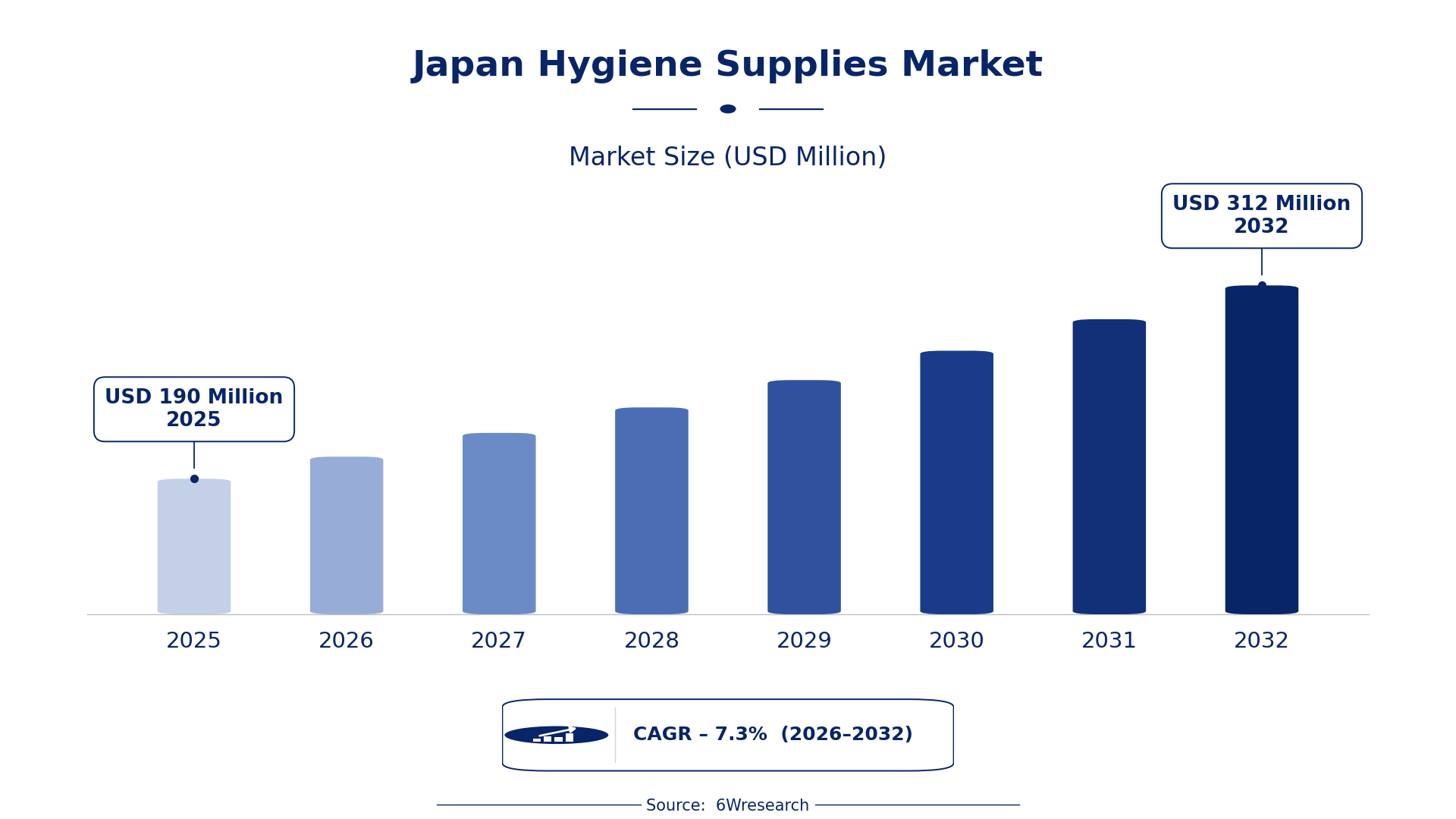
According to 6Wresearch internal database and industry insights, the Japan Hygiene Supplies Market was valued at USD 190 Million in 2025 and is projected to reach USD 312 Million by 2032, growing at a CAGR of approximately 7.3% during 2026–2032.
Japan Hygiene Supplies Market Highlights
| Report Metric | Details |
| Report Name | Japan Hygiene Supplies Market (2026-2032) |
| Market Size 2025 | USD 190 Million |
| Market Size 2032 | USD 312 Million |
| Absolute Growth 2025–2032 | USD 122 Million |
| CAGR 2026–2032 | 7.3% |
| Peak Annual Growth | 8.4% in 2028 |
| Forecast Period | 2026–2032 |
| Historical Data | 2022–2025 |
| Base Year | 2025 |
| Leading Supply Type, 2025 | Commercial Cleaning Supplies (49% share) |
| Leading Target Setting, 2025 | Offices & Institutions (36% share) |
| Leading Packaging Format, 2025 | Bulk/Canister (41% share) |
| Leading End User, 2025 | Facility Managers (37% share) |
| Fastest-Growing Supply Type | Industrial Cleaning Tools (9.9% CAGR) |
| Fastest-Growing Target Setting | Factories & Warehouses (9.5% CAGR) |
| Fastest-Growing Packaging Format | Industrial Grade (10.0% CAGR) |
| Fastest-Growing End User | Janitorial Services (9.1% CAGR) |
| Growing Sector | Personal Sanitary Supplies |
| Key End Users | Facility Managers, Janitorial Services, Consumers, Offices |
Japan Hygiene Supplies Market Year-wise Growth Rate and Key Drivers (2022–2032)
This graph illustrates the annual growth rates of the market from 2022 to 2032, highlighting a steady upward trajectory and projected market expansion over the forecast period.
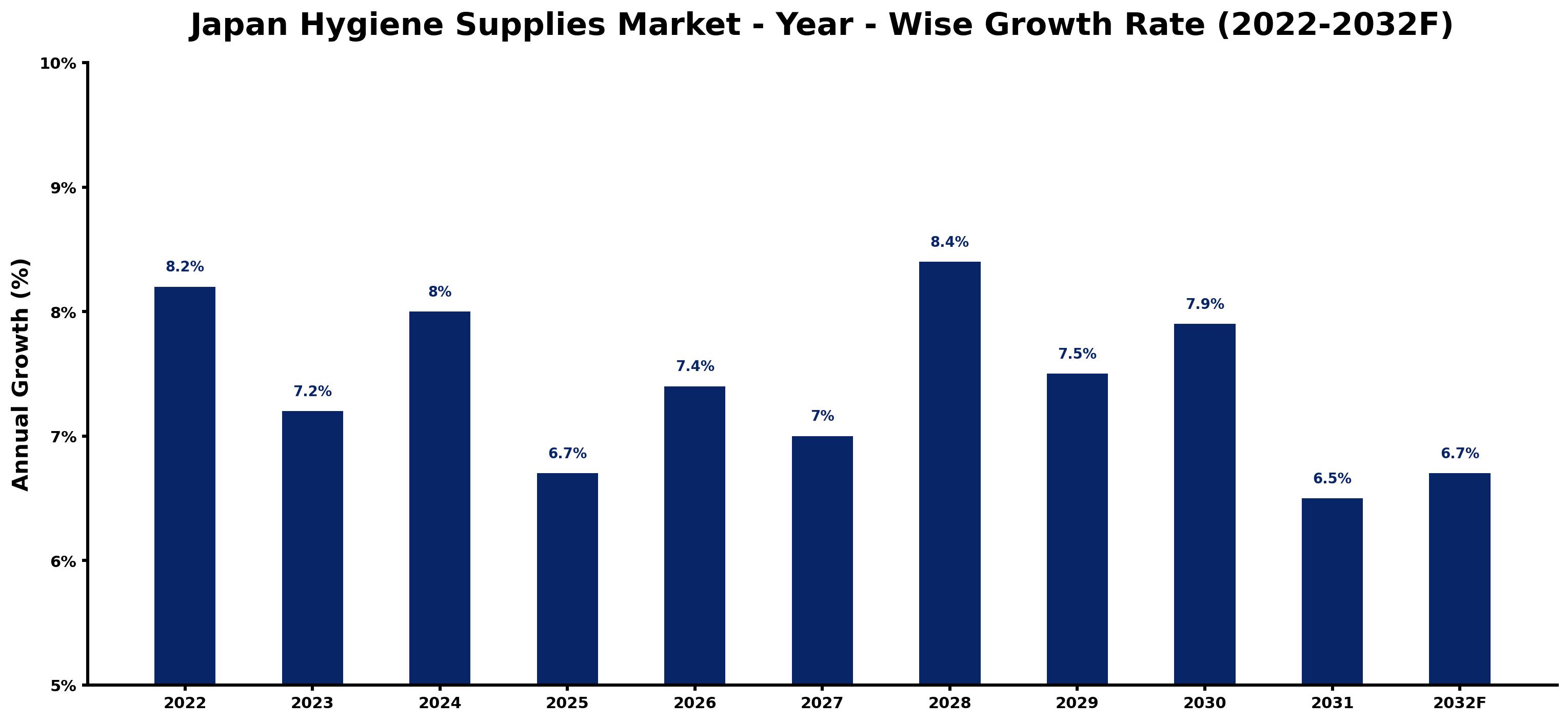
The table below sets out the estimated growth rate for each year and the main factor behind it.
| Year | Estimated Annual Growth (%) | Market Rationale |
| 2022 | 8.2 | The market exhibited strong demand, supported by public health initiatives and cleanliness standards. |
| 2023 | 7.2 | Growth slowed as market adjustments followed the peak demand observed in the previous year. |
| 2024 | 8.0 | Demand increased as hygiene awareness continued to rise among consumers and businesses alike. |
| 2025 | 6.7 | Growth decelerated as market saturation began to impact purchasing patterns. |
| 2026 | 7.4 | The market is expected to rebound with renewed investments in hygiene supplies across various sectors. |
| 2027 | 7.0 | Growth is projected to moderate as the market stabilises following the previous year's surge. |
| 2028 | 8.4 | The peak growth rate is anticipated due to heightened hygiene standards in public facilities. |
| 2029 | 7.5 | Demand is expected to slow as the market adjusts to the high growth rates of the previous year. |
| 2030 | 7.9 | Growth will accelerate again as new hygiene initiatives are introduced in urban areas. |
| 2031 | 6.5 | The market is projected to experience a slowdown as competition intensifies among suppliers. |
| 2032 | 6.7 | Demand is expected to increase as consumers continue to prioritise personal hygiene and cleanliness. |
Note: Market size estimations and growth projections presented in this report are based on 6Wresearch's proprietary forecasting methodology, utilizing the latest available industry data, government publications, and primary research inputs.
Japan Hygiene Supplies Market Synopsis
Hygiene supplies encompass a range of products designed to uphold cleanliness and health in commercial, industrial, and personal environments. Strong demand from the Tokyo metropolitan area, where offices and institutions require effective hygiene solutions, drives the Japan Hygiene Supplies Market. The amendments to the Food Sanitation Act in 2018 have further stimulated sector growth. Rising awareness of hygiene standards among consumers and businesses is expected to significantly propel market expansion by 2032.
Market Dynamics Impact Analysis (2026–2032)
| Factor | Type | Impact | Primary Segment Affected |
| Rising awareness of hygiene standards in urban areas | Driver | High | Commercial Cleaning Supplies |
| Increasing regulations on workplace hygiene compliance | Driver | High | Industrial Cleaning Tools |
| Growing demand for personal hygiene products among consumers | Opportunity | High | Personal Sanitary Supplies |
| Expansion of public health initiatives promoting cleanliness | Opportunity | Medium | Public Dispensers |
| High competition among suppliers leading to price pressures | Restraint | High | Commercial Cleaning Supplies |
| Challenges in maintaining consistent product quality across suppliers | Restraint | Medium | Industrial Cleaning Tools |
| Rising costs of raw materials impacting production | Challenge | High | Personal Sanitary Supplies |
| Compliance with stringent hygiene regulations affecting market entry | Challenge | Medium | Public Dispensers |
Evaluation of Drivers in Japan Hygiene Supplies Market (2026–2032)
The table below links each growth driver to the segment it affects and the evidence for it.
| Drivers | Primary Segment Affected | Why It Matters (Evidence) |
| Increased spending on hygiene supplies by offices and institutions | Commercial Cleaning Supplies | The Tokyo metropolitan area, with its high concentration of businesses, drives demand, resulting in a market value of approximately ¥1 trillion for public health initiatives. |
| Stricter regulations on workplace hygiene standards | Industrial Cleaning Tools | The growing need for compliance in factories has resulted in a strong CAGR for this segment, as companies invest in better cleaning tools. |
| Rising consumer spending on personal hygiene products | Personal Sanitary Supplies | Japanese households spend around ¥10,000 annually on hygiene products, reflecting increased awareness and demand. |
| Public health initiatives promoting sanitation | Public Dispensers | The installation of public dispensers for hand sanitizers is increasing, especially in urban areas, improving public hygiene. |
| Growing demand for bulk hygiene supplies in commercial settings | Bulk/Canister | The commercial sector's need for large-scale cleaning solutions has led to a strong market presence in urban centres. |
Behind the steady rise in orders sits the Tokyo metropolitan area, which has the highest concentration of offices and institutions requiring hygiene supplies. Approximately 126 million people in Japan drive demand for personal sanitary supplies, with households spending around ¥10,000 annually on such products.
Evaluation of Restraints in Japan Hygiene Supplies Market
The key brakes on demand, and where they bite hardest, are shown below.
| Market Restraint | Primary Segment Affected | Why It Matters (Evidence) |
| Intense competition among suppliers leading to price pressures | Commercial Cleaning Supplies | As suppliers compete for market share, prices are driven down, impacting profitability for many companies. |
| Inconsistent product quality from various suppliers | Industrial Cleaning Tools | Quality variations can lead to dissatisfaction among buyers, affecting repeat purchases and brand loyalty. |
| Rising costs of raw materials impacting production | Personal Sanitary Supplies | Increased material costs can result in higher prices for consumers, reducing demand for certain products. |
| Compliance with stringent hygiene regulations affecting market entry | Public Dispensers | New entrants face challenges in meeting regulatory requirements, which can delay product launches. |
| Limited awareness of advanced hygiene solutions among smaller facilities | Bulk/Canister | Smaller facilities may not invest in bulk solutions due to a lack of information on their benefits. |
Japan Hygiene Supplies Market Challenges
Intense competition among producers leads to price wars that can erode profit margins and potentially compromise product quality. Supply chain issues arise from reliance on imported materials, causing delays that may extend lead times for distributors by up to three weeks. Rapid technological advancements require producers to innovate, yet many lack the financial resources for investment, limiting their ability to adapt to changing market demands. Buyers are facing rising costs, with the average household spending about ¥10,000 annually on hygiene products, which strains budgets, particularly in urban areas with high living expenses.
Trends in the Japan Hygiene Supplies Market
Below are the shifts with the largest effect on the Japan Hygiene Supplies Market.
- Shift towards Sustainable Hygiene Products: Since 2021, there has been a noticeable shift towards sustainable hygiene products in Japan. The Plastic Resource Circulation Act promotes the use of biodegradable materials, with an increasing number of hygiene supplies adopting eco-friendly packaging. This trend is reshaping supplier strategies, encouraging investments in sustainable alternatives.
- Transition from Traditional to Automated Hygiene Solutions: In 2023, the adoption of automated hygiene solutions began to rise, particularly in urban areas. Facilities are increasingly implementing touchless dispensers and automated cleaning systems, improving efficiency and hygiene standards. This shift will drive demand for new products in the hygiene supplies market.
- Emergence of Antimicrobial Hygiene Products: The introduction of antimicrobial products has gained traction since the implementation of JIS Z 2801 standards. These products are becoming essential in healthcare facilities, which number over 8,000 across Japan, as they help maintain higher sanitation levels.
- Increased Focus on Hygiene in Public Spaces: In 2023, public dispensers for hand sanitizers saw a rise in installation, particularly in Tokyo. This increase aligns with the Food Sanitation Act amendments, aimed at improving public sanitation standards, resulting in greater demand for hygiene supplies.
Investment Opportunities in the Japan Hygiene Supplies Market
Where to invest in the Japan Hygiene Supplies Market: the main openings are set out below.
- Facility Managers Seeking Hygiene Solutions: Facility managers in urban areas are increasingly in search of hygiene solutions, with a market gap of around ¥1 trillion for public health initiatives. Suppliers can tap into this market by collaborating with local cleaning services to offer tailored solutions.
- Growing Demand for Industrial Cleaning Tools: The industrial cleaning tools segment is set to expand, driven by stricter workplace hygiene regulations. Suppliers can effectively target factories and warehouses to meet this rising demand.
- Expansion of Public Health Initiatives: With an annual budget of about ¥1 trillion for public health initiatives, there is a significant opportunity for suppliers to provide hygiene products to public facilities. Collaborating with government agencies can facilitate market entry.
- Rising Consumer Interest in Personal Hygiene Products: The average household in Japan allocates approximately ¥10,000 annually for personal hygiene products, indicating a robust market opportunity. Suppliers can enter this space by offering innovative and eco-friendly hygiene solutions.
Government Initiatives in the Japan Hygiene Supplies Market
The Food Sanitation Act amendment, introduced in 2018, promotes higher public sanitation standards. This legislation mandates that producers adhere to stricter hygiene practices, ensuring safer products for consumers and improving overall public health. The amendment made HACCP-based hygiene management mandatory for food businesses, enhancing compliance and safety in food-related hygiene supplies.
Facility managers and public institutions benefit from the Food Sanitation Act amendment, which allocates funding for hygiene supplies and equipment. The Ministry of Health, Labour and Welfare oversees the implementation of this amendment, approving projects aimed at improving hygiene standards in public facilities, thereby enhancing cleanliness and safety for the public.
Future Insight of the Japan Hygiene Supplies Market
Technological advancements in antimicrobial standards will reshape demand for hygiene supplies by 2032. Urban centres will see a rise in public sanitiser dispensers, improving accessibility for users. The annual budget for public health initiatives, estimated at around ¥1 trillion, will support the hygiene supplies sector. Stricter regulations on workplace cleanliness will compel suppliers to elevate their product offerings, creating opportunities for both buyers and suppliers.
Market Segmentation Analysis
Japan Hygiene Supplies Market report covers a detailed analysis of the following market segments:
By Supply Type – Commercial Cleaning Supplies Lead, Industrial Cleaning Tools Expected to Grow Fastest
According to Saurav Kr Singh, Senior Research Analyst at 6Wresearch, Commercial Cleaning Supplies held 49% of the Japan Hygiene Supplies Market by supply type in 2025. Commercial cleaning supplies lead the market due to their widespread use in offices and institutions, essential for maintaining hygiene standards. The high concentration of businesses in the Tokyo metropolitan area significantly contributes to this demand. The quickest growth will come from Industrial Cleaning Tools, forecast to expand at a CAGR of 9.9% between 2026 and 2032. Industrial cleaning tools are experiencing rapid growth as stricter hygiene regulations are implemented in factories and warehouses, driving the need for compliance with health standards. This segment's expansion reflects the increasing focus on maintaining cleanliness in industrial settings. Suppliers should focus on enhancing their commercial cleaning product lines to cater to the growing demand in urban areas.
By Target Setting – Offices & Institutions Lead, Factories & Warehouses Expected to Grow Fastest
In 2025, Offices & Institutions led the target setting split with a 36% share. Offices and institutions lead the market as they are essential for maintaining hygiene standards, especially in urban centres. The high demand in the Tokyo metropolitan area illustrates the critical need for effective hygiene solutions in these environments. Factories & Warehouses are set to record the highest CAGR in this split, 9.5% over 2026–2032. Factories and warehouses are experiencing the fastest growth due to the need for industrial hygiene and safety compliance, particularly with recent regulatory changes. This trend reflects a growing awareness of health standards in industrial operations. Buyers in industrial sectors must prioritise compliance with hygiene regulations, presenting opportunities for suppliers to offer tailored solutions.
By Packaging Format – Bulk/Canister Leads, Industrial Grade Expected to Grow Fastest
Bulk/Canister accounted for 41% of the market by packaging format in 2025. Bulk and canister formats are favoured in commercial environments for large-scale cleaning, allowing for efficient use in high-demand settings. This preference is driven by the need for cost-effective solutions that support extensive cleaning operations. Industrial Grade is projected to grow fastest, at a CAGR of 10.0% during 2026–2032. Industrial grade packaging is gaining momentum as it is tailored for heavy-duty cleaning tasks in industrial environments, meeting the demand for more resilient hygiene solutions. This trend highlights the necessity for effective cleaning products in challenging conditions. Suppliers should explore the development of more industrial-grade packaging options to address the increasing needs of industrial clients.
By End User – Facility Managers Lead, Janitorial Services Expected to Grow Fastest
The largest end user category in 2025 was Facility Managers, at 37% of revenue. Facility managers represent the largest segment as they oversee hygiene maintenance in various facilities, ensuring adherence to health regulations. Their pivotal role in managing cleanliness drives the demand for hygiene supplies across multiple sectors. Over 2026–2032, Janitorial Services are expected to post the fastest growth, at a CAGR of 9.1%. Janitorial services are experiencing the fastest growth as they increasingly depend on hygiene supplies to deliver effective cleaning solutions. This trend signals a rising demand for professional cleaning products across diverse industries. Suppliers must engage with janitorial service providers to align their offerings with the evolving requirements of the cleaning sector.
Key Attractiveness of the Report
- 10 Years of Market Numbers
- Historical Data Starting from 2022 to 2025
- Base Year 2025
- Forecast Data until 2032
- Key Performance Indicators Impacting the Market
- Major Upcoming Developments and Projects
Key Highlights of the Report:
- Japan Hygiene Supplies Market Outlook
- Market Size of Japan Hygiene Supplies Market, 2025
- Forecast of Japan Hygiene Supplies Market, 2032
- Historical Data and Forecast of Japan Hygiene Supplies Revenues & Volume for the Period 2022-2032F
- Japan Hygiene Supplies Market Trend Evolution
- Japan Hygiene Supplies Market Drivers and Challenges
- Japan Hygiene Supplies Price Trends
- Japan Hygiene Supplies Porter's Five Forces
- Japan Hygiene Supplies Industry Life Cycle
- Historical Data and Forecast of Japan Hygiene Supplies Market Revenues & Volume By Supply Type for the Period 2022-2032F
- Historical Data and Forecast of Japan Hygiene Supplies Market Revenues & Volume By Commercial Cleaning Supplies for the Period 2022-2032F
- Historical Data and Forecast of Japan Hygiene Supplies Market Revenues & Volume By Industrial Cleaning Tools for the Period 2022-2032F
- Historical Data and Forecast of Japan Hygiene Supplies Market Revenues & Volume By Personal Sanitary Supplies for the Period 2022-2032F
- Historical Data and Forecast of Japan Hygiene Supplies Market Revenues & Volume By Refill Supplies for the Period 2022-2032F
- Historical Data and Forecast of Japan Hygiene Supplies Market Revenues & Volume By Target Setting for the Period 2022-2032F
- Historical Data and Forecast of Japan Hygiene Supplies Market Revenues & Volume By Offices & Institutions for the Period 2022-2032F
- Historical Data and Forecast of Japan Hygiene Supplies Market Revenues & Volume By Factories & Warehouses for the Period 2022-2032F
- Historical Data and Forecast of Japan Hygiene Supplies Market Revenues & Volume By Households for the Period 2022-2032F
- Historical Data and Forecast of Japan Hygiene Supplies Market Revenues & Volume By Public Dispensers for the Period 2022-2032F
- Historical Data and Forecast of Japan Hygiene Supplies Market Revenues & Volume By Packaging Format for the Period 2022-2032F
- Historical Data and Forecast of Japan Hygiene Supplies Market Revenues & Volume By Bulk/Canister for the Period 2022-2032F
- Historical Data and Forecast of Japan Hygiene Supplies Market Revenues & Volume By Industrial Grade for the Period 2022-2032F
- Historical Data and Forecast of Japan Hygiene Supplies Market Revenues & Volume By Retail Packs for the Period 2022-2032F
- Historical Data and Forecast of Japan Hygiene Supplies Market Revenues & Volume By Refill Cartridges for the Period 2022-2032F
- Historical Data and Forecast of Japan Hygiene Supplies Market Revenues & Volume By End User for the Period 2022-2032F
- Historical Data and Forecast of Japan Hygiene Supplies Market Revenues & Volume By Facility Managers for the Period 2022-2032F
- Historical Data and Forecast of Japan Hygiene Supplies Market Revenues & Volume By Janitorial Services for the Period 2022-2032F
- Historical Data and Forecast of Japan Hygiene Supplies Market Revenues & Volume By Consumers for the Period 2022-2032F
- Historical Data and Forecast of Japan Hygiene Supplies Market Revenues & Volume By Civic Infrastructure for the Period 2022-2032F
- Japan Hygiene Supplies Import Export Trade Statistics
- Market Opportunity Assessment By Supply Type
- Market Opportunity Assessment By Target Setting
- Market Opportunity Assessment By Packaging Format
- Market Opportunity Assessment By End User
- Japan Hygiene Supplies Top Companies Market Share
- Japan Hygiene Supplies Competitive Benchmarking By Technical and Operational Parameters
- Japan Hygiene Supplies Company Profiles
- Japan Hygiene Supplies Key Strategic Recommendations
Market Covered
The following segment groups are covered in the report.
By Supply Type
- Commercial Cleaning Supplies
- Industrial Cleaning Tools
- Personal Sanitary Supplies
- Refill Supplies
By Target Setting
- Offices & Institutions
- Factories & Warehouses
- Households
- Public Dispensers
By Packaging Format
- Bulk/Canister
- Industrial Grade
- Retail Packs
- Refill Cartridges
By End User
- Facility Managers
- Janitorial Services
- Consumers
- Civic Infrastructure































