Japan IC Substrate Market Size & Growth Rate
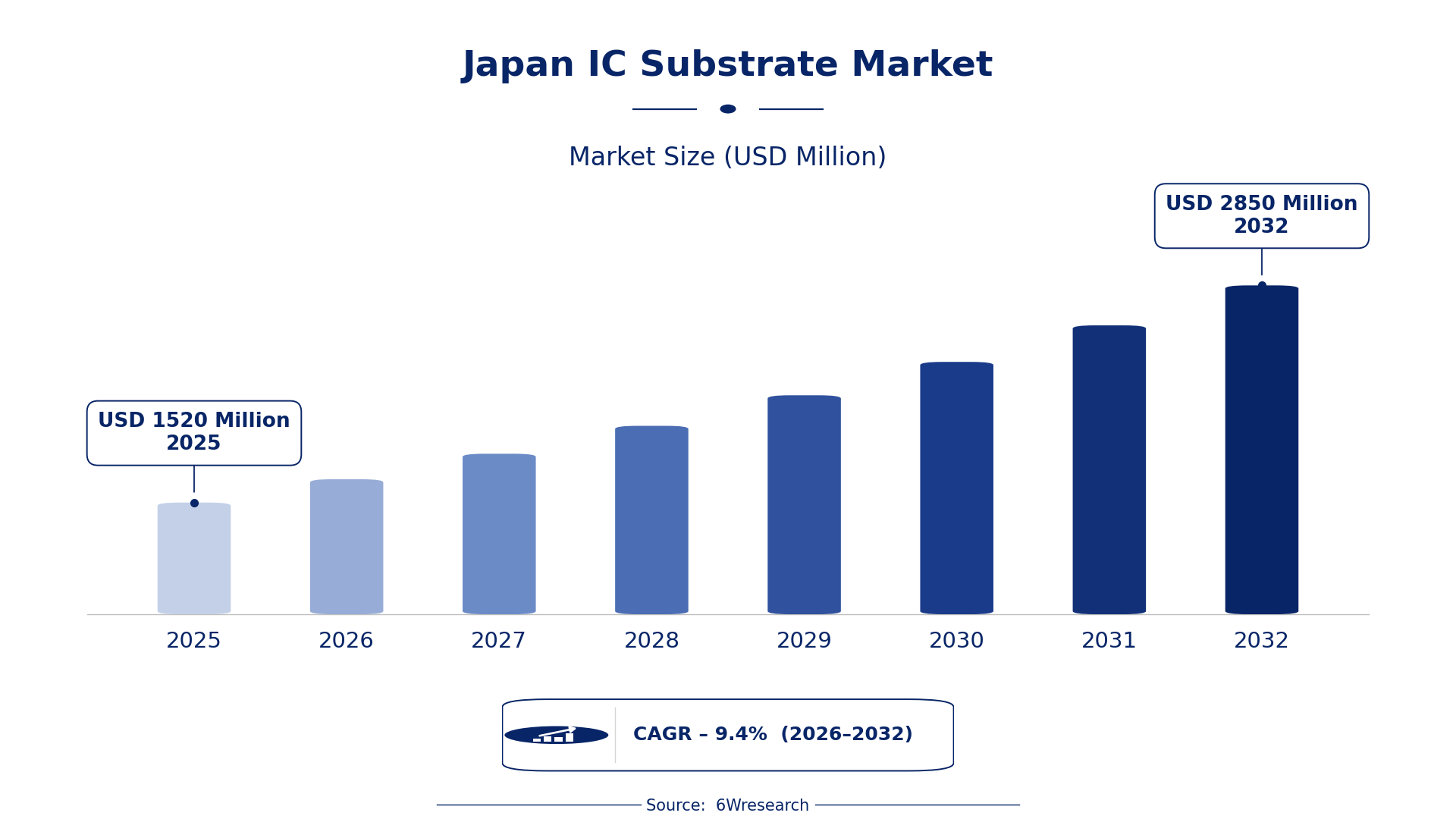
According to 6Wresearch internal database and industry insights, the Japan IC Substrate Market was valued at USD 1,520 Million in 2025 and is projected to reach USD 2,850 Million by 2032, growing at a CAGR of approximately 9.4% during 2026–2032.
Japan IC Substrate Market Highlights
| Report Metric | Details |
| Report Name | Japan IC Substrate Market (2026-2032) |
| Market Size 2025 | USD 1,520 Million |
| Market Size 2032 | USD 2,850 Million |
| Absolute Growth 2025–2032 | USD 1,330 Million |
| CAGR 2026–2032 | 9.4% |
| Peak Annual Growth | 10.5% in 2032 |
| Forecast Period | 2026–2032 |
| Historical Data | 2022–2025 |
| Base Year | 2025 |
| Leading Substrate Type, 2025 | Rigid Substrates (40% share) |
| Leading Layer Structure, 2025 | Multilayer PCBs (42% share) |
| Leading Application Segment, 2025 | CPUs/GPUs (38% share) |
| Leading End User, 2025 | Processor Manufacturers (43% share) |
| Fastest-Growing Substrate Type | Flexible Substrates (13.8% CAGR) |
| Fastest-Growing Layer Structure | Polyimide-Based (12.4% CAGR) |
| Fastest-Growing Application Segment | Mobile & Wearables (13.4% CAGR) |
| Fastest-Growing End User | Flexible Electronics Firms (12.7% CAGR) |
| Growing Sector | Consumer Electronics |
| Key End Users | Processor Manufacturers, Semiconductor OEMs, Flexible Electronics Firms, Automotive Manufacturers |
Japan IC Substrate Market Year-wise Growth Rate and Key Drivers (2022–2032)
This graph illustrates the annual growth rates of the market from 2022 to 2032, highlighting a steady upward trajectory and projected market expansion over the forecast period.
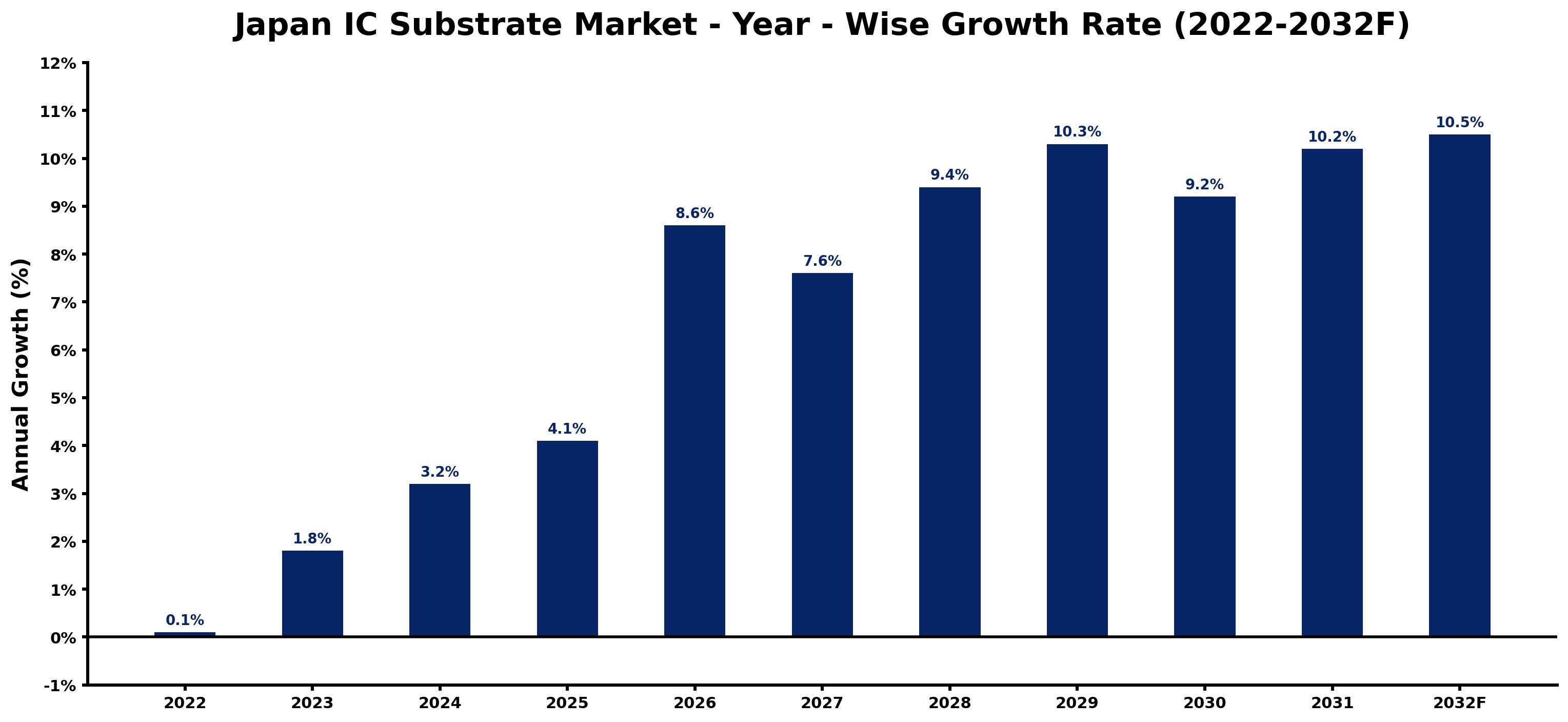
Each row of the following table gives one year's estimated growth and the event or demand shift that explains it.
| Year | Estimated Annual Growth (%) | Market Rationale |
| 2022 | 0.1 | The market showed minimal growth as demand stabilised after previous fluctuations. |
| 2023 | 1.8 | Demand for IC substrates increased due to rising consumer electronics production. |
| 2024 | 3.2 | Growth accelerated as manufacturers expanded their semiconductor capabilities. |
| 2025 | 4.1 | The market reached a peak growth rate, driven by high-performance applications. |
| 2026 | 8.6 | Investment in semiconductor technology is expected to surge, boosting substrate demand. |
| 2027 | 7.6 | Growth is projected to slow slightly as supply chain adjustments take place. |
| 2028 | 9.4 | Demand is expected to increase again as new technologies emerge in high-speed devices. |
| 2029 | 10.3 | The market will continue to grow, supported by advancements in mobile applications. |
| 2030 | 9.2 | Growth will moderate as the market adjusts to supply capabilities. |
| 2031 | 10.2 | Demand is expected to rise again due to increased production in the semiconductor sector. |
| 2032 | 10.5 | The market is projected to peak with strong investments in advanced semiconductor technologies. |
Note: Market size estimations and growth projections presented in this report are based on 6Wresearch's proprietary forecasting methodology, utilizing the latest available industry data, government publications, and primary research inputs.
Japan IC Substrate Market Synopsis
IC substrates are critical components in electronic devices, made from materials like glass fibre and resin, supporting CPUs, GPUs, and integrated circuits. The Japan IC Substrate Market is growing due to rising demand from processor manufacturers and flexible electronics firms. The semiconductor industry, employing over 200,000 people, is investing heavily in technology, with a government allocation of ¥50 billion for semiconductor R&D in 2023. This investment is expected to strengthen domestic production capabilities and meet the increasing needs of consumer electronics and telecommunications sectors.
Market Dynamics Impact Analysis (2026–2032)
| Factor | Type | Impact | Primary Segment Affected |
| Growing demand for high-performance computing applications | Driver | High | Rigid Substrates |
| Increased adoption of flexible electronics in consumer devices | Driver | High | Flexible Substrates |
| Rising demand for advanced substrates in automotive applications | Opportunity | Medium | Embedded Substrates |
| Expansion of mobile device manufacturing in Japan | Opportunity | High | Organic Substrates |
| Supply chain disruptions affecting raw materials availability | Restraint | High | Polyimide-Based |
| High production costs limiting market entry for new players | Restraint | Medium | BT/FR-4 Materials |
| Limited capacity to meet surging demand for advanced substrates | Challenge | High | Multilayer PCBs |
| Technological advancements leading to rapid market changes | Challenge | Medium | High-Speed Devices |
Evaluation of Drivers in Japan IC Substrate Market (2026–2032)
The factors lifting demand, and the evidence behind each, are summarised below.
| Drivers | Primary Segment Affected | Why It Matters (Evidence) |
| Increased production of consumer electronics | CPUs/GPUs | Japan produced 1.5 billion IC substrates in 2022, reflecting high demand from manufacturers. |
| Growth in mobile and wearable device markets | Flexible Substrates | Flexible substrates are projected to grow by 15% by 2025, reflecting consumer electronics expansion. |
| Investment in semiconductor technology | Organic Substrates | Investment in semiconductor technology reached ¥300 billion in 2023, boosting demand for advanced materials. |
| Rising automotive applications for embedded substrates | Embedded Substrates | Embedded substrates are increasingly used in automotive applications, driving demand for innovation. |
| Technological advancements in high-speed devices | High-Speed Devices | High-speed devices require advanced multilayer PCB designs, increasing the need for high-performance materials. |
A wider customer base explains much of the growth, as demand from processor manufacturers remains strong, with Japan producing 1.5 billion IC substrates in 2022. The mobile and wearable device markets are expanding, with flexible substrates projected to grow by 15% by 2025. Investment in semiconductor technology reached ¥300 billion in 2023, boosting demand for advanced materials. The automotive sector is increasingly adopting embedded substrates, further driving market growth. Advancements in high-speed devices necessitate advanced multilayer PCB designs, increasing the need for high-performance materials.
Evaluation of Restraints in Japan IC Substrate Market
Below are the constraints most often cited by buyers and suppliers, with the segment each affects.
| Market Restraint | Primary Segment Affected | Why It Matters (Evidence) |
| Supply chain disruptions impacting raw materials | Polyimide-Based | Supply chain disruptions have limited the availability of essential materials, increasing production times. |
| High production costs for advanced substrates | BT/FR-4 Materials | High production costs create barriers for new entrants, limiting competition in the market. |
| Limited capacity to meet demand for advanced substrates | Multilayer PCBs | Manufacturers struggle to scale production quickly enough to satisfy surging demand. |
| Technological changes requiring rapid adaptation | High-Speed Devices | Rapid technological advancements necessitate constant updates to production processes, complicating operations. |
| Regulatory compliance costs for new entrants | Rigid Substrates | New regulations increase compliance costs, making it difficult for smaller firms to compete. |
Japan IC Substrate Market Challenges
High costs for IC substrates in Japan arise from expensive raw materials and skilled labour, which can shrink profit margins for producers. This situation compels manufacturers to raise prices, potentially alienating price-sensitive buyers in a competitive market. Limited technology adoption restricts innovation in substrate designs, preventing buyers from accessing advanced features that are increasingly necessary. Consequently, local manufacturers risk losing market share to international competitors who can offer superior products at lower prices. In 2022, Japan produced 1.5 billion IC substrates, highlighting the scale of production amid these challenges.
Trends in the Japan IC Substrate Market
Below are the shifts with the largest effect on the Japan IC Substrate Market.
- Shift from Rigid to Flexible Substrates: The transition to flexible substrates began in 2023 as manufacturers sought lighter, more versatile materials. Flexible substrates are projected to grow by 15% by 2025, reflecting changing consumer preferences.
- Emergence of Polyimide-Based Substrates: Since 2022, polyimide-based substrates have gained traction in aerospace applications, with demand driven by their high-temperature resistance. This segment is expected to expand as aerospace technology advances.
- Growing Adoption of Embedded Substrates in Automotive: Starting in 2023, embedded substrates have seen increased use in automotive applications, driven by the rise of electric vehicles. This shift is anticipated to improve performance and reliability in automotive electronics.
- Increased Focus on High-Speed Devices: The demand for high-speed devices has surged since 2022, with manufacturers investing in advanced multilayer PCB designs. This shift is necessary for meeting the needs of high-performance computing applications.
Investment Opportunities in the Japan IC Substrate Market
The following opportunities in the Japan IC Substrate Market pair current demand with a clear way in.
- Investment in Semiconductor R&D: Now is the time to invest in semiconductor R&D, with the government allocating ¥50 billion in 2023. Processor manufacturers are seeking effective solutions to improve production capabilities.
- Expansion into Automotive Embedded Solutions: With the automotive sector increasingly adopting embedded substrates, there is a significant opportunity for investment. Flexible electronics firms can partner with automotive manufacturers to develop tailored solutions.
- Market Gap in High-Speed Device Substrates: The demand for high-speed device substrates is rising, with a projected increase in production. Semiconductor OEMs are seeking advanced materials to meet these needs, presenting an entry opportunity.
- Growth in Mobile Device Manufacturing: The mobile device market is expanding rapidly, creating a demand for flexible substrates. Collaborating with local manufacturers in Kyoto Prefecture can facilitate market entry.
Government Initiatives in the Japan IC Substrate Market
The Semiconductor and Digital Industry Strategy, established in June 2021, aims to secure domestic semiconductor manufacturing by improving R&D capabilities. This strategy complements the Economic Security Promotion Act of 2022, which supports supply-chain resilience for critical products, ensuring a stable supply of IC substrates.
Processor manufacturers benefit from the Economic Security Promotion Act, which provides funding for research and development. The Ministry of Economy, Trade and Industry oversees the allocation of ¥50 billion for semiconductor R&D, enabling firms to innovate and improve production processes.
Future Insight of the Japan IC Substrate Market
Investment in semiconductor technology reached ¥300 billion in 2023, driving demand for IC substrates as manufacturers enhance their capabilities. By 2032, flexible substrates will grow by 15%, meeting the rising need for advanced electronics in consumer and IoT devices. The Tokyo region will continue to be a key hub, supported by government initiatives aimed at a 30% increase in semiconductor production by 2030. Standards like JIS C 6481 will ensure quality and reliability, providing advantages for both buyers and suppliers.
Market Segmentation Analysis
Japan IC Substrate Market report covers a detailed analysis of the following market segments:
By Substrate Type – Rigid Substrates Lead, Flexible Substrates Expected to Grow Fastest
According to Saurav Kr Singh, Senior Research Analyst at 6Wresearch, Rigid Substrates held 40% of the Japan IC Substrate Market by substrate type in 2025. Rigid substrates dominate the market as they are essential for high-performance applications, particularly in CPUs and GPUs. Their importance is underscored by the concentration of semiconductor manufacturing facilities in the Tokyo region, which supports their extensive use. The quickest growth will come from Flexible Substrates, forecast to expand at a CAGR of 13.8% between 2026 and 2032. The growth of flexible substrates is propelled by the increasing demand for mobile devices and wearables, which require adaptable and lightweight materials. With an anticipated 15% growth by 2025, this segment is aligning with the industry's focus on portable electronics. Suppliers should enhance their flexible substrate production capabilities to capitalise on the rising demand in consumer electronics.
By Layer Structure – Multilayer PCBs Lead, Polyimide-Based Expected to Grow Fastest
With 42% of layer structure revenue in 2025, Multilayer PCBs was the largest category. Multilayer PCBs dominate the market as they are vital for complex circuit designs in high-performance electronics. Their essential function in advanced semiconductor applications makes them a preferred choice among manufacturers. Polyimide-Based is projected to grow fastest, at a CAGR of 12.4% during 2026–2032. Polyimide-based substrates are the fastest-growing segment, driven by their necessity in high-temperature applications, especially within the aerospace sector. This trend highlights a movement towards more durable materials in challenging environments. Buyers in high-performance industries should invest in polyimide-based solutions to ensure reliability under extreme conditions.
By Application Segment – CPUs/GPUs Leads, Mobile & Wearables Expected to Grow Fastest
In 2025, CPUs/GPUs led the application segment split with a 38% share. CPUs and GPUs lead the application segment, serving as the backbone for computing power in various electronic devices. The substantial demand for these components in Japan's electronics sector drives the necessity for reliable IC substrates. Mobile & Wearables are set to record the highest CAGR in this split, 13.4% over 2026–2032. Mobile and wearables are experiencing the fastest growth, indicating a shift in consumer preferences towards portable technology. This trend highlights the need for substrates that support compact and efficient designs in the electronics market. Suppliers need to adapt their offerings to cater to the growing requirements of mobile and wearable applications.
By End User – Processor Manufacturers Lead, Flexible Electronics Firms Expected to Grow Fastest
The largest end user category in 2025 was Processor Manufacturers, at 43% of revenue. Processor manufacturers represent the largest end user group, being major consumers of IC substrates for their products. Their continuous demand for advanced substrates fuels the growth of this segment in Japan's semiconductor industry. Over 2026–2032, Flexible Electronics Firms are expected to post the fastest growth, at a CAGR of 12.7%. Flexible electronics firms are the fastest-growing end user segment, driven by the push for innovation in portable technology. This growth suggests an expanding market for substrates that support flexible designs. Suppliers should align their strategies with the needs of flexible electronics firms to capture emerging opportunities.
Key Attractiveness of the Report
- 10 Years of Market Numbers
- Historical Data Starting from 2022 to 2025
- Base Year 2025
- Forecast Data until 2032
- Key Performance Indicators Impacting the Market
- Major Upcoming Developments and Projects
Key Highlights of the Report:
- Japan IC Substrate Market Outlook
- Market Size of Japan IC Substrate Market, 2025
- Forecast of Japan IC Substrate Market, 2032
- Historical Data and Forecast of Japan IC Substrate Revenues & Volume for the Period 2022-2032F
- Japan IC Substrate Market Trend Evolution
- Japan IC Substrate Market Drivers and Challenges
- Japan IC Substrate Price Trends
- Japan IC Substrate Porter's Five Forces
- Japan IC Substrate Industry Life Cycle
- Historical Data and Forecast of Japan IC Substrate Market Revenues & Volume By Substrate Type for the Period 2022-2032F
- Historical Data and Forecast of Japan IC Substrate Market Revenues & Volume By Rigid Substrates for the Period 2022-2032F
- Historical Data and Forecast of Japan IC Substrate Market Revenues & Volume By Flexible Substrates for the Period 2022-2032F
- Historical Data and Forecast of Japan IC Substrate Market Revenues & Volume By Embedded Substrates for the Period 2022-2032F
- Historical Data and Forecast of Japan IC Substrate Market Revenues & Volume By Organic Substrates for the Period 2022-2032F
- Historical Data and Forecast of Japan IC Substrate Market Revenues & Volume By Layer Structure for the Period 2022-2032F
- Historical Data and Forecast of Japan IC Substrate Market Revenues & Volume By Multilayer PCBs for the Period 2022-2032F
- Historical Data and Forecast of Japan IC Substrate Market Revenues & Volume By Polyimide-Based for the Period 2022-2032F
- Historical Data and Forecast of Japan IC Substrate Market Revenues & Volume By Component-in-Substrate for the Period 2022-2032F
- Historical Data and Forecast of Japan IC Substrate Market Revenues & Volume By BT/FR-4 Materials for the Period 2022-2032F
- Historical Data and Forecast of Japan IC Substrate Market Revenues & Volume By Application Segment for the Period 2022-2032F
- Historical Data and Forecast of Japan IC Substrate Market Revenues & Volume By CPUs/GPUs for the Period 2022-2032F
- Historical Data and Forecast of Japan IC Substrate Market Revenues & Volume By Mobile & Wearables for the Period 2022-2032F
- Historical Data and Forecast of Japan IC Substrate Market Revenues & Volume By High-Speed Devices for the Period 2022-2032F
- Historical Data and Forecast of Japan IC Substrate Market Revenues & Volume By Memory ICs for the Period 2022-2032F
- Historical Data and Forecast of Japan IC Substrate Market Revenues & Volume By End User for the Period 2022-2032F
- Historical Data and Forecast of Japan IC Substrate Market Revenues & Volume By Processor Manufacturers for the Period 2022-2032F
- Historical Data and Forecast of Japan IC Substrate Market Revenues & Volume By Flexible Electronics Firms for the Period 2022-2032F
- Historical Data and Forecast of Japan IC Substrate Market Revenues & Volume By Semiconductor OEMs for the Period 2022-2032F
- Historical Data and Forecast of Japan IC Substrate Market Revenues & Volume By DRAM/Flash Makers for the Period 2022-2032F
- Japan IC Substrate Import Export Trade Statistics
- Market Opportunity Assessment By Substrate Type
- Market Opportunity Assessment By Layer Structure
- Market Opportunity Assessment By Application Segment
- Market Opportunity Assessment By End User
- Japan IC Substrate Top Companies Market Share
- Japan IC Substrate Competitive Benchmarking By Technical and Operational Parameters
- Japan IC Substrate Company Profiles
- Japan IC Substrate Key Strategic Recommendations
Market Covered
Segments analysed in this report are listed below.
By Substrate Type
- Rigid Substrates
- Flexible Substrates
- Embedded Substrates
- Organic Substrates
By Layer Structure
- Multilayer PCBs
- Polyimide-Based
- Component-in-Substrate
- BT/FR-4 Materials
By Application Segment
- CPUs/GPUs
- Mobile & Wearables
- High-Speed Devices
- Memory ICs
By End User
- Processor Manufacturers
- Flexible Electronics Firms
- Semiconductor OEMs
- DRAM/Flash Makers































