Japan IC Testing Devices Market Size & Growth Rate
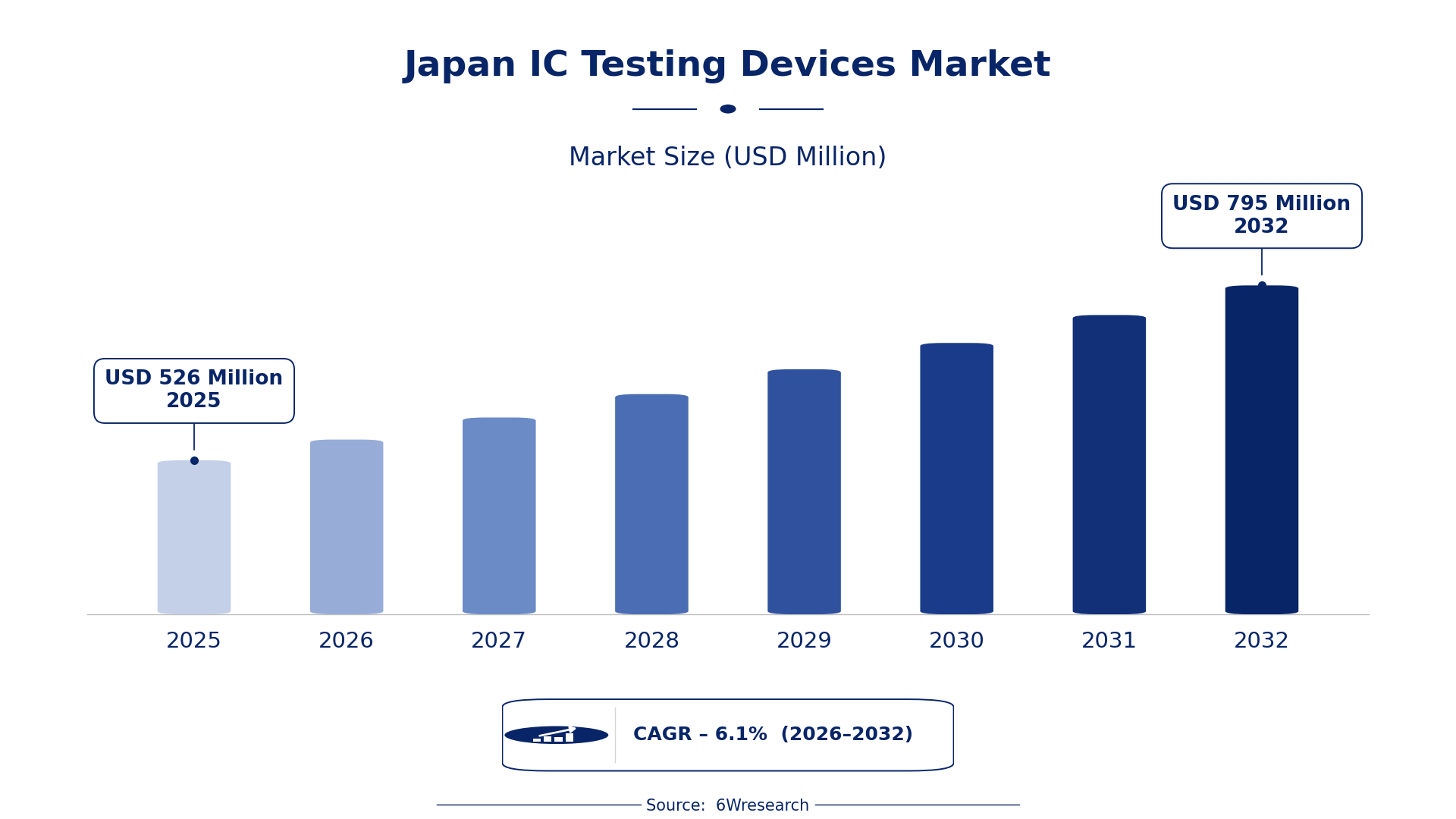
According to 6Wresearch internal database and industry insights, the Japan IC Testing Devices Market was valued at USD 526 Million in 2025 and is projected to reach USD 795 Million by 2032, growing at a CAGR of approximately 6.1% during 2026–2032.
Japan IC Testing Devices Market Highlights
| Report Metric | Details |
| Report Name | Japan IC Testing Devices Market (2026-2032) |
| Market Size 2025 | USD 526 Million |
| Market Size 2032 | USD 795 Million |
| Absolute Growth 2025–2032 | USD 269 Million |
| CAGR 2026–2032 | 6.1% |
| Peak Annual Growth | 7.0% in 2026 |
| Forecast Period | 2026–2032 |
| Historical Data | 2022–2025 |
| Base Year | 2025 |
| Leading Testing Device Type, 2025 | Probe Cards (53% share) |
| Leading Test Category, 2025 | Wafer-Level Testing (39% share) |
| Leading Technology Support, 2025 | High Frequency (48% share) |
| Leading End User, 2025 | Foundries (38% share) |
| Fastest-Growing Testing Device Type | ATE (Automatic Test Equip) (8.6% CAGR) |
| Fastest-Growing Test Category | Functional Testing (7.8% CAGR) |
| Fastest-Growing Technology Support | Analog/Digital (8.8% CAGR) |
| Fastest-Growing End User | IC Design Firms (7.9% CAGR) |
| Growing Sector | IC Design Firms |
| Key End Users | Foundries, IC Design Firms, Packaging & Reliability Labs, Contract Manufacturers |
Japan IC Testing Devices Market Year-wise Growth Rate and Key Drivers (2022–2032)
This graph illustrates the annual growth rates of the market from 2022 to 2032, highlighting a steady upward trajectory and projected market expansion over the forecast period.
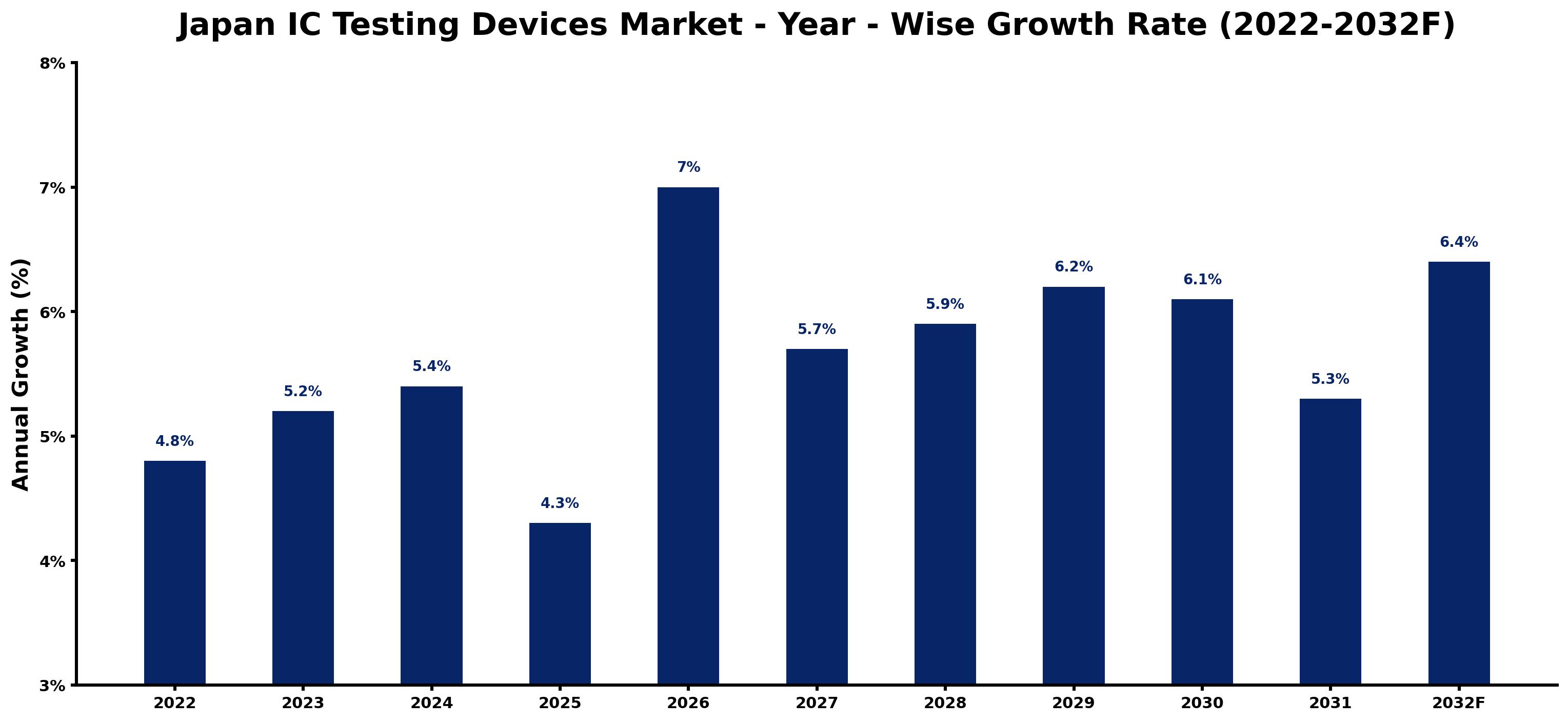
Year by year, the estimates below pair each growth rate with the development that shaped it.
| Year | Estimated Annual Growth (%) | Market Rationale |
| 2022 | 4.8 | The market showed steady growth, driven by demand from domestic manufacturers. |
| 2023 | 5.2 | Growth accelerated as semiconductor exports reached 1.5 trillion JPY, boosting testing needs. |
| 2024 | 5.4 | Continued expansion was supported by rising consumer electronics demand in Japan. |
| 2025 | 4.3 | Growth slowed as market conditions adjusted to increased production capacity. |
| 2026 | 7.0 | The market peaked with investments in semiconductor technology innovation. |
| 2027 | 5.7 | A slight slowdown followed as manufacturers adjusted to peak demand. |
| 2028 | 5.9 | Growth resumed as new testing technologies gained traction in the market. |
| 2029 | 6.2 | The market continued to grow, driven by advancements in functional testing. |
| 2030 | 6.1 | A slowdown occurred as companies focused on optimising existing testing processes. |
| 2031 | 5.3 | Growth moderated as the market stabilised amid competitive pressures. |
| 2032 | 6.4 | Demand is expected to rise again as new applications for ICs emerge. |
Note: Market size estimations and growth projections presented in this report are based on 6Wresearch's proprietary forecasting methodology, utilizing the latest available industry data, government publications, and primary research inputs.
Japan IC Testing Devices Market Synopsis
IC Testing Devices serve as crucial instruments for assessing the performance and reliability of integrated circuits, produced through precision engineering processes that utilise advanced materials. The Japan IC Testing Devices Market is growing due to robust domestic demand from manufacturers and exports. The semiconductor market, valued at approximately 4 trillion JPY in 2022, benefits from ongoing technological advancements and government initiatives, including the 2023 programme for semiconductor technology innovation, which will further stimulate demand for testing devices. With over 100 IC design firms actively employing these devices, the market is poised for growth as manufacturers aim to improve product quality and production efficiency.
Market Dynamics Impact Analysis (2026–2032)
| Factor | Type | Impact | Primary Segment Affected |
| Rising demand for semiconductor testing due to increased production. | Driver | High | Functional Testing |
| Technological advancements in testing devices enhance efficiency. | Driver | High | ATE (Automatic Test Equip) |
| Growing market for reliability testing in automotive applications. | Opportunity | High | Reliability Testing |
| Investment in semiconductor manufacturing facilities is increasing. | Opportunity | High | Wafer-Level Testing |
| High competition among testing device manufacturers limits pricing power. | Restraint | Medium | Probe Cards |
| Dependence on global semiconductor supply chains can disrupt availability. | Restraint | Medium | Socket Testers |
| Capacity constraints in production may hinder supply. | Challenge | High | Burn-In Systems |
| Rapid technological changes require constant updates to testing equipment. | Challenge | High | High Frequency |
Evaluation of Drivers in Japan IC Testing Devices Market (2026–2032)
The main growth drivers and the segments they affect most are set out below.
| Drivers | Primary Segment Affected | Why It Matters (Evidence) |
| Increased production of consumer electronics drives demand for testing devices. | Functional Testing | Functional testing accounts for approximately 30% of the total testing market in Japan. |
| Automation in testing processes improves efficiency and reduces time. | ATE (Automatic Test Equip) | The installed base of ATE systems in Japan is estimated at over 1,000 units. |
| Reliability testing is vital for automotive ICs, reflecting the sector's growth. | Reliability Testing | Reliability testing is essential for automotive ICs, with the sector expanding significantly. |
| The expansion of semiconductor manufacturing facilities boosts testing needs. | Wafer-Level Testing | Tokyo and Osaka are key industrial regions for semiconductor manufacturing. |
| Technological advancements in testing devices improve testing capabilities. | High Frequency | High Frequency testing supports the increasing complexity of semiconductor designs. |
Much of the new demand traces back to the growth of the consumer electronics sector, which drives the need for testing devices. In 2022, Japan's semiconductor market was valued at approximately 4 trillion JPY, prompting manufacturers to invest in ATE systems, with over 1,000 units installed. The automotive sector is expanding, leading to increased demand for Reliability Testing to ensure IC performance. The growth of semiconductor manufacturing facilities in Tokyo and Osaka is boosting the need for Wafer-Level Testing. Advancements in High Frequency testing are improving the capabilities of testing devices, allowing for more efficient evaluation of complex semiconductor designs.
Evaluation of Restraints in Japan IC Testing Devices Market
These restraints slow adoption and weigh on supplier margins.
| Market Restraint | Primary Segment Affected | Why It Matters (Evidence) |
| Strict regulations under the JIS Z 8701 standard can delay product launches. | Probe Cards | Compliance with the JIS Z 8701 standard can delay product launches by up to six months. |
| Supply chain disruptions occur due to limited suppliers of semiconductor materials. | ATE (Automatic Test Equip) | Limited suppliers can lead to increased costs that may rise by 15% for manufacturers. |
| Price volatility in the semiconductor market affects testing device prices. | Reliability Testing | Fluctuations in the semiconductor market can inflate testing device prices by 10%. |
| Technology adoption lags in some sectors, causing inefficiencies. | Wafer-Level Testing | Outdated testing methods can reduce output by 20% for firms relying on them. |
| Increased competition among manufacturers can lead to pricing pressures. | Functional Testing | Competitive pressures can lead to price reductions that affect profitability. |
Japan IC Testing Devices Market Challenges
Producers of IC Testing Devices face strict regulations under the JIS Z 8701 standard, which can postpone product launches by up to six months due to compliance requirements. Supply chain disruptions arise because semiconductor materials are often sourced from a limited number of suppliers, raising costs by 15% for manufacturers. Buyers encounter price fluctuations as the semiconductor market varies, resulting in testing device price increases of 10% during peak demand. Technology adoption is sluggish in some areas, leading to inefficiencies that can reduce output by 20% for firms relying on outdated testing methods.
Trends in the Japan IC Testing Devices Market
Several trends are reshaping the Japan IC Testing Devices Market; the most important are set out below.
- Shift from Traditional to Automated Testing: Tokyo is experiencing a shift towards automated testing systems, enhancing efficiency in semiconductor manufacturing. The adoption of automated test equipment is projected to increase significantly over the next three years.
- Emergence of Advanced Reliability Testing: The 2023 programme for semiconductor technology innovation is promoting advanced reliability testing methods. This initiative aims to improve testing accuracy, with an expected increase in adoption among manufacturers.
- Transition to High Frequency Testing: High Frequency testing is becoming more prevalent in Japan, particularly in automotive applications. This shift reflects the growing complexity of semiconductor designs, with a projected increase in demand by 2025.
- Focus on Functional Testing Innovations: IC Design Firms are prioritising innovations in functional testing to enhance product development. This focus is expected to drive an increase in the functional testing market by 2026.
Investment Opportunities in the Japan IC Testing Devices Market
The opportunities below stand out in the Japan IC Testing Devices Market for new entrants and existing suppliers.
- Investment in ATE Systems: The market gap for ATE systems is considerable, with over 1,000 units currently installed. Investing in ATE systems is timely due to the rising demand from manufacturers in Tokyo and Osaka, where semiconductor production is concentrated.
- Expansion of Reliability Testing Services: With the automotive sector's growth, there is a demand for improved reliability testing services. The existing market gap presents opportunities for service providers to establish operations in key industrial hubs.
- Supply of High Frequency Testing Equipment: The demand for High Frequency testing equipment is on the rise, particularly in automotive applications. Suppliers can enter the market by collaborating with IC Design Firms focused on high-speed designs.
- Development of Modular Testing Solutions: The need for flexible testing setups is increasing, with an anticipated rise in demand for modular solutions. Suppliers should prioritise the development of modular testing systems to address this demand.
Government Initiatives in the Japan IC Testing Devices Market
The PMDA, established in 2004, oversees the regulation of pharmaceuticals and medical devices, ensuring compliance with safety standards. The agency's role is critical for IC Testing Device manufacturers, as they must adhere to strict testing and quality assurance protocols, which can involve significant investment in compliance measures.
The Ministry of Economy, Trade and Industry supports semiconductor technology innovation through funding initiatives. In 2023, the government allocated 200 billion JPY for these initiatives, benefiting manufacturers by improving their testing capabilities and promoting research and development.
Future Insight of the Japan IC Testing Devices Market
By 2032, suppliers will gain from advancements in testing technology, including automated systems that boost efficiency. The government's allocation of 200 billion JPY for semiconductor innovation will encourage new developments in testing processes. Adoption of the ISO/IEC 17025 standard will ensure consistent quality in testing laboratories across the country. As Japan's semiconductor exports are projected to reach 2 trillion JPY, buyers will encounter more competitive options in international markets, driving further collaboration and innovation.
Market Segmentation Analysis
Japan IC Testing Devices Market report covers a detailed analysis of the following market segments:
By Testing Device Type – Probe Cards Lead, ATE (Automatic Test Equip) Expected to Grow Fastest
According to Saurav Kr Singh, Senior Research Analyst at 6Wresearch, Probe Cards took 53% of testing device type revenue in 2025, more than any other category. Probe cards are integral to wafer testing, ensuring integrated circuits function correctly before they are diced into individual chips. Their widespread use among semiconductor manufacturers in regions like Tokyo and Osaka solidifies their dominant market position. Over 2026–2032, ATE (Automatic Test Equip) is expected to post the fastest growth, at a CAGR of 8.6%. The ATE segment is experiencing rapid growth due to its ability to automate testing processes, which increases efficiency in semiconductor production. With over 1,000 ATE systems currently in operation, this trend is likely to continue as demand escalates. Suppliers should focus on enhancing automation features to meet the growing demand for ATE systems.
By Test Category – Wafer-Level Testing Leads, Functional Testing Expected to Grow Fastest
Wafer-Level Testing held 39% of the Japan IC Testing Devices Market by test category in 2025. Wafer-level testing is crucial for assessing the performance of wafers before they are cut into individual chips, making it a key component of the semiconductor manufacturing process. Its extensive adoption by foundries significantly contributes to its leading market share. The quickest growth will come from Functional Testing, forecast to expand at a CAGR of 7.8% between 2026 and 2032. Functional testing is gaining traction as it ensures that integrated circuits function as intended, which is vital for maintaining quality in a competitive semiconductor landscape. The increasing complexity of IC designs is further driving the demand for this testing method. Buyers should prioritise acquiring functional testing solutions to guarantee the reliability of their products.
By Technology Support – High Frequency Leads, Analog/Digital Expected to Grow Fastest
The largest technology support category in 2025 was High Frequency, at 48% of revenue. High frequency technology is vital for testing high-speed integrated circuits, which are becoming more prevalent in modern electronics. Its importance is underscored by Japan's substantial semiconductor market, valued at approximately 4 trillion JPY in 2022. Analog/Digital is projected to grow fastest, at a CAGR of 8.8% during 2026–2032. The analog/digital segment is swiftly expanding as it caters to the needs of both analog and digital components, reflecting the diverse requirements of the semiconductor industry. This growth is further propelled by the increasing integration of these technologies in consumer electronics. Suppliers should create versatile testing solutions that accommodate both analog and digital technologies.
By End User – Foundries Lead, IC Design Firms Expected to Grow Fastest
Foundries accounted for 38% of the market by end user in 2025. Foundries are the main users of testing devices, depending on these tools to produce high-quality integrated circuits. Their significant role in Japan's semiconductor sector ensures they maintain a leading market share. IC Design Firms are set to record the highest CAGR in this split, 7.9% over 2026–2032. IC design firms are increasingly utilising testing devices for product development, driven by the need for comprehensive validation of complex designs. This trend is expected to accelerate as the demand for advanced integrated circuits grows. Suppliers must tailor their offerings to address the specific needs of IC design firms to capitalise on this expanding market.
Key Attractiveness of the Report
- 10 Years of Market Numbers
- Historical Data Starting from 2022 to 2025
- Base Year 2025
- Forecast Data until 2032
- Key Performance Indicators Impacting the Market
- Major Upcoming Developments and Projects
Key Highlights of the Report:
- Japan IC Testing Devices Market Outlook
- Market Size of Japan IC Testing Devices Market, 2025
- Forecast of Japan IC Testing Devices Market, 2032
- Historical Data and Forecast of Japan IC Testing Devices Revenues & Volume for the Period 2022-2032F
- Japan IC Testing Devices Market Trend Evolution
- Japan IC Testing Devices Market Drivers and Challenges
- Japan IC Testing Devices Price Trends
- Japan IC Testing Devices Porter's Five Forces
- Japan IC Testing Devices Industry Life Cycle
- Historical Data and Forecast of Japan IC Testing Devices Market Revenues & Volume By Testing Device Type for the Period 2022-2032F
- Historical Data and Forecast of Japan IC Testing Devices Market Revenues & Volume By Probe Cards for the Period 2022-2032F
- Historical Data and Forecast of Japan IC Testing Devices Market Revenues & Volume By ATE (Automatic Test Equip) for the Period 2022-2032F
- Historical Data and Forecast of Japan IC Testing Devices Market Revenues & Volume By Burn-In Systems for the Period 2022-2032F
- Historical Data and Forecast of Japan IC Testing Devices Market Revenues & Volume By Socket Testers for the Period 2022-2032F
- Historical Data and Forecast of Japan IC Testing Devices Market Revenues & Volume By Test Category for the Period 2022-2032F
- Historical Data and Forecast of Japan IC Testing Devices Market Revenues & Volume By Wafer-Level Testing for the Period 2022-2032F
- Historical Data and Forecast of Japan IC Testing Devices Market Revenues & Volume By Functional Testing for the Period 2022-2032F
- Historical Data and Forecast of Japan IC Testing Devices Market Revenues & Volume By Reliability Testing for the Period 2022-2032F
- Historical Data and Forecast of Japan IC Testing Devices Market Revenues & Volume By Final Device Validation for the Period 2022-2032F
- Historical Data and Forecast of Japan IC Testing Devices Market Revenues & Volume By Technology Support for the Period 2022-2032F
- Historical Data and Forecast of Japan IC Testing Devices Market Revenues & Volume By High Frequency for the Period 2022-2032F
- Historical Data and Forecast of Japan IC Testing Devices Market Revenues & Volume By Analog/Digital for the Period 2022-2032F
- Historical Data and Forecast of Japan IC Testing Devices Market Revenues & Volume By Heat/Stress Simulation for the Period 2022-2032F
- Historical Data and Forecast of Japan IC Testing Devices Market Revenues & Volume By Modular Interface for the Period 2022-2032F
- Historical Data and Forecast of Japan IC Testing Devices Market Revenues & Volume By End User for the Period 2022-2032F
- Historical Data and Forecast of Japan IC Testing Devices Market Revenues & Volume By Foundries for the Period 2022-2032F
- Historical Data and Forecast of Japan IC Testing Devices Market Revenues & Volume By IC Design Firms for the Period 2022-2032F
- Historical Data and Forecast of Japan IC Testing Devices Market Revenues & Volume By Packaging & Reliability Labs for the Period 2022-2032F
- Historical Data and Forecast of Japan IC Testing Devices Market Revenues & Volume By Contract Manufacturers for the Period 2022-2032F
- Japan IC Testing Devices Import Export Trade Statistics
- Market Opportunity Assessment By Testing Device Type
- Market Opportunity Assessment By Test Category
- Market Opportunity Assessment By Technology Support
- Market Opportunity Assessment By End User
- Japan IC Testing Devices Top Companies Market Share
- Japan IC Testing Devices Competitive Benchmarking By Technical and Operational Parameters
- Japan IC Testing Devices Company Profiles
- Japan IC Testing Devices Key Strategic Recommendations
Market Covered
This report examines the market across the segments below.
By Testing Device Type
- Probe Cards
- ATE (Automatic Test Equip)
- Burn-In Systems
- Socket Testers
By Test Category
- Wafer-Level Testing
- Functional Testing
- Reliability Testing
- Final Device Validation
By Technology Support
- High Frequency
- Analog/Digital
- Heat/Stress Simulation
- Modular Interface
By End User
- Foundries
- IC Design Firms
- Packaging & Reliability Labs
- Contract Manufacturers































