Japan Ice Detection Sensor Market Size & Growth Rate
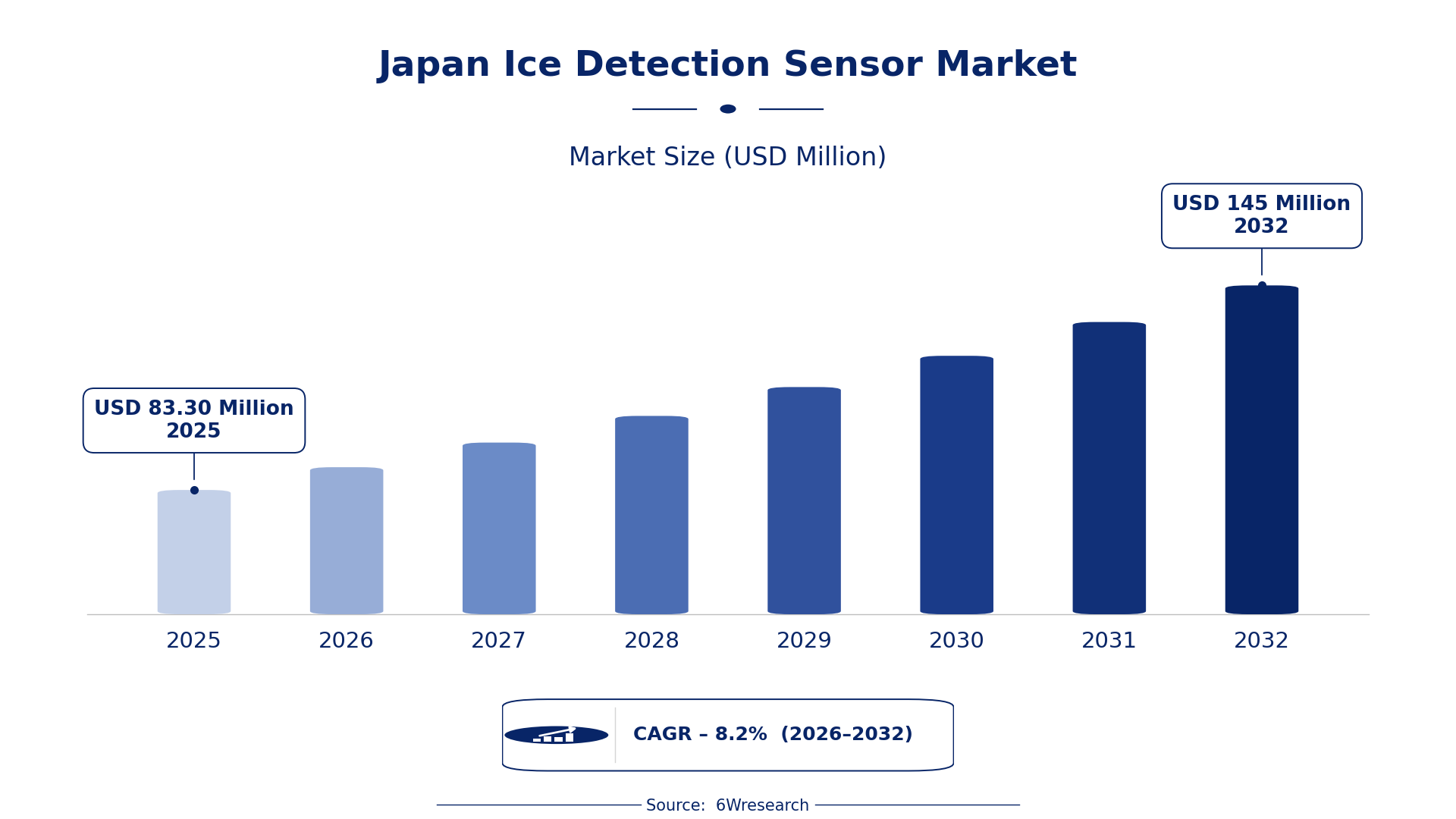
According to 6Wresearch internal database and industry insights, the Japan Ice Detection Sensor Market was valued at USD 83.30 Million in 2025 and is projected to reach USD 145 Million by 2032, growing at a CAGR of approximately 8.2% during 2026–2032.
Japan Ice Detection Sensor Market Highlights
| Report Metric | Details |
| Report Name | Japan Ice Detection Sensor Market (2026-2032) |
| Market Size 2025 | USD 83.30 Million |
| Market Size 2032 | USD 145 Million |
| Absolute Growth 2025–2032 | USD 61.70 Million |
| CAGR 2026–2032 | 8.2% |
| Peak Annual Growth | 9.3% in 2028 |
| Forecast Period | 2026–2032 |
| Historical Data | 2022–2025 |
| Base Year | 2025 |
| Leading Sensor Type, 2025 | Optical Sensors (43% share) |
| Leading Detection Principle, 2025 | Temperature & Conductivity (37% share) |
| Leading Application, 2025 | Aircraft Wings (43% share) |
| Leading End User, 2025 | Aviation OEMs (47% share) |
| Fastest-Growing Sensor Type | Infrared Sensors (12.1% CAGR) |
| Fastest-Growing Detection Principle | Surface Echo Detection (10.5% CAGR) |
| Fastest-Growing Application | Smart Cars (11.4% CAGR) |
| Fastest-Growing End User | ADAS Integrators (10.6% CAGR) |
| Growing Sector | Smart Cars |
| Key End Users | Aircraft Wings, Roads & Bridges, Smart Cars, Wind Turbines |
Japan Ice Detection Sensor Market Year-wise Growth Rate and Key Drivers (2022–2032)
This graph illustrates the annual growth rates of the market from 2022 to 2032, highlighting a steady upward trajectory and projected market expansion over the forecast period.
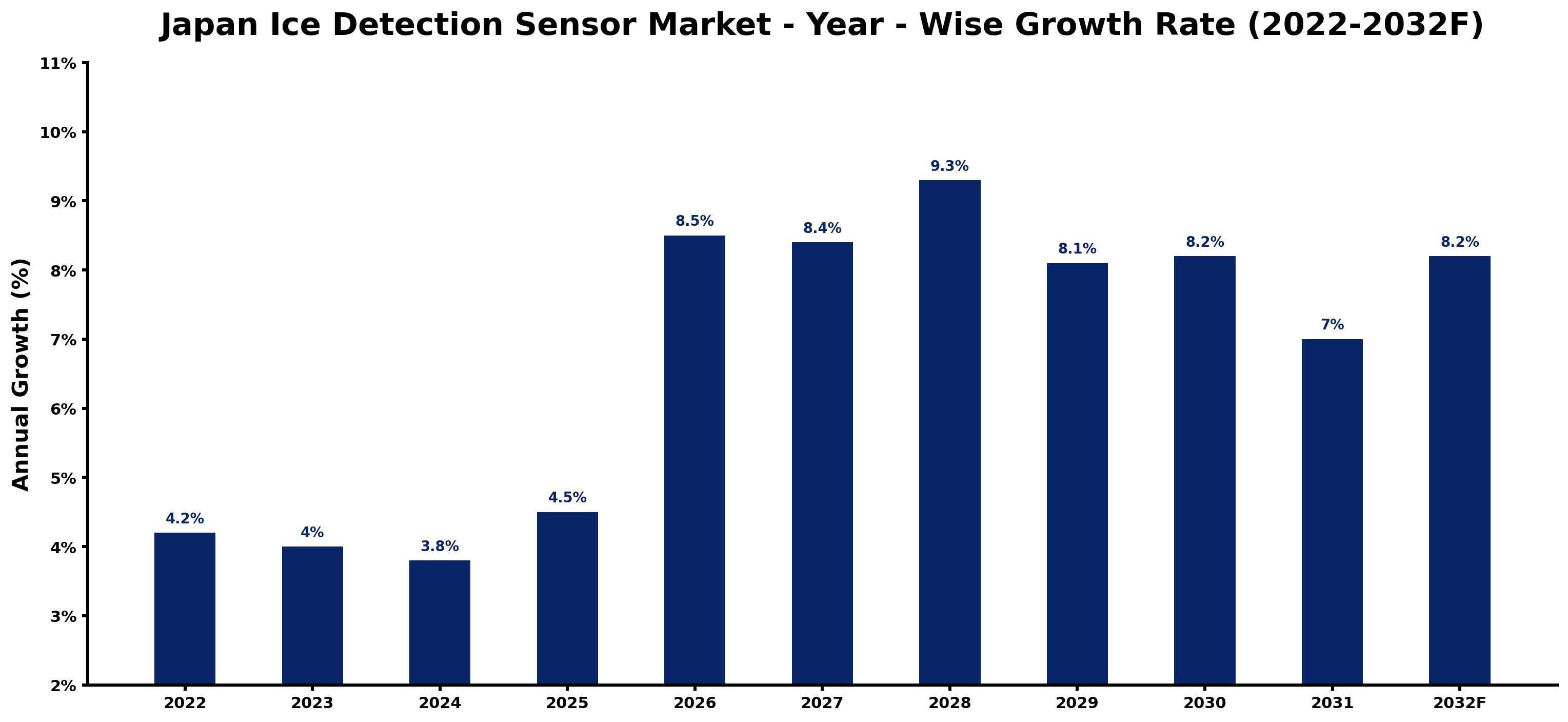
The table below sets out the estimated growth rate for each year and the main factor behind it.
| Year | Estimated Annual Growth (%) | Market Rationale |
| 2022 | 4.2 | The market showed steady growth due to ongoing winter conditions affecting safety measures. |
| 2023 | 4.0 | Growth slowed slightly as demand stabilised amid consistent winter weather patterns. |
| 2024 | 3.8 | Market growth continued to decelerate as the demand plateaued in response to existing installations. |
| 2025 | 4.5 | Demand surged as aviation safety regulations mandated ice detection sensors for commercial aircraft. |
| 2026 | 8.5 | Growth is projected to increase as renewable energy firms adopt sensors for wind turbine efficiency. |
| 2027 | 8.4 | Demand growth is anticipated to slow as the market adjusts to heightened sensor installations in prior years. |
| 2028 | 9.3 | The peak growth year will see investments in smart car technologies integrating ice detection. |
| 2029 | 8.1 | Market growth is expected to decelerate as the focus shifts to optimising existing sensor technologies. |
| 2030 | 8.2 | Demand is projected to rise again as new applications for sensors emerge in urban smart car systems. |
| 2031 | 7.0 | Growth will slow as market saturation begins to impact new installations and innovations. |
| 2032 | 8.2 | Demand is anticipated to rise as advancements in sensor technology improve performance. |
Note: Market size estimations and growth projections presented in this report are based on 6Wresearch's proprietary forecasting methodology, utilizing the latest available industry data, government publications, and primary research inputs.
Japan Ice Detection Sensor Market Synopsis
Ice detection sensors monitor and detect ice formation on surfaces, utilising technologies such as resistive, optical, and ultrasonic methods. These sensors are critical for aviation safety, renewable energy efficiency, and road safety. The Japan Ice Detection Sensor Market is expanding due to increased demand from aviation OEMs and renewable energy firms, alongside stringent regulations and technological advancements, with the Tokyo metropolitan area requiring these systems for safety in aviation operations.
Market Dynamics Impact Analysis (2026–2032)
| Factor | Type | Impact | Primary Segment Affected |
| Increased aviation safety regulations | Driver | High | Aircraft Wings |
| Growing adoption of sensors in renewable energy | Driver | High | Wind Turbines |
| Expansion of smart car technologies | Opportunity | Medium | Smart Cars |
| Rising demand for road safety solutions | Opportunity | Medium | Roads & Bridges |
| High initial investment costs for sensor installation | Restraint | High | Optical Sensors |
| Limited awareness of advanced sensor technologies | Restraint | Medium | Optical Sensors |
| Competition from alternative ice detection methods | Challenge | High | Optical Sensors |
| Technological obsolescence of existing sensors | Challenge | Medium | Optical Sensors |
Evaluation of Drivers in Japan Ice Detection Sensor Market (2026–2032)
Key forces behind demand, with the segment each one moves most, are listed below.
| Drivers | Primary Segment Affected | Why It Matters (Evidence) |
| Increased aviation safety regulations | Aircraft Wings | Aviation safety regulations mandate the use of ice detection sensors on commercial aircraft, driving demand for reliable solutions. |
| Growing adoption of sensors in renewable energy | Wind Turbines | Renewable energy firms are implementing ice detection sensors to optimise wind turbine performance, enhancing operational efficiency. |
| Technological advancements in sensor capabilities | Infrared Sensors | Infrared sensors provide more accurate readings, increasing demand among manufacturers for advanced ice detection solutions. |
| Heavy snowfall in regions like Tohoku | Roads & Bridges | Severe winter conditions necessitate ice detection solutions for public safety on roads. |
| Investment in road safety technologies | Roads & Bridges | The National Highway Authority allocated JPY 1 billion for improving road safety technologies, including ice detection systems. |
In 2023, the National Highway Authority allocated JPY 1 billion for improving road safety technologies, boosting sensor installations on roads and bridges. The Renewable Energy Association of Japan promotes the use of sensors in wind energy applications, increasing operational efficiency. Manufacturers are integrating advanced infrared sensors, leading to higher orders from aviation firms. The growing focus on safety in aviation and transportation sectors is propelling market growth.
Evaluation of Restraints in Japan Ice Detection Sensor Market
Several factors work against faster growth; the main ones are summarised below.
| Market Restraint | Primary Segment Affected | Why It Matters (Evidence) |
| High initial investment costs for sensor installation | Optical Sensors | The upfront costs associated with installing ice detection sensors can deter potential buyers, limiting market penetration. |
| Limited awareness of advanced sensor technologies | Optical Sensors | Many potential users lack knowledge about the benefits and functionalities of modern ice detection sensors, hindering adoption. |
| Competition from alternative ice detection methods | Optical Sensors | Alternative methods for detecting ice may offer lower costs, challenging the market share of ice detection sensors. |
| Technological obsolescence of existing sensors | Optical Sensors | As technology advances, older sensor models may become outdated, leading to reduced demand for replacements. |
| Regulatory compliance challenges | Optical Sensors | Navigating complex regulations can delay sensor adoption, impacting overall market growth. |
Japan Ice Detection Sensor Market Challenges
Ice detection sensors in the Tokyo metropolitan area face intense competition, with numerous suppliers vying for contracts at airports, leading to price reductions that can cut profit margins for producers by up to 15%. In the Hokkaido region, buyers experience erratic demand due to unpredictable winter weather, resulting in procurement delays of up to four weeks for critical safety equipment. Rising production costs, driven by Japan's minimum wage increase to JPY 1,055 per hour, create pressure on suppliers, potentially increasing prices for end-users in aviation and transportation by 10%. Limited adoption of advanced sensing technologies restricts efficiency improvements, impacting both producers and buyers in their operations.
Trends in the Japan Ice Detection Sensor Market
These developments are changing demand patterns in the Japan Ice Detection Sensor Market.
- Shift from Traditional to Smart Ice Detection Systems: The integration of ice detection sensors into smart cars is gaining traction, particularly in urban areas. This trend is reflected in the increasing adoption of optical sensors, which improve vehicle safety and situational awareness.
- Transition from Aviation to Renewable Energy Applications: The focus has shifted from primarily aviation applications to renewable energy uses, particularly in wind turbines. In 2023, the Renewable Energy Association of Japan reported a 20% increase in sensor installations for wind energy efficiency.
- Emergence of Advanced Sensor Technologies: The introduction of infrared sensors in 2026 marked a notable advancement in ice detection technology. These sensors provide more accurate readings, which are important for ensuring safety in aviation and renewable energy sectors.
- Growing Integration of Ice Detection in Road Safety Solutions: The National Highway Authority's 2023 initiative to improve road safety technologies has led to increased demand for ice detection sensors on roads and bridges, highlighting a shift towards enhanced public safety measures.
Investment Opportunities in the Japan Ice Detection Sensor Market
Several openings in the Japan Ice Detection Sensor Market merit attention from investors.
- Investment in Smart Car Technologies: The Tokyo metropolitan area requires advanced ice detection systems for smart cars, with a projected increase in demand by 2025. Collaborating with automotive manufacturers can facilitate market entry.
- Expansion in Renewable Energy Sector: The Tohoku region's renewable energy firms are increasingly adopting ice detection sensors, with a rise in installations expected. Suppliers can enter by partnering with local energy companies.
- Road Safety Improvements: Highway authorities are focusing on enhancing road safety technologies, with a funding boost of JPY 1 billion in 2023. Suppliers can engage with government contracts to provide necessary systems.
- Growth in the Aviation Sector: Aviation OEMs are projected to increase their sensor purchases due to stricter regulations. Suppliers should target partnerships with these manufacturers.
Government Initiatives in the Japan Ice Detection Sensor Market
The Economic Security Promotion Act (2022) supports supply-chain resilience for critical products and materials, strengthening the operational capabilities of ice detection sensor producers. This law complements existing regulations by ensuring that manufacturers can access necessary resources without disruption.
In 2023, the National Highway Authority allocated JPY 1 billion for improving road safety technologies, including ice detection systems. The agency oversees the implementation of these funds to enhance public safety measures across Japan.
Future Insight of the Japan Ice Detection Sensor Market
By 2032, new road safety programmes will integrate advanced ice detection systems, improving safety for drivers and pedestrians. The Renewable Energy Association's initiatives will boost sensor deployment in wind energy applications, increasing operational efficiency. With the Japan Meteorological Agency's data becoming more precise, buyers will benefit from improved forecasting, enabling timely installations. The shift towards advanced sensing technologies will open new market opportunities, aligning with the growing demand for smart transport solutions.
Market Segmentation Analysis
Japan Ice Detection Sensor Market report covers a detailed analysis of the following market segments:
By Sensor Type – Optical Sensors Lead, Infrared Sensors Expected to Grow Fastest
According to Saurav Kr Singh, Senior Research Analyst at 6Wresearch, the largest sensor type category in 2025 was Optical Sensors, at 43% of revenue. Optical sensors lead the market due to their critical role in monitoring ice on aircraft wings, essential for ensuring aviation safety. The high number of airports in the Tokyo metropolitan area drives substantial demand for these sensors. Infrared Sensors are set to record the highest CAGR in this split, 12.1% over 2026–2032. Infrared sensors are experiencing rapid growth as they provide accurate temperature measurements, crucial for detecting ice on various surfaces. Their rising adoption in smart car technologies is significantly contributing to their market acceleration. Suppliers should prioritise the development of advanced infrared sensor technologies to meet the increasing demands in the automotive sector.
By Detection Principle – Temperature & Conductivity Leads, Surface Echo Detection Expected to Grow Fastest
Temperature & Conductivity took 37% of detection principle revenue in 2025, more than any other category. Temperature and conductivity detection methods dominate the market as they are essential for accurately assessing ice formation based on temperature changes. The Japan Meteorological Agency's data on winter weather conditions supports the demand for these reliable detection methods. Over 2026–2032, Surface Echo Detection is expected to post the fastest growth, at a CAGR of 10.5%. Surface echo detection is gaining traction due to its effectiveness in analysing reflected signals to detect ice. This technology's integration into advanced systems is expected to accelerate its adoption in various applications. Buyers should consider investing in surface echo detection technologies to improve their ice monitoring capabilities.
By Application – Aircraft Wings Lead, Smart Cars Expected to Grow Fastest
With 43% of application revenue in 2025, Aircraft Wings was the largest category. Aircraft wings represent the largest application for ice detection sensors, as their use is vital for maintaining safety during winter operations. Aviation safety regulations in Japan mandate these sensors, underscoring their importance in the industry. Smart Cars are projected to grow fastest, at a CAGR of 11.4% during 2026–2032. Smart cars are the fastest-growing application since they enhance vehicle safety by detecting icy road conditions. The increasing focus on advanced driver-assistance systems is driving substantial demand for these sensors in the automotive sector. Suppliers need to concentrate on developing sensors tailored for smart car applications to capitalise on opportunities in this expanding market.
By End User – Aviation OEMs Lead, ADAS Integrators Expected to Grow Fastest
In 2025, Aviation OEMs led the end user split with a 47% share. Aviation OEMs are the primary end users of ice detection sensors, as these devices are essential for ensuring aircraft safety in winter conditions. Stringent aviation safety regulations in Japan necessitate the integration of these sensors into aircraft design. The quickest growth will come from ADAS Integrators, forecast to expand at a CAGR of 10.6% between 2026 and 2032. ADAS integrators are rapidly adopting ice detection sensors to enhance the safety features of advanced driver-assistance systems. The growing demand for smarter vehicle technologies is significantly boosting growth in this segment. Suppliers should align their products with the needs of ADAS integrators to leverage the increasing demand for safety technologies.
Key Attractiveness of the Report
- 10 Years of Market Numbers
- Historical Data Starting from 2022 to 2025
- Base Year 2025
- Forecast Data until 2032
- Key Performance Indicators Impacting the Market
- Major Upcoming Developments and Projects
Key Highlights of the Report:
- Japan Ice Detection Sensor Market Outlook
- Market Size of Japan Ice Detection Sensor Market, 2025
- Forecast of Japan Ice Detection Sensor Market, 2032
- Historical Data and Forecast of Japan Ice Detection Sensor Revenues & Volume for the Period 2022-2032F
- Japan Ice Detection Sensor Market Trend Evolution
- Japan Ice Detection Sensor Market Drivers and Challenges
- Japan Ice Detection Sensor Price Trends
- Japan Ice Detection Sensor Porter's Five Forces
- Japan Ice Detection Sensor Industry Life Cycle
- Historical Data and Forecast of Japan Ice Detection Sensor Market Revenues & Volume By Sensor Type for the Period 2022-2032F
- Historical Data and Forecast of Japan Ice Detection Sensor Market Revenues & Volume By Resistive Sensors for the Period 2022-2032F
- Historical Data and Forecast of Japan Ice Detection Sensor Market Revenues & Volume By Optical Sensors for the Period 2022-2032F
- Historical Data and Forecast of Japan Ice Detection Sensor Market Revenues & Volume By Ultrasonic Sensors for the Period 2022-2032F
- Historical Data and Forecast of Japan Ice Detection Sensor Market Revenues & Volume By Infrared Sensors for the Period 2022-2032F
- Historical Data and Forecast of Japan Ice Detection Sensor Market Revenues & Volume By Detection Principle for the Period 2022-2032F
- Historical Data and Forecast of Japan Ice Detection Sensor Market Revenues & Volume By Temperature & Conductivity for the Period 2022-2032F
- Historical Data and Forecast of Japan Ice Detection Sensor Market Revenues & Volume By Light Scattering for the Period 2022-2032F
- Historical Data and Forecast of Japan Ice Detection Sensor Market Revenues & Volume By Surface Echo Detection for the Period 2022-2032F
- Historical Data and Forecast of Japan Ice Detection Sensor Market Revenues & Volume By Radiation Analysis for the Period 2022-2032F
- Historical Data and Forecast of Japan Ice Detection Sensor Market Revenues & Volume By Application for the Period 2022-2032F
- Historical Data and Forecast of Japan Ice Detection Sensor Market Revenues & Volume By Aircraft Wings for the Period 2022-2032F
- Historical Data and Forecast of Japan Ice Detection Sensor Market Revenues & Volume By Wind Turbines for the Period 2022-2032F
- Historical Data and Forecast of Japan Ice Detection Sensor Market Revenues & Volume By Roads & Bridges for the Period 2022-2032F
- Historical Data and Forecast of Japan Ice Detection Sensor Market Revenues & Volume By Smart Cars for the Period 2022-2032F
- Historical Data and Forecast of Japan Ice Detection Sensor Market Revenues & Volume By End User for the Period 2022-2032F
- Historical Data and Forecast of Japan Ice Detection Sensor Market Revenues & Volume By Aviation OEMs for the Period 2022-2032F
- Historical Data and Forecast of Japan Ice Detection Sensor Market Revenues & Volume By Renewable Energy Firms for the Period 2022-2032F
- Historical Data and Forecast of Japan Ice Detection Sensor Market Revenues & Volume By Highway Authorities for the Period 2022-2032F
- Historical Data and Forecast of Japan Ice Detection Sensor Market Revenues & Volume By ADAS Integrators for the Period 2022-2032F
- Japan Ice Detection Sensor Import Export Trade Statistics
- Market Opportunity Assessment By Sensor Type
- Market Opportunity Assessment By Detection Principle
- Market Opportunity Assessment By Application
- Market Opportunity Assessment By End User
- Japan Ice Detection Sensor Top Companies Market Share
- Japan Ice Detection Sensor Competitive Benchmarking By Technical and Operational Parameters
- Japan Ice Detection Sensor Company Profiles
- Japan Ice Detection Sensor Key Strategic Recommendations
Market Covered
The study includes the following segmentation.
By Sensor Type
- Resistive Sensors
- Optical Sensors
- Ultrasonic Sensors
- Infrared Sensors
By Detection Principle
- Temperature & Conductivity
- Light Scattering
- Surface Echo Detection
- Radiation Analysis
By Application
- Aircraft Wings
- Wind Turbines
- Roads & Bridges
- Smart Cars
By End User
- Aviation OEMs
- Renewable Energy Firms
- Highway Authorities
- ADAS Integrators































