Japan Ice Inhibition Solutions Market Size & Growth Rate
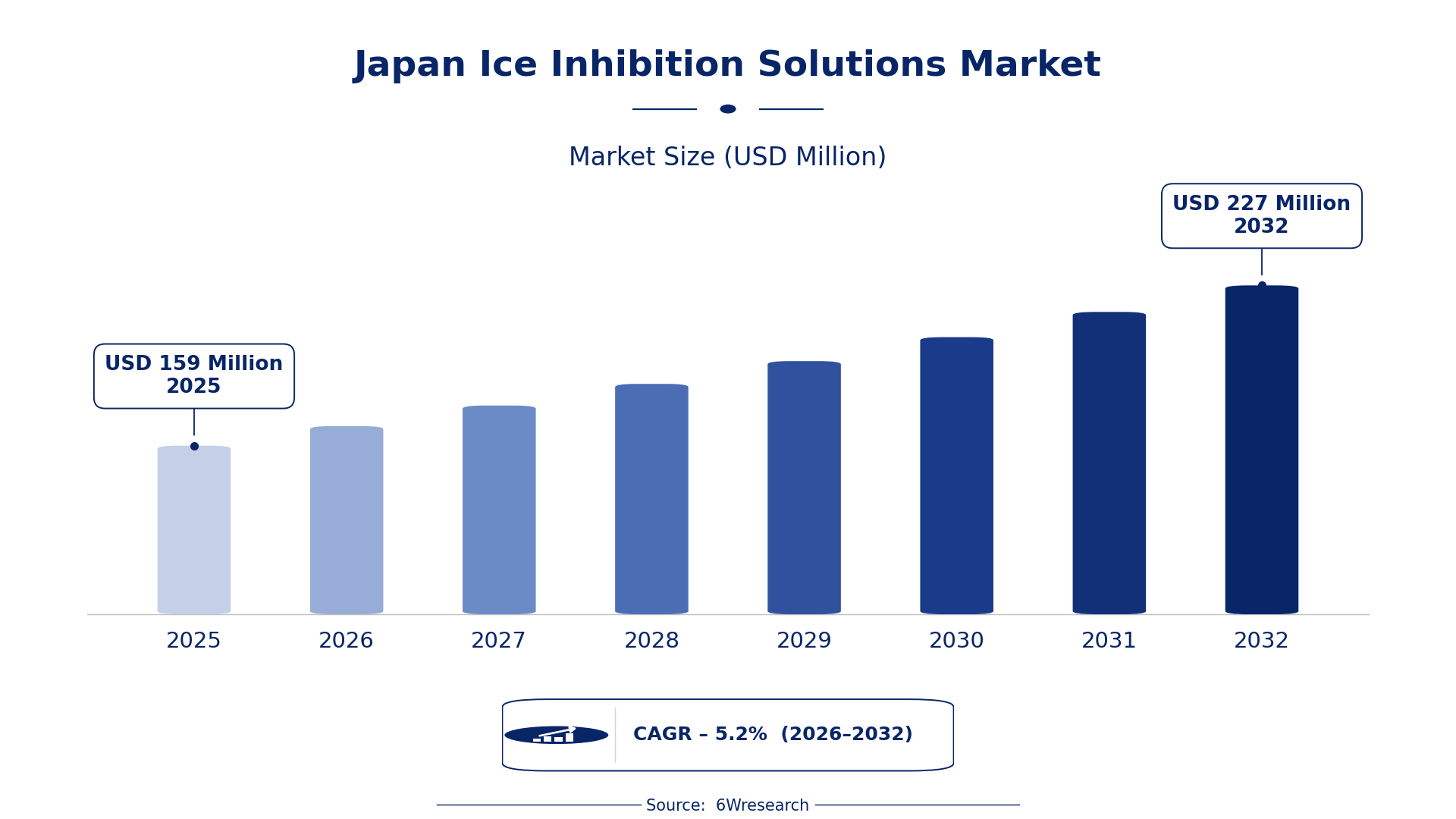
According to 6Wresearch internal database and industry insights, the Japan Ice Inhibition Solutions Market was valued at USD 159 Million in 2025 and is projected to reach USD 227 Million by 2032, growing at a CAGR of approximately 5.2% during 2026–2032.
Japan Ice Inhibition Solutions Market Highlights
| Report Metric | Details |
| Report Name | Japan Ice Inhibition Solutions Market (2026-2032) |
| Market Size 2025 | USD 159 Million |
| Market Size 2032 | USD 227 Million |
| Absolute Growth 2025–2032 | USD 68 Million |
| CAGR 2026–2032 | 5.2% |
| Peak Annual Growth | 6.8% in 2028 |
| Forecast Period | 2026–2032 |
| Historical Data | 2022–2025 |
| Base Year | 2025 |
| Leading Solution Type, 2025 | Glycol-Based Solutions (37% share) |
| Leading Base Material, 2025 | Propylene/Ethylene Glycol (41% share) |
| Leading Application Surface, 2025 | Aviation Wings (41% share) |
| Leading End User, 2025 | Airline Maintenance Crews (39% share) |
| Fastest-Growing Solution Type | Salt-Based Sprays (7.4% CAGR) |
| Fastest-Growing Base Material | Sodium/Calcium Chloride (7.3% CAGR) |
| Fastest-Growing Application Surface | Roads (6.7% CAGR) |
| Fastest-Growing End User | Municipal Road Departments (6.8% CAGR) |
| Growing Sector | road safety |
| Key End Users | municipal road departments, utility companies, airline maintenance crews |
Japan Ice Inhibition Solutions Market Year-wise Growth Rate and Key Drivers (2022–2032)
This graph illustrates the annual growth rates of the market from 2022 to 2032, highlighting a steady upward trajectory and projected market expansion over the forecast period.
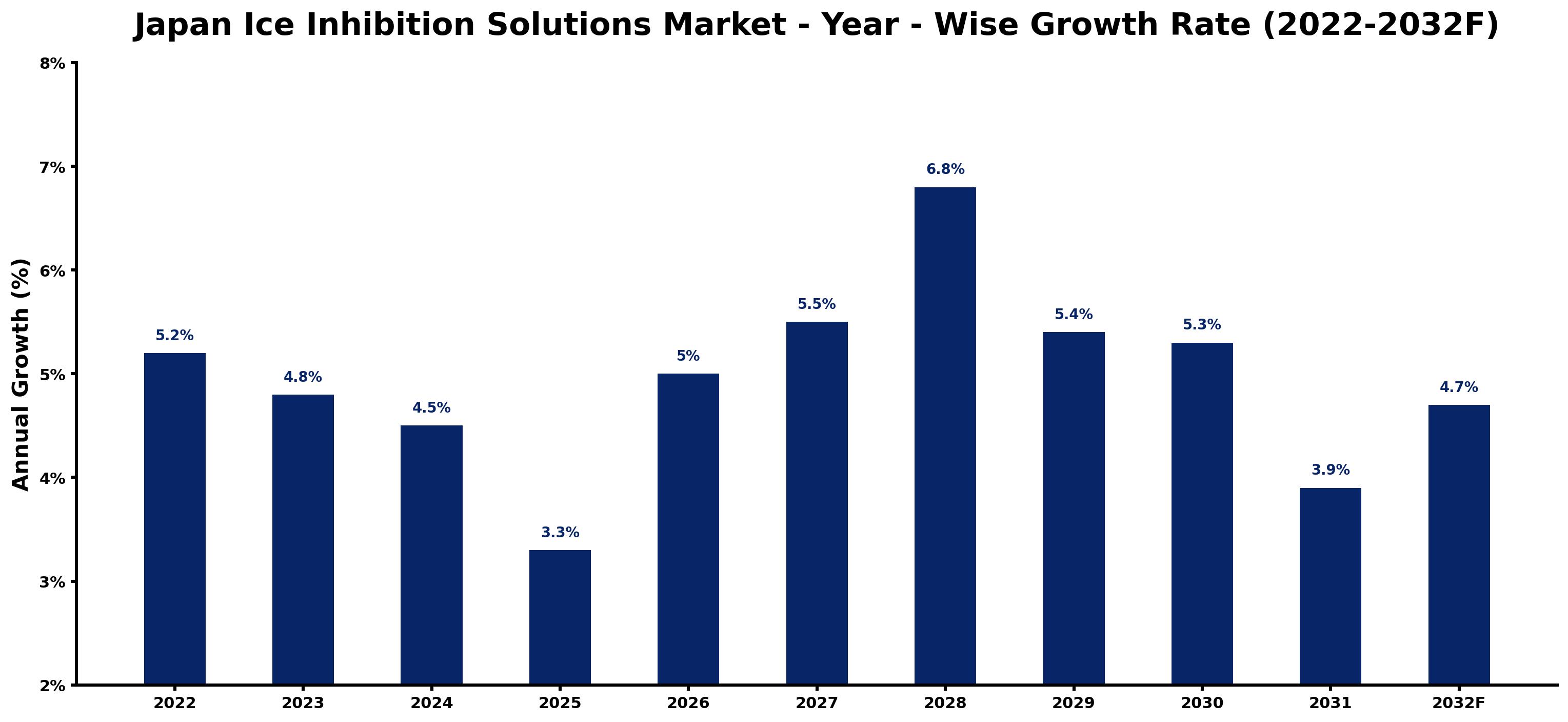
Year by year, the estimates below pair each growth rate with the development that shaped it.
| Year | Estimated Annual Growth (%) | Market Rationale |
| 2022 | 5.2 | Demand was strong due to heavy snowfall in regions like Hokkaido. |
| 2023 | 4.8 | Growth slowed as municipal road departments adjusted their budgets for winter maintenance. |
| 2024 | 4.5 | Market expansion continued but at a reduced rate from previous years due to variable weather conditions. |
| 2025 | 3.3 | Demand growth decelerated as winter conditions varied across regions, impacting purchasing decisions. |
| 2026 | 5.0 | Increased investment in de-icing solutions is expected to boost market growth as winter approaches. |
| 2027 | 5.5 | Demand is projected to rise with heightened focus on road safety during winter months. |
| 2028 | 6.8 | Peak growth will occur as severe winter conditions drive purchases of de-icing solutions. |
| 2029 | 5.4 | Growth is expected to slow as the market stabilises after peak demand during harsh winters. |
| 2030 | 5.3 | Demand will remain steady, supported by ongoing winter maintenance needs and public safety campaigns. |
| 2031 | 3.9 | Growth is projected to decelerate as market conditions normalise post-peak winter demand. |
| 2032 | 4.7 | Demand is expected to rise as sustainable solutions gain traction among municipalities. |
Note: Market size estimations and growth projections presented in this report are based on 6Wresearch's proprietary forecasting methodology, utilizing the latest available industry data, government publications, and primary research inputs.
Japan Ice Inhibition Solutions Market Synopsis
Ice Inhibition Solutions are chemical formulations that prevent ice formation on surfaces, primarily used for de-icing roads, sidewalks, and aviation wings. The Japan Ice Inhibition Solutions Market is growing due to steady demand from municipal road departments and utility companies, driven by heavy winter snowfall, which can exceed 600 cm in regions like Hokkaido. In 2023, the government allocated ¥5 billion for winter road maintenance, further stimulating market growth through enhanced de-icing initiatives and public safety measures.
Market Dynamics Impact Analysis (2026–2032)
| Factor | Type | Impact | Primary Segment Affected |
| Heavy snowfall in regions like Hokkaido drives demand for effective de-icing solutions. | Driver | High | Glycol-Based Solutions |
| Increased focus on road safety leads to higher purchases of de-icing materials. | Driver | High | Salt-Based Sprays |
| Growing interest in eco-friendly solutions presents opportunities for organic anti-icers. | Opportunity | Medium | Organic Anti-Icers |
| The need for effective de-icing on aviation wings opens new markets for suppliers. | Opportunity | High | Aviation Wings |
| Fluctuating winter conditions can lead to inconsistent demand for ice inhibition solutions. | Restraint | Medium | Sodium/Calcium Chloride |
| Regulatory compliance regarding chemical usage may restrict market access for some products. | Restraint | High | Fluorinated Polymers |
| Rising costs of raw materials can pressure suppliers and affect pricing strategies. | Challenge | High | Hydrophobic Nanocoatings |
| Limited capacity for production may hinder suppliers from meeting peak demand periods. | Challenge | Medium | Beet Juice Mix |
Evaluation of Drivers in Japan Ice Inhibition Solutions Market (2026–2032)
The factors lifting demand, and the evidence behind each, are summarised below.
| Drivers | Primary Segment Affected | Why It Matters (Evidence) |
| Heavy snowfall in Hokkaido and Tohoku regions increases demand for de-icing solutions. | Glycol-Based Solutions | Municipal road departments utilize over 100,000 tons of de-icing materials annually, ensuring road safety. |
| Road safety campaigns emphasise the importance of effective de-icing solutions. | Salt-Based Sprays | The average annual snowfall in Hokkaido can exceed 600 cm, necessitating reliable de-icing products. |
| Urbanisation in regions like Tokyo boosts demand for sustainable de-icing services. | Organic Anti-Icers | Sustainable de-icing services are gaining traction in urban areas, reflecting a shift towards eco-friendly solutions. |
| Airports implement de-icing procedures on numerous aircraft daily during winter. | Aviation Wings | Increased air traffic during winter necessitates effective de-icing solutions for aircraft safety. |
| Utility companies report increased demand for ice inhibition solutions during winter months. | Sodium/Calcium Chloride | This is essential for maintaining infrastructure and public safety during harsh winter conditions. |
What keeps demand rising is the heavy snowfall in regions like Hokkaido, where the average annual snowfall can exceed 600 cm. Municipal road departments utilise over 100,000 tons of de-icing materials each year, creating a need for effective solutions to ensure public safety. Increased air traffic during winter necessitates reliable de-icing products for airports managing procedures on numerous aircraft daily. Urbanisation in Tokyo boosts demand for sustainable de-icing services, reflecting a shift towards eco-friendly solutions. Utility companies also report heightened demand during winter months, further supporting the market's growth.
Evaluation of Restraints in Japan Ice Inhibition Solutions Market
The main factors holding the market back are set out below.
| Market Restraint | Primary Segment Affected | Why It Matters (Evidence) |
| Fluctuating winter conditions can lead to inconsistent demand for ice inhibition solutions. | Sodium/Calcium Chloride | Variable snowfall affects purchasing decisions by municipal road departments, impacting their budgets. |
| Regulatory compliance regarding chemical usage may restrict market access for some products. | Fluorinated Polymers | Producers must adhere to stringent JIS standards for de-icing chemicals, limiting some product offerings. |
| Rising costs of raw materials can pressure suppliers and affect pricing strategies. | Hydrophobic Nanocoatings | Increased production costs may deter manufacturers from expanding their product offerings in the market. |
| Limited capacity for production may hinder suppliers from meeting peak demand periods. | Beet Juice Mix | Seasonal spikes in demand can overwhelm existing production capabilities, affecting supply reliability. |
| Environmental concerns may limit the use of traditional de-icing agents. | Salt-Based Sprays | Local agencies promote eco-friendly alternatives, impacting traditional sales and market dynamics. |
Japan Ice Inhibition Solutions Market Challenges
High costs for ice inhibition solutions burden municipal budgets, with over ¥5 billion allocated for winter road maintenance in 2023. Intense competition among suppliers drives down prices, which can compromise quality and increase safety risks for utility companies. A shortage of skilled workers in winter maintenance results in slower response times, delaying effective de-icing during heavy snowfall for municipalities. Supply chain issues arise from reliance on specific chemical formulations, causing delays that leave cities unprepared for severe conditions in regions like Hokkaido.
Trends in the Japan Ice Inhibition Solutions Market
The trends below show where the Japan Ice Inhibition Solutions Market is heading.
- Shift towards Sustainable De-Icing Practices: In 2023, the government launched a new initiative to promote sustainable winter maintenance practices. This trend is visible in urban areas like Tokyo, where sustainable de-icing services are gaining traction, reflecting a growing demand for eco-friendly solutions.
- Transition from Traditional to Organic Solutions: Local environmental agencies promote the use of organic anti-icers, particularly in regions with strict regulations. This shift is gaining momentum as municipalities trial eco-friendly alternatives to conventional de-icing agents.
- Emergence of Hydrophobic Nanocoatings: The adoption of hydrophobic nanocoatings is being explored for long-term ice prevention. This technology is currently being tested in various regions, with promising results indicating potential for widespread application in the future.
- Increased Focus on Aviation Safety: Airports are implementing enhanced de-icing procedures for numerous aircraft daily during winter. This focus on aviation safety is driving demand for effective ice inhibition solutions in the aviation sector.
Investment Opportunities in the Japan Ice Inhibition Solutions Market
The openings below show where demand in the Japan Ice Inhibition Solutions Market is visible and how suppliers can enter.
- Partner with Local Municipalities: Local road departments are seeking effective de-icing solutions, particularly in regions like Hokkaido. With annual snowfall exceeding 600 cm, suppliers can enter through partnerships to provide products tailored to municipal needs.
- Invest in Eco-Friendly Solutions: Municipalities are increasingly interested in sustainable de-icing options, particularly in urban areas. Suppliers can capitalise on this trend by offering organic anti-icers and gaining certifications like ISO 14001 to enhance market access.
- Expand Offerings for Aviation Wings: Airports are implementing de-icing procedures on numerous aircraft daily during winter. This presents an opportunity for suppliers to enhance their product lines specifically for aviation applications, ensuring compliance with safety standards.
- Focus on Utility Companies: Utility companies report increased demand for ice inhibition solutions during winter months. Suppliers can target this sector by providing tailored solutions that ensure infrastructure safety and reliability during harsh weather.
Government Initiatives in the Japan Ice Inhibition Solutions Market
The GX Promotion Act, initiated in 2023, establishes a framework for sustainable winter maintenance practices, building on previous regulations. This act encourages the adoption of eco-friendly de-icing solutions, aligning with Japan's broader environmental goals and setting standards for chemical usage in the market.
In 2023, the government allocated ¥5 billion for winter road maintenance initiatives, overseen by the Ministry of Land, Infrastructure, Transport and Tourism. This funding supports the implementation of effective de-icing solutions, ensuring public safety during harsh winter conditions and enhancing infrastructure resilience.
Future Insight of the Japan Ice Inhibition Solutions Market
A policy-driven shift towards sustainable winter maintenance practices will reshape the market by 2032. Increased government funding will support eco-friendly initiatives, leading to broader adoption of organic solutions. Municipalities will implement advanced de-icing technologies, including trials of eco-friendly alternatives, to ensure effective ice prevention. Research by the Japan Society of Civil Engineers will drive innovations that improve road safety for the population, particularly in snow-prone areas.
Market Segmentation Analysis
Japan Ice Inhibition Solutions Market report covers a detailed analysis of the following market segments:
By Solution Type – Glycol-Based Solutions Lead, Salt-Based Sprays Expected to Grow Fastest
According to Saurav Kr Singh, Senior Research Analyst at 6Wresearch, in 2025, Glycol-Based Solutions led the solution type split with a 37% share. Glycol-Based Solutions hold the largest share due to their effective performance in de-icing applications, particularly in regions like Hokkaido where heavy snowfall is common. Municipal road departments rely heavily on these solutions, utilising over 100,000 tons annually for winter maintenance. Salt-Based Sprays are projected to grow fastest, at a CAGR of 7.4% during 2026–2032. Salt-Based Sprays are experiencing rapid growth as they are commonly applied on roads and sidewalks, meeting the urgent demand for ice control during harsh winters. Their cost-effectiveness and ease of application make them increasingly popular among municipal users. Suppliers should focus on expanding their offerings of salt-based sprays to capture the growing demand in urban areas.
By Base Material – Propylene/Ethylene Glycol Leads, Sodium/Calcium Chloride Expected to Grow Fastest
Propylene/Ethylene Glycol held 41% of the Japan Ice Inhibition Solutions Market by base material in 2025. Propylene/Ethylene Glycol is the leading base material as it is the primary component in many de-icing solutions, ensuring effective performance in severe winter conditions. Its widespread use in municipal applications solidifies its dominant position in the market. Over 2026–2032, Sodium/Calcium Chloride is expected to post the fastest growth, at a CAGR of 7.3%. Sodium/Calcium Chloride is the fastest-growing base material due to its status as a traditional de-icing agent that is widely used for its affordability and effectiveness. Increased adoption by municipal road departments during winter months is driving this growth. Buyers should consider sourcing sodium/calcium chloride to benefit from its cost advantages and effectiveness in ice prevention.
By Application Surface – Aviation Wings Lead, Roads Expected to Grow Fastest
With 41% of application surface revenue in 2025, Aviation Wings was the largest category. Aviation Wings capture the largest share because they are vital for maintaining aircraft safety during winter operations. The stringent de-icing protocols at airports, which service over 1,000 aircraft daily, highlight the importance of this application. Roads are set to record the highest CAGR in this split, 6.7% over 2026–2032. Roads are the fastest-growing application surface, driven by heightened public safety initiatives and an increase in road safety campaigns. Municipal road departments are prioritising effective de-icing solutions to address the urgent need for improved winter road maintenance. This suggests that suppliers must concentrate on developing tailored solutions for road applications to meet the increasing demand for safety and efficiency.
By End User – Airline Maintenance Crews Lead, Municipal Road Departments Expected to Grow Fastest
Airline Maintenance Crews accounted for 39% of the market by end user in 2025. Airline Maintenance Crews are the leading end user as their operations are essential for safe aircraft operations during winter months. The high volume of de-icing procedures conducted daily at airports underscores their critical role in the market. The quickest growth will come from Municipal Road Departments, forecast to expand at a CAGR of 6.8% between 2026 and 2032. Municipal Road Departments are the fastest-growing end user segment, reflecting the increasing demand for effective ice inhibition solutions to ensure public road safety. Their reliance on de-icing materials during winter months is driving this growth. Suppliers should strengthen relationships with municipal road departments to align with their growing needs for effective winter maintenance solutions.
Key Attractiveness of the Report
- 10 Years of Market Numbers
- Historical Data Starting from 2022 to 2025
- Base Year 2025
- Forecast Data until 2032
- Key Performance Indicators Impacting the Market
- Major Upcoming Developments and Projects
Key Highlights of the Report:
- Japan Ice Inhibition Solutions Market Outlook
- Market Size of Japan Ice Inhibition Solutions Market, 2025
- Forecast of Japan Ice Inhibition Solutions Market, 2032
- Historical Data and Forecast of Japan Ice Inhibition Solutions Revenues & Volume for the Period 2022-2032F
- Japan Ice Inhibition Solutions Market Trend Evolution
- Japan Ice Inhibition Solutions Market Drivers and Challenges
- Japan Ice Inhibition Solutions Price Trends
- Japan Ice Inhibition Solutions Porter's Five Forces
- Japan Ice Inhibition Solutions Industry Life Cycle
- Historical Data and Forecast of Japan Ice Inhibition Solutions Market Revenues & Volume By Solution Type for the Period 2022-2032F
- Historical Data and Forecast of Japan Ice Inhibition Solutions Market Revenues & Volume By Glycol-Based Solutions for the Period 2022-2032F
- Historical Data and Forecast of Japan Ice Inhibition Solutions Market Revenues & Volume By Salt-Based Sprays for the Period 2022-2032F
- Historical Data and Forecast of Japan Ice Inhibition Solutions Market Revenues & Volume By Organic Anti-Icers for the Period 2022-2032F
- Historical Data and Forecast of Japan Ice Inhibition Solutions Market Revenues & Volume By Hydrophobic Nanocoatings for the Period 2022-2032F
- Historical Data and Forecast of Japan Ice Inhibition Solutions Market Revenues & Volume By Base Material for the Period 2022-2032F
- Historical Data and Forecast of Japan Ice Inhibition Solutions Market Revenues & Volume By Propylene/Ethylene Glycol for the Period 2022-2032F
- Historical Data and Forecast of Japan Ice Inhibition Solutions Market Revenues & Volume By Sodium/Calcium Chloride for the Period 2022-2032F
- Historical Data and Forecast of Japan Ice Inhibition Solutions Market Revenues & Volume By Beet Juice Mix for the Period 2022-2032F
- Historical Data and Forecast of Japan Ice Inhibition Solutions Market Revenues & Volume By Fluorinated Polymers for the Period 2022-2032F
- Historical Data and Forecast of Japan Ice Inhibition Solutions Market Revenues & Volume By Application Surface for the Period 2022-2032F
- Historical Data and Forecast of Japan Ice Inhibition Solutions Market Revenues & Volume By Aviation Wings for the Period 2022-2032F
- Historical Data and Forecast of Japan Ice Inhibition Solutions Market Revenues & Volume By Roads for the Period 2022-2032F
- Historical Data and Forecast of Japan Ice Inhibition Solutions Market Revenues & Volume By Sidewalks for the Period 2022-2032F
- Historical Data and Forecast of Japan Ice Inhibition Solutions Market Revenues & Volume By Power Lines for the Period 2022-2032F
- Historical Data and Forecast of Japan Ice Inhibition Solutions Market Revenues & Volume By End User for the Period 2022-2032F
- Historical Data and Forecast of Japan Ice Inhibition Solutions Market Revenues & Volume By Airline Maintenance Crews for the Period 2022-2032F
- Historical Data and Forecast of Japan Ice Inhibition Solutions Market Revenues & Volume By Municipal Road Departments for the Period 2022-2032F
- Historical Data and Forecast of Japan Ice Inhibition Solutions Market Revenues & Volume By Sustainable De-Icing Services for the Period 2022-2032F
- Historical Data and Forecast of Japan Ice Inhibition Solutions Market Revenues & Volume By Utility Companies for the Period 2022-2032F
- Japan Ice Inhibition Solutions Import Export Trade Statistics
- Market Opportunity Assessment By Solution Type
- Market Opportunity Assessment By Base Material
- Market Opportunity Assessment By Application Surface
- Market Opportunity Assessment By End User
- Japan Ice Inhibition Solutions Top Companies Market Share
- Japan Ice Inhibition Solutions Competitive Benchmarking By Technical and Operational Parameters
- Japan Ice Inhibition Solutions Company Profiles
- Japan Ice Inhibition Solutions Key Strategic Recommendations
Market Covered
The report covers the following segments.
By Solution Type
- Glycol-Based Solutions
- Salt-Based Sprays
- Organic Anti-Icers
- Hydrophobic Nanocoatings
By Base Material
- Propylene/Ethylene Glycol
- Sodium/Calcium Chloride
- Beet Juice Mix
- Fluorinated Polymers
By Application Surface
- Aviation Wings
- Roads
- Sidewalks
- Power Lines
By End User
- Airline Maintenance Crews
- Municipal Road Departments
- Sustainable De-Icing Services
- Utility Companies































