Japan Icephobic Coatings Market Size & Growth Rate
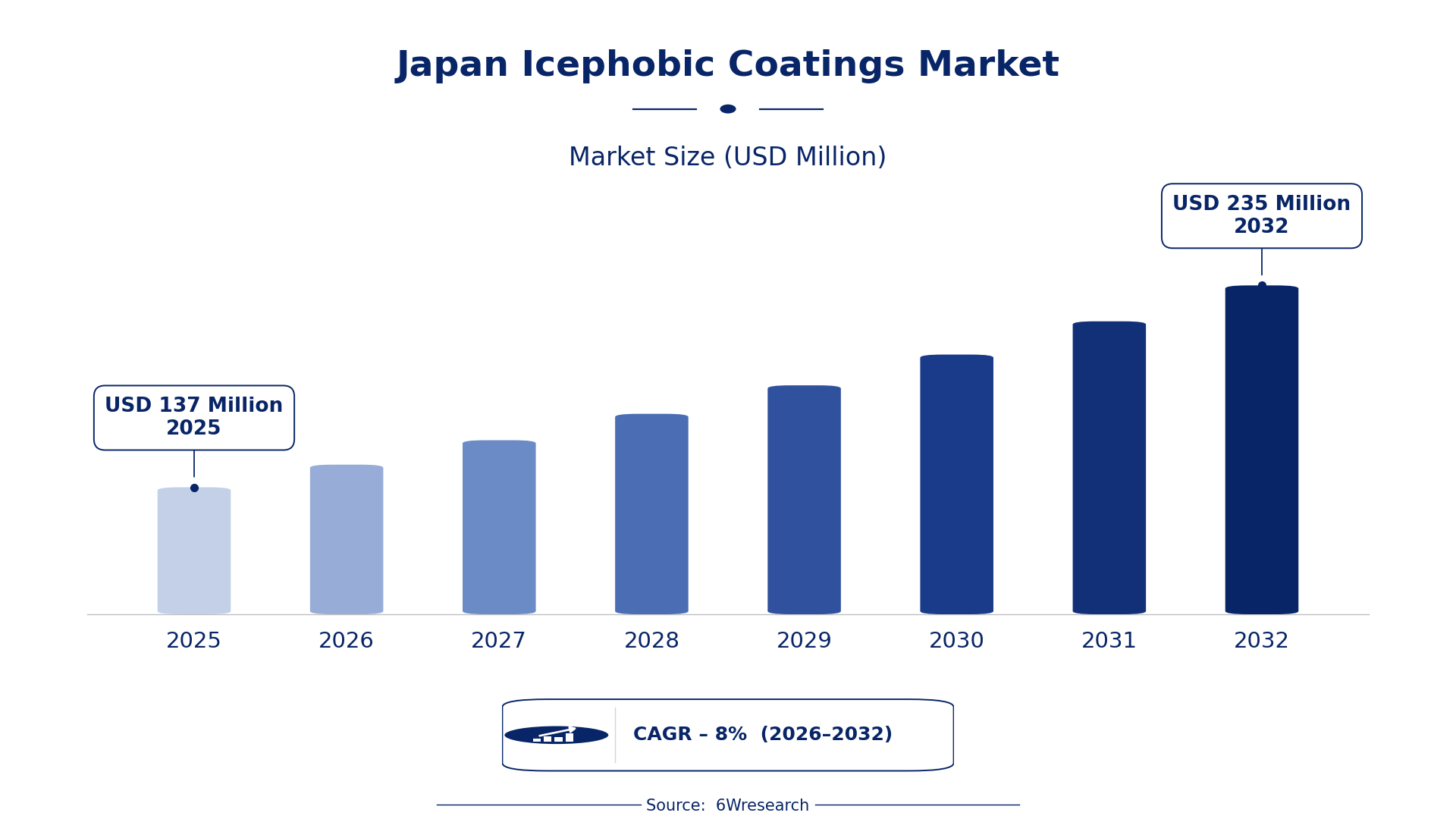
According to 6Wresearch internal database and industry insights, the Japan Icephobic Coatings Market was valued at USD 137 Million in 2025 and is projected to reach USD 235 Million by 2032, growing at a CAGR of approximately 8% during 2026–2032.
Japan Icephobic Coatings Market Highlights
| Report Metric | Details |
| Report Name | Japan Icephobic Coatings Market (2026-2032) |
| Market Size 2025 | USD 137 Million |
| Market Size 2032 | USD 235 Million |
| Absolute Growth 2025–2032 | USD 98 Million |
| CAGR 2026–2032 | 8% |
| Peak Annual Growth | 8.7% in 2032 |
| Forecast Period | 2026–2032 |
| Historical Data | 2022–2025 |
| Base Year | 2025 |
| Leading Coating Type, 2025 | Superhydrophobic Coatings (40% share) |
| Leading Functional Mechanism, 2025 | Water Repellence (42% share) |
| Leading Target Application, 2025 | Aircraft Surfaces (36% share) |
| Leading End User, 2025 | Aerospace OEMs (38% share) |
| Fastest-Growing Coating Type | Low Surface Energy Coatings (11.3% CAGR) |
| Fastest-Growing Functional Mechanism | Ice Detachment Ease (10.4% CAGR) |
| Fastest-Growing Target Application | Wind Turbines (11.4% CAGR) |
| Fastest-Growing End User | Renewable Energy Firms (10.7% CAGR) |
| Growing Sector | Aerospace |
| Key End Users | Aerospace OEMs, Renewable Energy Firms, UAV Manufacturers |
Japan Icephobic Coatings Market Year-wise Growth Rate and Key Drivers (2022–2032)
This graph illustrates the annual growth rates of the market from 2022 to 2032, highlighting a steady upward trajectory and projected market expansion over the forecast period.
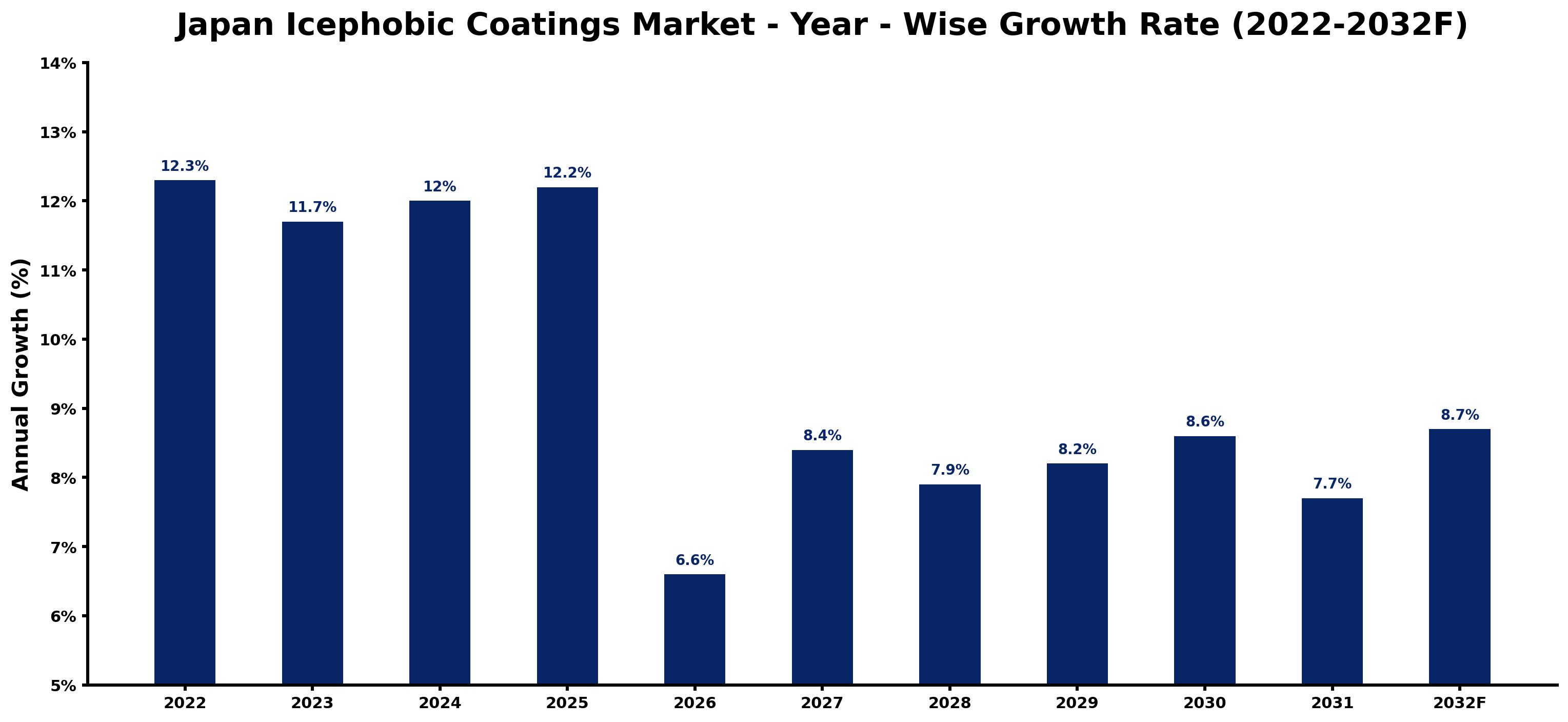
The following figures match every annual growth estimate with the main market development of that year, giving the reasoning behind each rise or slowdown.
| Year | Estimated Annual Growth (%) | Market Rationale |
| 2022 | 12.3 | The market experienced strong demand due to advancements in coating technology and increased aerospace activities. |
| 2023 | 11.7 | Growth slowed as the market adjusted to previous high levels of activity while still expanding. |
| 2024 | 12.0 | Demand increased as aerospace manufacturers adopted new coatings for improved performance. |
| 2025 | 12.2 | The market continued to grow as the adoption of icephobic coatings in renewable energy expanded. |
| 2026 | 6.6 | Growth is expected to slow as the market faces capacity constraints in production and supply chain issues. |
| 2027 | 8.4 | Demand is projected to pick up again as new technologies in coatings are introduced to the market. |
| 2028 | 7.9 | Growth is expected to slow as the market stabilises after a period of rapid expansion in previous years. |
| 2029 | 8.2 | Demand is projected to increase due to the rising need for ice-resistant technologies in UAV applications. |
| 2030 | 8.6 | Growth is expected to continue as investments in advanced materials for aerospace and renewable energy surge. |
| 2031 | 7.7 | The market is projected to experience a slowdown as competition intensifies among coating manufacturers. |
| 2032 | 8.7 | Demand is expected to surge as the aerospace sector adopts new standards for icephobic coatings. |
Note: Market size estimations and growth projections presented in this report are based on 6Wresearch's proprietary forecasting methodology, utilizing the latest available industry data, government publications, and primary research inputs.
Japan Icephobic Coatings Market Synopsis
Icephobic coatings are advanced materials designed to prevent ice accumulation on surfaces, primarily made using polymer chemistry and nanotechnology. Their main applications are in aerospace, renewable energy, and automotive sectors, particularly in environments prone to icing. The Japan Icephobic Coatings Market is expanding due to rising demand from aerospace manufacturers and renewable energy firms, driven by the need for improved performance and safety. In 2023, notable technological advancements are increasing adoption across various applications, particularly in wind energy and UAV sectors.
Market Dynamics Impact Analysis (2026–2032)
| Factor | Type | Impact | Primary Segment Affected |
| Rising demand from the aerospace industry for enhanced safety and performance | Driver | High | Water Repellence |
| Increasing adoption of icephobic coatings in wind energy applications | Driver | High | Wind Turbines |
| Growing interest in eco-friendly coating technologies | Opportunity | Medium | Low Surface Energy Coatings |
| Expansion of UAV applications requiring ice-resistant coatings | Opportunity | Medium | Drones/Unmanned Aircraft |
| High production costs of advanced coatings limiting market entry | Restraint | High | Superhydrophobic Coatings |
| Limited awareness among potential users about the benefits of icephobic coatings | Restraint | Medium | Elastomeric Coatings |
| Capacity constraints in production facilities affecting supply | Challenge | High | Phase-Change Coatings |
| Compliance with stringent regulations on chemical substances | Challenge | Medium | Low Surface Energy Coatings |
Evaluation of Drivers in Japan Icephobic Coatings Market (2026–2032)
The main growth drivers and the segments they affect most are set out below.
| Drivers | Primary Segment Affected | Why It Matters (Evidence) |
| Increased investments in aerospace technologies | Water Repellence | The aerospace sector in Japan is investing heavily in advanced materials, leading to a projected growth of 12% in demand for icephobic coatings. |
| Expansion of wind energy capacity | Wind Turbines | The total installed capacity of wind energy in Japan reached 4.4 GW as of 2022, driving demand for icephobic coatings. |
| Technological advancements in coating formulations | Low Surface Energy Coatings | New formulations are being developed, increasing demand from manufacturers looking for improved performance. |
| Rising production of UAVs | Drones/Unmanned Aircraft | The expected growth in UAV demand is pushing manufacturers to seek specialized coatings for operational reliability. |
| Focus on eco-friendly materials | Superhydrophobic Coatings | Support for initiatives promoting eco-friendly coating technologies is boosting market interest. |
Purchasing is picking up as the aerospace industry increases its investments in advanced materials, with a projected growth of 12% in demand for icephobic coatings. The total installed capacity of wind energy in Japan reached 4.4 GW as of 2022, driving the need for coatings that improve energy efficiency. New formulations are being developed, leading to greater adoption among manufacturers. The expected growth in UAV demand pushes manufacturers to seek specialized coatings for operational reliability. Increased interest in sustainable technologies is driving demand for eco-friendly solutions in the coatings market.
Evaluation of Restraints in Japan Icephobic Coatings Market
The table below lists the restraints and the evidence behind each.
| Market Restraint | Primary Segment Affected | Why It Matters (Evidence) |
| High production costs of advanced coatings limiting market entry | Superhydrophobic Coatings | Production costs for advanced coatings can exceed 20% of total project budgets, deterring potential entrants. |
| Limited awareness among potential users about the benefits of icephobic coatings | Elastomeric Coatings | Many potential users remain unaware of the advantages, resulting in lower adoption rates in various sectors. |
| Production capacity limitations affecting supply | Phase-Change Coatings | Manufacturers face challenges in scaling production to meet rising demand, impacting delivery timelines. |
| Compliance with stringent regulations on chemical substances | Low Surface Energy Coatings | Manufacturers must navigate complex regulations, increasing compliance costs and delaying product launches. |
| Market fragmentation leading to intense competition | Water Repellence | Numerous small players in the market create price pressures, affecting profitability for established firms. |
Japan Icephobic Coatings Market Challenges
Manufacturers incur higher production costs due to a limited number of local suppliers for raw materials, raising expenses by up to 15% for producers. Delays arise from the need to comply with ISO 9001 standards, impacting product launch timelines and reducing competitiveness for producers. Buyers in the aerospace sector face price increases as the demand for icephobic coatings outstrips supply, leading to procurement costs rising by 10%. Continuous technological advancements require substantial investments from producers, straining budgets and potentially delaying innovation in product development.
Trends in the Japan Icephobic Coatings Market
The following changes are redrawing the Japan Icephobic Coatings Market.
- Shift from Conventional to Advanced Coatings: Since 2023, the Japanese aerospace sector has been transitioning from conventional coatings to advanced icephobic solutions. This shift is illustrated by the increasing adoption of these technologies to improve performance and safety in aircraft.
- Emergence of Eco-Friendly Coating Solutions: In 2023, initiatives to promote eco-friendly coating technologies gained traction, particularly in the renewable energy sector. This trend is reflected in the increasing number of projects focused on sustainable product offerings, enhancing market potential.
- Increased Demand for UAVs: The demand for UAVs has surged since 2022, prompting manufacturers to seek specialized ice-resistant coatings. This growth is supported by the increasing number of projects focused on UAV technology development and integration.
- Adoption of Nanotechnology in Coatings: The use of nanotechnology in icephobic coatings has become more prevalent since 2023, improving performance characteristics. Ongoing research is enhancing coating effectiveness, driving interest across various sectors.
Investment Opportunities in the Japan Icephobic Coatings Market
The openings below show where demand in the Japan Icephobic Coatings Market is visible and how suppliers can enter.
- Timing for Investment in Eco-Friendly Coatings: With increasing regulations promoting eco-friendly technologies, now is an ideal time to invest in low surface energy coatings. The support for these initiatives provides a clear pathway for market entry, particularly in the renewable energy sector.
- Gap in UAV Coating Solutions: The expected growth in UAV demand presents a notable gap in the market for specialized coatings. Targeting UAV manufacturers in regions like Tokyo could yield substantial returns as demand rises for reliable ice-resistant solutions.
- Investment in Wind Energy Coatings: The total installed capacity of wind energy in Japan reached 4.4 GW, indicating a strong market for icephobic coatings. Suppliers can engage with renewable energy firms to provide tailored solutions that enhance energy efficiency.
- Focus on Aerospace Applications: The aerospace sector's increasing focus on advanced materials creates an opportunity for suppliers of icephobic coatings. Collaborating with aerospace OEMs in Nagoya could facilitate market penetration and drive growth.
Government Initiatives in the Japan Icephobic Coatings Market
The regulatory environment for icephobic coatings is shaped by several laws, including the Chemical Substances Control Law of 1973, which mandates the evaluation of chemical substances in manufacturing. The Industrial Standardization Act of 1949, amended in 2019, governs product standards, ensuring quality and safety in coatings. These regulations promote the development and use of advanced materials in various sectors, including aerospace and renewable energy.
In 2023, Japan initiated a program to promote renewable energy technologies, including icephobic coatings for wind turbines, funded by the Ministry of the Environment. This initiative aims to support research and development projects, increasing the adoption of advanced coatings in the renewable energy sector. The program has allocated substantial funding to enhance the integration of these technologies.
Future Insight of the Japan Icephobic Coatings Market
Aerospace buyers will see enhanced aircraft performance through advancements in self-healing icephobic coatings by 2032. The renewable energy sector will gain efficiency in wind energy applications as advanced coatings gain traction, driven by government initiatives. Research institutions will spearhead the development of new materials, increasing collaboration between academia and industry. By 2032, the total installed capacity of wind energy in Japan is expected to reach 10 GW, creating new opportunities for innovative coating solutions.
Market Segmentation Analysis
Japan Icephobic Coatings Market report covers a detailed analysis of the following market segments:
By Coating Type – Superhydrophobic Coatings Lead, Low Surface Energy Coatings Expected to Grow Fastest
According to Saurav Kr Singh, Senior Research Analyst at 6Wresearch, in 2025, Superhydrophobic Coatings led the coating type split with a 40% share. Superhydrophobic coatings dominate the market as they effectively prevent ice buildup, particularly in the aerospace sector. Their essential role in maintaining aircraft performance and safety in key industrial regions like Tokyo and Nagoya underscores their significance. Over 2026–2032, Low Surface Energy Coatings are expected to post the fastest growth, at a CAGR of 11.3%. Low surface energy coatings are rapidly gaining traction due to their ability to enhance ice detachment, crucial for operational efficiency in wind turbines. The recent programme launched in 2023 to boost renewable energy technologies further accelerates this segment's growth. Suppliers should concentrate on developing low surface energy coatings to align with the increasing demand in the renewable energy sector.
By Functional Mechanism – Water Repellence Leads, Ice Detachment Ease Expected to Grow Fastest
The largest functional mechanism category in 2025 was Water Repellence, at 42% of revenue. Water repellence is vital for icephobic coatings, as it effectively prevents ice formation on surfaces, especially in aviation applications. This mechanism is essential for ensuring aircraft safety and reliability in icy environments, making it a key consideration for manufacturers. Ice Detachment Ease is set to record the highest CAGR in this split, 10.4% over 2026–2032. Ice detachment ease is becoming increasingly important due to its significant impact on aviation safety, particularly as the demand for efficient ice management rises. The aerospace industry's commitment to safety is driving the swift growth of this mechanism. Buyers should prioritise coatings that exhibit excellent ice detachment properties to ensure operational safety.
By Target Application – Aircraft Surfaces Lead, Wind Turbines Expected to Grow Fastest
Aircraft Surfaces held 36% of the Japan Icephobic Coatings Market by target application in 2025. Aircraft surfaces are the leading application for icephobic coatings, essential for maintaining flight performance and safety. The stringent standards in the aerospace sector make this application a primary focus for manufacturers. Wind Turbines are projected to grow fastest, at a CAGR of 11.4% during 2026–2032. Wind turbines are the fastest-growing application for icephobic coatings, driven by the need to improve energy efficiency in renewable sources. With Japan's wind energy capacity reaching 4.4 GW, this segment is set for substantial growth. Suppliers must align their offerings with the increasing demand in the wind energy sector.
By End User – Aerospace OEMs Lead, Renewable Energy Firms Expected to Grow Fastest
With 38% of end user revenue in 2025, Aerospace OEMs was the largest category. Aerospace OEMs represent the largest end user group for icephobic coatings, necessitating advanced materials to guarantee aircraft safety and performance. Their established industry presence and high consumption rates solidify their leading market position. The quickest growth will come from Renewable Energy Firms, forecast to expand at a CAGR of 10.7% between 2026 and 2032. Renewable energy firms are rapidly embracing icephobic coatings, particularly for wind energy applications, to enhance efficiency and minimise maintenance. Government initiatives promoting renewable technologies are further supporting this trend. Suppliers should target renewable energy firms to take advantage of the expanding market for icephobic coatings.
Key Attractiveness of the Report
- 10 Years of Market Numbers
- Historical Data Starting from 2022 to 2025
- Base Year 2025
- Forecast Data until 2032
- Key Performance Indicators Impacting the Market
- Major Upcoming Developments and Projects
Key Highlights of the Report:
- Japan Icephobic Coatings Market Outlook
- Market Size of Japan Icephobic Coatings Market, 2025
- Forecast of Japan Icephobic Coatings Market, 2032
- Historical Data and Forecast of Japan Icephobic Coatings Revenues & Volume for the Period 2022-2032F
- Japan Icephobic Coatings Market Trend Evolution
- Japan Icephobic Coatings Market Drivers and Challenges
- Japan Icephobic Coatings Price Trends
- Japan Icephobic Coatings Porter's Five Forces
- Japan Icephobic Coatings Industry Life Cycle
- Historical Data and Forecast of Japan Icephobic Coatings Market Revenues & Volume By Coating Type for the Period 2022-2032F
- Historical Data and Forecast of Japan Icephobic Coatings Market Revenues & Volume By Superhydrophobic Coatings for the Period 2022-2032F
- Historical Data and Forecast of Japan Icephobic Coatings Market Revenues & Volume By Low Surface Energy Coatings for the Period 2022-2032F
- Historical Data and Forecast of Japan Icephobic Coatings Market Revenues & Volume By Phase-Change Coatings for the Period 2022-2032F
- Historical Data and Forecast of Japan Icephobic Coatings Market Revenues & Volume By Elastomeric Coatings for the Period 2022-2032F
- Historical Data and Forecast of Japan Icephobic Coatings Market Revenues & Volume By Functional Mechanism for the Period 2022-2032F
- Historical Data and Forecast of Japan Icephobic Coatings Market Revenues & Volume By Water Repellence for the Period 2022-2032F
- Historical Data and Forecast of Japan Icephobic Coatings Market Revenues & Volume By Ice Detachment Ease for the Period 2022-2032F
- Historical Data and Forecast of Japan Icephobic Coatings Market Revenues & Volume By Self-Healing Anti-Ice for the Period 2022-2032F
- Historical Data and Forecast of Japan Icephobic Coatings Market Revenues & Volume By Mechanical Shedding for the Period 2022-2032F
- Historical Data and Forecast of Japan Icephobic Coatings Market Revenues & Volume By Target Application for the Period 2022-2032F
- Historical Data and Forecast of Japan Icephobic Coatings Market Revenues & Volume By Aircraft Surfaces for the Period 2022-2032F
- Historical Data and Forecast of Japan Icephobic Coatings Market Revenues & Volume By Wind Turbines for the Period 2022-2032F
- Historical Data and Forecast of Japan Icephobic Coatings Market Revenues & Volume By Sensors & Cameras for the Period 2022-2032F
- Historical Data and Forecast of Japan Icephobic Coatings Market Revenues & Volume By Drones/Unmanned Aircraft for the Period 2022-2032F
- Historical Data and Forecast of Japan Icephobic Coatings Market Revenues & Volume By End User for the Period 2022-2032F
- Historical Data and Forecast of Japan Icephobic Coatings Market Revenues & Volume By Aerospace OEMs for the Period 2022-2032F
- Historical Data and Forecast of Japan Icephobic Coatings Market Revenues & Volume By Renewable Energy Firms for the Period 2022-2032F
- Historical Data and Forecast of Japan Icephobic Coatings Market Revenues & Volume By Automotive OEMs for the Period 2022-2032F
- Historical Data and Forecast of Japan Icephobic Coatings Market Revenues & Volume By UAV Manufacturers for the Period 2022-2032F
- Japan Icephobic Coatings Import Export Trade Statistics
- Market Opportunity Assessment By Coating Type
- Market Opportunity Assessment By Functional Mechanism
- Market Opportunity Assessment By Target Application
- Market Opportunity Assessment By End User
- Japan Icephobic Coatings Top Companies Market Share
- Japan Icephobic Coatings Competitive Benchmarking By Technical and Operational Parameters
- Japan Icephobic Coatings Company Profiles
- Japan Icephobic Coatings Key Strategic Recommendations
Market Covered
The report covers the following segments.
By Coating Type
- Superhydrophobic Coatings
- Low Surface Energy Coatings
- Phase-Change Coatings
- Elastomeric Coatings
By Functional Mechanism
- Water Repellence
- Ice Detachment Ease
- Self-Healing Anti-Ice
- Mechanical Shedding
By Target Application
- Aircraft Surfaces
- Wind Turbines
- Sensors & Cameras
- Drones/Unmanned Aircraft
By End User
- Aerospace OEMs
- Renewable Energy Firms
- Automotive OEMs
- UAV Manufacturers































