Japan ICU Testing Equipment Market Size & Growth Rate
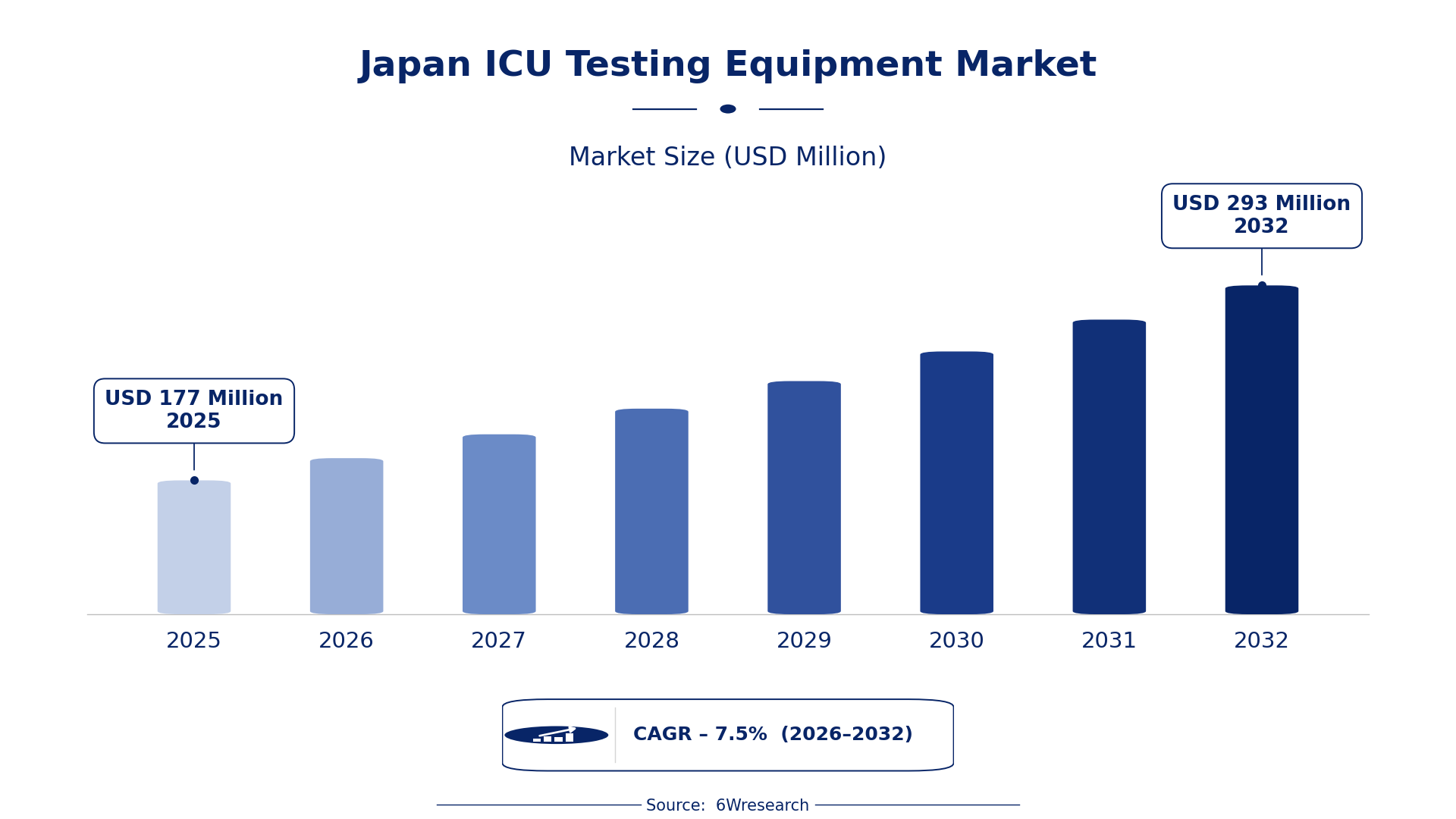
According to 6Wresearch internal database and industry insights, the Japan ICU Testing Equipment Market was valued at USD 177 Million in 2025 and is projected to reach USD 293 Million by 2032, growing at a CAGR of approximately 7.5% during 2026–2032.
Japan ICU Testing Equipment Market Highlights
| Report Metric | Details |
| Report Name | Japan ICU Testing Equipment Market (2026-2032) |
| Market Size 2025 | USD 177 Million |
| Market Size 2032 | USD 293 Million |
| Absolute Growth 2025–2032 | USD 116 Million |
| CAGR 2026–2032 | 7.5% |
| Peak Annual Growth | 8.5% in 2028 |
| Forecast Period | 2026–2032 |
| Historical Data | 2022–2025 |
| Base Year | 2025 |
| Leading Test Type, 2025 | Blood Gas Analyzers (50% share) |
| Leading Equipment Category, 2025 | Point-of-Care (48% share) |
| Leading Sample Type, 2025 | Blood (50% share) |
| Leading End User, 2025 | Critical Care Labs (38% share) |
| Fastest-Growing Test Type | CRP & Procalcitonin (10.5% CAGR) |
| Fastest-Growing Sample Type | Plasma/Serum (11.0% CAGR) |
| Fastest-Growing End User | Sepsis Management Centers (9.5% CAGR) |
| Growing Sector | Critical Care |
| Key End Users | Hospitals, Emergency Units, Critical Care Labs, Sepsis Management Centers |
Japan ICU Testing Equipment Market Year-wise Growth Rate and Key Drivers (2022–2032)
This graph illustrates the annual growth rates of the market from 2022 to 2032, highlighting a steady upward trajectory and projected market expansion over the forecast period.
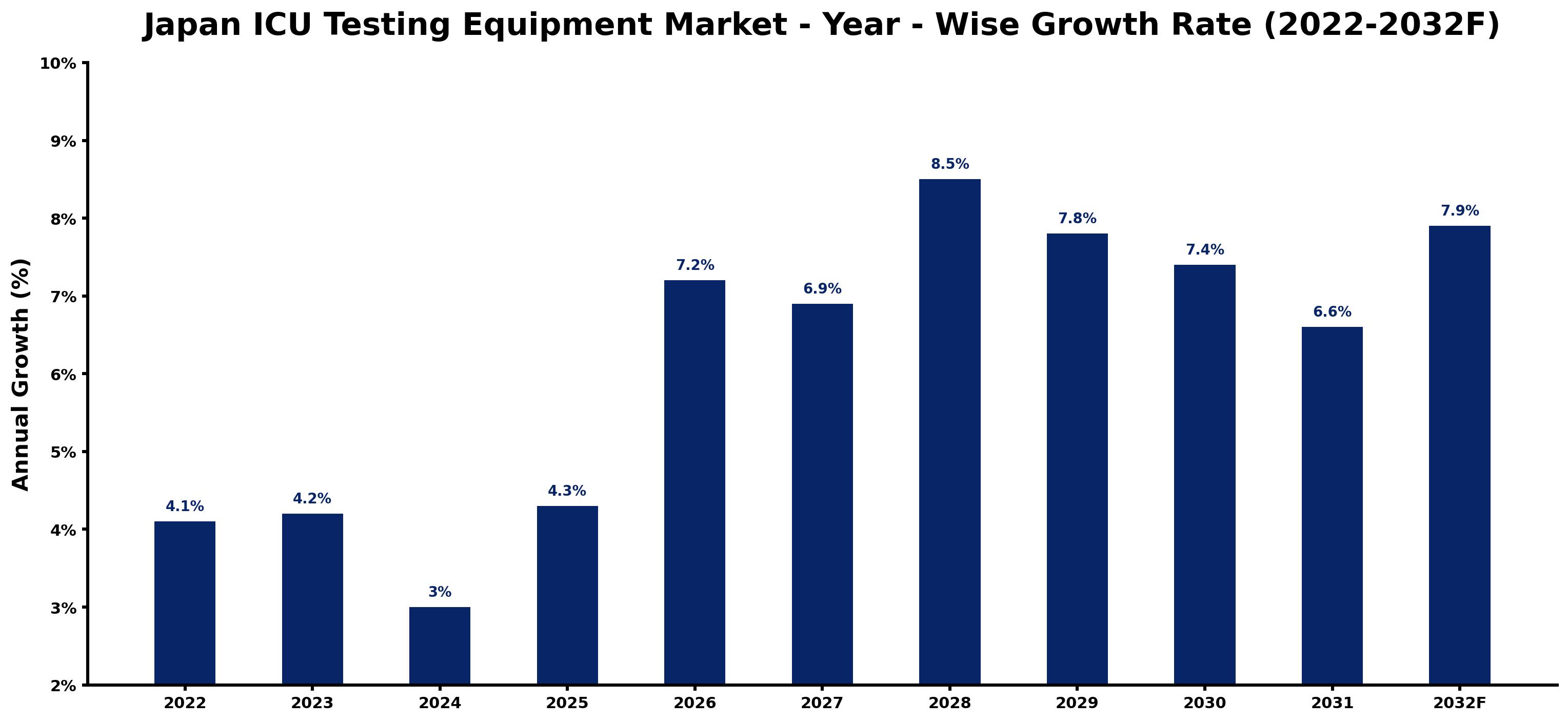
Below, each year's estimated growth is shown next to the factor that most influenced it.
| Year | Estimated Annual Growth (%) | Market Rationale |
| 2022 | 4.1 | The market experienced steady growth as healthcare providers focused on improving patient monitoring capabilities. |
| 2023 | 4.2 | Demand increased due to the ongoing emphasis on enhancing critical care diagnostics across hospitals. |
| 2024 | 3.0 | Growth slowed as hospitals adjusted budgets amidst rising operational costs and resource allocation. |
| 2025 | 4.3 | The market rebounded with renewed investments in ICU technologies and equipment upgrades. |
| 2026 | 7.2 | Purchasing is expected to rise as hospitals adopt advanced point-of-care testing solutions. |
| 2027 | 6.9 | Growth is projected to slow slightly as market saturation begins to take effect. |
| 2028 | 8.5 | Demand is anticipated to peak with the introduction of new diagnostic technologies. |
| 2029 | 7.8 | Growth will moderate as the market stabilises following the peak in demand. |
| 2030 | 7.4 | A continued focus on quality care will sustain growth, though at a reduced rate. |
| 2031 | 6.6 | The market is expected to grow at a slower pace as competition intensifies. |
| 2032 | 7.9 | Demand is projected to rise again as the healthcare sector adapts to an aging population. |
Note: Market size estimations and growth projections presented in this report are based on 6Wresearch's proprietary forecasting methodology, utilizing the latest available industry data, government publications, and primary research inputs.
Japan ICU Testing Equipment Market Synopsis
ICU Testing Equipment includes diagnostic devices essential for monitoring critical health parameters in intensive care units. Key technologies such as blood gas analyzers and hematology analyzers are vital for real-time patient assessments. The Japan ICU Testing Equipment Market is growing due to increased demand from healthcare providers, with over 800 ICU facilities and a patient population of approximately 30,000 at any given time. The ongoing adoption of point-of-care testing and advancements in sepsis management are driving further investments in this sector.
Market Dynamics Impact Analysis (2026–2032)
| Factor | Type | Impact | Primary Segment Affected |
| Rising demand for real-time diagnostics in critical care settings | Driver | High | Blood Gas Analyzers |
| Growing focus on sepsis management programs in hospitals | Driver | High | CRP & Procalcitonin |
| Expansion of critical care labs in urban areas | Opportunity | Medium | Critical Care Labs |
| Increased investment in ICU technology by healthcare providers | Opportunity | Medium | Point-of-Care |
| High operational costs affecting hospital budgets | Restraint | High | Hematology Analyzers |
| Market saturation leading to competitive pricing pressures | Restraint | Medium | Electrolyte Analyzers |
| Limited availability of skilled technicians for advanced equipment | Challenge | High | ICU Labs |
| Regulatory hurdles for new medical device approvals | Challenge | Medium | Emergency Units |
Evaluation of Drivers in Japan ICU Testing Equipment Market (2026–2032)
Demand rests on the following drivers, each shown with the segment it touches most.
| Drivers | Primary Segment Affected | Why It Matters (Evidence) |
| Increased patient admissions in ICUs | Blood Gas Analyzers | The average ICU patient population is approximately 30,000, driving demand for blood gas testing. |
| Implementation of sepsis management protocols | CRP & Procalcitonin | Sepsis management programs are now in over 70% of Japanese hospitals, increasing the need for infection markers. |
| Technological advancements in point-of-care testing | Point-of-Care | Rapid adoption of point-of-care testing in emergency units improves diagnostic capabilities, enhancing patient outcomes. |
| Growing aging population requiring intensive care | Hematology Analyzers | The aging population in Japan is increasing the demand for blood diagnostics, particularly in critical care settings. |
| Increased focus on quality patient care | Electrolyte Analyzers | Healthcare providers are prioritising accurate electrolyte monitoring to improve patient outcomes, driving demand. |
Purchasing is picking up as the healthcare sector expands its critical care capabilities. Blood gas analyzers are used in 95% of Japanese ICUs, reflecting the need for real-time diagnostics. The average number of tests performed per ICU patient is around 15 daily, driving demand for hematology analyzers, essential for over 50% of critical care diagnostics. The rapid adoption of point-of-care testing in emergency units is reshaping ICU diagnostics, with hospitals seeking immediate results for critical decision-making.
Evaluation of Restraints in Japan ICU Testing Equipment Market
These are the pressures that could keep growth below its potential.
| Market Restraint | Primary Segment Affected | Why It Matters (Evidence) |
| High operational costs limiting hospital investments | Hematology Analyzers | Rising operational costs are forcing hospitals to allocate budgets more conservatively, impacting their ability to invest in new equipment. |
| Market saturation leading to price competition | Electrolyte Analyzers | Intense competition among suppliers is driving down prices, impacting profitability and limiting investment in innovation. |
| Limited technician availability for advanced equipment | ICU Labs | A shortage of skilled technicians hampers the effective use of advanced ICU testing equipment, delaying patient diagnostics. |
| Regulatory delays for new product approvals | Emergency Units | Stringent regulations can prolong the time to market for new testing devices, affecting availability for critical care. |
| Budget constraints affecting equipment upgrades | Point-of-Care | Hospitals face budget limitations that restrict timely upgrades of essential testing equipment, impacting patient care. |
Japan ICU Testing Equipment Market Challenges
High costs burden hospitals due to outdated technology, delaying patient diagnostics by up to 24 hours and affecting treatment decisions. Suppliers face rising production costs as Japan's minimum wage increases to JPY 1,055 per hour, forcing price hikes that strain hospital budgets. Limited availability of advanced ICU testing equipment leads to supply chain bottlenecks, resulting in longer lead times for hospitals that require immediate access to critical devices. Stringent compliance with ISO 15189 complicates product approval for suppliers, extending timelines and delaying market entry for new technologies, which ultimately impacts patient care in ICUs.
Trends in the Japan ICU Testing Equipment Market
Several trends are reshaping the Japan ICU Testing Equipment Market; the most important are set out below.
- Shift towards Point-of-Care Testing: Point-of-care testing is increasingly adopted in emergency units, providing immediate results for critical decision-making. This shift is reflected as hospitals report a 30% increase in point-of-care device usage since 2022.
- Increased Focus on Sepsis Management: Critical care labs are prioritising sepsis management, with infection markers like CRP and procalcitonin gaining traction. Over 70% of hospitals have implemented sepsis management programs, reflecting a growing commitment to improving patient outcomes.
- Expansion of Critical Care Facilities: The number of ICU facilities in Japan has surpassed 800, driven by the increasing patient population. This expansion supports the rising demand for ICU testing equipment, with an average ICU patient population of 30,000.
- Adoption of Advanced Diagnostic Technologies: The healthcare sector is embracing advanced diagnostic technologies, particularly in urban areas. Investment in ICU technology has been prioritised, with government funding allocated for improvements in emergency healthcare services.
Investment Opportunities in the Japan ICU Testing Equipment Market
Several openings in the Japan ICU Testing Equipment Market merit attention from investors.
- Investment in Urban Critical Care Labs: Urban areas are expanding critical care labs, focusing on advanced technologies. The government has allocated funds for improving emergency healthcare services in 2023, creating a valuable investment opportunity.
- Growing Demand for Infection Markers: With infection markers increasingly used in sepsis management, there is a gap in supply. Sepsis management centers are looking to improve their diagnostic capabilities, providing an opportunity for suppliers.
- Enhancement of Point-of-Care Testing: The rapid adoption of point-of-care testing in emergency units presents a timely investment opportunity. Hospitals are seeking reliable point-of-care solutions to improve patient outcomes.
- Development of New Diagnostic Technologies: As the healthcare sector embraces advanced diagnostics, there is a strong demand for new solutions. The Tokyo Medical University is actively involved in ICU research and development, indicating a need for innovative technologies.
Government Initiatives in the Japan ICU Testing Equipment Market
The Act on the Rational Use of Energy mandates that large energy users adopt energy-efficient technologies, impacting ICU testing equipment producers by promoting sustainable practices in healthcare facilities. Established in 1979, this law aims to reduce energy consumption, critical for operational efficiency in hospitals. The government has allocated funds for improving emergency healthcare services in 2023, enhancing the infrastructure for ICU testing equipment.
The Pharmaceuticals and Medical Devices Agency oversees regulations for medical devices, ensuring compliance with safety standards. This agency approves new medical devices and funds initiatives aimed at improving healthcare services, impacting the availability and quality of ICU testing equipment.
Future Insight of the Japan ICU Testing Equipment Market
Emerging technologies will reshape demand for ICU testing equipment by 2032, facilitating faster diagnostics and improved patient management. Increased government funding for emergency healthcare services will drive investment in ICU technology, enhancing hospital capabilities. Updated clinical guidelines for sepsis management will necessitate specific diagnostic tools in critical care. As the population ages, the average number of tests performed per ICU patient is expected to rise to around 20 per day, intensifying the need for efficient and reliable testing solutions.
Market Segmentation Analysis
Japan ICU Testing Equipment Market report covers a detailed analysis of the following market segments:
By Test Type – Blood Gas Analyzers Lead, CRP & Procalcitonin Expected to Grow Fastest
According to Saurav Kr Singh, Senior Research Analyst at 6Wresearch, Blood Gas Analyzers accounted for 50% of the market by test type in 2025. Blood gas analyzers hold the largest share due to their critical role in monitoring blood gases, with usage in 95% of Japanese ICUs. This essential function ensures consistent demand from healthcare providers who rely on accurate real-time analysis for patient management. CRP & Procalcitonin is set to record the highest CAGR in this split, 10.5% over 2026–2032. The rapid growth of CRP and procalcitonin testing is fuelled by their significance in sepsis management, with over 70% of hospitals implementing related programs. This increasing focus on infection markers will likely expand their usage in critical care diagnostics. Suppliers should prioritise the availability of infection marker testing to address the rising demand in critical care environments.
By Equipment Category – Point-of-Care Leads and Records the Fastest Growth
With 48% of equipment category revenue in 2025, Point-of-Care was the largest category. Point-of-care testing equipment leads the market as it delivers immediate results essential for critical decision-making in intensive care units. Its broad adoption in emergency units reinforces its market dominance and ensures continued relevance in patient care. Point-of-Care is also forecast to expand faster than any other category, at a CAGR of 9.8% over 2026–2032. The growth of point-of-care testing is driven by its capacity to provide timely results, which are increasingly vital in emergency healthcare scenarios. As critical care labs expand, the demand for such equipment will continue to grow, further solidifying its market position. Suppliers must ensure they have sufficient point-of-care solutions to meet the increasing demand from critical care facilities.
By Sample Type – Blood Leads, Plasma/Serum Expected to Grow Fastest
The largest sample type category in 2025 was Blood, at 50% of revenue. Blood serves as the primary sample type for most ICU testing, underscoring its critical importance in monitoring patient health. With approximately 30,000 ICU patients at any time, the reliance on blood tests is evident across facilities. Plasma/Serum is projected to grow fastest, at a CAGR of 11.0% during 2026–2032. Plasma is experiencing rapid growth due to its essential role in biochemical tests that are increasingly utilised in critical care. This shift is supported by the rising implementation of sepsis management programs in over 70% of hospitals. Suppliers must adapt to the increasing demand for plasma testing solutions to meet the evolving needs of critical care diagnostics.
By End User – Critical Care Labs Lead, Sepsis Management Centers Expected to Grow Fastest
In 2025, Critical Care Labs led the end user split with a 38% share. Critical care labs are the primary users of ICU testing equipment, utilising advanced diagnostics to monitor patient health effectively. Their central role in intensive care ensures a consistent demand for testing technologies. The quickest growth will come from Sepsis Management Centers, forecast to expand at a CAGR of 9.5% between 2026 and 2032. Sepsis management centers are rapidly expanding their capabilities, focusing on diagnostics to improve patient outcomes in sepsis cases. This targeted approach is likely to drive growth in this segment as healthcare priorities shift. Suppliers should target sepsis management centers with tailored solutions to capitalise on the growing emphasis on infection management.
Key Attractiveness of the Report
- 10 Years of Market Numbers
- Historical Data Starting from 2022 to 2025
- Base Year 2025
- Forecast Data until 2032
- Key Performance Indicators Impacting the Market
- Major Upcoming Developments and Projects
Key Highlights of the Report:
- Japan ICU Testing Equipment Market Outlook
- Market Size of Japan ICU Testing Equipment Market, 2025
- Forecast of Japan ICU Testing Equipment Market, 2032
- Historical Data and Forecast of Japan ICU Testing Equipment Revenues & Volume for the Period 2022-2032F
- Japan ICU Testing Equipment Market Trend Evolution
- Japan ICU Testing Equipment Market Drivers and Challenges
- Japan ICU Testing Equipment Price Trends
- Japan ICU Testing Equipment Porter's Five Forces
- Japan ICU Testing Equipment Industry Life Cycle
- Historical Data and Forecast of Japan ICU Testing Equipment Market Revenues & Volume By Test Type for the Period 2022-2032F
- Historical Data and Forecast of Japan ICU Testing Equipment Market Revenues & Volume By Blood Gas Analyzers for the Period 2022-2032F
- Historical Data and Forecast of Japan ICU Testing Equipment Market Revenues & Volume By Hematology Analyzers for the Period 2022-2032F
- Historical Data and Forecast of Japan ICU Testing Equipment Market Revenues & Volume By Electrolyte Analyzers for the Period 2022-2032F
- Historical Data and Forecast of Japan ICU Testing Equipment Market Revenues & Volume By CRP & Procalcitonin for the Period 2022-2032F
- Historical Data and Forecast of Japan ICU Testing Equipment Market Revenues & Volume By Equipment Category for the Period 2022-2032F
- Historical Data and Forecast of Japan ICU Testing Equipment Market Revenues & Volume By Point-of-Care for the Period 2022-2032F
- Historical Data and Forecast of Japan ICU Testing Equipment Market Revenues & Volume By Complete Blood Count for the Period 2022-2032F
- Historical Data and Forecast of Japan ICU Testing Equipment Market Revenues & Volume By Sodium, Potassium Levels for the Period 2022-2032F
- Historical Data and Forecast of Japan ICU Testing Equipment Market Revenues & Volume By Infection Markers for the Period 2022-2032F
- Historical Data and Forecast of Japan ICU Testing Equipment Market Revenues & Volume By Sample Type for the Period 2022-2032F
- Historical Data and Forecast of Japan ICU Testing Equipment Market Revenues & Volume By Blood for the Period 2022-2032F
- Historical Data and Forecast of Japan ICU Testing Equipment Market Revenues & Volume By Whole Blood for the Period 2022-2032F
- Historical Data and Forecast of Japan ICU Testing Equipment Market Revenues & Volume By Plasma/Serum for the Period 2022-2032F
- Historical Data and Forecast of Japan ICU Testing Equipment Market Revenues & Volume By Serum for the Period 2022-2032F
- Historical Data and Forecast of Japan ICU Testing Equipment Market Revenues & Volume By End User for the Period 2022-2032F
- Historical Data and Forecast of Japan ICU Testing Equipment Market Revenues & Volume By Critical Care Labs for the Period 2022-2032F
- Historical Data and Forecast of Japan ICU Testing Equipment Market Revenues & Volume By ICU Labs for the Period 2022-2032F
- Historical Data and Forecast of Japan ICU Testing Equipment Market Revenues & Volume By Emergency Units for the Period 2022-2032F
- Historical Data and Forecast of Japan ICU Testing Equipment Market Revenues & Volume By Sepsis Management Centers for the Period 2022-2032F
- Japan ICU Testing Equipment Import Export Trade Statistics
- Market Opportunity Assessment By Test Type
- Market Opportunity Assessment By Equipment Category
- Market Opportunity Assessment By Sample Type
- Market Opportunity Assessment By End User
- Japan ICU Testing Equipment Top Companies Market Share
- Japan ICU Testing Equipment Competitive Benchmarking By Technical and Operational Parameters
- Japan ICU Testing Equipment Company Profiles
- Japan ICU Testing Equipment Key Strategic Recommendations
Market Covered
The study includes the following segmentation.
By Test Type
- Blood Gas Analyzers
- Hematology Analyzers
- Electrolyte Analyzers
- CRP & Procalcitonin
By Equipment Category
- Point-of-Care
- Complete Blood Count
- Sodium
- Potassium Levels
- Infection Markers
By Sample Type
- Blood
- Whole Blood
- Plasma/Serum
- Serum
By End User
- Critical Care Labs
- ICU Labs
- Emergency Units
- Sepsis Management Centers































