Japan ICU Ventilation Market Size & Growth Rate
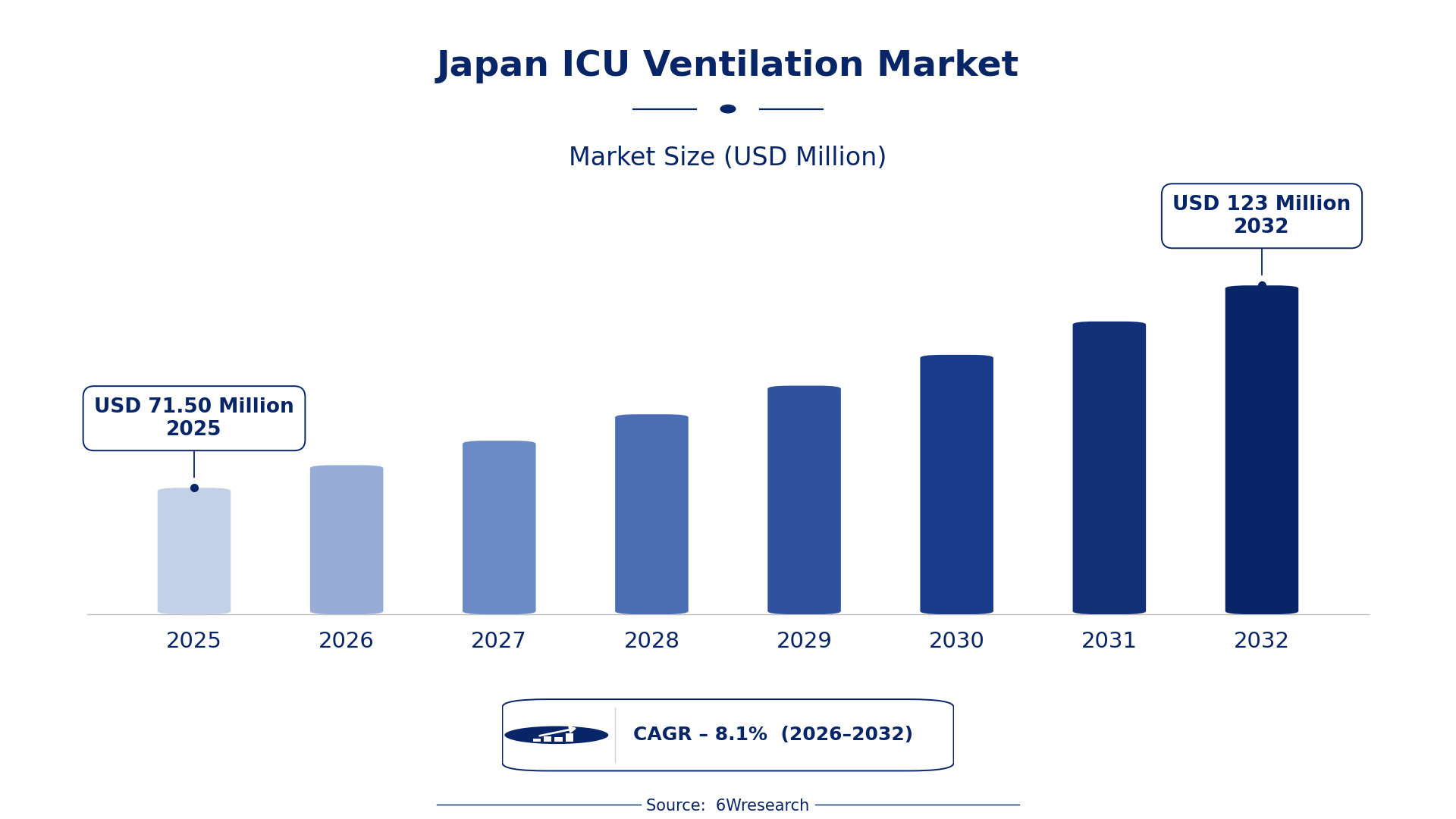
According to 6Wresearch internal database and industry insights, the Japan ICU Ventilation Market was valued at USD 71.50 Million in 2025 and is projected to reach USD 123 Million by 2032, growing at a CAGR of approximately 8.1% during 2026–2032.
Japan ICU Ventilation Market Highlights
| Report Metric | Details |
| Report Name | Japan ICU Ventilation Market (2026-2032) |
| Market Size 2025 | USD 71.50 Million |
| Market Size 2032 | USD 123 Million |
| Absolute Growth 2025–2032 | USD 51.50 Million |
| CAGR 2026–2032 | 8.1% |
| Peak Annual Growth | 8.7% in 2026 |
| Forecast Period | 2026–2032 |
| Historical Data | 2022–2025 |
| Base Year | 2025 |
| Leading Ventilation Type, 2025 | Invasive Ventilation (36% share) |
| Leading Interface Type, 2025 | Endotracheal Tube (45% share) |
| Leading Patient Age Group, 2025 | Adult (35% share) |
| Leading End User, 2025 | Critical Care Hospitals (40% share) |
| Fastest-Growing Ventilation Type | Non-Invasive Ventilation (11.7% CAGR) |
| Fastest-Growing Interface Type | Face/Nasal Mask (11.9% CAGR) |
| Fastest-Growing Patient Age Group | Geriatric (10.3% CAGR) |
| Fastest-Growing End User | Pediatric ICUs (10.4% CAGR) |
| Growing Sector | Critical Care Services |
| Key End Users | Critical Care Hospitals, Pediatric ICUs, Neonatal ICUs, Step-Down ICUs |
Japan ICU Ventilation Market Year-wise Growth Rate and Key Drivers (2022–2032)
This graph illustrates the annual growth rates of the market from 2022 to 2032, highlighting a steady upward trajectory and projected market expansion over the forecast period.
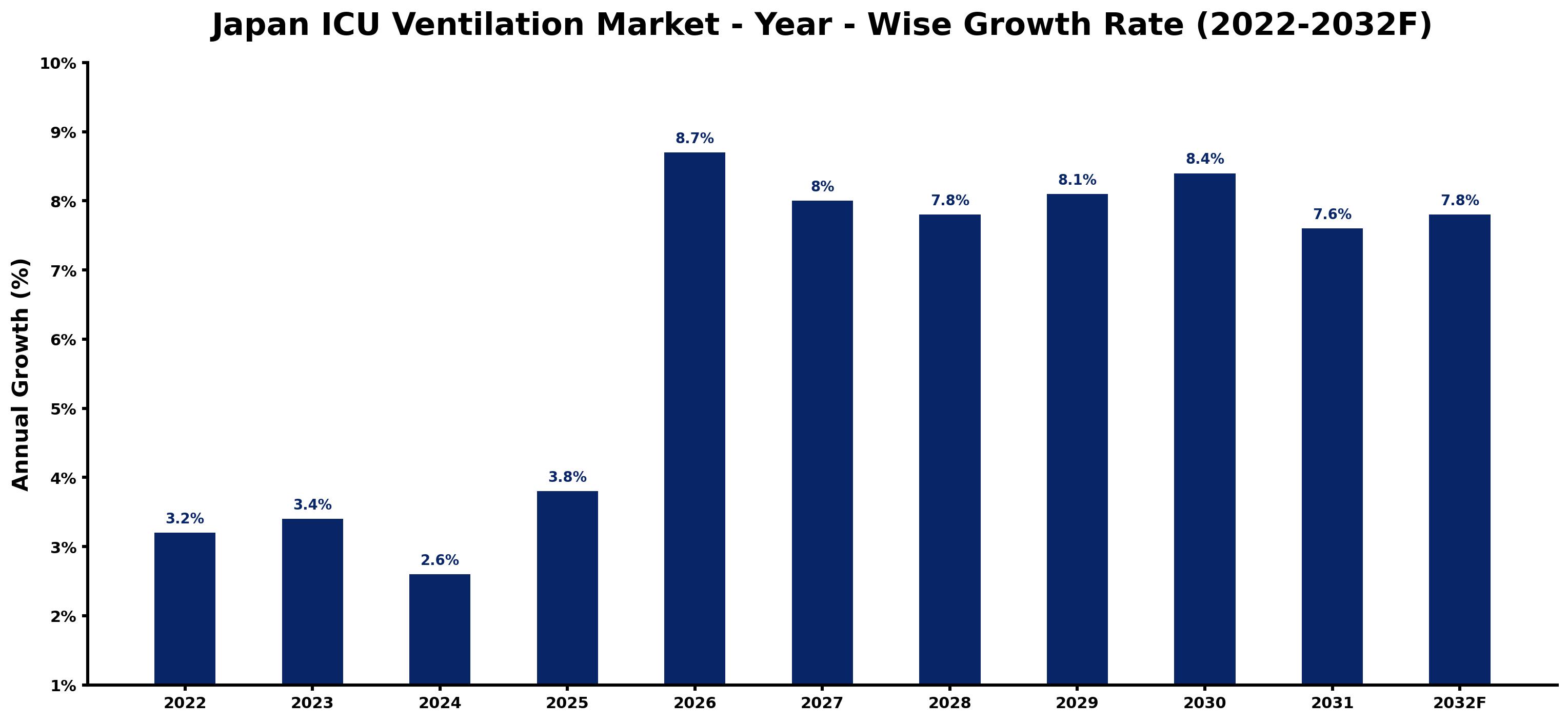
Each row of the following table gives one year's estimated growth and the event or demand shift that explains it.
| Year | Estimated Annual Growth (%) | Market Rationale |
| 2022 | 3.2 | The market showed steady growth due to ongoing demand for critical care services. |
| 2023 | 3.4 | Growth accelerated as hospitals increased investments in advanced ventilation technologies. |
| 2024 | 2.6 | Growth slowed slightly as hospitals faced budget constraints amid rising operational costs. |
| 2025 | 3.8 | The market rebounded with increased focus on patient care and technology upgrades. |
| 2026 | 8.7 | Growth is expected to peak as hospitals expand ICU capacities in response to patient needs. |
| 2027 | 8.0 | Growth is projected to slow as market saturation begins to affect new equipment purchases. |
| 2028 | 7.8 | Demand is expected to continue slowing as hospitals optimise existing resources and equipment. |
| 2029 | 8.1 | Growth is expected to resume as new healthcare initiatives encourage equipment upgrades. |
| 2030 | 8.4 | Demand will remain strong with hospitals focusing on improving patient outcomes. |
| 2031 | 7.6 | Growth is projected to slow again as market conditions stabilise and competition increases. |
| 2032 | 7.8 | The market is expected to grow as technology adoption continues to rise. |
Note: Market size estimations and growth projections presented in this report are based on 6Wresearch's proprietary forecasting methodology, utilizing the latest available industry data, government publications, and primary research inputs.
Japan ICU Ventilation Market Synopsis
ICU ventilation products are advanced medical devices designed to support patients with respiratory failure in intensive care units. These devices are essential for providing mechanical ventilation and ensuring adequate oxygenation. The Japan ICU Ventilation Market is expanding due to a strong healthcare system and increasing demand from critical care hospitals. In 2023, a government programme allocated ¥2 billion for ICU equipment upgrades, while adult patients account for 75% of ICU ventilation cases, driving further investments in this sector.
Market Dynamics Impact Analysis (2026–2032)
| Factor | Type | Impact | Primary Segment Affected |
| Increasing investments in healthcare technology | Driver | High | Invasive Ventilation |
| Rising number of ICU beds in hospitals | Driver | High | Non-Invasive Ventilation |
| Growing demand for specialized neonatal ventilation | Opportunity | High | Neonatal |
| Expansion of critical care hospitals in urban areas | Opportunity | High | Critical Care Hospitals |
| High costs of advanced ventilation systems | Restraint | High | Invasive Ventilation |
| Limited availability of trained ICU staff | Restraint | High | Non-Invasive Ventilation |
| Regulatory compliance requirements for new devices | Challenge | High | Invasive Ventilation |
| Capacity constraints in existing ICU facilities | Challenge | High | Critical Care Hospitals |
Evaluation of Drivers in Japan ICU Ventilation Market (2026–2032)
Below are the drivers that matter most for revenue growth, with supporting evidence.
| Drivers | Primary Segment Affected | Why It Matters (Evidence) |
| Investment in advanced medical technologies | Invasive Ventilation | This investment allows hospitals to acquire new devices and upgrades, improving patient care. |
| Increase in ICU bed capacity | Non-Invasive Ventilation | The growth in ICU beds necessitates more ventilation systems to support patient needs, with approximately 300,000 beds in Japan. |
| Rising prevalence of respiratory diseases | Neonatal | The increase in respiratory conditions among infants drives demand for specialized ventilation solutions. |
| Government funding for healthcare improvements | Critical Care Hospitals | Government initiatives, such as the ¥2 billion programme, support hospitals in upgrading their ventilation equipment. |
| Adoption of smart ventilation modes | Smart Modes (PRVC etc.) | These modes improve ventilation efficiency, leading to increased purchases by hospitals seeking better patient outcomes. |
A wider customer base explains much of the growth, as hospitals invest in advanced medical technologies to improve patient care. In 2022, Japan had approximately 300,000 ICU beds, prompting hospitals to acquire more ventilation systems. The rising prevalence of respiratory diseases, particularly among infants, drives demand for specialized neonatal ventilation solutions. The adoption of smart ventilation modes is increasing, as hospitals seek to improve efficiency and patient comfort, resulting in more purchases.
Evaluation of Restraints in Japan ICU Ventilation Market
The following restraints limit how fast demand can grow.
| Market Restraint | Primary Segment Affected | Why It Matters (Evidence) |
| High costs associated with advanced ventilation systems | Invasive Ventilation | The investment required for new systems limits purchasing capabilities for some hospitals. |
| Shortage of trained ICU staff | Non-Invasive Ventilation | Limited availability of skilled personnel affects the effective use of ventilation technologies. |
| Stringent regulatory compliance for new devices | Smart Modes (PRVC etc.) | Compliance with regulations can delay the introduction of new ventilation technologies. |
| Capacity limitations in existing ICU facilities | Critical Care Hospitals | Overcrowding in ICUs can hinder the ability to adopt new ventilation systems. |
| Budget constraints faced by hospitals | Neonatal | Financial limitations may restrict hospitals from investing in necessary equipment upgrades. |
Japan ICU Ventilation Market Challenges
A shortage of trained ICU staff limits producers from fully implementing advanced ventilation technologies, leading to delayed patient treatment and higher operational costs for hospitals. Supply chain disruptions challenge importers as local manufacturers increase competition, causing delivery delays of up to three months for essential equipment to healthcare facilities. Buyers face rising costs due to compliance with regulations such as ISO 80601-2-12, which forces suppliers to allocate substantial resources for quality assurance. Growing demand for specialised ventilation in neonatal ICUs pressures producers to innovate, potentially straining their resources and extending product development timelines.
Trends in the Japan ICU Ventilation Market
Four trends stand out in the Japan ICU Ventilation Market.
- Shift towards Non-Invasive Ventilation: A growing preference for non-invasive ventilation methods is apparent in Japan, particularly in critical care settings. In 2023, the adoption rate for face/nasal masks rose by 11.9%, reflecting a shift in practice towards less invasive techniques.
- Expansion of Pediatric ICUs: The number of pediatric ICUs in Japan has increased, focusing on specialised care for children. With around 150 pediatric ICUs, demand for tailored ventilation solutions is rising, driven by a 10.4% growth in this segment.
- Increased Focus on Smart Ventilation Technologies: The trend towards smart ventilation technologies is gaining momentum, with hospitals adopting advanced modes to improve patient outcomes. The implementation of ISO 80601-2-12 standards is facilitating this shift, improving device efficiency.
- Government Support for ICU Equipment Upgrades: In 2023, the Japanese government allocated ¥2 billion for upgrading ICU equipment, reflecting a commitment to improving critical care capabilities. This funding is expected to drive further investments in advanced ventilation systems.
Investment Opportunities in the Japan ICU Ventilation Market
The following areas offer the clearest openings for investors and suppliers in the Japan ICU Ventilation Market.
- Critical Care Hospitals in Urban Areas: Urban critical care hospitals are expanding their facilities, with over 1,000 hospitals equipped with ICU ventilation systems. Investing in advanced ventilation technologies can meet the rising demand for critical care services.
- Neonatal ICUs Requiring Specialized Equipment: With the increasing demand for specialised ventilation in neonatal ICUs, there is an opportunity to supply tailored solutions. The growth in this segment is driven by the rising number of infants requiring respiratory support.
- Government Funding for Equipment Upgrades: Now is an ideal time to invest in ICU ventilation systems, as the government has allocated ¥2 billion for upgrades. Collaborating with critical care hospitals can facilitate access to this funding.
- Technological Advancements in Ventilation: Investing in smart ventilation technologies presents an opportunity, as hospitals seek to improve patient management. The adoption of these technologies is supported by guidelines from the Japanese Society of Intensive Care Medicine.
Government Initiatives in the Japan ICU Ventilation Market
The Medical Care Act of 1948 sets essential standards for hospitals and clinics, including staffing and facilities. This law ensures that ICU ventilation systems meet specific quality requirements, influencing the types of devices used in critical care settings. Additionally, the Long-Term Care Insurance Act, enacted in 1997, provides funding for nursing care, indirectly supporting the need for advanced ventilation technologies in critical care environments.
The Economic Security Promotion Act of 2022 supports supply-chain resilience for critical products, ensuring that hospitals can access necessary ventilation equipment. The Ministry of Health, Labour and Welfare oversees the implementation of various healthcare initiatives and funds training programmes for ICU staff, improving their ability to manage advanced ventilation systems effectively.
Future Insight of the Japan ICU Ventilation Market
Investment in ICU ventilation technology will increase significantly by 2032, driven by a government programme allocating ¥2 billion for equipment upgrades. This funding will enhance the infrastructure of over 300,000 ICU beds, improving patient management capabilities across facilities. The growth of neonatal ICUs will lead to a focus on tailored ventilation solutions, addressing specific needs for infant care. Training programmes for ICU staff will evolve, refining ventilation management practices and delivering substantial advantages for both buyers and suppliers in the market.
Market Segmentation Analysis
Japan ICU Ventilation Market report covers a detailed analysis of the following market segments:
By Ventilation Type – Invasive Ventilation Leads, Non-Invasive Ventilation Expected to Grow Fastest
According to Saurav Kr Singh, Senior Research Analyst at 6Wresearch, Invasive Ventilation took 36% of ventilation type revenue in 2025, more than any other category. Invasive ventilation is essential for patients requiring full respiratory support, especially in critical care settings. The high number of ICU beds, exceeding 300,000, underscores its dominant role in the market. The quickest growth will come from Non-Invasive Ventilation, forecast to expand at a CAGR of 11.7% between 2026 and 2032. Non-invasive ventilation is witnessing rapid growth as it addresses the needs of patients with less severe respiratory issues, reflecting a broader trend towards less invasive care. Government initiatives that encourage advanced medical technology adoption further fuel this segment's expansion. Suppliers should focus on developing non-invasive solutions to meet the rising demand in the market.
By Interface Type – Endotracheal Tube Leads, Face/Nasal Mask Expected to Grow Fastest
In 2025, Endotracheal Tube led the interface type split with a 45% share. The endotracheal tube is the primary interface for invasive ventilation, critical for managing patients in intensive care. Its widespread use across more than 1,000 critical care hospitals in Japan reinforces its leading position in the market. Over 2026–2032, Face/Nasal Mask is expected to post the fastest growth, at a CAGR of 11.9%. Face/nasal masks are rapidly growing in popularity as they are commonly used for non-invasive ventilation, appealing to patients who prefer comfort. The increasing emphasis on patient comfort and quicker recovery times drives this segment's growth. Buyers need to consider a variety of interface options to improve patient care and outcomes.
By Patient Age Group – Adult Leads, Geriatric Expected to Grow Fastest
The largest patient age group category in 2025 was Adult, at 35% of revenue. Adults constitute the primary demographic in ICUs, accounting for 75% of cases, which establishes this group's leading market share. The average age of ICU patients being 65 years highlights the critical need for tailored ventilation solutions for this population. Geriatric is projected to grow fastest, at a CAGR of 10.3% during 2026–2032. The geriatric segment is seeing rapid growth due to the rising number of elderly patients requiring critical care services. This demographic trend is projected to continue, increasing the demand for specialised ventilation products. Suppliers ought to focus on creating products specifically designed for the geriatric population to capture this expanding market.
By End User – Critical Care Hospitals Lead, Pediatric ICUs Expected to Grow Fastest
Critical Care Hospitals accounted for 40% of the market by end user in 2025. Critical care hospitals are the main end-users of ICU ventilation systems, given their role in providing intensive care services across Japan. With a high concentration of such facilities in the Tokyo region, they dominate the market. Pediatric ICUs is set to record the highest CAGR in this split, 10.4% over 2026–2032. Pediatric ICUs are experiencing rapid growth as they cater to the specialized needs of children requiring ventilation. The rise in demand for tailored ventilation solutions in these units reflects a broader trend towards specialised care. Suppliers should prioritise innovations that cater specifically to the needs of pediatric ICUs to capitalise on this growth.
Key Attractiveness of the Report
- 10 Years of Market Numbers
- Historical Data Starting from 2022 to 2025
- Base Year 2025
- Forecast Data until 2032
- Key Performance Indicators Impacting the Market
- Major Upcoming Developments and Projects
Key Highlights of the Report:
- Japan ICU Ventilation Market Outlook
- Market Size of Japan ICU Ventilation Market, 2025
- Forecast of Japan ICU Ventilation Market, 2032
- Historical Data and Forecast of Japan ICU Ventilation Revenues & Volume for the Period 2022-2032F
- Japan ICU Ventilation Market Trend Evolution
- Japan ICU Ventilation Market Drivers and Challenges
- Japan ICU Ventilation Price Trends
- Japan ICU Ventilation Porter's Five Forces
- Japan ICU Ventilation Industry Life Cycle
- Historical Data and Forecast of Japan ICU Ventilation Market Revenues & Volume By Ventilation Type for the Period 2022-2032F
- Historical Data and Forecast of Japan ICU Ventilation Market Revenues & Volume By Invasive Ventilation for the Period 2022-2032F
- Historical Data and Forecast of Japan ICU Ventilation Market Revenues & Volume By Non-Invasive Ventilation for the Period 2022-2032F
- Historical Data and Forecast of Japan ICU Ventilation Market Revenues & Volume By High-Frequency Ventilation for the Period 2022-2032F
- Historical Data and Forecast of Japan ICU Ventilation Market Revenues & Volume By Hybrid Ventilation for the Period 2022-2032F
- Historical Data and Forecast of Japan ICU Ventilation Market Revenues & Volume By Interface Type for the Period 2022-2032F
- Historical Data and Forecast of Japan ICU Ventilation Market Revenues & Volume By Endotracheal Tube for the Period 2022-2032F
- Historical Data and Forecast of Japan ICU Ventilation Market Revenues & Volume By Face/Nasal Mask for the Period 2022-2032F
- Historical Data and Forecast of Japan ICU Ventilation Market Revenues & Volume By Oscillatory for the Period 2022-2032F
- Historical Data and Forecast of Japan ICU Ventilation Market Revenues & Volume By Smart Modes (PRVC etc.) for the Period 2022-2032F
- Historical Data and Forecast of Japan ICU Ventilation Market Revenues & Volume By Patient Age Group for the Period 2022-2032F
- Historical Data and Forecast of Japan ICU Ventilation Market Revenues & Volume By Adult for the Period 2022-2032F
- Historical Data and Forecast of Japan ICU Ventilation Market Revenues & Volume By Geriatric for the Period 2022-2032F
- Historical Data and Forecast of Japan ICU Ventilation Market Revenues & Volume By Neonatal for the Period 2022-2032F
- Historical Data and Forecast of Japan ICU Ventilation Market Revenues & Volume By All for the Period 2022-2032F
- Historical Data and Forecast of Japan ICU Ventilation Market Revenues & Volume By End User for the Period 2022-2032F
- Historical Data and Forecast of Japan ICU Ventilation Market Revenues & Volume By Critical Care Hospitals for the Period 2022-2032F
- Historical Data and Forecast of Japan ICU Ventilation Market Revenues & Volume By Step-Down ICUs for the Period 2022-2032F
- Historical Data and Forecast of Japan ICU Ventilation Market Revenues & Volume By Pediatric ICUs for the Period 2022-2032F
- Historical Data and Forecast of Japan ICU Ventilation Market Revenues & Volume By ICU Anesthesia Departments for the Period 2022-2032F
- Japan ICU Ventilation Import Export Trade Statistics
- Market Opportunity Assessment By Ventilation Type
- Market Opportunity Assessment By Interface Type
- Market Opportunity Assessment By Patient Age Group
- Market Opportunity Assessment By End User
- Japan ICU Ventilation Top Companies Market Share
- Japan ICU Ventilation Competitive Benchmarking By Technical and Operational Parameters
- Japan ICU Ventilation Company Profiles
- Japan ICU Ventilation Key Strategic Recommendations
Market Covered
Coverage by segment is as follows.
By Ventilation Type
- Invasive Ventilation
- Non-Invasive Ventilation
- High-Frequency Ventilation
- Hybrid Ventilation
By Interface Type
- Endotracheal Tube
- Face/Nasal Mask
- Oscillatory
- Smart Modes (PRVC etc.)
By Patient Age Group
- Adult
- Geriatric
- Neonatal
- All
By End User
- Critical Care Hospitals
- Step-Down ICUs
- Pediatric ICUs
- ICU Anesthesia Departments































