Japan ICU Ventilator Market Size & Growth Rate
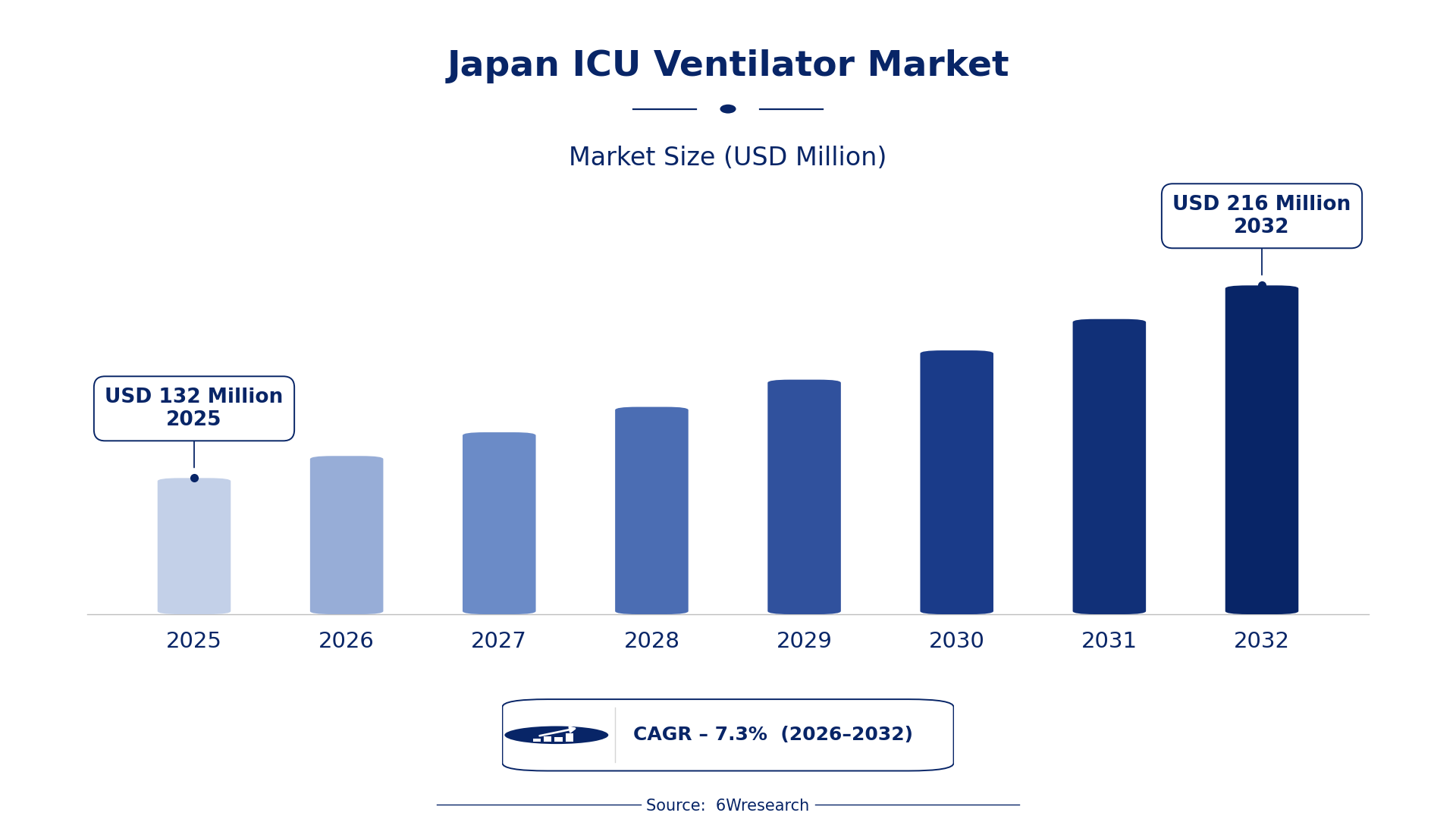
According to 6Wresearch internal database and industry insights, the Japan ICU Ventilator Market was valued at USD 132 Million in 2025 and is projected to reach USD 216 Million by 2032, growing at a CAGR of approximately 7.3% during 2026–2032.
Japan ICU Ventilator Market Highlights
| Report Metric | Details |
| Report Name | Japan ICU Ventilator Market (2026-2032) |
| Market Size 2025 | USD 132 Million |
| Market Size 2032 | USD 216 Million |
| Absolute Growth 2025–2032 | USD 84 Million |
| CAGR 2026–2032 | 7.3% |
| Peak Annual Growth | 7.9% in 2028 |
| Forecast Period | 2026–2032 |
| Historical Data | 2022–2025 |
| Base Year | 2025 |
| Leading Ventilator Type, 2025 | Conventional Ventilator (36% share) |
| Leading Operating Mode, 2025 | Volume/Pressure Control (52% share) |
| Leading Mobility, 2025 | Fixed (49% share) |
| Leading End User, 2025 | Hospitals (49% share) |
| Fastest-Growing Ventilator Type | Portable Ventilator (10.3% CAGR) |
| Fastest-Growing Operating Mode | Transport/Backup Use (10.0% CAGR) |
| Fastest-Growing Mobility | Mobile Battery-Operated (9.5% CAGR) |
| Fastest-Growing End User | Field & Emergency ICUs (9.3% CAGR) |
| Growing Sector | Field & Emergency ICUs |
| Key End Users | Hospitals, Field & Emergency ICUs, Tertiary Care Facilities, Pediatric Units |
Japan ICU Ventilator Market Year-wise Growth Rate and Key Drivers (2022–2032)
This graph illustrates the annual growth rates of the market from 2022 to 2032, highlighting a steady upward trajectory and projected market expansion over the forecast period.
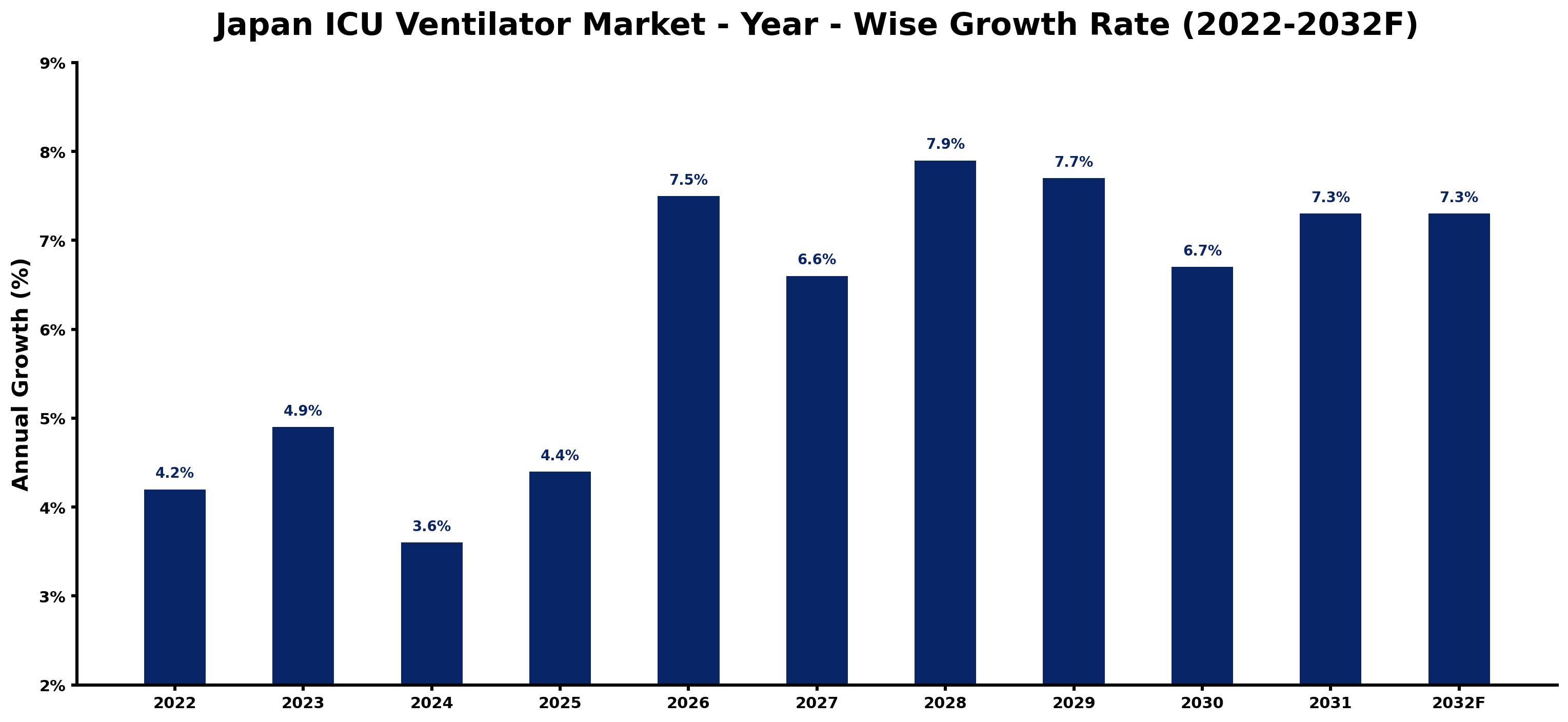
The table below sets out the estimated growth rate for each year and the main factor behind it.
| Year | Estimated Annual Growth (%) | Market Rationale |
| 2022 | 4.2 | The market experienced steady demand due to ongoing healthcare needs. |
| 2023 | 4.9 | Growth accelerated as hospitals expanded ICU capacities amid rising respiratory cases. |
| 2024 | 3.6 | The growth rate slowed as hospitals adjusted to previous demand surges. |
| 2025 | 4.4 | Increased investments in healthcare technology spurred faster growth this year. |
| 2026 | 7.5 | Demand is expected to surge as hospitals adopt advanced ventilator technologies more widely. |
| 2027 | 6.6 | Growth will moderate as market saturation begins to affect purchasing decisions. |
| 2028 | 7.9 | The peak growth rate is projected as emergency services expand capabilities. |
| 2029 | 7.7 | A slight slowdown is expected as the market stabilises after rapid expansion. |
| 2030 | 6.7 | Growth is projected to slow as hospitals focus on optimising existing resources. |
| 2031 | 7.3 | Demand is expected to increase again due to ongoing investments in healthcare infrastructure. |
| 2032 | 7.3 | The market is projected to maintain strong growth driven by technological advancements. |
Note: Market size estimations and growth projections presented in this report are based on 6Wresearch's proprietary forecasting methodology, utilizing the latest available industry data, government publications, and primary research inputs.
Japan ICU Ventilator Market Synopsis
ICU ventilators are advanced medical devices designed to provide mechanical ventilation to patients with severe respiratory distress. These devices support patients during surgical procedures and emergencies. The Japan ICU Ventilator Market is expanding due to the aging population, which increases demand for critical care services. In 2023, over 8,000 hospitals were equipped with ICU facilities, driving investments in healthcare technology that reached over ¥1 trillion. The national strategy for improving emergency medical services, implemented since 2022, further supports this growth.
Market Dynamics Impact Analysis (2026–2032)
| Factor | Type | Impact | Primary Segment Affected |
| Growing aging population increases demand for critical care services. | Driver | High | Advanced ICU Ventilator |
| Investment in healthcare technology is rising, enhancing ventilator capabilities. | Driver | High | Portable Ventilator |
| Emerging need for advanced ventilators in emergency medical services. | Opportunity | High | Transport/Backup Use |
| Increasing focus on neonatal care drives demand for specialised ventilators. | Opportunity | Medium | Neonatal Ventilator |
| High costs of advanced ventilators limit accessibility for some facilities. | Restraint | High | Advanced ICU Ventilator |
| Regulatory compliance can delay product approvals and market entry. | Restraint | Medium | Portable Ventilator |
| Rising operational costs challenge hospital budgets for equipment procurement. | Challenge | High | Hospitals |
| Capacity constraints in healthcare facilities can limit service expansion. | Challenge | Medium | Field & Emergency ICUs |
Evaluation of Drivers in Japan ICU Ventilator Market (2026–2032)
Key forces behind demand, with the segment each one moves most, are listed below.
| Drivers | Primary Segment Affected | Why It Matters (Evidence) |
| Aging population increases the need for critical care services. | Advanced ICU Ventilator | Japan's population of approximately 125 million, with a significant aging demographic, drives demand for advanced ventilators. |
| Investment in healthcare technology enhances ventilator capabilities. | Portable Ventilator | Healthcare technology investments reached over ¥1 trillion in 2023, leading to more purchases of portable ventilators. |
| Emergency medical services require portable ventilators for effective patient transport. | Transport/Backup Use | Over 1,000 emergency medical service units across Japan rely on portable ventilators for critical situations. |
| Neonatal care needs drive demand for specialised ventilators. | Neonatal Ventilator | More than 500 neonatal intensive care units in Japan depend on neonatal ventilators for infant care. |
| Technological advancements improve patient outcomes with AI-based ventilators. | AI-Based Adaptive Modes | AI-based ventilators are gaining traction in major hospitals, improving patient management capabilities. |
Most of the extra volume comes from Japan's aging population, which increases the need for critical care services. Approximately 125 million people live in Japan, with a significant portion being elderly, driving demand for advanced ICU ventilators. Investment in healthcare technology reached over ¥1 trillion in 2023, improving the capabilities of ventilators. Emergency medical services require these devices, with over 1,000 units relying on them for patient transport. Neonatal care needs are substantial, as more than 500 neonatal intensive care units depend on specialised ventilators for infant care. Technological advancements, particularly in AI-based ventilators, are improving patient outcomes in major hospitals.
Evaluation of Restraints in Japan ICU Ventilator Market
These restraints slow adoption and weigh on supplier margins.
| Market Restraint | Primary Segment Affected | Why It Matters (Evidence) |
| Limited availability of skilled technicians affects ventilator operation efficiency. | Advanced ICU Ventilator | Hospitals struggle to find skilled technicians to operate advanced ICU ventilators, delaying patient care and increasing operational costs. |
| Supply chain disruptions impact timely access to essential components. | Portable Ventilator | Supply chain disruptions for essential electronic components lead to longer lead times, forcing hospitals to postpone equipment upgrades. |
| Regulatory compliance can delay market entry for new models. | Neonatal Ventilator | Regulatory compliance with the JIS T 0601 standard can slow down the approval process for new ventilator models. |
| Intense competition may compromise product quality. | Transport/Backup Use | Intense competition among producers drives down prices, which can affect the quality of ventilators. |
| Market saturation limits growth opportunities. | AI-Based Adaptive Modes | Market saturation begins to affect purchasing decisions, leading to slower growth in advanced ventilator segments. |
Japan ICU Ventilator Market Challenges
Hospitals struggle to recruit skilled technicians for advanced ICU ventilators, leading to delayed patient treatment and rising operational costs. Supply chain disruptions for critical electronic components extend lead times, forcing hospitals to postpone equipment upgrades and impacting patient care. Adherence to the JIS T 0601 standard can lengthen the approval process for new ventilator models, resulting in market entry delays and limiting choices for healthcare providers. Increased competition among producers drives prices down, which may compromise ventilator quality and adversely affect outcomes in critical care settings.
Trends in the Japan ICU Ventilator Market
The shifts below are changing how Japan ICU Ventilator Market products are bought and supplied.
- Shift Towards AI-Based Ventilators: The integration of AI-based ventilators is gaining traction, with major hospitals adopting these technologies for improved patient outcomes. In 2023, over 20% of hospitals began using AI-based models, enhancing monitoring capabilities.
- Increase in Portable Ventilator Usage: The demand for portable ventilators has surged, particularly in emergency medical services. In 2023, over 1,000 emergency service units reported increased reliance on portable ventilators for patient transport.
- Focus on Neonatal Ventilation Solutions: There is a growing emphasis on neonatal ventilators in Japan, with over 500 neonatal intensive care units prioritising these devices for infant care. This shift reflects the increasing need for specialised equipment.
- Expansion of Emergency Medical Services: The national strategy for improving emergency medical services has led to increased investment in portable ventilators. Since 2022, funding for emergency services has risen, ensuring better access during critical situations.
Investment Opportunities in the Japan ICU Ventilator Market
The following opportunities in the Japan ICU Ventilator Market pair current demand with a clear way in.
- Partnerships for Advanced Ventilator Technology: Local partnerships are essential for introducing advanced ventilator technologies in Japan. With healthcare technology investments exceeding ¥1 trillion in 2023, collaborating with hospitals can facilitate market entry.
- Supply of Portable Ventilators to Emergency Services: The demand for portable ventilators in emergency medical services is significant, with over 1,000 units needing upgrades. Suppliers can enter this market through partnerships with local emergency service providers.
- Focus on Neonatal Ventilator Production: Investing in neonatal ventilator production is timely, given the over 500 neonatal intensive care units in Japan. Collaborating with healthcare facilities can facilitate market access.
- Enhancing Training for Technicians: There is a pressing need for enhanced training programmes for technicians managing advanced ventilators. By investing in training initiatives, suppliers can ensure a competent workforce and improve service delivery.
Government Initiatives in the Japan ICU Ventilator Market
The Medical Care Act of 1948 sets essential standards for hospitals and clinics, including staffing and facilities, ensuring quality care for patients needing ICU ventilators. The Long-Term Care Insurance Act, enacted in 1997 and effective from 2000, provides funding for nursing care and support services, directly benefiting the elderly population that relies heavily on ICU services. More recently, the Economic Security Promotion Act of 2022 supports supply-chain resilience for critical products, including medical devices, enhancing the availability of ICU ventilators in Japan.
The Ministry of Health, Labour and Welfare oversees the implementation of these regulations, ensuring compliance among healthcare providers. Hospitals utilise the Long-Term Care Insurance Act to secure funding for advanced ICU ventilators, facilitating better patient care. The Ministry also approves new ventilator models, ensuring they meet the JIS T 0601 standard, which governs safety and performance, thus protecting patients and improving treatment outcomes across the healthcare sector.
Future Insight of the Japan ICU Ventilator Market
A policy-driven focus on enhancing emergency medical services will accelerate the adoption of AI-based ventilators in ICUs, improving patient monitoring and care. Investment in portable ventilators will increase access during emergencies, aligning with national healthcare strategies. By 2032, healthcare technology investment will surpass ¥1 trillion, prompting suppliers to innovate in response to evolving demands. Comprehensive training programmes for technicians will ensure a skilled workforce capable of operating advanced ventilator technologies effectively.
Market Segmentation Analysis
Japan ICU Ventilator Market report covers a detailed analysis of the following market segments:
By Ventilator Type – Conventional Ventilator Leads, Portable Ventilator Expected to Grow Fastest
According to Saurav Kr Singh, Senior Research Analyst at 6Wresearch, in 2025, Conventional Ventilator led the ventilator type split with a 36% share. Conventional ventilators are essential in hospitals for general ventilation needs, with over 8,000 hospitals equipped with ICU facilities across Japan. Their established role in supporting patients with respiratory distress solidifies their leading market position. Portable Ventilator is set to record the highest CAGR in this split, 10.3% over 2026–2032. The portable ventilator segment is experiencing rapid growth due to the increasing necessity for equipment in emergency medical services, with over 1,000 units in operation nationwide. This trend will likely continue as Japan enhances its emergency medical response framework. Suppliers should prioritise expanding portable ventilator offerings to address the growing demand in emergency situations.
By Operating Mode – Volume/Pressure Control Leads, Transport/Backup Use Expected to Grow Fastest
With 52% of operating mode revenue in 2025, Volume/Pressure Control was the largest category. Volume/pressure control is the leading operating mode as it is the standard for most ventilators in use, providing reliable support for patients in critical care. This mode is preferred in hospitals, where consistent and controlled ventilation is essential for patient outcomes. Over 2026–2032, Transport/Backup Use is expected to post the fastest growth, at a CAGR of 10.0%. Transport/backup use is growing quickly, driven by the need for effective ventilatory support in emergency medical services. With Japan's national strategy for improving emergency medical services, this mode's importance will likely increase further. Buyers should prioritise ventilators with transport/backup capabilities to ensure readiness for emergency situations.
By Mobility – Fixed Leads, Mobile Battery-Operated Expected to Grow Fastest
Fixed held 49% of the Japan ICU Ventilator Market by mobility in 2025. Fixed ventilators are standard in most hospital settings, providing dependable support for patients needing intensive care. Their widespread use in over 8,000 hospitals illustrates their critical role in the healthcare system. Mobile Battery-Operated is projected to grow fastest, at a CAGR of 9.5% during 2026–2032. Mobile battery-operated ventilators are witnessing rapid growth due to their vital function in emergency and transport scenarios, particularly as demand for portable solutions increases. This segment's expansion aligns with the need for adaptable patient care during emergencies. Suppliers must focus on enhancing mobile battery-operated ventilator offerings to meet the rising need for portable solutions in emergencies.
By End User – Hospitals Lead, Field & Emergency ICUs Expected to Grow Fastest
Hospitals took 49% of end user revenue in 2025, more than any other category. Hospitals are the primary end-users of ICU ventilators, constituting the majority of demand due to their extensive application in critical care environments. The average ICU bed occupancy rate of around 80% during peak seasons highlights their reliance on these devices. The quickest growth will come from Field & Emergency ICUs, forecast to expand at a CAGR of 9.3% between 2026 and 2032. Field and emergency ICUs are rapidly expanding as they are crucial for emergency response and disaster management, especially with Japan's emphasis on improving emergency medical services. This growth reflects the increasing necessity for immediate ventilatory support in critical situations. Suppliers should consider targeting field and emergency ICU markets to align with the rising demand for immediate care solutions.
Key Attractiveness of the Report
- 10 Years of Market Numbers
- Historical Data Starting from 2022 to 2025
- Base Year 2025
- Forecast Data until 2032
- Key Performance Indicators Impacting the Market
- Major Upcoming Developments and Projects
Key Highlights of the Report:
- Japan ICU Ventilator Market Outlook
- Market Size of Japan ICU Ventilator Market, 2025
- Forecast of Japan ICU Ventilator Market, 2032
- Historical Data and Forecast of Japan ICU Ventilator Revenues & Volume for the Period 2022-2032F
- Japan ICU Ventilator Market Trend Evolution
- Japan ICU Ventilator Market Drivers and Challenges
- Japan ICU Ventilator Price Trends
- Japan ICU Ventilator Porter's Five Forces
- Japan ICU Ventilator Industry Life Cycle
- Historical Data and Forecast of Japan ICU Ventilator Market Revenues & Volume By Ventilator Type for the Period 2022-2032F
- Historical Data and Forecast of Japan ICU Ventilator Market Revenues & Volume By Conventional Ventilator for the Period 2022-2032F
- Historical Data and Forecast of Japan ICU Ventilator Market Revenues & Volume By Portable Ventilator for the Period 2022-2032F
- Historical Data and Forecast of Japan ICU Ventilator Market Revenues & Volume By Advanced ICU Ventilator for the Period 2022-2032F
- Historical Data and Forecast of Japan ICU Ventilator Market Revenues & Volume By Neonatal Ventilator for the Period 2022-2032F
- Historical Data and Forecast of Japan ICU Ventilator Market Revenues & Volume By Operating Mode for the Period 2022-2032F
- Historical Data and Forecast of Japan ICU Ventilator Market Revenues & Volume By Volume/Pressure Control for the Period 2022-2032F
- Historical Data and Forecast of Japan ICU Ventilator Market Revenues & Volume By Transport/Backup Use for the Period 2022-2032F
- Historical Data and Forecast of Japan ICU Ventilator Market Revenues & Volume By AI-Based Adaptive Modes for the Period 2022-2032F
- Historical Data and Forecast of Japan ICU Ventilator Market Revenues & Volume By Low Pressure/Volume Modes for the Period 2022-2032F
- Historical Data and Forecast of Japan ICU Ventilator Market Revenues & Volume By Mobility for the Period 2022-2032F
- Historical Data and Forecast of Japan ICU Ventilator Market Revenues & Volume By Fixed for the Period 2022-2032F
- Historical Data and Forecast of Japan ICU Ventilator Market Revenues & Volume By Mobile Battery-Operated for the Period 2022-2032F
- Historical Data and Forecast of Japan ICU Ventilator Market Revenues & Volume By Fixed for the Period 2022-2032F
- Historical Data and Forecast of Japan ICU Ventilator Market Revenues & Volume By Cart-Mounted for the Period 2022-2032F
- Historical Data and Forecast of Japan ICU Ventilator Market Revenues & Volume By End User for the Period 2022-2032F
- Historical Data and Forecast of Japan ICU Ventilator Market Revenues & Volume By Hospitals for the Period 2022-2032F
- Historical Data and Forecast of Japan ICU Ventilator Market Revenues & Volume By Field & Emergency ICUs for the Period 2022-2032F
- Historical Data and Forecast of Japan ICU Ventilator Market Revenues & Volume By Tertiary Care Facilities for the Period 2022-2032F
- Historical Data and Forecast of Japan ICU Ventilator Market Revenues & Volume By Pediatric Units for the Period 2022-2032F
- Japan ICU Ventilator Import Export Trade Statistics
- Market Opportunity Assessment By Ventilator Type
- Market Opportunity Assessment By Operating Mode
- Market Opportunity Assessment By Mobility
- Market Opportunity Assessment By End User
- Japan ICU Ventilator Top Companies Market Share
- Japan ICU Ventilator Competitive Benchmarking By Technical and Operational Parameters
- Japan ICU Ventilator Company Profiles
- Japan ICU Ventilator Key Strategic Recommendations
Market Covered
This report examines the market across the segments below.
By Ventilator Type
- Conventional Ventilator
- Portable Ventilator
- Advanced ICU Ventilator
- Neonatal Ventilator
By Operating Mode
- Volume/Pressure Control
- Transport/Backup Use
- AI-Based Adaptive Modes
- Low Pressure/Volume Modes
By Mobility
- Fixed
- Mobile Battery-Operated
- Cart-Mounted
By End User
- Hospitals
- Field & Emergency ICUs
- Tertiary Care Facilities
- Pediatric Units































