Japan Identity Verification AI Market Size & Growth Rate
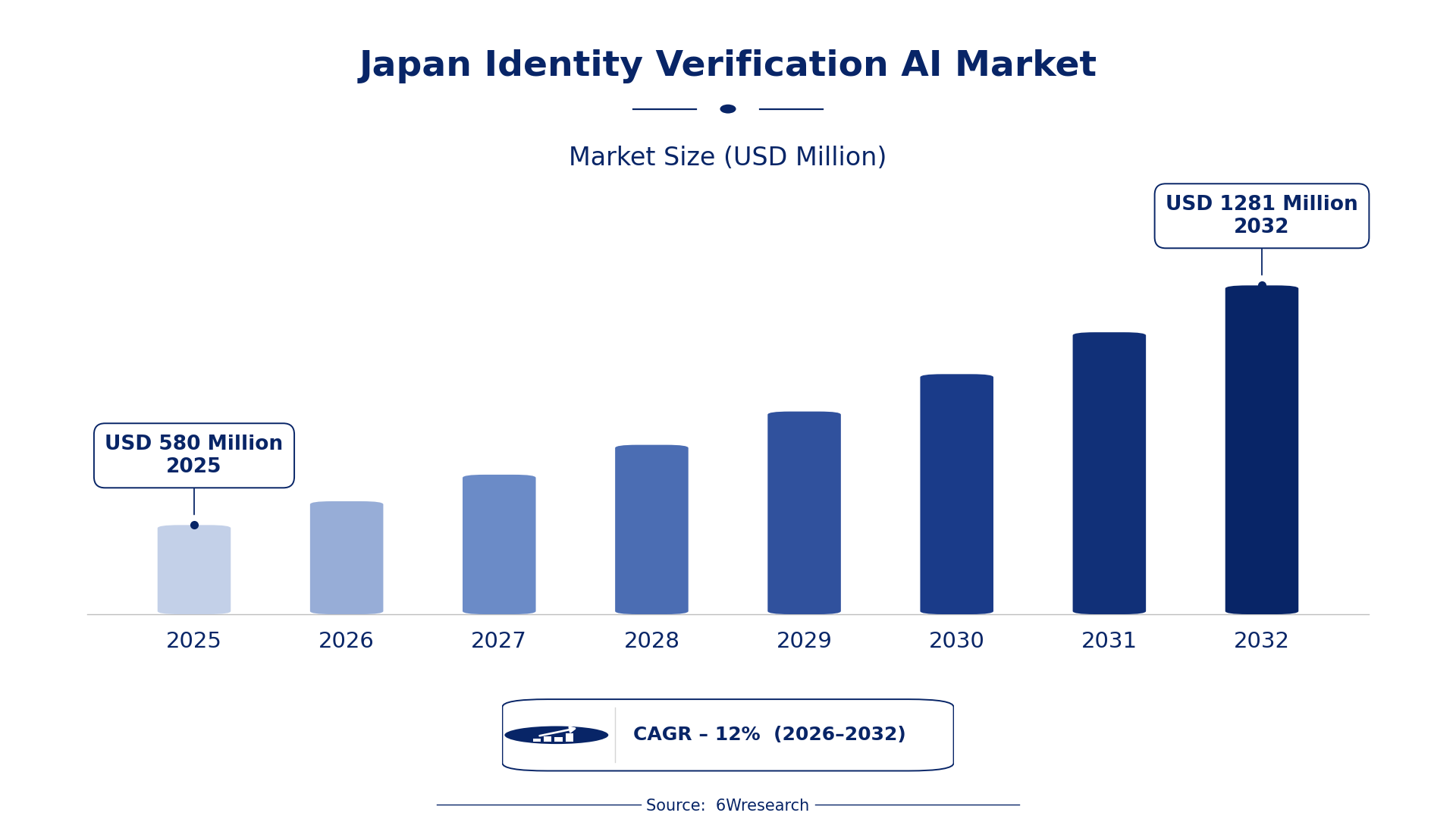
According to 6Wresearch internal database and industry insights, the Japan Identity Verification AI Market was valued at USD 580 Million in 2025 and is projected to reach USD 1,281 Million by 2032, growing at a CAGR of approximately 12% during 2026–2032.
Japan Identity Verification AI Market Highlights
| Report Metric | Details |
| Report Name | Japan Identity Verification AI Market (2026-2032) |
| Market Size 2025 | USD 580 Million |
| Market Size 2032 | USD 1,281 Million |
| Absolute Growth 2025–2032 | USD 701 Million |
| CAGR 2026–2032 | 12% |
| Peak Annual Growth | 13.9% in 2027 |
| Forecast Period | 2026–2032 |
| Historical Data | 2022–2025 |
| Base Year | 2025 |
| Leading Verification Mode, 2025 | Facial Recognition (37% share) |
| Leading AI Technology Used, 2025 | Deep Learning/CNNs (37% share) |
| Leading Use Case, 2025 | eKYC (39% share) |
| Leading End User, 2025 | Fintech & Banking (45% share) |
| Fastest-Growing Verification Mode | Behavioral Biometrics (15.5% CAGR) |
| Fastest-Growing AI Technology Used | OCR + NLP (17.2% CAGR) |
| Fastest-Growing Use Case | Fraud Prevention (15.6% CAGR) |
| Fastest-Growing End User | E-commerce & e-Gov Platforms (15.9% CAGR) |
| Growing Sector | Fintech and Banking |
| Key End Users | Fintech, Banking, E-commerce, Government |
Japan Identity Verification AI Market Year-wise Growth Rate and Key Drivers (2022–2032)
This graph illustrates the annual growth rates of the market from 2022 to 2032, highlighting a steady upward trajectory and projected market expansion over the forecast period.

For each year, the table pairs the estimated growth rate with the leading influence on demand, showing how the drivers changed across the period.
| Year | Estimated Annual Growth (%) | Market Rationale |
| 2022 | 11.2 | The market showed strong activity with high adoption rates in financial services. |
| 2023 | 10.6 | Growth slowed as the market adjusted to increased regulatory scrutiny in identity verification. |
| 2024 | 10.1 | Demand continued to rise, but at a slower pace due to market saturation in some sectors. |
| 2025 | 9.7 | The market experienced a further slowdown as competition intensified among service providers. |
| 2026 | 13.6 | Growth is expected to accelerate as new technologies improve efficiency and user experience in identity verification. |
| 2027 | 13.9 | The market is projected to peak with substantial investments in AI technologies that improve security measures. |
| 2028 | 12.4 | Growth is anticipated to moderate as the market begins to stabilise following rapid technological advancements. |
| 2029 | 12.0 | The pace of growth is expected to slow as established players consolidate their positions in the market. |
| 2030 | 11.5 | Demand will remain steady as regulatory frameworks become more defined and clear. |
| 2031 | 10.0 | The market is projected to continue growing, driven by increased digital transactions across sectors. |
| 2032 | 10.6 | Growth is expected to accelerate again as new applications of identity verification AI emerge. |
Note: Market size estimations and growth projections presented in this report are based on 6Wresearch's proprietary forecasting methodology, utilizing the latest available industry data, government publications, and primary research inputs.
Japan Identity Verification AI Market Synopsis
Identity Verification AI employs advanced technologies like facial recognition and document verification to authenticate identities, primarily developed through deep learning algorithms. The Japan Identity Verification AI Market is growing due to rising demand from sectors such as fintech and e-commerce, driven by the need for secure online transactions and compliance with regulations. In 2023, the government launched a digital identity program to improve eKYC processes, further stimulating market growth and enhancing security measures in financial transactions.
Market Dynamics Impact Analysis (2026–2032)
| Factor | Type | Impact | Primary Segment Affected |
| Growing demand for secure online transactions | Driver | High | eKYC |
| Increased regulatory requirements for identity verification | Driver | High | Document Verification |
| Expansion of fintech services requiring identity verification | Opportunity | High | Fintech & Banking |
| Rising adoption of AI technologies in various sectors | Opportunity | Medium | Facial Recognition |
| High competition among identity verification providers | Restraint | High | Behavioral Biometrics |
| Privacy concerns regarding data usage in identity verification | Restraint | Medium | Document Verification |
| Challenges in integrating new technologies with legacy systems | Challenge | High | Secure Login |
| Limited awareness of advanced identity verification solutions | Challenge | Medium | Fraud Prevention |
Evaluation of Drivers in Japan Identity Verification AI Market (2026–2032)
These are the developments adding the most demand over the forecast period.
| Drivers | Primary Segment Affected | Why It Matters (Evidence) |
| High adoption of eKYC processes in financial services | eKYC | Over 80% of banks in Japan have implemented identity verification AI to streamline customer onboarding. |
| Increased focus on regulatory compliance | Document Verification | The Financial Services Agency of Japan has set stringent guidelines for identity verification in fintech applications. |
| Growing demand for secure online transactions | Facial Recognition | The Tokyo metropolitan area is a major hub for fintech innovation, driving demand for identity verification solutions. |
| Rising investment in AI technologies | Deep Learning/CNNs | The National Institute of Advanced Industrial Science and Technology supports research in AI technologies for identity verification. |
| Expansion of e-commerce platforms requiring identity verification | Fraud Prevention | The Ministry of Internal Affairs and Communications promotes AI use for secure online transactions. |
Most of the extra volume comes from the increasing adoption of eKYC processes, with over 80% of banks in Japan implementing identity verification AI to streamline customer onboarding. Guidelines for fintech applications further increase demand for document verification solutions. The focus on secure online transactions is pushing the use of facial recognition technologies. The growing demand for fraud prevention solutions is also clear as companies seek to strengthen their security measures.
Evaluation of Restraints in Japan Identity Verification AI Market
The key brakes on demand, and where they bite hardest, are shown below.
| Market Restraint | Primary Segment Affected | Why It Matters (Evidence) |
| High costs associated with implementing advanced identity verification technologies deter smaller firms from entering the market. | Facial Recognition | The initial investment required for sophisticated systems can exceed 30% of a smaller company's annual budget, limiting their ability to compete. |
| Regulatory compliance requirements increase operational costs for financial institutions. | Document Verification | Adhering to guidelines set by the Financial Services Agency can raise compliance costs by approximately 25%, impacting profitability. |
| A shortage of skilled professionals in AI technologies hampers development and implementation. | Behavioral Biometrics | The demand for AI talent outstrips supply, leading to increased hiring costs by 20% and project delays. |
| Privacy concerns surrounding data usage in identity verification restrict the adoption of certain technologies. | Voice Authentication | Strict privacy laws limit the use of voice data, making it challenging for firms to implement effective solutions. |
| Integration challenges with existing systems can delay the deployment of new identity verification solutions. | eKYC | Many financial institutions face difficulties in merging new technologies with legacy systems, resulting in project timelines extending by several months. |
Japan Identity Verification AI Market Challenges
In Japan, fintech firms struggle to implement advanced identity verification technologies, causing delays in transaction processing. This challenge arises from the rapid pace of technological change, resulting in potential revenue losses of up to 30% for banks due to transaction failures. Compliance with the Financial Services Agency's guidelines creates additional burdens, leading to implementation delays that can extend for several months. A lack of skilled AI professionals compounds these issues, increasing hiring costs by 20% for companies. High costs associated with adopting new technologies also deter smaller players, limiting competition and innovation in the market.
Trends in the Japan Identity Verification AI Market
Four trends stand out in the Japan Identity Verification AI Market.
- Shift towards Improved eKYC Solutions: In 2023, a digital identity program was initiated to streamline eKYC processes, impacting over 80% of banks. This shift is projected to improve security and efficiency in customer verification.
- Increase in Facial Recognition Applications: Facial recognition technology is increasingly adopted in public spaces, regulated under Japanese privacy laws. As of 2023, this trend is anticipated to grow, improving security measures in various sectors.
- Growing Use of AI in Fraud Prevention: Financial institutions are increasingly employing AI technologies for fraud prevention. In 2023, the Ministry of Internal Affairs and Communications promoted AI use, resulting in improved security in online transactions.
- Expansion of Voice Authentication in Call Centers: Voice authentication is gaining traction in call centers, improving customer service efficiency. As of 2023, this technology is being integrated into numerous customer service operations.
Investment Opportunities in the Japan Identity Verification AI Market
The following opportunities in the Japan Identity Verification AI Market pair current demand with a clear way in.
- Increasing Demand for Secure Online Transactions: With Japan's population of approximately 126 million, the market for identity verification solutions is expanding. Fintech companies are increasingly seeking advanced solutions to improve security.
- Investment in AI Technologies: The growing adoption of AI technologies presents a strong opportunity for suppliers. The National Institute of Advanced Industrial Science and Technology supports research, indicating a need for innovative solutions.
- Expansion of eKYC in Financial Services: As over 80% of banks adopt identity verification AI, the demand for eKYC solutions is surging. Companies can enter this market by partnering with local fintech firms.
- Growth in E-commerce Platforms: The e-commerce sector is rapidly expanding, creating a demand for identity verification technologies. Suppliers can target this sector by offering tailored solutions for online platforms.
Government Initiatives in the Japan Identity Verification AI Market
The Digital Agency, established in September 2021, leads the government's digital transformation efforts. This agency sets common system standards that impact identity verification processes across various sectors, ensuring compliance and improving security measures for buyers.
In 2023, the government allocated substantial funding to support the development of digital identity solutions. The Ministry of Internal Affairs and Communications oversees this initiative, promoting the use of AI technologies for secure online transactions, which directly benefits identity verification AI buyers.
Future Insight of the Japan Identity Verification AI Market
By 2032, clinics will increasingly utilise AI-driven identity verification solutions to enhance patient security and streamline processes. The government's digital identity program will drive efficiency, benefiting both buyers and suppliers. As over 80% of banks adopt these technologies, the standardisation of ISO/IEC 27001 will ensure consistent security measures across the sector. The Tokyo metropolitan area is set to emerge as a central hub for identity verification innovation, fostering collaboration among technology developers and attracting significant investments.
Market Segmentation Analysis
Japan Identity Verification AI Market report covers a detailed analysis of the following market segments:
By Verification Mode – Facial Recognition Leads, Behavioral Biometrics Expected to Grow Fastest
According to Saurav Kr Singh, Senior Research Analyst at 6Wresearch, the largest verification mode category in 2025 was Facial Recognition, at 37% of revenue. Facial recognition technology holds the largest share as it is widely implemented across various applications, particularly in the financial sector. For instance, over 80% of banks in Japan have integrated this technology into their security measures. The quickest growth will come from Behavioral Biometrics, forecast to expand at a CAGR of 15.5% between 2026 and 2032. The rapid growth of behavioral biometrics is attributed to its effectiveness in enhancing security, especially in environments like call centres. This method serves as an essential addition to existing verification technologies, addressing rising security concerns. Suppliers should consider incorporating behavioral biometrics into their offerings to meet the increasing demand for comprehensive security solutions.
By AI Technology Used – Deep Learning/CNNs Lead, OCR + NLP Expected to Grow Fastest
Deep Learning/CNNs took 37% of ai technology used revenue in 2025, more than any other category. Deep learning and CNNs dominate the market because they are essential for processing and analysing biometric data, which is critical for effective identity verification. Their widespread adoption across various sectors underscores their significance in this field. OCR + NLP is set to record the highest CAGR in this split, 17.2% over 2026–2032. The combination of OCR and NLP is experiencing rapid growth as it plays a crucial role in efficiently reading and interpreting identity documents, which is vital for compliance. This integration significantly enhances the verification process. Buyers will benefit from suppliers that offer advanced OCR and NLP solutions to improve the efficiency of document verification.
By Use Case – eKYC Leads, Fraud Prevention Expected to Grow Fastest
eKYC accounted for 39% of the market by use case in 2025. eKYC is the leading use case due to its importance in financial services for verifying customer identities, especially following the introduction of the digital identity programme. This process is essential for meeting regulatory requirements set by the Financial Services Agency. Fraud Prevention is projected to grow fastest, at a CAGR of 15.6% during 2026–2032. Fraud prevention is rapidly gaining momentum as businesses increasingly focus on protecting against identity theft, particularly with the rise of online transactions. The heightened emphasis on security is driving growth in this area. Suppliers need to prioritise the development of solutions that enhance fraud prevention capabilities to align with market needs.
By End User – Fintech & Banking Leads, E-commerce & e-Gov Platforms Expected to Grow Fastest
In 2025, Fintech & Banking led the end user split with a 45% share. Fintech and banking represent the largest end user segment, relying heavily on identity verification solutions to secure financial transactions. The ongoing digital transformation in this sector has solidified its leading position in the market. Over 2026–2032, E-commerce & e-Gov Platforms are expected to post the fastest growth, at a CAGR of 15.9%. E-commerce and e-government platforms are witnessing the fastest growth due to the rising demand for secure online transactions in these sectors. The surge in digital interactions has made robust identity verification essential. Suppliers should tailor their solutions to address the specific needs of e-commerce and e-government platforms to capitalise on this growth.
Key Attractiveness of the Report
- 10 Years of Market Numbers
- Historical Data Starting from 2022 to 2025
- Base Year 2025
- Forecast Data until 2032
- Key Performance Indicators Impacting the Market
- Major Upcoming Developments and Projects
Key Highlights of the Report:
- Japan Identity Verification AI Market Outlook
- Market Size of Japan Identity Verification AI Market, 2025
- Forecast of Japan Identity Verification AI Market, 2032
- Historical Data and Forecast of Japan Identity Verification AI Revenues & Volume for the Period 2022-2032F
- Japan Identity Verification AI Market Trend Evolution
- Japan Identity Verification AI Market Drivers and Challenges
- Japan Identity Verification AI Price Trends
- Japan Identity Verification AI Porter's Five Forces
- Japan Identity Verification AI Industry Life Cycle
- Historical Data and Forecast of Japan Identity Verification AI Market Revenues & Volume By Verification Mode for the Period 2022-2032F
- Historical Data and Forecast of Japan Identity Verification AI Market Revenues & Volume By Facial Recognition for the Period 2022-2032F
- Historical Data and Forecast of Japan Identity Verification AI Market Revenues & Volume By Document Verification for the Period 2022-2032F
- Historical Data and Forecast of Japan Identity Verification AI Market Revenues & Volume By Behavioral Biometrics for the Period 2022-2032F
- Historical Data and Forecast of Japan Identity Verification AI Market Revenues & Volume By Voice Authentication for the Period 2022-2032F
- Historical Data and Forecast of Japan Identity Verification AI Market Revenues & Volume By AI Technology Used for the Period 2022-2032F
- Historical Data and Forecast of Japan Identity Verification AI Market Revenues & Volume By Deep Learning/CNNs for the Period 2022-2032F
- Historical Data and Forecast of Japan Identity Verification AI Market Revenues & Volume By OCR + NLP for the Period 2022-2032F
- Historical Data and Forecast of Japan Identity Verification AI Market Revenues & Volume By ML Pattern Recognition for the Period 2022-2032F
- Historical Data and Forecast of Japan Identity Verification AI Market Revenues & Volume By Voiceprint AI for the Period 2022-2032F
- Historical Data and Forecast of Japan Identity Verification AI Market Revenues & Volume By Use Case for the Period 2022-2032F
- Historical Data and Forecast of Japan Identity Verification AI Market Revenues & Volume By eKYC, Secure Login for the Period 2022-2032F
- Historical Data and Forecast of Japan Identity Verification AI Market Revenues & Volume By ID Card Matching for the Period 2022-2032F
- Historical Data and Forecast of Japan Identity Verification AI Market Revenues & Volume By Fraud Prevention for the Period 2022-2032F
- Historical Data and Forecast of Japan Identity Verification AI Market Revenues & Volume By Call Center Access for the Period 2022-2032F
- Historical Data and Forecast of Japan Identity Verification AI Market Revenues & Volume By End User for the Period 2022-2032F
- Historical Data and Forecast of Japan Identity Verification AI Market Revenues & Volume By Fintech & Banking for the Period 2022-2032F
- Historical Data and Forecast of Japan Identity Verification AI Market Revenues & Volume By E-commerce & e-Gov Platforms for the Period 2022-2032F
- Historical Data and Forecast of Japan Identity Verification AI Market Revenues & Volume By Online Platforms for the Period 2022-2032F
- Historical Data and Forecast of Japan Identity Verification AI Market Revenues & Volume By Telecom Providers for the Period 2022-2032F
- Japan Identity Verification AI Import Export Trade Statistics
- Market Opportunity Assessment By Verification Mode
- Market Opportunity Assessment By AI Technology Used
- Market Opportunity Assessment By Use Case
- Market Opportunity Assessment By End User
- Japan Identity Verification AI Top Companies Market Share
- Japan Identity Verification AI Competitive Benchmarking By Technical and Operational Parameters
- Japan Identity Verification AI Company Profiles
- Japan Identity Verification AI Key Strategic Recommendations
Market Covered
Coverage by segment is as follows.
By Verification Mode
- Facial Recognition
- Document Verification
- Behavioral Biometrics
- Voice Authentication
By AI Technology Used
- Deep Learning/CNNs
- OCR + NLP
- ML Pattern Recognition
- Voiceprint AI
By Use Case
- eKYC
- Secure Login
- ID Card Matching
- Fraud Prevention
- Call Center Access
By End User
- Fintech & Banking
- E-commerce & e-Gov Platforms
- Online Platforms
- Telecom Providers































