Japan Identity Verification Devices Market Size & Growth Rate
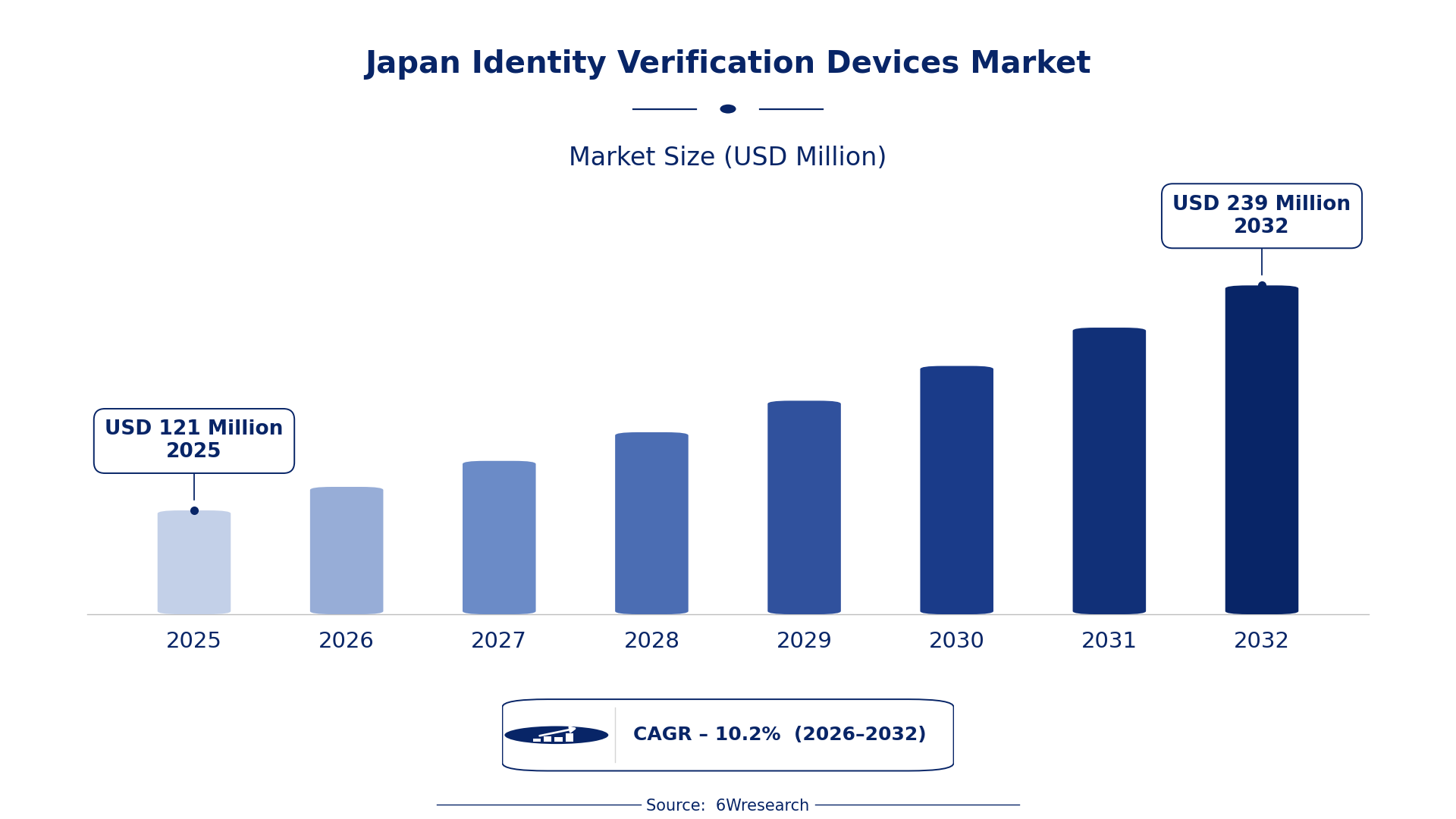
According to 6Wresearch internal database and industry insights, the Japan Identity Verification Devices Market was valued at USD 121 Million in 2025 and is projected to reach USD 239 Million by 2032, growing at a CAGR of approximately 10.2% during 2026–2032.
Japan Identity Verification Devices Market Highlights
| Report Metric | Details |
| Report Name | Japan Identity Verification Devices Market (2026-2032) |
| Market Size 2025 | USD 121 Million |
| Market Size 2032 | USD 239 Million |
| Absolute Growth 2025–2032 | USD 118 Million |
| CAGR 2026–2032 | 10.2% |
| Peak Annual Growth | 12.0% in 2026 |
| Forecast Period | 2026–2032 |
| Historical Data | 2022–2025 |
| Base Year | 2025 |
| Leading Device Type, 2025 | Biometric Scanners (40% share) |
| Leading Input Format, 2025 | Fingerprint/Face (52% share) |
| Leading Connectivity Type, 2025 | Wired/Wireless (40% share) |
| Leading End User, 2025 | Financial Services (46% share) |
| Fastest-Growing Device Type | Iris Recognition Devices (14.0% CAGR) |
| Fastest-Growing Input Format | NFC/Chip-based ID (14.1% CAGR) |
| Fastest-Growing End User | Airports & Immigration (12.8% CAGR) |
| Growing Sector | Financial Services |
| Key End Users | Financial Institutions, Airports, Security Providers, Retailers |
Japan Identity Verification Devices Market Year-wise Growth Rate and Key Drivers (2022–2032)
This graph illustrates the annual growth rates of the market from 2022 to 2032, highlighting a steady upward trajectory and projected market expansion over the forecast period.
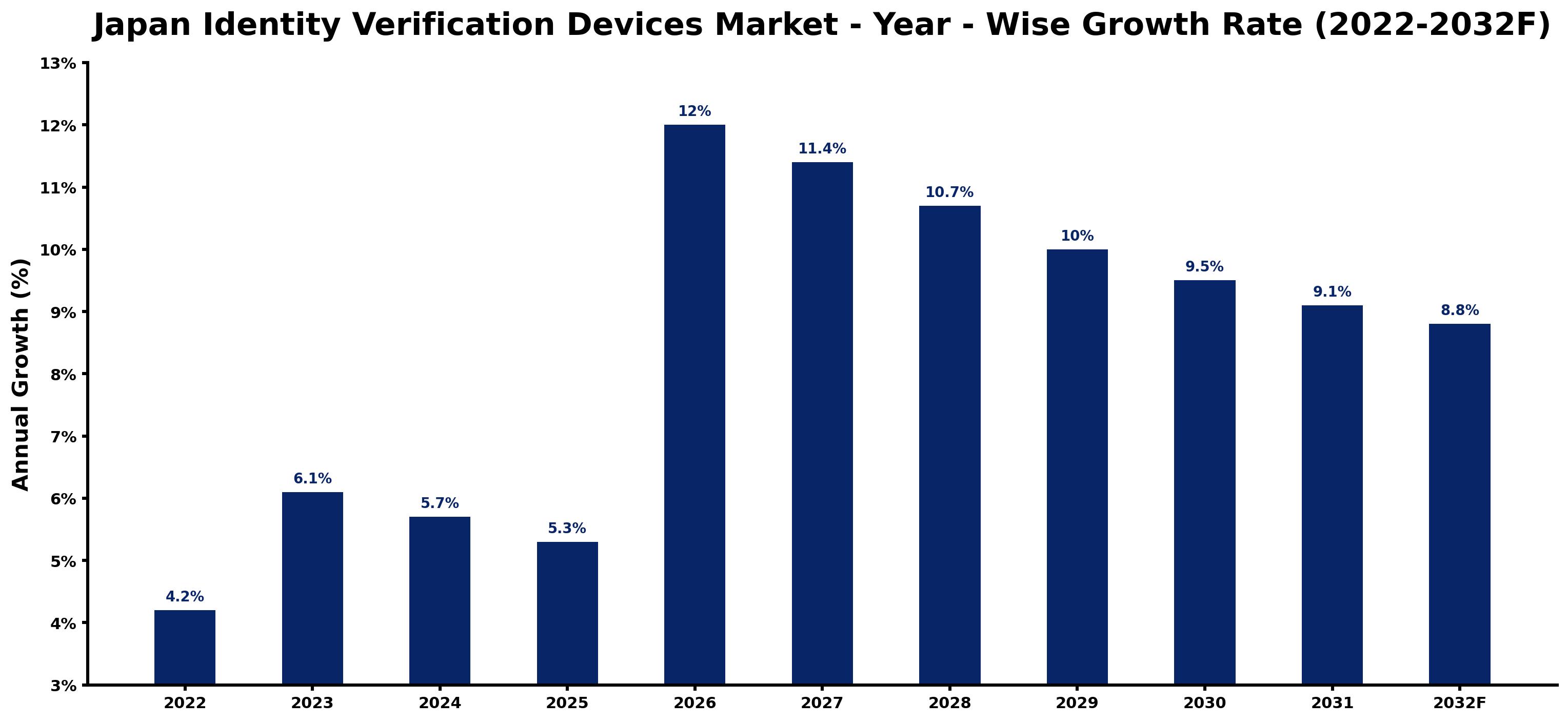
The following figures match every annual growth estimate with the main market development of that year, giving the reasoning behind each rise or slowdown.
| Year | Estimated Annual Growth (%) | Market Rationale |
| 2022 | 4.2 | The market experienced steady growth due to increased security needs. |
| 2023 | 6.1 | Demand accelerated as biometric technologies gained wider acceptance in various sectors. |
| 2024 | 5.7 | Growth slowed as market saturation began to impact new installations. |
| 2025 | 5.3 | The market continued to grow, albeit at a slower pace, as competition intensified. |
| 2026 | 12.0 | Demand surged with the introduction of advanced biometric systems in airports. |
| 2027 | 11.4 | Growth decelerated slightly as the market matured and new entrants emerged. |
| 2028 | 10.7 | The market is projected to maintain growth, driven by ongoing technological advancements. |
| 2029 | 10.0 | Demand will continue to rise, supported by increasing security concerns. |
| 2030 | 9.5 | Growth will slow further as the market reaches a saturation point. |
| 2031 | 9.1 | The market will experience a slight slowdown as competition becomes more pronounced. |
| 2032 | 8.8 | Growth is expected to stabilise as demand aligns with market capacity. |
Note: Market size estimations and growth projections presented in this report are based on 6Wresearch's proprietary forecasting methodology, utilizing the latest available industry data, government publications, and primary research inputs.
Japan Identity Verification Devices Market Synopsis
Identity verification devices are technologies that confirm a person's identity using biometrics or smart cards. In Japan, over 100 million biometric devices were installed in 2022, reflecting strong demand driven by sectors such as finance and security. The Japan Identity Verification Devices Market is expanding due to rising security needs, technological advancements, and increased adoption in financial services and immigration processes.
Market Dynamics Impact Analysis (2026–2032)
| Factor | Type | Impact | Primary Segment Affected |
| Increased security needs drive demand for biometric scanners in various sectors. | Driver | High | Biometric Scanners |
| Growing adoption of smart card readers in financial services enhances transaction security. | Driver | High | Smart Card Readers |
| The rising use of NFC technology in retail creates opportunities for contactless identity verification. | Opportunity | High | NFC/Chip-based ID |
| Investment in airport security systems opens avenues for advanced biometric solutions. | Opportunity | High | Airports & Immigration |
| Market saturation limits the growth potential of existing identity verification technologies. | Restraint | Medium | Biometric Scanners |
| Strict regulations on identity verification devices may hinder market entry for new players. | Restraint | Medium | Smart Card Readers |
| Supply chain disruptions can delay the availability of key components for identity verification devices. | Challenge | High | Fingerprint/Face |
| Technological advancements may outpace current production capabilities, affecting supply. | Challenge | Medium | Iris Recognition Devices |
Evaluation of Drivers in Japan Identity Verification Devices Market (2026–2032)
The factors lifting demand, and the evidence behind each, are summarised below.
| Drivers | Primary Segment Affected | Why It Matters (Evidence) |
| Rising security concerns in Japan boost demand for biometric scanners. | Biometric Scanners | In 2022, Japan had over 100 million biometric devices installed, prompting increased purchases. |
| Smart card readers are essential for secure financial transactions in banking. | Smart Card Readers | Over 80% of financial institutions in Japan utilise smart card readers for security. |
| The expansion of NFC technology in retail boosts contactless payment solutions. | NFC/Chip-based ID | The growing use of NFC technology supports increased demand for secure identity verification. |
| Government initiatives to improve airport security drive biometric adoption. | Airports & Immigration | In 2023, a program launched to improve airport security using biometric devices increased demand. |
| Investment in security technology is projected to rise significantly in the coming years. | Access Control Terminals | Investment is expected to increase by 15% over the next five years, boosting market growth. |
Spending rises because rising security concerns in Japan are boosting demand for biometric scanners, with over 100 million devices installed in 2022. Smart card readers are essential for secure financial transactions, as over 80% of financial institutions utilise them. The expansion of NFC technology in retail supports contactless payment solutions, further increasing demand. Investment in security technology is projected to rise significantly, supporting market growth.
Evaluation of Restraints in Japan Identity Verification Devices Market
The main factors holding the market back are set out below.
| Market Restraint | Primary Segment Affected | Why It Matters (Evidence) |
| Market saturation limits growth potential for existing biometric technologies. | Biometric Scanners | With over 100 million devices installed, new installations face challenges in gaining traction. |
| Strict regulations may hinder market entry for new identity verification technologies. | Smart Card Readers | The National Police Agency implements regulations that can delay product approvals. |
| Supply chain disruptions can delay availability of key components for devices. | Fingerprint/Face | Global supply chain issues have affected the timely delivery of biometric components. |
| Technological advancements may outpace current production capabilities. | Iris Recognition Devices | Manufacturers struggle to keep up with the rapid pace of technology development. |
| High competition in the market can lead to price pressures on manufacturers. | Access Control Terminals | As more players enter the market, pricing strategies become increasingly aggressive. |
Japan Identity Verification Devices Market Challenges
A shortage of skilled technicians hampers the installation and maintenance of identity verification devices, causing delays for hospitals that require timely upgrades. Price competition among suppliers results in lower quality products, affecting buyers who depend on reliable technology for essential operations. Rising demand for advanced biometric systems drives up costs, with installation expenses expected to increase by 20% for financial institutions. Strict regulations from the National Police Agency can delay product launches for suppliers, making it challenging for them to meet buyer needs quickly.
Trends in the Japan Identity Verification Devices Market
The trends below show where the Japan Identity Verification Devices Market is heading.
- Shift from Traditional to Biometric Systems: Japanese airports began adopting advanced biometric systems for passenger processing in 2023, improving security and efficiency. This shift is reflected as biometric systems are now used in over 30% of airport security processes.
- Transition from Wired to Wireless Connectivity: Tokyo is increasingly adopting wireless connectivity in customer service kiosks, with 60% of new installations using wireless technology. This transition improves user experience and operational efficiency.
- Emergence of NFC Technology in Retail: Since 2022, the use of NFC technology in identity verification has expanded significantly in retail, with a 25% increase in adoption. This trend facilitates secure and contactless transactions for consumers.
- Growing Focus on Security in Financial Services: Financial services are prioritising advanced identity verification technologies, with 80% of institutions implementing biometric solutions by 2025. This trend reflects the industry's commitment to improving transaction security.
Investment Opportunities in the Japan Identity Verification Devices Market
Investors looking at the Japan Identity Verification Devices Market should consider the following areas.
- Gap in Biometric Device Adoption: With 60% of financial institutions still relying on traditional methods, there is an opportunity to invest in biometric solutions. Financial services need advanced identity verification technologies to improve security.
- Airports Seeking Enhanced Security Solutions: Airports in Japan are currently investing in biometric systems, with a projected budget of JPY 10 billion for upgrades. Collaborating with local technology providers can facilitate entry into this market.
- Growing Demand for NFC Solutions in Retail: The retail sector is increasingly adopting NFC technology for secure transactions, with a 25% growth expected. Suppliers can enter this market by partnering with retailers to provide NFC-enabled devices.
- Investment in Security Technology: With a projected 15% increase in security technology investment, there is an opportunity for suppliers to provide innovative solutions. Engaging with financial institutions can lead to fruitful partnerships.
Government Initiatives in the Japan Identity Verification Devices Market
The PMD Act regulates the approval and quality of identity verification devices, ensuring safety and efficacy for users. The act mandates rigorous testing and certification processes for manufacturers, which helps maintain high standards in the industry. Additionally, the Industrial Standardization Act governs the JIS product standards, ensuring that devices meet specific performance criteria, which is important for market acceptance.
In 2023, the government allocated JPY 5 billion to improve airport security through biometric systems, overseen by the Ministry of Internal Affairs and Communications. This funding supports the implementation of advanced identity verification technologies in airports, ensuring compliance with national security standards.
Future Insight of the Japan Identity Verification Devices Market
By 2032, hospitals will adopt advanced biometric systems for patient identification, enhancing security and efficiency. The expansion of NFC technology in retail will streamline transactions, benefiting buyers who value speed. Government programs aimed at improving airport security will boost demand for identity verification devices, creating opportunities for suppliers. Investment in security technology is set to rise by 15% over the next five years, encouraging both buyers and suppliers to adapt to evolving industry standards.
Market Segmentation Analysis
Japan Identity Verification Devices Market report covers a detailed analysis of the following market segments:
By Device Type – Biometric Scanners Lead, Iris Recognition Devices Expected to Grow Fastest
According to Saurav Kr Singh, Senior Research Analyst at 6Wresearch, Biometric Scanners took 40% of device type revenue in 2025, more than any other category. Biometric scanners dominate the market as they are widely utilised in finance and security sectors, providing essential secure identification. The presence of over 100 million biometric devices installed in Japan highlights their critical role in various applications. Iris Recognition Devices are set to record the highest CAGR in this split, 14.0% over 2026–2032. Iris recognition devices are experiencing rapid growth due to their deployment in high-security government facilities, which reflects the increasing focus on stringent security measures. This trend is further supported by government initiatives aimed at enhancing airport security with biometric technologies. Suppliers should concentrate on advancing biometric solutions to meet the rising demand for security in key sectors.
By Input Format – Fingerprint/Face Leads, NFC/Chip-based ID Expected to Grow Fastest
Fingerprint/Face held 52% of the Japan Identity Verification Devices Market by input format in 2025. Fingerprint and face recognition technologies dominate the market as they are widely adopted in access control and mobile devices, making them the preferred choice for identity verification. Their integration into more than 80% of financial institutions in Japan highlights their critical role in ensuring secure transactions. NFC/Chip-based ID is projected to grow fastest, at a CAGR of 14.1% during 2026–2032. NFC and chip-based ID formats are rapidly gaining popularity, especially in contactless payment systems, as consumers increasingly seek convenience and efficiency in transactions. This shift indicates a broader trend towards embracing digital payment solutions across Japan. Buyers will gain from investing in NFC technology to optimise payment processes and improve user experience.
By Connectivity Type – Wired/Wireless Leads and Records the Fastest Growth
The largest connectivity type category in 2025 was Wired/Wireless, at 40% of revenue. Wired and wireless connectivity types are essential for the operation of identity verification devices, ensuring flexibility and reliability across numerous applications. Their ability to support both secure environments and public access points caters to a wide range of operational requirements. Its lead should widen, with a projected CAGR of 12.9% during 2026–2032, the highest in this split. The consistent demand for wired and wireless solutions indicates that as technology evolves, the need for versatile connectivity options will persist. This trend allows suppliers to effectively address diverse customer preferences and requirements. Suppliers should focus on developing versatile connectivity options to meet varied market demands.
By End User – Financial Services Lead, Airports & Immigration Expected to Grow Fastest
With 46% of end user revenue in 2025, Financial Services was the largest category. The financial services sector leads the market as it is heavily reliant on secure banking and transaction processes, which require robust identity verification solutions. The strict regulations imposed by the Financial Services Agency further underline the critical need for these devices in this industry. Over 2026–2032, Airports & Immigration is expected to post the fastest growth, at a CAGR of 12.8%. Airports and immigration services are rapidly integrating advanced identity verification technologies to improve border control and passenger verification processes. This growth is driven by rising travel demands and the need for enhanced security measures. Suppliers must tailor their offerings to meet the specific requirements of the airport and immigration sectors to leverage this growing market.
Key Attractiveness of the Report
- 10 Years of Market Numbers
- Historical Data Starting from 2022 to 2025
- Base Year 2025
- Forecast Data until 2032
- Key Performance Indicators Impacting the Market
- Major Upcoming Developments and Projects
Key Highlights of the Report:
- Japan Identity Verification Devices Market Outlook
- Market Size of Japan Identity Verification Devices Market, 2025
- Forecast of Japan Identity Verification Devices Market, 2032
- Historical Data and Forecast of Japan Identity Verification Devices Revenues & Volume for the Period 2022-2032F
- Japan Identity Verification Devices Market Trend Evolution
- Japan Identity Verification Devices Market Drivers and Challenges
- Japan Identity Verification Devices Price Trends
- Japan Identity Verification Devices Porter's Five Forces
- Japan Identity Verification Devices Industry Life Cycle
- Historical Data and Forecast of Japan Identity Verification Devices Market Revenues & Volume By Device Type for the Period 2022-2032F
- Historical Data and Forecast of Japan Identity Verification Devices Market Revenues & Volume By Biometric Scanners for the Period 2022-2032F
- Historical Data and Forecast of Japan Identity Verification Devices Market Revenues & Volume By Smart Card Readers for the Period 2022-2032F
- Historical Data and Forecast of Japan Identity Verification Devices Market Revenues & Volume By Iris Recognition Devices for the Period 2022-2032F
- Historical Data and Forecast of Japan Identity Verification Devices Market Revenues & Volume By Voiceprint Devices for the Period 2022-2032F
- Historical Data and Forecast of Japan Identity Verification Devices Market Revenues & Volume By Input Format for the Period 2022-2032F
- Historical Data and Forecast of Japan Identity Verification Devices Market Revenues & Volume By Fingerprint/Face for the Period 2022-2032F
- Historical Data and Forecast of Japan Identity Verification Devices Market Revenues & Volume By NFC/Chip-based ID for the Period 2022-2032F
- Historical Data and Forecast of Japan Identity Verification Devices Market Revenues & Volume By IR Optical for the Period 2022-2032F
- Historical Data and Forecast of Japan Identity Verification Devices Market Revenues & Volume By Audio for the Period 2022-2032F
- Historical Data and Forecast of Japan Identity Verification Devices Market Revenues & Volume By Connectivity Type for the Period 2022-2032F
- Historical Data and Forecast of Japan Identity Verification Devices Market Revenues & Volume By USB/Bluetooth for the Period 2022-2032F
- Historical Data and Forecast of Japan Identity Verification Devices Market Revenues & Volume By Wired/Wireless for the Period 2022-2032F
- Historical Data and Forecast of Japan Identity Verification Devices Market Revenues & Volume By Wired for the Period 2022-2032F
- Historical Data and Forecast of Japan Identity Verification Devices Market Revenues & Volume By Cloud for the Period 2022-2032F
- Historical Data and Forecast of Japan Identity Verification Devices Market Revenues & Volume By End User for the Period 2022-2032F
- Historical Data and Forecast of Japan Identity Verification Devices Market Revenues & Volume By Access Control Terminals for the Period 2022-2032F
- Historical Data and Forecast of Japan Identity Verification Devices Market Revenues & Volume By Financial Services for the Period 2022-2032F
- Historical Data and Forecast of Japan Identity Verification Devices Market Revenues & Volume By Airports & Immigration for the Period 2022-2032F
- Historical Data and Forecast of Japan Identity Verification Devices Market Revenues & Volume By Customer Service Kiosks for the Period 2022-2032F
- Japan Identity Verification Devices Import Export Trade Statistics
- Market Opportunity Assessment By Device Type
- Market Opportunity Assessment By Input Format
- Market Opportunity Assessment By Connectivity Type
- Market Opportunity Assessment By End User
- Japan Identity Verification Devices Top Companies Market Share
- Japan Identity Verification Devices Competitive Benchmarking By Technical and Operational Parameters
- Japan Identity Verification Devices Company Profiles
- Japan Identity Verification Devices Key Strategic Recommendations
Market Covered
This report examines the market across the segments below.
By Device Type
- Biometric Scanners
- Smart Card Readers
- Iris Recognition Devices
- Voiceprint Devices
By Input Format
- Fingerprint/Face
- NFC/Chip-based ID
- IR Optical
- Audio
By Connectivity Type
- USB/Bluetooth
- Wired/Wireless
- Wired
- Cloud
By End User
- Access Control Terminals
- Financial Services
- Airports & Immigration
- Customer Service Kiosks































