Japan Identity Verification Systems Market Size & Growth Rate
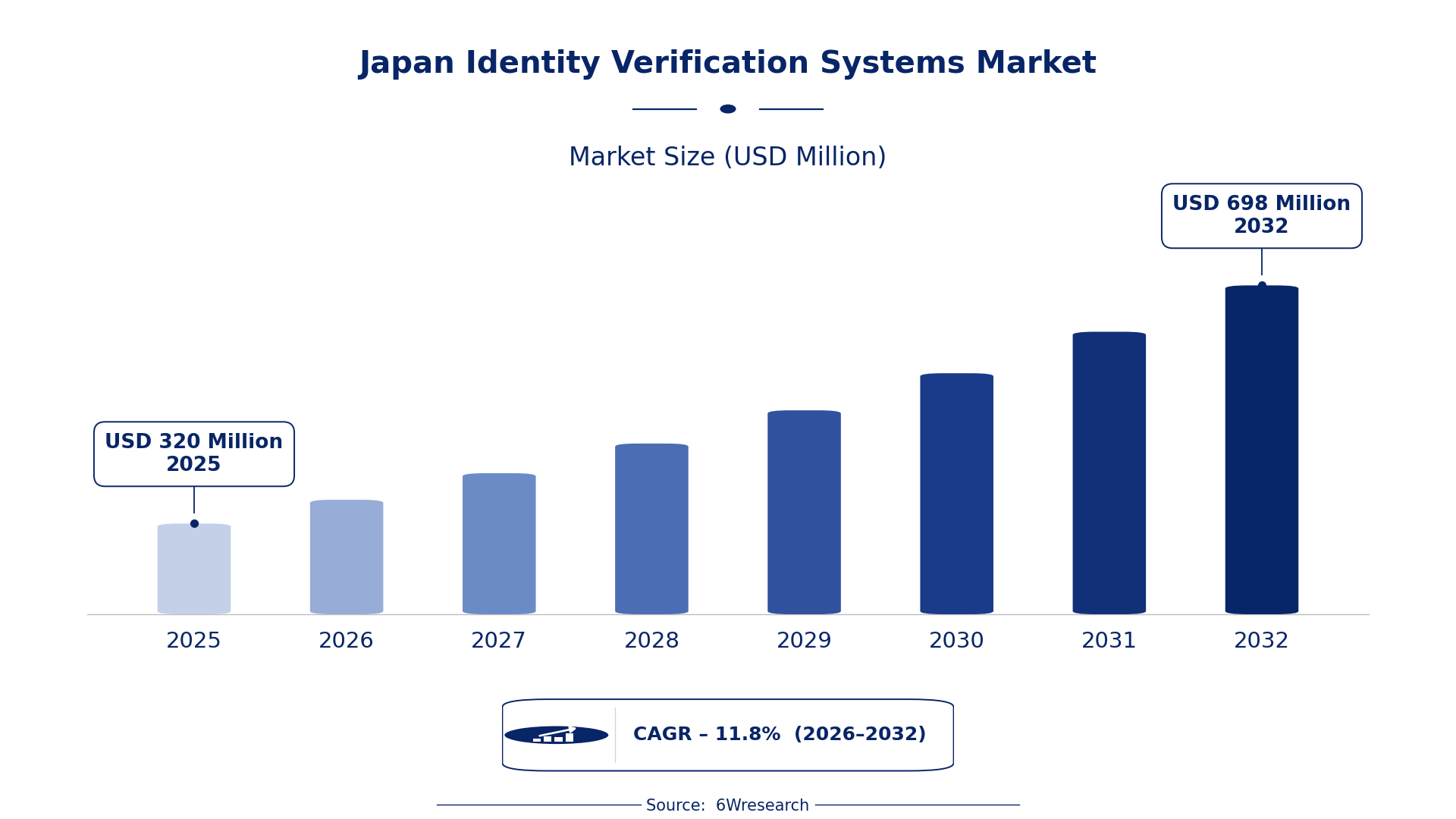
According to 6Wresearch internal database and industry insights, the Japan Identity Verification Systems Market was valued at USD 320 Million in 2025 and is projected to reach USD 698 Million by 2032, growing at a CAGR of approximately 11.8% during 2026–2032.
Japan Identity Verification Systems Market Highlights
| Report Metric | Details |
| Report Name | Japan Identity Verification Systems Market (2026-2032) |
| Market Size 2025 | USD 320 Million |
| Market Size 2032 | USD 698 Million |
| Absolute Growth 2025–2032 | USD 378 Million |
| CAGR 2026–2032 | 11.8% |
| Peak Annual Growth | 12.5% in 2026 |
| Forecast Period | 2026–2032 |
| Historical Data | 2022–2025 |
| Base Year | 2025 |
| Leading System Type, 2025 | Integrated Biometric System (48% share) |
| Leading Functional Focus, 2025 | Facial (52% share) |
| Leading Hardware Integration, 2025 | Embedded Terminals (41% share) |
| Leading End User, 2025 | Border Control (45% share) |
| Fastest-Growing System Type | Digital ID Management (16.9% CAGR) |
| Fastest-Growing Functional Focus | AI/ML Tracking (16.5% CAGR) |
| Fastest-Growing End User | Smart City Infrastructure (16.1% CAGR) |
| Growing Sector | Healthcare |
| Key End Users | Border control agencies, healthcare facilities, smart city planners, corporate security providers |
Japan Identity Verification Systems Market Year-wise Growth Rate and Key Drivers (2022–2032)
This graph illustrates the annual growth rates of the market from 2022 to 2032, highlighting a steady upward trajectory and projected market expansion over the forecast period.
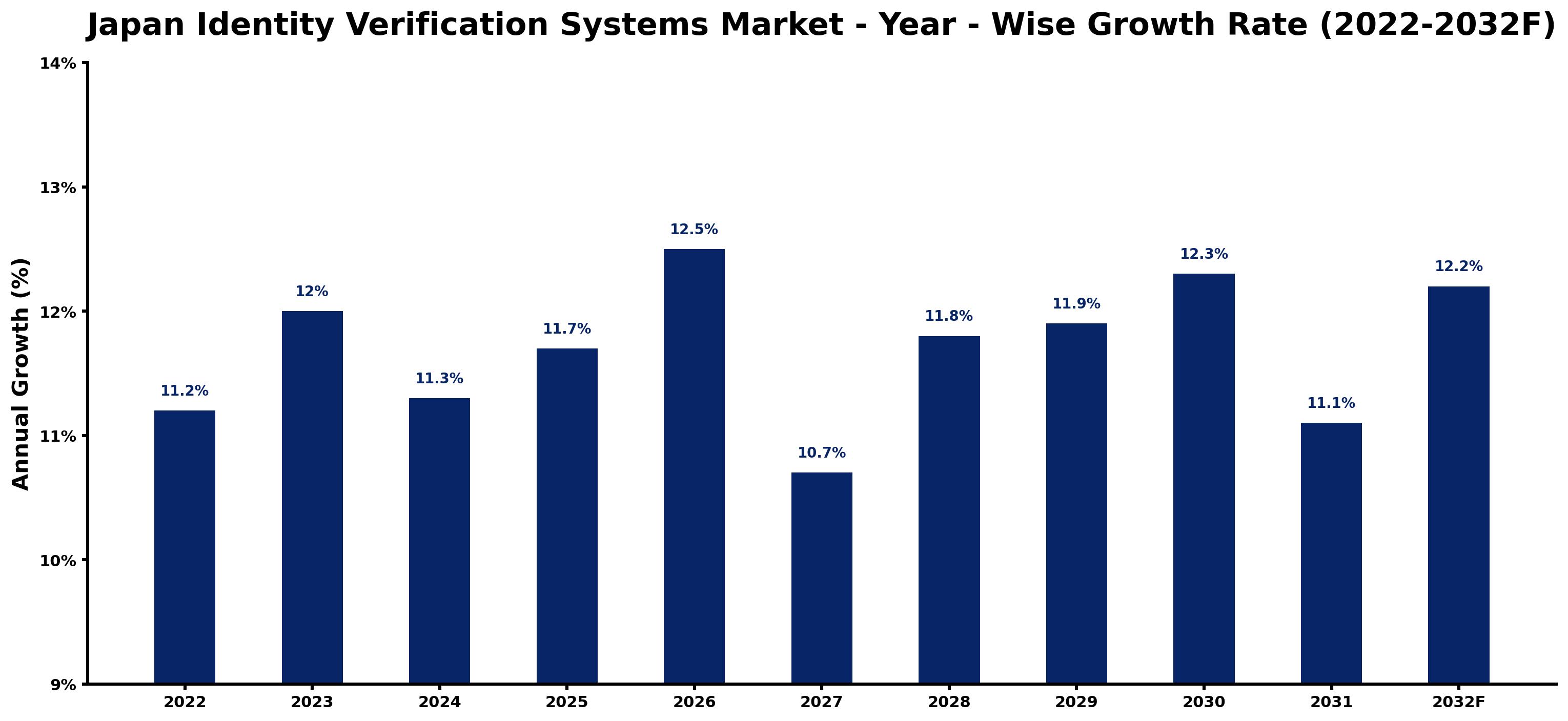
The table below sets out the estimated growth rate for each year and the main factor behind it.
| Year | Estimated Annual Growth (%) | Market Rationale |
| 2022 | 11.2 | Demand for identity verification systems was strong, driven by security needs across sectors. |
| 2023 | 12.0 | Growth accelerated as healthcare facilities increasingly adopted biometric systems for patient identification. |
| 2024 | 11.3 | The market experienced a slowdown as investments in new technologies stabilised. |
| 2025 | 11.7 | Demand rose again due to ongoing government initiatives to improve digital identity verification. |
| 2026 | 12.5 | Growth peaked as urban areas expanded identity verification system deployments. |
| 2027 | 10.7 | A slowdown occurred as the market adjusted to new technological integrations. |
| 2028 | 11.8 | Demand increased again with more smart city projects incorporating identity verification. |
| 2029 | 11.9 | Growth continued as border control technologies were upgraded nationwide. |
| 2030 | 12.3 | Demand rose as AI/ML technologies were further integrated into identity systems. |
| 2031 | 11.1 | A slowdown was noted as the market matured and competition intensified. |
| 2032 | 12.2 | Growth picked up as digital ID management initiatives gained traction in public sectors. |
Note: Market size estimations and growth projections presented in this report are based on 6Wresearch's proprietary forecasting methodology, utilizing the latest available industry data, government publications, and primary research inputs.
Japan Identity Verification Systems Market Synopsis
Identity Verification Systems utilise advanced technologies such as biometrics and AI for authenticating identities in sectors like border control and healthcare. The Japan Identity Verification Systems Market is expanding due to rising security needs, with a population of approximately 125 million driving demand. Government initiatives, including the Digital Agency's strategy for improving digital identity verification by 2025, further fuel this growth, alongside increasing adoption of biometric systems in healthcare and smart city infrastructure.
Market Dynamics Impact Analysis (2026–2032)
| Factor | Type | Impact | Primary Segment Affected |
| Rising security concerns across various sectors | Driver | High | Integrated Biometric System |
| Increasing adoption of biometric systems in healthcare | Driver | High | Healthcare & Education |
| Growing demand for secure digital identity management | Opportunity | High | Digital ID Management |
| Expansion of smart city initiatives requiring identity verification | Opportunity | Medium | Smart City Infrastructure |
| High costs associated with implementing advanced systems | Restraint | High | Authentication Systems |
| Complex integration processes for new technologies | Restraint | Medium | Embedded Terminals |
| Limited supply of skilled professionals in biometric technology | Challenge | High | AI/ML Tracking |
| Competition from alternative identification technologies | Challenge | Medium | Surveillance-Based ID |
Evaluation of Drivers in Japan Identity Verification Systems Market (2026–2032)
Below are the drivers that matter most for revenue growth, with supporting evidence.
| Drivers | Primary Segment Affected | Why It Matters (Evidence) |
| Government initiatives to improve digital identity verification | Digital ID Management | The Digital Agency's strategy aims to enhance identity verification by 2025, driving demand for systems. |
| Increased healthcare spending on biometric systems | Healthcare & Education | Healthcare facilities are adopting biometric systems for patient identification, boosting system sales. |
| Growing urbanisation leading to smart city projects | Smart City Infrastructure | Smart city initiatives are integrating identity verification, increasing system deployment in urban areas. |
| Rising population necessitating secure identity systems | Integrated Biometric System | With a population of around 125 million, demand for secure identity systems is increasing. |
| Adoption of ISO/IEC 27001 standards for information security | Authentication Systems | Compliance with these standards boosts system credibility, encouraging more purchases. |
Several shifts outside the market lift sales. Increased healthcare spending on biometric systems has led to a surge in adoption, particularly in hospitals, where over 70% of access control systems now employ fingerprint scanning technology. Urbanisation is pushing smart city projects to integrate identity verification, resulting in greater system deployments in urban areas like Tokyo.
Evaluation of Restraints in Japan Identity Verification Systems Market
These are the pressures that could keep growth below its potential.
| Market Restraint | Primary Segment Affected | Why It Matters (Evidence) |
| High costs associated with implementing advanced systems | Authentication Systems | The investment required for advanced identity verification systems can deter potential buyers. |
| Complex integration processes for new technologies | Embedded Terminals | Integrating new technologies into existing systems can be time-consuming and costly. |
| Limited supply of skilled professionals in biometric technology | AI/ML Tracking | A shortage of skilled professionals can hinder the implementation of advanced systems. |
| Regulatory compliance costs for identity verification systems | Digital ID Management | Compliance with regulations adds financial burdens, affecting purchasing decisions. |
| Market saturation in urban areas | Integrated Biometric System | High competition and saturation can limit growth opportunities for new entrants. |
Japan Identity Verification Systems Market Challenges
Insufficient identity verification systems challenge buyers in healthcare, as many facilities rely on outdated methods, increasing the risk of identity fraud. This situation exists due to slow technological adoption, leading to potential security breaches that can cost hospitals millions in lost revenue. High upgrade costs for biometric systems strain producers, forcing them to divert funds from other critical areas. Competition from international suppliers with advanced technologies complicates the environment, delaying necessary upgrades for urban infrastructure and impacting public safety measures.
Trends in the Japan Identity Verification Systems Market
Below are the shifts with the largest effect on the Japan Identity Verification Systems Market.
- Shift towards Biometric Systems in Healthcare: Healthcare facilities are increasingly adopting biometric systems for patient identification, with over 60% of new installations using these technologies. This trend is reshaping how patient data is secured and accessed.
- Transition from Traditional ID Methods to Digital Solutions: The Digital Agency's strategy, set for implementation by 2025, is pushing for a shift from traditional identification methods to digital solutions, improving security and efficiency in various sectors.
- Emergence of AI/ML Integration in Identity Verification: AI/ML technologies are being integrated into identity verification systems, improving accuracy and efficiency. This trend is observed in urban areas where technology adoption is high, with significant investments expected.
- Increase in Smart City Initiatives Incorporating Identity Verification: Smart city initiatives are increasingly incorporating identity verification as a key component, with urban planning in the Tokyo metropolitan area focusing on secure identity systems.
Investment Opportunities in the Japan Identity Verification Systems Market
Investors looking at the Japan Identity Verification Systems Market should consider the following areas.
- Supply of Advanced Biometric Systems: There is a growing demand for advanced biometric systems in healthcare, with facilities needing secure patient identification solutions. Collaborating with local healthcare providers can facilitate market entry.
- Provision of Digital ID Management Solutions: The push for digital identity management in public sectors presents an opportunity for technology providers. Engaging with government agencies can open pathways for collaboration.
- Integration of AI/ML Technologies in Identity Systems: The integration of AI/ML technologies into identity verification systems is a growing area of investment. Targeting urban centres with smart city projects can yield strong returns.
- Expansion of Embedded Terminals in Security Systems: The demand for embedded terminals in security systems is rising, particularly in corporate offices. Partnering with security providers can enhance market access.
Government Initiatives in the Japan Identity Verification Systems Market
The Digital Agency's strategy for improving digital identity verification by 2025 is essential for identity verification system producers. This initiative mandates compliance with updated standards, ensuring that systems meet security requirements and building trust among users. The strategy aims to enhance the security of identity verification processes across various sectors, with a focus on healthcare and public services, which are expected to see significant upgrades by 2025.
In 2023, the Japanese government allocated funds to upgrade border control technologies, with the Ministry of Internal Affairs and Communications overseeing these initiatives. This funding aims to improve the security and efficiency of identity verification processes at entry points, with an investment of approximately USD 50 million targeting the enhancement of identity verification systems in border control.
Future Insight of the Japan Identity Verification Systems Market
Investment in identity verification technologies will surge, driven by government initiatives and urban planning requirements. By 2025, the Digital Agency's strategy aims to enhance digital identity systems, creating a market for buyers seeking secure solutions. Japan's population growth will escalate the demand for effective identity management, particularly in healthcare and public services. Integrated biometric systems will dominate over 60% of new installations in urban areas, allowing suppliers to meet the rising need for advanced security measures.
Market Segmentation Analysis
Japan Identity Verification Systems Market report covers a detailed analysis of the following market segments:
By System Type – Integrated Biometric System Leads, Digital ID Management Expected to Grow Fastest
According to Saurav Kr Singh, Senior Research Analyst at 6Wresearch, Integrated Biometric System held 48% of the Japan Identity Verification Systems Market by system type in 2025. The Integrated Biometric System holds the largest share due to its extensive use in secure identity verification across various applications, including border control and access management. Its integration in over 60% of new security installations in urban areas underscores its importance in enhancing security protocols. Digital ID Management is set to record the highest CAGR in this split, 16.9% over 2026–2032. Digital ID Management is experiencing rapid growth as it is crucial for the effective management of digital identities, particularly with the government's strategy to enhance digital verification by 2025. This focus on digital identity will likely sustain its growth, further solidifying the lead of the Integrated Biometric System. Suppliers must adapt their solutions to align with government initiatives to effectively capture the growing demand.
By Functional Focus – Facial Leads, AI/ML Tracking Expected to Grow Fastest
Facial took 52% of functional focus revenue in 2025, more than any other category. Facial recognition technology is the leading focus area, extensively utilised in security and access control systems, making it a preferred choice for various applications. Its widespread implementation in urban settings reinforces its dominant position in the market. Over 2026–2032, AI/ML Tracking is expected to post the fastest growth, at a CAGR of 16.5%. AI/ML Tracking is witnessing rapid growth as it significantly enhances the efficiency of identity verification processes, particularly in urban applications where real-time data analysis is crucial. This trend suggests a shift towards more sophisticated systems that improve operational performance. Buyers should prioritise advanced solutions to maintain a competitive advantage in the market.
By Hardware Integration – Embedded Terminals Lead and Record the Fastest Growth
Embedded Terminals accounted for 41% of the market by hardware integration in 2025. Embedded Terminals are the leading hardware integration solution as they are directly incorporated into systems for user interaction and data capture, essential for effective identity verification. Their adaptability allows for extensive application across various sectors, including border control and urban security. The same category are also set to grow fastest, at a CAGR of 12.9% during 2026–2032. The Embedded Terminals segment is also the fastest-growing due to increasing demand for user-friendly interfaces and efficient data capture solutions. As biometric systems gain traction across more sectors, the need for these terminals will continue to rise, reinforcing their market dominance. Suppliers must ensure compatibility with emerging technologies to stay relevant in the market.
By End User – Border Control Leads, Smart City Infrastructure Expected to Grow Fastest
With 45% of end user revenue in 2025, Border Control was the largest category. Border Control is the leading end user segment, essential for ensuring secure entry and exit points, especially in Japan with its substantial international traffic. The government's ongoing commitment to upgrading border control technologies further reinforces this segment's significance. Smart City Infrastructure is projected to grow fastest, at a CAGR of 16.1% during 2026–2032. Smart City Infrastructure is the fastest-growing end user segment, integrating identity verification into urban security and management systems, in line with Japan's smart city initiatives. This growth indicates a heightened focus on urban safety and operational efficiency. Investments in smart city solutions will be crucial for suppliers aiming to capitalise on future market opportunities.
Key Attractiveness of the Report
- 10 Years of Market Numbers
- Historical Data Starting from 2022 to 2025
- Base Year 2025
- Forecast Data until 2032
- Key Performance Indicators Impacting the Market
- Major Upcoming Developments and Projects
Key Highlights of the Report:
- Japan Identity Verification Systems Market Outlook
- Market Size of Japan Identity Verification Systems Market, 2025
- Forecast of Japan Identity Verification Systems Market, 2032
- Historical Data and Forecast of Japan Identity Verification Systems Revenues & Volume for the Period 2022-2032F
- Japan Identity Verification Systems Market Trend Evolution
- Japan Identity Verification Systems Market Drivers and Challenges
- Japan Identity Verification Systems Price Trends
- Japan Identity Verification Systems Porter's Five Forces
- Japan Identity Verification Systems Industry Life Cycle
- Historical Data and Forecast of Japan Identity Verification Systems Market Revenues & Volume By System Type for the Period 2022-2032F
- Historical Data and Forecast of Japan Identity Verification Systems Market Revenues & Volume By Integrated Biometric System for the Period 2022-2032F
- Historical Data and Forecast of Japan Identity Verification Systems Market Revenues & Volume By Authentication Systems for the Period 2022-2032F
- Historical Data and Forecast of Japan Identity Verification Systems Market Revenues & Volume By Digital ID Management for the Period 2022-2032F
- Historical Data and Forecast of Japan Identity Verification Systems Market Revenues & Volume By Surveillance-Based ID for the Period 2022-2032F
- Historical Data and Forecast of Japan Identity Verification Systems Market Revenues & Volume By Functional Focus for the Period 2022-2032F
- Historical Data and Forecast of Japan Identity Verification Systems Market Revenues & Volume By Facial, Fingerprint Scan for the Period 2022-2032F
- Historical Data and Forecast of Japan Identity Verification Systems Market Revenues & Volume By Real-Time Access Validation for the Period 2022-2032F
- Historical Data and Forecast of Japan Identity Verification Systems Market Revenues & Volume By Lifecycle & Credentials for the Period 2022-2032F
- Historical Data and Forecast of Japan Identity Verification Systems Market Revenues & Volume By AI/ML Tracking for the Period 2022-2032F
- Historical Data and Forecast of Japan Identity Verification Systems Market Revenues & Volume By Hardware Integration for the Period 2022-2032F
- Historical Data and Forecast of Japan Identity Verification Systems Market Revenues & Volume By Embedded Terminals for the Period 2022-2032F
- Historical Data and Forecast of Japan Identity Verification Systems Market Revenues & Volume By Card/Token Devices for the Period 2022-2032F
- Historical Data and Forecast of Japan Identity Verification Systems Market Revenues & Volume By Secure Database Backend for the Period 2022-2032F
- Historical Data and Forecast of Japan Identity Verification Systems Market Revenues & Volume By Video Analytics for the Period 2022-2032F
- Historical Data and Forecast of Japan Identity Verification Systems Market Revenues & Volume By End User for the Period 2022-2032F
- Historical Data and Forecast of Japan Identity Verification Systems Market Revenues & Volume By Border Control for the Period 2022-2032F
- Historical Data and Forecast of Japan Identity Verification Systems Market Revenues & Volume By Office Security Providers for the Period 2022-2032F
- Historical Data and Forecast of Japan Identity Verification Systems Market Revenues & Volume By Healthcare & Education for the Period 2022-2032F
- Historical Data and Forecast of Japan Identity Verification Systems Market Revenues & Volume By Smart City Infrastructure for the Period 2022-2032F
- Japan Identity Verification Systems Import Export Trade Statistics
- Market Opportunity Assessment By System Type
- Market Opportunity Assessment By Functional Focus
- Market Opportunity Assessment By Hardware Integration
- Market Opportunity Assessment By End User
- Japan Identity Verification Systems Top Companies Market Share
- Japan Identity Verification Systems Competitive Benchmarking By Technical and Operational Parameters
- Japan Identity Verification Systems Company Profiles
- Japan Identity Verification Systems Key Strategic Recommendations
Market Covered
This report examines the market across the segments below.
By System Type
- Integrated Biometric System
- Authentication Systems
- Digital ID Management
- Surveillance-Based ID
By Functional Focus
- Facial
- Fingerprint Scan
- Real-Time Access Validation
- Lifecycle & Credentials
- AI/ML Tracking
By Hardware Integration
- Embedded Terminals
- Card/Token Devices
- Secure Database Backend
- Video Analytics
By End User
- Border Control
- Office Security Providers
- Healthcare & Education
- Smart City Infrastructure































