Japan Ignition Timing Control Market Size & Growth Rate
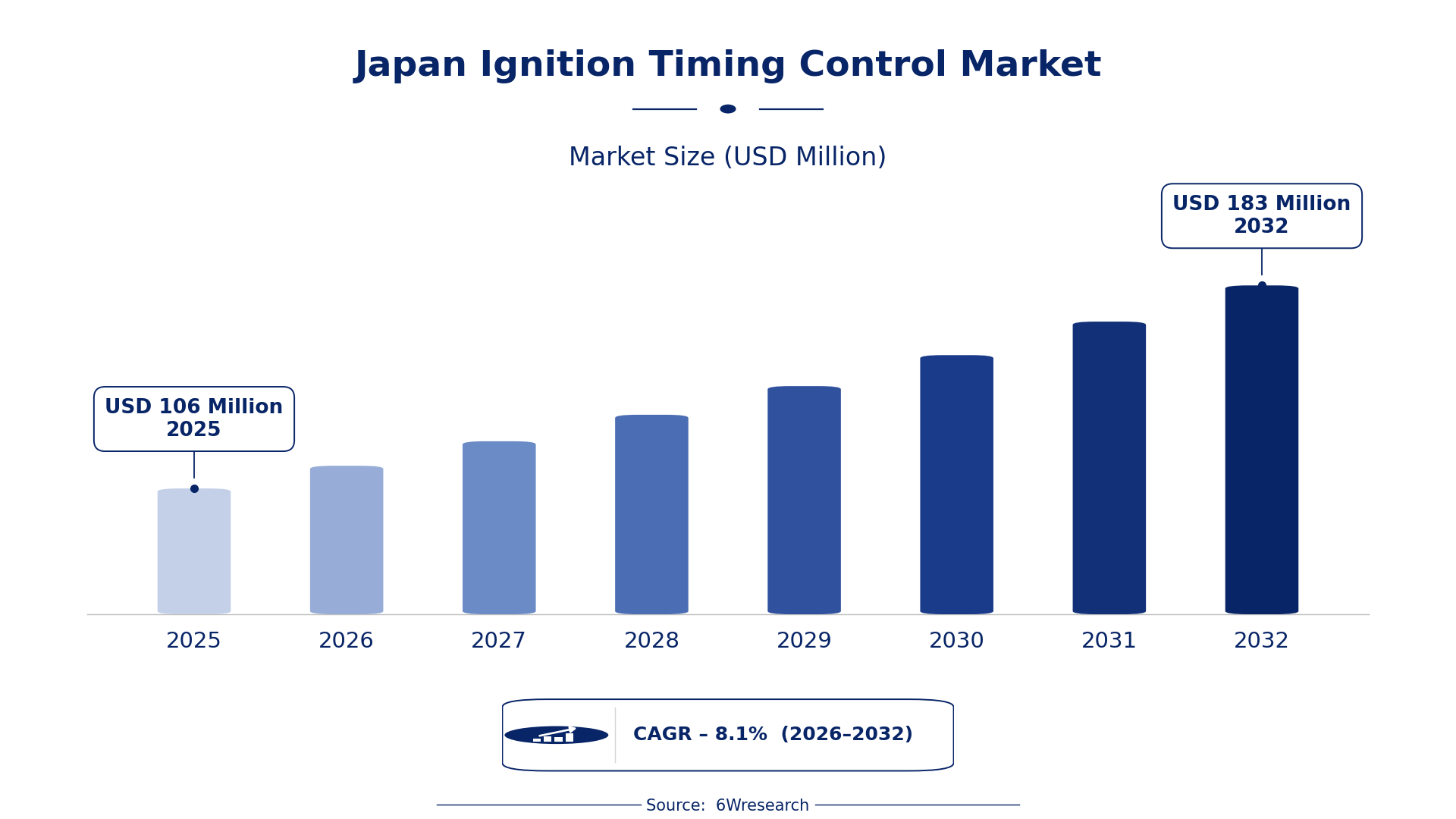
According to 6Wresearch internal database and industry insights, the Japan Ignition Timing Control Market was valued at USD 106 Million in 2025 and is projected to reach USD 183 Million by 2032, growing at a CAGR of approximately 8.1% during 2026–2032.
Japan Ignition Timing Control Market Highlights
| Report Metric | Details |
| Report Name | Japan Ignition Timing Control Market (2026-2032) |
| Market Size 2025 | USD 106 Million |
| Market Size 2032 | USD 183 Million |
| Absolute Growth 2025–2032 | USD 77 Million |
| CAGR 2026–2032 | 8.1% |
| Peak Annual Growth | 9.4% in 2032 |
| Forecast Period | 2026–2032 |
| Historical Data | 2022–2025 |
| Base Year | 2025 |
| Leading Control Type, 2025 | Manual Timing Control (45% share) |
| Leading Adjustment Type, 2025 | Static Tuning (48% share) |
| Leading Integration Level, 2025 | Mechanical Distributors (50% share) |
| Leading End User, 2025 | Classic Engine Restorers (39% share) |
| Fastest-Growing Control Type | Electronic Timing Control (12.0% CAGR) |
| Fastest-Growing Adjustment Type | Dynamic ECU-Controlled (11.4% CAGR) |
| Fastest-Growing Integration Level | Engine Management System (11.8% CAGR) |
| Fastest-Growing End User | Modern Car OEMs (11.1% CAGR) |
| Growing Sector | Modern Car OEMs |
| Key End Users | Classic Engine Restorers, Modern Car OEMs, Sports Car Manufacturers, Autonomous Vehicle Makers |
Japan Ignition Timing Control Market Year-wise Growth Rate and Key Drivers (2022–2032)
This graph illustrates the annual growth rates of the market from 2022 to 2032, highlighting a steady upward trajectory and projected market expansion over the forecast period.
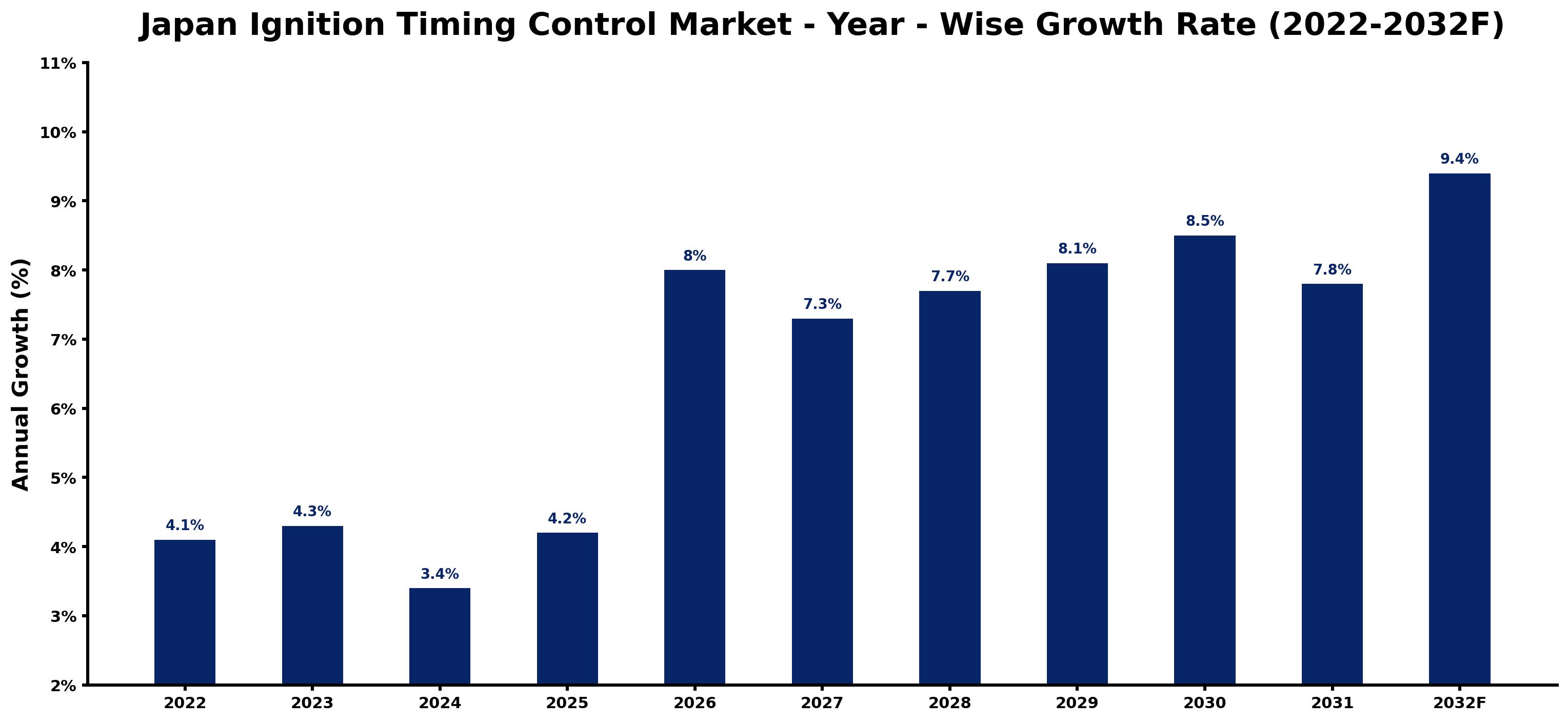
Each row of the following table gives one year's estimated growth and the event or demand shift that explains it.
| Year | Estimated Annual Growth (%) | Market Rationale |
| 2022 | 4.1 | The market experienced steady growth due to ongoing automotive production activities. |
| 2023 | 4.3 | Demand increased as automotive manufacturers ramped up production of new models. |
| 2024 | 3.4 | Growth slowed slightly as market adjustments took place in response to supply chain issues. |
| 2025 | 4.2 | The market rebounded with renewed interest in performance enhancements for vehicles. |
| 2026 | 8.0 | A surge in demand for electronic systems is expected to drive significant growth in the market. |
| 2027 | 7.3 | Growth is projected to slow as the market adjusts to new technology integrations in vehicles. |
| 2028 | 7.7 | Demand is expected to rise again as manufacturers adopt advanced timing control solutions. |
| 2029 | 8.1 | The market is projected to continue growing with the introduction of innovative engine management technologies. |
| 2030 | 8.5 | Growth will remain strong as the focus on efficiency and emissions reduction intensifies. |
| 2031 | 7.8 | A slight slowdown is expected as the market stabilises amidst evolving consumer preferences. |
| 2032 | 9.4 | The market is projected to peak due to heightened demand for advanced ignition systems in new vehicles. |
Note: Market size estimations and growth projections presented in this report are based on 6Wresearch's proprietary forecasting methodology, utilizing the latest available industry data, government publications, and primary research inputs.
Japan Ignition Timing Control Market Synopsis
Ignition timing control manages the spark timing in internal combustion engines, improving performance and fuel efficiency while reducing emissions. In Japan, the automotive industry produced 8.3 million vehicles in 2022, which drives demand for advanced ignition systems. The integration of electronic timing control and the adoption of variable valve timing technologies are propelling market growth. The government aims to cut CO2 emissions from vehicles by 30% by 2030, stimulating investment in ignition timing innovations.
Market Dynamics Impact Analysis (2026–2032)
| Factor | Type | Impact | Primary Segment Affected |
| Rising adoption of electronic timing control systems | Driver | High | Electronic Timing Control |
| Increasing demand for performance tuning in modern vehicles | Driver | High | Real-Time Adjustment |
| Growth in automotive production capacity in the Tokyo region | Opportunity | High | Modern Car OEMs |
| Emerging demand for adaptive fuel efficiency technologies | Opportunity | Medium | Adaptive Fuel Efficiency |
| Limited adoption of AI-based timing control systems | Restraint | Medium | AI-Based Timing Control |
| Outdated mechanical distributors hinder performance improvements | Restraint | High | Mechanical Distributors |
| Challenges in integrating new technologies into existing systems | Challenge | High | Dynamic ECU-Controlled |
| High costs associated with developing advanced ignition systems | Challenge | Medium | Variable Valve Timing |
Evaluation of Drivers in Japan Ignition Timing Control Market (2026–2032)
The following drivers explain most of the expected growth.
| Drivers | Primary Segment Affected | Why It Matters (Evidence) |
| Increased production of vehicles with electronic systems | Electronic Timing Control | Japan's automotive market produced 8.3 million vehicles in 2022, boosting demand for electronic timing solutions. |
| Growing focus on performance tuning by automotive enthusiasts | Real-Time Adjustment | With over 5 million people employed in the automotive sector, demand for tuning technologies is rising. |
| Adoption of variable valve timing in new models | Variable Valve Timing | Variable Valve Timing systems are standard in over 80% of new vehicles, improving performance. |
| Emergence of advanced engine management systems | Engine Management System | The integration of advanced technologies in vehicles is driving demand for sophisticated management solutions. |
| Rising consumer interest in fuel efficiency technologies | Adaptive Fuel Efficiency | Adaptive fuel efficiency technologies are being adopted by 60% of new models by 2025. |
Behind the steady rise in orders sits the increased production of vehicles equipped with electronic timing systems, with Japan's automotive market producing 8.3 million vehicles in 2022. The growing focus on performance tuning by automotive enthusiasts has led to heightened demand for real-time adjustment technologies, supported by over 5 million people employed in the sector. The emergence of advanced engine management systems is driving demand, as manufacturers seek to optimise vehicle performance. Consumer interest in fuel efficiency technologies is rising, with a significant portion of new models expected to adopt adaptive fuel efficiency by 2025.
Evaluation of Restraints in Japan Ignition Timing Control Market
The main factors holding the market back are set out below.
| Market Restraint | Primary Segment Affected | Why It Matters (Evidence) |
| Skills shortage in the automotive sector | Electronic Timing Control | In 2023, Japan's automotive sector faced a skills shortage, delaying product development for manufacturers. |
| Increased costs for retrofitting systems | Real-Time Adjustment | Buyers experience increased costs as the average age of vehicles on Japanese roads exceeds 13 years. |
| Supply chain disruptions | Variable Valve Timing | Reliance on specific automotive components causes delays in production schedules for domestic manufacturers. |
| Competition from new regulations | Engine Management System | Emerging regulations compel firms to invest in compliance with ISO 26262 standards. |
| Limited adoption of AI-based technologies | AI-Based Timing Control | AI-based timing control remains a minor segment due to its limited adoption in the market. |
Japan Ignition Timing Control Market Challenges
Japan's automotive sector faces a skills shortage, with approximately 5 million employees needing advanced training in ignition timing technologies, which delays product development for manufacturers. Buyers encounter increased costs as the average age of vehicles on Japanese roads exceeds 13 years, leading to a surge in demand for retrofitting ignition systems. Supply chain disruptions arise from reliance on specific automotive components, causing production delays for domestic manufacturers. Competition intensifies as new regulations emerge, forcing firms to invest in compliance with ISO 26262 standards, diverting resources from innovation efforts.
Trends in the Japan Ignition Timing Control Market
Buyers and suppliers in the Japan Ignition Timing Control Market are adjusting to the following trends.
- Shift from Mechanical to Electronic Timing Control: Since 2022, Japan's automotive industry has transitioned from mechanical to electronic timing control systems, driven by performance demands. This shift is clear as over 80% of new vehicles now feature electronic systems.
- Increase in Real-Time Adjustment Technologies: In 2023, the adoption of real-time adjustment technologies surged, with approximately 60% of new models integrating these systems. This trend reflects the growing demand for enhanced vehicle performance and efficiency.
- Focus on Adaptive Fuel Efficiency: Starting in 2023, adaptive fuel efficiency technologies gained traction, with 60% of new models expected to adopt these systems by 2025. This shift supports the industry's goal of reducing emissions and improving fuel economy.
- Emergence of Advanced Engine Management Systems: In recent years, advanced engine management systems have become essential for modern vehicles, with a notable increase in their integration. This trend is expected to continue as manufacturers seek to optimise engine performance.
Investment Opportunities in the Japan Ignition Timing Control Market
The following opportunities in the Japan Ignition Timing Control Market pair current demand with a clear way in.
- Investment in Electronic Timing Control: The Tokyo region offers opportunities for investment in electronic timing control technologies, with the automotive market producing 8.3 million vehicles in 2022. Companies can enter through local partnerships or joint ventures.
- Expansion of Real-Time Adjustment Systems: With a growing focus on performance tuning, there is a gap for suppliers of real-time adjustment systems in Japan's automotive sector. Engaging with modern car OEMs can facilitate market entry.
- Development of Adaptive Fuel Efficiency Technologies: As adaptive fuel efficiency technologies are set to be adopted by 60% of new models by 2025, suppliers can capitalise on this trend by aligning their offerings with automotive manufacturers' needs.
- Growth in Engine Management Systems: The increasing integration of advanced engine management systems presents opportunities for suppliers in the automotive sector. Collaborating with modern car OEMs can enhance market presence.
Government Initiatives in the Japan Ignition Timing Control Market
The Economic Security Promotion Act (2022) supports supply-chain resilience for critical automotive components, ensuring that manufacturers can maintain production levels. This law encourages investment in local supply chains, which is important for ignition timing control technologies.
The Ministry of Land, Infrastructure, Transport and Tourism oversees vehicle regulations, approving new technologies and standards. This agency plays a crucial role in ensuring that ignition timing control systems meet safety and performance requirements.
Future Insight of the Japan Ignition Timing Control Market
Advanced algorithms for ignition timing control will reshape demand by 2032, as the integration of real-time adjustment systems becomes prevalent in new vehicles. The government's programme to promote electric vehicle technologies will drive suppliers to adapt to emerging standards. By 2025, adaptive fuel efficiency technologies will be standard in 60% of new models, improving fuel economy. As the automotive market continues to produce 8.3 million vehicles annually, buyers will benefit from improved engine performance and reduced emissions.
Market Segmentation Analysis
Japan Ignition Timing Control Market report covers a detailed analysis of the following market segments:
By Control Type – Manual Timing Control Leads, Electronic Timing Control Expected to Grow Fastest
According to Saurav Kr Singh, Senior Research Analyst at 6Wresearch, Manual Timing Control took 45% of control type revenue in 2025, more than any other category. Manual Timing Control holds the largest share as it is primarily used in classic vehicles, appealing to a niche market of vintage car enthusiasts. This segment benefits from a dedicated buyer group focused on restoration projects, ensuring a steady demand for these systems. Electronic Timing Control is projected to grow fastest, at a CAGR of 12.0% during 2026–2032. Electronic Timing Control is rapidly gaining traction due to the widespread adoption of advanced ignition systems in modern vehicles, which are crucial for enhancing performance and fuel efficiency. This trend is evidenced by the increasing integration of such systems in over 80% of new vehicle models. Suppliers should focus on developing advanced electronic solutions to cater to the growing demand from modern automotive manufacturers.
By Adjustment Type – Static Tuning Leads, Dynamic ECU-Controlled Expected to Grow Fastest
Static Tuning accounted for 48% of the market by adjustment type in 2025. Static Tuning leads the market primarily due to its application in specific tuning scenarios, appealing to those who value traditional methods. This segment is supported by a dedicated group of enthusiasts who prefer established tuning techniques for their vehicles. Dynamic ECU-Controlled is set to record the highest CAGR in this split, 11.4% over 2026–2032. Dynamic ECU-Controlled systems are experiencing rapid growth as they provide essential adjustments for optimising engine performance in modern vehicles. This shift highlights the industry's transition towards more sophisticated and efficient engine management technologies. Buyers will benefit from investing in dynamic systems that enhance performance and efficiency in contemporary automotive applications.
By Integration Level – Mechanical Distributors Lead, Engine Management System Expected to Grow Fastest
In 2025, Mechanical Distributors led the integration level split with a 50% share. Mechanical Distributors dominate the market as they have historical significance in ignition systems, particularly in older vehicles that still utilise this technology. This segment appeals to a group focused on maintaining traditional systems in classic cars. The quickest growth will come from Engine Management System, forecast to expand at a CAGR of 11.8% between 2026 and 2032. Engine Management Systems are quickly gaining popularity as they are essential for the functionality of modern vehicles, reflecting a clear trend towards more integrated management solutions. This growth indicates a shift towards more efficient vehicle technologies that meet contemporary demands. Suppliers must prioritise the development of advanced engine management solutions to align with the industry's technological advancements.
By End User – Classic Engine Restorers Lead, Modern Car OEMs Expected to Grow Fastest
With 39% of end user revenue in 2025, Classic Engine Restorers was the largest category. Classic Engine Restorers represent the largest share as they cater to a niche market dedicated to vintage vehicles, ensuring a steady demand for specific ignition solutions. This segment thrives on the passion of enthusiasts who seek authenticity in restoration. Over 2026–2032, Modern Car OEMs are expected to post the fastest growth, at a CAGR of 11.1%. Modern Car OEMs are the fastest-growing segment, driven by the need for advanced ignition systems in the production of new vehicles. This reflects the industry's focus on performance and compliance with stringent emissions regulations. Suppliers should align their offerings with the needs of modern car manufacturers to capitalise on the increasing demand for advanced ignition technologies.
Key Attractiveness of the Report
- 10 Years of Market Numbers
- Historical Data Starting from 2022 to 2025
- Base Year 2025
- Forecast Data until 2032
- Key Performance Indicators Impacting the Market
- Major Upcoming Developments and Projects
Key Highlights of the Report:
- Japan Ignition Timing Control Market Outlook
- Market Size of Japan Ignition Timing Control Market, 2025
- Forecast of Japan Ignition Timing Control Market, 2032
- Historical Data and Forecast of Japan Ignition Timing Control Revenues & Volume for the Period 2022-2032F
- Japan Ignition Timing Control Market Trend Evolution
- Japan Ignition Timing Control Market Drivers and Challenges
- Japan Ignition Timing Control Price Trends
- Japan Ignition Timing Control Porter's Five Forces
- Japan Ignition Timing Control Industry Life Cycle
- Historical Data and Forecast of Japan Ignition Timing Control Market Revenues & Volume By Control Type for the Period 2022-2032F
- Historical Data and Forecast of Japan Ignition Timing Control Market Revenues & Volume By Manual Timing Control for the Period 2022-2032F
- Historical Data and Forecast of Japan Ignition Timing Control Market Revenues & Volume By Electronic Timing Control for the Period 2022-2032F
- Historical Data and Forecast of Japan Ignition Timing Control Market Revenues & Volume By Variable Valve Timing for the Period 2022-2032F
- Historical Data and Forecast of Japan Ignition Timing Control Market Revenues & Volume By AI-Based Timing Control for the Period 2022-2032F
- Historical Data and Forecast of Japan Ignition Timing Control Market Revenues & Volume By Adjustment Type for the Period 2022-2032F
- Historical Data and Forecast of Japan Ignition Timing Control Market Revenues & Volume By Static Tuning for the Period 2022-2032F
- Historical Data and Forecast of Japan Ignition Timing Control Market Revenues & Volume By Dynamic ECU-Controlled for the Period 2022-2032F
- Historical Data and Forecast of Japan Ignition Timing Control Market Revenues & Volume By Real-Time Adjustment for the Period 2022-2032F
- Historical Data and Forecast of Japan Ignition Timing Control Market Revenues & Volume By Adaptive Fuel Efficiency for the Period 2022-2032F
- Historical Data and Forecast of Japan Ignition Timing Control Market Revenues & Volume By Integration Level for the Period 2022-2032F
- Historical Data and Forecast of Japan Ignition Timing Control Market Revenues & Volume By Mechanical Distributors for the Period 2022-2032F
- Historical Data and Forecast of Japan Ignition Timing Control Market Revenues & Volume By Engine Management System for the Period 2022-2032F
- Historical Data and Forecast of Japan Ignition Timing Control Market Revenues & Volume By Integrated with Sensors for the Period 2022-2032F
- Historical Data and Forecast of Japan Ignition Timing Control Market Revenues & Volume By Cloud-Connected ECU for the Period 2022-2032F
- Historical Data and Forecast of Japan Ignition Timing Control Market Revenues & Volume By End User for the Period 2022-2032F
- Historical Data and Forecast of Japan Ignition Timing Control Market Revenues & Volume By Classic Engine Restorers for the Period 2022-2032F
- Historical Data and Forecast of Japan Ignition Timing Control Market Revenues & Volume By Modern Car OEMs for the Period 2022-2032F
- Historical Data and Forecast of Japan Ignition Timing Control Market Revenues & Volume By Sports Car Manufacturers for the Period 2022-2032F
- Historical Data and Forecast of Japan Ignition Timing Control Market Revenues & Volume By Autonomous Vehicle Makers for the Period 2022-2032F
- Japan Ignition Timing Control Import Export Trade Statistics
- Market Opportunity Assessment By Control Type
- Market Opportunity Assessment By Adjustment Type
- Market Opportunity Assessment By Integration Level
- Market Opportunity Assessment By End User
- Japan Ignition Timing Control Top Companies Market Share
- Japan Ignition Timing Control Competitive Benchmarking By Technical and Operational Parameters
- Japan Ignition Timing Control Company Profiles
- Japan Ignition Timing Control Key Strategic Recommendations
Market Covered
Coverage by segment is as follows.
By Control Type
- Manual Timing Control
- Electronic Timing Control
- Variable Valve Timing
- AI-Based Timing Control
By Adjustment Type
- Static Tuning
- Dynamic ECU-Controlled
- Real-Time Adjustment
- Adaptive Fuel Efficiency
By Integration Level
- Mechanical Distributors
- Engine Management System
- Integrated with Sensors
- Cloud-Connected ECU
By End User
- Classic Engine Restorers
- Modern Car OEMs
- Sports Car Manufacturers
- Autonomous Vehicle Makers































