Japan Imaging Analytics Market Size & Growth Rate
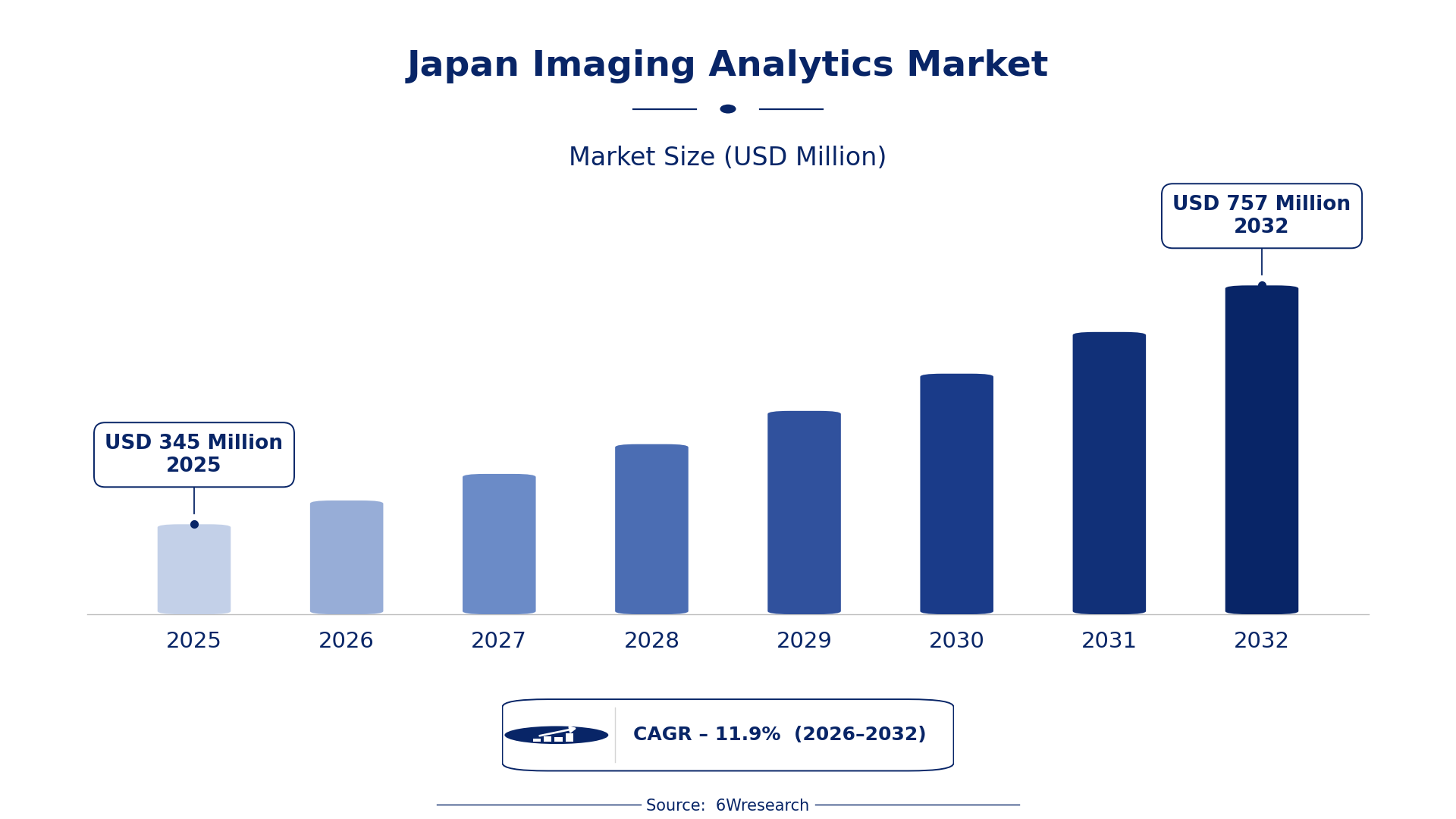
According to 6Wresearch internal database and industry insights, the Japan Imaging Analytics Market was valued at USD 345 Million in 2025 and is projected to reach USD 757 Million by 2032, growing at a CAGR of approximately 11.9% during 2026–2032.
Japan Imaging Analytics Market Highlights
| Report Metric | Details |
| Report Name | Japan Imaging Analytics Market (2026-2032) |
| Market Size 2025 | USD 345 Million |
| Market Size 2032 | USD 757 Million |
| Absolute Growth 2025–2032 | USD 412 Million |
| CAGR 2026–2032 | 11.9% |
| Peak Annual Growth | 13.8% in 2032 |
| Forecast Period | 2026–2032 |
| Historical Data | 2022–2025 |
| Base Year | 2025 |
| Leading Analytics Type, 2025 | Predictive Analytics (49% share) |
| Leading Modality Source, 2025 | CT/MRI/PET (43% share) |
| Leading Technology Used, 2025 | AI & Machine Learning (41% share) |
| Leading End User, 2025 | Hospitals (53% share) |
| Fastest-Growing Analytics Type | Descriptive Analytics (16.8% CAGR) |
| Fastest-Growing Modality Source | Ultrasound/X-Ray (18.5% CAGR) |
| Fastest-Growing Technology Used | Cloud-Based Platforms (17.9% CAGR) |
| Fastest-Growing End User | Diagnostic Centers (16.3% CAGR) |
| Growing Sector | Healthcare |
| Key End Users | Hospitals, Diagnostic Centers, Radiology Labs |
Japan Imaging Analytics Market Year-wise Growth Rate and Key Drivers (2022–2032)
This graph illustrates the annual growth rates of the market from 2022 to 2032, highlighting a steady upward trajectory and projected market expansion over the forecast period.
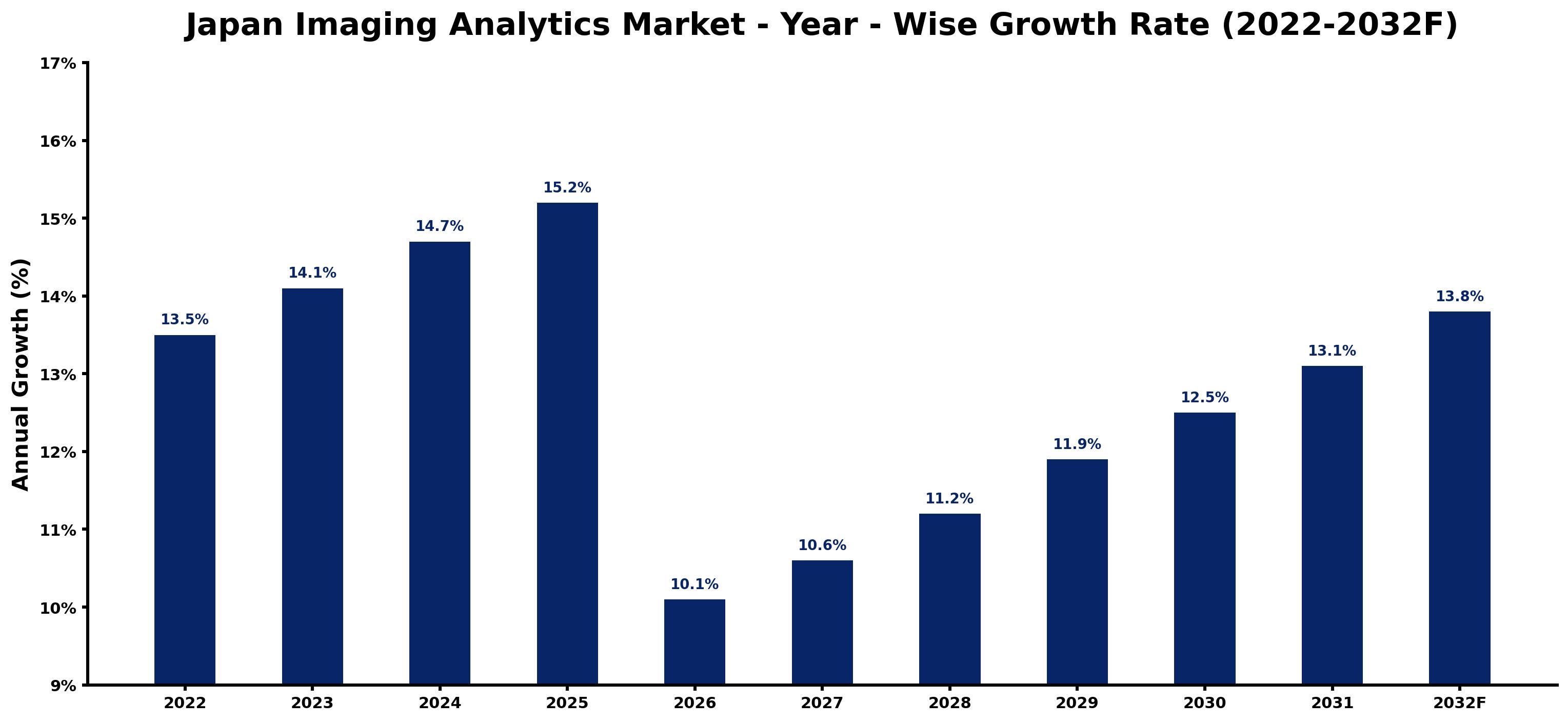
The yearly estimates that follow link every growth rate to its principal driver, so readers can see why the pace changed in each period.
| Year | Estimated Annual Growth (%) | Market Rationale |
| 2022 | 13.5 | The market demonstrated strong activity with notable hospital adoption of imaging analytics technologies. |
| 2023 | 14.1 | Growth accelerated due to increased hospital investments in advanced imaging technologies and analytics. |
| 2024 | 14.7 | The upward trend continued as more diagnostic centers integrated imaging analytics into their workflows. |
| 2025 | 15.2 | The market reached its historical peak, driven by high demand for predictive analytics in hospitals. |
| 2026 | 10.1 | Growth is expected to slow as market maturation begins, with hospitals focusing on optimising existing technologies. |
| 2027 | 10.6 | Demand is projected to increase as hospitals seek to improve patient outcomes through enhanced imaging analytics. |
| 2028 | 11.2 | The market is expected to maintain growth as healthcare expenditure rises, driving investment in imaging technologies. |
| 2029 | 11.9 | Demand will continue to rise, supported by advancements in AI and machine learning for imaging analytics. |
| 2030 | 12.5 | Growth is expected to persist as hospitals expand their imaging capabilities to meet patient needs more effectively. |
| 2031 | 13.1 | The market will grow steadily as diagnostic centers adopt more sophisticated imaging analytics solutions. |
| 2032 | 13.8 | The market is projected to peak again, driven by widespread AI integration in healthcare imaging processes. |
Note: Market size estimations and growth projections presented in this report are based on 6Wresearch's proprietary forecasting methodology, utilizing the latest available industry data, government publications, and primary research inputs.
Japan Imaging Analytics Market Synopsis
Imaging analytics leverages advanced algorithms and machine learning models to interpret medical imaging data, improving diagnostic accuracy and patient outcomes. The Japan Imaging Analytics Market is expanding, primarily driven by hospitals and diagnostic centres. Healthcare expenditure is projected to reach 12 trillion yen by 2025, prompting investments in advanced imaging technologies, while a government programme launched in 2023 aims to support AI integration in healthcare, further fuelling demand.
Market Dynamics Impact Analysis (2026–2032)
| Factor | Type | Impact | Primary Segment Affected |
| Growing healthcare expenditure | Driver | High | Predictive Analytics |
| Increased adoption of AI technologies | Driver | High | AI & Machine Learning |
| Rising demand for real-time analytics | Opportunity | Medium | Real-time Analytics |
| Expansion of diagnostic centers | Opportunity | Medium | Diagnostic Centers |
| High costs of advanced imaging systems | Restraint | High | CT/MRI/PET |
| Limited awareness of imaging analytics benefits | Restraint | Medium | Descriptive Analytics |
| Competition from alternative diagnostic methods | Challenge | High | Ultrasound/X-Ray |
| Slow integration of new technologies | Challenge | Medium | Cloud-Based Platforms |
Evaluation of Drivers in Japan Imaging Analytics Market (2026–2032)
The table below links each growth driver to the segment it affects and the evidence for it.
| Drivers | Primary Segment Affected | Why It Matters (Evidence) |
| Increased healthcare expenditure | Predictive Analytics | Japan's healthcare expenditure is expected to reach 12 trillion yen by 2025, driving hospitals to invest in predictive analytics. |
| Adoption of AI and machine learning | AI & Machine Learning | The integration of AI technologies improves diagnostic accuracy, leading hospitals to purchase more imaging analytics solutions. |
| Demand for real-time decision-making | Real-time Analytics | Hospitals are increasingly seeking real-time analytics to improve patient outcomes, resulting in higher purchases of these solutions. |
| Expansion of diagnostic centers | Diagnostic Centers | With over 1,500 diagnostic centers in Japan, the demand for imaging analytics is rising as these facilities enhance their services. |
| Technological advancements in imaging | CT/MRI/PET | The installed base of around 5,000 MRI machines in Japan drives demand for advanced imaging analytics technologies. |
Several shifts outside the market lift sales. Japan's healthcare expenditure is expected to reach 12 trillion yen by 2025, prompting hospitals to invest in predictive analytics solutions. The integration of AI technologies improves diagnostic accuracy, leading to increased purchases of imaging analytics. Hospitals are also seeking real-time analytics to improve patient outcomes, resulting in higher demand for these solutions. The expansion of diagnostic centres in Japan is driving the need for advanced imaging analytics to improve service offerings.
Evaluation of Restraints in Japan Imaging Analytics Market
The main factors holding the market back are set out below.
| Market Restraint | Primary Segment Affected | Why It Matters (Evidence) |
| High costs of advanced imaging systems | CT/MRI/PET | The high costs associated with advanced imaging systems limit their adoption among smaller healthcare facilities. |
| Limited awareness of imaging analytics benefits | Descriptive Analytics | Many healthcare providers remain unaware of the advantages of imaging analytics, hindering market growth. |
| Competition from alternative diagnostic methods | Ultrasound/X-Ray | Alternative diagnostic methods can be more cost-effective, impacting the demand for imaging analytics solutions. |
| Slow integration of new technologies | Cloud-Based Platforms | The slow pace of technology integration in healthcare settings delays the adoption of cloud-based imaging analytics. |
| Regulatory hurdles for new technologies | AI & Machine Learning | Strict regulations surrounding AI technologies can slow down the introduction of new imaging analytics solutions. |
Japan Imaging Analytics Market Challenges
Japan's reliance on imported imaging analytics technology creates supply chain vulnerabilities, leading to procurement delays of up to six weeks for hospitals. Buyers face escalating costs as the limited availability of advanced imaging solutions can raise expenses by 15% annually. A shortage of skilled professionals in data analysis hampers the effective implementation of imaging analytics, resulting in extended project timelines for diagnostic centres. Compliance with ISO 13485 standards imposes additional operational costs of around 10% for producers, which ultimately translates to higher prices for buyers.
Trends in the Japan Imaging Analytics Market
The trends below show where the Japan Imaging Analytics Market is heading.
- Transition from Traditional to AI-Driven Imaging: Tokyo is experiencing a shift towards AI-driven imaging analytics, with hospitals increasingly adopting these technologies. In 2023, the government launched a programme to support AI integration in healthcare, reflecting a growing trend in the sector.
- Shift towards Real-Time Analytics: There is a noticeable change in hospitals prioritising real-time analytics for immediate decision-making in clinical settings. The average patient turnover for imaging procedures is increasing annually, necessitating faster analytics.
- Emergence of Cloud-Based Platforms: Cloud-based platforms are becoming more prevalent in imaging analytics, allowing for better data storage and access. The market for these platforms is expected to grow as more hospitals seek efficient solutions.
- Growth of Diagnostic Centers: The rise of diagnostic centres in Japan is influencing the imaging analytics market, with over 1,500 centres now using these technologies. This growth is driving demand for advanced imaging solutions.
Investment Opportunities in the Japan Imaging Analytics Market
The openings below show where demand in the Japan Imaging Analytics Market is visible and how suppliers can enter.
- Rising Healthcare Expenditure: With Japan's healthcare expenditure expected to reach 12 trillion yen by 2025, there is an opportunity to supply advanced imaging analytics solutions to hospitals needing to improve their services.
- Demand for Real-Time Analytics Solutions: Diagnostic centres are actively seeking to improve their imaging capabilities, creating a need for advanced analytics solutions that enhance workflow and patient outcomes.
- Investment in AI Technologies: Hospitals are looking for technologies to improve diagnostic accuracy and patient outcomes, presenting an opportunity for suppliers of AI-driven imaging analytics.
- Expansion of Diagnostic Centers: As the number of diagnostic centres grows, there is a need for imaging analytics solutions to improve service offerings. Partnering with local diagnostic centres can facilitate market entry.
Government Initiatives in the Japan Imaging Analytics Market
The Medical Care Act (1948) sets standards for hospitals and clinics, ensuring that facilities meet the necessary requirements for imaging analytics. This law impacts buyers by mandating compliance with quality standards, which drives the demand for advanced imaging solutions.
The Ministry of Health, Labour and Welfare (MHLW) oversees the funding of digital health initiatives, including imaging analytics. In 2023, the ministry allocated funds to support the integration of AI technologies in healthcare, benefiting hospitals and diagnostic centres.
Future Insight of the Japan Imaging Analytics Market
Hospitals will adopt imaging analytics more widely by 2032, driven by the government's 2023 initiative to enhance AI integration in medical practices. New standards from the Japanese Society of Radiology will ensure higher quality in imaging analytics applications. The installed base of MRI machines is expected to increase, supporting greater diagnostic capabilities. Tokyo and Osaka will emerge as key hubs for technological advancements, promoting collaboration between research institutions and healthcare providers.
Market Segmentation Analysis
Japan Imaging Analytics Market report covers a detailed analysis of the following market segments:
By Analytics Type – Predictive Analytics Leads, Descriptive Analytics Expected to Grow Fastest
According to Saurav Kr Singh, Senior Research Analyst at 6Wresearch, with 49% of analytics type revenue in 2025, Predictive Analytics was the largest category. Predictive analytics holds the largest share as it is essential for forecasting patient outcomes based on imaging data. This method is widely applied in hospitals, significantly improving diagnostic accuracy and patient management. Over 2026–2032, Descriptive Analytics is expected to post the fastest growth, at a CAGR of 16.8%. Descriptive analytics is growing rapidly due to its ability to analyse historical data, which is important for refining imaging processes. The increasing focus on operational efficiency in healthcare settings is driving this trend. Suppliers should focus on developing descriptive analytics solutions to meet the rising demands of healthcare providers.
By Modality Source – CT/MRI/PET Leads, Ultrasound/X-Ray Expected to Grow Fastest
CT/MRI/PET held 43% of the Japan Imaging Analytics Market by modality source in 2025. CT/MRI/PET modalities lead the market as they are extensively employed for diagnostic imaging, with around 5,000 MRI machines in operation across Japan. Their established presence in hospitals ensures a consistent demand for imaging analytics. Ultrasound/X-Ray is projected to grow fastest, at a CAGR of 18.5% during 2026–2032. Ultrasound/X-Ray modalities are experiencing swift growth owing to their prevalent use in imaging analytics, especially in outpatient contexts. The rising patient turnover for imaging procedures is driving the expansion of this segment. Buyers may discover opportunities in investing in ultrasound and X-ray analytics to improve service delivery.
By Technology Used – AI & Machine Learning Leads, Cloud-Based Platforms Expected to Grow Fastest
In 2025, AI & Machine Learning led the technology used split with a 41% share. AI and machine learning are the leading technologies in imaging analytics, as they form the core of data analysis for imaging data interpretation. Their integration into healthcare facilities is critical for improving diagnostic capabilities. Cloud-Based Platforms are set to record the highest CAGR in this split, 17.9% over 2026–2032. Cloud-based platforms are rapidly gaining traction as they facilitate data storage and access for imaging analytics, aligning with the government's push for digital health initiatives. This trend is expected to continue as healthcare facilities seek efficient solutions. Suppliers should prioritise cloud-based solutions to support the growing demand for scalable imaging analytics.
By End User – Hospitals Lead, Diagnostic Centers Expected to Grow Fastest
Hospitals accounted for 53% of the market by end user in 2025. Hospitals are the primary users of imaging analytics solutions, with over 8,000 facilities employing this technology to enhance patient care. Their extensive operations require advanced analytics to achieve improved outcomes. The quickest growth will come from Diagnostic Centers, forecast to expand at a CAGR of 16.3% between 2026 and 2032. Diagnostic centers are experiencing the fastest growth as they become significant users of imaging services, driven by the rising demand for specialised imaging analytics. Their expanding role in outpatient care is facilitating this rapid growth. Suppliers should tailor their offerings to meet the specific needs of diagnostic centers to capitalise on this growth.
Key Attractiveness of the Report
- 10 Years of Market Numbers
- Historical Data Starting from 2022 to 2025
- Base Year 2025
- Forecast Data until 2032
- Key Performance Indicators Impacting the Market
- Major Upcoming Developments and Projects
Key Highlights of the Report:
- Japan Imaging Analytics Market Outlook
- Market Size of Japan Imaging Analytics Market, 2025
- Forecast of Japan Imaging Analytics Market, 2032
- Historical Data and Forecast of Japan Imaging Analytics Revenues & Volume for the Period 2022-2032F
- Japan Imaging Analytics Market Trend Evolution
- Japan Imaging Analytics Market Drivers and Challenges
- Japan Imaging Analytics Price Trends
- Japan Imaging Analytics Porter's Five Forces
- Japan Imaging Analytics Industry Life Cycle
- Historical Data and Forecast of Japan Imaging Analytics Market Revenues & Volume By Analytics Type for the Period 2022-2032F
- Historical Data and Forecast of Japan Imaging Analytics Market Revenues & Volume By Predictive Analytics for the Period 2022-2032F
- Historical Data and Forecast of Japan Imaging Analytics Market Revenues & Volume By Descriptive Analytics for the Period 2022-2032F
- Historical Data and Forecast of Japan Imaging Analytics Market Revenues & Volume By Prescriptive Analytics for the Period 2022-2032F
- Historical Data and Forecast of Japan Imaging Analytics Market Revenues & Volume By Real-time Analytics for the Period 2022-2032F
- Historical Data and Forecast of Japan Imaging Analytics Market Revenues & Volume By Modality Source for the Period 2022-2032F
- Historical Data and Forecast of Japan Imaging Analytics Market Revenues & Volume By CT/MRI/PET for the Period 2022-2032F
- Historical Data and Forecast of Japan Imaging Analytics Market Revenues & Volume By Ultrasound/X-Ray for the Period 2022-2032F
- Historical Data and Forecast of Japan Imaging Analytics Market Revenues & Volume By Multimodal Imaging for the Period 2022-2032F
- Historical Data and Forecast of Japan Imaging Analytics Market Revenues & Volume By Wearable/POC Imaging for the Period 2022-2032F
- Historical Data and Forecast of Japan Imaging Analytics Market Revenues & Volume By Technology Used for the Period 2022-2032F
- Historical Data and Forecast of Japan Imaging Analytics Market Revenues & Volume By AI & Machine Learning for the Period 2022-2032F
- Historical Data and Forecast of Japan Imaging Analytics Market Revenues & Volume By Cloud-Based Platforms for the Period 2022-2032F
- Historical Data and Forecast of Japan Imaging Analytics Market Revenues & Volume By Deep Learning Models for the Period 2022-2032F
- Historical Data and Forecast of Japan Imaging Analytics Market Revenues & Volume By Edge AI for the Period 2022-2032F
- Historical Data and Forecast of Japan Imaging Analytics Market Revenues & Volume By End User for the Period 2022-2032F
- Historical Data and Forecast of Japan Imaging Analytics Market Revenues & Volume By Hospitals for the Period 2022-2032F
- Historical Data and Forecast of Japan Imaging Analytics Market Revenues & Volume By Diagnostic Centers for the Period 2022-2032F
- Historical Data and Forecast of Japan Imaging Analytics Market Revenues & Volume By Radiology Labs for the Period 2022-2032F
- Historical Data and Forecast of Japan Imaging Analytics Market Revenues & Volume By Mobile Health Apps for the Period 2022-2032F
- Japan Imaging Analytics Import Export Trade Statistics
- Market Opportunity Assessment By Analytics Type
- Market Opportunity Assessment By Modality Source
- Market Opportunity Assessment By Technology Used
- Market Opportunity Assessment By End User
- Japan Imaging Analytics Top Companies Market Share
- Japan Imaging Analytics Competitive Benchmarking By Technical and Operational Parameters
- Japan Imaging Analytics Company Profiles
- Japan Imaging Analytics Key Strategic Recommendations
Market Covered
The following segment groups are covered in the report.
By Analytics Type
- Predictive Analytics
- Descriptive Analytics
- Prescriptive Analytics
- Real-time Analytics
By Modality Source
- CT/MRI/PET
- Ultrasound/X-Ray
- Multimodal Imaging
- Wearable/POC Imaging
By Technology Used
- AI & Machine Learning
- Cloud-Based Platforms
- Deep Learning Models
- Edge AI
By End User
- Hospitals
- Diagnostic Centers
- Radiology Labs
- Mobile Health Apps































