Japan Imaging Diagnostics Market Size & Growth Rate
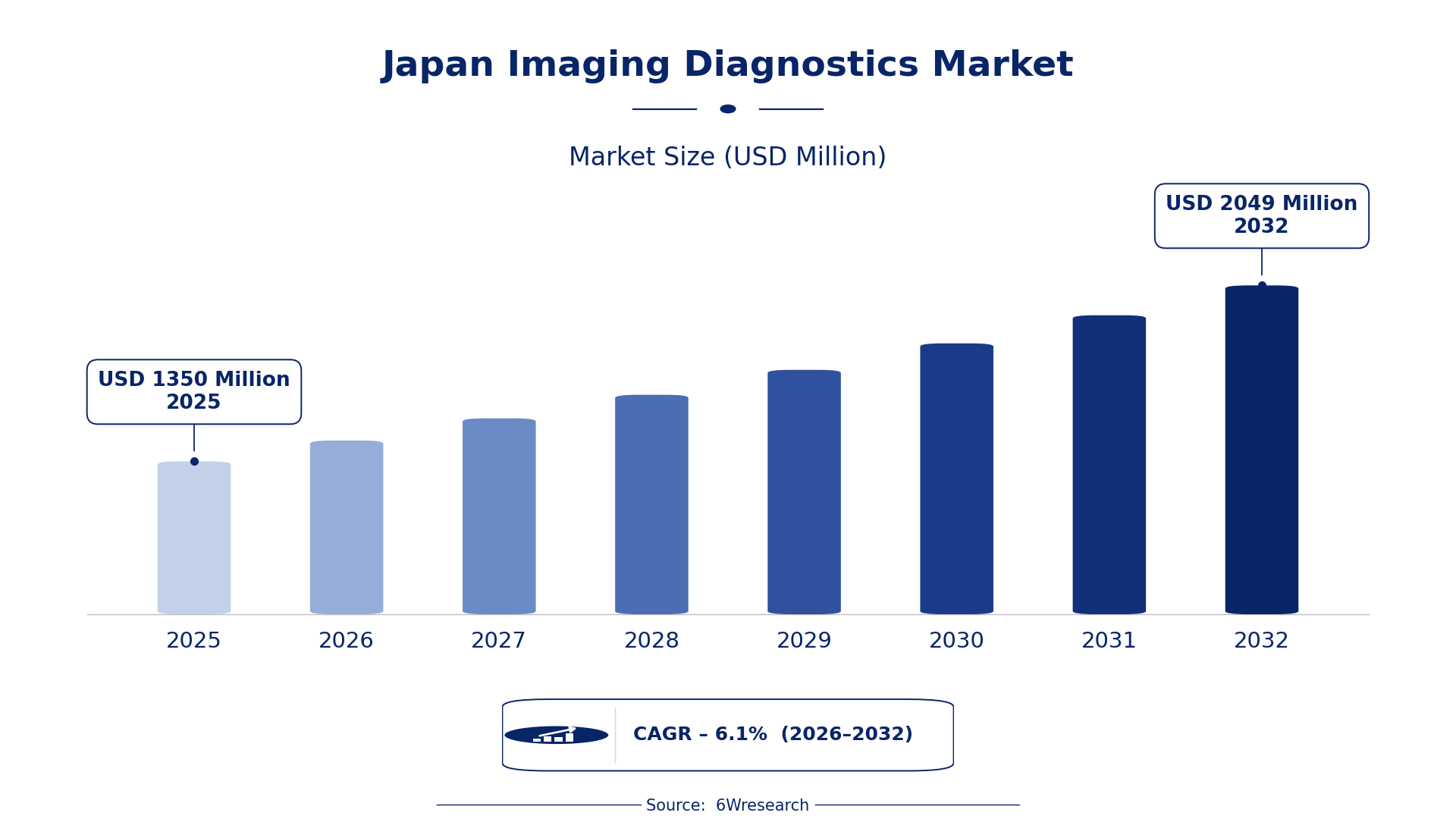
According to 6Wresearch internal database and industry insights, the Japan Imaging Diagnostics Market was valued at USD 1,350 Million in 2025 and is projected to reach USD 2,049 Million by 2032, growing at a CAGR of approximately 6.1% during 2026–2032.
Japan Imaging Diagnostics Market Highlights
| Report Metric | Details |
| Report Name | Japan Imaging Diagnostics Market (2026-2032) |
| Market Size 2025 | USD 1,350 Million |
| Market Size 2032 | USD 2,049 Million |
| Absolute Growth 2025–2032 | USD 699 Million |
| CAGR 2026–2032 | 6.1% |
| Peak Annual Growth | 7.0% in 2027 |
| Forecast Period | 2026–2032 |
| Historical Data | 2022–2025 |
| Base Year | 2025 |
| Leading Modality Type, 2025 | MRI (46% share) |
| Leading Diagnostic Application, 2025 | Soft Tissue Analysis (35% share) |
| Leading Image Type, 2025 | Cross-sectional (49% share) |
| Leading End User, 2025 | Multi-specialty Hospitals (37% share) |
| Fastest-Growing Modality Type | CT (8.9% CAGR) |
| Fastest-Growing Diagnostic Application | Bone/Internal Organs (8.5% CAGR) |
| Fastest-Growing Image Type | 3D Slices (8.7% CAGR) |
| Fastest-Growing End User | Diagnostic Centers (8.1% CAGR) |
| Growing Sector | Healthcare diagnostics |
| Key End Users | Hospitals, diagnostic centers, clinics, healthcare providers |
Japan Imaging Diagnostics Market Year-wise Growth Rate and Key Drivers (2022–2032)
This graph illustrates the annual growth rates of the market from 2022 to 2032, highlighting a steady upward trajectory and projected market expansion over the forecast period.
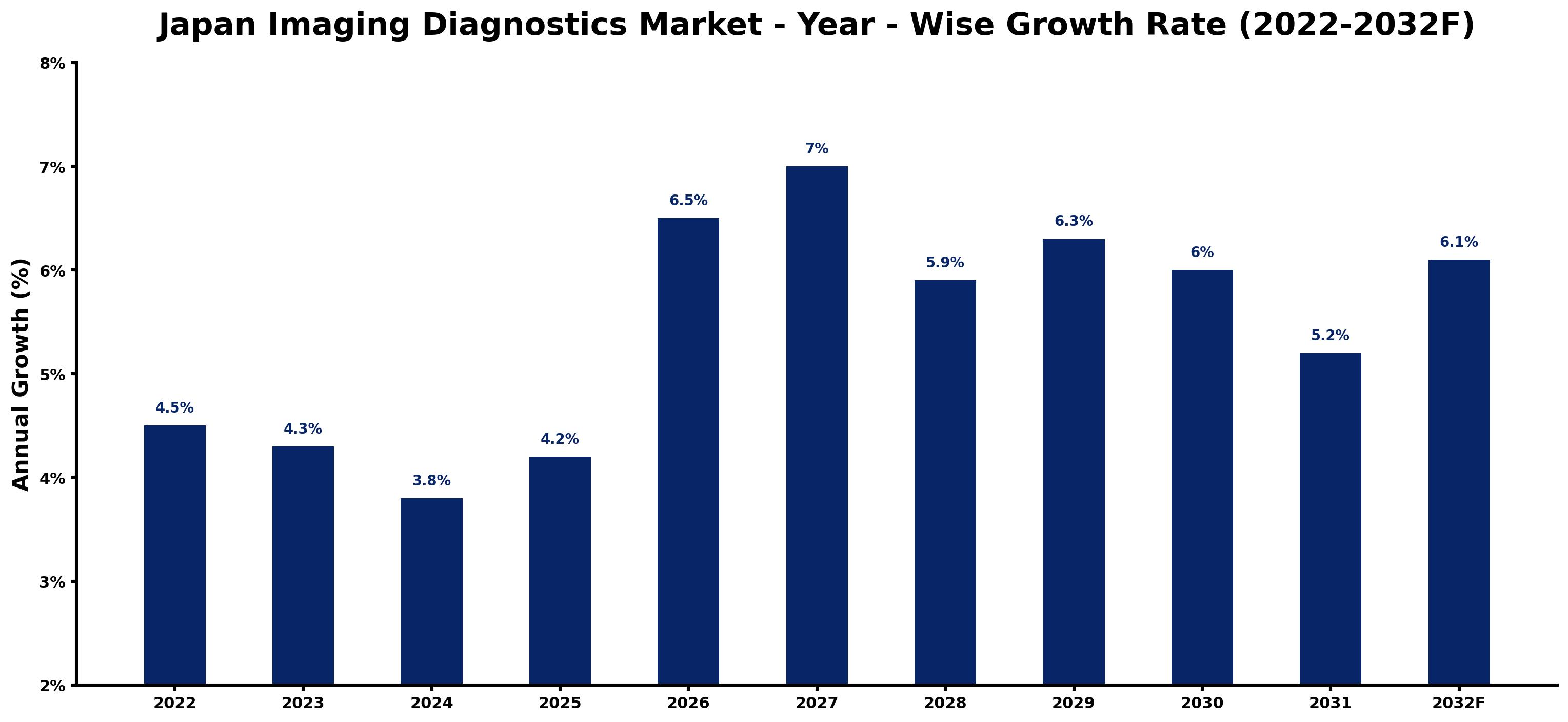
Annual growth estimates for each year appear below with the principal reason behind them, explaining the shifts that set the pace of the market.
| Year | Estimated Annual Growth (%) | Market Rationale |
| 2022 | 4.5 | The market was characterised by steady demand from hospitals and clinics. |
| 2023 | 4.3 | Growth slowed as healthcare expenditure faced slight pressures from economic factors. |
| 2024 | 3.8 | Demand continued to slow due to increasing wait times for imaging services. |
| 2025 | 4.2 | Growth accelerated as hospitals invested in modern imaging technologies. |
| 2026 | 6.5 | Demand is expected to surge with advancements in imaging technology and increased healthcare spending. |
| 2027 | 7.0 | The market is projected to peak as hospitals expand their imaging capabilities. |
| 2028 | 5.9 | Growth will slow as the market stabilises after rapid advancements. |
| 2029 | 6.3 | Demand is expected to increase again as new imaging technologies gain traction in hospitals. |
| 2030 | 6.0 | Growth will moderate as the market adjusts to earlier expansions. |
| 2031 | 5.2 | Demand is projected to continue slowing as the market reaches a more mature phase. |
| 2032 | 6.1 | Growth is expected to rise again with new healthcare initiatives and technology. |
Note: Market size estimations and growth projections presented in this report are based on 6Wresearch's proprietary forecasting methodology, utilizing the latest available industry data, government publications, and primary research inputs.
Japan Imaging Diagnostics Market Synopsis
Imaging diagnostics include technologies such as MRI, CT, X-ray, and ultrasound, which are vital for disease detection and treatment planning. In Japan, the healthcare sector is a primary consumer, with over 8,000 MRI units installed across facilities. The Japan Imaging Diagnostics Market is expanding due to rising healthcare expenditure, which reached JPY 42 trillion in 2023, and increased demand from multi-specialty hospitals, particularly for advanced imaging technologies.
Market Dynamics Impact Analysis (2026–2032)
| Factor | Type | Impact | Primary Segment Affected |
| Rising healthcare expenditure | Driver | High | MRI |
| Technological advancements in imaging equipment | Driver | High | CT |
| Growing demand for imaging diagnostics in rural areas | Opportunity | Medium | Ultrasound |
| Increase in diagnostic centers focusing on imaging | Opportunity | Medium | X-Ray |
| High costs associated with advanced imaging technologies | Restraint | High | Soft Tissue Analysis |
| Long wait times for imaging procedures in urban areas | Restraint | Medium | Bone/Internal Organs |
| Limited access to advanced imaging in rural facilities | Challenge | High | Skeletal |
| Aging imaging equipment requiring replacement | Challenge | Medium | Dental |
Evaluation of Drivers in Japan Imaging Diagnostics Market (2026–2032)
The following drivers explain most of the expected growth.
| Drivers | Primary Segment Affected | Why It Matters (Evidence) |
| Increased healthcare expenditure | MRI | Japan's national medical care expenditure reached about JPY 46.7 trillion in 2022, leading to more purchases of MRI units. |
| Advancements in imaging technology | CT | The introduction of new CT scanners has improved diagnostic capabilities, driving demand among hospitals. |
| Growing elderly population | Ultrasound | With 29.3% of the population aged 65 or older, there is a rising need for ultrasound services for prenatal and health monitoring. |
| Expansion of diagnostic centers | X-Ray | The number of accredited diagnostic imaging facilities increased by 5% in 2023, boosting demand for X-ray technologies. |
| Focus on soft tissue analysis | Soft Tissue Analysis | The demand for detailed imaging for tumor identification is increasing, supported by advancements in imaging techniques. |
Orders keep climbing as hospitals modernise their imaging capabilities, supported by Japan's national medical care expenditure of JPY 46.7 trillion in 2022. The elderly population, comprising 29.3% of the total, increases the need for ultrasound services, prompting more purchases. The number of diagnostic centers rose by 5% in 2023, improving access to X-ray technologies. New CT scanners have improved diagnostic accuracy, prompting hospitals to invest in new equipment. The growing focus on soft tissue analysis further drives demand for MRI units, essential for identifying tumors and abnormalities.
Evaluation of Restraints in Japan Imaging Diagnostics Market
Several factors work against faster growth; the main ones are summarised below.
| Market Restraint | Primary Segment Affected | Why It Matters (Evidence) |
| High costs of advanced imaging technologies | Soft Tissue Analysis | The average price of MRI equipment can exceed JPY 100 million, limiting purchases by smaller facilities. |
| Long wait times for imaging procedures | Bone/Internal Organs | Urban hospitals experience an average wait time of about 2 weeks for MRI scans, affecting patient throughput. |
| Limited access to imaging in rural areas | Skeletal | Rural facilities often lack advanced imaging technology, constraining service delivery. |
| Aging imaging equipment | Dental | The average age of imaging equipment in Japan is around 7 years, necessitating replacement investments. |
| Regulatory hurdles for new technology adoption | Ultrasound | New imaging devices must pass stringent reviews by the Pharmaceuticals and Medical Devices Agency, delaying market entry. |
Japan Imaging Diagnostics Market Challenges
Delays in obtaining MRI scans average two weeks in urban areas, which frustrates hospitals striving for timely diagnoses. An aging workforce contributes to a technician shortage, restricting operational capacity and service delivery for clinics. Many facilities struggle with outdated equipment, as the average age of imaging devices is around seven years, resulting in higher maintenance costs for producers. Japan's healthcare expenditure reached 42 trillion JPY in 2023, placing financial pressure on hospitals and limiting their investment in new imaging technologies.
Trends in the Japan Imaging Diagnostics Market
The following changes are redrawing the Japan Imaging Diagnostics Market.
- Tokyo Leading in Imaging Technology Adoption: Tokyo serves as a hub for imaging diagnostics, boasting a high concentration of advanced imaging facilities. In 2023, over 1,200 accredited diagnostic imaging facilities were recorded in Japan, improving access to advanced technologies.
- Multi-specialty Hospitals Expanding Imaging Services: Multi-specialty hospitals are increasingly investing in imaging technologies, holding a 37% market share in 2025. This trend stems from the need for comprehensive diagnostic capabilities across various medical specialties.
- New Standards for Imaging Practices: The Japan Radiological Society is establishing updated standards for imaging practices and safety, promoting best practices in imaging diagnostics. These standards are important for ensuring patient safety and improving diagnostic accuracy.
- Shift Towards Real-Time Imaging Techniques: There is a growing trend towards real-time imaging techniques in surgical procedures, enhancing precision. In 2023, the usage of real-time imaging techniques increased, reflecting a shift in surgical practices.
Investment Opportunities in the Japan Imaging Diagnostics Market
The following areas offer the clearest openings for investors and suppliers in the Japan Imaging Diagnostics Market.
- Expansion of Diagnostic Centers in Tokyo: Tokyo's diagnostic centers are increasingly adopting advanced imaging technologies, with a 5% increase in facilities in 2023. This growth presents opportunities for suppliers to provide state-of-the-art imaging equipment.
- Investment in Rural Imaging Facilities: With the government allocating 10 billion JPY for healthcare technology advancements, there is an opportunity to supply imaging technologies to rural hospitals. Collaborating with local healthcare providers can facilitate market entry.
- Growing Demand for Dental Imaging Technologies: The rising demand for dental imaging technologies in urban areas is apparent, with an increase in dental examinations. Suppliers can target this market by offering tailored imaging solutions for dental practices.
- Focus on Soft Tissue Analysis Technologies: The need for advanced soft tissue analysis technologies is increasing, particularly for tumour identification. Suppliers can enter this market by partnering with multi-specialty hospitals to provide innovative imaging solutions.
Government Initiatives in the Japan Imaging Diagnostics Market
The Long-Term Care Insurance Act, enacted in 1997, provides funding for nursing care and support services for older adults, impacting the demand for imaging diagnostics. The Next-Generation Medical Infrastructure Act of 2017 allows for the anonymisation of medical data, facilitating research and development in imaging technologies.
In 2023, the government allocated 10 billion JPY for healthcare technology advancements, including imaging diagnostics. The Pharmaceuticals and Medical Devices Agency oversees the review and monitoring of medical devices, ensuring safety and efficacy for buyers.
Future Insight of the Japan Imaging Diagnostics Market
A policy-driven shift will modernise imaging systems in rural areas, improving patient access and increasing demand for advanced solutions. The government will allocate 10 billion JPY for healthcare technology advancements, stimulating innovation among suppliers. As the average age of imaging equipment approaches ten years, facilities will focus on upgrades, improving service quality for hospitals and clinics. Collaboration between research agencies and imaging specialists will speed up the development of new techniques, ensuring healthcare providers remain competitive in medical technology.
Market Segmentation Analysis
Japan Imaging Diagnostics Market report covers a detailed analysis of the following market segments:
By Modality Type – MRI Leads, CT Expected to Grow Fastest
According to Saurav Kr Singh, Senior Research Analyst at 6Wresearch, the largest modality type category in 2025 was MRI, at 46% of revenue. MRI holds the largest share as it is extensively used in hospitals for detailed soft tissue imaging, which is crucial for diagnosing various conditions. The robust installed base, with over 8,000 MRI units in Japan, underscores the demand from healthcare facilities. CT is set to record the highest CAGR in this split, 8.9% over 2026–2032. CT is experiencing rapid growth due to its essential role in the swift diagnosis of internal injuries, particularly in emergency settings. The approximately 3,500 CT scanners available enhance access to rapid imaging services, further propelling its adoption. Suppliers should focus on enhancing CT offerings to capitalise on its growing demand in emergency care.
By Diagnostic Application – Soft Tissue Analysis Leads, Bone/Internal Organs Expected to Grow Fastest
In 2025, Soft Tissue Analysis led the diagnostic application split with a 35% share. Soft Tissue Analysis leads the market as it is critical for identifying tumors and abnormalities, making it a priority for healthcare providers. This application is predominantly utilised in multi-specialty hospitals, which are the primary users of imaging technologies. Bone/Internal Organs are projected to grow fastest, at a CAGR of 8.5% during 2026–2032. The Bone/Internal segment is witnessing the fastest growth due to its vital role in assessing fractures and overall health, especially in trauma cases. The increasing number of diagnostic examinations related to these applications supports this segment's expansion. Buyers should prioritise technologies that support Bone/Internal analysis to meet the rising demand for comprehensive diagnostic services.
By Image Type – Cross-sectional Leads, 3D Slices Expected to Grow Fastest
With 49% of image type revenue in 2025, Cross-sectional was the largest category. Cross-sectional imaging dominates the market as it provides detailed internal views, which are crucial for accurate diagnosis and treatment planning. This method is widely adopted in hospitals, ensuring a strong demand for cross-sectional imaging technologies. The quickest growth will come from 3D Slices, forecast to expand at a CAGR of 8.7% between 2026 and 2032. 3D Slices are growing rapidly as they enhance the visualization of complex structures, which is increasingly important in surgical planning. The adoption of advanced imaging techniques is driving this segment's growth. Suppliers should invest in 3D imaging technologies to meet the increasing demand for advanced visualization in clinical settings.
By End User – Multi-specialty Hospitals Lead, Diagnostic Centers Expected to Grow Fastest
Multi-specialty Hospitals held 37% of the Japan Imaging Diagnostics Market by end user in 2025. Multi-specialty Hospitals represent the largest share as they are the primary users of imaging technologies, catering to diverse patient needs. With over 8,100 hospitals in Japan, this segment benefits from a broad installed base and consistent demand. Over 2026–2032, Diagnostic Centers are expected to post the fastest growth, at a CAGR of 8.1%. Diagnostic Centers are growing the fastest as they specialise in imaging services, addressing the rising demand for quick and accurate diagnostics. The increase in the number of these centres indicates a shift towards specialised imaging services. Suppliers should consider partnerships with diagnostic centres to leverage their growth and enhance service offerings.
Key Attractiveness of the Report
- 10 Years of Market Numbers
- Historical Data Starting from 2022 to 2025
- Base Year 2025
- Forecast Data until 2032
- Key Performance Indicators Impacting the Market
- Major Upcoming Developments and Projects
Key Highlights of the Report:
- Japan Imaging Diagnostics Market Outlook
- Market Size of Japan Imaging Diagnostics Market, 2025
- Forecast of Japan Imaging Diagnostics Market, 2032
- Historical Data and Forecast of Japan Imaging Diagnostics Revenues & Volume for the Period 2022-2032F
- Japan Imaging Diagnostics Market Trend Evolution
- Japan Imaging Diagnostics Market Drivers and Challenges
- Japan Imaging Diagnostics Price Trends
- Japan Imaging Diagnostics Porter's Five Forces
- Japan Imaging Diagnostics Industry Life Cycle
- Historical Data and Forecast of Japan Imaging Diagnostics Market Revenues & Volume By Modality Type for the Period 2022-2032F
- Historical Data and Forecast of Japan Imaging Diagnostics Market Revenues & Volume By MRI for the Period 2022-2032F
- Historical Data and Forecast of Japan Imaging Diagnostics Market Revenues & Volume By CT for the Period 2022-2032F
- Historical Data and Forecast of Japan Imaging Diagnostics Market Revenues & Volume By X-Ray for the Period 2022-2032F
- Historical Data and Forecast of Japan Imaging Diagnostics Market Revenues & Volume By Ultrasound for the Period 2022-2032F
- Historical Data and Forecast of Japan Imaging Diagnostics Market Revenues & Volume By Diagnostic Application for the Period 2022-2032F
- Historical Data and Forecast of Japan Imaging Diagnostics Market Revenues & Volume By Soft Tissue Analysis for the Period 2022-2032F
- Historical Data and Forecast of Japan Imaging Diagnostics Market Revenues & Volume By Bone/Internal Organs for the Period 2022-2032F
- Historical Data and Forecast of Japan Imaging Diagnostics Market Revenues & Volume By Skeletal, Dental for the Period 2022-2032F
- Historical Data and Forecast of Japan Imaging Diagnostics Market Revenues & Volume By Pregnancy, Organs for the Period 2022-2032F
- Historical Data and Forecast of Japan Imaging Diagnostics Market Revenues & Volume By Image Type for the Period 2022-2032F
- Historical Data and Forecast of Japan Imaging Diagnostics Market Revenues & Volume By Cross-sectional for the Period 2022-2032F
- Historical Data and Forecast of Japan Imaging Diagnostics Market Revenues & Volume By 3D Slices for the Period 2022-2032F
- Historical Data and Forecast of Japan Imaging Diagnostics Market Revenues & Volume By 2D Flat Images for the Period 2022-2032F
- Historical Data and Forecast of Japan Imaging Diagnostics Market Revenues & Volume By Real-Time Imaging for the Period 2022-2032F
- Historical Data and Forecast of Japan Imaging Diagnostics Market Revenues & Volume By End User for the Period 2022-2032F
- Historical Data and Forecast of Japan Imaging Diagnostics Market Revenues & Volume By Multi-specialty Hospitals for the Period 2022-2032F
- Historical Data and Forecast of Japan Imaging Diagnostics Market Revenues & Volume By Diagnostic Centers for the Period 2022-2032F
- Historical Data and Forecast of Japan Imaging Diagnostics Market Revenues & Volume By Primary Care Clinics for the Period 2022-2032F
- Historical Data and Forecast of Japan Imaging Diagnostics Market Revenues & Volume By Maternity & General Clinics for the Period 2022-2032F
- Japan Imaging Diagnostics Import Export Trade Statistics
- Market Opportunity Assessment By Modality Type
- Market Opportunity Assessment By Diagnostic Application
- Market Opportunity Assessment By Image Type
- Market Opportunity Assessment By End User
- Japan Imaging Diagnostics Top Companies Market Share
- Japan Imaging Diagnostics Competitive Benchmarking By Technical and Operational Parameters
- Japan Imaging Diagnostics Company Profiles
- Japan Imaging Diagnostics Key Strategic Recommendations
Market Covered
The study includes the following segmentation.
By Modality Type
- MRI
- CT
- X-Ray
- Ultrasound
By Diagnostic Application
- Soft Tissue Analysis
- Bone/Internal Organs
- Skeletal
- Dental
- Pregnancy
- Organs
By Image Type
- Cross-sectional
- 3D Slices
- 2D Flat Images
- Real-Time Imaging
By End User
- Multi-specialty Hospitals
- Diagnostic Centers
- Primary Care Clinics
- Maternity & General Clinics































