Japan Imaging Sensor Market Size & Growth Rate
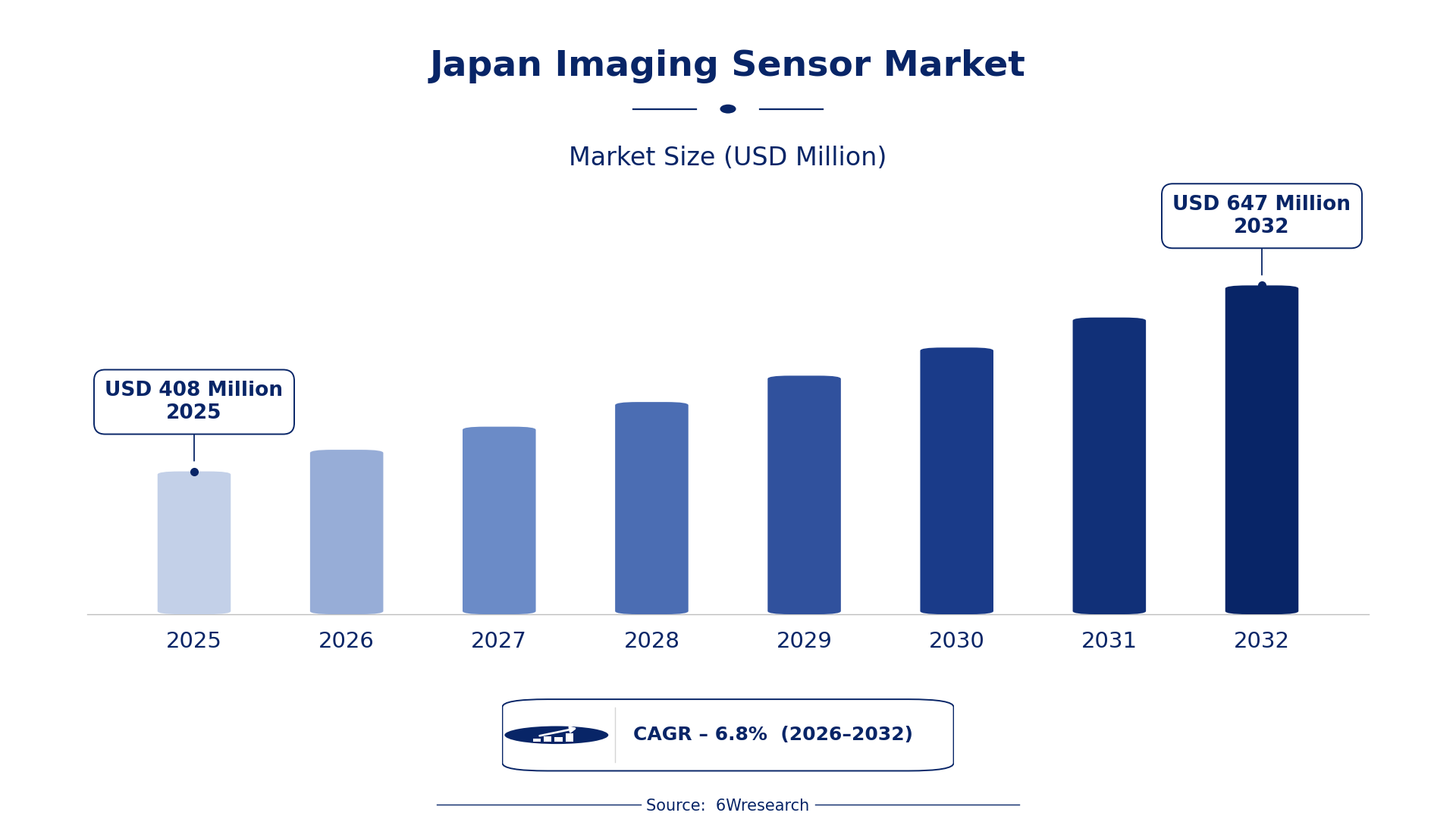
According to 6Wresearch internal database and industry insights, the Japan Imaging Sensor Market was valued at USD 408 Million in 2025 and is projected to reach USD 647 Million by 2032, growing at a CAGR of approximately 6.8% during 2026–2032.
Japan Imaging Sensor Market Highlights
| Report Metric | Details |
| Report Name | Japan Imaging Sensor Market (2026-2032) |
| Market Size 2025 | USD 408 Million |
| Market Size 2032 | USD 647 Million |
| Absolute Growth 2025–2032 | USD 239 Million |
| CAGR 2026–2032 | 6.8% |
| Peak Annual Growth | 7.5% in 2027 |
| Forecast Period | 2026–2032 |
| Historical Data | 2022–2025 |
| Base Year | 2025 |
| Leading Sensor Type, 2025 | CMOS Sensors (48% share) |
| Leading Image Format, 2025 | Digital RGB (45% share) |
| Leading Technology Used, 2025 | Active Pixel Sensor (41% share) |
| Leading End User, 2025 | Camera Manufacturers (45% share) |
| Fastest-Growing Sensor Type | CCD Sensors (9.7% CAGR) |
| Fastest-Growing Image Format | High-Resolution (9.5% CAGR) |
| Fastest-Growing Technology Used | Charge-Coupled Device (9.4% CAGR) |
| Fastest-Growing End User | Medical Imaging OEMs (9.1% CAGR) |
| Growing Sector | Healthcare and Automotive |
| Key End Users | Camera Manufacturers, Medical Imaging OEMs, Surveillance & Defense, Autonomous Vehicle Makers |
Japan Imaging Sensor Market Year-wise Growth Rate and Key Drivers (2022–2032)
This graph illustrates the annual growth rates of the market from 2022 to 2032, highlighting a steady upward trajectory and projected market expansion over the forecast period.
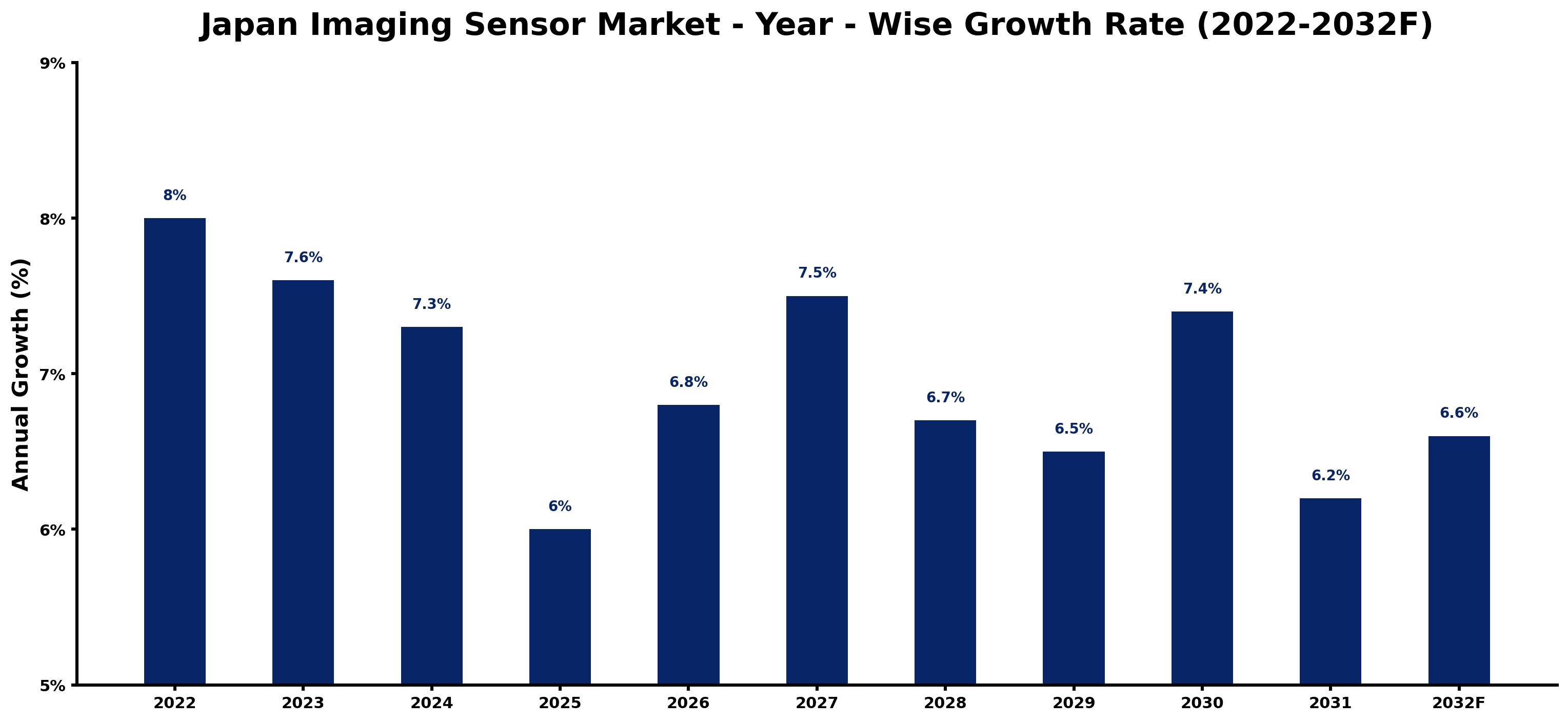
Below, each year's estimated growth is shown next to the factor that most influenced it.
| Year | Estimated Annual Growth (%) | Market Rationale |
| 2022 | 8.0 | The market experienced strong demand from camera manufacturers and consumer electronics sectors. |
| 2023 | 7.6 | Growth slowed due to market saturation in consumer electronics and increased competition. |
| 2024 | 7.3 | Demand continued to slow as the market adjusted to previous rapid growth rates. |
| 2025 | 6.0 | The market stabilised as investments in new technologies began to emerge. |
| 2026 | 6.8 | Growth is anticipated to rise as the automotive sector increases its use of imaging sensors. |
| 2027 | 7.5 | Demand is set to increase sharply due to advancements in autonomous vehicle technologies. |
| 2028 | 6.7 | Growth is expected to slow as the market matures and competition intensifies. |
| 2029 | 6.5 | A further slowdown is anticipated as the market reaches a saturation point in certain segments. |
| 2030 | 7.4 | Growth is likely to rebound as new applications for imaging sensors are developed. |
| 2031 | 6.2 | The market is projected to slow again as existing technologies dominate. |
| 2032 | 6.6 | Growth is expected to rise as demand for high-resolution imaging applications increases. |
Note: Market size estimations and growth projections presented in this report are based on 6Wresearch's proprietary forecasting methodology, utilizing the latest available industry data, government publications, and primary research inputs.
Japan Imaging Sensor Market Synopsis
Imaging sensors are electronic devices that convert light into electronic signals and are essential in various applications, including photography, medical imaging, surveillance, and autonomous vehicle navigation. The Japan Imaging Sensor Market is valued at approximately 1.5 billion USD as of 2023, driven by strong demand from camera manufacturers and the automotive sector. The increasing adoption of CMOS sensors, which account for over 70% of the market, and the projected growth in LiDAR sensor usage by the automotive sector are key growth factors.
Market Dynamics Impact Analysis (2026–2032)
| Factor | Type | Impact | Primary Segment Affected |
| Growing demand for high-resolution imaging in professional applications | Driver | High | High-Resolution |
| Increased use of imaging sensors in autonomous vehicles | Driver | High | LiDAR Image Sensors |
| Rising demand for thermal imaging in healthcare | Opportunity | High | Thermal Sensors |
| Expansion of smart city initiatives requiring surveillance sensors | Opportunity | High | Surveillance & Defense |
| Market saturation in consumer electronics leading to slower growth | Restraint | Medium | CMOS Sensors |
| Intense competition among sensor manufacturers affecting pricing | Restraint | Medium | Active Pixel Sensor |
| High production costs for advanced imaging technologies | Challenge | High | CCD Sensors |
| Dependency on semiconductor supply chains causing delays | Challenge | High | Infrared Arrays |
Evaluation of Drivers in Japan Imaging Sensor Market (2026–2032)
The table below links each growth driver to the segment it affects and the evidence for it.
| Drivers | Primary Segment Affected | Why It Matters (Evidence) |
| Increased adoption of CMOS sensors due to their cost-effectiveness | CMOS Sensors | CMOS sensors account for over 70% of the market, resulting in higher purchases by camera manufacturers. |
| Growing demand for LiDAR sensors in autonomous vehicles | LiDAR Image Sensors | The automotive sector is projected to increase LiDAR usage by 30% by 2025, boosting demand. |
| Rising healthcare investments in diagnostic imaging | Thermal Sensors | Over 1,000 hospitals in Japan utilise thermal imaging for diagnostics, increasing sensor demand. |
| Advancements in drone technology requiring high-resolution sensors | High-Resolution | High-resolution imaging sensors are increasingly used in drone mapping and surveying applications. |
| Urban safety initiatives boosting surveillance sensor demand | Surveillance & Defense | Demand for surveillance sensors is supported by urban safety initiatives in major cities like Tokyo. |
What keeps demand rising is the growing adoption of advanced imaging technologies, particularly in the automotive and healthcare sectors. The automotive industry is set to significantly increase its usage of LiDAR sensors, creating a surge in demand. In healthcare, investments in diagnostic imaging are on the rise, with many hospitals utilising thermal imaging for patient diagnostics. Advancements in drone technology are resulting in increased demand for high-resolution imaging sensors used in mapping and surveying applications.
Evaluation of Restraints in Japan Imaging Sensor Market
Below are the constraints most often cited by buyers and suppliers, with the segment each affects.
| Market Restraint | Primary Segment Affected | Why It Matters (Evidence) |
| Market saturation in consumer electronics limiting growth potential | CMOS Sensors | As the market matures, demand from consumer electronics is stabilising, impacting growth rates. |
| Intense competition causing price pressures among manufacturers | Active Pixel Sensor | Increased competition among manufacturers is driving down prices, affecting profitability. |
| High production costs for advanced imaging technologies | CCD Sensors | The costs associated with producing CCD sensors remain high, limiting their market penetration. |
| Dependency on semiconductor supply chains causing delays | Infrared Arrays | Supply chain issues for semiconductors can lead to production delays for imaging sensors. |
| Limited innovation in traditional imaging technologies | Charge-Coupled Device | The slow pace of innovation in CCD technology is hindering growth opportunities. |
Japan Imaging Sensor Market Challenges
Producers face a skills gap in advanced imaging sensor technologies, which limits innovation and extends product development timelines by up to 20%. This issue stems from the rapid technological advancements in Japan, making it difficult for workers to keep pace with new requirements. Importers encounter rising semiconductor material costs, which have increased by 15% over the past year, directly impacting their pricing strategies and profit margins. Buyers experience intense competition from low-cost alternatives, leading to a 20% rise in warranty claims as they compromise on quality. Technology adoption lags in integrating new imaging standards, hindering operational efficiency for hospitals that depend on up-to-date diagnostic tools.
Trends in the Japan Imaging Sensor Market
The following changes are redrawing the Japan Imaging Sensor Market.
- Shift from Traditional to High-Resolution Imaging: In 2023, the demand for high-resolution imaging sensors surged, particularly in professional applications. High-resolution sensors are increasingly used in drone technology for mapping, with a projected growth rate of 9.5% in this segment.
- Transition from CCD to CMOS Sensors: The shift from CCD to CMOS sensors has been notable, with CMOS accounting for over 70% of the market. This transition is supported by their cost-effectiveness and efficiency in consumer cameras.
- Camera Manufacturers Prioritising Advanced Imaging Technologies: Camera manufacturers are prioritising advanced imaging technologies, with a 10% increase in digital camera production reported in 2023. This trend reflects the rising need for high-quality imaging solutions.
- Surveillance Demand Driven by Urban Safety Initiatives: Urban safety initiatives in major cities have led to increased demand for surveillance sensors. The focus on public safety is expected to drive growth in this sector.
Investment Opportunities in the Japan Imaging Sensor Market
The opportunities below stand out in the Japan Imaging Sensor Market for new entrants and existing suppliers.
- Camera Manufacturers Seeking Advanced Solutions: Camera manufacturers are currently looking for advanced imaging solutions, with the market valued at 1.5 billion USD in 2023. Collaborating with local suppliers can facilitate entry into this growing market.
- Increasing Demand for Thermal Imaging in Healthcare: As over 1,000 hospitals utilise thermal imaging for diagnostics, there is a clear opportunity for suppliers to meet this demand. Investing in partnerships with medical imaging OEMs can strengthen market presence.
- Autonomous Vehicle Makers Increasing Sensor Needs: With the automotive sector projected to increase LiDAR sensor usage by 30% by 2025, there is a distinct opportunity for suppliers. Establishing joint ventures with automotive manufacturers can facilitate market entry.
- Smart City Initiatives Driving Surveillance Sensor Demand: The Tokyo Metropolitan Government's initiatives to promote smart city technologies are creating opportunities for surveillance sensor suppliers. Engaging with local authorities can provide pathways for market entry.
Government Initiatives in the Japan Imaging Sensor Market
The Semiconductor and Digital Industry Strategy, enacted by METI in June 2021, aims to secure domestic semiconductor manufacturing. This policy is important for imaging sensor producers, as it provides funding and support for technology advancements, ensuring a stable supply chain for manufacturers. The strategy includes measures to improve production capabilities and stimulate innovation in imaging technologies, with a target to increase domestic production by 20% by 2025.
The Long-Term Care Insurance Act, overseen by the Ministry of Health, Labour and Welfare, funds nursing care and support services. Medical imaging OEMs benefit from this scheme, as it facilitates access to advanced imaging technologies, improving their product offerings. The act supports numerous facilities, ensuring that they can acquire the latest imaging equipment to enhance patient care.
Future Insight of the Japan Imaging Sensor Market
By 2032, Japan's imaging sensor market will experience a policy-driven shift towards smart manufacturing, prompting suppliers to invest in advanced production technologies. The automotive sector is projected to increase its use of LiDAR sensors by 30% by 2025, aligning with government initiatives to enhance autonomous vehicle capabilities. Buyers will see improvements in imaging standards like ISO 12232, ensuring higher quality and performance in products. Smart city initiatives will stimulate demand for surveillance sensors, creating new opportunities for suppliers to innovate and expand their offerings.
Market Segmentation Analysis
Japan Imaging Sensor Market report covers a detailed analysis of the following market segments:
By Sensor Type – CMOS Sensors Lead, CCD Sensors Expected to Grow Fastest
According to Saurav Kr Singh, Senior Research Analyst at 6Wresearch, with 48% of sensor type revenue in 2025, CMOS Sensors was the largest category. CMOS sensors dominate the market due to their extensive use in consumer cameras and smartphones, appealing to a wide range of manufacturers. Their adoption rate surpasses 70%, indicating strong demand from everyday users who seek reliable imaging solutions. CCD Sensors are projected to grow fastest, at a CAGR of 9.7% during 2026–2032. CCD sensors are witnessing rapid growth as industries increasingly require them for specialised imaging applications that demand high-quality outputs. This trend highlights a rising interest in CCD technology as sectors pursue superior imaging capabilities, further widening the gap with CMOS. Suppliers should focus on enhancing CCD technology to capitalise on the expanding niche markets.
By Image Format – Digital RGB Leads, High-Resolution Expected to Grow Fastest
The largest image format category in 2025 was Digital RGB, at 45% of revenue. Digital RGB format is the leading choice in the market, serving as the standard for digital photography and widely adopted by both amateur and professional users. Its compatibility with various devices ensures sustained demand across the imaging sector. The quickest growth will come from High-Resolution, forecast to expand at a CAGR of 9.5% between 2026 and 2032. High-resolution formats are experiencing swift growth due to the increasing need for professional imaging and surveillance applications. As sectors prioritise detailed imaging, the shift towards high-resolution formats is expected to accelerate, reinforcing its market position. Buyers will benefit from suppliers offering high-resolution solutions to meet the rising demands of professional imaging.
By Technology Used – Active Pixel Sensor Leads, Charge-Coupled Device Expected to Grow Fastest
Active Pixel Sensor took 41% of technology used revenue in 2025, more than any other category. Active pixel sensors are prevalent in modern cameras, making them the leading technology in the imaging sensor market. Their efficiency and performance in everyday devices solidify their position among manufacturers. Charge-Coupled Device is set to record the highest CAGR in this split, 9.4% over 2026–2032. Charge-coupled devices are gaining traction in high-end applications, driving their growth as industries demand superior imaging quality. This trend suggests that active pixel sensors will maintain their lead while CCDs carve out a larger niche. Suppliers need to balance their offerings between active pixel and charge-coupled technologies to cater to diverse market needs.
By End User – Camera Manufacturers Lead, Medical Imaging OEMs Expected to Grow Fastest
In 2025, Camera Manufacturers led the end user split with a 45% share. Camera manufacturers are the primary users of imaging sensors, integrating them extensively into their products to meet consumer needs. Their dominant presence in the market underscores the essential role of imaging sensors within the camera industry. Over 2026–2032, Medical Imaging OEMs are expected to post the fastest growth, at a CAGR of 9.1%. Medical imaging OEMs are rapidly increasing their use of imaging sensors as advancements in healthcare technology progress, particularly in diagnostic applications. This surge indicates a promising growth trajectory for suppliers focused on the medical sector, enhancing their market opportunities. Suppliers should explore strategic partnerships with medical imaging OEMs to leverage the expanding healthcare market.
Key Attractiveness of the Report
- 10 Years of Market Numbers
- Historical Data Starting from 2022 to 2025
- Base Year 2025
- Forecast Data until 2032
- Key Performance Indicators Impacting the Market
- Major Upcoming Developments and Projects
Key Highlights of the Report:
- Japan Imaging Sensor Market Outlook
- Market Size of Japan Imaging Sensor Market, 2025
- Forecast of Japan Imaging Sensor Market, 2032
- Historical Data and Forecast of Japan Imaging Sensor Revenues & Volume for the Period 2022-2032F
- Japan Imaging Sensor Market Trend Evolution
- Japan Imaging Sensor Market Drivers and Challenges
- Japan Imaging Sensor Price Trends
- Japan Imaging Sensor Porter's Five Forces
- Japan Imaging Sensor Industry Life Cycle
- Historical Data and Forecast of Japan Imaging Sensor Market Revenues & Volume By Sensor Type for the Period 2022-2032F
- Historical Data and Forecast of Japan Imaging Sensor Market Revenues & Volume By CMOS Sensors for the Period 2022-2032F
- Historical Data and Forecast of Japan Imaging Sensor Market Revenues & Volume By CCD Sensors for the Period 2022-2032F
- Historical Data and Forecast of Japan Imaging Sensor Market Revenues & Volume By Thermal Sensors for the Period 2022-2032F
- Historical Data and Forecast of Japan Imaging Sensor Market Revenues & Volume By LiDAR Image Sensors for the Period 2022-2032F
- Historical Data and Forecast of Japan Imaging Sensor Market Revenues & Volume By Image Format for the Period 2022-2032F
- Historical Data and Forecast of Japan Imaging Sensor Market Revenues & Volume By Digital RGB for the Period 2022-2032F
- Historical Data and Forecast of Japan Imaging Sensor Market Revenues & Volume By High-Resolution for the Period 2022-2032F
- Historical Data and Forecast of Japan Imaging Sensor Market Revenues & Volume By IR/Heat Mapping for the Period 2022-2032F
- Historical Data and Forecast of Japan Imaging Sensor Market Revenues & Volume By Depth Perception for the Period 2022-2032F
- Historical Data and Forecast of Japan Imaging Sensor Market Revenues & Volume By Technology Used for the Period 2022-2032F
- Historical Data and Forecast of Japan Imaging Sensor Market Revenues & Volume By Active Pixel Sensor for the Period 2022-2032F
- Historical Data and Forecast of Japan Imaging Sensor Market Revenues & Volume By Charge-Coupled Device for the Period 2022-2032F
- Historical Data and Forecast of Japan Imaging Sensor Market Revenues & Volume By Infrared Arrays for the Period 2022-2032F
- Historical Data and Forecast of Japan Imaging Sensor Market Revenues & Volume By Laser + Photodetectors for the Period 2022-2032F
- Historical Data and Forecast of Japan Imaging Sensor Market Revenues & Volume By End User for the Period 2022-2032F
- Historical Data and Forecast of Japan Imaging Sensor Market Revenues & Volume By Camera Manufacturers for the Period 2022-2032F
- Historical Data and Forecast of Japan Imaging Sensor Market Revenues & Volume By Medical Imaging OEMs for the Period 2022-2032F
- Historical Data and Forecast of Japan Imaging Sensor Market Revenues & Volume By Surveillance & Defense for the Period 2022-2032F
- Historical Data and Forecast of Japan Imaging Sensor Market Revenues & Volume By Autonomous Vehicle Makers for the Period 2022-2032F
- Japan Imaging Sensor Import Export Trade Statistics
- Market Opportunity Assessment By Sensor Type
- Market Opportunity Assessment By Image Format
- Market Opportunity Assessment By Technology Used
- Market Opportunity Assessment By End User
- Japan Imaging Sensor Top Companies Market Share
- Japan Imaging Sensor Competitive Benchmarking By Technical and Operational Parameters
- Japan Imaging Sensor Company Profiles
- Japan Imaging Sensor Key Strategic Recommendations
Market Covered
The study includes the following segmentation.
By Sensor Type
- CMOS Sensors
- CCD Sensors
- Thermal Sensors
- LiDAR Image Sensors
By Image Format
- Digital RGB
- High-Resolution
- IR/Heat Mapping
- Depth Perception
By Technology Used
- Active Pixel Sensor
- Charge-Coupled Device
- Infrared Arrays
- Laser + Photodetectors
By End User
- Camera Manufacturers
- Medical Imaging OEMs
- Surveillance & Defense
- Autonomous Vehicle Makers































