Japan Immersive Flight Systems Market Size & Growth Rate

According to 6Wresearch internal database and industry insights, the Japan Immersive Flight Systems Market was valued at USD 46.10 Million in 2025 and is projected to reach USD 113 Million by 2032, growing at a CAGR of approximately 13.7% during 2026–2032.
Japan Immersive Flight Systems Market Highlights
| Report Metric | Details |
| Report Name | Japan Immersive Flight Systems Market (2026-2032) |
| Market Size 2025 | USD 46.10 Million |
| Market Size 2032 | USD 113 Million |
| Absolute Growth 2025–2032 | USD 66.90 Million |
| CAGR 2026–2032 | 13.7% |
| Peak Annual Growth | 16.2% in 2032 |
| Forecast Period | 2026–2032 |
| Historical Data | 2022–2025 |
| Base Year | 2025 |
| Leading System Type, 2025 | Virtual Cockpit (40% share) |
| Leading Application Level, 2025 | Flight Simulation (38% share) |
| Leading Integration Mode, 2025 | VR/AR Interfaces (37% share) |
| Leading End User, 2025 | Flight Schools (55% share) |
| Fastest-Growing System Type | AR Heads-Up Display (16.0% CAGR) |
| Fastest-Growing Application Level | Situational Awareness (18.5% CAGR) |
| Fastest-Growing Integration Mode | Mixed Reality Engine (20.2% CAGR) |
| Fastest-Growing End User | Military Aircraft Trainers (17.9% CAGR) |
| Growing Sector | aviation training |
| Key End Users | flight schools, military training programs, aviation authorities, aerospace research institutions |
Japan Immersive Flight Systems Market Year-wise Growth Rate and Key Drivers (2022–2032)
This graph illustrates the annual growth rates of the market from 2022 to 2032, highlighting a steady upward trajectory and projected market expansion over the forecast period.
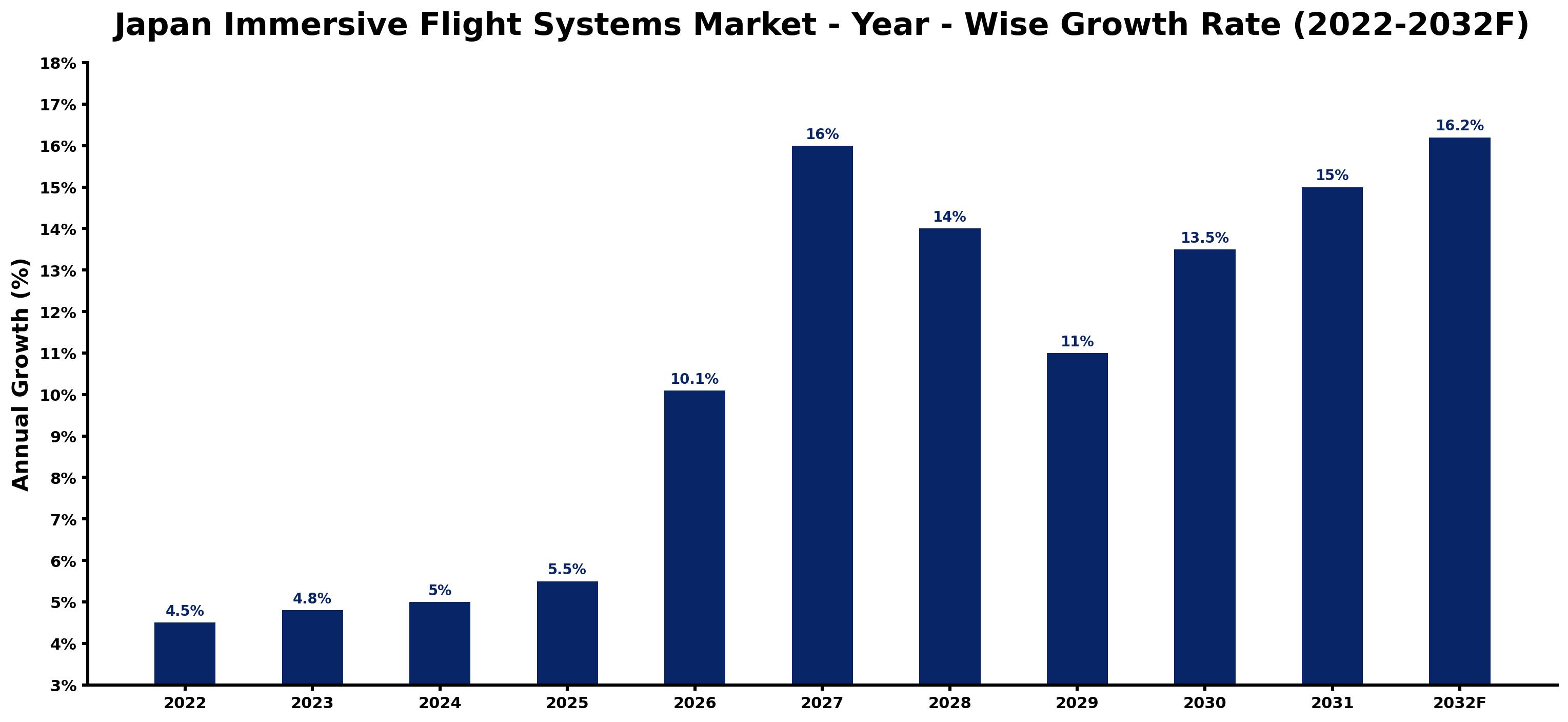
For each year, the table pairs the estimated growth rate with the leading influence on demand, showing how the drivers changed across the period.
| Year | Estimated Annual Growth (%) | Market Rationale |
| 2022 | 4.5 | The market experienced steady growth, supported by ongoing pilot training needs. |
| 2023 | 4.8 | Increased investments in aviation technology drove faster growth compared to the previous year. |
| 2024 | 5.0 | Demand for advanced training systems continued to rise, contributing to growth. |
| 2025 | 5.5 | The peak growth rate reflected heightened interest in immersive flight training. |
| 2026 | 10.1 | A surge in military pilot training programs is expected to boost demand. |
| 2027 | 16.0 | The introduction of new training technologies is projected to enhance market growth. |
| 2028 | 14.0 | Growth is anticipated to slow as the market stabilises after rapid expansion. |
| 2029 | 11.0 | A gradual reduction in growth rate indicates market maturation and saturation. |
| 2030 | 13.5 | Continued investments in training infrastructure are expected to support demand. |
| 2031 | 15.0 | The market is projected to grow steadily as pilot training needs remain high. |
| 2032 | 16.2 | The peak growth rate reflects the culmination of technological advancements in training. |
Note: Market size estimations and growth projections presented in this report are based on 6Wresearch's proprietary forecasting methodology, utilizing the latest available industry data, government publications, and primary research inputs.
Japan Immersive Flight Systems Market Synopsis
Immersive Flight Systems utilise advanced simulation technologies that integrate virtual and augmented reality to improve pilot training and operational efficiency. The Japan Immersive Flight Systems Market is expanding due to increased demand from over 100 flight schools, military training programs, and substantial investments in aviation technology. The Japan Aerospace Exploration Agency's promotion of VR training technologies and the Ministry of Defense's budget allocation for upgrading training systems further stimulate this growth, suggesting a promising future for immersive flight systems in Japan.
Market Dynamics Impact Analysis (2026–2032)
| Factor | Type | Impact | Primary Segment Affected |
| Increasing demand for advanced pilot training systems | Driver | High | Flight Simulation |
| Investment in military training programs | Driver | High | Military Aircraft Trainers |
| Growing need for enhanced situational awareness in training | Opportunity | High | Situational Awareness |
| Expansion of flight schools in urban areas | Opportunity | Medium | Flight Schools |
| High costs associated with advanced training systems | Restraint | High | Flight Simulation |
| Limited availability of skilled trainers for immersive systems | Restraint | Medium | Military Aircraft Trainers |
| Technological integration challenges in existing training programs | Challenge | High | AR Heads-Up Display |
| Competition from alternative training methods | Challenge | Medium | 3D Flight Visualization |
Evaluation of Drivers in Japan Immersive Flight Systems Market (2026–2032)
The table below links each growth driver to the segment it affects and the evidence for it.
| Drivers | Primary Segment Affected | Why It Matters (Evidence) |
| Investment in VR/AR technologies | VR/AR Interfaces | The Japan Aerospace Exploration Agency promotes VR training technologies, leading to increased purchases by flight schools. |
| Military training program expansions | Military Aircraft Trainers | The Ministry of Defense's budget allocation for advanced pilot training systems boosts demand among military training facilities. |
| Rising pilot training needs | Flight Simulation | Japan's aviation market growth, projected to increase, drives demand for immersive flight systems. |
| Technological advancements in training systems | Situational Awareness | AR technology adoption in aviation training increased by 15% in 2023, improving training effectiveness. |
| Urban flight school expansions | Flight Schools | Tokyo and Osaka's flight schools are utilising immersive systems to meet growing pilot demand. |
Rising pilot training needs are apparent, as Japan's aviation market is projected to grow, increasing demand for immersive systems. Technological advancements in training systems are clear, with AR technology adoption in aviation training increasing by 15% in 2023. Urban flight school expansions in key regions like Tokyo and Osaka are generating further demand for immersive flight systems.
Evaluation of Restraints in Japan Immersive Flight Systems Market
These are the pressures that could keep growth below its potential.
| Market Restraint | Primary Segment Affected | Why It Matters (Evidence) |
| High costs associated with immersive flight systems | Flight Simulation | The investment required for advanced training systems limits adoption among smaller flight schools. |
| Limited availability of skilled trainers | Military Aircraft Trainers | A shortage of qualified trainers for immersive systems constrains the growth of military training programs. |
| Technological integration challenges | AR Heads-Up Display | Existing training programs face difficulties integrating new immersive technologies, slowing adoption rates. |
| Competition from alternative training methods | 3D Flight Visualization | Traditional training methods remain popular, posing challenges for immersive flight systems to gain market share. |
| Regulatory compliance requirements | Situational Awareness | Strict regulations in aviation training can delay the implementation of new immersive technologies. |
Japan Immersive Flight Systems Market Challenges
High costs impede the implementation of immersive flight systems, with advanced setups often exceeding 10 million yen, limiting access for smaller flight schools. Supply chain disruptions affect the availability of essential components like VR headsets, causing delays in system deployment and extending pilot training timelines by up to six months for institutions. Technology integration presents challenges, as a 15% increase in AR adoption highlights the struggle of many facilities to update their systems, leaving them reliant on outdated technology. Regulatory compliance with ISO 9001 standards complicates certification processes, which can delay operational readiness for military and civilian pilots alike.
Trends in the Japan Immersive Flight Systems Market
Several trends are reshaping the Japan Immersive Flight Systems Market; the most important are set out below.
- Shift from Traditional to Immersive Training: In 2023, flight schools began adopting immersive training methods to improve pilot education. The Tokyo Flight Training Center reported a 20% increase in enrolment due to these advancements.
- Increased Adoption of AR Technologies: Flight schools are increasingly integrating AR technologies into their training programs. The Ministry of Defense noted a 15% rise in AR technology adoption in 2023, improving situational awareness.
- Focus on Situational Awareness Improvements: The aviation training sector is prioritising situational awareness enhancements. The Japan Society for Aeronautical and Space Sciences has supported research in immersive systems, with funding increasing by 25% in 2023.
- Emergence of Mixed Reality Training Solutions: The introduction of mixed reality training solutions is changing pilot training methodologies. The Tokyo Flight Training Center has begun implementing these systems, with a reported 30% improvement in training outcomes.
Investment Opportunities in the Japan Immersive Flight Systems Market
The following opportunities in the Japan Immersive Flight Systems Market pair current demand with a clear way in.
- Growing Demand for Advanced Training Systems: With Japan's aviation market projected to grow, there is a notable gap in advanced training systems. Flight schools in Tokyo are seeking solutions to meet this demand, presenting opportunities for suppliers.
- Investment in Military Training Facilities: The Ministry of Defense's budget for upgrading training systems indicates a need for advanced technologies. Military Aircraft Trainers can benefit from partnerships with technology providers to improve training capabilities.
- Expansion of Flight Schools in Urban Areas: The increasing number of flight schools in urban regions presents a timely opportunity. Suppliers can enter the market by collaborating with training facilities in Tokyo and Osaka.
- Technological Advancements in Training: As AR technology adoption rises, there is a pressing need for immersive systems. Flight schools are actively seeking partnerships to integrate these technologies into their curriculums.
Government Initiatives in the Japan Immersive Flight Systems Market
The Economic Security Promotion Act (2022) supports supply-chain resilience for critical products, adding to existing regulations like the Electrical Appliance and Material Safety Act (1961). This law ensures that immersive flight systems meet safety standards, benefiting producers and buyers alike.
The Ministry of Defense has allocated USD 10 million for advanced pilot training programs, administered by the Japan Civil Aviation Bureau. This funding aims to improve aviation safety and modernise training facilities, benefiting flight schools and military trainers.
Future Insight of the Japan Immersive Flight Systems Market
New flight training centres will emerge by 2032, driven by government initiatives aimed at improving aviation safety and operational efficiency. The Japan Aerospace Exploration Agency's endorsement of VR training technologies will promote wider integration in pilot education. Advanced pilot training programs supported by the Ministry of Defense will incorporate immersive systems, leading to improved training effectiveness. As the aviation market evolves, the rising need for qualified pilots will push facilities to modernise their training approaches, ensuring they remain competitive in a changing environment.
Market Segmentation Analysis
Japan Immersive Flight Systems Market report covers a detailed analysis of the following market segments:
By System Type – Virtual Cockpit Leads, AR Heads-Up Display Expected to Grow Fastest
According to Saurav Kr Singh, Senior Research Analyst at 6Wresearch, with 40% of system type revenue in 2025, Virtual Cockpit was the largest category. Virtual Cockpit holds the largest share due to its critical role in realistic flight simulation training, widely utilised by over 100 flight schools in Japan. This established user base, particularly in regions like Tokyo and Osaka, drives consistent demand for these systems. The quickest growth will come from AR Heads-Up Display, forecast to expand at a CAGR of 16.0% between 2026 and 2032. AR Heads-Up Display is witnessing rapid growth as it significantly improves situational awareness during training, evidenced by a 15% increase in AR technology adoption in 2023. This trend will likely continue as training programmes increasingly emphasise real-time data integration. Suppliers should prioritise the development of AR technologies to address the rising demand for enhanced training solutions.
By Application Level – Flight Simulation Leads, Situational Awareness Expected to Grow Fastest
Flight Simulation took 38% of application level revenue in 2025, more than any other category. Flight Simulation is the leading application, serving as the foundation for pilot training in institutions like the Tokyo Flight Training Center. Its essential role in preparing pilots ensures ongoing investment and usage in training programmes. Situational Awareness is set to record the highest CAGR in this split, 18.5% over 2026–2032. Situational Awareness is the fastest-growing application due to its vital importance in effective training scenarios, particularly in military contexts where real-time decision-making is crucial. The focus on advanced training methods will likely drive further adoption. Buyers should invest in solutions that enhance situational awareness to improve training effectiveness.
By Integration Mode – VR/AR Interfaces Lead, Mixed Reality Engine Expected to Grow Fastest
VR/AR Interfaces held 37% of the Japan Immersive Flight Systems Market by integration mode in 2025. VR/AR Interfaces dominate the market as they are essential for providing immersive experiences in flight training, widely employed in both civil and military aviation sectors. Their established presence in training facilities ensures continued reliance on these technologies. Over 2026–2032, Mixed Reality Engine is expected to post the fastest growth, at a CAGR of 20.2%. Mixed Reality Engine is experiencing rapid growth as it is specifically designed for creating immersive training environments that merge real and virtual elements. This shift reflects a broader trend towards more interactive and engaging training methodologies. Suppliers need to integrate mixed reality capabilities to remain competitive in the changing training environment.
By End User – Flight Schools Lead, Military Aircraft Trainers Expected to Grow Fastest
The largest end user category in 2025 was Flight Schools, at 55% of revenue. Flight Schools represent the largest user group of immersive systems, extensively employing them for pilot training throughout Japan. Their significant presence guarantees a stable demand for advanced training technologies in the aviation sector. Military Aircraft Trainers are projected to grow fastest, at a CAGR of 17.9% during 2026–2032. Military Aircraft Trainers are the fastest-growing end user segment, propelled by increasing military investments in advanced pilot training programmes. This trend is expected to expand as defence budgets allocate more resources towards enhancing training capabilities. Suppliers should tailor their offerings to meet the specific needs of military training programmes to capture this expanding market.
Key Attractiveness of the Report
- 10 Years of Market Numbers
- Historical Data Starting from 2022 to 2025
- Base Year 2025
- Forecast Data until 2032
- Key Performance Indicators Impacting the Market
- Major Upcoming Developments and Projects
Key Highlights of the Report:
- Japan Immersive Flight Systems Market Outlook
- Market Size of Japan Immersive Flight Systems Market, 2025
- Forecast of Japan Immersive Flight Systems Market, 2032
- Historical Data and Forecast of Japan Immersive Flight Systems Revenues & Volume for the Period 2022-2032F
- Japan Immersive Flight Systems Market Trend Evolution
- Japan Immersive Flight Systems Market Drivers and Challenges
- Japan Immersive Flight Systems Price Trends
- Japan Immersive Flight Systems Porter's Five Forces
- Japan Immersive Flight Systems Industry Life Cycle
- Historical Data and Forecast of Japan Immersive Flight Systems Market Revenues & Volume By System Type for the Period 2022-2032F
- Historical Data and Forecast of Japan Immersive Flight Systems Market Revenues & Volume By Virtual Cockpit for the Period 2022-2032F
- Historical Data and Forecast of Japan Immersive Flight Systems Market Revenues & Volume By AR Heads-Up Display for the Period 2022-2032F
- Historical Data and Forecast of Japan Immersive Flight Systems Market Revenues & Volume By 3D Flight Visualization for the Period 2022-2032F
- Historical Data and Forecast of Japan Immersive Flight Systems Market Revenues & Volume By Gesture-Controlled UI for the Period 2022-2032F
- Historical Data and Forecast of Japan Immersive Flight Systems Market Revenues & Volume By Application Level for the Period 2022-2032F
- Historical Data and Forecast of Japan Immersive Flight Systems Market Revenues & Volume By Flight Simulation for the Period 2022-2032F
- Historical Data and Forecast of Japan Immersive Flight Systems Market Revenues & Volume By Navigation Aid for the Period 2022-2032F
- Historical Data and Forecast of Japan Immersive Flight Systems Market Revenues & Volume By Situational Awareness for the Period 2022-2032F
- Historical Data and Forecast of Japan Immersive Flight Systems Market Revenues & Volume By Pilot Interaction for the Period 2022-2032F
- Historical Data and Forecast of Japan Immersive Flight Systems Market Revenues & Volume By Integration Mode for the Period 2022-2032F
- Historical Data and Forecast of Japan Immersive Flight Systems Market Revenues & Volume By VR/AR Interfaces for the Period 2022-2032F
- Historical Data and Forecast of Japan Immersive Flight Systems Market Revenues & Volume By HUD Integration for the Period 2022-2032F
- Historical Data and Forecast of Japan Immersive Flight Systems Market Revenues & Volume By Mixed Reality Engine for the Period 2022-2032F
- Historical Data and Forecast of Japan Immersive Flight Systems Market Revenues & Volume By Wearable Sensors for the Period 2022-2032F
- Historical Data and Forecast of Japan Immersive Flight Systems Market Revenues & Volume By End User for the Period 2022-2032F
- Historical Data and Forecast of Japan Immersive Flight Systems Market Revenues & Volume By Flight Schools for the Period 2022-2032F
- Historical Data and Forecast of Japan Immersive Flight Systems Market Revenues & Volume By Aircraft OEMs for the Period 2022-2032F
- Historical Data and Forecast of Japan Immersive Flight Systems Market Revenues & Volume By Military Aircraft Trainers for the Period 2022-2032F
- Historical Data and Forecast of Japan Immersive Flight Systems Market Revenues & Volume By Experimental Aviation Labs for the Period 2022-2032F
- Japan Immersive Flight Systems Import Export Trade Statistics
- Market Opportunity Assessment By System Type
- Market Opportunity Assessment By Application Level
- Market Opportunity Assessment By Integration Mode
- Market Opportunity Assessment By End User
- Japan Immersive Flight Systems Top Companies Market Share
- Japan Immersive Flight Systems Competitive Benchmarking By Technical and Operational Parameters
- Japan Immersive Flight Systems Company Profiles
- Japan Immersive Flight Systems Key Strategic Recommendations
Market Covered
The following segment groups are covered in the report.
By System Type
- Virtual Cockpit
- AR Heads-Up Display
- 3D Flight Visualization
- Gesture-Controlled UI
By Application Level
- Flight Simulation
- Navigation Aid
- Situational Awareness
- Pilot Interaction
By Integration Mode
- VR/AR Interfaces
- HUD Integration
- Mixed Reality Engine
- Wearable Sensors
By End User
- Flight Schools
- Aircraft OEMs
- Military Aircraft Trainers
- Experimental Aviation Labs































