Japan Immune Health Ingredients Market Size & Growth Rate
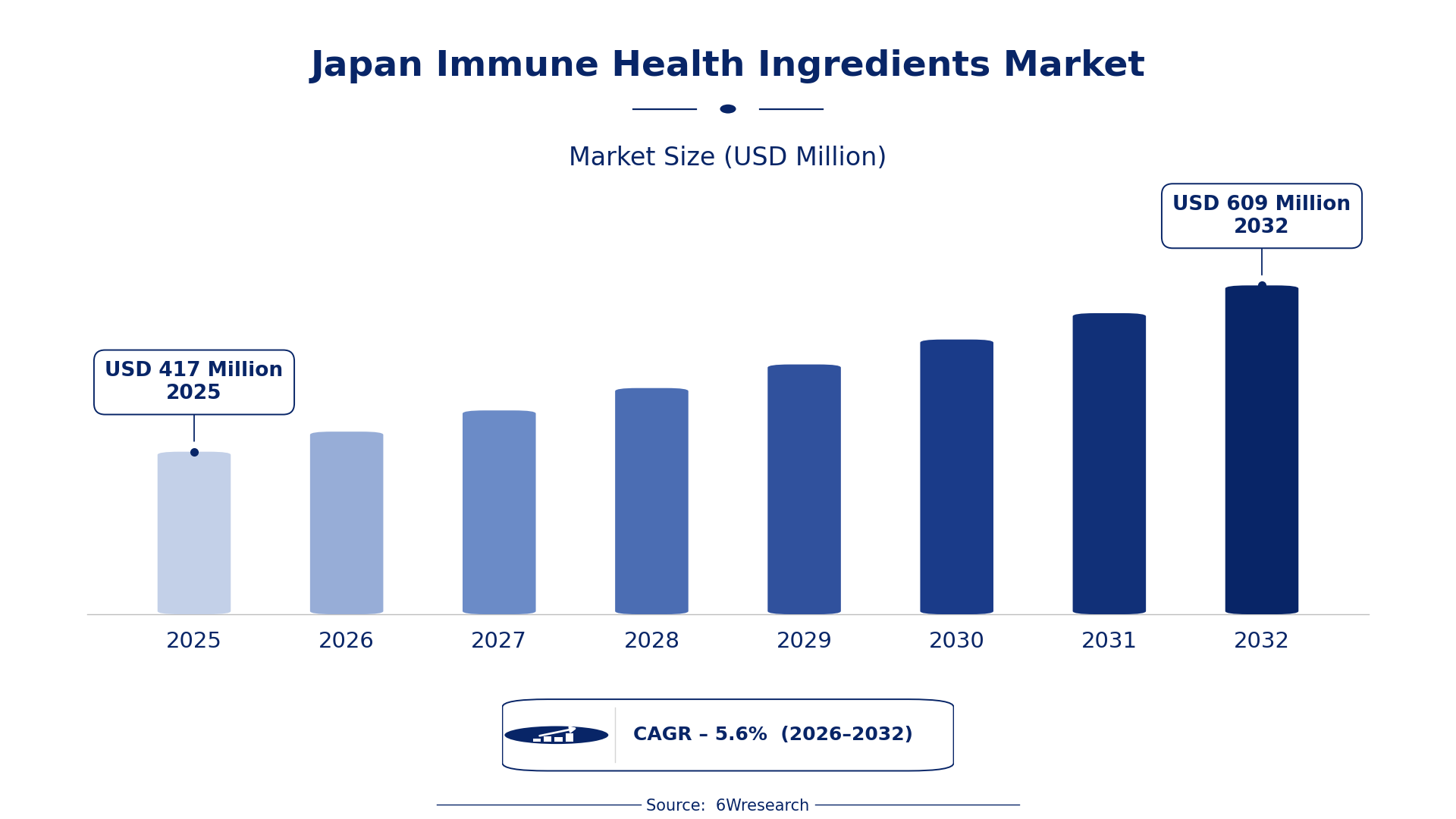
According to 6Wresearch internal database and industry insights, the Japan Immune Health Ingredients Market was valued at USD 417 Million in 2025 and is projected to reach USD 609 Million by 2032, growing at a CAGR of approximately 5.6% during 2026–2032.
Japan Immune Health Ingredients Market Highlights
| Report Metric | Details |
| Report Name | Japan Immune Health Ingredients Market (2026-2032) |
| Market Size 2025 | USD 417 Million |
| Market Size 2032 | USD 609 Million |
| Absolute Growth 2025–2032 | USD 192 Million |
| CAGR 2026–2032 | 5.6% |
| Peak Annual Growth | 6.5% in 2026 |
| Forecast Period | 2026–2032 |
| Historical Data | 2022–2025 |
| Base Year | 2025 |
| Leading Ingredient Type, 2025 | Probiotics (41% share) |
| Leading Source Type, 2025 | Fermented Cultures (47% share) |
| Leading Delivery Form, 2025 | Capsules/Drinks (48% share) |
| Leading End User, 2025 | Nutraceutical Firms (42% share) |
| Fastest-Growing Ingredient Type | Vitamins (C, D, E) (7.7% CAGR) |
| Fastest-Growing Source Type | Natural/Synthetic (7.9% CAGR) |
| Fastest-Growing Delivery Form | Tablets/Sprays (8.0% CAGR) |
| Fastest-Growing End User | Supplement Brands (6.9% CAGR) |
| Growing Sector | Supplement Brands |
| Key End Users | Nutraceutical Firms, Supplement Brands, Functional Food Producers, Wellness Brands |
Japan Immune Health Ingredients Market Year-wise Growth Rate and Key Drivers (2022–2032)
This graph illustrates the annual growth rates of the market from 2022 to 2032, highlighting a steady upward trajectory and projected market expansion over the forecast period.
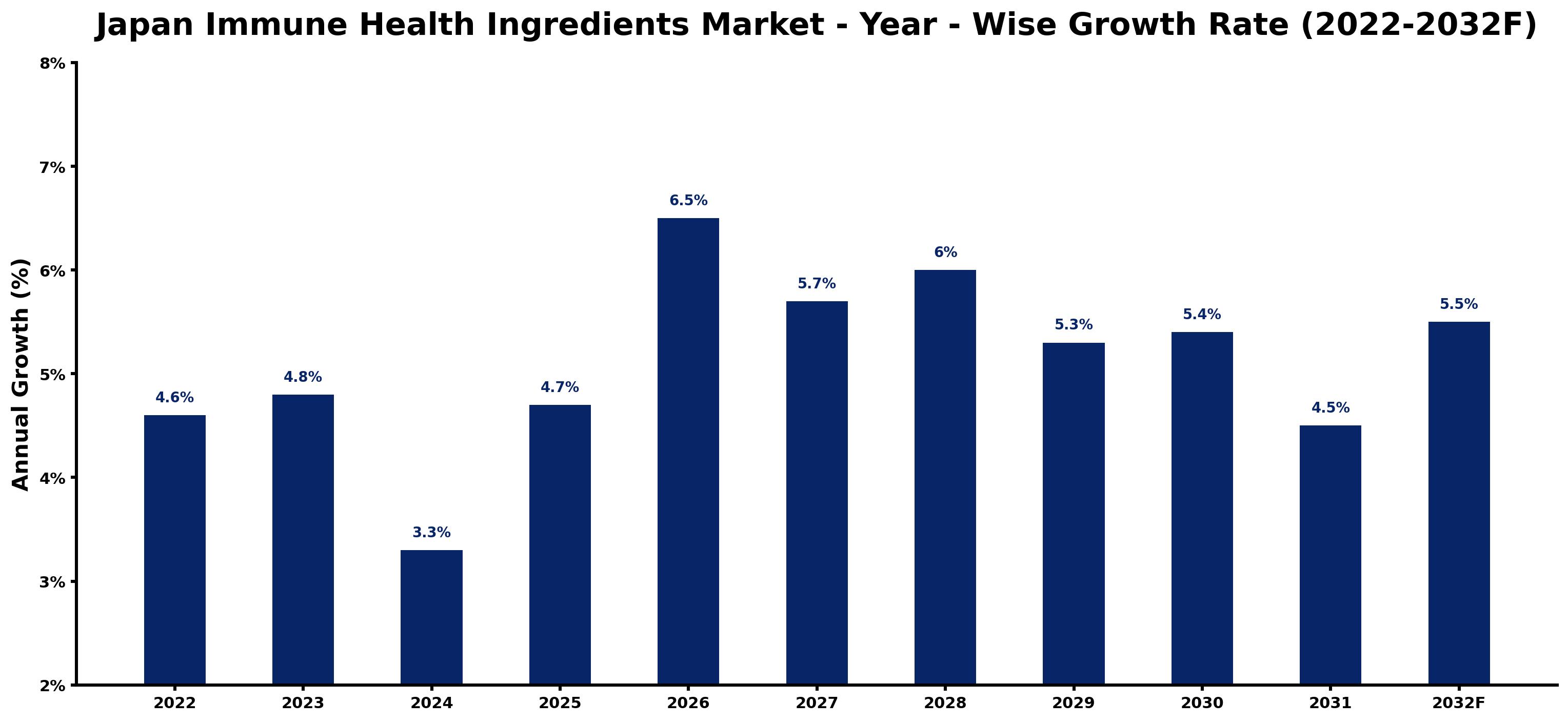
Annual growth estimates for each year appear below with the principal reason behind them, explaining the shifts that set the pace of the market.
| Year | Estimated Annual Growth (%) | Market Rationale |
| 2022 | 4.6 | The market showed steady growth, reflecting ongoing consumer interest in health and wellness products. |
| 2023 | 4.8 | Growth accelerated as awareness of immune health ingredients increased among consumers and producers alike. |
| 2024 | 3.3 | The growth rate slowed due to market saturation and increased competition among suppliers. |
| 2025 | 4.7 | Demand rose again as nutraceutical firms expanded their product lines featuring immune health ingredients. |
| 2026 | 6.5 | The peak growth is anticipated from heightened consumer focus on health. |
| 2027 | 5.7 | Growth is projected to slow as market conditions stabilise and competition intensifies among ingredient suppliers. |
| 2028 | 6.0 | Demand is expected to increase again as new product innovations attract consumer interest in immune support. |
| 2029 | 5.3 | The market is projected to experience a slowdown as consumer preferences begin to shift towards alternative health solutions. |
| 2030 | 5.4 | Growth is expected to resume as new research highlights the benefits of immune health ingredients. |
| 2031 | 4.5 | The market is projected to slow as consumers become more discerning about ingredient sourcing and product efficacy. |
| 2032 | 5.5 | Demand is expected to rise as technological advancements improve ingredient formulation and delivery. |
Note: Market size estimations and growth projections presented in this report are based on 6Wresearch's proprietary forecasting methodology, utilizing the latest available industry data, government publications, and primary research inputs.
Japan Immune Health Ingredients Market Synopsis
Immune health ingredients are compounds that support the immune system, often derived from natural sources through fermentation or extraction processes. The Japan Immune Health Ingredients Market is expanding, driven by the nutraceutical and functional food industries, with key buyer groups including nutraceutical firms and supplement brands. An ageing population, increased health awareness, and a functional food market valued at over 3 trillion JPY are propelling growth in this sector.
Market Dynamics Impact Analysis (2026–2032)
| Factor | Type | Impact | Primary Segment Affected |
| Growing health awareness among consumers | Driver | High | Probiotics |
| Rising demand for dietary supplements | Driver | High | Vitamins (C, D, E) |
| Increasing consumer interest in natural products | Opportunity | High | Herbal Extracts |
| Expansion of the functional food market | Opportunity | High | Functional Food Producers |
| Market saturation leading to intense competition | Restraint | Medium | Zinc & Selenium |
| Regulatory compliance costs for new entrants | Restraint | Medium | Natural/Synthetic |
| Challenges in sourcing high-quality ingredients | Challenge | High | Fermented Cultures |
| Technological barriers in product development | Challenge | Medium | Capsules/Drinks |
Evaluation of Drivers in Japan Immune Health Ingredients Market (2026–2032)
The main growth drivers and the segments they affect most are set out below.
| Drivers | Primary Segment Affected | Why It Matters (Evidence) |
| Increased consumption of probiotics | Probiotics | Probiotics are included in over 50% of dietary supplements, driving higher purchases by nutraceutical firms. |
| High sales of vitamins C and D | Vitamins (C, D, E) | Vitamins C and D are among the top-selling supplements, driving demand from health-conscious consumers. |
| Growing interest in natural health solutions | Herbal Extracts | The rising trend for natural products boosts purchases among wellness brands focusing on herbal formulations. |
| Expansion of functional food offerings | Functional Food Producers | The functional food market, valued at over 3 trillion JPY, encourages producers to integrate immune health ingredients. |
| Increased health awareness | Zinc & Selenium | Heightened awareness of health has led to increased purchases of immune-supportive trace minerals. |
Much of the new demand traces back to the increasing consumption of probiotics, with over 50% of dietary supplements in Japan containing these ingredients. High sales of vitamins C and D, which rank among the top-selling supplements, drive purchases from health-conscious consumers. Interest in natural health solutions is growing, as wellness brands focus on herbal formulations. The functional food market, valued at over 3 trillion JPY, encourages producers to integrate immune health ingredients. Increased awareness of health has led to a surge in purchases of immune-supportive trace minerals like zinc and selenium.
Evaluation of Restraints in Japan Immune Health Ingredients Market
The main factors holding the market back are set out below.
| Market Restraint | Primary Segment Affected | Why It Matters (Evidence) |
| Market saturation leading to intense competition | Zinc & Selenium | The growing number of suppliers has created a competitive environment, complicating market entry for newcomers. |
| Regulatory compliance costs for new entrants | Natural/Synthetic | New companies face high costs to meet regulatory standards, which can deter investment in the market. |
| Challenges in sourcing high-quality ingredients | Fermented Cultures | Sourcing premium ingredients can be difficult, impacting producers' ability to deliver quality products. |
| Technological barriers in product development | Capsules/Drinks | Developing new delivery forms requires substantial investment in technology, limiting options for smaller firms. |
| Consumer scepticism towards new products | Vitamins (C, D, E) | As consumers become more discerning, they may hesitate to try new supplements without proven efficacy. |
Japan Immune Health Ingredients Market Challenges
Buyers face high costs due to limited local sourcing of immune health ingredients, leading to price increases of up to 15% during supply disruptions. Technology adoption is slow, causing delays in product launches by six months for suppliers, which affects their competitiveness. Regulatory complexities extend the approval process for new products, adding an average of 12 weeks for suppliers to enter the market. The ageing population, with 29.3% over 65, escalates demand for immune health solutions, putting pressure on hospitals grappling with rising medical expenditures of JPY 46.7 trillion in 2022.
Trends in the Japan Immune Health Ingredients Market
Four trends stand out in the Japan Immune Health Ingredients Market.
- Shift from Traditional to Functional Foods: Since 2023, there has been a noticeable shift in consumer preference from traditional foods to functional foods that support immune health. The growing awareness of health benefits has led to a 15% increase in functional food sales in the Tokyo region.
- Emergence of Plant-Based Ingredients: In 2023, the trend towards plant-based ingredients gained traction, with a 20% rise in products featuring plant-derived immune health ingredients. This shift is evident among wellness brands promoting natural solutions.
- Focus on Personalized Nutrition: Beginning in 2024, personalized nutrition has become a priority, with companies tailoring supplements to individual health needs. This trend is reflected in a 30% increase in customised supplement offerings across Japan.
- Growth of Online Sales Channels: In 2023, online sales channels for immune health ingredients saw a 25% increase, reflecting changing consumer shopping habits. This shift is particularly evident among nutraceutical firms targeting tech-savvy consumers.
Investment Opportunities in the Japan Immune Health Ingredients Market
The openings below show where demand in the Japan Immune Health Ingredients Market is visible and how suppliers can enter.
- Investment in Immune Health: With the functional food market valued at over 3 trillion JPY, there is a strong opportunity for suppliers to provide immune health ingredients. Nutraceutical firms in the Tokyo region are particularly interested in expanding their product lines.
- Supply of Innovative Delivery Forms: The demand for new delivery formats is rising, especially for capsules and drinks. Collaborating with local nutraceutical firms can help suppliers meet this growing need effectively.
- Entry into the Herbal Extract Market: With the increasing interest in natural products, suppliers should focus on herbal extracts. Wellness brands are seeking high-quality herbal ingredients to incorporate into their offerings.
- Targeting Health-Conscious Consumers: The rising awareness of health benefits presents an opportunity for suppliers to develop products aimed at health-conscious consumers. Engaging with supplement brands can facilitate market entry.
Government Initiatives in the Japan Immune Health Ingredients Market
The PMDA oversees the approval and quality of health products, ensuring that immune health ingredients meet safety standards. Compliance with the PMD Act is essential for producers, as it requires rigorous testing and quality assurance measures to maintain market access. The agency has approved numerous products, contributing to a safer market environment for consumers and suppliers alike.
The Next-Generation Medical Infrastructure Act allows certified bodies to anonymise medical data for research and product development. This initiative, supported by the Japan Agency for Medical Research and Development, aims to stimulate innovation in the health sector, benefiting both producers and consumers. The programme has allocated substantial funding to enhance research capabilities and improve product offerings.
Future Insight of the Japan Immune Health Ingredients Market
Advancements in extraction technology will reshape the production of immune health ingredients, enhancing efficiency and product quality. By 2032, the Health Japan 21 programme will drive greater consumer awareness about preventive health, leading to increased demand for immune support products. The functional food market is set to expand as consumers prioritise health benefits in their diets. New safety standards like ISO 22000 will streamline compliance, ensuring consistent quality and reliability for both buyers and suppliers in the immune health ingredients market.
Market Segmentation Analysis
Japan Immune Health Ingredients Market report covers a detailed analysis of the following market segments:
By Ingredient Type – Probiotics Lead, Vitamins (C, D, E) Expected to Grow Fastest
According to Saurav Kr Singh, Senior Research Analyst at 6Wresearch, Probiotics accounted for 41% of the market by ingredient type in 2025. Probiotics hold the largest share due to their extensive use in dietary supplements, particularly for gut health and immune support. Their presence in over 50% of dietary supplements in Japan reflects a strong consumer preference for these ingredients. Over 2026–2032, Vitamins (C, D, E) is expected to post the fastest growth, at a CAGR of 7.7%. Vitamins, especially C and D, are rapidly gaining traction as they are crucial for immune function and overall health. The increasing consumer awareness and demand for these vitamins suggest a robust growth trajectory in the market. Suppliers should prioritise expanding their vitamin offerings to align with the rising consumer demand.
By Source Type – Fermented Cultures Lead, Natural/Synthetic Expected to Grow Fastest
Fermented Cultures held 47% of the Japan Immune Health Ingredients Market by source type in 2025. Fermented cultures lead the market as they are the primary source of probiotics, which are essential for immune health. Their established use in various dietary supplements reinforces their dominant position in Japan's immune health ingredients market. Natural/Synthetic is set to record the highest CAGR in this split, 7.9% over 2026–2032. Natural and synthetic sources are experiencing rapid growth as they cater to diverse consumer preferences and product formulations. This trend is evident as consumers increasingly seek both natural and scientifically validated health solutions. Buyers should explore sourcing both natural and synthetic ingredients to attract a wider consumer base.
By Delivery Form – Capsules/Drinks Lead, Tablets/Sprays Expected to Grow Fastest
The largest delivery form category in 2025 was Capsules/Drinks, at 48% of revenue. Capsules and drinks are the most common delivery forms for immune health supplements, widely accepted for their convenience and effectiveness. Their popularity is reinforced by consumer preference for easy-to-consume formats that fit into busy lifestyles. The quickest growth will come from Tablets/Sprays, forecast to expand at a CAGR of 8.0% between 2026 and 2032. Tablets and sprays are quickly becoming popular due to their ease of use and precise dosage, meeting consumer demands for convenience. This trend is likely to continue as consumers seek more user-friendly options in their health regimens. Suppliers should invest in developing tablets and spray formats to capture the growing segment of convenience-oriented consumers.
By End User – Nutraceutical Firms Lead, Supplement Brands Expected to Grow Fastest
With 42% of end user revenue in 2025, Nutraceutical Firms was the largest category. Nutraceutical firms are the primary users of immune health ingredients, leveraging these components to develop effective health products. Their significant presence in the market is underscored by the numerous hospitals and health facilities in Japan that incorporate these products. Supplement Brands are projected to grow fastest, at a CAGR of 6.9% during 2026–2032. Supplement brands are quickly expanding their market share by focusing specifically on immune health products, responding to the growing consumer awareness and demand. This shift indicates a trend towards more targeted health solutions within the industry. Suppliers should enhance collaborations with supplement brands to improve distribution and market penetration.
Key Attractiveness of the Report
- 10 Years of Market Numbers
- Historical Data Starting from 2022 to 2025
- Base Year 2025
- Forecast Data until 2032
- Key Performance Indicators Impacting the Market
- Major Upcoming Developments and Projects
Key Highlights of the Report:
- Japan Immune Health Ingredients Market Outlook
- Market Size of Japan Immune Health Ingredients Market, 2025
- Forecast of Japan Immune Health Ingredients Market, 2032
- Historical Data and Forecast of Japan Immune Health Ingredients Revenues & Volume for the Period 2022-2032F
- Japan Immune Health Ingredients Market Trend Evolution
- Japan Immune Health Ingredients Market Drivers and Challenges
- Japan Immune Health Ingredients Price Trends
- Japan Immune Health Ingredients Porter's Five Forces
- Japan Immune Health Ingredients Industry Life Cycle
- Historical Data and Forecast of Japan Immune Health Ingredients Market Revenues & Volume By Ingredient Type for the Period 2022-2032F
- Historical Data and Forecast of Japan Immune Health Ingredients Market Revenues & Volume By Probiotics for the Period 2022-2032F
- Historical Data and Forecast of Japan Immune Health Ingredients Market Revenues & Volume By Vitamins (C, D, E) for the Period 2022-2032F
- Historical Data and Forecast of Japan Immune Health Ingredients Market Revenues & Volume By Zinc & Selenium for the Period 2022-2032F
- Historical Data and Forecast of Japan Immune Health Ingredients Market Revenues & Volume By Botanicals for the Period 2022-2032F
- Historical Data and Forecast of Japan Immune Health Ingredients Market Revenues & Volume By Source Type for the Period 2022-2032F
- Historical Data and Forecast of Japan Immune Health Ingredients Market Revenues & Volume By Fermented Cultures for the Period 2022-2032F
- Historical Data and Forecast of Japan Immune Health Ingredients Market Revenues & Volume By Natural/Synthetic for the Period 2022-2032F
- Historical Data and Forecast of Japan Immune Health Ingredients Market Revenues & Volume By Trace Minerals for the Period 2022-2032F
- Historical Data and Forecast of Japan Immune Health Ingredients Market Revenues & Volume By Herbal Extracts for the Period 2022-2032F
- Historical Data and Forecast of Japan Immune Health Ingredients Market Revenues & Volume By Delivery Form for the Period 2022-2032F
- Historical Data and Forecast of Japan Immune Health Ingredients Market Revenues & Volume By Capsules/Drinks for the Period 2022-2032F
- Historical Data and Forecast of Japan Immune Health Ingredients Market Revenues & Volume By Tablets/Sprays for the Period 2022-2032F
- Historical Data and Forecast of Japan Immune Health Ingredients Market Revenues & Volume By Powder/Capsule for the Period 2022-2032F
- Historical Data and Forecast of Japan Immune Health Ingredients Market Revenues & Volume By Liquid/Drops for the Period 2022-2032F
- Historical Data and Forecast of Japan Immune Health Ingredients Market Revenues & Volume By End User for the Period 2022-2032F
- Historical Data and Forecast of Japan Immune Health Ingredients Market Revenues & Volume By Nutraceutical Firms for the Period 2022-2032F
- Historical Data and Forecast of Japan Immune Health Ingredients Market Revenues & Volume By Supplement Brands for the Period 2022-2032F
- Historical Data and Forecast of Japan Immune Health Ingredients Market Revenues & Volume By Functional Food Producers for the Period 2022-2032F
- Historical Data and Forecast of Japan Immune Health Ingredients Market Revenues & Volume By Wellness Brands for the Period 2022-2032F
- Japan Immune Health Ingredients Import Export Trade Statistics
- Market Opportunity Assessment By Ingredient Type
- Market Opportunity Assessment By Source Type
- Market Opportunity Assessment By Delivery Form
- Market Opportunity Assessment By End User
- Japan Immune Health Ingredients Top Companies Market Share
- Japan Immune Health Ingredients Competitive Benchmarking By Technical and Operational Parameters
- Japan Immune Health Ingredients Company Profiles
- Japan Immune Health Ingredients Key Strategic Recommendations
Market Covered
The report covers the following segments.
By Ingredient Type
- Probiotics
- Vitamins (C, D, E)
- Zinc & Selenium
- Botanicals
By Source Type
- Fermented Cultures
- Natural/Synthetic
- Trace Minerals
- Herbal Extracts
By Delivery Form
- Capsules/Drinks
- Tablets/Sprays
- Powder/Capsule
- Liquid/Drops
By End User
- Nutraceutical Firms
- Supplement Brands
- Functional Food Producers
- Wellness Brands































