Japan Immuno-Oncology Market Size & Growth Rate
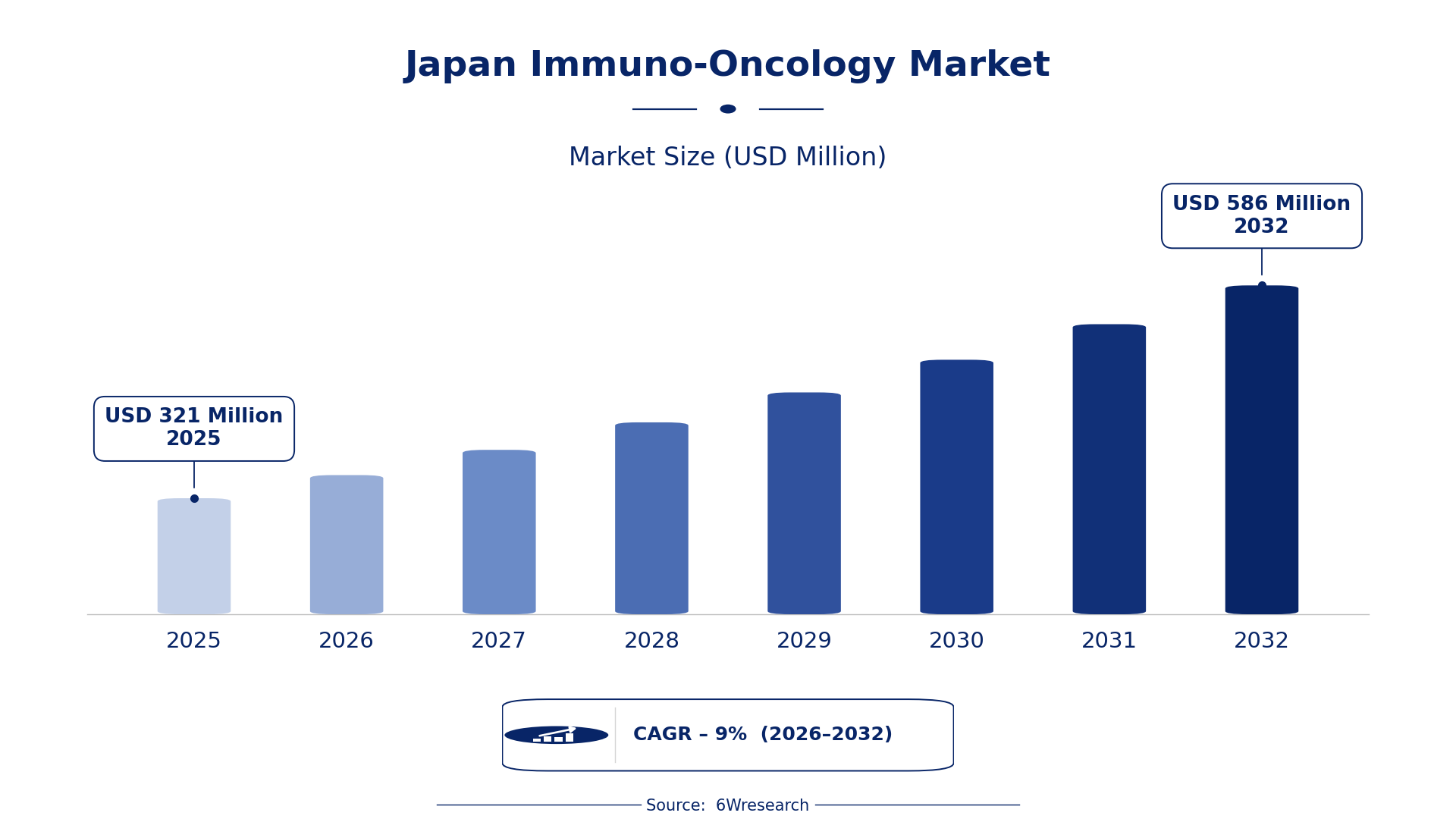
According to 6Wresearch internal database and industry insights, the Japan Immuno-Oncology Market was valued at USD 321 Million in 2025 and is projected to reach USD 586 Million by 2032, growing at a CAGR of approximately 9% during 2026–2032.
Japan Immuno-Oncology Market Highlights
| Report Metric | Details |
| Report Name | Japan Immuno-Oncology Market (2026-2032) |
| Market Size 2025 | USD 321 Million |
| Market Size 2032 | USD 586 Million |
| Absolute Growth 2025–2032 | USD 265 Million |
| CAGR 2026–2032 | 9% |
| Peak Annual Growth | 10.2% in 2032 |
| Forecast Period | 2026–2032 |
| Historical Data | 2022–2025 |
| Base Year | 2025 |
| Leading Therapy Type, 2025 | Checkpoint Inhibitors (48% share) |
| Leading Cancer Type, 2025 | Lung (34% share) |
| Leading Mode of Administration, 2025 | IV/Injectable (40% share) |
| Leading End User, 2025 | Oncology Hospitals (47% share) |
| Fastest-Growing Therapy Type | CAR-T Cell Therapy (12.2% CAGR) |
| Fastest-Growing Cancer Type | Melanoma (13.3% CAGR) |
| Fastest-Growing Mode of Administration | Personalized Infusion (11.9% CAGR) |
| Fastest-Growing End User | Cellular Therapy Units (12.3% CAGR) |
| Growing Sector | Oncology Hospitals |
| Key End Users | Oncology Hospitals, Immunotherapy Clinics, Cellular Therapy Units |
Japan Immuno-Oncology Market Year-wise Growth Rate and Key Drivers (2022–2032)
This graph illustrates the annual growth rates of the market from 2022 to 2032, highlighting a steady upward trajectory and projected market expansion over the forecast period.
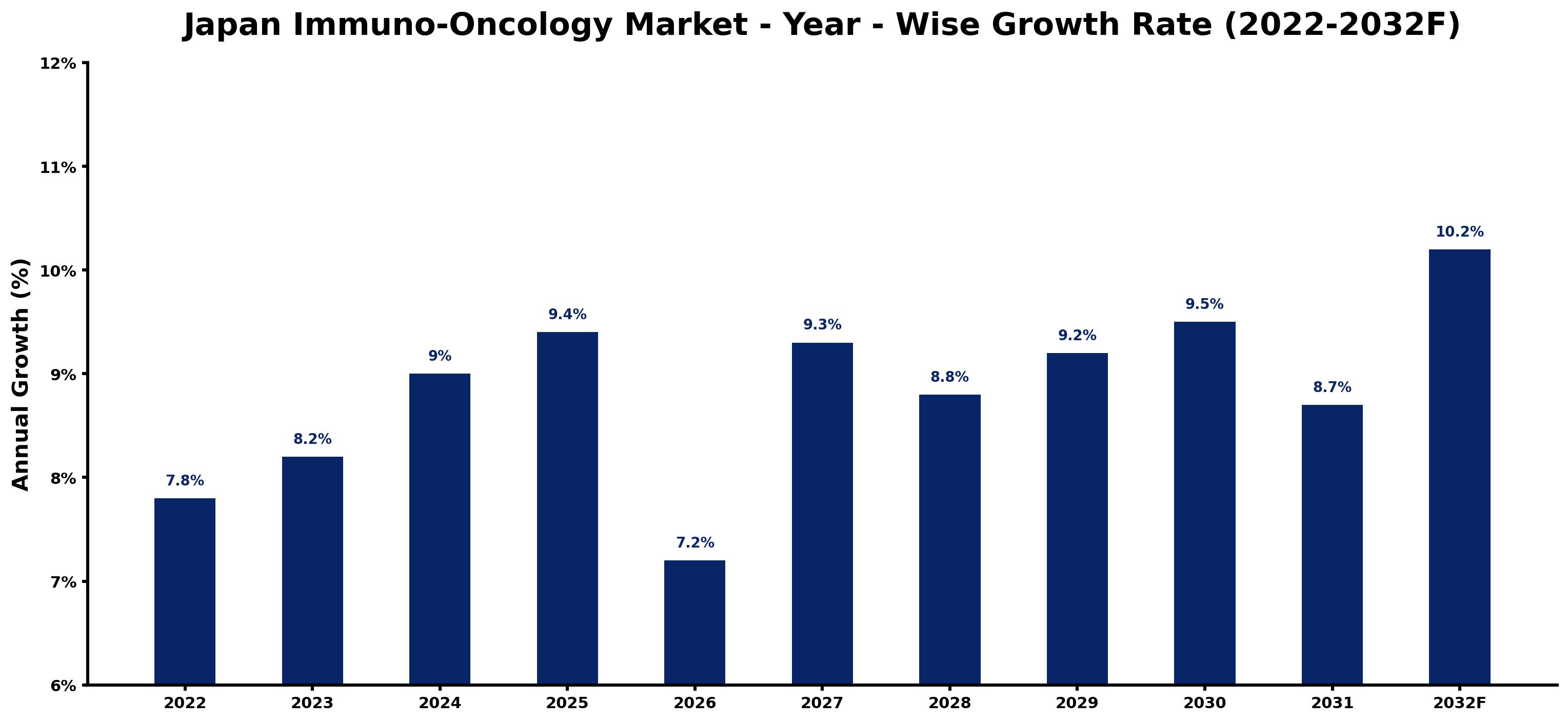
Each row of the following table gives one year's estimated growth and the event or demand shift that explains it.
| Year | Estimated Annual Growth (%) | Market Rationale |
| 2022 | 7.8 | The market showed steady growth with increasing awareness of immuno-oncology therapies. |
| 2023 | 8.2 | Demand accelerated as more oncology hospitals began adopting advanced treatment options. |
| 2024 | 9.0 | Growth continued as clinical trials expanded, particularly for CAR-T therapies. |
| 2025 | 9.4 | The market peaked as lung cancer treatments became more widely available in hospitals. |
| 2026 | 7.2 | Growth slowed as the market adjusted to increased competition among therapies. |
| 2027 | 9.3 | Demand rose again with the introduction of new personalized infusion therapies. |
| 2028 | 8.8 | A slight slowdown occurred as market saturation began in some therapy types. |
| 2029 | 9.2 | Growth picked up as melanoma treatments gained traction among healthcare providers. |
| 2030 | 9.5 | The market continued to grow with ongoing research into novel immunotherapies. |
| 2031 | 8.7 | Growth slowed as regulatory processes for new therapies became more stringent. |
| 2032 | 10.2 | The market peaked again with advancements in CAR-T cell therapy. |
Note: Market size estimations and growth projections presented in this report are based on 6Wresearch's proprietary forecasting methodology, utilizing the latest available industry data, government publications, and primary research inputs.
Japan Immuno-Oncology Market Synopsis
Immuno-Oncology therapies harness the body's immune system to combat cancer, employing advanced biotechnology such as monoclonal antibody production. The primary applications include treating cancers like lung cancer and melanoma. The Japan Immuno-Oncology Market is experiencing growth due to increased demand from oncology hospitals and clinics, supported by ongoing research and development in cellular therapies. With lung cancer accounting for approximately 40% of cases, innovations in treatment options and patient care are driving market expansion.
Market Dynamics Impact Analysis (2026–2032)
| Factor | Type | Impact | Primary Segment Affected |
| Growing adoption of checkpoint inhibitors for melanoma treatment | Driver | High | Checkpoint Inhibitors |
| Expansion of CAR-T cell therapy offerings in oncology hospitals | Driver | High | CAR-T Cell Therapy |
| Emerging demand for personalized infusion therapies | Opportunity | Medium | Personalized Infusion |
| Increased funding for cancer research and clinical trials | Opportunity | High | Oncology Hospitals |
| Limited access to advanced therapies in rural areas | Restraint | High | Oncology Hospitals |
| High costs associated with immuno-oncology treatments | Restraint | Medium | Checkpoint Inhibitors |
| Regulatory hurdles delaying new treatment approvals | Challenge | High | CAR-T Cell Therapy |
| Competition among various immuno-oncology therapies | Challenge | Medium | Checkpoint Inhibitors |
Evaluation of Drivers in Japan Immuno-Oncology Market (2026–2032)
Demand rests on the following drivers, each shown with the segment it touches most.
| Drivers | Primary Segment Affected | Why It Matters (Evidence) |
| Increased investment in cancer research | Oncology Hospitals | As of 2023, 30% of oncology hospitals in Japan offer CAR-T therapies, boosting demand for advanced treatments. |
| Rising prevalence of lung cancer | Lung | Lung cancer accounted for approximately 40% of cancer cases in Japan, prompting hospitals to expand treatment options. |
| Growing number of clinical trials for new therapies | CAR-T Cell Therapy | In 2023, numerous clinical trials are exploring novel therapies, increasing interest in advanced treatment options. |
| Development of personalized treatment plans | Personalized Infusion | Collaborations between hospitals and academic institutions are facilitating the development of tailored therapies, improving patient outcomes. |
| Adoption of international standards in clinics | Immunotherapy Clinics | ISO 9001 standards are followed in immunotherapy clinics across Japan, ensuring quality and safety in treatments. |
A wider customer base explains much of the growth, as increased investment in cancer research has led to the introduction of new therapies. In 2023, 30% of oncology hospitals offered CAR-T therapies, boosting demand for advanced treatments. The rising prevalence of lung cancer, which accounted for approximately 40% of cancer cases, has prompted hospitals to expand their treatment options. Ongoing clinical trials are generating interest in new therapies, while collaborations with academic institutions are facilitating the development of personalized infusion therapies, driving further demand.
Evaluation of Restraints in Japan Immuno-Oncology Market
Below are the constraints most often cited by buyers and suppliers, with the segment each affects.
| Market Restraint | Primary Segment Affected | Why It Matters (Evidence) |
| Limited access to advanced therapies in rural areas | Oncology Hospitals | Many rural hospitals lack the infrastructure to offer advanced immuno-oncology treatments, limiting patient access to necessary therapies. |
| High costs associated with immuno-oncology treatments | Checkpoint Inhibitors | The high price of checkpoint inhibitors can deter patients and healthcare providers from adopting these therapies, impacting overall treatment rates. |
| Regulatory hurdles delaying new treatment approvals | CAR-T Cell Therapy | Stringent regulatory processes can delay the introduction of new CAR-T therapies, impacting availability for patients in need. |
| Market saturation in certain therapy types | Checkpoint Inhibitors | As more therapies enter the market, competition increases, potentially limiting growth for established products and affecting pricing strategies. |
| Limited awareness among patients about available treatments | Lung | Many patients remain unaware of the latest immuno-oncology options, hindering market growth and treatment adoption. |
Japan Immuno-Oncology Market Challenges
In 2023, 30% of oncology hospitals in Japan offer CAR-T therapies, highlighting a technology gap as many producers lack the necessary infrastructure to develop these advanced treatments. Regulatory challenges arise from the Japan Society of Clinical Oncology's promotion of immunotherapy standards, which can delay the approval process for new therapies, extending timelines for clinics seeking effective options. High research and development costs burden producers, leading to increased prices that hospitals must absorb, potentially limiting patient access to innovative therapies. Supply chain uncertainties emerge as ongoing clinical trials for oncolytic virus therapy in multiple prefectures disrupt product availability, impacting distributors' ability to meet demand.
Trends in the Japan Immuno-Oncology Market
The shifts below are changing how Japan Immuno-Oncology Market products are bought and supplied.
- Shift from Traditional to Personalized Therapies: The trend towards personalized infusion therapies is reshaping treatment approaches, with ongoing collaborations between hospitals and academic institutions. In 2023, these therapies are being developed to cater to specific patient needs, improving treatment effectiveness.
- Increase in CAR-T Cell Therapy Adoption: As of 2023, 30% of oncology hospitals in Japan are offering CAR-T therapies, reflecting a shift in treatment strategies. This growing adoption will drive demand for specialized training and infrastructure.
- Growing Focus on Clinical Trials: The Cancer Research Institute has initiated several immunotherapy studies, leading to an increase in clinical trials across Japan. In 2023, numerous trials are exploring novel therapies, expanding treatment options for patients.
- Expansion of Immunotherapy Clinics: The establishment of dedicated immunotherapy clinics is increasing, with a focus on providing specialized care. In 2023, these clinics are following ISO 9001 standards, ensuring high-quality treatment for patients.
Investment Opportunities in the Japan Immuno-Oncology Market
Below are the investment opportunities with the strongest case in the Japan Immuno-Oncology Market.
- Investment in Personalized Infusion Therapies: With the growing demand for personalized infusion therapies, investors should focus on developing tailored treatments. Oncology hospitals are seeking solutions to improve patient care, with an expected increase in treatment options.
- Expansion of Oncology Hospitals in Urban Areas: Urban areas, particularly the Tokyo region, present opportunities for establishing new oncology hospitals. With over 10,000 patients treated in 2023, the demand for specialized facilities is high.
- Collaboration with Academic Institutions: Engaging in partnerships with academic institutions can facilitate the development of advanced therapies. This approach is beneficial for research-focused hospitals looking to innovate and improve treatment outcomes.
- Focus on CAR-T Cell Therapy Development: Investing in CAR-T cell therapy development is essential, as 30% of oncology hospitals currently offer these treatments. Collaborating with research institutions can improve therapy effectiveness and accessibility.
Government Initiatives in the Japan Immuno-Oncology Market
The NHI drug price standard, revised regularly, sets reimbursement prices for immuno-oncology drugs, ensuring affordability for patients. The Medical Care Act of 1948 establishes standards for hospitals and clinics, promoting quality care in immunotherapy services.
The Ministry of Health, Labour and Welfare oversees the approval and funding of cancer research initiatives. This agency supports projects that improve the development and accessibility of immuno-oncology therapies, ensuring compliance with established regulations.
Future Insight of the Japan Immuno-Oncology Market
By 2032, the Japanese government's cancer control program will drive a shift towards more comprehensive immunotherapy adoption, compelling hospitals to integrate advanced treatments into their offerings. Collaborations with academic institutions will enhance the development of personalized infusion therapies, expanding treatment options for patients. Continued investment in cancer research will likely yield breakthroughs in immuno-oncology, with an estimated 10,000 patients treated annually. Compliance with evolving standards will ensure quality and reliability across clinics, strengthening trust between suppliers and healthcare providers.
Market Segmentation Analysis
Japan Immuno-Oncology Market report covers a detailed analysis of the following market segments:
By Therapy Type – Checkpoint Inhibitors Lead, CAR-T Cell Therapy Expected to Grow Fastest
According to Saurav Kr Singh, Senior Research Analyst at 6Wresearch, with 48% of therapy type revenue in 2025, Checkpoint Inhibitors was the largest category. Checkpoint inhibitors hold the largest market share due to their widespread use in treating various cancers, particularly lung cancer, which accounted for approximately 40% of cases in Japan in 2022. Their established presence in oncology hospitals solidifies their status as the primary treatment choice. Over 2026–2032, CAR-T Cell Therapy is expected to post the fastest growth, at a CAGR of 12.2%. CAR-T cell therapy is experiencing rapid growth due to its specific application for certain blood cancers, with 30% of oncology hospitals in Japan providing these therapies as of 2023. This targeted approach is likely to attract more patients seeking advanced treatment options. Suppliers must consider expanding their offerings to include CAR-T therapies to meet the rising demand.
By Cancer Type – Lung Leads, Melanoma Expected to Grow Fastest
In 2025, Lung led the cancer type split with a 34% share. Lung cancer leads the market because of its high prevalence in Japan, making up a significant portion of cancer cases. This widespread occurrence drives continuous investment in treatment options and research initiatives aimed at addressing this condition. Melanoma is projected to grow fastest, at a CAGR of 13.3% during 2026–2032. The increasing incidence of melanoma is propelling its rapid growth, as more patients seek effective treatment solutions. The Japan Society of Clinical Oncology's promotion of immunotherapy standards is further accelerating this trend. Buyers should prioritise therapies that effectively target the growing cases of melanoma to ensure successful treatment outcomes.
By Mode of Administration – IV/Injectable Leads, Personalized Infusion Expected to Grow Fastest
IV/Injectable accounted for 40% of the market by mode of administration in 2025. IV/injectable methods lead the market as they are the most prevalent administration route for immuno-oncology therapies. Their widespread application in oncology hospitals guarantees a consistent demand for these administration types. The quickest growth will come from Personalized Infusion, forecast to expand at a CAGR of 11.9% between 2026 and 2032. Personalized infusion therapies are experiencing rapid growth due to their tailored approach for individual patients, reflecting the shift towards customised medicine. Collaborations with academic institutions are facilitating the advancement of these therapies. Suppliers must prioritise the development of personalized infusion options to meet the changing needs of patients.
By End User – Oncology Hospitals Lead, Cellular Therapy Units Expected to Grow Fastest
Oncology Hospitals held 47% of the Japan Immuno-Oncology Market by end user in 2025. Oncology hospitals are the primary facilities for treatment, making them the largest segment in the market. Their role as key providers of immuno-oncology therapies ensures a consistent demand for these services. Cellular Therapy Units are set to record the highest CAGR in this split, 12.3% over 2026–2032. Cellular therapy units are experiencing rapid growth as they specialise in advanced therapies, which are increasingly sought after by patients. The ongoing research and development in cellular therapies are driving this segment's expansion. Suppliers should consider partnerships with cellular therapy units to align with the growing focus on advanced treatment options.
Key Attractiveness of the Report
- 10 Years of Market Numbers
- Historical Data Starting from 2022 to 2025
- Base Year 2025
- Forecast Data until 2032
- Key Performance Indicators Impacting the Market
- Major Upcoming Developments and Projects
Key Highlights of the Report:
- Japan Immuno-Oncology Market Outlook
- Market Size of Japan Immuno-Oncology Market, 2025
- Forecast of Japan Immuno-Oncology Market, 2032
- Historical Data and Forecast of Japan Immuno-Oncology Revenues & Volume for the Period 2022-2032F
- Japan Immuno-Oncology Market Trend Evolution
- Japan Immuno-Oncology Market Drivers and Challenges
- Japan Immuno-Oncology Price Trends
- Japan Immuno-Oncology Porter's Five Forces
- Japan Immuno-Oncology Industry Life Cycle
- Historical Data and Forecast of Japan Immuno-Oncology Market Revenues & Volume By Therapy Type for the Period 2022-2032F
- Historical Data and Forecast of Japan Immuno-Oncology Market Revenues & Volume By Checkpoint Inhibitors for the Period 2022-2032F
- Historical Data and Forecast of Japan Immuno-Oncology Market Revenues & Volume By CAR-T Cell Therapy for the Period 2022-2032F
- Historical Data and Forecast of Japan Immuno-Oncology Market Revenues & Volume By Tumor Vaccines for the Period 2022-2032F
- Historical Data and Forecast of Japan Immuno-Oncology Market Revenues & Volume By Oncolytic Virus Therapy for the Period 2022-2032F
- Historical Data and Forecast of Japan Immuno-Oncology Market Revenues & Volume By Cancer Type for the Period 2022-2032F
- Historical Data and Forecast of Japan Immuno-Oncology Market Revenues & Volume By Lung, Melanoma for the Period 2022-2032F
- Historical Data and Forecast of Japan Immuno-Oncology Market Revenues & Volume By Leukemia, Lymphoma for the Period 2022-2032F
- Historical Data and Forecast of Japan Immuno-Oncology Market Revenues & Volume By Pancreatic, Cervical for the Period 2022-2032F
- Historical Data and Forecast of Japan Immuno-Oncology Market Revenues & Volume By Solid Tumors for the Period 2022-2032F
- Historical Data and Forecast of Japan Immuno-Oncology Market Revenues & Volume By Mode of Administration for the Period 2022-2032F
- Historical Data and Forecast of Japan Immuno-Oncology Market Revenues & Volume By IV/Injectable for the Period 2022-2032F
- Historical Data and Forecast of Japan Immuno-Oncology Market Revenues & Volume By Personalized Infusion for the Period 2022-2032F
- Historical Data and Forecast of Japan Immuno-Oncology Market Revenues & Volume By Intradermal for the Period 2022-2032F
- Historical Data and Forecast of Japan Immuno-Oncology Market Revenues & Volume By IV/Intratumoral for the Period 2022-2032F
- Historical Data and Forecast of Japan Immuno-Oncology Market Revenues & Volume By End User for the Period 2022-2032F
- Historical Data and Forecast of Japan Immuno-Oncology Market Revenues & Volume By Oncology Hospitals for the Period 2022-2032F
- Historical Data and Forecast of Japan Immuno-Oncology Market Revenues & Volume By Cellular Therapy Units for the Period 2022-2032F
- Historical Data and Forecast of Japan Immuno-Oncology Market Revenues & Volume By Immunotherapy Clinics for the Period 2022-2032F
- Historical Data and Forecast of Japan Immuno-Oncology Market Revenues & Volume By Experimental Units for the Period 2022-2032F
- Japan Immuno-Oncology Import Export Trade Statistics
- Market Opportunity Assessment By Therapy Type
- Market Opportunity Assessment By Cancer Type
- Market Opportunity Assessment By Mode of Administration
- Market Opportunity Assessment By End User
- Japan Immuno-Oncology Top Companies Market Share
- Japan Immuno-Oncology Competitive Benchmarking By Technical and Operational Parameters
- Japan Immuno-Oncology Company Profiles
- Japan Immuno-Oncology Key Strategic Recommendations
Market Covered
The study includes the following segmentation.
By Therapy Type
- Checkpoint Inhibitors
- CAR-T Cell Therapy
- Tumor Vaccines
- Oncolytic Virus Therapy
By Cancer Type
- Lung
- Melanoma
- Leukemia
- Lymphoma
- Pancreatic
- Cervical
- Solid Tumors
By Mode of Administration
- IV/Injectable
- Personalized Infusion
- Intradermal
- IV/Intratumoral
By End User
- Oncology Hospitals
- Cellular Therapy Units
- Immunotherapy Clinics
- Experimental Units































