Japan Immunoassay Testing Market Size & Growth Rate
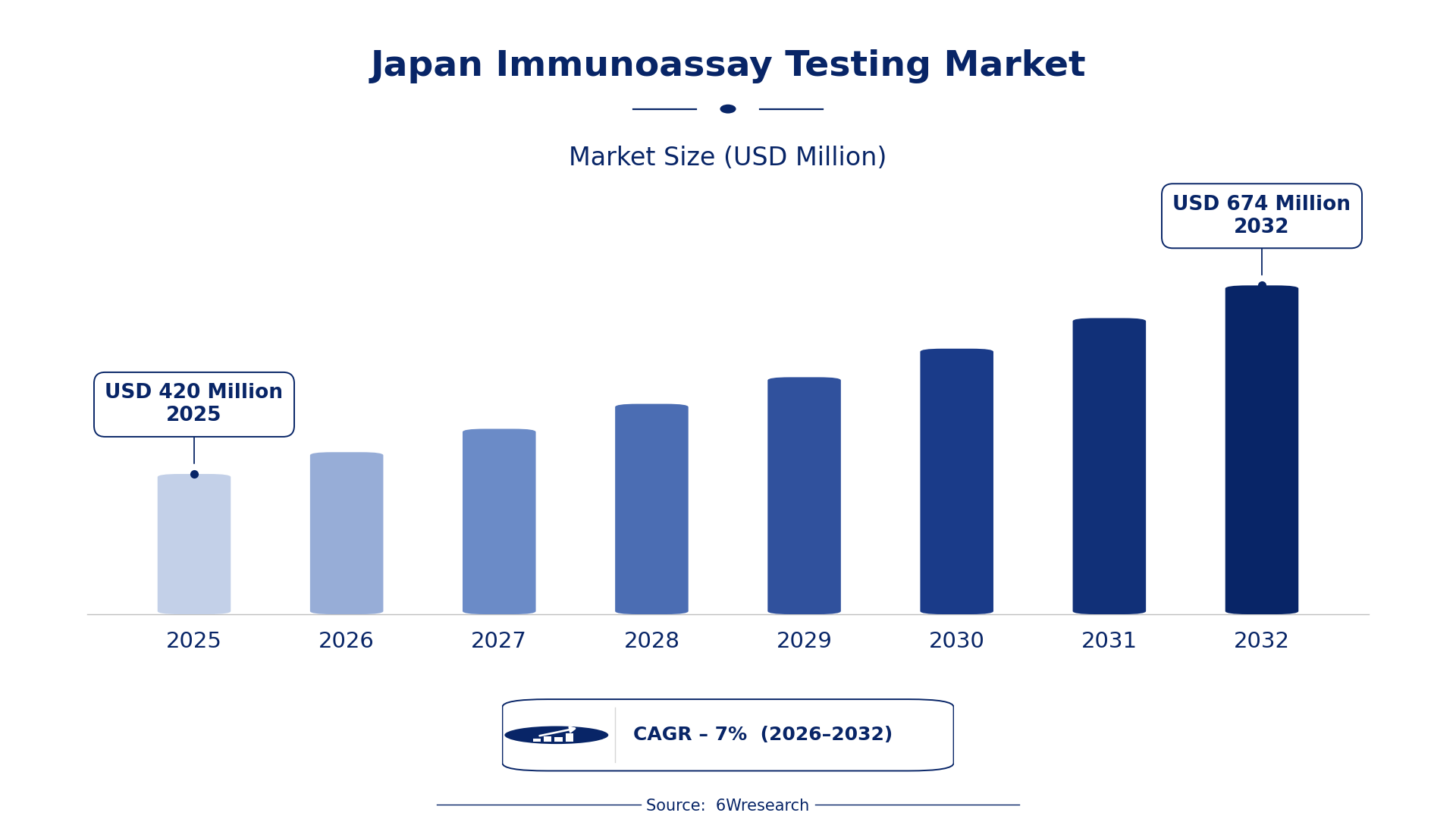
According to 6Wresearch internal database and industry insights, the Japan Immunoassay Testing Market was valued at USD 420 Million in 2025 and is projected to reach USD 674 Million by 2032, growing at a CAGR of approximately 7% during 2026–2032.
Japan Immunoassay Testing Market Highlights
| Report Metric | Details |
| Report Name | Japan Immunoassay Testing Market (2026-2032) |
| Market Size 2025 | USD 420 Million |
| Market Size 2032 | USD 674 Million |
| Absolute Growth 2025–2032 | USD 254 Million |
| CAGR 2026–2032 | 7% |
| Peak Annual Growth | 7.3% in 2030 |
| Forecast Period | 2026–2032 |
| Historical Data | 2022–2025 |
| Base Year | 2025 |
| Leading Test Type, 2025 | Antibody Testing (43% share) |
| Leading Sample Type, 2025 | Blood (49% share) |
| Leading Disease Focus, 2025 | COVID-19 (37% share) |
| Leading End User, 2025 | Hospitals (49% share) |
| Fastest-Growing Test Type | Antigen Testing (9.7% CAGR) |
| Fastest-Growing Sample Type | Serum (10.1% CAGR) |
| Fastest-Growing Disease Focus | HIV (9.4% CAGR) |
| Fastest-Growing End User | Diagnostic Labs (8.9% CAGR) |
| Growing Sector | Healthcare diagnostics |
| Key End Users | Hospitals, Diagnostic Labs, Endocrinology Clinics, Oncology Centers |
Japan Immunoassay Testing Market Year-wise Growth Rate and Key Drivers (2022–2032)
This graph illustrates the annual growth rates of the market from 2022 to 2032, highlighting a steady upward trajectory and projected market expansion over the forecast period.
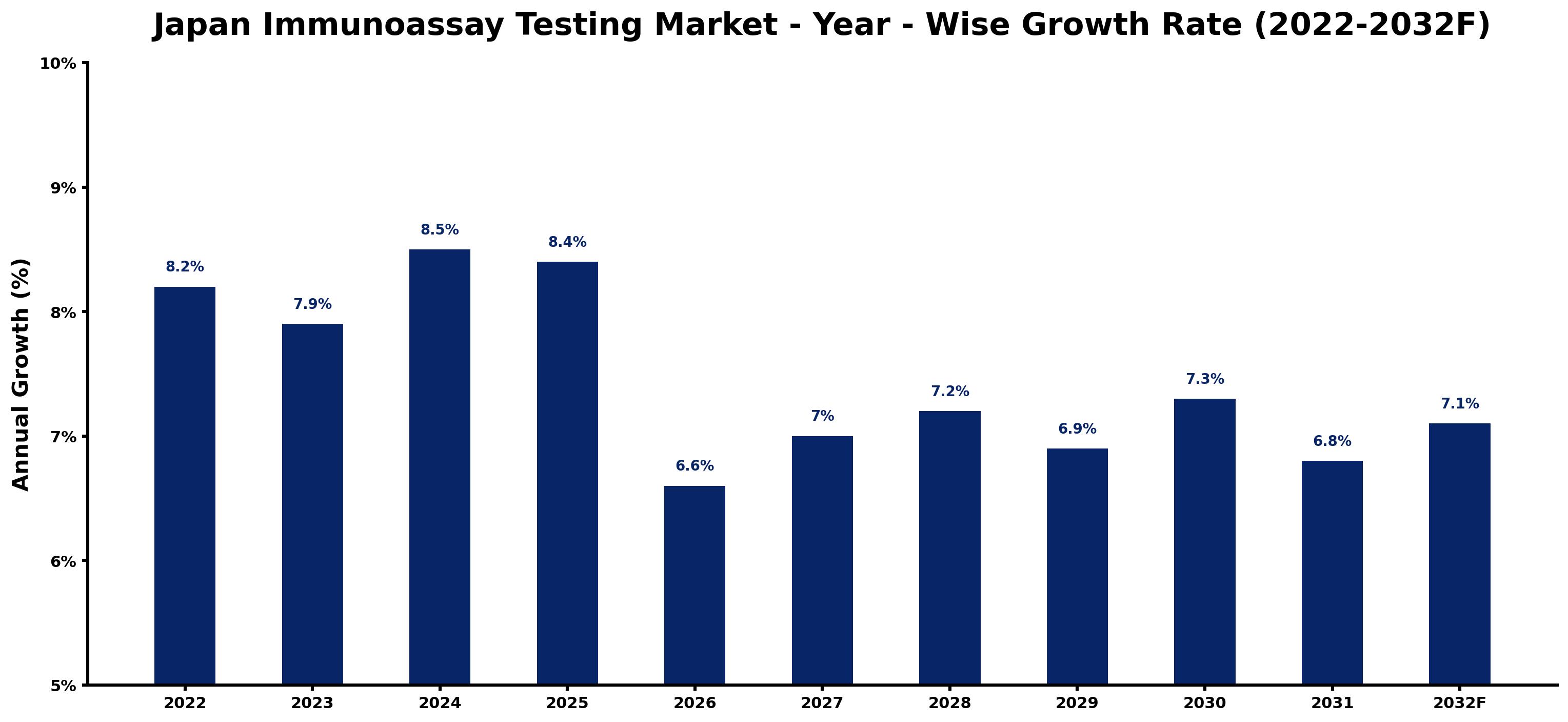
Below, each year's estimated growth is shown next to the factor that most influenced it.
| Year | Estimated Annual Growth (%) | Market Rationale |
| 2022 | 8.2 | The market experienced steady growth, driven by increased healthcare demand. |
| 2023 | 7.9 | Growth slowed slightly due to market adjustments and resource allocation. |
| 2024 | 8.5 | A surge in immunoassay tests for various diseases boosted growth rates. |
| 2025 | 8.4 | Growth moderated as hospitals adjusted to new testing protocols and demands. |
| 2026 | 6.6 | The market growth rate is expected to slow as demand stabilises following previous peaks. |
| 2027 | 7.0 | Increased requests for diagnostic tests will lead to a rise in growth rates. |
| 2028 | 7.2 | Growth is projected to accelerate with heightened focus on infectious disease testing. |
| 2029 | 6.9 | The market will experience a slight slowdown as demand begins to stabilise. |
| 2030 | 7.3 | Growth is expected to pick up again with advancements in testing technologies. |
| 2031 | 6.8 | The market is projected to see a slowdown as hospitals manage capacity and resources. |
| 2032 | 7.1 | Growth will resume as healthcare providers increase immunoassay testing. |
Note: Market size estimations and growth projections presented in this report are based on 6Wresearch's proprietary forecasting methodology, utilizing the latest available industry data, government publications, and primary research inputs.
Japan Immunoassay Testing Market Synopsis
Immunoassay testing identifies antibodies or antigens in samples, primarily for diagnosing diseases and monitoring health conditions. The Japan Immunoassay Testing Market is growing due to a rising population and increased testing for infectious diseases. In 2023, over 1 million immunoassay tests were conducted, reflecting strong demand from hospitals and diagnostic labs. Advancements in diagnostic technologies further propel this growth, positioning the market for continued expansion.
Market Dynamics Impact Analysis (2026–2032)
| Factor | Type | Impact | Primary Segment Affected |
| Increased healthcare demand due to population growth | Driver | High | Antibody Testing |
| Rising prevalence of infectious diseases driving testing needs | Driver | High | Antigen Testing |
| Investment in cancer detection programs creating opportunities | Opportunity | High | Tumor Marker Tests |
| Growing demand for hormone assays in endocrinology clinics | Opportunity | Medium | Hormone Assays |
| High costs associated with advanced testing equipment | Restraint | High | Antibody Testing |
| Strict regulatory requirements for testing procedures | Restraint | Medium | Antibody Testing |
| Limited access to advanced diagnostic technologies in rural areas | Challenge | High | Antibody Testing |
| Competition among diagnostic labs affecting pricing strategies | Challenge | Medium | Diagnostic Labs |
Evaluation of Drivers in Japan Immunoassay Testing Market (2026–2032)
These are the developments adding the most demand over the forecast period.
| Drivers | Primary Segment Affected | Why It Matters (Evidence) |
| Growing patient turnover in hospitals | Antibody Testing | The average patient turnover of around 80 patients per day drives demand for immunoassay tests in hospitals. |
| Increased focus on infectious disease testing | Antigen Testing | The rise in infectious diseases has led to higher testing volumes, particularly for rapid tests. |
| Research initiatives by the National Cancer Center | Tumor Marker Tests | Extensive research funded by the National Cancer Center is increasing the demand for cancer-related tests. |
| Rising requests for hormone assays in endocrinology | Hormone Assays | Endocrinology clinics report a surge in hormone assay requests, particularly for thyroid tests. |
| Implementation of the JIS Z 8801 standard | Antibody Testing | The JIS Z 8801 standard ensures quality and reliability, boosting confidence in immunoassay testing. |
Much of the new demand stems from the increasing patient turnover in hospitals, with an average of 80 patients per day driving the need for immunoassay tests. The rise in infectious diseases has led to heightened testing volumes, particularly for rapid antigen tests. The implementation of the JIS Z 8801 standard improves the reliability of testing, encouraging hospitals and diagnostic labs to invest in immunoassay technologies.
Evaluation of Restraints in Japan Immunoassay Testing Market
Below are the constraints most often cited by buyers and suppliers, with the segment each affects.
| Market Restraint | Primary Segment Affected | Why It Matters (Evidence) |
| High costs associated with advanced diagnostic equipment | Hospitals | The installed base of over 10,000 diagnostic units in hospitals creates financial pressure on procurement. |
| Strict regulatory requirements for testing procedures | Antibody Testing | Compliance with regulations can delay testing implementation, impacting timely diagnosis. |
| Limited access to advanced diagnostic technologies in rural areas | Hospitals | Rural hospitals face challenges in acquiring the latest immunoassay testing technologies. |
| Competition among diagnostic labs affecting pricing strategies | Diagnostic Labs | Intense competition can lead to price wars, impacting profitability for diagnostic labs. |
| Dependence on skilled personnel for testing accuracy | Antibody Testing | A shortage of trained technicians can hinder the efficiency of immunoassay testing. |
Japan Immunoassay Testing Market Challenges
Hospitals face rising testing costs due to reliance on imported reagents, inflating expenses by 20%. Diagnostic labs encounter strict regulations, causing test approval delays that can extend by three months. Increased patient turnover, averaging 80 patients daily, pressures buyers as demand for immunoassay tests exceeds supply capabilities. Intense competition among diagnostic labs in Tokyo and Osaka leads to price wars, eroding profit margins for producers and limiting their ability to invest in new technologies.
Trends in the Japan Immunoassay Testing Market
Several trends are reshaping the Japan Immunoassay Testing Market; the most important are set out below.
- Shift from Traditional to Automated Immunoassay Testing: The National Institute of Infectious Diseases is promoting automated immunoassay testing, with over 1 million tests conducted in 2023. This shift improves efficiency and accuracy for diagnostic labs.
- Increase in Point-of-Care Testing: In 2023, the demand for point-of-care immunoassay tests rose significantly, with hospitals adopting rapid testing methods. This trend allows for quicker diagnosis and treatment decisions.
- Growing Focus on Cancer Detection: The government allocated ¥500 million for cancer detection programs in 2023, driving interest in tumor marker tests. This funding supports research and development in oncology diagnostics.
- Expansion of Hormone Assays in Endocrinology: Endocrinology clinics are increasingly requesting hormone assays, particularly thyroid tests, reflecting a shift in patient needs. This growth is supported by rising awareness of hormonal health.
Investment Opportunities in the Japan Immunoassay Testing Market
Investors looking at the Japan Immunoassay Testing Market should consider the following areas.
- Joint Ventures with Local Diagnostic Labs: Now is an ideal time for partnerships with local diagnostic labs, especially in Tokyo and Osaka, where demand is high. Collaborating can facilitate market entry and expand service offerings.
- Investment in Cancer Detection Technologies: With ¥500 million allocated for cancer detection programs, there is a significant opportunity to invest in advanced testing technologies. Targeting oncology centers can yield substantial returns.
- Expansion of Point-of-Care Testing Facilities: The demand for point-of-care testing is increasing, with hospitals seeking rapid testing solutions. Establishing facilities in urban areas can effectively meet this growing need.
- Development of Automated Testing Solutions: The trend towards automation in immunoassay testing offers a gap for innovative solutions. Focusing on technology development can position suppliers favourably in the market.
Government Initiatives in the Japan Immunoassay Testing Market
The Medical Care Act of 1948 sets standards for hospitals and clinics, including staffing and facilities, ensuring quality in immunoassay testing. The Clinical Trials Act of 2017 established rules for conducting clinical research, improving the reliability of test results and promoting innovation in testing methods.
The Pharmaceuticals and Medical Devices Agency (PMDA) reviews medical devices and monitors post-market safety, ensuring that immunoassay tests meet regulatory standards. The Japan Agency for Medical Research and Development (AMED) funds research initiatives, including those focused on cancer detection, promoting advancements in immunoassay technologies.
Future Insight of the Japan Immunoassay Testing Market
Hospitals will see changes by 2032, as patient turnover increases and demand for immunoassay tests rises. Advancements in automated immunoassay systems will improve efficiency, allowing facilities to process tests more quickly. Enhanced cancer detection programmes will provide better early diagnosis options for patients. With the government allocating ¥500 million for these initiatives, suppliers must adapt to meet the evolving needs of healthcare professionals.
Market Segmentation Analysis
Japan Immunoassay Testing Market report covers a detailed analysis of the following market segments:
By Test Type – Antibody Testing Leads, Antigen Testing Expected to Grow Fastest
According to Saurav Kr Singh, Senior Research Analyst at 6Wresearch, Antibody Testing accounted for 43% of the market by test type in 2025. Antibody testing holds the largest share due to its extensive application in detecting specific antibodies related to infections, particularly in hospitals where over 1 million tests are conducted annually. This widespread use underscores its critical role in patient diagnostics and health monitoring. The quickest growth will come from Antigen Testing, forecast to expand at a CAGR of 9.7% between 2026 and 2032. Antigen testing is experiencing rapid growth as it enables quick detection of pathogens, which is vital during health emergencies. The increasing emphasis on timely results in diagnostic labs is propelling this segment's expansion. Suppliers should enhance their antigen testing offerings to address the growing demand in the market.
By Sample Type – Blood Leads, Serum Expected to Grow Fastest
The largest sample type category in 2025 was Blood, at 49% of revenue. Blood is the primary sample type for various immunoassays, making it the most widely used in hospitals and diagnostic labs throughout Japan. Its established role in testing procedures ensures a strong and consistent demand. Serum is set to record the highest CAGR in this split, 10.1% over 2026–2032. Serum is gaining traction as a commonly used sample type for testing, particularly in specialised diagnostics. The versatility of serum in various tests contributes to its rapid adoption in clinical settings. Buyers may benefit from sourcing serum-based testing solutions to align with evolving testing preferences.
By Disease Focus – COVID-19 Leads, HIV Expected to Grow Fastest
COVID-19 took 37% of disease focus revenue in 2025, more than any other category. COVID-19 testing is the leading focus area as it is essential for diagnosing current infections, especially in light of recent public health challenges. The urgent requirement for accurate and efficient testing has solidified its dominant position in the market. HIV is projected to grow fastest, at a CAGR of 9.4% during 2026–2032. HIV testing is witnessing robust growth as it is crucial for screening and diagnosis, particularly in hospitals where testing is mandated. This trend highlights a growing emphasis on infectious disease management within healthcare settings. Suppliers should prioritise HIV testing solutions to capitalise on the increasing focus on this area in healthcare.
By End User – Hospitals Lead, Diagnostic Labs Expected to Grow Fastest
Hospitals held 49% of the Japan Immunoassay Testing Market by end user in 2025. Hospitals are the primary end-users of immunoassay tests, relying heavily on them for patient diagnosis and health monitoring. With over 10,000 units of diagnostic equipment installed, hospitals represent a consistent demand source for these tests. Over 2026–2032, Diagnostic Labs are expected to post the fastest growth, at a CAGR of 8.9%. Diagnostic labs are rapidly emerging as key users of a diverse range of tests, driven by the need for specialised and timely diagnostics. Their expanding role in healthcare suggests a sustained increase in demand for immunoassay testing. Suppliers should strategically target diagnostic labs to capture the growing market segment.
Key Attractiveness of the Report
- 10 Years of Market Numbers
- Historical Data Starting from 2022 to 2025
- Base Year 2025
- Forecast Data until 2032
- Key Performance Indicators Impacting the Market
- Major Upcoming Developments and Projects
Key Highlights of the Report:
- Japan Immunoassay Testing Market Outlook
- Market Size of Japan Immunoassay Testing Market, 2025
- Forecast of Japan Immunoassay Testing Market, 2032
- Historical Data and Forecast of Japan Immunoassay Testing Revenues & Volume for the Period 2022-2032F
- Japan Immunoassay Testing Market Trend Evolution
- Japan Immunoassay Testing Market Drivers and Challenges
- Japan Immunoassay Testing Price Trends
- Japan Immunoassay Testing Porter's Five Forces
- Japan Immunoassay Testing Industry Life Cycle
- Historical Data and Forecast of Japan Immunoassay Testing Market Revenues & Volume By Test Type for the Period 2022-2032F
- Historical Data and Forecast of Japan Immunoassay Testing Market Revenues & Volume By Antibody Testing for the Period 2022-2032F
- Historical Data and Forecast of Japan Immunoassay Testing Market Revenues & Volume By Antigen Testing for the Period 2022-2032F
- Historical Data and Forecast of Japan Immunoassay Testing Market Revenues & Volume By Hormone Assays for the Period 2022-2032F
- Historical Data and Forecast of Japan Immunoassay Testing Market Revenues & Volume By Tumor Marker Tests for the Period 2022-2032F
- Historical Data and Forecast of Japan Immunoassay Testing Market Revenues & Volume By Sample Type for the Period 2022-2032F
- Historical Data and Forecast of Japan Immunoassay Testing Market Revenues & Volume By Blood, Serum for the Period 2022-2032F
- Historical Data and Forecast of Japan Immunoassay Testing Market Revenues & Volume By Swab, Blood for the Period 2022-2032F
- Historical Data and Forecast of Japan Immunoassay Testing Market Revenues & Volume By Blood, Saliva for the Period 2022-2032F
- Historical Data and Forecast of Japan Immunoassay Testing Market Revenues & Volume By Serum for the Period 2022-2032F
- Historical Data and Forecast of Japan Immunoassay Testing Market Revenues & Volume By Disease Focus for the Period 2022-2032F
- Historical Data and Forecast of Japan Immunoassay Testing Market Revenues & Volume By COVID-19, HIV for the Period 2022-2032F
- Historical Data and Forecast of Japan Immunoassay Testing Market Revenues & Volume By Influenza, Hepatitis for the Period 2022-2032F
- Historical Data and Forecast of Japan Immunoassay Testing Market Revenues & Volume By Thyroid, Reproductive for the Period 2022-2032F
- Historical Data and Forecast of Japan Immunoassay Testing Market Revenues & Volume By Cancer Detection for the Period 2022-2032F
- Historical Data and Forecast of Japan Immunoassay Testing Market Revenues & Volume By End User for the Period 2022-2032F
- Historical Data and Forecast of Japan Immunoassay Testing Market Revenues & Volume By Hospitals for the Period 2022-2032F
- Historical Data and Forecast of Japan Immunoassay Testing Market Revenues & Volume By Diagnostic Labs for the Period 2022-2032F
- Historical Data and Forecast of Japan Immunoassay Testing Market Revenues & Volume By Endocrinology Clinics for the Period 2022-2032F
- Historical Data and Forecast of Japan Immunoassay Testing Market Revenues & Volume By Oncology Centers for the Period 2022-2032F
- Japan Immunoassay Testing Import Export Trade Statistics
- Market Opportunity Assessment By Test Type
- Market Opportunity Assessment By Sample Type
- Market Opportunity Assessment By Disease Focus
- Market Opportunity Assessment By End User
- Japan Immunoassay Testing Top Companies Market Share
- Japan Immunoassay Testing Competitive Benchmarking By Technical and Operational Parameters
- Japan Immunoassay Testing Company Profiles
- Japan Immunoassay Testing Key Strategic Recommendations
Market Covered
Segments analysed in this report are listed below.
By Test Type
- Antibody Testing
- Antigen Testing
- Hormone Assays
- Tumor Marker Tests
By Sample Type
- Blood
- Serum
- Swab
- Saliva
By Disease Focus
- COVID-19
- HIV
- Influenza
- Hepatitis
- Thyroid
- Reproductive
- Cancer Detection
By End User
- Hospitals
- Diagnostic Labs
- Endocrinology Clinics
- Oncology Centers































