Japan Immunoglobulin Therapy Market Size & Growth Rate
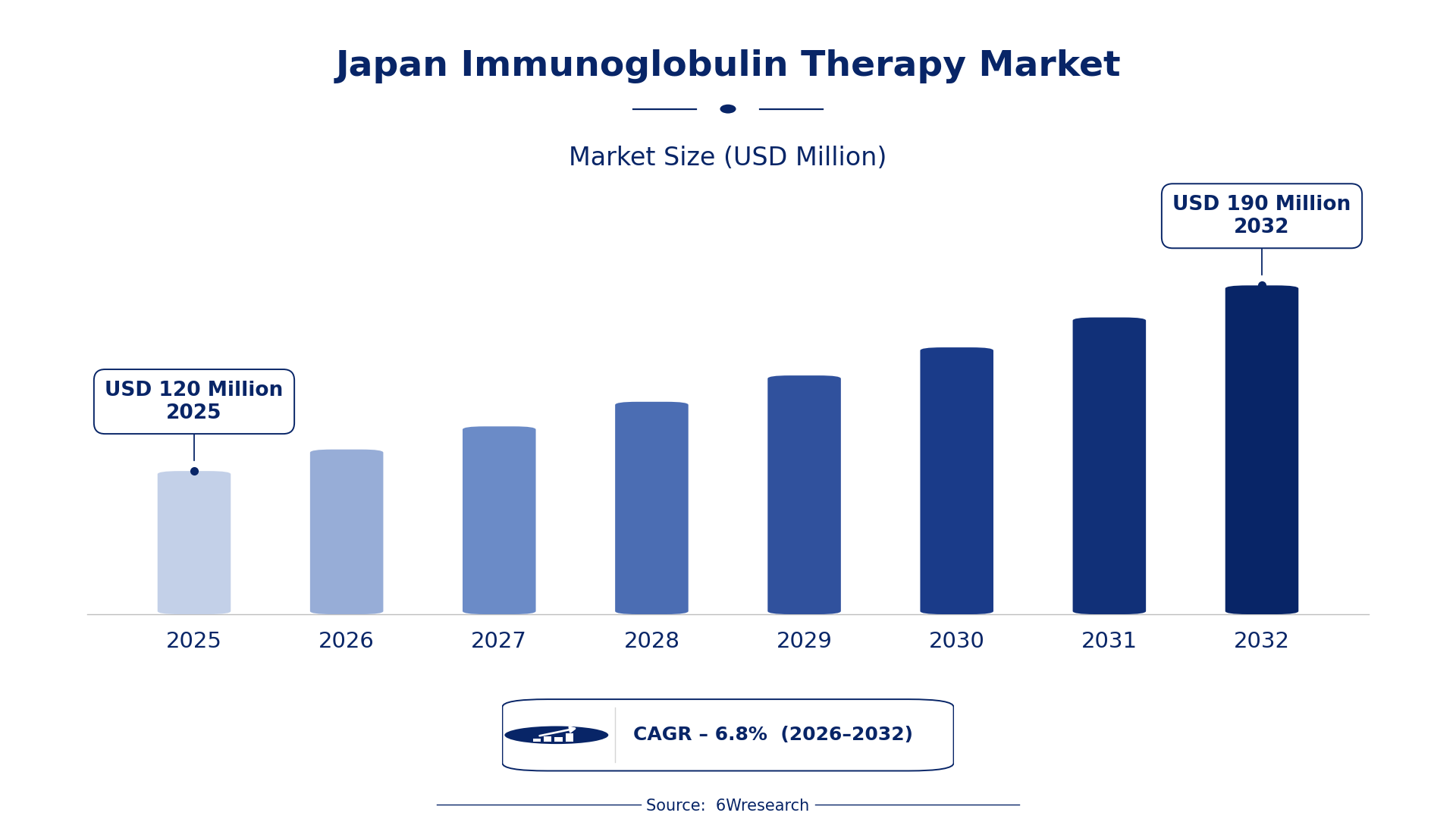
According to 6Wresearch internal database and industry insights, the Japan Immunoglobulin Therapy Market was valued at USD 120 Million in 2025 and is projected to reach USD 190 Million by 2032, growing at a CAGR of approximately 6.8% during 2026–2032.
Japan Immunoglobulin Therapy Market Highlights
| Report Metric | Details |
| Report Name | Japan Immunoglobulin Therapy Market (2026-2032) |
| Market Size 2025 | USD 120 Million |
| Market Size 2032 | USD 190 Million |
| Absolute Growth 2025–2032 | USD 70 Million |
| CAGR 2026–2032 | 6.8% |
| Peak Annual Growth | 7.6% in 2028 |
| Forecast Period | 2026–2032 |
| Historical Data | 2022–2025 |
| Base Year | 2025 |
| Leading Therapy Type, 2025 | IVIG (41% share) |
| Leading Source Type, 2025 | Human Plasma Derived (36% share) |
| Leading Route of Administration, 2025 | Intravenous (49% share) |
| Leading End User, 2025 | Tertiary Hospitals (42% share) |
| Fastest-Growing Therapy Type | SCIG (9.0% CAGR) |
| Fastest-Growing Source Type | Subcutaneous (9.4% CAGR) |
| Fastest-Growing Route of Administration | Home/Outpatient Setting (8.9% CAGR) |
| Fastest-Growing End User | Specialty Pharmacies (9.1% CAGR) |
| Growing Sector | Specialty Pharmacies |
| Key End Users | Tertiary Hospitals, Specialty Pharmacies, Transplant Centers, Clinical Research Sites |
Japan Immunoglobulin Therapy Market Year-wise Growth Rate and Key Drivers (2022–2032)
This graph illustrates the annual growth rates of the market from 2022 to 2032, highlighting a steady upward trajectory and projected market expansion over the forecast period.
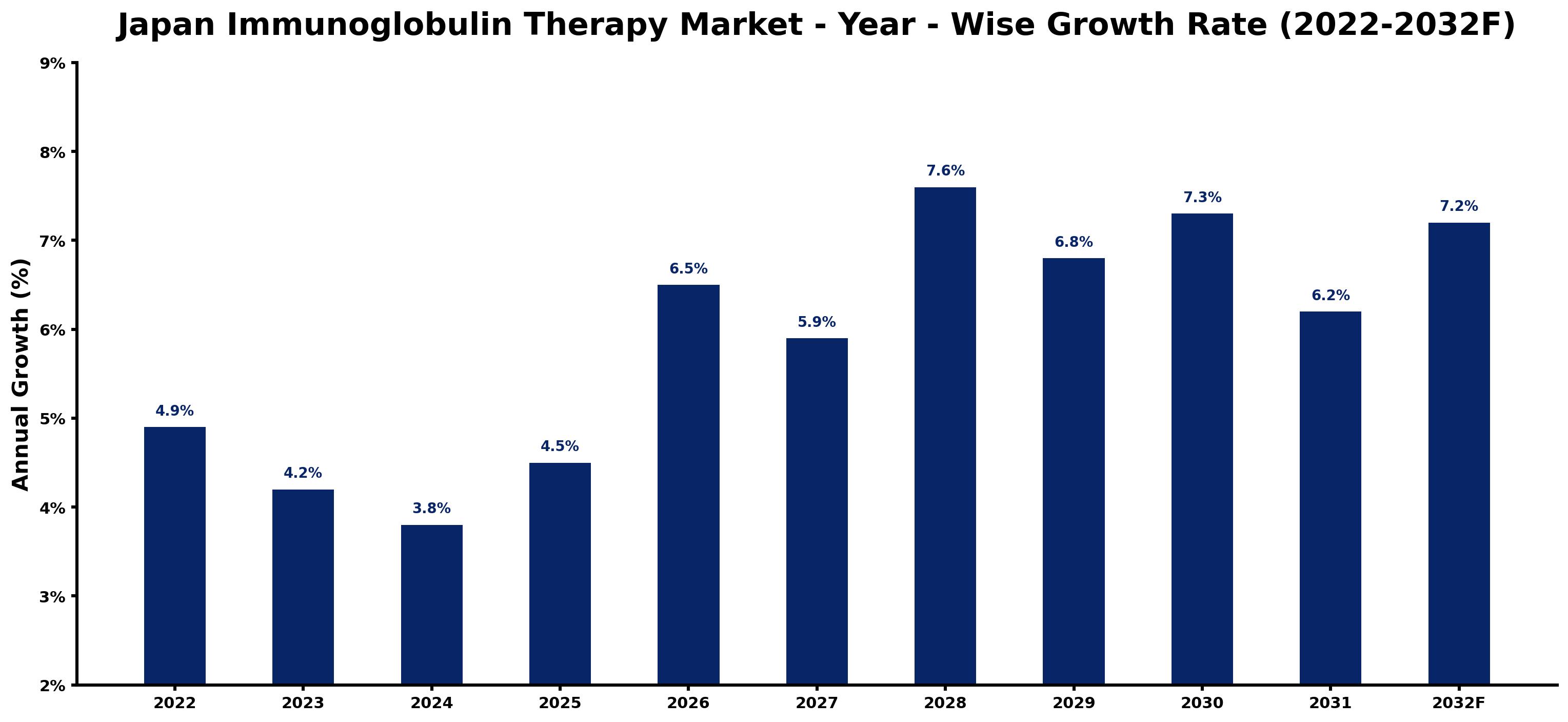
Below, each year's estimated growth is shown next to the factor that most influenced it.
| Year | Estimated Annual Growth (%) | Market Rationale |
| 2022 | 4.9 | The market experienced steady growth, reflecting strong demand from hospitals. |
| 2023 | 4.2 | Growth slowed slightly as hospitals adjusted to supply chain challenges. |
| 2024 | 3.8 | Continued adjustments in supply chains contributed to a further slowdown in growth. |
| 2025 | 4.5 | Demand increased as hospitals expanded immunoglobulin therapy offerings. |
| 2026 | 6.5 | Growth accelerated due to rising patient numbers and treatment options. |
| 2027 | 5.9 | A slight slowdown occurred as market conditions stabilised post-2026. |
| 2028 | 7.6 | Demand surged with new treatment protocols and increased patient access. |
| 2029 | 6.8 | Growth moderated as the market adjusted to higher supply levels. |
| 2030 | 7.3 | Demand rose again as outpatient settings gained popularity for treatments. |
| 2031 | 6.2 | Growth slowed as the market stabilised after rapid expansions. |
| 2032 | 7.2 | A renewed push for immunoglobulin therapies is expected to drive growth. |
Note: Market size estimations and growth projections presented in this report are based on 6Wresearch's proprietary forecasting methodology, utilizing the latest available industry data, government publications, and primary research inputs.
Japan Immunoglobulin Therapy Market Synopsis
Immunoglobulin therapy utilises antibodies from human plasma to treat immune deficiencies and autoimmune disorders. The Japan Immunoglobulin Therapy Market is set for growth, driven by approximately 10,000 individuals with primary immunodeficiency and over 100 tertiary hospitals employing these therapies. An ageing population and a growing preference for outpatient settings are increasing the demand for immunoglobulin therapies nationwide, with over 30,000 patients treated each year.
Market Dynamics Impact Analysis (2026–2032)
| Factor | Type | Impact | Primary Segment Affected |
| Increasing patient population with primary immunodeficiency drives demand for immunoglobulin therapy. | Driver | High | IVIG |
| Growing preference for subcutaneous administration enhances patient convenience and adherence. | Driver | High | SCIG |
| Expansion of specialty pharmacies increases distribution channels for immunoglobulin products. | Opportunity | High | Specialty Pharmacies |
| Clinical trials for emerging therapies present opportunities for new treatment options. | Opportunity | Medium | Recombinant Ig Therapy |
| High costs associated with immunoglobulin therapy can limit access for some patients. | Restraint | High | IVIG |
| Supply chain disruptions can affect the availability of immunoglobulin products. | Restraint | Medium | Human Plasma Derived |
| Limited production capacity can restrict the growth potential of the market. | Challenge | High | IVIG |
| Competition from alternative therapies may impact market share for immunoglobulin products. | Challenge | Medium | SCIG |
Evaluation of Drivers in Japan Immunoglobulin Therapy Market (2026–2032)
Key forces behind demand, with the segment each one moves most, are listed below.
| Drivers | Primary Segment Affected | Why It Matters (Evidence) |
| Growing awareness of immunodeficiency disorders increases patient referrals for treatment. | IVIG | The estimated 10,000 individuals in Japan with primary immunodeficiency require consistent therapy. |
| Rising preference for home administration of therapies increases patient compliance. | SCIG | Over 20% of patients opted for subcutaneous immunoglobulin therapy in 2023. |
| Expansion of healthcare facilities increases access to immunoglobulin therapies. | Human Plasma Derived | More than 100 tertiary hospitals in Japan are utilising immunoglobulin therapy. |
| Increased funding for clinical research supports the development of new therapies. | Recombinant Ig Therapy | The government allocated ¥1 billion for research on immunoglobulin therapies in 2023. |
| Inclusion of immunoglobulin therapy in national health insurance broadens patient access. | Hyperimmune Globulins | This coverage allows patients to afford necessary treatments. |
Volumes grow on the back of an increasing patient population, with approximately 30,000 patients treated annually in Japan. The average annual expenditure on immunoglobulin therapy per patient is around ¥1 million, highlighting the financial commitment needed for treatment. Specialty pharmacies, which account for 40% of distribution, are improving access to these therapies. The growing preference for subcutaneous administration is driving demand, with over 20% of patients opting for this method in 2023. Clinical research funding, with ¥1 billion allocated in 2023, supports the development of new therapies, further stimulating market growth.
Evaluation of Restraints in Japan Immunoglobulin Therapy Market
Below are the constraints most often cited by buyers and suppliers, with the segment each affects.
| Market Restraint | Primary Segment Affected | Why It Matters (Evidence) |
| High costs associated with immunoglobulin therapy can limit patient access. | IVIG | The average annual expenditure of ¥1 million per patient poses financial challenges. |
| Supply chain disruptions can affect the availability of immunoglobulin products. | Human Plasma Derived | Recent global supply chain issues have impacted product availability. |
| Limited production capacity can restrict the growth potential of the market. | IVIG | Production challenges can lead to shortages in supply for hospitals. |
| Regulatory hurdles can delay the introduction of new therapies. | Recombinant Ig Therapy | Clinical Trials Act requirements may prolong the approval process. |
| Competition from alternative therapies may impact market share for immunoglobulin products. | SCIG | Emerging therapies could divert patients from traditional immunoglobulin treatments. |
Japan Immunoglobulin Therapy Market Challenges
A key challenge in immunoglobulin therapy is the dependence on outdated production technology, which reduces efficiency and raises costs for hospitals. Regulatory obstacles from the Pharmaceutical and Medical Device Agency delay approvals for new therapies, limiting access for over 30,000 patients each year. Compliance with JIS standards raises operational costs, affecting pricing strategies for specialty pharmacies that manage 40% of distribution. Disruptions in the plasma collection supply chain can cause significant delays, impacting the availability of therapies for buyers, particularly in outpatient settings.
Trends in the Japan Immunoglobulin Therapy Market
The trends below show where the Japan Immunoglobulin Therapy Market is heading.
- Shift from Hospital to Outpatient Settings: Since 2023, there has been a notable shift towards outpatient settings for immunoglobulin therapy. Over 30,000 patients are treated annually, with a projected 15% increase in outpatient use by 2025, improving convenience for patients.
- Increasing Adoption of Subcutaneous Immunoglobulin Therapy: The trend towards subcutaneous immunoglobulin therapy began gaining traction in 2023, with over 20% of patients opting for this method. This shift allows for greater patient autonomy and comfort in managing their treatments.
- Growth in Clinical Research Initiatives: The Japanese Society for Immunology launched a new research initiative in 2023, focusing on advancing immunoglobulin therapies. This initiative aims to improve treatment options and patient outcomes, reflecting a commitment to innovation.
- Expansion of Specialty Pharmacy Networks: Specialty pharmacies have become increasingly important in the distribution of immunoglobulin products, accounting for 40% of the market. This growth facilitates better access to therapies for patients across Japan.
Investment Opportunities in the Japan Immunoglobulin Therapy Market
The following areas offer the clearest openings for investors and suppliers in the Japan Immunoglobulin Therapy Market.
- Investment in Home Administration Solutions: The rising preference for home administration of therapies presents an opportunity to invest in subcutaneous immunoglobulin products, with over 20% of patients opting for this method in 2023. Collaborating with specialty pharmacies can facilitate market entry.
- Development of Recombinant Ig Therapies: With ongoing clinical trials for recombinant Ig therapies, there is an opportunity to invest in this emerging area. The government’s ¥1 billion funding for research supports advancements in treatment options.
- Expansion of Tertiary Hospital Networks: Investing in immunoglobulin therapy solutions for tertiary hospitals is promising, as over 100 hospitals currently utilise these therapies. Establishing partnerships with healthcare providers can strengthen market presence.
- Focus on Clinical Research Funding: The government’s allocation of ¥1 billion for immunoglobulin therapy research highlights the need for new solutions. Engaging with clinical research sites can lead to fresh developments and increased market share.
Government Initiatives in the Japan Immunoglobulin Therapy Market
The Pharmaceutical and Medical Device Agency (PMDA) regulates immunoglobulin therapy, ensuring that products meet safety and efficacy standards. The agency's thorough approval process helps maintain quality in the market, impacting producers and buyers alike. In 2023, the government allocated ¥1 billion for research on immunoglobulin therapies, supporting advancements in treatment options.
The Ministry of Health, Labour and Welfare (MHLW) implements the National Health Insurance (NHI) drug price standard, which sets reimbursement prices for immunoglobulin therapies. This framework ensures that patients have access to necessary treatments while providing a stable pricing environment for producers.
Future Insight of the Japan Immunoglobulin Therapy Market
Clinics will experience a notable shift towards outpatient immunoglobulin therapy, with a projected increase of 15% by 2025, improving patient care. By 2032, advancements in clinical research will yield more effective therapies, enhancing health outcomes for patients. Government funding initiatives will drive progress in treatment options, presenting new opportunities for suppliers. Stricter quality standards from the Japan Immunoglobulin Study Group will ensure safer therapies, building trust among healthcare providers.
Market Segmentation Analysis
Japan Immunoglobulin Therapy Market report covers a detailed analysis of the following market segments:
By Therapy Type – IVIG Leads, SCIG Expected to Grow Fastest
According to Saurav Kr Singh, Senior Research Analyst at 6Wresearch, in 2025, IVIG led the therapy type split with a 41% share. IVIG is the foremost treatment for immunodeficiency disorders, utilised extensively across Japan's healthcare facilities. Its critical role is highlighted by its presence in over 100 tertiary hospitals, which rely on this therapy for patient care. Over 2026–2032, SCIG is expected to post the fastest growth, at a CAGR of 9.0%. The increasing preference for SCIG is largely due to its convenience, allowing patients to manage their therapy from home. With over 20% of patients opting for this method in 2023, its adoption is expected to rise as more individuals seek flexible treatment solutions. Suppliers must prioritise the availability of SCIG to cater to the growing demand for home-based therapies.
By Source Type – Human Plasma Derived Leads, Subcutaneous Expected to Grow Fastest
Human Plasma Derived took 36% of source type revenue in 2025, more than any other category. Human Plasma Derived immunoglobulins represent the primary source for production, ensuring a reliable supply for patient treatment. This method is vital for meeting the needs of the estimated 30,000 patients receiving therapy annually in Japan. Subcutaneous is projected to grow fastest, at a CAGR of 9.4% during 2026–2032. Subcutaneous administration is gaining popularity as it provides a more patient-friendly approach to therapy. The increasing number of patients choosing this route indicates a clear shift towards less invasive treatment methods. Suppliers should focus on developing Subcutaneous products to align with patient preferences and market trends.
By Route of Administration – Intravenous Leads, Home/Outpatient Setting Expected to Grow Fastest
The largest route of administration category in 2025 was Intravenous, at 49% of revenue. Intravenous administration is the standard method in hospitals, ensuring reliable delivery of immunoglobulin therapy to patients. Its widespread adoption in over 100 tertiary hospitals solidifies its position as the leading route in Japan. Home/Outpatient Setting is set to record the highest CAGR in this split, 8.9% over 2026–2032. The Home/Outpatient Setting is gaining traction as patients prefer convenience and flexibility in their treatment plans. This shift is underscored by a projected 15% increase in outpatient usage by 2025. Suppliers must adapt their strategies to cater to the growing preference for outpatient treatment options.
By End User – Tertiary Hospitals Lead, Specialty Pharmacies Expected to Grow Fastest
Tertiary Hospitals accounted for 42% of the market by end user in 2025. Tertiary Hospitals are the primary users of immunoglobulin therapies, accounting for a large share of treatments administered annually. Their established infrastructure is vital for managing the needs of patients requiring these therapies. The quickest growth will come from Specialty Pharmacies, forecast to expand at a CAGR of 9.1% between 2026 and 2032. Specialty Pharmacies are becoming key distributors for outpatient therapies, reflecting a change in how patients obtain immunoglobulin products. Their influence is expected to expand as outpatient treatment becomes more common. Suppliers should focus on strengthening partnerships with Specialty Pharmacies to enhance the availability of immunoglobulin therapies.
Key Attractiveness of the Report
- 10 Years of Market Numbers
- Historical Data Starting from 2022 to 2025
- Base Year 2025
- Forecast Data until 2032
- Key Performance Indicators Impacting the Market
- Major Upcoming Developments and Projects
Key Highlights of the Report:
- Japan Immunoglobulin Therapy Market Outlook
- Market Size of Japan Immunoglobulin Therapy Market, 2025
- Forecast of Japan Immunoglobulin Therapy Market, 2032
- Historical Data and Forecast of Japan Immunoglobulin Therapy Revenues & Volume for the Period 2022-2032F
- Japan Immunoglobulin Therapy Market Trend Evolution
- Japan Immunoglobulin Therapy Market Drivers and Challenges
- Japan Immunoglobulin Therapy Price Trends
- Japan Immunoglobulin Therapy Porter's Five Forces
- Japan Immunoglobulin Therapy Industry Life Cycle
- Historical Data and Forecast of Japan Immunoglobulin Therapy Market Revenues & Volume By Therapy Type for the Period 2022-2032F
- Historical Data and Forecast of Japan Immunoglobulin Therapy Market Revenues & Volume By IVIG for the Period 2022-2032F
- Historical Data and Forecast of Japan Immunoglobulin Therapy Market Revenues & Volume By SCIG for the Period 2022-2032F
- Historical Data and Forecast of Japan Immunoglobulin Therapy Market Revenues & Volume By Hyperimmune Globulins for the Period 2022-2032F
- Historical Data and Forecast of Japan Immunoglobulin Therapy Market Revenues & Volume By Recombinant Ig Therapy for the Period 2022-2032F
- Historical Data and Forecast of Japan Immunoglobulin Therapy Market Revenues & Volume By Source Type for the Period 2022-2032F
- Historical Data and Forecast of Japan Immunoglobulin Therapy Market Revenues & Volume By Human Plasma Derived for the Period 2022-2032F
- Historical Data and Forecast of Japan Immunoglobulin Therapy Market Revenues & Volume By Subcutaneous for the Period 2022-2032F
- Historical Data and Forecast of Japan Immunoglobulin Therapy Market Revenues & Volume By High Antibody Concentration for the Period 2022-2032F
- Historical Data and Forecast of Japan Immunoglobulin Therapy Market Revenues & Volume By Lab-Synthesized for the Period 2022-2032F
- Historical Data and Forecast of Japan Immunoglobulin Therapy Market Revenues & Volume By Route of Administration for the Period 2022-2032F
- Historical Data and Forecast of Japan Immunoglobulin Therapy Market Revenues & Volume By Intravenous for the Period 2022-2032F
- Historical Data and Forecast of Japan Immunoglobulin Therapy Market Revenues & Volume By Home/Outpatient Setting for the Period 2022-2032F
- Historical Data and Forecast of Japan Immunoglobulin Therapy Market Revenues & Volume By IV for the Period 2022-2032F
- Historical Data and Forecast of Japan Immunoglobulin Therapy Market Revenues & Volume By Emerging Use for the Period 2022-2032F
- Historical Data and Forecast of Japan Immunoglobulin Therapy Market Revenues & Volume By End User for the Period 2022-2032F
- Historical Data and Forecast of Japan Immunoglobulin Therapy Market Revenues & Volume By Tertiary Hospitals for the Period 2022-2032F
- Historical Data and Forecast of Japan Immunoglobulin Therapy Market Revenues & Volume By Specialty Pharmacies for the Period 2022-2032F
- Historical Data and Forecast of Japan Immunoglobulin Therapy Market Revenues & Volume By Transplant Centers for the Period 2022-2032F
- Historical Data and Forecast of Japan Immunoglobulin Therapy Market Revenues & Volume By Clinical Research Sites for the Period 2022-2032F
- Japan Immunoglobulin Therapy Import Export Trade Statistics
- Market Opportunity Assessment By Therapy Type
- Market Opportunity Assessment By Source Type
- Market Opportunity Assessment By Route of Administration
- Market Opportunity Assessment By End User
- Japan Immunoglobulin Therapy Top Companies Market Share
- Japan Immunoglobulin Therapy Competitive Benchmarking By Technical and Operational Parameters
- Japan Immunoglobulin Therapy Company Profiles
- Japan Immunoglobulin Therapy Key Strategic Recommendations
Market Covered
The report covers the following segments.
By Therapy Type
- IVIG
- SCIG
- Hyperimmune Globulins
- Recombinant Ig Therapy
By Source Type
- Human Plasma Derived
- Subcutaneous
- High Antibody Concentration
- Lab-Synthesized
By Route of Administration
- Intravenous
- Home/Outpatient Setting
- IV
- Emerging Use
By End User
- Tertiary Hospitals
- Specialty Pharmacies
- Transplant Centers
- Clinical Research Sites































