Japan Immunology Research Market Size & Growth Rate
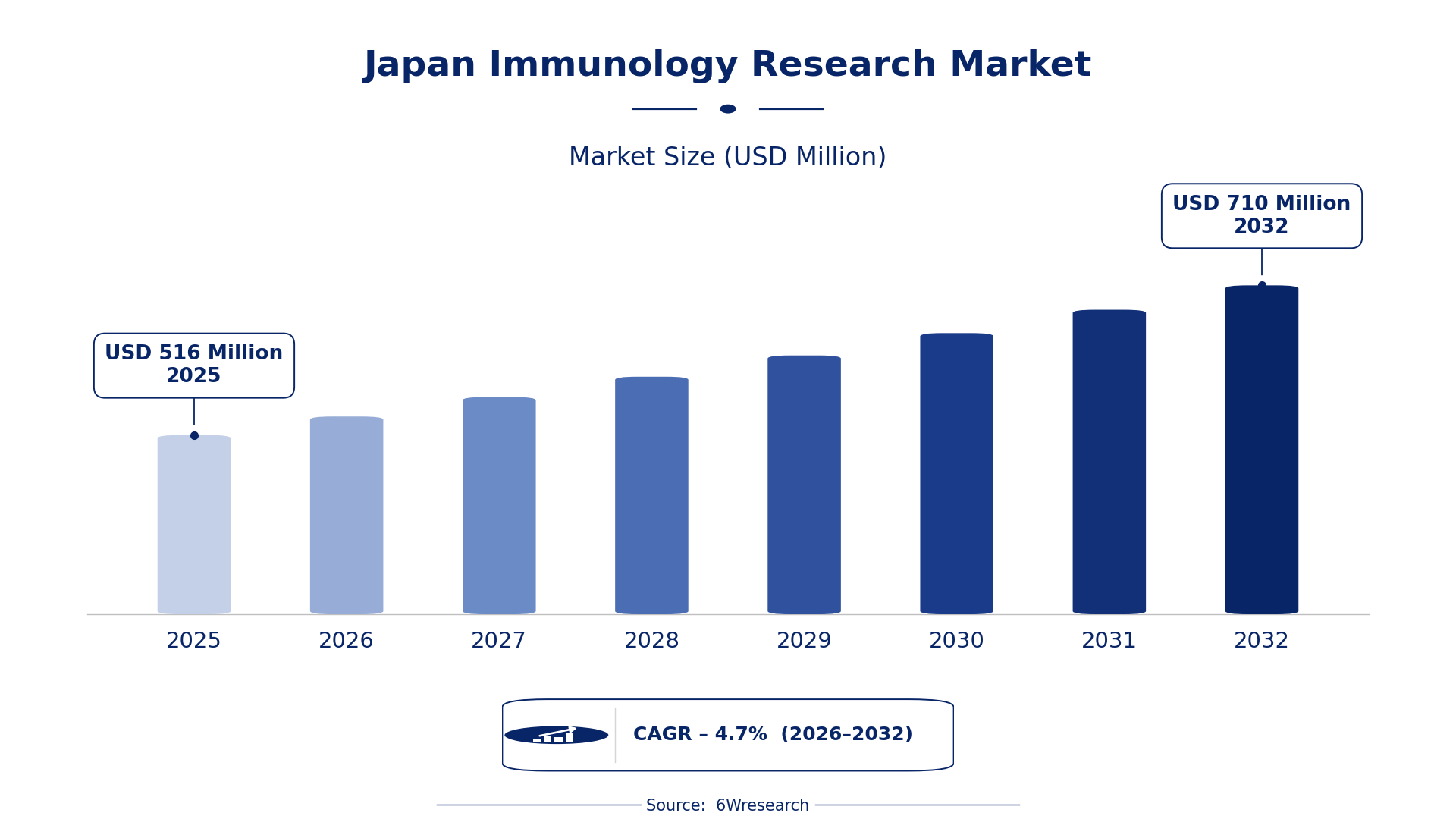
According to 6Wresearch internal database and industry insights, the Japan Immunology Research Market was valued at USD 516 Million in 2025 and is projected to reach USD 710 Million by 2032, growing at a CAGR of approximately 4.7% during 2026–2032.
Japan Immunology Research Market Highlights
| Report Metric | Details |
| Report Name | Japan Immunology Research Market (2026-2032) |
| Market Size 2025 | USD 516 Million |
| Market Size 2032 | USD 710 Million |
| Absolute Growth 2025–2032 | USD 194 Million |
| CAGR 2026–2032 | 4.7% |
| Peak Annual Growth | 5.6% in 2029 |
| Forecast Period | 2026–2032 |
| Historical Data | 2022–2025 |
| Base Year | 2025 |
| Leading Research Focus, 2025 | Vaccine Development (49% share) |
| Leading Experiment Type, 2025 | In-vitro/Preclinical (37% share) |
| Leading Research Tools, 2025 | ELISA (40% share) |
| Leading End User, 2025 | Academic Labs (52% share) |
| Fastest-Growing Research Focus | Cytokine Signaling (6.5% CAGR) |
| Fastest-Growing Experiment Type | Pathway Analysis (6.8% CAGR) |
| Fastest-Growing Research Tools | Flow Cytometry (7.2% CAGR) |
| Fastest-Growing End User | Pharmaceutical Companies (6.4% CAGR) |
| Growing Sector | Immunology Research |
| Key End Users | Academic Labs, Pharmaceutical Companies, Immunology Institutes, Oncology R&D Centers |
Japan Immunology Research Market Year-wise Growth Rate and Key Drivers (2022–2032)
This graph illustrates the annual growth rates of the market from 2022 to 2032, highlighting a steady upward trajectory and projected market expansion over the forecast period.
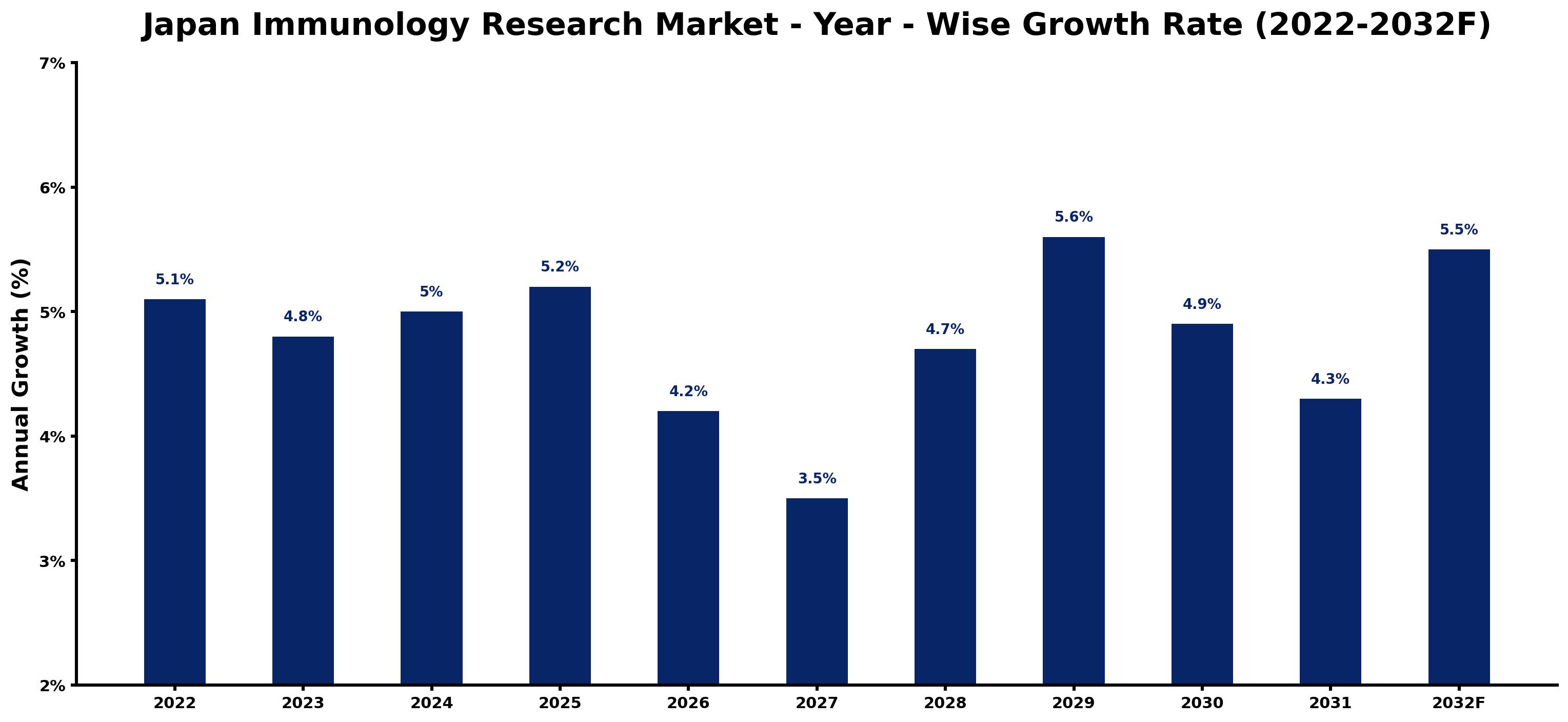
Each row of the following table gives one year's estimated growth and the event or demand shift that explains it.
| Year | Estimated Annual Growth (%) | Market Rationale |
| 2022 | 5.1 | The market experienced steady growth due to increased research funding and interest. |
| 2023 | 4.8 | Growth slowed as funding adjustments were made in response to shifting research priorities. |
| 2024 | 5.0 | Demand rose again as new vaccine candidates entered development phases. |
| 2025 | 5.2 | Growth accelerated with the introduction of advanced immunology research initiatives. |
| 2026 | 4.2 | A slowdown is expected as competition intensifies among research institutions. |
| 2027 | 3.5 | Continued investment in R&D is projected to contribute to a further slowdown in growth. |
| 2028 | 4.7 | Growth is expected to pick up as new technologies gain traction in research applications. |
| 2029 | 5.6 | The market is anticipated to peak with heightened funding for vaccine development and trials. |
| 2030 | 4.9 | A slight slowdown is projected as the market stabilises after rapid growth. |
| 2031 | 4.3 | Growth will continue to slow as the focus shifts to long-term research projects. |
| 2032 | 5.5 | Demand is expected to surge again as breakthroughs in immunology research emerge. |
Note: Market size estimations and growth projections presented in this report are based on 6Wresearch's proprietary forecasting methodology, utilizing the latest available industry data, government publications, and primary research inputs.
Japan Immunology Research Market Synopsis
Immunology research focuses on understanding immune responses and developing therapies, including vaccine development and studies on autoimmune diseases. The Japan Immunology Research Market is poised for growth, driven by substantial investments in research initiatives, including ¥5 billion allocated for vaccine research in 2023.
Market Dynamics Impact Analysis (2026–2032)
| Factor | Type | Impact | Primary Segment Affected |
| Increased funding for vaccine research initiatives | Driver | High | Vaccine Development |
| Growing emphasis on autoimmune disease research | Driver | High | Autoimmune Models |
| Rising demand for advanced research tools | Opportunity | Medium | Vaccine Development |
| Expansion of collaborative research programs | Opportunity | Medium | Vaccine Development |
| Limited availability of advanced research technologies | Restraint | High | Vaccine Development |
| High competition among research institutions | Restraint | Medium | Vaccine Development |
| Challenges in securing consistent funding | Challenge | High | Vaccine Development |
| Regulatory hurdles in clinical trial approvals | Challenge | Medium | Vaccine Development |
Evaluation of Drivers in Japan Immunology Research Market (2026–2032)
The main growth drivers and the segments they affect most are set out below.
| Drivers | Primary Segment Affected | Why It Matters (Evidence) |
| Increased government funding for vaccine initiatives | Vaccine Development | Japan allocated ¥5 billion in 2023 to support vaccine research, boosting development capabilities. |
| Growing focus on autoimmune disease therapies | Autoimmune Models | With 30 new vaccine candidates produced in 2022, demand for related research tools has surged. |
| Rising adoption of Flow Cytometry in labs | Flow Cytometry | Flow Cytometry is used in over 60% of immunology labs, driving demand for related equipment. |
| Expansion of academic research programs | Academic Labs | Over 200 academic labs are focusing on immunology, increasing the need for advanced research tools. |
| Emerging technologies like CRISPR | CRISPR | CRISPR technology is utilized in 40% of genetic research projects, boosting demand for advanced solutions. |
The presence of over 200 academic labs focusing on immunology drives demand for advanced tools, particularly as new vaccine candidates enter development phases. The growing focus on autoimmune disease therapies has surged interest among pharmaceutical companies.
Evaluation of Restraints in Japan Immunology Research Market
The following restraints limit how fast demand can grow.
| Market Restraint | Primary Segment Affected | Why It Matters (Evidence) |
| Limited access to advanced research technologies | Vaccine Development | Many labs face challenges in acquiring advanced technologies, which can hinder research progress. |
| Intense competition among research institutions | Vaccine Development | High competition can lead to funding challenges, affecting project viability and timelines. |
| Inconsistent funding for long-term projects | Vaccine Development | Securing stable funding remains a challenge, impacting the continuity of research initiatives. |
| Regulatory complexities in clinical trials | Vaccine Development | Navigating regulatory requirements can delay the approval of critical research projects. |
| Shortage of skilled personnel in immunology | Vaccine Development | A lack of qualified researchers can limit the capacity for conducting advanced studies. |
Japan Immunology Research Market Challenges
Budget constraints in academic labs limit the hiring of skilled researchers, resulting in delays for funding applications and slowing project progress. Outdated technology in many immunology institutes hampers the development of new vaccine candidates, which can lead to missed opportunities in a competitive market. Increased competition among research institutions raises operational costs, forcing buyers to reallocate funds from other critical areas. Limited patient enrolment in clinical trials, averaging 1,500 annually, restricts data collection and can delay the introduction of new therapies for autoimmune diseases.
Trends in the Japan Immunology Research Market
Below are the shifts with the largest effect on the Japan Immunology Research Market.
- Shift in Focus to Autoimmune Disease Research: Academic institutions are increasingly prioritising autoimmune disease research, with 15 major immunology institutes leading the charge. In 2023, Japan launched a new initiative specifically targeting autoimmune diseases, reflecting a growing awareness of these health challenges.
- Transition from Traditional to Advanced Research Tools: The adoption of advanced research tools is on the rise, particularly in academic labs. Flow Cytometry, used in over 60% of immunology labs, improves research capabilities and precision.
- Emergence of CRISPR Technology in Genetic Research: Since 2022, CRISPR technology has gained significant traction, being utilised in 40% of genetic research projects. This trend is reshaping immunology research, enabling more precise genetic modifications.
- Increase in Collaborative Research Initiatives: Collaboration between universities and research institutes is becoming more common, especially in the Tokyo region. This trend is supported by government funding for joint research programs, promoting innovation and knowledge sharing.
Investment Opportunities in the Japan Immunology Research Market
Where to invest in the Japan Immunology Research Market: the main openings are set out below.
- Tokyo Region as a Hub for Immunology Research: The Tokyo region is becoming a focal point for immunology research, with investment opportunities growing. In 2023, Japan allocated ¥5 billion for vaccine research initiatives, attracting both domestic and international researchers.
- Investment in Advanced Research Tools: There is a growing demand for advanced research tools like Flow Cytometry, with over 60% of labs using it. Suppliers can enter this market by partnering with academic institutions in Japan.
- Gap in Skilled Personnel for Immunology Research: With a shortage of skilled researchers, there is a pressing need for training programs. Investing in educational initiatives can help bridge this gap, particularly in academic labs.
- Expansion of Autoimmune Disease Research Programs: The launch of new initiatives for autoimmune disease research presents an opportunity for investment. Collaborating with immunology institutes can facilitate entry into this emerging market.
Government Initiatives in the Japan Immunology Research Market
The Medical Care Act of 1948 established standards for healthcare facilities, including those involved in immunology research. This law has ensured quality and safety in research practices, influencing funding allocations and research priorities. The Ministry of Health, Labour and Welfare oversees funding for immunology research initiatives. In 2023, it allocated ¥5 billion for vaccine research, promoting collaboration between academic labs and pharmaceutical companies to improve research outcomes.
The Japan Immunology Association promotes education and research in the field, facilitating knowledge sharing among researchers. The association supports various initiatives, including annual conferences that bring together experts to discuss advancements in immunology, fostering collaboration and innovation in the sector.
Future Insight of the Japan Immunology Research Market
Investment in immunology research will reach ¥10 billion by 2032, creating demand for advanced research methodologies. The adoption of cutting-edge technologies will streamline vaccine development, improving the speed of bringing new treatments to market. Collaborative research initiatives with universities will cultivate a more dynamic environment for breakthroughs in autoimmune disease therapies. The establishment of additional academic labs will ensure a continuous supply of skilled researchers, meeting the demands of the evolving market.
Market Segmentation Analysis
Japan Immunology Research Market report covers a detailed analysis of the following market segments:
By Research Focus – Vaccine Development Leads, Cytokine Signaling Expected to Grow Fastest
According to Saurav Kr Singh, Senior Research Analyst at 6Wresearch, Vaccine Development accounted for 49% of the market by research focus in 2025. Vaccine Development holds the largest share due to the critical role it plays in public health solutions, with Japan producing 30 new vaccine candidates in 2022. The ongoing investment in vaccine research, particularly in response to emerging health challenges, solidifies its importance in the market. The quickest growth will come from Cytokine Signaling, forecast to expand at a CAGR of 6.5% between 2026 and 2032. Cytokine Signaling is experiencing rapid growth as it is essential for understanding immune responses, with increasing research initiatives aimed at this area. The launch of new autoimmune disease research initiatives in 2023 further propels this segment's expansion. Suppliers should focus on developing tools and resources that support vaccine research to align with market demands.
By Experiment Type – In-vitro/Preclinical Leads, Pathway Analysis Expected to Grow Fastest
In-vitro/Preclinical took 37% of experiment type revenue in 2025, more than any other category. In-vitro/Preclinical experimentation commands the largest share as it serves as the standard method for hypothesis testing in immunology research. This approach is extensively employed in over 200 academic labs across Japan, which reinforces its leading position in the market. Pathway Analysis is projected to grow fastest, at a CAGR of 6.8% during 2026–2032. Pathway Analysis is witnessing the highest growth owing to its vital importance in deciphering disease mechanisms, crucial for the progression of immunology studies. The rising intricacy of diseases necessitates advanced analytical techniques, thereby accelerating the demand for this segment. Suppliers should prioritise the development of pathway analysis tools to cater to the increasing research requirements.
By Research Tools – ELISA Leads, Flow Cytometry Expected to Grow Fastest
ELISA held 40% of the Japan Immunology Research Market by research tools in 2025. ELISA is the leading research tool as it is widely used for detecting proteins in immunology studies, with an installed base exceeding 1,000 units in Japanese labs. Its established presence in the market ensures that it remains the preferred choice for many researchers. Flow Cytometry is set to record the highest CAGR in this split, 7.2% over 2026–2032. Flow Cytometry is growing rapidly as it is essential for cell analysis, which is increasingly important in immunology research. The adoption of this technology in over 60% of labs highlights its critical role in advancing research capabilities. Suppliers should prioritise the development of Flow Cytometry technologies to meet the rising demand.
By End User – Academic Labs Lead, Pharmaceutical Companies Expected to Grow Fastest
The largest end user category in 2025 was Academic Labs, at 52% of revenue. Academic Labs dominate the end user segment as they are the primary users for research, with more than 200 labs focused on immunology. Their pivotal role in foundational research establishes their leading status in the market. Over 2026–2032, Pharmaceutical Companies are expected to post the fastest growth, at a CAGR of 6.4%. Pharmaceutical Companies represent the fastest-growing end user as they are ramping up investments in drug development, which relies heavily on advanced immunology research. The concentration of pharmaceutical R&D activities in the Tokyo region further fuels this growth. Suppliers must tailor their products and services to align with the specific needs of pharmaceutical companies to capitalise on emerging market opportunities.
Key Attractiveness of the Report
- 10 Years of Market Numbers
- Historical Data Starting from 2022 to 2025
- Base Year 2025
- Forecast Data until 2032
- Key Performance Indicators Impacting the Market
- Major Upcoming Developments and Projects
Key Highlights of the Report:
- Japan Immunology Research Market Outlook
- Market Size of Japan Immunology Research Market, 2025
- Forecast of Japan Immunology Research Market, 2032
- Historical Data and Forecast of Japan Immunology Research Revenues & Volume for the Period 2022-2032F
- Japan Immunology Research Market Trend Evolution
- Japan Immunology Research Market Drivers and Challenges
- Japan Immunology Research Price Trends
- Japan Immunology Research Porter's Five Forces
- Japan Immunology Research Industry Life Cycle
- Historical Data and Forecast of Japan Immunology Research Market Revenues & Volume By Research Focus for the Period 2022-2032F
- Historical Data and Forecast of Japan Immunology Research Market Revenues & Volume By Vaccine Development for the Period 2022-2032F
- Historical Data and Forecast of Japan Immunology Research Market Revenues & Volume By Cytokine Signaling for the Period 2022-2032F
- Historical Data and Forecast of Japan Immunology Research Market Revenues & Volume By Autoimmune Models for the Period 2022-2032F
- Historical Data and Forecast of Japan Immunology Research Market Revenues & Volume By Tumor Immunology for the Period 2022-2032F
- Historical Data and Forecast of Japan Immunology Research Market Revenues & Volume By Experiment Type for the Period 2022-2032F
- Historical Data and Forecast of Japan Immunology Research Market Revenues & Volume By In-vitro/Preclinical for the Period 2022-2032F
- Historical Data and Forecast of Japan Immunology Research Market Revenues & Volume By Pathway Analysis for the Period 2022-2032F
- Historical Data and Forecast of Japan Immunology Research Market Revenues & Volume By Mouse/Humanized Models for the Period 2022-2032F
- Historical Data and Forecast of Japan Immunology Research Market Revenues & Volume By Tumor Microenvironment for the Period 2022-2032F
- Historical Data and Forecast of Japan Immunology Research Market Revenues & Volume By Research Tools for the Period 2022-2032F
- Historical Data and Forecast of Japan Immunology Research Market Revenues & Volume By ELISA, Flow Cytometry for the Period 2022-2032F
- Historical Data and Forecast of Japan Immunology Research Market Revenues & Volume By PCR, Western Blot for the Period 2022-2032F
- Historical Data and Forecast of Japan Immunology Research Market Revenues & Volume By CRISPR, Cell Cultures for the Period 2022-2032F
- Historical Data and Forecast of Japan Immunology Research Market Revenues & Volume By 3D Co-Culture for the Period 2022-2032F
- Historical Data and Forecast of Japan Immunology Research Market Revenues & Volume By End User for the Period 2022-2032F
- Historical Data and Forecast of Japan Immunology Research Market Revenues & Volume By Academic Labs for the Period 2022-2032F
- Historical Data and Forecast of Japan Immunology Research Market Revenues & Volume By Pharmaceutical Companies for the Period 2022-2032F
- Historical Data and Forecast of Japan Immunology Research Market Revenues & Volume By Immunology Institutes for the Period 2022-2032F
- Historical Data and Forecast of Japan Immunology Research Market Revenues & Volume By Oncology R&D Centers for the Period 2022-2032F
- Japan Immunology Research Import Export Trade Statistics
- Market Opportunity Assessment By Research Focus
- Market Opportunity Assessment By Experiment Type
- Market Opportunity Assessment By Research Tools
- Market Opportunity Assessment By End User
- Japan Immunology Research Top Companies Market Share
- Japan Immunology Research Competitive Benchmarking By Technical and Operational Parameters
- Japan Immunology Research Company Profiles
- Japan Immunology Research Key Strategic Recommendations
Market Covered
The report covers the following segments.
By Research Focus
- Vaccine Development
- Cytokine Signaling
- Autoimmune Models
- Tumor Immunology
By Experiment Type
- In-vitro/Preclinical
- Pathway Analysis
- Mouse/Humanized Models
- Tumor Microenvironment
By Research Tools
- ELISA
- Flow Cytometry
- PCR
- Western Blot
- CRISPR
- Cell Cultures
- 3D Co-Culture
By End User
- Academic Labs
- Pharmaceutical Companies
- Immunology Institutes
- Oncology R&D Centers































