Japan Immunotherapy for Pancreatic Cancer Market Size & Growth Rate
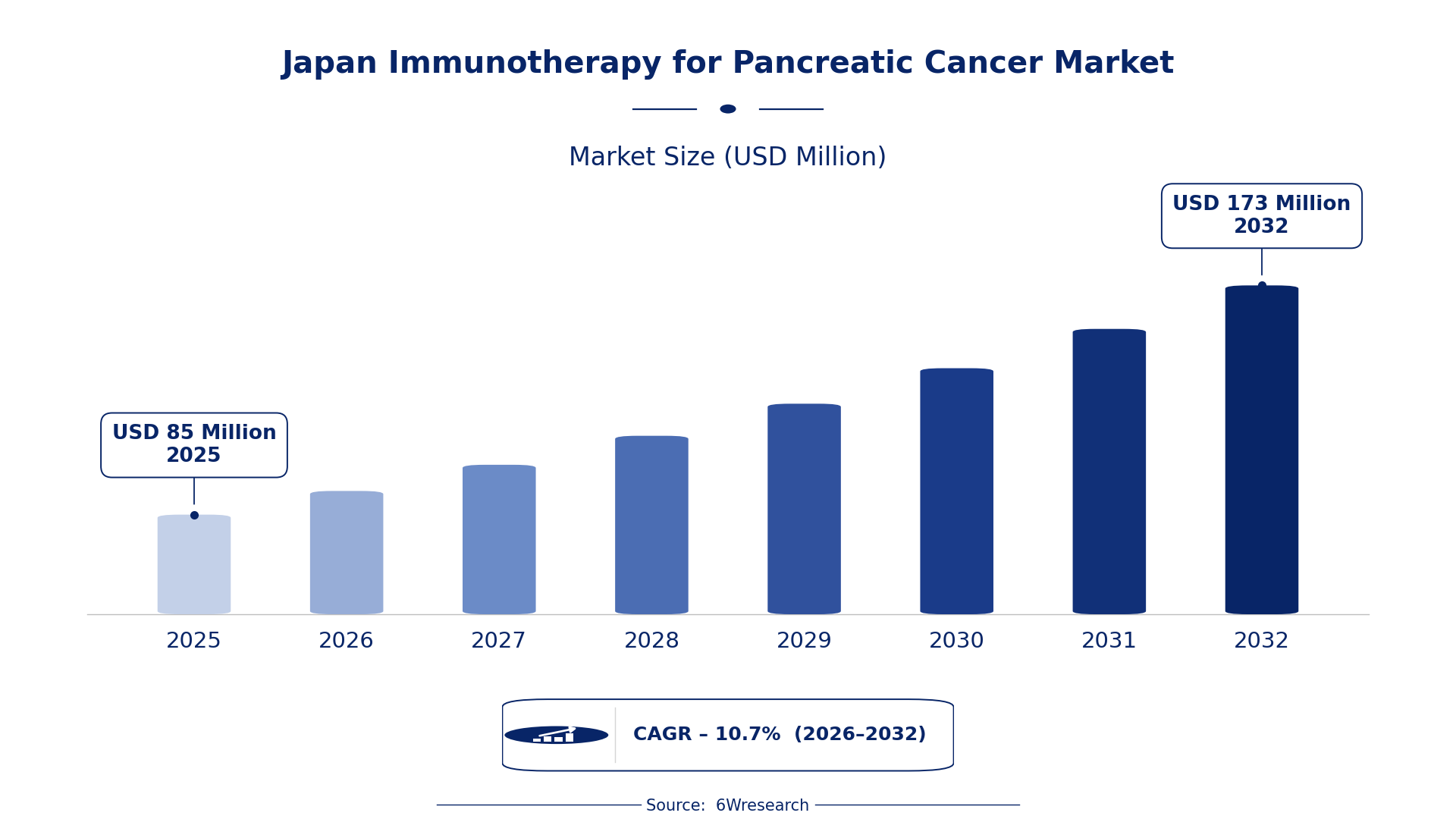
According to 6Wresearch internal database and industry insights, the Japan Immunotherapy for Pancreatic Cancer Market was valued at USD 85 Million in 2025 and is projected to reach USD 173 Million by 2032, growing at a CAGR of approximately 10.7% during 2026–2032.
Japan Immunotherapy for Pancreatic Cancer Market Highlights
| Report Metric | Details |
| Report Name | Japan Immunotherapy for Pancreatic Cancer Market (2026-2032) |
| Market Size 2025 | USD 85 Million |
| Market Size 2032 | USD 173 Million |
| Absolute Growth 2025–2032 | USD 88 Million |
| CAGR 2026–2032 | 10.7% |
| Peak Annual Growth | 13.0% in 2030 |
| Forecast Period | 2026–2032 |
| Historical Data | 2022–2025 |
| Base Year | 2025 |
| Leading Therapy Approach, 2025 | Immune Checkpoint Blockade (40% share) |
| Leading Target Mechanism, 2025 | PD-1 (35% share) |
| Leading Drug Type, 2025 | Nivolumab (37% share) |
| Leading End User, 2025 | Oncology Hospitals (54% share) |
| Fastest-Growing Therapy Approach | Vaccine-Based Therapy (13.7% CAGR) |
| Fastest-Growing Target Mechanism | CTLA-4 (13.8% CAGR) |
| Fastest-Growing Drug Type | Pembrolizumab (14.6% CAGR) |
| Fastest-Growing End User | Research Institutions (13.2% CAGR) |
| Growing Sector | oncology |
| Key End Users | oncology hospitals, research institutions, clinical trial units |
Japan Immunotherapy for Pancreatic Cancer Market Year-wise Growth Rate and Key Drivers (2022–2032)
This graph illustrates the annual growth rates of the market from 2022 to 2032, highlighting a steady upward trajectory and projected market expansion over the forecast period.
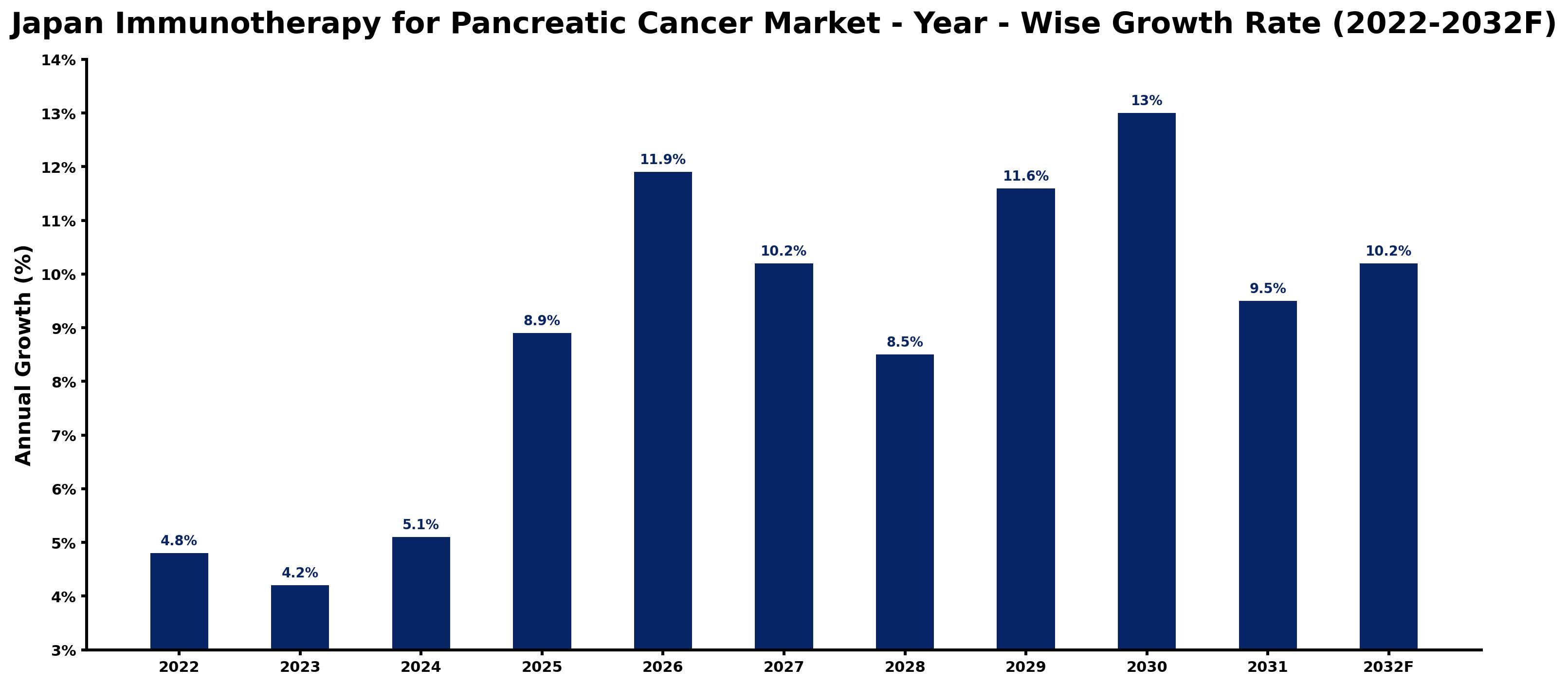
The following figures match every annual growth estimate with the main market development of that year, giving the reasoning behind each rise or slowdown.
| Year | Estimated Annual Growth (%) | Market Rationale |
| 2022 | 4.8 | The market showed steady growth, reflecting ongoing advancements in immunotherapy. |
| 2023 | 4.2 | Growth slowed slightly as the market adjusted to new treatment protocols and guidelines. |
| 2024 | 5.1 | Increased clinical trial activity contributed to faster growth compared to the previous year. |
| 2025 | 8.9 | The introduction of new therapies and heightened awareness drove growth. |
| 2026 | 11.9 | Demand is anticipated to surge as oncology hospitals adopt advanced immunotherapy treatments. |
| 2027 | 10.2 | Growth is projected to moderate as the market stabilises following a peak in new drug approvals. |
| 2028 | 8.5 | The market is expected to continue growing, albeit at a slower rate as competition intensifies. |
| 2029 | 11.6 | Renewed interest in emerging therapies will lead to faster growth as new trials commence. |
| 2030 | 13.0 | The market is projected to peak as breakthrough therapies gain widespread acceptance among providers. |
| 2031 | 9.5 | Growth is expected to slow due to market saturation and increased competition among therapies. |
| 2032 | 10.2 | Demand is expected to rise again as new research and treatments emerge. |
Note: Market size estimations and growth projections presented in this report are based on 6Wresearch's proprietary forecasting methodology, utilizing the latest available industry data, government publications, and primary research inputs.
Japan Immunotherapy for Pancreatic Cancer Market Synopsis
Immunotherapy for pancreatic cancer utilises the body's immune system to combat cancer cells, employing techniques like genetic engineering and vaccine technology. In Japan, the Japan Immunotherapy for Pancreatic Cancer Market is expanding due to rising pancreatic cancer diagnoses, with approximately 39,000 new cases reported in 2023. Government investment in cancer research initiatives, totalling ¥10 billion this year, further drives demand for effective therapies and treatment options.
Market Dynamics Impact Analysis (2026–2032)
| Factor | Type | Impact | Primary Segment Affected |
| Growing number of clinical trials for immunotherapy | Driver | High | Immune Checkpoint Blockade |
| Increased funding for cancer research initiatives | Driver | High | Research Institutions |
| Emerging demand for vaccine-based therapies | Opportunity | Medium | Vaccine-Based Therapy |
| Rising awareness and education on pancreatic cancer | Opportunity | Medium | Oncology Hospitals |
| High costs associated with immunotherapy treatments | Restraint | High | Nivolumab |
| Limited access to clinical trial participation | Restraint | Medium | Clinical Trial Units |
| Regulatory hurdles for new drug approvals | Challenge | High | Oncology Hospitals |
| Capacity constraints in oncology hospitals | Challenge | Medium | Cancer Research Hospitals |
Evaluation of Drivers in Japan Immunotherapy for Pancreatic Cancer Market (2026–2032)
Below are the drivers that matter most for revenue growth, with supporting evidence.
| Drivers | Primary Segment Affected | Why It Matters (Evidence) |
| Increased number of oncology hospitals | Immune Checkpoint Blockade | Over 50 oncology hospitals in Japan are improving treatment access, leading to higher immunotherapy adoption. |
| Ongoing clinical trials for new therapies | Nivolumab | With over 200 active clinical trials for pancreatic cancer, demand for new therapies is rising. |
| Government funding for cancer research | Research Institutions | The government allocated ¥10 billion in 2023, boosting research and development in immunotherapy. |
| Growing patient population with pancreatic cancer | Oncology Hospitals | Approximately 39,000 new cases diagnosed in 2023 are increasing treatment demand across hospitals. |
| Collaboration on vaccine-based therapies | Vaccine-Based Therapy | Research institutions are collaborating on vaccine-based therapies, driving interest in new treatment options. |
In 2023, approximately 39,000 new pancreatic cancer cases were reported, prompting hospitals to expand treatment options. Ongoing clinical trials for new therapies, with over 200 active studies, generate interest among healthcare providers. Collaborative efforts among research institutions on vaccine-based therapies are also driving demand for new treatment modalities.
Evaluation of Restraints in Japan Immunotherapy for Pancreatic Cancer Market
The key brakes on demand, and where they bite hardest, are shown below.
| Market Restraint | Primary Segment Affected | Why It Matters (Evidence) |
| High costs of immunotherapy treatments | Nivolumab | The average treatment costs can be prohibitive, limiting patient access to therapies. |
| Limited participation in clinical trials | Clinical Trial Units | Strict eligibility criteria restrict patient access to potentially life-saving therapies. |
| Regulatory challenges for new therapies | Oncology Hospitals | Lengthy approval processes can delay access to new treatments for patients. |
| Capacity issues in oncology hospitals | Cancer Research Hospitals | Increasing patient numbers can strain resources, affecting treatment availability. |
| Insurance coverage limitations | Research Institutions | Not all therapies are covered, which can deter patients from seeking advanced treatments. |
Japan Immunotherapy for Pancreatic Cancer Market Challenges
Regulatory hurdles for new immunotherapy treatments in Japan create delays, as the government requires extensive clinical trial data. This impacts hospitals, causing approximately 39,000 pancreatic cancer patients to face longer wait times for effective therapies. A shortage of oncology specialists hampers the delivery of advanced treatments, forcing healthcare providers to manage increasing patient loads with limited resources. This skills gap can lead to operational inefficiencies, ultimately compromising patient care quality. Heightened competition for funding among hospitals raises operational costs, which diverts crucial resources away from patient services.
Trends in the Japan Immunotherapy for Pancreatic Cancer Market
Below are the shifts with the largest effect on the Japan Immunotherapy for Pancreatic Cancer Market.
- Shift Towards Personalized Medicine: The Japanese government promotes personalized medicine in cancer treatment, improving patient outcomes. In 2023, this approach is being adopted in various treatment protocols, leading to tailored therapies.
- Increased Focus on Vaccine-Based Therapies: Research institutions are intensifying efforts on vaccine-based therapies for pancreatic cancer, with ongoing studies indicating a 13.7% CAGR. This shift aims to improve treatment options for patients.
- Rising Adoption of CAR-T Therapy: Clinical trial units are exploring CAR-T therapy for pancreatic cancer, with trials ongoing in multiple research institutions. This emerging approach is expected to gain traction in the coming years.
- Expansion of Clinical Trials: The number of clinical trials for pancreatic cancer has exceeded 200 in 2023, reflecting a growing commitment to research. This expansion is vital for developing new treatment options.
Investment Opportunities in the Japan Immunotherapy for Pancreatic Cancer Market
The following areas offer the clearest openings for investors and suppliers in the Japan Immunotherapy for Pancreatic Cancer Market.
- Collaborations with Research Institutions: Partnering with research institutions can facilitate access to new therapies, addressing the gap in treatment options. The government allocated ¥10 billion for cancer research in 2023.
- Supply of Advanced Immunotherapy Drugs: With rising demand for immunotherapy, supplying advanced drugs like Nivolumab presents a significant opportunity. Oncology hospitals are the primary buyers seeking effective treatments.
- Investment in Clinical Trial Units: Investing in clinical trial units can help meet the demand for new therapies, with over 200 ongoing trials indicating a need for resources and support.
- Development of Vaccine-Based Therapies: The focus on vaccine-based therapies is growing, with research institutions actively seeking partnerships. This presents an opportunity to supply effective solutions to oncology hospitals.
Government Initiatives in the Japan Immunotherapy for Pancreatic Cancer Market
The Clinical Trials Act, effective since 2018, establishes essential rules for conducting clinical research, ensuring transparency and patient safety. This law complements the Medical Care Act, which sets standards for hospitals, reinforcing the regulatory framework for cancer treatments.
In 2023, the government allocated ¥10 billion for cancer research initiatives, overseen by the Ministry of Health, Labour and Welfare. This funding supports the development of new therapies and improves treatment accessibility.
Future Insight of the Japan Immunotherapy for Pancreatic Cancer Market
Innovative vaccine technologies will reshape demand for pancreatic cancer therapies by 2032, improving patient outcomes. The government's commitment to increase funding for cancer research initiatives by 2025 will drive the development of new treatment options. Clinical trials for diverse immunotherapy methods are anticipated to grow, expanding available therapies. By 2032, adherence to ISO 9001 standards in oncology facilities will enhance quality management, ensuring better patient care experiences.
Market Segmentation Analysis
Japan Immunotherapy for Pancreatic Cancer Market report covers a detailed analysis of the following market segments:
By Therapy Approach – Immune Checkpoint Blockade Leads, Vaccine-Based Therapy Expected to Grow Fastest
According to Saurav Kr Singh, Senior Research Analyst at 6Wresearch, Immune Checkpoint Blockade held 40% of the Japan Immunotherapy for Pancreatic Cancer Market by therapy approach in 2025. Immune Checkpoint Blockade holds the largest share due to its extensive use in treating pancreatic cancer within Japan's oncology hospitals. This approach has demonstrated effectiveness in enhancing patient survival rates, particularly in facilities adhering to established treatment guidelines. Vaccine-Based Therapy is set to record the highest CAGR in this split, 13.7% over 2026–2032. Vaccine-Based Therapy is experiencing rapid growth as ongoing clinical trials in research institutions indicate promising results for pancreatic cancer treatment. The government's allocation of ¥10 billion for cancer research initiatives is expected to further accelerate advancements in this area. Suppliers should focus on partnerships with research institutions to capitalise on the increasing interest in vaccine-based therapies.
By Target Mechanism – PD-1 Leads, CTLA-4 Expected to Grow Fastest
In 2025, PD-1 led the target mechanism split with a 35% share. PD-1 is the leading target mechanism in immunotherapy, primarily because of its crucial role in enhancing immune responses against pancreatic cancer cells. This target is widely utilised in treatment protocols across oncology hospitals in Japan, ensuring its prominence. The quickest growth will come from CTLA-4, forecast to expand at a CAGR of 13.8% between 2026 and 2032. CTLA-4 is emerging as the fastest-growing target mechanism, driven by its potential in combination therapies currently being evaluated in clinical trials. The rising interest in novel therapeutic combinations is likely to boost its adoption in the near future. Buyers should remain updated on developments in target mechanisms to access the most effective therapies available.
By Drug Type – Nivolumab Leads, Pembrolizumab Expected to Grow Fastest
Nivolumab accounted for 37% of the market by drug type in 2025. Nivolumab leads the drug type segment as it is widely approved for various cancers, including pancreatic cancer, and is commonly used in oncology hospitals. Its established efficacy and safety profile contribute to its strong market presence. Pembrolizumab is projected to grow fastest, at a CAGR of 14.6% during 2026–2032. Pembrolizumab is the fastest-growing drug type, with its increasing use in clinical settings supported by emerging evidence of its effectiveness against pancreatic cancer. The ongoing research and clinical trials are anticipated to further boost its market penetration. Suppliers must ensure a reliable supply of Pembrolizumab to meet the escalating demand in clinical applications.
By End User – Oncology Hospitals Lead, Research Institutions Expected to Grow Fastest
With 54% of end user revenue in 2025, Oncology Hospitals was the largest category. Oncology Hospitals dominate the end user segment as they serve as the primary treatment centres for pancreatic cancer patients in Japan. The high concentration of specialised oncology hospitals in urban regions improves access to advanced immunotherapy treatments. Over 2026–2032, Research Institutions are expected to post the fastest growth, at a CAGR of 13.2%. Research Institutions are the fastest-growing end user group, propelled by an increase in clinical trials focusing on innovative therapies for pancreatic cancer. The collaboration between these institutions and heightened funding initiatives is expected to drive their growth. Suppliers should engage with research institutions to align with the growing emphasis on clinical trials and new treatment modalities.
Key Attractiveness of the Report
- 10 Years of Market Numbers
- Historical Data Starting from 2022 to 2025
- Base Year 2025
- Forecast Data until 2032
- Key Performance Indicators Impacting the Market
- Major Upcoming Developments and Projects
Key Highlights of the Report:
- Japan Immunotherapy for Pancreatic Cancer Market Outlook
- Market Size of Japan Immunotherapy for Pancreatic Cancer Market, 2025
- Forecast of Japan Immunotherapy for Pancreatic Cancer Market, 2032
- Historical Data and Forecast of Japan Immunotherapy for Pancreatic Cancer Revenues & Volume for the Period 2022-2032F
- Japan Immunotherapy for Pancreatic Cancer Market Trend Evolution
- Japan Immunotherapy for Pancreatic Cancer Market Drivers and Challenges
- Japan Immunotherapy for Pancreatic Cancer Price Trends
- Japan Immunotherapy for Pancreatic Cancer Porter's Five Forces
- Japan Immunotherapy for Pancreatic Cancer Industry Life Cycle
- Historical Data and Forecast of Japan Immunotherapy for Pancreatic Cancer Market Revenues & Volume By Therapy Approach for the Period 2022-2032F
- Historical Data and Forecast of Japan Immunotherapy for Pancreatic Cancer Market Revenues & Volume By Immune Checkpoint Blockade for the Period 2022-2032F
- Historical Data and Forecast of Japan Immunotherapy for Pancreatic Cancer Market Revenues & Volume By Vaccine-Based Therapy for the Period 2022-2032F
- Historical Data and Forecast of Japan Immunotherapy for Pancreatic Cancer Market Revenues & Volume By CAR-T Therapy for the Period 2022-2032F
- Historical Data and Forecast of Japan Immunotherapy for Pancreatic Cancer Market Revenues & Volume By Oncolytic Virus Therapy for the Period 2022-2032F
- Historical Data and Forecast of Japan Immunotherapy for Pancreatic Cancer Market Revenues & Volume By Target Mechanism for the Period 2022-2032F
- Historical Data and Forecast of Japan Immunotherapy for Pancreatic Cancer Market Revenues & Volume By PD-1, CTLA-4 for the Period 2022-2032F
- Historical Data and Forecast of Japan Immunotherapy for Pancreatic Cancer Market Revenues & Volume By KRAS, Telomerase for the Period 2022-2032F
- Historical Data and Forecast of Japan Immunotherapy for Pancreatic Cancer Market Revenues & Volume By Experimental Application for the Period 2022-2032F
- Historical Data and Forecast of Japan Immunotherapy for Pancreatic Cancer Market Revenues & Volume By Direct Tumor Target for the Period 2022-2032F
- Historical Data and Forecast of Japan Immunotherapy for Pancreatic Cancer Market Revenues & Volume By Drug Type for the Period 2022-2032F
- Historical Data and Forecast of Japan Immunotherapy for Pancreatic Cancer Market Revenues & Volume By Nivolumab, Pembrolizumab for the Period 2022-2032F
- Historical Data and Forecast of Japan Immunotherapy for Pancreatic Cancer Market Revenues & Volume By Personalized Peptides for the Period 2022-2032F
- Historical Data and Forecast of Japan Immunotherapy for Pancreatic Cancer Market Revenues & Volume By Engineered T-Cells for the Period 2022-2032F
- Historical Data and Forecast of Japan Immunotherapy for Pancreatic Cancer Market Revenues & Volume By Modified Viruses for the Period 2022-2032F
- Historical Data and Forecast of Japan Immunotherapy for Pancreatic Cancer Market Revenues & Volume By End User for the Period 2022-2032F
- Historical Data and Forecast of Japan Immunotherapy for Pancreatic Cancer Market Revenues & Volume By Oncology Hospitals for the Period 2022-2032F
- Historical Data and Forecast of Japan Immunotherapy for Pancreatic Cancer Market Revenues & Volume By Research Institutions for the Period 2022-2032F
- Historical Data and Forecast of Japan Immunotherapy for Pancreatic Cancer Market Revenues & Volume By Clinical Trial Units for the Period 2022-2032F
- Historical Data and Forecast of Japan Immunotherapy for Pancreatic Cancer Market Revenues & Volume By Cancer Research Hospitals for the Period 2022-2032F
- Japan Immunotherapy for Pancreatic Cancer Import Export Trade Statistics
- Market Opportunity Assessment By Therapy Approach
- Market Opportunity Assessment By Target Mechanism
- Market Opportunity Assessment By Drug Type
- Market Opportunity Assessment By End User
- Japan Immunotherapy for Pancreatic Cancer Top Companies Market Share
- Japan Immunotherapy for Pancreatic Cancer Competitive Benchmarking By Technical and Operational Parameters
- Japan Immunotherapy for Pancreatic Cancer Company Profiles
- Japan Immunotherapy for Pancreatic Cancer Key Strategic Recommendations
Market Covered
This report examines the market across the segments below.
By Therapy Approach
- Immune Checkpoint Blockade
- Vaccine-Based Therapy
- CAR-T Therapy
- Oncolytic Virus Therapy
By Target Mechanism
- PD-1
- CTLA-4
- KRAS
- Telomerase
- Experimental Application
- Direct Tumor Target
By Drug Type
- Nivolumab
- Pembrolizumab
- Personalized Peptides
- Engineered T-Cells
- Modified Viruses
By End User
- Oncology Hospitals
- Research Institutions
- Clinical Trial Units
- Cancer Research Hospitals































