Japan Impact Investment Market Size & Growth Rate
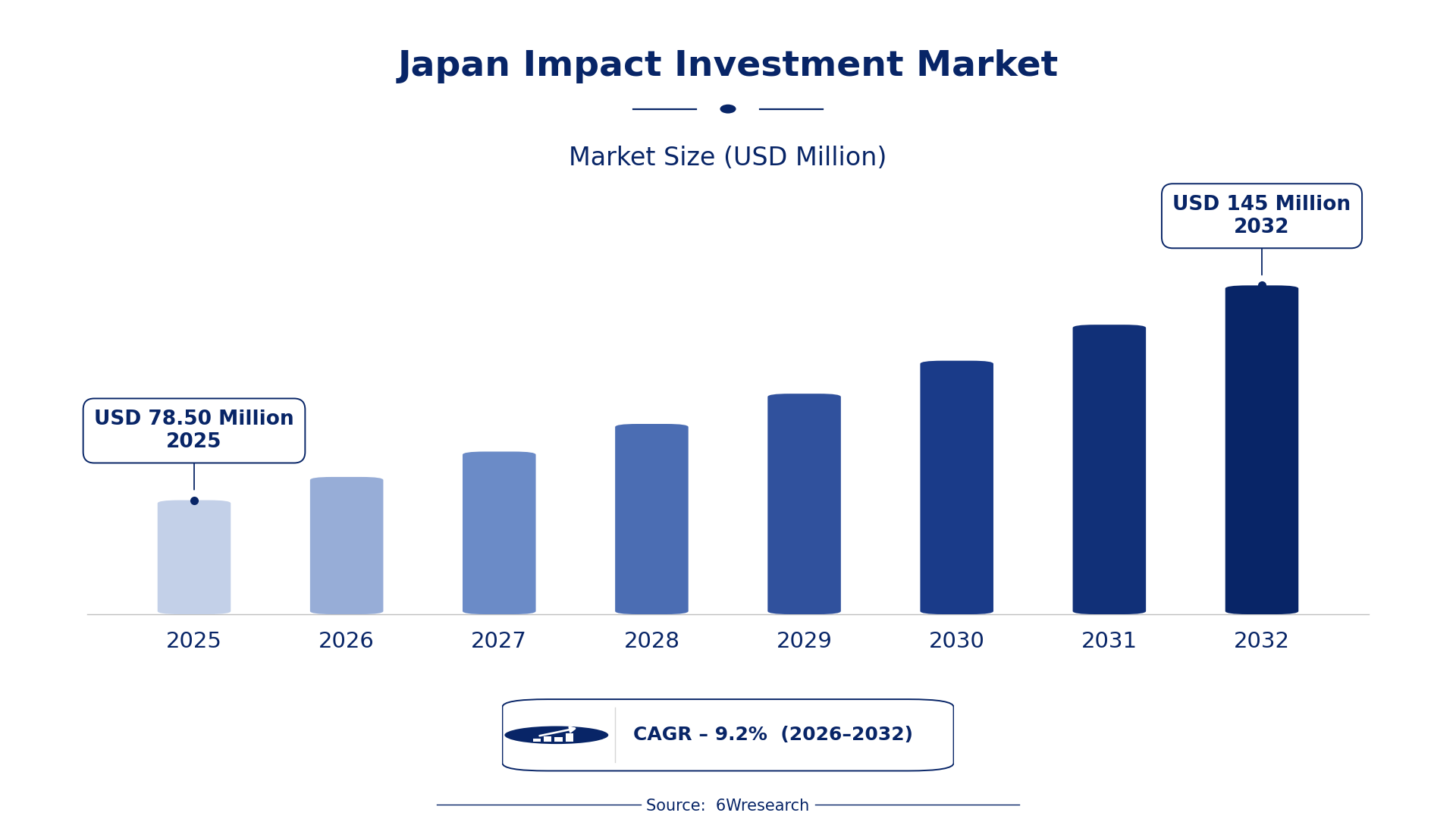
According to 6Wresearch internal database and industry insights, the Japan Impact Investment Market was valued at USD 78.50 Million in 2025 and is projected to reach USD 145 Million by 2032, growing at a CAGR of approximately 9.2% during 2026–2032.
Japan Impact Investment Market Highlights
| Report Metric | Details |
| Report Name | Japan Impact Investment Market (2026-2032) |
| Market Size 2025 | USD 78.50 Million |
| Market Size 2032 | USD 145 Million |
| Absolute Growth 2025–2032 | USD 66.50 Million |
| CAGR 2026–2032 | 9.2% |
| Peak Annual Growth | 10.2% in 2032 |
| Forecast Period | 2026–2032 |
| Historical Data | 2022–2025 |
| Base Year | 2025 |
| Leading Investment Type, 2025 | ESG Funds (37% share) |
| Leading Focus Area, 2025 | Environment/Social (44% share) |
| Leading Target Outcome, 2025 | Financial + Social Return (44% share) |
| Leading End User, 2025 | Institutional Investors (54% share) |
| Fastest-Growing Investment Type | Green Bonds (13.0% CAGR) |
| Fastest-Growing Focus Area | Renewable Energy (11.5% CAGR) |
| Fastest-Growing Target Outcome | Measurable Impact (11.7% CAGR) |
| Fastest-Growing End User | Governments/NGOs (11.8% CAGR) |
| Growing Sector | Impact Investment |
| Key End Users | Institutional Investors, Governments/NGOs, Social Enterprises, Venture Capital Firms |
Japan Impact Investment Market Year-wise Growth Rate and Key Drivers (2022–2032)
This graph illustrates the annual growth rates of the market from 2022 to 2032, highlighting a steady upward trajectory and projected market expansion over the forecast period.
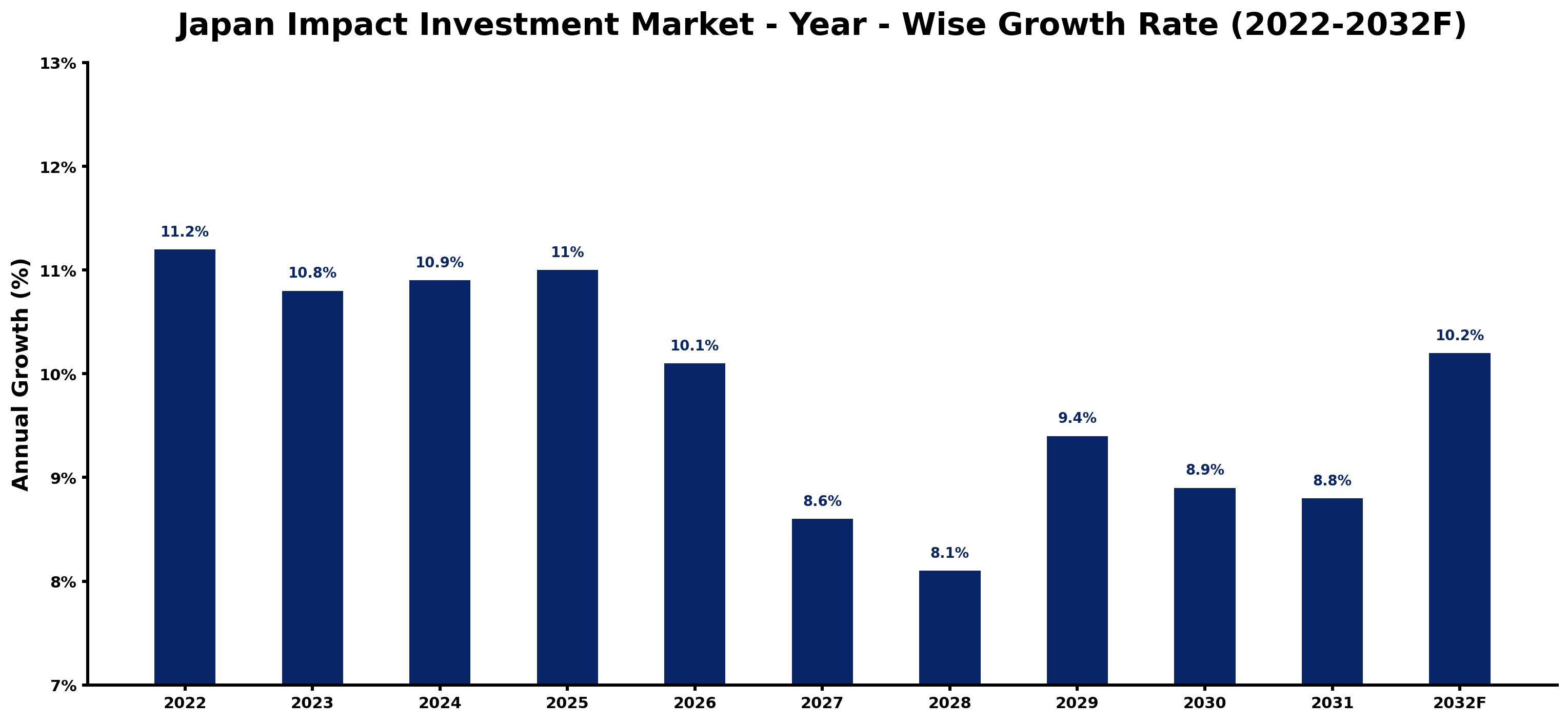
Below, each year's estimated growth is shown next to the factor that most influenced it.
| Year | Estimated Annual Growth (%) | Market Rationale |
| 2022 | 11.2 | Strong interest in sustainable finance drove substantial investment in impact projects. |
| 2023 | 10.8 | Demand for ESG funds continued to rise, reflecting growing awareness of social responsibility. |
| 2024 | 10.9 | Investment in renewable energy projects accelerated as climate initiatives gained traction. |
| 2025 | 11.0 | Institutional investors increased allocations to impact investments, recognising their dual benefits. |
| 2026 | 10.1 | Growth moderated as market maturity led to more cautious investment strategies. |
| 2027 | 8.6 | Investor focus shifted towards measurable impact, influencing funding decisions. |
| 2028 | 8.1 | Sustainable finance trends continued to evolve, impacting investment flows. |
| 2029 | 9.4 | Renewable energy projects attracted renewed interest, boosting funding levels. |
| 2030 | 8.9 | Market growth slowed as investors adapted to changing economic conditions. |
| 2031 | 8.8 | Interest in social impact ventures remained steady, sustaining investment levels. |
| 2032 | 10.2 | The market is projected to peak as net-zero targets drive further investments. |
Note: Market size estimations and growth projections presented in this report are based on 6Wresearch's proprietary forecasting methodology, utilizing the latest available industry data, government publications, and primary research inputs.
Japan Impact Investment Market Synopsis
Impact investment focuses on generating social and environmental benefits alongside financial returns, facilitated through ESG funds and green bonds. The Japan Impact Investment Market is expanding, driven by institutional investors, government initiatives, and NGOs, with ESG investment reaching ¥30 trillion in 2022 and green bond issuances of ¥1 trillion in 2023. This growth reflects a commitment to sustainable finance and the increasing demand for projects addressing social and environmental issues, particularly in renewable energy and social enterprises.
Market Dynamics Impact Analysis (2026–2032)
| Factor | Type | Impact | Primary Segment Affected |
| Growing institutional interest in ESG funds and green bonds | Driver | High | ESG Funds |
| Government initiatives promoting renewable energy projects | Driver | High | Renewable Energy |
| Increasing demand for measurable impact investments | Opportunity | High | Social Impact VC |
| Emerging interest in green bonds for financing environmental projects | Opportunity | High | Green Bonds |
| Limited awareness of impact investment opportunities among retail investors | Restraint | Medium | Microfinance |
| Challenges in measuring social impact effectively | Restraint | Medium | Social Impact VC |
| High competition for funding among impact-focused startups | Challenge | Medium | Social Enterprises |
| Regulatory complexities surrounding ESG disclosures | Challenge | Medium | ESG Funds |
Evaluation of Drivers in Japan Impact Investment Market (2026–2032)
The table below links each growth driver to the segment it affects and the evidence for it.
| Drivers | Primary Segment Affected | Why It Matters (Evidence) |
| Institutional investors increasing allocations to ESG funds | ESG Funds | Japan's ESG investment market reached ¥30 trillion in 2022, driving demand for sustainable investment strategies. |
| Government support for renewable energy initiatives | Renewable Energy | Investment in renewable energy projects is expected to exceed ¥5 trillion by 2025, encouraging more funding. |
| Growth of social enterprises attracting impact-focused capital | Social Impact VC | Social Impact VC investments totaled ¥100 billion in 2023, reflecting rising interest in social missions. |
| Rising interest in green bonds for environmental projects | Green Bonds | The Green Bond market in Japan saw issuances of ¥1 trillion in 2023, highlighting demand for sustainable financing. |
| Increased focus on measurable impact among investors | Measurable Impact | The Japan Social Impact Investment Taskforce promotes effective assessment of impact investments. |
Much of the new demand traces back to the growth of ESG funds, which reached ¥30 trillion in 2022, attracting institutional investors seeking sustainable strategies. Support for renewable energy projects will drive investment levels beyond ¥5 trillion by 2025. Social enterprises are gaining traction, with investments reflecting a strong interest in funding ventures with social missions. The Green Bond market, with issuances of ¥1 trillion in 2023, showcases the rising demand for financing environmentally beneficial projects. The focus on measurable impact is shaping investor strategies, as effective assessment methods are increasingly promoted.
Evaluation of Restraints in Japan Impact Investment Market
These restraints slow adoption and weigh on supplier margins.
| Market Restraint | Primary Segment Affected | Why It Matters (Evidence) |
| Limited funding sources for microfinance institutions delay project approvals and restrict client access to capital. | Microfinance | This constraint affects the ability to support small-scale entrepreneurs effectively. |
| Shortage of trained professionals in the impact investment sector leads to inefficiencies in project evaluation. | Social Impact VC | This issue costs investors valuable time and resources, hindering investment decisions. |
| Increased competition from new entrants drives down returns for existing funds. | ESG Funds | This challenge complicates efforts for established funds to attract investors. |
| Complex regulatory environment raises compliance costs for buyers. | Green Bonds | Evolving guidelines can increase costs by up to 15%, hindering timely investment decisions. |
| Market saturation limits growth opportunities for social enterprises. | Social Enterprises | This saturation makes it difficult for new projects to secure funding. |
Japan Impact Investment Market Challenges
Japan's microfinance institutions serve over 50,000 clients annually, yet they struggle with limited funding sources that delay project approvals and restrict client access to capital. A shortage of trained professionals in the impact investment sector leads to inefficiencies in project evaluation, costing investors valuable time and resources. Increased competition emerges as new entrants flood the market, driving down returns and complicating efforts for existing funds to attract investors. Buyers face a complex regulatory environment, with evolving guidelines from the Financial Services Agency that can raise compliance costs by up to 15%, hindering timely investment decisions.
Trends in the Japan Impact Investment Market
Several trends are reshaping the Japan Impact Investment Market; the most important are set out below.
- Shift from Traditional to Impact Investment: Japan has seen a notable shift from traditional investments to impact investment, particularly among institutional investors. In 2023, Social Impact VC investments reached ¥100 billion, indicating a growing preference for funding ventures with social missions.
- Emergence of Green Bonds as a Financing Tool: The Green Bond market in Japan has gained momentum, with issuances reaching ¥1 trillion in 2023. This trend highlights a shift towards financing projects that deliver environmental benefits, appealing to socially conscious investors.
- Growing Focus on Measurable Impact: Investors are increasingly prioritising measurable impact in their investment decisions. The Japan Social Impact Investment Taskforce, established in 2021, has been instrumental in promoting effective assessment methods, influencing funding strategies.
- Institutional Investors Leading the Charge: Institutional investors are at the forefront of the impact investment movement in Japan, holding a 54% share in 2025. Their growing interest is driving demand for sustainable investment vehicles, reshaping the market.
Investment Opportunities in the Japan Impact Investment Market
Below are the investment opportunities with the strongest case in the Japan Impact Investment Market.
- Tokyo as a Hub for Green Investments: Tokyo's focus on renewable energy projects creates a significant opportunity for impact investors. With investment in renewable energy expected to exceed ¥5 trillion by 2025, local partnerships can facilitate market entry.
- Growing Demand from Institutional Investors: Institutional investors are increasingly seeking impact investment opportunities, with a projected market size of USD 78.50 million by 2025. Collaborating with local NGOs can enhance access to this growing segment.
- Emerging Interest in Social Enterprises: The rising interest in social enterprises presents a unique investment opportunity. With Social Impact VC investments totaling ¥100 billion in 2023, targeting this sector can yield strong returns.
- Expansion of Green Bonds in Financing: The expansion of green bonds as a financing tool offers substantial opportunities. With issuances reaching ¥1 trillion in 2023, engaging with local financial institutions can facilitate access to this market.
Government Initiatives in the Japan Impact Investment Market
The Act on the Rational Use of Energy, established in 1979, obliges large energy users to improve energy efficiency and report their energy use. This regulation encourages companies to invest in energy-saving technologies, impacting their operational costs and sustainability practices. The Ministry of the Environment launched the Green Bond Guidelines in 2020 to promote transparency and standardisation in green financing, supporting projects that align with environmental goals. This measure aids institutional investors in identifying viable green investment opportunities.
The Japan Bank for International Cooperation supports green investments with low-interest loans, facilitating access to capital for projects that align with environmental goals. This scheme benefits institutional investors seeking to fund sustainable initiatives, enabling them to invest in projects that contribute to Japan's net-zero emissions target by 2050.
Future Insight of the Japan Impact Investment Market
The introduction of innovative funding mechanisms will support the growth of social enterprises, creating new opportunities for impact investments. By 2032, the government's commitment to achieving net-zero emissions will drive substantial investments in green projects, exceeding ¥5 trillion for renewable energy. The establishment of comprehensive ESG frameworks will enhance transparency and attract more institutional investors. Enhanced collaboration between public and private sectors will align investment strategies with societal needs, benefiting both buyers and suppliers.
Market Segmentation Analysis
Japan Impact Investment Market report covers a detailed analysis of the following market segments:
By Investment Type – ESG Funds Lead, Green Bonds Expected to Grow Fastest
According to Saurav Kr Singh, Senior Research Analyst at 6Wresearch, the largest investment type category in 2025 was ESG Funds, at 37% of revenue. ESG Funds hold the largest share as they are extensively utilised by institutional investors pursuing sustainable investment strategies. In 2022, Japan's ESG investment market reached ¥30 trillion, reflecting the strong inclination towards these funds. Green Bonds are set to record the highest CAGR in this split, 13.0% over 2026–2032. Green Bonds are experiencing swift growth, propelled by the government's commitment to achieving net-zero emissions by 2050 and the issuance of ¥1 trillion in 2023. This momentum is expected to persist as more investors gravitate towards projects with environmental benefits. Suppliers should prioritise the development of ESG products to align with the rising demand from institutional investors.
By Focus Area – Environment/Social Leads, Renewable Energy Expected to Grow Fastest
Environment/Social took 44% of focus area revenue in 2025, more than any other category. The Environment/Social focus area leads as it addresses pressing environmental and social issues, appealing to a broad range of investors. This segment's importance is underscored by the government's commitment to sustainable development and the Sustainable Development Goals framework. The quickest growth will come from Renewable Energy, forecast to expand at a CAGR of 11.5% between 2026 and 2032. Renewable Energy is growing quickly, with investments expected to exceed ¥5 trillion by 2025, reflecting the urgent need for clean energy solutions. This growth is supported by government initiatives and subsidies for renewable projects. Buyers should align their investments with environmental goals to capitalise on the growing focus on renewable energy.
By Target Outcome – Financial + Social Return Leads, Measurable Impact Expected to Grow Fastest
In 2025, Financial + Social Return led the target outcome split with a 44% share. The Financial + Social Return outcome holds the largest share as it aligns with the core objective of impact investments, attracting a diverse range of investors. This focus on both financial and societal benefits is exemplified by the growing interest in ESG funds in Japan. Measurable Impact is projected to grow fastest, at a CAGR of 11.7% during 2026–2032. Measurable Impact is experiencing rapid growth due to the increasing demand for clear evaluations of investment effectiveness among stakeholders. This trend is exemplified by the Japan Social Impact Investment Taskforce's efforts to promote impact investing standards. Suppliers must develop methods to quantify impact effectively to meet the evolving expectations of investors.
By End User – Institutional Investors Lead, Governments/NGOs Expected to Grow Fastest
Institutional Investors accounted for 54% of the market by end user in 2025. Institutional Investors lead the market as they are the primary source of capital for impact investments, providing essential funding for various initiatives. Their significant role is highlighted by the reported 20% increase in impact-focused funds in 2023. Over 2026–2032, Governments/NGOs are expected to post the fastest growth, at a CAGR of 11.8%. Governments and NGOs are accelerating their involvement, significantly influencing funding and policy support for impact investments. This trend is reflected in the Ministry of the Environment's initiatives to boost green investments. Buyers should engage with governments and NGOs to leverage funding opportunities and enhance their impact.
Key Attractiveness of the Report
- 10 Years of Market Numbers
- Historical Data Starting from 2022 to 2025
- Base Year 2025
- Forecast Data until 2032
- Key Performance Indicators Impacting the Market
- Major Upcoming Developments and Projects
Key Highlights of the Report:
- Japan Impact Investment Market Outlook
- Market Size of Japan Impact Investment Market, 2025
- Forecast of Japan Impact Investment Market, 2032
- Historical Data and Forecast of Japan Impact Investment Revenues & Volume for the Period 2022-2032F
- Japan Impact Investment Market Trend Evolution
- Japan Impact Investment Market Drivers and Challenges
- Japan Impact Investment Price Trends
- Japan Impact Investment Porter's Five Forces
- Japan Impact Investment Industry Life Cycle
- Historical Data and Forecast of Japan Impact Investment Market Revenues & Volume By Investment Type for the Period 2022-2032F
- Historical Data and Forecast of Japan Impact Investment Market Revenues & Volume By ESG Funds for the Period 2022-2032F
- Historical Data and Forecast of Japan Impact Investment Market Revenues & Volume By Green Bonds for the Period 2022-2032F
- Historical Data and Forecast of Japan Impact Investment Market Revenues & Volume By Social Impact VC for the Period 2022-2032F
- Historical Data and Forecast of Japan Impact Investment Market Revenues & Volume By Microfinance for the Period 2022-2032F
- Historical Data and Forecast of Japan Impact Investment Market Revenues & Volume By Focus Area for the Period 2022-2032F
- Historical Data and Forecast of Japan Impact Investment Market Revenues & Volume By Environment/Social for the Period 2022-2032F
- Historical Data and Forecast of Japan Impact Investment Market Revenues & Volume By Renewable Energy, Infra for the Period 2022-2032F
- Historical Data and Forecast of Japan Impact Investment Market Revenues & Volume By Startups in Health/Edu for the Period 2022-2032F
- Historical Data and Forecast of Japan Impact Investment Market Revenues & Volume By Poverty Reduction for the Period 2022-2032F
- Historical Data and Forecast of Japan Impact Investment Market Revenues & Volume By Target Outcome for the Period 2022-2032F
- Historical Data and Forecast of Japan Impact Investment Market Revenues & Volume By Financial + Social Return for the Period 2022-2032F
- Historical Data and Forecast of Japan Impact Investment Market Revenues & Volume By Measurable Impact for the Period 2022-2032F
- Historical Data and Forecast of Japan Impact Investment Market Revenues & Volume By Equity + Impact Growth for the Period 2022-2032F
- Historical Data and Forecast of Japan Impact Investment Market Revenues & Volume By Community Impact for the Period 2022-2032F
- Historical Data and Forecast of Japan Impact Investment Market Revenues & Volume By End User for the Period 2022-2032F
- Historical Data and Forecast of Japan Impact Investment Market Revenues & Volume By Institutional Investors for the Period 2022-2032F
- Historical Data and Forecast of Japan Impact Investment Market Revenues & Volume By Governments/NGOs for the Period 2022-2032F
- Historical Data and Forecast of Japan Impact Investment Market Revenues & Volume By Venture Capital Firms for the Period 2022-2032F
- Historical Data and Forecast of Japan Impact Investment Market Revenues & Volume By Social Enterprises for the Period 2022-2032F
- Japan Impact Investment Import Export Trade Statistics
- Market Opportunity Assessment By Investment Type
- Market Opportunity Assessment By Focus Area
- Market Opportunity Assessment By Target Outcome
- Market Opportunity Assessment By End User
- Japan Impact Investment Top Companies Market Share
- Japan Impact Investment Competitive Benchmarking By Technical and Operational Parameters
- Japan Impact Investment Company Profiles
- Japan Impact Investment Key Strategic Recommendations
Market Covered
The report covers the following segments.
By Investment Type
- ESG Funds
- Green Bonds
- Social Impact VC
- Microfinance
By Focus Area
- Environment/Social
- Renewable Energy
- Infra
- Startups in Health/Edu
- Poverty Reduction
By Target Outcome
- Financial + Social Return
- Measurable Impact
- Equity + Impact Growth
- Community Impact
By End User
- Institutional Investors
- Governments/NGOs
- Venture Capital Firms
- Social Enterprises































