Japan Impact protection components Market Size & Growth Rate
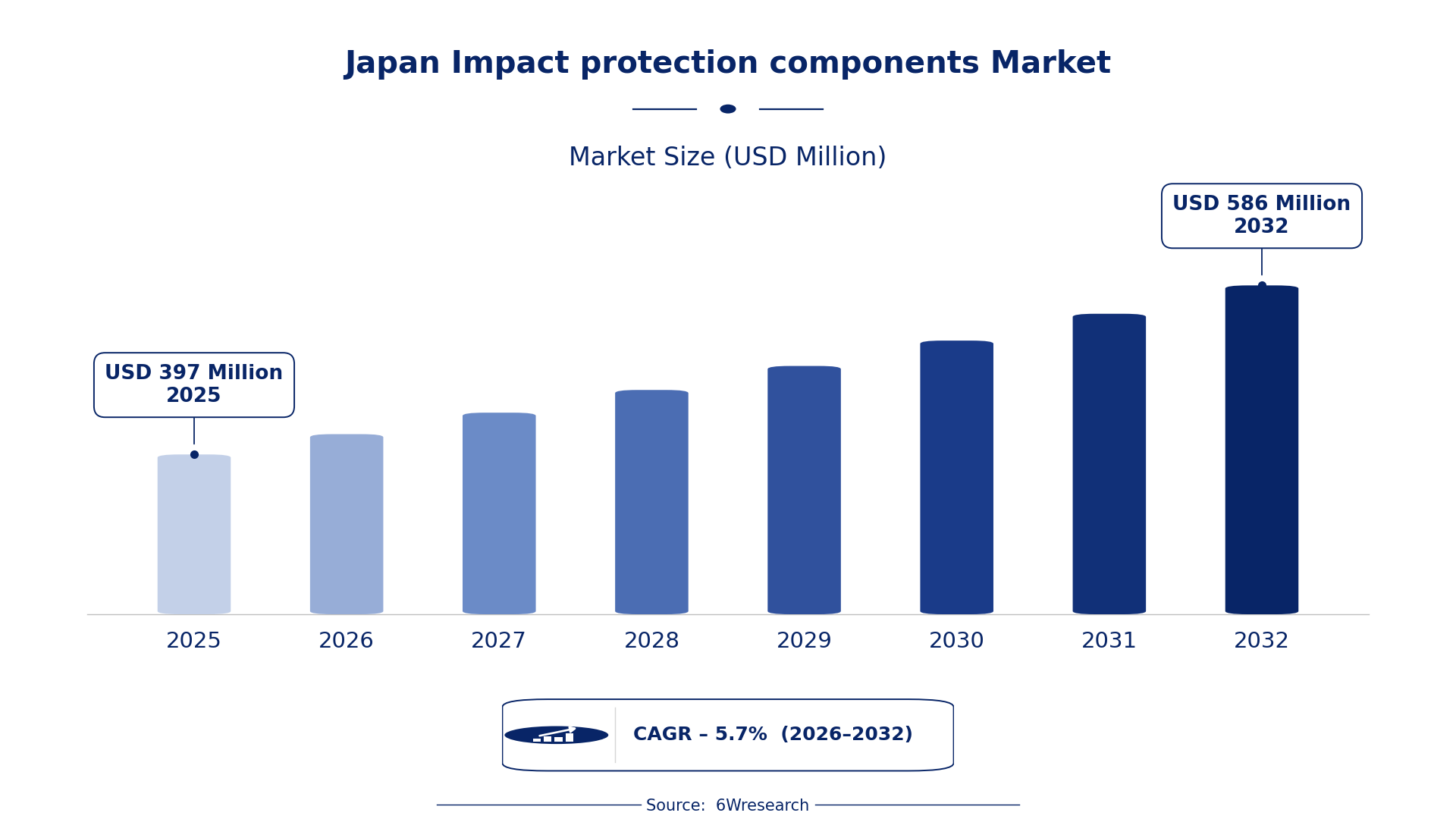
According to 6Wresearch internal database and industry insights, the Japan Impact protection components Market was valued at USD 397 Million in 2025 and is projected to reach USD 586 Million by 2032, growing at a CAGR of approximately 5.7% during 2026–2032.
Japan Impact protection components Market Highlights
| Report Metric | Details |
| Report Name | Japan Impact protection components Market (2026-2032) |
| Market Size 2025 | USD 397 Million |
| Market Size 2032 | USD 586 Million |
| Absolute Growth 2025–2032 | USD 189 Million |
| CAGR 2026–2032 | 5.7% |
| Peak Annual Growth | 6.5% in 2028 |
| Forecast Period | 2026–2032 |
| Historical Data | 2022–2025 |
| Base Year | 2025 |
| Leading Component Type, 2025 | Crumple Zones (51% share) |
| Leading Application Area, 2025 | Passenger Vehicles (43% share) |
| Leading Material Used, 2025 | High-Strength Steel (43% share) |
| Leading End User, 2025 | OEMs (45% share) |
| Fastest-Growing Component Type | Impact-Resistant Bumpers (8.0% CAGR) |
| Fastest-Growing Application Area | Door Assembly (7.1% CAGR) |
| Fastest-Growing Material Used | Composite (8.2% CAGR) |
| Fastest-Growing End User | Tier 1 Suppliers (7.4% CAGR) |
| Growing Sector | automotive safety |
| Key End Users | OEMs, Auto Body Manufacturers, Tier 1 Suppliers |
Japan Impact protection components Market Year-wise Growth Rate and Key Drivers (2022–2032)
This graph illustrates the annual growth rates of the market from 2022 to 2032, highlighting a steady upward trajectory and projected market expansion over the forecast period.
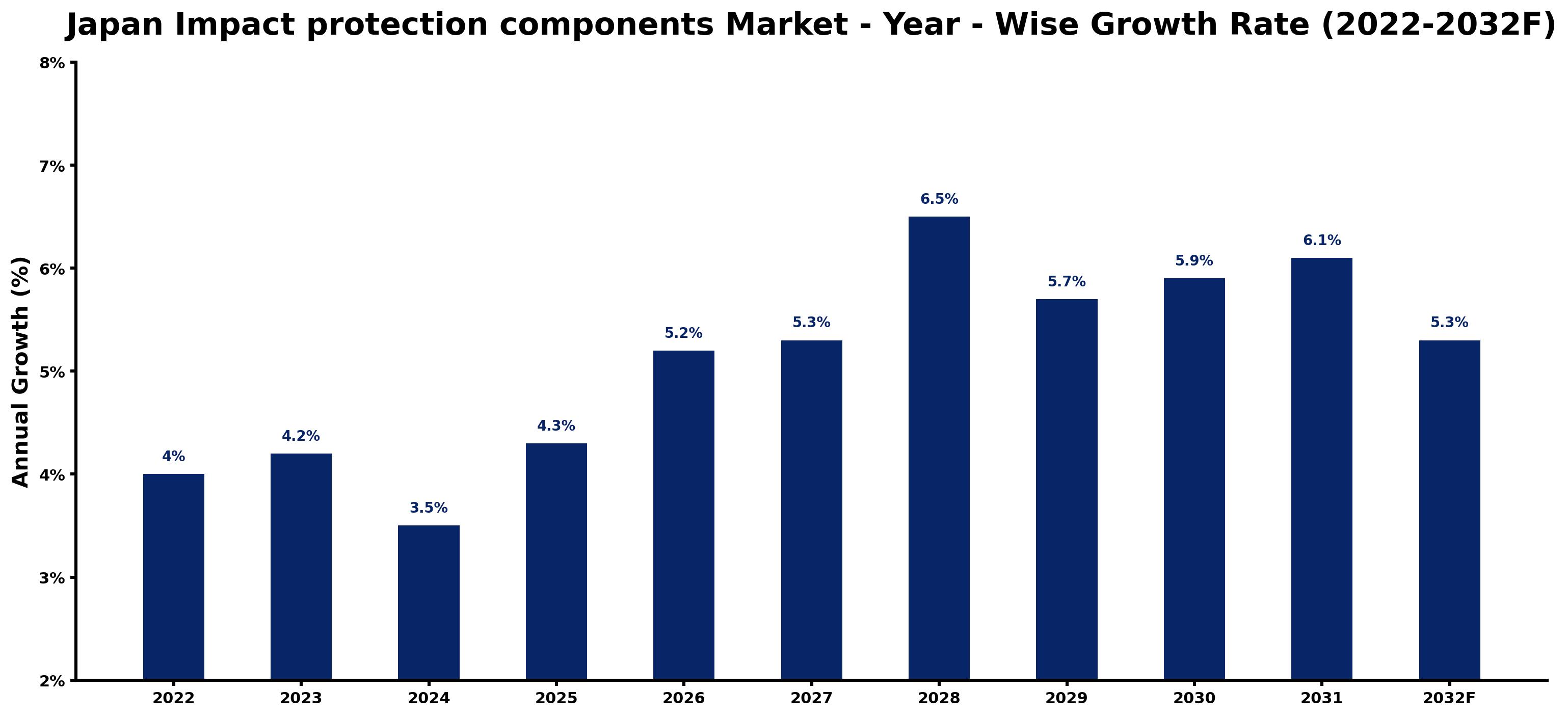
The yearly estimates that follow link every growth rate to its principal driver, so readers can see why the pace changed in each period.
| Year | Estimated Annual Growth (%) | Market Rationale |
| 2022 | 4.0 | The market experienced steady growth, driven by ongoing safety innovations in the automotive sector. |
| 2023 | 4.2 | Demand for impact protection components increased as manufacturers focused on improving vehicle safety features. |
| 2024 | 3.5 | Growth slowed as some manufacturers adjusted production to meet evolving safety standards. |
| 2025 | 4.3 | The market saw a resurgence in growth due to rising safety mandates and consumer awareness. |
| 2026 | 5.2 | Investment in advanced materials is expected to create new demand for impact protection components. |
| 2027 | 5.3 | Increased production capacities will contribute to sustained growth in the automotive safety market. |
| 2028 | 6.5 | The peak growth year will be driven by heightened regulatory standards and consumer safety expectations. |
| 2029 | 5.7 | Growth is projected to slow slightly as manufacturers adapt to new safety regulations and market conditions. |
| 2030 | 5.9 | Demand is expected to rise again as automotive production increases, focusing on safety innovations. |
| 2031 | 6.1 | The market will continue to grow as new technologies in impact protection gain traction. |
| 2032 | 5.3 | Growth is projected to slow as the market stabilises, reflecting maturity in safety component adoption. |
Note: Market size estimations and growth projections presented in this report are based on 6Wresearch's proprietary forecasting methodology, utilizing the latest available industry data, government publications, and primary research inputs.
Japan Impact protection components Market Synopsis
Impact protection components absorb energy during collisions and are primarily constructed from materials such as aluminum, steel, and composites. The Japan Impact Protection Components Market is growing due to stricter safety regulations and increasing consumer demand for vehicle safety. With the automotive sector valued at over $100 billion, domestic manufacturers are prioritising developments that improve safety, especially in passenger vehicles. The rising use of high-strength steel in new models highlights the industry's dedication to safety improvements, driving robust growth in this market.
Market Dynamics Impact Analysis (2026–2032)
| Factor | Type | Impact | Primary Segment Affected |
| Rising safety regulations drive demand for impact protection components in vehicles. | Driver | High | Crumple Zones |
| Increasing consumer awareness of vehicle safety enhances demand for impact protection components. | Driver | High | Impact-Resistant Bumpers |
| Growing automotive production in Japan creates opportunities for suppliers of impact protection components. | Opportunity | High | Passenger Vehicles |
| The shift towards advanced materials presents opportunities for innovation in impact protection components. | Opportunity | Medium | High-Strength Steel |
| Fluctuations in raw material prices can impact the production costs of impact protection components. | Restraint | High | Energy Absorbers |
| Compliance with stringent safety standards requires continuous investment from manufacturers. | Restraint | Medium | Side Impact Beams |
| Limited availability of skilled workforce affects production capacity in the automotive sector. | Challenge | High | OEMs |
| Technological advancements require ongoing investment, which can strain smaller manufacturers. | Challenge | Medium | Automotive Assembly Plants |
Evaluation of Drivers in Japan Impact protection components Market (2026–2032)
Demand rests on the following drivers, each shown with the segment it touches most.
| Drivers | Primary Segment Affected | Why It Matters (Evidence) |
| Increased investment in safety innovations boosts demand for impact protection components. | Crumple Zones | The automotive sector's focus on safety has led to a 15% increase in the adoption of energy-absorbing bumpers. |
| Growing consumer demand for safer vehicles drives manufacturers to improve impact protection features. | Impact-Resistant Bumpers | With automotive production reaching 8.3 million units in 2022, the need for safety components has surged. |
| Rising regulatory standards compel manufacturers to integrate advanced safety features in vehicles. | Energy Absorbers | JIS standard 2236 mandates rigorous testing of impact protection components, increasing their adoption. |
| Technological advancements in materials lead to improved performance of impact protection components. | High-Strength Steel | High-strength steel is now used in 60% of new vehicle models, improving safety and fuel efficiency. |
| The expansion of automotive assembly plants in Japan increases the production of safety components. | Passenger Vehicles | The Tokyo region houses numerous assembly plants focusing on safety innovations. |
A wider customer base explains much of the growth, as increased investment in safety innovations drives demand for impact protection components. The automotive sector's focus on safety features has led to a rise in energy-absorbing bumper adoption, reflecting consumer preferences. With automotive production reaching 8.3 million units in 2022, the need for safety components has surged, while the expansion of assembly plants supports this trend.
Evaluation of Restraints in Japan Impact protection components Market
The main factors holding the market back are set out below.
| Market Restraint | Primary Segment Affected | Why It Matters (Evidence) |
| Fluctuating raw material prices can lead to increased production costs for manufacturers. | Energy Absorbers | The volatility in steel prices can affect profit margins, impacting OEMs' purchasing decisions. |
| Compliance with stringent safety regulations requires ongoing investment from manufacturers. | Side Impact Beams | Manufacturers must invest to meet JIS standard 2236, affecting their budgets. |
| Limited availability of skilled workforce can hinder production capacity in the automotive sector. | OEMs | A shortage of skilled workers may delay the production of impact protection components. |
| Technological advancements require continuous investment, straining smaller manufacturers' resources. | Automotive Assembly Plants | Smaller plants may struggle to keep up with the pace of technological change, affecting competitiveness. |
| Market saturation in certain segments can limit growth opportunities for new entrants. | Crumple Zones | Established players dominate the market, making it difficult for newcomers to gain traction. |
Japan Impact protection components Market Challenges
Japan's automotive industry encounters challenges due to its dependence on local production, leading to delays for buyers in obtaining crucial impact protection components. The concentration of assembly plants in the Tokyo region means that disruptions, such as natural disasters, can extend lead times for manufacturers. Rising costs of high-strength steel have raised production expenses by 10%, affecting profit margins for suppliers. Compliance with JIS standard 2236 necessitates extensive testing, which can prolong production timelines by several weeks, delaying product availability for buyers.
Trends in the Japan Impact protection components Market
Four trends stand out in the Japan Impact protection components Market.
- Shift Towards High-Strength Steel: The automotive sector is increasingly adopting high-strength steel, with 60% of new vehicle models incorporating this material. This shift improves safety and fuel efficiency, providing manufacturers with a competitive edge.
- Rise of Energy-Absorbing Bumpers: The implementation of energy-absorbing bumpers has surged due to safety mandates, with a 15% increase in adoption in recent years. This trend reflects the industry's commitment to improving passenger safety.
- Focus on Advanced Safety Features: The automotive industry is increasingly prioritising advanced safety features, driven by consumer demand and regulatory requirements. The Japan Automobile Manufacturers Association promotes these innovations, improving overall vehicle safety.
- Expansion of Automotive Assembly Plants: The Tokyo region is experiencing notable growth in automotive assembly plants, focusing on safety innovations. With over 1,000 plants, this expansion supports the demand for impact protection components.
Investment Opportunities in the Japan Impact protection components Market
Investors looking at the Japan Impact protection components Market should consider the following areas.
- Growing Demand for Safety Innovations: With Japan's automotive sector valued over $100 billion, there is an opportunity for suppliers of impact protection components to innovate. The focus on safety features is driving demand for new technologies.
- Investment in Advanced Materials: The increasing use of high-strength steel in new models presents an opportunity for suppliers to invest in this material. OEMs are actively seeking partnerships to improve safety features.
- Expansion in the Tokyo Region: The Tokyo region's automotive assembly plants are expanding, creating opportunities for suppliers of impact protection components. This growth is driven by the need for improved safety in vehicles.
- Focus on Compliance with Safety Standards: The stringent safety regulations in Japan create a demand for compliant impact protection components. Suppliers can enter this market by ensuring their products meet JIS standard 2236.
Government Initiatives in the Japan Impact protection components Market
The Economic Security Promotion Act of 2022 supports supply-chain resilience for critical automotive products, including impact protection components. This measure encourages manufacturers to invest in local production capabilities, ensuring a stable supply of essential materials. Compliance with this act is important for manufacturers to maintain their competitive edge in the market.
In 2023, the Japanese government launched a program to improve vehicle safety standards, overseen by the Ministry of Land, Infrastructure, Transport and Tourism. This initiative aims to strengthen safety regulations, benefiting both manufacturers and consumers. The program includes funding for research and development of advanced safety technologies.
Future Insight of the Japan Impact protection components Market
By 2032, advancements in materials technology will shift demand for impact protection components, as manufacturers seek lighter alternatives for improved energy absorption. The government's new vehicle safety program will compel suppliers to adopt stricter safety standards, ensuring compliance with evolving regulations. Adoption of energy-absorbing bumpers is projected to increase by 30% in new vehicle models. Ongoing innovation in the automotive sector will position safety features as key selling points, benefiting both suppliers and buyers.
Market Segmentation Analysis
Japan Impact protection components Market report covers a detailed analysis of the following market segments:
By Component Type – Crumple Zones Lead, Impact-Resistant Bumpers Expected to Grow Fastest
According to Saurav Kr Singh, Senior Research Analyst at 6Wresearch, the largest component type category in 2025 was Crumple Zones, at 51% of revenue. Crumple zones are crucial for energy absorption during collisions, making them indispensable for vehicle safety. Their widespread integration in new vehicle models in Japan underscores their significance to manufacturers and adherence to safety standards. Impact-Resistant Bumpers are projected to grow fastest, at a CAGR of 8.0% during 2026–2032. Impact-resistant bumpers are seeing a marked increase in adoption, with a 15% rise linked to stringent safety mandates. This trend indicates that as regulations tighten, the demand for these bumpers will likely continue to grow. Suppliers should focus on producing impact-resistant bumpers to meet the rising safety requirements.
By Application Area – Passenger Vehicles Lead, Door Assembly Expected to Grow Fastest
Passenger Vehicles took 43% of application area revenue in 2025, more than any other category. Passenger vehicles dominate the market for impact protection components, driven by high production volumes in Japan. This leadership is reinforced by consumer demand for enhanced safety features in personal vehicles. Over 2026–2032, Door Assembly is expected to post the fastest growth, at a CAGR of 7.1%. The door assembly segment is experiencing rapid growth due to its essential role in side impact safety, reflecting a stronger regulatory emphasis. As safety standards advance, this segment is expected to expand further. Buyers should prioritise suppliers with expertise in door assembly to ensure compliance with evolving safety regulations.
By Material Used – High-Strength Steel Leads, Composite Expected to Grow Fastest
In 2025, High-Strength Steel led the material used split with a 43% share. High-strength steel is preferred for its superior strength-to-weight ratio, making it ideal for impact protection applications. Its use in 60% of new vehicle models highlights its leading market position. Composite is set to record the highest CAGR in this split, 8.2% over 2026–2032. Composite materials are increasingly popular in specialised applications, driven by their lightweight and energy-absorbing properties. As manufacturers seek advancements, the demand for composites is anticipated to rise significantly. Suppliers must invest in composite technologies to seize emerging market opportunities.
By End User – OEMs Lead, Tier 1 Suppliers Expected to Grow Fastest
OEMs held 45% of the Japan Impact protection components Market by end user in 2025. OEMs are the primary users of impact protection components, incorporating these features into their vehicle designs. Their substantial presence in the automotive sector solidifies their leading role as end users. The quickest growth will come from Tier 1 Suppliers, forecast to expand at a CAGR of 7.4% between 2026 and 2032. Tier 1 suppliers are rapidly expanding as they supply essential components to OEMs, indicating a shift towards outsourcing in the industry. This trend suggests that Tier 1 suppliers will play a larger role in shaping the supply chain. OEMs should enhance collaborations with Tier 1 suppliers to improve supply chain efficiency and ensure compliance with safety standards.
Key Attractiveness of the Report
- 10 Years of Market Numbers
- Historical Data Starting from 2022 to 2025
- Base Year 2025
- Forecast Data until 2032
- Key Performance Indicators Impacting the Market
- Major Upcoming Developments and Projects
Key Highlights of the Report:
- Japan Impact protection components Market Outlook
- Market Size of Japan Impact protection components Market, 2025
- Forecast of Japan Impact protection components Market, 2032
- Historical Data and Forecast of Japan Impact protection components Revenues & Volume for the Period 2022-2032F
- Japan Impact protection components Market Trend Evolution
- Japan Impact protection components Market Drivers and Challenges
- Japan Impact protection components Price Trends
- Japan Impact protection components Porter's Five Forces
- Japan Impact protection components Industry Life Cycle
- Historical Data and Forecast of Japan Impact protection components Market Revenues & Volume By Component Type for the Period 2022-2032F
- Historical Data and Forecast of Japan Impact protection components Market Revenues & Volume By Crumple Zones for the Period 2022-2032F
- Historical Data and Forecast of Japan Impact protection components Market Revenues & Volume By Side Impact Beams for the Period 2022-2032F
- Historical Data and Forecast of Japan Impact protection components Market Revenues & Volume By Impact-Resistant Bumpers for the Period 2022-2032F
- Historical Data and Forecast of Japan Impact protection components Market Revenues & Volume By Energy Absorbers for the Period 2022-2032F
- Historical Data and Forecast of Japan Impact protection components Market Revenues & Volume By Application Area for the Period 2022-2032F
- Historical Data and Forecast of Japan Impact protection components Market Revenues & Volume By Vehicle Front/Rear for the Period 2022-2032F
- Historical Data and Forecast of Japan Impact protection components Market Revenues & Volume By Door Assembly for the Period 2022-2032F
- Historical Data and Forecast of Japan Impact protection components Market Revenues & Volume By Passenger Vehicles for the Period 2022-2032F
- Historical Data and Forecast of Japan Impact protection components Market Revenues & Volume By Chassis/Frames for the Period 2022-2032F
- Historical Data and Forecast of Japan Impact protection components Market Revenues & Volume By Material Used for the Period 2022-2032F
- Historical Data and Forecast of Japan Impact protection components Market Revenues & Volume By Aluminum, Steel for the Period 2022-2032F
- Historical Data and Forecast of Japan Impact protection components Market Revenues & Volume By High-Strength Steel for the Period 2022-2032F
- Historical Data and Forecast of Japan Impact protection components Market Revenues & Volume By Polypropylene for the Period 2022-2032F
- Historical Data and Forecast of Japan Impact protection components Market Revenues & Volume By Foam, Composite for the Period 2022-2032F
- Historical Data and Forecast of Japan Impact protection components Market Revenues & Volume By End User for the Period 2022-2032F
- Historical Data and Forecast of Japan Impact protection components Market Revenues & Volume By OEMs for the Period 2022-2032F
- Historical Data and Forecast of Japan Impact protection components Market Revenues & Volume By Auto Body Manufacturers for the Period 2022-2032F
- Historical Data and Forecast of Japan Impact protection components Market Revenues & Volume By Tier 1 Suppliers for the Period 2022-2032F
- Historical Data and Forecast of Japan Impact protection components Market Revenues & Volume By Automotive Assembly Plants for the Period 2022-2032F
- Japan Impact protection components Import Export Trade Statistics
- Market Opportunity Assessment By Component Type
- Market Opportunity Assessment By Application Area
- Market Opportunity Assessment By Material Used
- Market Opportunity Assessment By End User
- Japan Impact protection components Top Companies Market Share
- Japan Impact protection components Competitive Benchmarking By Technical and Operational Parameters
- Japan Impact protection components Company Profiles
- Japan Impact protection components Key Strategic Recommendations
Market Covered
This report examines the market across the segments below.
By Component Type
- Crumple Zones
- Side Impact Beams
- Impact-Resistant Bumpers
- Energy Absorbers
By Application Area
- Vehicle Front/Rear
- Door Assembly
- Passenger Vehicles
- Chassis/Frames
By Material Used
- Aluminum
- Steel
- High-Strength Steel
- Polypropylene
- Foam
- Composite
By End User
- OEMs
- Auto Body Manufacturers
- Tier 1 Suppliers
- Automotive Assembly Plants































