Japan Implantable Artificial Kidney Market Size & Growth Rate
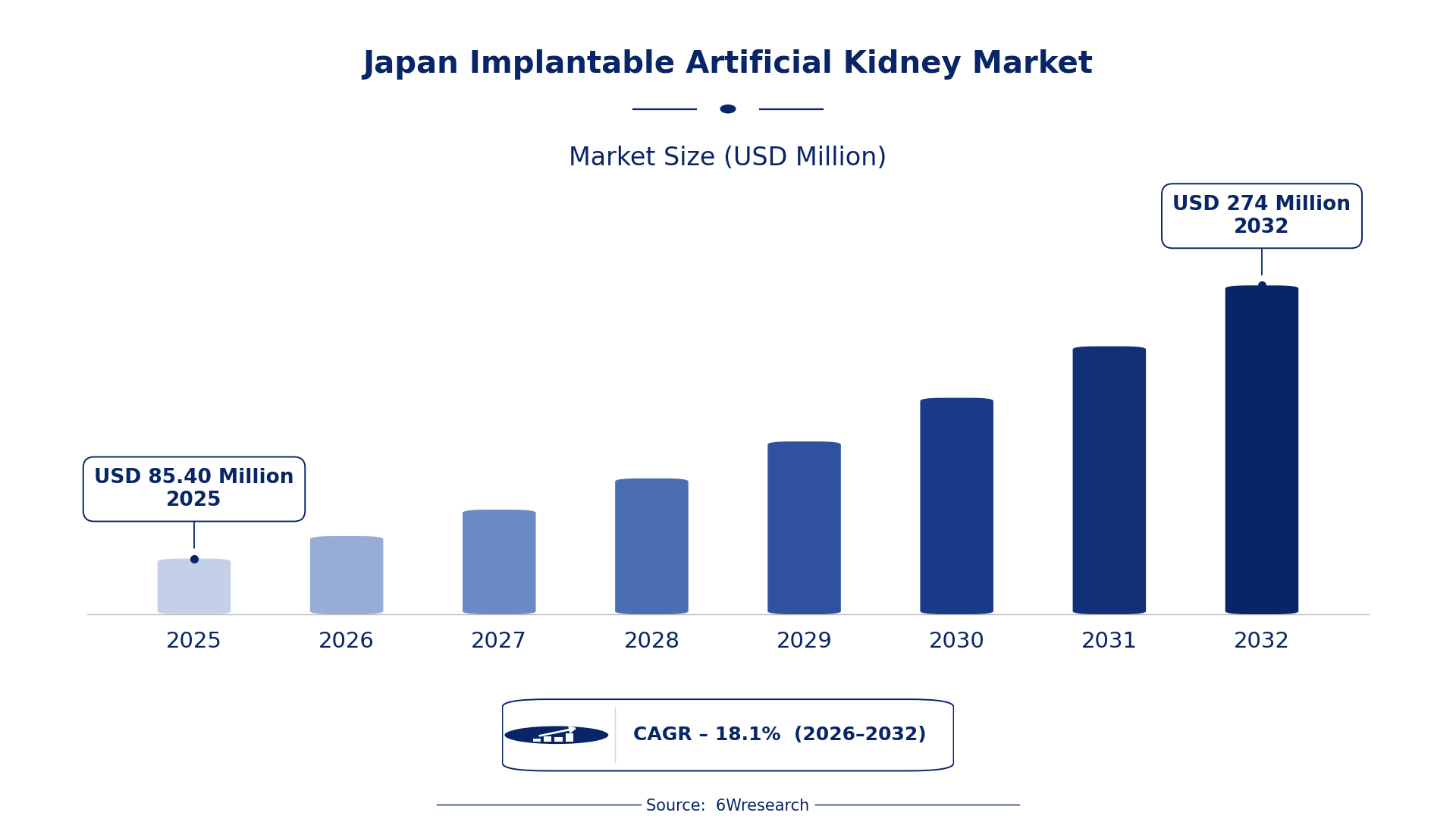
According to 6Wresearch internal database and industry insights, the Japan Implantable Artificial Kidney Market was valued at USD 85.40 Million in 2025 and is projected to reach USD 274 Million by 2032, growing at a CAGR of approximately 18.1% during 2026–2032.
Japan Implantable Artificial Kidney Market Highlights
| Report Metric | Details |
| Report Name | Japan Implantable Artificial Kidney Market (2026-2032) |
| Market Size 2025 | USD 85.40 Million |
| Market Size 2032 | USD 274 Million |
| Absolute Growth 2025–2032 | USD 188.60 Million |
| CAGR 2026–2032 | 18.1% |
| Peak Annual Growth | 25.0% in 2032 |
| Forecast Period | 2026–2032 |
| Historical Data | 2022–2025 |
| Base Year | 2025 |
| Leading Implant Type, 2025 | Biohybrid Devices (44% share) |
| Leading Filtration Method, 2025 | Silicon Membrane + Cells (39% share) |
| Leading Power Source, 2025 | Internal Battery (37% share) |
| Leading End User, 2025 | Renal Care Hospitals (55% share) |
| Fastest-Growing Implant Type | Wearable Artificial Kidney (19.4% CAGR) |
| Fastest-Growing Filtration Method | Portable Filtration (19.2% CAGR) |
| Fastest-Growing Power Source | Rechargeable (20.5% CAGR) |
| Fastest-Growing End User | CKD Patient Services (23.6% CAGR) |
| Growing Sector | Renal Care Services |
| Key End Users | Renal Care Hospitals, CKD Patient Services, Dialysis Replacement Clinics, Academic Medical Centers |
Japan Implantable Artificial Kidney Market Year-wise Growth Rate and Key Drivers (2022–2032)
This graph illustrates the annual growth rates of the market from 2022 to 2032, highlighting a steady upward trajectory and projected market expansion over the forecast period.
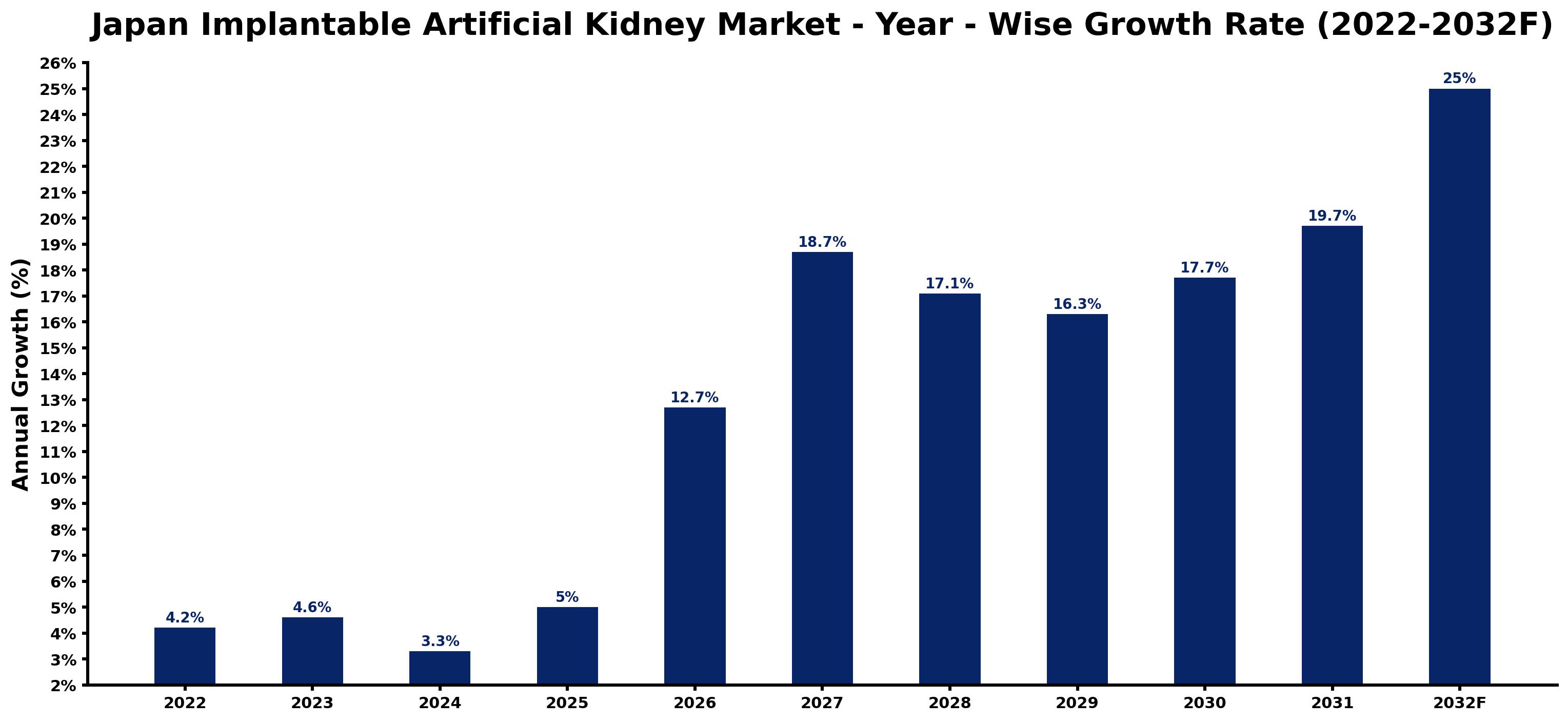
Annual growth estimates for each year appear below with the principal reason behind them, explaining the shifts that set the pace of the market.
| Year | Estimated Annual Growth (%) | Market Rationale |
| 2022 | 4.2 | The market showed stable growth, driven by ongoing healthcare advancements. |
| 2023 | 4.6 | Growth accelerated due to increased awareness of chronic kidney disease management. |
| 2024 | 3.3 | The market experienced a slowdown as competition intensified among healthcare providers. |
| 2025 | 5.0 | Demand surged as more renal care hospitals adopted advanced treatment solutions. |
| 2026 | 12.7 | Growth is expected to accelerate as clinical trials for biohybrid devices expand. |
| 2027 | 18.7 | The market will continue to rise, supported by increased investments in renal health technologies. |
| 2028 | 17.1 | Growth is projected to slow slightly as market saturation begins to affect new product launches. |
| 2029 | 16.3 | The market will maintain growth as CKD patient services expand across regions. |
| 2030 | 17.7 | Demand is expected to increase as the Ministry of Health aims for a 20% reduction in CKD prevalence by 2030. |
| 2031 | 19.7 | Growth will continue with rising investments in advanced renal therapies and technologies. |
| 2032 | 25.0 | The market is projected to peak as biohybrid devices become widely adopted in clinical settings. |
Note: Market size estimations and growth projections presented in this report are based on 6Wresearch's proprietary forecasting methodology, utilizing the latest available industry data, government publications, and primary research inputs.
Japan Implantable Artificial Kidney Market Synopsis
The Implantable Artificial Kidney replicates kidney functions for chronic kidney disease patients, utilising advanced biocompatible materials and filtration methods. The Japan Implantable Artificial Kidney Market is expanding due to the rising prevalence of chronic kidney disease, with approximately 13 million affected individuals. Key drivers include the government's investment of ¥5 billion in renal health initiatives and the launch of a programme to improve renal care services, which stimulates demand among healthcare providers and research institutions.
Market Dynamics Impact Analysis (2026–2032)
| Factor | Type | Impact | Primary Segment Affected |
| Rising prevalence of chronic kidney disease | Driver | High | Biohybrid Devices |
| Government funding for renal health initiatives | Driver | High | CKD Patient Services |
| Increased demand for innovative renal therapies | Opportunity | High | Fully Implantable Device |
| Growing research collaborations in renal health | Opportunity | Medium | Research Prototypes |
| High costs of advanced medical devices | Restraint | High | Wearable Artificial Kidney |
| Limited adoption of portable filtration devices | Restraint | Medium | Portable Filtration |
| Long wait times for kidney transplants | Challenge | High | Dialysis Replacement Clinics |
| Competition among healthcare providers | Challenge | Medium | Academic Medical Centers |
Evaluation of Drivers in Japan Implantable Artificial Kidney Market (2026–2032)
Below are the drivers that matter most for revenue growth, with supporting evidence.
| Drivers | Primary Segment Affected | Why It Matters (Evidence) |
| Increasing CKD patient population | Biohybrid Devices | With approximately 13 million CKD patients, demand for renal replacement therapy rises sharply. |
| Government investment in renal health | CKD Patient Services | The ¥5 billion allocated for renal health initiatives boosts funding for new treatments. |
| Clinical trials for biohybrid devices | Fully Implantable Device | Trials in major hospitals validate the demand for these devices, increasing patient interest. |
| Growing awareness of chronic kidney disease | Renal Care Hospitals | Increased public awareness leads to higher patient referrals to renal care facilities, boosting demand. |
| Research collaborations with universities | Research Prototypes | Collaborations drive the development of new renal therapies, expanding market opportunities. |
Buyers are adding capacity as Tokyo experiences a surge in demand for biohybrid devices, driven by the approximately 13 million individuals affected by chronic kidney disease. Clinical trials for biohybrid devices in major hospitals validate their demand and increase patient referrals. Public awareness of chronic kidney disease leads to higher demand for CKD patient services, while partnerships with universities support the development of new renal therapies.
Evaluation of Restraints in Japan Implantable Artificial Kidney Market
The key brakes on demand, and where they bite hardest, are shown below.
| Market Restraint | Primary Segment Affected | Why It Matters (Evidence) |
| High costs associated with advanced medical devices | Wearable Artificial Kidney | The average cost of implantable devices limits accessibility for many patients, impacting adoption rates. |
| Limited adoption of portable filtration devices | Portable Filtration | Despite testing in clinical settings, portable filtration devices have not yet gained mainstream acceptance. |
| Long wait times for kidney transplants | Dialysis Replacement Clinics | The average wait time for kidney transplants exceeds three years, affecting demand for alternative renal therapies. |
| Intense competition among healthcare providers | Academic Medical Centers | Price wars reduce profitability for providers of renal health services, impacting their ability to invest in new technologies. |
| Regulatory hurdles in device approval | Research Prototypes | Stringent regulations can delay the introduction of new renal therapies to the market. |
Japan Implantable Artificial Kidney Market Challenges
Approval processes for implantable artificial kidneys face delays due to stringent regulations, with compliance to the ISO 13485 standard requiring extensive documentation, costing manufacturers up to ¥1 billion per device. High production costs arise from the advanced biocompatible materials required, which can inflate retail prices for healthcare providers by 30%, restricting patient access. Buyers encounter difficulties as the average wait time for kidney transplants exceeds three years, intensifying the demand for alternative solutions. Supply chain issues emerge as over 1,000 dialysis clinics vie for limited resources, resulting in delays for patients needing timely renal therapies.
Trends in the Japan Implantable Artificial Kidney Market
Below are the shifts with the largest effect on the Japan Implantable Artificial Kidney Market.
- Shift from Traditional Dialysis to Implantable Solutions: Since 2023, renal care hospitals are increasingly adopting implantable artificial kidneys, improving patient quality of life. This shift is evidenced by the government's programme aimed at improving renal care services, which has allocated substantial resources.
- Growing Focus on Research and Development: Academic Medical Centers are prioritising research on biohybrid devices, with multiple prototypes being developed. This trend reflects the need for new solutions in renal therapy, supported by ongoing clinical trials that validate their effectiveness.
- Increased Integration of Technology in Renal Care: The introduction of advanced filtration methods, such as silicon membrane + cells, is transforming renal care practices. This change is evident in clinical settings where these technologies are currently being tested, improving treatment outcomes.
- Emergence of Collaborative Research Initiatives: Collaboration between leading universities and healthcare providers began in 2023, focusing on developing new renal therapies. This initiative aims to improve the effectiveness of treatments available to CKD patients, with promising results.
Investment Opportunities in the Japan Implantable Artificial Kidney Market
Where to invest in the Japan Implantable Artificial Kidney Market: the main openings are set out below.
- Healthcare Providers Seeking Advanced Solutions: Renal care hospitals are looking for advanced treatment options, with the market projected to reach USD 85.40 million by 2025. Investing in biohybrid devices can meet this growing demand.
- Research Institutions Focusing on CKD Solutions: Academic Medical Centers are increasingly prioritising research on renal therapies, with funding opportunities available. Collaborating with these institutions can support product development efforts.
- Investment in Clinical Trials for New Devices: Ongoing clinical trials for biohybrid devices indicate a strong demand for new renal solutions. Suppliers can enter this market by partnering with hospitals conducting these trials.
- Government Support for Renal Health Initiatives: The Japanese government allocated ¥5 billion for renal health initiatives in 2023, creating opportunities for suppliers of renal technologies. Engaging with local partners can facilitate market entry.
Government Initiatives in the Japan Implantable Artificial Kidney Market
The Economic Security Promotion Act supports supply-chain resilience for critical products, including medical devices. This measure encourages manufacturers to improve production capabilities, ensuring a stable supply of implantable artificial kidneys. The act aims to secure domestic manufacturing and reduce dependency on foreign suppliers, benefiting healthcare providers and patients alike.
The Ministry of Health oversees the approval of medical devices and funds initiatives aimed at improving renal health services. This includes supporting clinical trials and research collaborations, ensuring that new technologies meet safety and efficacy standards. The ministry's involvement facilitates quicker access to new renal therapies for healthcare providers.
Future Insight of the Japan Implantable Artificial Kidney Market
The launch of new renal care facilities will enhance service delivery in Japan's healthcare system. By 2032, clinical trials for advanced filtration methods will facilitate broader adoption, improving patient outcomes. The government’s investment of ¥5 billion in renal health initiatives will stimulate advancements in treatment options. Collaborations with leading universities will expedite the development of prototypes, ensuring that suppliers can effectively address the growing demands from healthcare providers.
Market Segmentation Analysis
Japan Implantable Artificial Kidney Market report covers a detailed analysis of the following market segments:
By Implant Type – Biohybrid Devices Lead, Wearable Artificial Kidney Expected to Grow Fastest
According to Saurav Kr Singh, Senior Research Analyst at 6Wresearch, the largest implant type category in 2025 was Biohybrid Devices, at 44% of revenue. Biohybrid devices dominate the market as they are effectively utilised for renal replacement therapy, particularly in urban healthcare settings like Tokyo. Their ongoing development through clinical trials and partnerships with universities solidifies their position as a preferred choice among healthcare providers. Wearable Artificial Kidney is projected to grow fastest, at a CAGR of 19.4% during 2026–2032. The wearable artificial kidney is experiencing rapid growth due to advancements in portable technologies being trialled in clinical environments, with promising outcomes expected soon. This segment's expansion will likely be sustained as the demand for innovative renal therapies continues to rise among patients. Suppliers should prioritise the development and availability of biohybrid devices to align with the increasing requirements of healthcare providers.
By Filtration Method – Silicon Membrane + Cells Lead, Portable Filtration Expected to Grow Fastest
In 2025, Silicon Membrane + Cells led the filtration method split with a 39% share. Silicon membrane combined with cells holds the largest share as it is directly utilised in filtration processes, ensuring effective renal function replication for patients. This method is well-established in existing medical devices, making it a preferred choice among manufacturers. The quickest growth will come from Portable Filtration, forecast to expand at a CAGR of 19.2% between 2026 and 2032. Portable filtration is projected to grow quickly as research into portable devices gains momentum, with clinical trials indicating a shift towards more adaptable solutions for patients. The increasing focus on patient-centric care is driving interest in this segment. Buyers may benefit from exploring portable filtration options as they become more viable, potentially improving patient outcomes.
By Power Source – Internal Battery Leads, Rechargeable Expected to Grow Fastest
Internal Battery accounted for 37% of the market by power source in 2025. The internal battery is the leading power source as it is essential for the operation of implantable devices, ensuring reliable energy for continuous functionality. Its widespread application in current models reinforces its strong market presence among healthcare providers. Over 2026–2032, Rechargeable is expected to post the fastest growth, at a CAGR of 20.5%. Rechargeable power sources are anticipated to grow quickly as they offer convenience for users, aligning with the trend towards more user-friendly medical devices. The increasing demand for sustainable solutions in healthcare is propelling this segment's progress. Suppliers should focus on investing in rechargeable technologies to meet the changing preferences of healthcare providers and patients.
By End User – Renal Care Hospitals Lead, CKD Patient Services Expected to Grow Fastest
Renal Care Hospitals held 55% of the Japan Implantable Artificial Kidney Market by end user in 2025. Renal care hospitals are the primary users of implantable artificial kidneys, catering to a large patient population with essential services. Their established infrastructure and expertise in renal care position them as key players in the market, especially in major regions like Tokyo and Osaka. CKD Patient Services are set to record the highest CAGR in this split, 23.6% over 2026–2032. CKD patient services are rapidly growing as they increasingly facilitate patient management and continuity of care, indicating a shift towards more holistic healthcare solutions. The focus on enhancing patient quality of life is driving this segment's growth. Healthcare providers should enhance CKD patient services to effectively address patient needs and improve overall care delivery.
Key Attractiveness of the Report
- 10 Years of Market Numbers
- Historical Data Starting from 2022 to 2025
- Base Year 2025
- Forecast Data until 2032
- Key Performance Indicators Impacting the Market
- Major Upcoming Developments and Projects
Key Highlights of the Report:
- Japan Implantable Artificial Kidney Market Outlook
- Market Size of Japan Implantable Artificial Kidney Market, 2025
- Forecast of Japan Implantable Artificial Kidney Market, 2032
- Historical Data and Forecast of Japan Implantable Artificial Kidney Revenues & Volume for the Period 2022-2032F
- Japan Implantable Artificial Kidney Market Trend Evolution
- Japan Implantable Artificial Kidney Market Drivers and Challenges
- Japan Implantable Artificial Kidney Price Trends
- Japan Implantable Artificial Kidney Porter's Five Forces
- Japan Implantable Artificial Kidney Industry Life Cycle
- Historical Data and Forecast of Japan Implantable Artificial Kidney Market Revenues & Volume By Implant Type for the Period 2022-2032F
- Historical Data and Forecast of Japan Implantable Artificial Kidney Market Revenues & Volume By Biohybrid Devices for the Period 2022-2032F
- Historical Data and Forecast of Japan Implantable Artificial Kidney Market Revenues & Volume By Wearable Artificial Kidney for the Period 2022-2032F
- Historical Data and Forecast of Japan Implantable Artificial Kidney Market Revenues & Volume By Fully Implantable Device for the Period 2022-2032F
- Historical Data and Forecast of Japan Implantable Artificial Kidney Market Revenues & Volume By Research Prototypes for the Period 2022-2032F
- Historical Data and Forecast of Japan Implantable Artificial Kidney Market Revenues & Volume By Filtration Method for the Period 2022-2032F
- Historical Data and Forecast of Japan Implantable Artificial Kidney Market Revenues & Volume By Silicon Membrane + Cells for the Period 2022-2032F
- Historical Data and Forecast of Japan Implantable Artificial Kidney Market Revenues & Volume By Portable Filtration for the Period 2022-2032F
- Historical Data and Forecast of Japan Implantable Artificial Kidney Market Revenues & Volume By Continuous Hemofiltration for the Period 2022-2032F
- Historical Data and Forecast of Japan Implantable Artificial Kidney Market Revenues & Volume By MEMS + Nanotech Integration for the Period 2022-2032F
- Historical Data and Forecast of Japan Implantable Artificial Kidney Market Revenues & Volume By Power Source for the Period 2022-2032F
- Historical Data and Forecast of Japan Implantable Artificial Kidney Market Revenues & Volume By Internal Battery for the Period 2022-2032F
- Historical Data and Forecast of Japan Implantable Artificial Kidney Market Revenues & Volume By Rechargeable for the Period 2022-2032F
- Historical Data and Forecast of Japan Implantable Artificial Kidney Market Revenues & Volume By Wireless Charging for the Period 2022-2032F
- Historical Data and Forecast of Japan Implantable Artificial Kidney Market Revenues & Volume By Experimental for the Period 2022-2032F
- Historical Data and Forecast of Japan Implantable Artificial Kidney Market Revenues & Volume By End User for the Period 2022-2032F
- Historical Data and Forecast of Japan Implantable Artificial Kidney Market Revenues & Volume By Renal Care Hospitals for the Period 2022-2032F
- Historical Data and Forecast of Japan Implantable Artificial Kidney Market Revenues & Volume By CKD Patient Services for the Period 2022-2032F
- Historical Data and Forecast of Japan Implantable Artificial Kidney Market Revenues & Volume By Dialysis Replacement Clinics for the Period 2022-2032F
- Historical Data and Forecast of Japan Implantable Artificial Kidney Market Revenues & Volume By Academic Medical Centers for the Period 2022-2032F
- Japan Implantable Artificial Kidney Import Export Trade Statistics
- Market Opportunity Assessment By Implant Type
- Market Opportunity Assessment By Filtration Method
- Market Opportunity Assessment By Power Source
- Market Opportunity Assessment By End User
- Japan Implantable Artificial Kidney Top Companies Market Share
- Japan Implantable Artificial Kidney Competitive Benchmarking By Technical and Operational Parameters
- Japan Implantable Artificial Kidney Company Profiles
- Japan Implantable Artificial Kidney Key Strategic Recommendations
Market Covered
The study includes the following segmentation.
By Implant Type
- Biohybrid Devices
- Wearable Artificial Kidney
- Fully Implantable Device
- Research Prototypes
By Filtration Method
- Silicon Membrane + Cells
- Portable Filtration
- Continuous Hemofiltration
- MEMS + Nanotech Integration
By Power Source
- Internal Battery
- Rechargeable
- Wireless Charging
- Experimental
By End User
- Renal Care Hospitals
- CKD Patient Services
- Dialysis Replacement Clinics
- Academic Medical Centers































