Japan Implantable Materials Market Size & Growth Rate
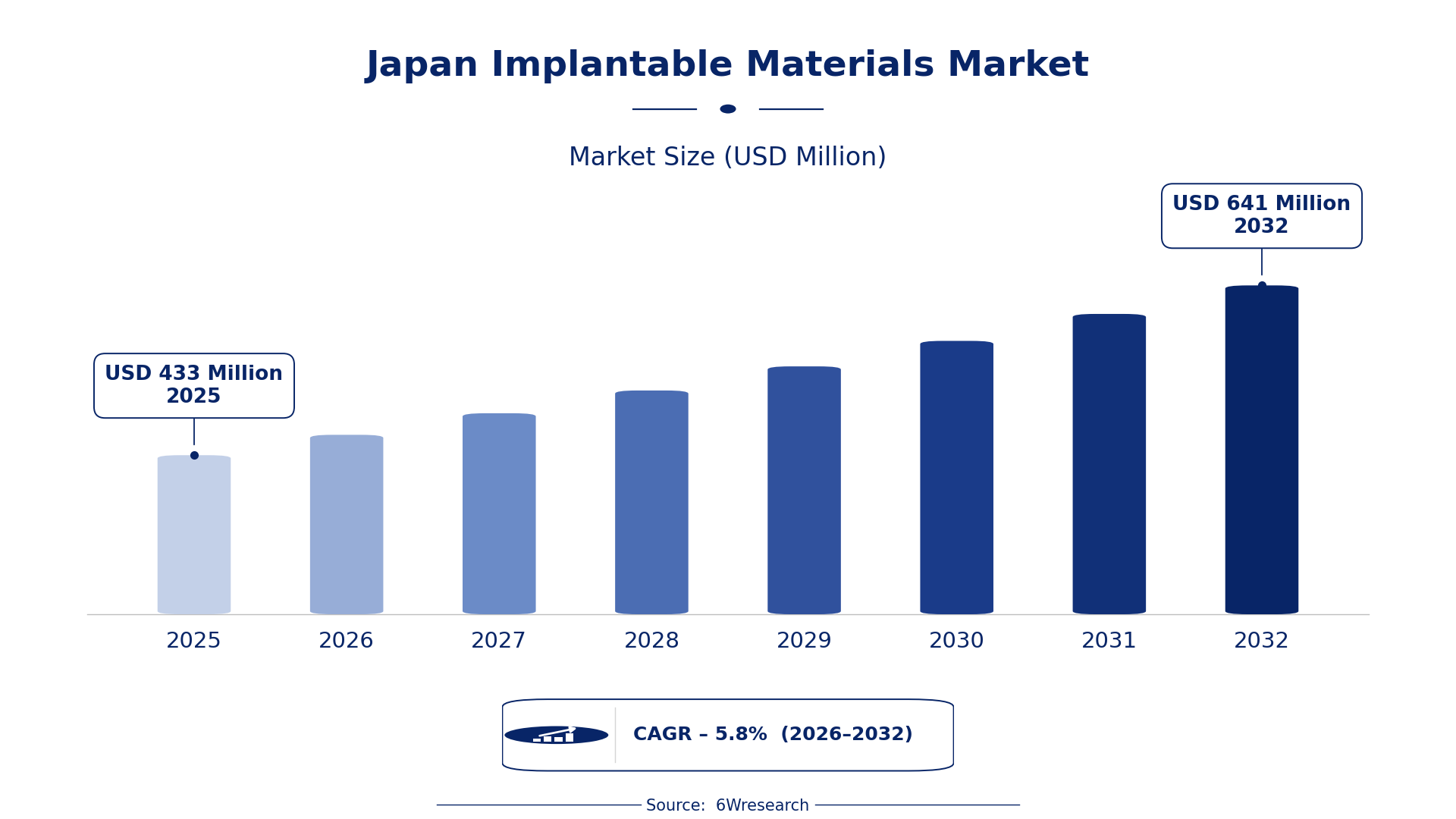
According to 6Wresearch internal database and industry insights, the Japan Implantable Materials Market was valued at USD 433 Million in 2025 and is projected to reach USD 641 Million by 2032, growing at a CAGR of approximately 5.8% during 2026–2032.
Japan Implantable Materials Market Highlights
| Report Metric | Details |
| Report Name | Japan Implantable Materials Market (2026-2032) |
| Market Size 2025 | USD 433 Million |
| Market Size 2032 | USD 641 Million |
| Absolute Growth 2025–2032 | USD 208 Million |
| CAGR 2026–2032 | 5.8% |
| Peak Annual Growth | 6.7% in 2030 |
| Forecast Period | 2026–2032 |
| Historical Data | 2022–2025 |
| Base Year | 2025 |
| Leading Material Type, 2025 | Titanium Alloys (44% share) |
| Leading Use Case, 2025 | Bone/Joint Implants (47% share) |
| Leading Biocompatibility Level, 2025 | Excellent (38% share) |
| Leading End User, 2025 | Orthopedic Implant Firms (40% share) |
| Fastest-Growing Material Type | PEEK (Polyether ether ketone) (8.6% CAGR) |
| Fastest-Growing Use Case | Spinal & Dental (8.4% CAGR) |
| Fastest-Growing End User | Biomedical OEMs (7.9% CAGR) |
| Growing Sector | Orthopedic Surgery |
| Key End Users | Orthopedic Implant Firms, Biomedical OEMs, Medical Material Suppliers |
Japan Implantable Materials Market Year-wise Growth Rate and Key Drivers (2022–2032)
This graph illustrates the annual growth rates of the market from 2022 to 2032, highlighting a steady upward trajectory and projected market expansion over the forecast period.
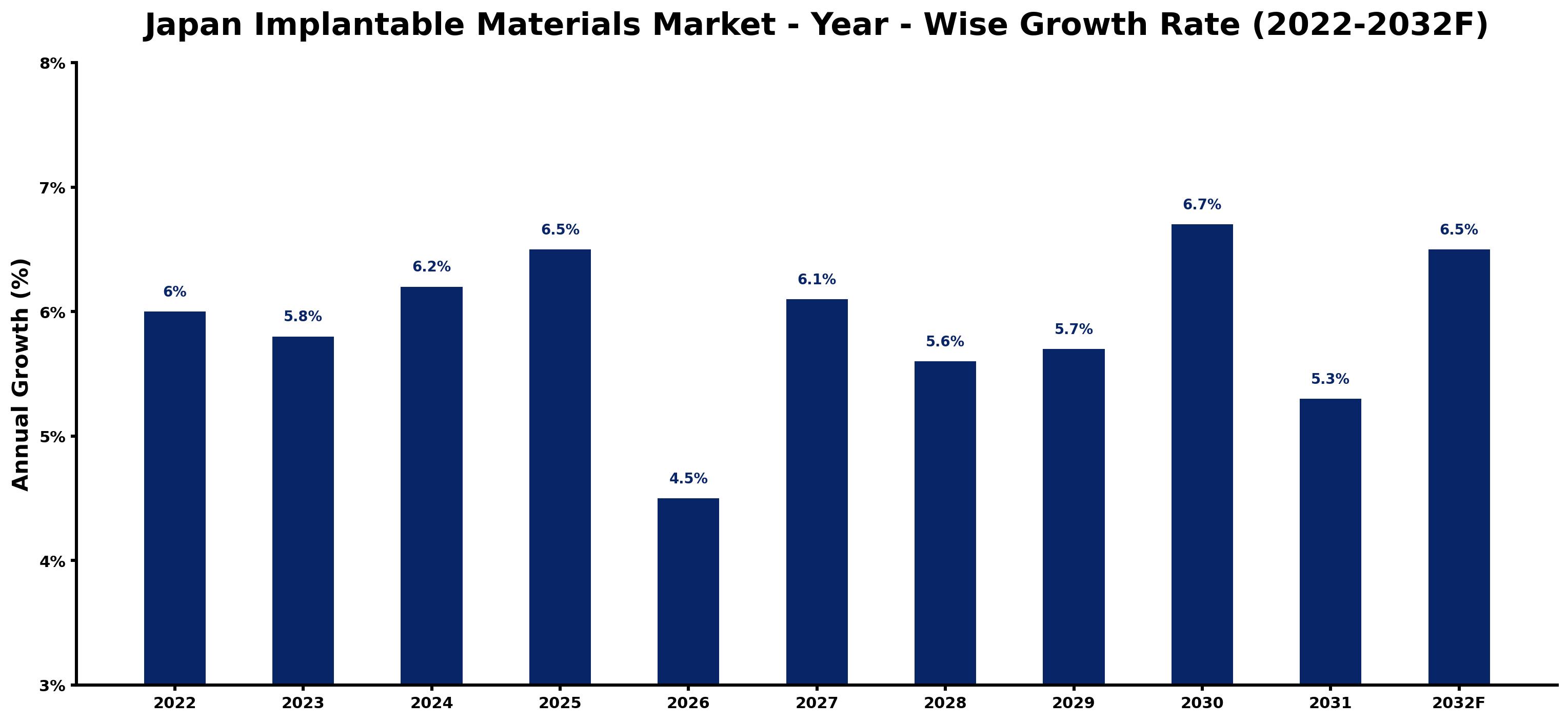
The table below sets out the estimated growth rate for each year and the main factor behind it.
| Year | Estimated Annual Growth (%) | Market Rationale |
| 2022 | 6.0 | The market showed solid growth due to a high number of orthopedic surgeries performed. |
| 2023 | 5.8 | Growth slowed slightly as the market adjusted to previous high demand levels. |
| 2024 | 6.2 | Increased adoption of advanced implant technologies contributed to faster growth. |
| 2025 | 6.5 | The market experienced strong demand driven by the aging population and surgical needs. |
| 2026 | 4.5 | Growth is expected to slow as the market stabilises after rapid expansion in previous years. |
| 2027 | 6.1 | Demand is projected to pick up again with rising investments in biomedical research and development. |
| 2028 | 5.6 | Growth is anticipated to slow as the market faces challenges in supply chain management. |
| 2029 | 5.7 | The market is expected to rebound with new product innovations and increased healthcare spending. |
| 2030 | 6.7 | A surge in demand for advanced implants will lead to the peak growth rate of the forecast period. |
| 2031 | 5.3 | Growth is projected to slow as the market begins to normalise after reaching peak levels. |
| 2032 | 6.5 | The market is expected to grow faster again due to ongoing technological advancements. |
Note: Market size estimations and growth projections presented in this report are based on 6Wresearch's proprietary forecasting methodology, utilizing the latest available industry data, government publications, and primary research inputs.
Japan Implantable Materials Market Synopsis
Implantable materials are biocompatible substances used in medical devices and implants, primarily made from metals, polymers, and ceramics. The Japan Implantable Materials Market is growing due to strong demand from the healthcare sector, particularly in orthopedic surgeries, which saw over 1.2 million procedures in 2022. Ongoing investment in research and development, supported by a government program allocating funds for biocompatible materials, is driving new demand and innovation in the market.
Market Dynamics Impact Analysis (2026–2032)
| Factor | Type | Impact | Primary Segment Affected |
| Aging population increasing demand for orthopedic surgeries | Driver | High | Bone/Joint Implants |
| Growing investments in biomedical research and development | Driver | High | Spinal & Dental |
| Emerging technologies in 3D printing of implants | Opportunity | High | Dental/Orthopedic |
| Rising healthcare expenditure supporting advanced implant adoption | Opportunity | Medium | Orthopedic Implant Firms |
| Regulatory approval processes can delay new product launches | Restraint | High | Bioceramics |
| Limited supply chain for advanced materials may restrict growth | Restraint | Medium | PEEK (Polyether ether ketone) |
| High competition among implant manufacturers affecting pricing | Challenge | High | Titanium Alloys |
| Technological advancements requiring continuous innovation | Challenge | Medium | Silicone-Based Polymers |
Evaluation of Drivers in Japan Implantable Materials Market (2026–2032)
The following drivers explain most of the expected growth.
| Drivers | Primary Segment Affected | Why It Matters (Evidence) |
| Increasing number of orthopedic surgeries | Bone/Joint Implants | Over 1.2 million orthopedic surgeries performed in Japan in 2022 drive demand for implantable materials. |
| Rising healthcare expenditure | Orthopedic Implant Firms | Japan's healthcare expenditure reached approximately 42 trillion yen in 2022, boosting demand for advanced implants. |
| Adoption of 3D printing technologies | Dental/Orthopedic | The government aims to increase the adoption of 3D-printed implants by 2025, improving production capabilities. |
| Growing focus on biocompatibility | Bioceramics | The Japan Institute of Medical Device Technology promotes innovation in biocompatible materials, increasing their use. |
| Collaborations between research institutions and manufacturers | Spinal & Dental | Research initiatives at Tokyo Medical University are driving advancements in implant technologies. |
Purchasing is picking up as the aging population increases the number of orthopedic surgeries, with over 1.2 million performed in 2022. Rising healthcare expenditure, which reached approximately 42 trillion yen, is driving demand for advanced implantable materials. Collaborations between research institutions and manufacturers are further driving innovation in implant materials.
Evaluation of Restraints in Japan Implantable Materials Market
The table below lists the restraints and the evidence behind each.
| Market Restraint | Primary Segment Affected | Why It Matters (Evidence) |
| Regulatory approval processes can take up to 12 months | Titanium Alloys | The lengthy approval process for new implantable materials can delay market entry and affect supply. |
| Limited supply chain for advanced materials | PEEK (Polyether ether ketone) | Supply chain constraints for advanced materials may hinder production and availability of implants. |
| High competition among manufacturers affecting pricing | Bone/Joint Implants | Intense competition can lead to price wars, impacting profitability for producers in the market. |
| Technological advancements require continuous innovation | Silicone-Based Polymers | Manufacturers must invest in R&D to keep up with rapid technological changes, increasing costs. |
| Market saturation in certain implant categories | Bioceramics | An oversupply in some implant categories can lead to reduced demand and lower prices. |
Japan Implantable Materials Market Challenges
Japan's regulatory approval process for new implantable materials can take up to 12 months, delaying product availability for producers and increasing costs for buyers. Limited adoption of advanced technologies, such as 3D printing, restricts innovation in implant design, reducing options for healthcare providers. A shortage of skilled professionals in biomedical engineering creates production bottlenecks, leading to longer lead times for suppliers. High healthcare expenditure, reaching approximately 42 trillion yen in 2022, pressures hospitals to manage budgets, which may limit their ability to invest in new implant technologies.
Trends in the Japan Implantable Materials Market
The shifts below are changing how Japan Implantable Materials Market products are bought and supplied.
- Shift from Traditional to 3D-Printed Implants: Since 2023, the adoption of 3D printing technologies for implantable materials has increased. The government aims to boost the use of 3D-printed implants, targeting a higher market share by 2025.
- Emergence of Biocompatible Materials: The focus on biocompatible materials has intensified since 2022, particularly in orthopedic applications. The Japan Medical Materials Association is promoting advanced biocompatible materials, reflecting a growing market trend.
- Increased Investment in Implant Research: In 2023, there was a notable increase in funding for research on biocompatible materials. This investment is expected to drive innovation and expand the range of available implantable materials.
- Growing Demand for Durable Implants: The demand for durable implantable materials has surged since 2022, particularly in orthopedic surgeries. The average lifespan of orthopedic implants is around 10-15 years, necessitating advancements in material durability.
Investment Opportunities in the Japan Implantable Materials Market
Below are the investment opportunities with the strongest case in the Japan Implantable Materials Market.
- Tokyo as a Hub for Biomedical Research: Tokyo is emerging as a leading hub for biomedical research, with over 1.2 million orthopedic surgeries performed annually. Suppliers should consider partnerships with local research institutions to access this growing market.
- Joint Ventures for Advanced Material Production: Establishing joint ventures with local manufacturers can facilitate entry into the implantable materials market. Collaborating with orthopedic implant firms can improve production capabilities and market reach.
- Supply of Biocompatible Materials: There is a growing need for biocompatible materials in the healthcare sector, particularly for orthopedic applications. Suppliers can target orthopedic implant firms to meet this demand effectively.
- Investment in 3D Printing Facilities: Investment in 3D printing facilities is important as the government aims to increase adoption by 2025. Collaborating with biomedical OEMs can provide access to new production techniques.
Government Initiatives in the Japan Implantable Materials Market
The PRTR Law requires businesses to report on chemical substances, impacting producers of implantable materials by ensuring compliance with safety standards. This regulation promotes transparency and accountability in the manufacturing process, which is vital for maintaining product quality.
The Ministry of Health, Labour and Welfare oversees medical device regulations, ensuring that implantable materials meet safety and efficacy standards. This oversight helps buyers trust the quality of implants, facilitating market growth.
Future Insight of the Japan Implantable Materials Market
A government programme to increase the adoption of 3D-printed implants by 2025 will transform production methods, enabling suppliers to deliver tailored solutions. By 2032, advancements in biocompatible materials will improve patient outcomes, especially in orthopedic and dental applications. The Tokyo region's commitment to biomedical research will drive innovation, resulting in more effective implant designs. As Japan targets a 46% reduction in greenhouse-gas emissions by 2030, sustainable practices in implant production will shape buyers' preferences.
Market Segmentation Analysis
Japan Implantable Materials Market report covers a detailed analysis of the following market segments:
By Material Type – Titanium Alloys Lead, PEEK (Polyether ether ketone) Expected to Grow Fastest
According to Saurav Kr Singh, Senior Research Analyst at 6Wresearch, with 44% of material type revenue in 2025, Titanium Alloys was the largest category. Titanium alloys hold the largest share due to their widespread use in orthopedic and dental implants, valued for their strength and biocompatibility. Their importance is highlighted by their application in over 1.2 million orthopedic surgeries conducted annually in Japan. PEEK (Polyether ether ketone) is projected to grow fastest, at a CAGR of 8.6% during 2026–2032. PEEK is witnessing rapid growth as it becomes more commonly used in spinal implants, thanks to its exceptional durability and flexibility. The government's push to increase the adoption of 3D-printed implants by 2025 is expected to further drive demand for PEEK materials. Suppliers should focus on scaling production of PEEK to meet the growing needs of the spinal implant market.
By Use Case – Bone/Joint Implants Lead, Spinal & Dental Expected to Grow Fastest
Bone/Joint Implants accounted for 47% of the market by use case in 2025. Bone and joint implants dominate the market as they are crucial for orthopedic surgeries and joint replacements, addressing a significant need in Japan's healthcare system. The high volume of orthopedic surgeries performed annually underscores the importance of this segment. Over 2026–2032, Spinal & Dental is expected to post the fastest growth, at a CAGR of 8.4%. The spinal and dental segment is growing the fastest, propelled by an increase in spinal fusion surgeries and dental restorations. This trend is supported by the placement of over 500,000 dental implants each year in Japan. Buyers should seek innovative solutions for spinal and dental applications to take advantage of emerging market trends.
By Biocompatibility Level – Excellent Leads and Records the Fastest Growth
In 2025, Excellent led the biocompatibility level split with a 38% share. The excellent biocompatibility level leads the market as it signifies superior compatibility with human tissue, making it ideal for critical implants. This is particularly relevant given Japan's stringent ISO 13485 standards for medical device quality management. Excellent is also forecast to expand faster than any other category, at a CAGR of 8.1% over 2026–2032. As the leader in biocompatibility, the excellent category also experiences the fastest growth, bolstered by ongoing research validating its use in advanced implant technologies. Government funding for biocompatible materials research further supports this upward trajectory. Suppliers must prioritise the development of materials with excellent biocompatibility to remain competitive in the implantable materials market.
By End User – Orthopedic Implant Firms Lead, Biomedical OEMs Expected to Grow Fastest
Orthopedic Implant Firms took 40% of end user revenue in 2025, more than any other category. Orthopedic implant firms are the primary users of implantable materials, essential for surgeries, thus commanding the largest market share. Their critical role is emphasised by the substantial number of orthopedic surgeries performed in Japan each year. The quickest growth will come from Biomedical OEMs, forecast to expand at a CAGR of 7.9% between 2026 and 2032. Biomedical OEMs represent the fastest-growing segment as they increasingly manufacture devices using implantable materials, reflecting a shift towards advanced medical technologies. This growth is further accelerated by ongoing research and innovation in implant materials. Suppliers should enhance partnerships with biomedical OEMs to capitalise on the rising demand for advanced medical devices.
Key Attractiveness of the Report
- 10 Years of Market Numbers
- Historical Data Starting from 2022 to 2025
- Base Year 2025
- Forecast Data until 2032
- Key Performance Indicators Impacting the Market
- Major Upcoming Developments and Projects
Key Highlights of the Report:
- Japan Implantable Materials Market Outlook
- Market Size of Japan Implantable Materials Market, 2025
- Forecast of Japan Implantable Materials Market, 2032
- Historical Data and Forecast of Japan Implantable Materials Revenues & Volume for the Period 2022-2032F
- Japan Implantable Materials Market Trend Evolution
- Japan Implantable Materials Market Drivers and Challenges
- Japan Implantable Materials Price Trends
- Japan Implantable Materials Porter's Five Forces
- Japan Implantable Materials Industry Life Cycle
- Historical Data and Forecast of Japan Implantable Materials Market Revenues & Volume By Material Type for the Period 2022-2032F
- Historical Data and Forecast of Japan Implantable Materials Market Revenues & Volume By Titanium Alloys for the Period 2022-2032F
- Historical Data and Forecast of Japan Implantable Materials Market Revenues & Volume By PEEK (Polyether ether ketone) for the Period 2022-2032F
- Historical Data and Forecast of Japan Implantable Materials Market Revenues & Volume By Silicone-Based Polymers for the Period 2022-2032F
- Historical Data and Forecast of Japan Implantable Materials Market Revenues & Volume By Bioceramics for the Period 2022-2032F
- Historical Data and Forecast of Japan Implantable Materials Market Revenues & Volume By Use Case for the Period 2022-2032F
- Historical Data and Forecast of Japan Implantable Materials Market Revenues & Volume By Bone/Joint Implants for the Period 2022-2032F
- Historical Data and Forecast of Japan Implantable Materials Market Revenues & Volume By Spinal & Dental for the Period 2022-2032F
- Historical Data and Forecast of Japan Implantable Materials Market Revenues & Volume By Pacemakers, Catheters for the Period 2022-2032F
- Historical Data and Forecast of Japan Implantable Materials Market Revenues & Volume By Dental/Orthopedic for the Period 2022-2032F
- Historical Data and Forecast of Japan Implantable Materials Market Revenues & Volume By Biocompatibility Level for the Period 2022-2032F
- Historical Data and Forecast of Japan Implantable Materials Market Revenues & Volume By High for the Period 2022-2032F
- Historical Data and Forecast of Japan Implantable Materials Market Revenues & Volume By Excellent for the Period 2022-2032F
- Historical Data and Forecast of Japan Implantable Materials Market Revenues & Volume By Flexible/Bio-Stable for the Period 2022-2032F
- Historical Data and Forecast of Japan Implantable Materials Market Revenues & Volume By Non-Toxic, Durable for the Period 2022-2032F
- Historical Data and Forecast of Japan Implantable Materials Market Revenues & Volume By End User for the Period 2022-2032F
- Historical Data and Forecast of Japan Implantable Materials Market Revenues & Volume By Orthopedic Implant Firms for the Period 2022-2032F
- Historical Data and Forecast of Japan Implantable Materials Market Revenues & Volume By Medical Material Suppliers for the Period 2022-2032F
- Historical Data and Forecast of Japan Implantable Materials Market Revenues & Volume By Biomedical OEMs for the Period 2022-2032F
- Historical Data and Forecast of Japan Implantable Materials Market Revenues & Volume By Surgical Product Firms for the Period 2022-2032F
- Japan Implantable Materials Import Export Trade Statistics
- Market Opportunity Assessment By Material Type
- Market Opportunity Assessment By Use Case
- Market Opportunity Assessment By Biocompatibility Level
- Market Opportunity Assessment By End User
- Japan Implantable Materials Top Companies Market Share
- Japan Implantable Materials Competitive Benchmarking By Technical and Operational Parameters
- Japan Implantable Materials Company Profiles
- Japan Implantable Materials Key Strategic Recommendations
Market Covered
Coverage by segment is as follows.
By Material Type
- Titanium Alloys
- PEEK (Polyether ether ketone)
- Silicone-Based Polymers
- Bioceramics
By Use Case
- Bone/Joint Implants
- Spinal & Dental
- Pacemakers
- Catheters
- Dental/Orthopedic
By Biocompatibility Level
- High
- Excellent
- Flexible/Bio-Stable
- Non-Toxic
- Durable
By End User
- Orthopedic Implant Firms
- Medical Material Suppliers
- Biomedical OEMs
- Surgical Product Firms































