Japan In-Cabin Monitoring Sensor Market Size & Growth Rate
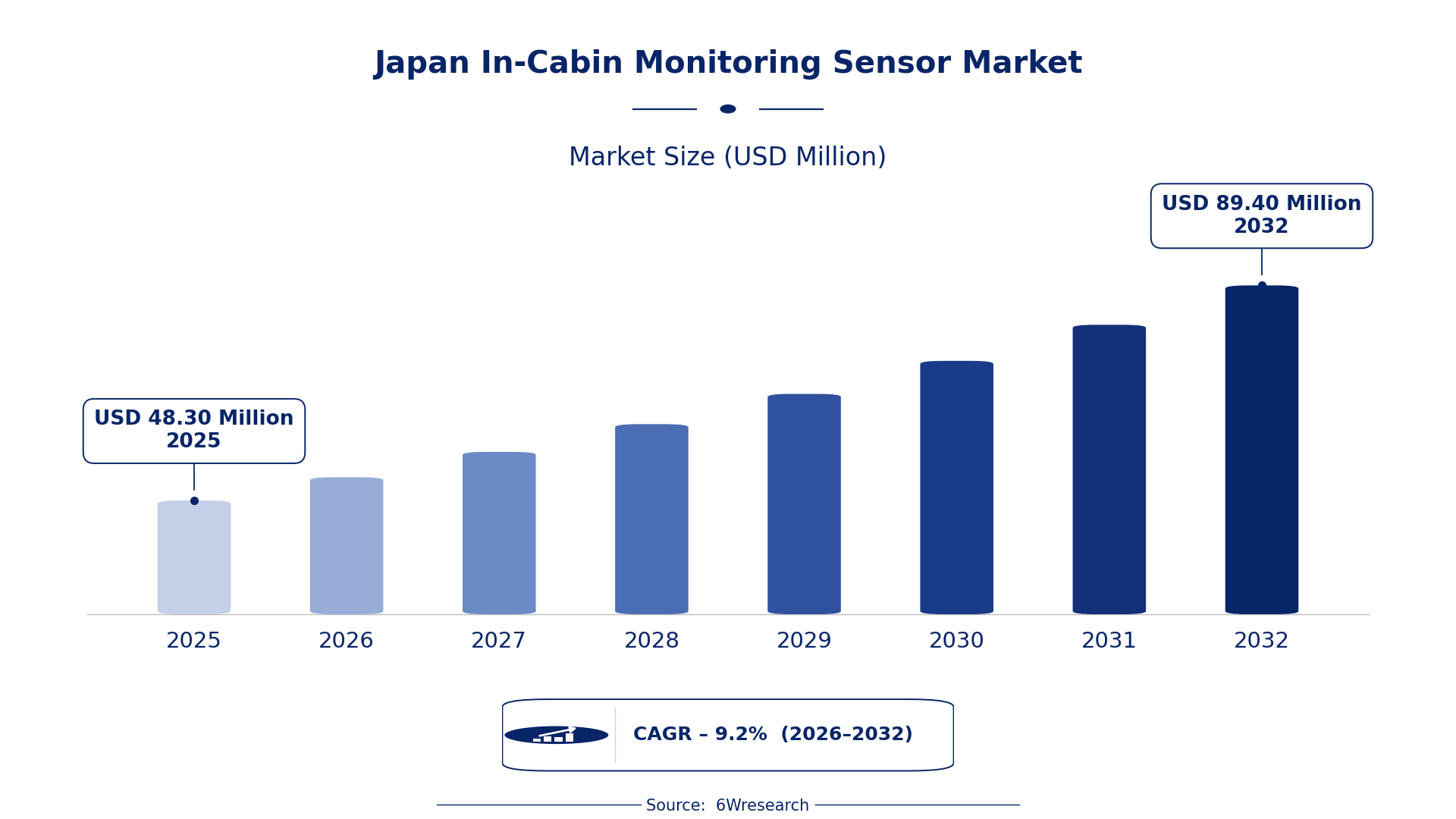
According to 6Wresearch internal database and industry insights, the Japan In-Cabin Monitoring Sensor Market was valued at USD 48.30 Million in 2025 and is projected to reach USD 89.40 Million by 2032, growing at a CAGR of approximately 9.2% during 2026–2032.
Japan In-Cabin Monitoring Sensor Market Highlights
| Report Metric | Details |
| Report Name | Japan In-Cabin Monitoring Sensor Market (2026-2032) |
| Market Size 2025 | USD 48.30 Million |
| Market Size 2032 | USD 89.40 Million |
| Absolute Growth 2025–2032 | USD 41.10 Million |
| CAGR 2026–2032 | 9.2% |
| Peak Annual Growth | 11.4% in 2026 |
| Forecast Period | 2026–2032 |
| Historical Data | 2022–2025 |
| Base Year | 2025 |
| Leading Monitoring Type, 2025 | Driver Monitoring (47% share) |
| Leading Sensor Technology, 2025 | Camera + Infrared (44% share) |
| Leading Application Area, 2025 | Drowsiness (34% share) |
| Leading End User, 2025 | ADAS Developers (48% share) |
| Fastest-Growing Monitoring Type | Occupant Detection (12.3% CAGR) |
| Fastest-Growing Sensor Technology | Ultrasonic + Pressure (13.2% CAGR) |
| Fastest-Growing Application Area | Distraction (11.1% CAGR) |
| Fastest-Growing End User | Automotive OEMs (11.8% CAGR) |
| Growing Sector | automotive safety technology |
| Key End Users | ADAS Developers, Automotive OEMs, Autonomous Vehicle Makers |
Japan In-Cabin Monitoring Sensor Market Year-wise Growth Rate and Key Drivers (2022–2032)
This graph illustrates the annual growth rates of the market from 2022 to 2032, highlighting a steady upward trajectory and projected market expansion over the forecast period.
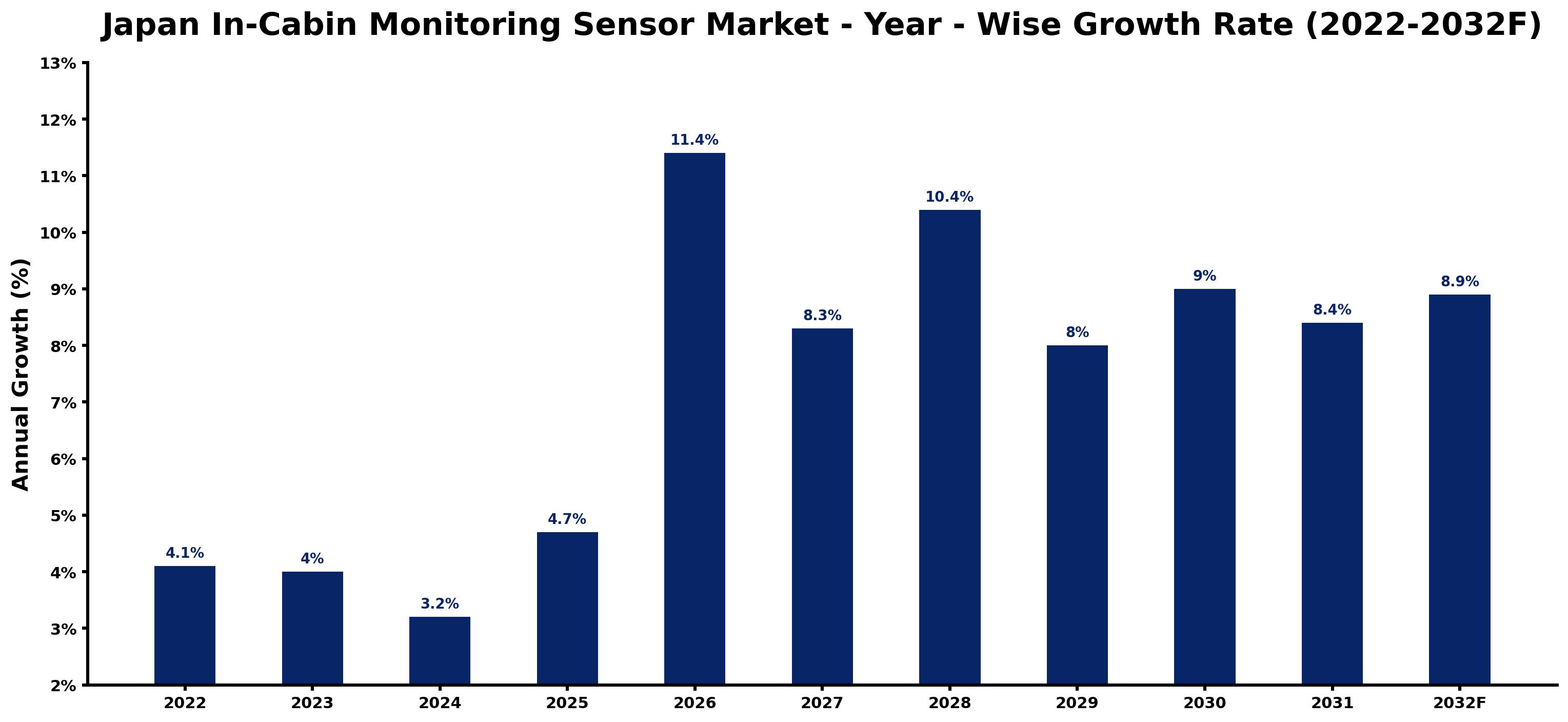
Below, each year's estimated growth is shown next to the factor that most influenced it.
| Year | Estimated Annual Growth (%) | Market Rationale |
| 2022 | 4.1 | The market exhibited steady demand from automotive manufacturers, reflecting ongoing safety concerns. |
| 2023 | 4.0 | Growth slowed as the market adjusted to previous highs, with demand stabilising. |
| 2024 | 3.2 | The market continued to expand, albeit at a slower pace, as new regulations emerged. |
| 2025 | 4.7 | Growth accelerated due to increased adoption of driver monitoring systems in vehicles. |
| 2026 | 11.4 | Demand is expected to surge as automotive safety regulations become stricter, driving technology investments. |
| 2027 | 8.3 | Growth is projected to slow as the market matures, with demand stabilising around established technologies. |
| 2028 | 10.4 | The market is expected to rebound with renewed interest in advanced safety features and technologies. |
| 2029 | 8.0 | Growth will decelerate as the market faces saturation in certain segments. |
| 2030 | 9.0 | Demand will increase as new automotive safety standards are introduced, encouraging upgrades. |
| 2031 | 8.4 | Growth is projected to moderate due to market saturation, with established technologies dominating. |
| 2032 | 8.9 | The market is expected to grow as new technologies are integrated into vehicles. |
Note: Market size estimations and growth projections presented in this report are based on 6Wresearch's proprietary forecasting methodology, utilizing the latest available industry data, government publications, and primary research inputs.
Japan In-Cabin Monitoring Sensor Market Synopsis
In-Cabin Monitoring Sensors are advanced systems designed to improve vehicle safety and user experience by monitoring driver and passenger behaviour. These systems utilise cameras and infrared sensors to detect drowsiness, distraction, and vital signs. The Japan In-Cabin Monitoring Sensor Market is expanding due to heightened demand from automotive manufacturers, driven by stringent safety regulations and technological advancements.
Market Dynamics Impact Analysis (2026–2032)
| Factor | Type | Impact | Primary Segment Affected |
| Increasing adoption of driver monitoring systems due to safety regulations | Driver | High | Driver Monitoring |
| Rising demand for occupant detection systems driven by safety standards | Driver | High | Occupant Detection |
| Growing investment in automotive safety technologies | Opportunity | High | ADAS Developers |
| Emerging need for advanced monitoring solutions in autonomous vehicles | Opportunity | High | Autonomous Vehicle Makers |
| Regulatory compliance costs impacting manufacturers | Restraint | High | Driver Monitoring |
| Limited integration of advanced technologies in older vehicle models | Restraint | Medium | Occupant Detection |
| Supply chain disruptions affecting semiconductor availability | Challenge | High | ADAS Developers |
| Competition from alternative safety technologies delaying adoption | Challenge | Medium | Autonomous Vehicle Makers |
Evaluation of Drivers in Japan In-Cabin Monitoring Sensor Market (2026–2032)
Key forces behind demand, with the segment each one moves most, are listed below.
| Drivers | Primary Segment Affected | Why It Matters (Evidence) |
| Increased focus on vehicle safety regulations | Driver Monitoring | The adoption rate of driver monitoring systems in new vehicles reached 30% in 2023, prompting manufacturers to invest in compliance. |
| Rising consumer awareness of safety features | Occupant Detection | Japan's automotive sector produced 8.3 million vehicles in 2022, leading to higher demand for safety technologies. |
| Technological advancements in sensor technology | Camera + Infrared | The Tokyo region is a major hub for automotive technology development, driving innovation in monitoring systems. |
| Expansion of advanced driver assistance systems (ADAS) | ADAS Developers | The Japan Automobile Manufacturers Association promotes safety technologies, increasing demand for monitoring solutions. |
| Government initiatives supporting automotive safety | Occupant Detection | The 'Smart Mobility Challenge' programme launched in 2023 aims to improve vehicle safety standards. |
Consumer awareness of safety features drives demand, as Japan's automotive sector produced 8.3 million vehicles in 2022. In the Tokyo region, significant investments in automotive technology development are enhancing the capabilities of in-cabin monitoring systems.
Evaluation of Restraints in Japan In-Cabin Monitoring Sensor Market
The main factors holding the market back are set out below.
| Market Restraint | Primary Segment Affected | Why It Matters (Evidence) |
| Regulatory compliance costs impacting manufacturers | Driver Monitoring | Compliance with safety regulations increases production costs, affecting profit margins for manufacturers. |
| Limited integration of advanced technologies in older vehicle models | Occupant Detection | Older vehicles often lack the necessary infrastructure to support advanced monitoring systems, limiting market reach. |
| Supply chain disruptions affecting semiconductor availability | ADAS Developers | Shortages in semiconductor supply have delayed production timelines, impacting the availability of monitoring systems. |
| Competition from alternative safety technologies delaying adoption | Autonomous Vehicle Makers | Emerging technologies may divert investment away from in-cabin monitoring systems, slowing their adoption. |
| Market saturation in established segments | Driver Monitoring | As the market matures, growth potential in established segments like driver monitoring may diminish. |
Japan In-Cabin Monitoring Sensor Market Challenges
A shortage of skilled technicians hampers the production of in-cabin monitoring sensors, as educational institutions struggle to keep pace with automotive technology advancements. Increased production costs arise from Japan's minimum wage rising to JPY 1,055 per hour, squeezing the profit margins of sensor manufacturers and forcing them to adjust pricing strategies. Supply chain disruptions occur due to reliance on a limited number of suppliers for critical components, causing delays in sensor delivery for automotive producers. Integration challenges persist because many vehicles lack the necessary infrastructure for modern monitoring systems, leading to elevated retrofitting costs for manufacturers.
Trends in the Japan In-Cabin Monitoring Sensor Market
Buyers and suppliers in the Japan In-Cabin Monitoring Sensor Market are adjusting to the following trends.
- Shift Towards Improved Driver Safety: Automotive manufacturers are increasingly prioritising driver safety features, as seen in the 30% adoption rate of driver monitoring systems in 2023. This trend reflects a growing commitment to safety in vehicle design.
- Transition from Traditional to Advanced Monitoring Technologies: The introduction of advanced monitoring technologies has gained momentum since the launch of the 'Smart Mobility Challenge' programme in 2023. This shift is driving innovation in vehicle safety features.
- Drowsiness Detection Gaining Prominence: Drowsiness detection systems are becoming a standard feature in vehicles, with a 34% market share in 2025. This trend highlights the importance of addressing driver fatigue in safety protocols.
- Increased Focus on Occupant Detection Systems: The demand for occupant detection systems is rising due to new safety regulations, with a projected growth rate of 12.3% from 2026 to 2032. This shift underscores the importance of passenger safety.
Investment Opportunities in the Japan In-Cabin Monitoring Sensor Market
The opportunities below stand out in the Japan In-Cabin Monitoring Sensor Market for new entrants and existing suppliers.
- ADAS Developers Seeking Advanced Solutions: ADAS Developers are looking for advanced in-cabin monitoring solutions, with the market projected to reach USD 48.30 million by 2025. Collaborating with local technology firms can facilitate market entry.
- Investment in Occupant Detection Technologies: Investment in occupant detection technologies is rising due to new safety regulations. The Tokyo region, a hub for automotive innovation, offers opportunities for partnerships.
- Expansion in Autonomous Vehicle Monitoring: The autonomous vehicle sector presents opportunities for advanced monitoring systems, with a projected market growth of 9.2% from 2026 to 2032. Engaging with industry stakeholders can improve market presence.
- Development of Integrated Safety Systems: There is a growing need for integrated safety systems in vehicles, driven by consumer demand for enhanced safety features. Collaborating with automotive OEMs can lead to successful product launches.
Government Initiatives in the Japan In-Cabin Monitoring Sensor Market
The Industrial Standardization Act, established in 1949 and amended in 2019, governs product and test standards for automotive sensors, ensuring compliance with safety regulations. This law mandates that manufacturers adhere to specific testing and certification processes, impacting their production methods and costs.
The 'Smart Mobility Challenge' programme, launched in 2023, aims to improve vehicle safety through advanced technologies. The Ministry of Land, Infrastructure, Transport and Tourism oversees this initiative, providing funding and support for projects that enhance in-cabin monitoring systems.
Future Insight of the Japan In-Cabin Monitoring Sensor Market
By 2032, policy shifts will drive a significant increase in vehicle safety technologies, prompting suppliers to innovate in response to new regulations. The installed base of vehicles with monitoring systems is projected to reach 1 million by 2025, indicating a robust market for these solutions. Enhanced collaboration in the Tokyo region will stimulate advancements in automotive technology. The government’s initiatives will encourage the development of comprehensive safety standards, benefiting both buyers and suppliers in the evolving automotive landscape.
Market Segmentation Analysis
Japan In-Cabin Monitoring Sensor Market report covers a detailed analysis of the following market segments:
By Monitoring Type – Driver Monitoring Leads, Occupant Detection Expected to Grow Fastest
According to Saurav Kr Singh, Senior Research Analyst at 6Wresearch, in 2025, Driver Monitoring led the monitoring type split with a 47% share. Driver Monitoring holds the largest share due to its essential role in ensuring safety and compliance with regulations. The installed base of vehicles with monitoring systems is projected to reach 1 million by 2025, indicating strong market reliance on this technology. Occupant Detection is projected to grow fastest, at a CAGR of 12.3% during 2026–2032. Occupant Detection is experiencing rapid growth as new safety regulations increase the demand for passenger safety features. The Ministry of Land, Infrastructure, Transport and Tourism's oversight of vehicle safety regulations is a key factor driving this segment's expansion. Suppliers should focus on developing occupant detection technologies to meet regulatory requirements.
By Sensor Technology – Camera + Infrared Leads, Ultrasonic + Pressure Expected to Grow Fastest
Camera + Infrared took 44% of sensor technology revenue in 2025, more than any other category. Camera + Infrared technology leads the market as it is widely used for effective monitoring of driver and passenger behaviour. Its integration into various vehicle models ensures a strong demand and established presence in the automotive sector. Ultrasonic + Pressure is set to record the highest CAGR in this split, 13.2% over 2026–2032. Ultrasonic + Pressure sensors are witnessing the fastest growth due to their application in specific safety features that are becoming more prevalent. The government's initiatives for advanced automotive technologies further stimulate this segment's rise. Buyers should consider incorporating Ultrasonic + Pressure sensors to enhance vehicle safety features.
By Application Area – Drowsiness Leads, Distraction Expected to Grow Fastest
With 34% of application area revenue in 2025, Drowsiness was the largest category. Drowsiness detection is the leading application area as it is critical for ensuring driver safety and preventing accidents. The increasing focus on driver monitoring systems highlights its importance in the automotive sector. Over 2026–2032, Distraction is expected to post the fastest growth, at a CAGR of 11.1%. Distraction detection is growing rapidly as it is vital for accident prevention, reflecting heightened awareness of driver behaviour. This trend is supported by ongoing safety initiatives and advancements in monitoring technologies. Suppliers must prioritise distraction detection solutions to align with emerging safety standards.
By End User – ADAS Developers Lead, Automotive OEMs Expected to Grow Fastest
ADAS Developers accounted for 48% of the market by end user in 2025. ADAS Developers dominate the market as they are the primary users of monitoring technology, integrating these systems into advanced driver assistance systems. Their focus on safety and compliance drives the demand for in-cabin monitoring sensors. The quickest growth will come from Automotive OEMs, forecast to expand at a CAGR of 11.8% between 2026 and 2032. Automotive OEMs are experiencing the fastest growth as they increasingly adopt in-cabin monitoring technologies in new vehicle models. This trend aligns with the industry's broader push for enhanced safety features. Suppliers should strengthen collaborations with Automotive OEMs to capitalise on the growing demand for monitoring systems.
Key Attractiveness of the Report
- 10 Years of Market Numbers
- Historical Data Starting from 2022 to 2025
- Base Year 2025
- Forecast Data until 2032
- Key Performance Indicators Impacting the Market
- Major Upcoming Developments and Projects
Key Highlights of the Report:
- Japan In-Cabin Monitoring Sensor Market Outlook
- Market Size of Japan In-Cabin Monitoring Sensor Market, 2025
- Forecast of Japan In-Cabin Monitoring Sensor Market, 2032
- Historical Data and Forecast of Japan In-Cabin Monitoring Sensor Revenues & Volume for the Period 2022-2032F
- Japan In-Cabin Monitoring Sensor Market Trend Evolution
- Japan In-Cabin Monitoring Sensor Market Drivers and Challenges
- Japan In-Cabin Monitoring Sensor Price Trends
- Japan In-Cabin Monitoring Sensor Porter's Five Forces
- Japan In-Cabin Monitoring Sensor Industry Life Cycle
- Historical Data and Forecast of Japan In-Cabin Monitoring Sensor Market Revenues & Volume By Monitoring Type for the Period 2022-2032F
- Historical Data and Forecast of Japan In-Cabin Monitoring Sensor Market Revenues & Volume By Driver Monitoring for the Period 2022-2032F
- Historical Data and Forecast of Japan In-Cabin Monitoring Sensor Market Revenues & Volume By Occupant Detection for the Period 2022-2032F
- Historical Data and Forecast of Japan In-Cabin Monitoring Sensor Market Revenues & Volume By Vital Sign Monitoring for the Period 2022-2032F
- Historical Data and Forecast of Japan In-Cabin Monitoring Sensor Market Revenues & Volume By Gesture Recognition for the Period 2022-2032F
- Historical Data and Forecast of Japan In-Cabin Monitoring Sensor Market Revenues & Volume By Sensor Technology for the Period 2022-2032F
- Historical Data and Forecast of Japan In-Cabin Monitoring Sensor Market Revenues & Volume By Camera + Infrared for the Period 2022-2032F
- Historical Data and Forecast of Japan In-Cabin Monitoring Sensor Market Revenues & Volume By Ultrasonic + Pressure for the Period 2022-2032F
- Historical Data and Forecast of Japan In-Cabin Monitoring Sensor Market Revenues & Volume By Radar, Thermal Sensors for the Period 2022-2032F
- Historical Data and Forecast of Japan In-Cabin Monitoring Sensor Market Revenues & Volume By 3D Cameras/ToF for the Period 2022-2032F
- Historical Data and Forecast of Japan In-Cabin Monitoring Sensor Market Revenues & Volume By Application Area for the Period 2022-2032F
- Historical Data and Forecast of Japan In-Cabin Monitoring Sensor Market Revenues & Volume By Drowsiness, Distraction for the Period 2022-2032F
- Historical Data and Forecast of Japan In-Cabin Monitoring Sensor Market Revenues & Volume By Child Presence, Safety for the Period 2022-2032F
- Historical Data and Forecast of Japan In-Cabin Monitoring Sensor Market Revenues & Volume By Heart/Respiratory Rate for the Period 2022-2032F
- Historical Data and Forecast of Japan In-Cabin Monitoring Sensor Market Revenues & Volume By Infotainment Interaction for the Period 2022-2032F
- Historical Data and Forecast of Japan In-Cabin Monitoring Sensor Market Revenues & Volume By End User for the Period 2022-2032F
- Historical Data and Forecast of Japan In-Cabin Monitoring Sensor Market Revenues & Volume By ADAS Developers for the Period 2022-2032F
- Historical Data and Forecast of Japan In-Cabin Monitoring Sensor Market Revenues & Volume By Automotive OEMs for the Period 2022-2032F
- Historical Data and Forecast of Japan In-Cabin Monitoring Sensor Market Revenues & Volume By Autonomous Vehicle Makers for the Period 2022-2032F
- Historical Data and Forecast of Japan In-Cabin Monitoring Sensor Market Revenues & Volume By Interior System Integrators for the Period 2022-2032F
- Japan In-Cabin Monitoring Sensor Import Export Trade Statistics
- Market Opportunity Assessment By Monitoring Type
- Market Opportunity Assessment By Sensor Technology
- Market Opportunity Assessment By Application Area
- Market Opportunity Assessment By End User
- Japan In-Cabin Monitoring Sensor Top Companies Market Share
- Japan In-Cabin Monitoring Sensor Competitive Benchmarking By Technical and Operational Parameters
- Japan In-Cabin Monitoring Sensor Company Profiles
- Japan In-Cabin Monitoring Sensor Key Strategic Recommendations
Market Covered
Coverage by segment is as follows.
By Monitoring Type
- Driver Monitoring
- Occupant Detection
- Vital Sign Monitoring
- Gesture Recognition
By Sensor Technology
- Camera + Infrared
- Ultrasonic + Pressure
- Radar
- Thermal Sensors
- 3D Cameras/ToF
By Application Area
- Drowsiness
- Distraction
- Child Presence
- Safety
- Heart/Respiratory Rate
- Infotainment Interaction
By End User
- ADAS Developers
- Automotive OEMs
- Autonomous Vehicle Makers
- Interior System Integrators































