Japan In-Cabin Proximity Sensor Market Size & Growth Rate
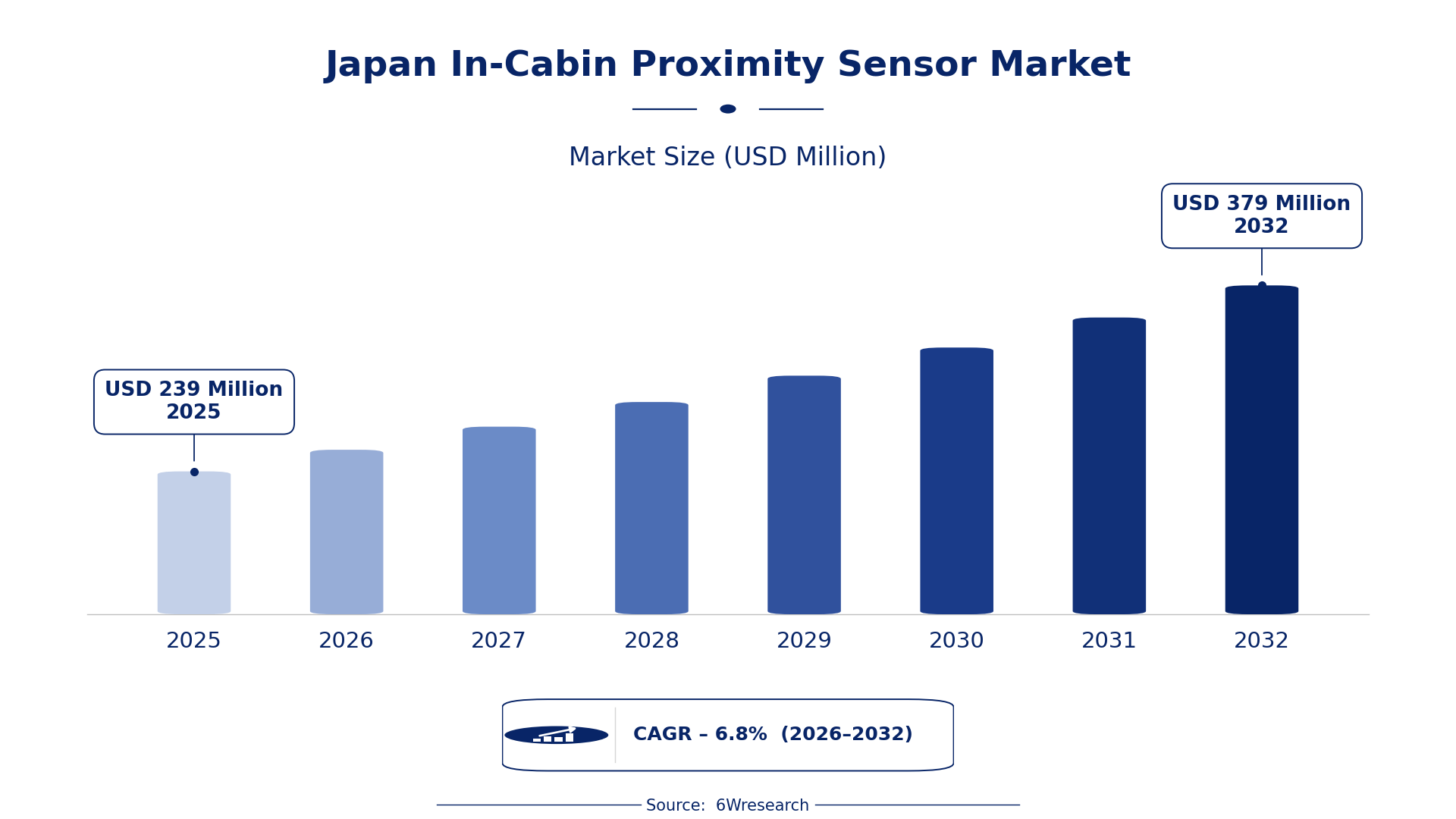
According to 6Wresearch internal database and industry insights, the Japan In-Cabin Proximity Sensor Market was valued at USD 239 Million in 2025 and is projected to reach USD 379 Million by 2032, growing at a CAGR of approximately 6.8% during 2026–2032.
Japan In-Cabin Proximity Sensor Market Highlights
| Report Metric | Details |
| Report Name | Japan In-Cabin Proximity Sensor Market (2026-2032) |
| Market Size 2025 | USD 239 Million |
| Market Size 2032 | USD 379 Million |
| Absolute Growth 2025–2032 | USD 140 Million |
| CAGR 2026–2032 | 6.8% |
| Peak Annual Growth | 8.7% in 2032 |
| Forecast Period | 2026–2032 |
| Historical Data | 2022–2025 |
| Base Year | 2025 |
| Leading Sensor Type, 2025 | Capacitive Proximity (42% share) |
| Leading Detection Range, 2025 | Short Range (cm) (45% share) |
| Leading Functionality, 2025 | Touchless Controls (43% share) |
| Leading End User, 2025 | Smart Cockpit OEMs (51% share) |
| Fastest-Growing Sensor Type | Infrared Proximity (10.5% CAGR) |
| Fastest-Growing Detection Range | Medium Range (8.9% CAGR) |
| Fastest-Growing Functionality | Gesture/Hand Detection (9.1% CAGR) |
| Fastest-Growing End User | Luxury Car Manufacturers (9.4% CAGR) |
| Growing Sector | automotive |
| Key End Users | Smart Cockpit OEMs, Luxury Car Manufacturers, EV/AV Manufacturers |
Japan In-Cabin Proximity Sensor Market Year-wise Growth Rate and Key Drivers (2022–2032)
This graph illustrates the annual growth rates of the market from 2022 to 2032, highlighting a steady upward trajectory and projected market expansion over the forecast period.
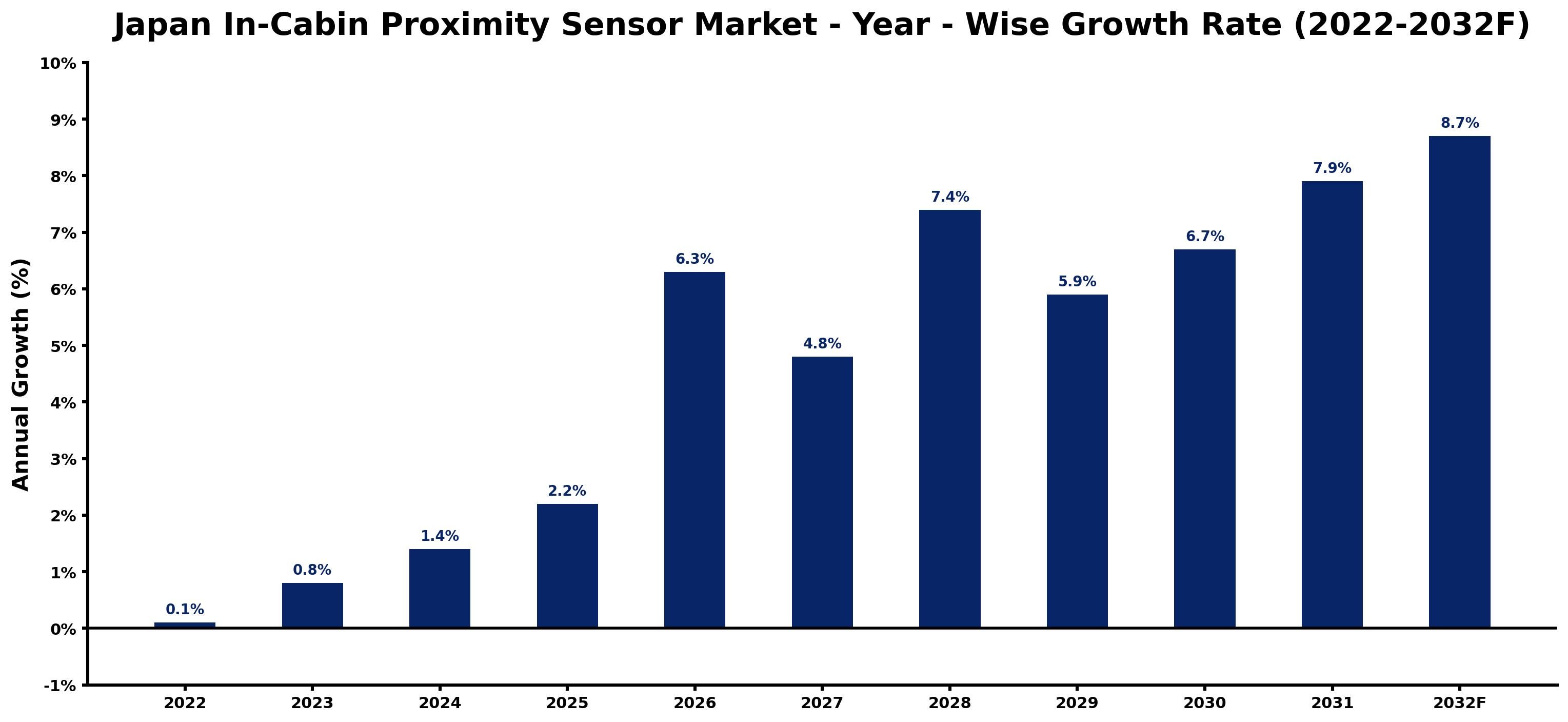
Annual growth estimates for each year appear below with the principal reason behind them, explaining the shifts that set the pace of the market.
| Year | Estimated Annual Growth (%) | Market Rationale |
| 2022 | 0.1 | The market showed minimal growth as the automotive sector began recovering from previous disruptions. |
| 2023 | 0.8 | Increased consumer interest in advanced vehicle features drove faster growth compared to the previous year. |
| 2024 | 1.4 | Demand for touchless controls expanded as more luxury vehicles incorporated advanced technologies. |
| 2025 | 2.2 | Growth accelerated as the automotive industry embraced higher safety standards and new features. |
| 2026 | 6.3 | The introduction of new models with advanced in-cabin technologies is expected to spur significant demand. |
| 2027 | 4.8 | Growth is projected to slow as market saturation begins to affect the adoption of existing technologies. |
| 2028 | 7.4 | A resurgence in luxury vehicle sales is expected to contribute to a faster growth rate than in 2027. |
| 2029 | 5.9 | The market will experience a slowdown as competition intensifies among sensor manufacturers. |
| 2030 | 6.7 | Demand is projected to rise again as manufacturers focus on integrating advanced safety features into vehicles. |
| 2031 | 7.9 | The market is expected to grow rapidly due to increasing consumer preference for smart vehicle technologies. |
| 2032 | 8.7 | Peak growth will be driven by widespread adoption of in-cabin sensors in electric vehicles. |
Note: Market size estimations and growth projections presented in this report are based on 6Wresearch's proprietary forecasting methodology, utilizing the latest available industry data, government publications, and primary research inputs.
Japan In-Cabin Proximity Sensor Market Synopsis
In-Cabin Proximity Sensors are sophisticated devices that detect objects within a vehicle's cabin, utilising technologies such as capacitive and infrared. Their primary applications include touchless controls and occupant classification, improving user experience and safety. The Japan In-Cabin Proximity Sensor Market is expanding due to rising demand from luxury and electric vehicle manufacturers, with over 60% of luxury vehicles adopting touchless controls. The automotive sector's focus on innovation and safety features is driving growth, supported by a thriving automotive industry valued at approximately 80 trillion yen.
Market Dynamics Impact Analysis (2026–2032)
| Factor | Type | Impact | Primary Segment Affected |
| Rising adoption of touchless controls in luxury vehicles | Driver | High | Touchless Controls |
| Increased production of electric vehicles | Driver | High | Smart Cockpit OEMs |
| Growing demand for advanced safety features | Opportunity | High | Occupant Classification |
| Expansion of smart mobility initiatives | Opportunity | High | Gesture/Hand Detection |
| High competition among sensor manufacturers | Restraint | Medium | Infrared Proximity |
| Market saturation in existing technologies | Restraint | Medium | Capacitive Proximity |
| Supply chain disruptions affecting component availability | Challenge | High | mmWave Radar |
| Technological advancements outpacing regulatory updates | Challenge | Medium | Ultrasonic Sensors |
Evaluation of Drivers in Japan In-Cabin Proximity Sensor Market (2026–2032)
The main growth drivers and the segments they affect most are set out below.
| Drivers | Primary Segment Affected | Why It Matters (Evidence) |
| Increased vehicle production in Japan | Smart Cockpit OEMs | In 2023, Japan produced about 9 million vehicles, boosting demand for advanced sensor technologies. |
| Growing consumer preference for luxury features | Touchless Controls | The adoption rate of touchless controls in luxury vehicles is over 60%, driving sensor integration. |
| Technological advancements in sensor capabilities | Infrared Proximity | Innovations in gesture detection are improving user interaction, increasing demand for these sensors. |
| Rising focus on vehicle safety standards | Occupant Classification | Adoption of advanced sensors is necessary to meet new safety standards for airbag deployment. |
| Expansion of electric vehicle market | mmWave Radar | In 2023, electric vehicle sales increased by 25% year-on-year, driving sensor demand. |
The strongest pull on demand comes from Japan's automotive sector, valued at approximately 80 trillion yen, which is investing heavily in advanced technologies. In 2023, Japan produced about 9 million vehicles, increasing the need for in-cabin sensors. The adoption rate of touchless controls in luxury vehicles exceeds 60%, leading manufacturers to integrate these features into their designs. Advanced occupant classification systems are necessary to comply with safety standards, further driving demand. Electric vehicle sales surged by 25% year-on-year, highlighting a growing market for advanced sensor technologies.
Evaluation of Restraints in Japan In-Cabin Proximity Sensor Market
The key brakes on demand, and where they bite hardest, are shown below.
| Market Restraint | Primary Segment Affected | Why It Matters (Evidence) |
| High competition among sensor manufacturers | Infrared Proximity | Intense competition has led to price wars, reducing profit margins for manufacturers. |
| Market saturation in existing technologies | Capacitive Proximity | As the market matures, growth opportunities for established technologies become limited. |
| Supply chain disruptions affecting component availability | mmWave Radar | Global supply chain challenges have delayed production timelines for critical components. |
| Technological advancements outpacing regulatory updates | Ultrasonic Sensors | Rapid innovation creates a gap between available technology and existing regulations. |
| Consumer reluctance to adopt new technologies | Gesture/Hand Detection | Some consumers prefer traditional controls, slowing the adoption of advanced features. |
Japan In-Cabin Proximity Sensor Market Challenges
Producers face intense competition, which pressures pricing and reduces profit margins, particularly for luxury vehicle manufacturers. Buyers are experiencing rising costs as the national minimum wage increases to JPY 1,055 per hour, elevating overall production expenses. Regulatory requirements from the Ministry of Land, Infrastructure, Transport and Tourism impose compliance costs that can delay product launches by several months, impacting manufacturers' market readiness. Supply chain challenges in sourcing components for in-cabin technologies can cause production delays, resulting in lost sales opportunities for manufacturers in a rapidly evolving automotive environment.
Trends in the Japan In-Cabin Proximity Sensor Market
The shifts below are changing how Japan In-Cabin Proximity Sensor Market products are bought and supplied.
- Shift from Traditional to Touchless Controls: In 2023, the adoption rate of touchless controls in luxury vehicles surpassed 60%, indicating a shift in consumer preferences. This trend is reshaping how manufacturers design user interfaces, leading to increased demand for advanced sensor technologies.
- Emergence of Gesture Detection in Smart Cockpits: The Tokyo Motor Show 2023 showcased innovations in gesture detection, with a growing focus on improving user interaction. This has led to a 10.5% CAGR for infrared proximity sensors, reflecting a shift towards more intuitive vehicle controls.
- Transition to Advanced Safety Features: The introduction of stricter safety regulations has driven manufacturers to invest in occupant classification systems. With compliance to safety standards becoming essential, demand for these sensors is expected to rise, supporting market growth.
- Growth of Electric Vehicle Segment: In 2023, Japan's electric vehicle sales increased by 25% year-on-year, demonstrating a shift towards sustainable mobility. This growth is prompting manufacturers to integrate advanced in-cabin technologies, driving sensor demand.
Investment Opportunities in the Japan In-Cabin Proximity Sensor Market
The openings below show where demand in the Japan In-Cabin Proximity Sensor Market is visible and how suppliers can enter.
- Timing for Smart Mobility Initiatives: With the government promoting smart mobility by 2025, there is an opportunity to invest in advanced sensor technologies. Smart cockpit OEMs are seeking solutions to enhance user experience and safety.
- Supply of Advanced Gesture Detection Sensors: The growing emphasis on gesture detection in vehicles offers a strong opportunity to supply infrared proximity sensors. The Tokyo metropolitan area, with its concentration of luxury car manufacturers, represents a prime market.
- Gap in Advanced Safety Features: As compliance with safety standards becomes mandatory, there is an increasing need for occupant classification sensors. This presents an opportunity to supply advanced mmWave radar technologies to automotive manufacturers.
- Investment in Touchless Control Technologies: With over 60% adoption of touchless controls in luxury vehicles, there is a clear opportunity to invest in capacitive proximity sensors. Partnering with luxury car manufacturers can facilitate market entry.
Government Initiatives in the Japan In-Cabin Proximity Sensor Market
The Economic Security Promotion Act (2022) supports supply-chain resilience for critical products, ensuring that manufacturers have access to necessary components for in-cabin sensors. This act is crucial for maintaining production levels and meeting safety standards in the automotive sector. The act also aims to strengthen domestic semiconductor manufacturing to support the growing automotive electronics market.
The Ministry of Land, Infrastructure, Transport and Tourism oversees vehicle safety standards, approving technologies that comply with regulations. This includes funding for research and development of advanced sensor technologies that improve vehicle safety and user experience. The ministry has allocated substantial resources to ensure compliance with evolving automotive standards.
Future Insight of the Japan In-Cabin Proximity Sensor Market
Technological advancements in touchless control systems will transform in-cabin proximity sensors by 2032, improving user interactions and safety features. The government's strategy for smart mobility will facilitate the integration of these systems across various vehicle types, expanding their market presence. Electric vehicle sales, projected to increase by 25% year-on-year, will further stimulate demand for advanced in-cabin technologies. The Tokyo Motor Show will continue to showcase innovations, reinforcing the importance of these systems in the automotive industry.
Market Segmentation Analysis
Japan In-Cabin Proximity Sensor Market report covers a detailed analysis of the following market segments:
By Sensor Type – Capacitive Proximity Leads, Infrared Proximity Expected to Grow Fastest
According to Saurav Kr Singh, Senior Research Analyst at 6Wresearch, Capacitive Proximity held 42% of the Japan In-Cabin Proximity Sensor Market by sensor type in 2025. Capacitive proximity sensors hold the largest share as they are essential for touchless controls in vehicles, a feature that enhances user interaction. Their widespread adoption in luxury vehicles illustrates their critical role in modern automotive design. The quickest growth will come from Infrared Proximity, forecast to expand at a CAGR of 10.5% between 2026 and 2032. Infrared proximity sensors are experiencing rapid growth due to their importance in gesture detection for smart cockpits, aligning with the industry's move towards more sophisticated interfaces. The showcase of these technologies at the Tokyo Motor Show 2023 highlights their increasing relevance. Suppliers need to focus on enhancing capacitive and infrared sensor technologies to meet the growing demands of the automotive market.
By Detection Range – Short Range (cm) Leads, Medium Range Expected to Grow Fastest
Short Range (cm) took 45% of detection range revenue in 2025, more than any other category. Short range sensors dominate the market as they are primarily used for immediate proximity detection, which is vital for user-friendly vehicle interfaces. Their extensive application in urban driving conditions underscores their importance in enhancing safety and convenience for drivers. Medium Range is set to record the highest CAGR in this split, 8.9% over 2026–2032. Medium range sensors are rapidly growing as they are suitable for a wider range of detection applications, which are becoming increasingly necessary in contemporary vehicle designs. Government strategies promoting smart mobility are expected to further boost this segment's growth. Buyers should consider integrating medium range sensors into their designs to stay ahead of future automotive technology trends.
By Functionality – Touchless Controls Lead, Gesture/Hand Detection Expected to Grow Fastest
In 2025, Touchless Controls led the functionality split with a 43% share. Touchless controls are the leading functionality in the market as they are crucial for modern vehicle interfaces, significantly improving user experience. The rising consumer demand for seamless interactions in vehicles drives the need for these advanced sensors. Over 2026–2032, Gesture/Hand Detection is expected to post the fastest growth, at a CAGR of 9.1%. Gesture and hand detection functionalities are gaining traction as they facilitate user interaction without physical contact, reflecting current health and safety considerations. The automotive industry's emphasis on innovative user experiences is likely to accelerate this growth further. Suppliers should prioritise the advancement of gesture detection technologies to remain competitive in the automotive sector.
By End User – Smart Cockpit OEMs Lead, Luxury Car Manufacturers Expected to Grow Fastest
Smart Cockpit OEMs accounted for 51% of the market by end user in 2025. Smart cockpit OEMs lead the market as they are the primary users of advanced sensor technologies, integrating these into next-generation vehicle designs. Their pivotal role in the automotive sector generates substantial demand for in-cabin proximity sensors. Luxury Car Manufacturers are projected to grow fastest, at a CAGR of 9.4% during 2026–2032. Luxury car manufacturers are witnessing the fastest growth due to their increasing demand for premium features, which often incorporate advanced sensor technologies. The notable rise in electric vehicle sales in the luxury segment is expected to further amplify this demand. Suppliers should target luxury car manufacturers to capitalise on the expanding market for premium automotive features.
Key Attractiveness of the Report
- 10 Years of Market Numbers
- Historical Data Starting from 2022 to 2025
- Base Year 2025
- Forecast Data until 2032
- Key Performance Indicators Impacting the Market
- Major Upcoming Developments and Projects
Key Highlights of the Report:
- Japan In-Cabin Proximity Sensor Market Outlook
- Market Size of Japan In-Cabin Proximity Sensor Market, 2025
- Forecast of Japan In-Cabin Proximity Sensor Market, 2032
- Historical Data and Forecast of Japan In-Cabin Proximity Sensor Revenues & Volume for the Period 2022-2032F
- Japan In-Cabin Proximity Sensor Market Trend Evolution
- Japan In-Cabin Proximity Sensor Market Drivers and Challenges
- Japan In-Cabin Proximity Sensor Price Trends
- Japan In-Cabin Proximity Sensor Porter's Five Forces
- Japan In-Cabin Proximity Sensor Industry Life Cycle
- Historical Data and Forecast of Japan In-Cabin Proximity Sensor Market Revenues & Volume By Sensor Type for the Period 2022-2032F
- Historical Data and Forecast of Japan In-Cabin Proximity Sensor Market Revenues & Volume By Capacitive Proximity for the Period 2022-2032F
- Historical Data and Forecast of Japan In-Cabin Proximity Sensor Market Revenues & Volume By Infrared Proximity for the Period 2022-2032F
- Historical Data and Forecast of Japan In-Cabin Proximity Sensor Market Revenues & Volume By Ultrasonic Sensors for the Period 2022-2032F
- Historical Data and Forecast of Japan In-Cabin Proximity Sensor Market Revenues & Volume By mmWave Radar for the Period 2022-2032F
- Historical Data and Forecast of Japan In-Cabin Proximity Sensor Market Revenues & Volume By Detection Range for the Period 2022-2032F
- Historical Data and Forecast of Japan In-Cabin Proximity Sensor Market Revenues & Volume By Short Range (cm) for the Period 2022-2032F
- Historical Data and Forecast of Japan In-Cabin Proximity Sensor Market Revenues & Volume By Medium Range for the Period 2022-2032F
- Historical Data and Forecast of Japan In-Cabin Proximity Sensor Market Revenues & Volume By Wide Range for the Period 2022-2032F
- Historical Data and Forecast of Japan In-Cabin Proximity Sensor Market Revenues & Volume By Long Range + High Accuracy for the Period 2022-2032F
- Historical Data and Forecast of Japan In-Cabin Proximity Sensor Market Revenues & Volume By Functionality for the Period 2022-2032F
- Historical Data and Forecast of Japan In-Cabin Proximity Sensor Market Revenues & Volume By Touchless Controls for the Period 2022-2032F
- Historical Data and Forecast of Japan In-Cabin Proximity Sensor Market Revenues & Volume By Gesture/Hand Detection for the Period 2022-2032F
- Historical Data and Forecast of Japan In-Cabin Proximity Sensor Market Revenues & Volume By Occupant Classification for the Period 2022-2032F
- Historical Data and Forecast of Japan In-Cabin Proximity Sensor Market Revenues & Volume By Vital Sign Monitoring for the Period 2022-2032F
- Historical Data and Forecast of Japan In-Cabin Proximity Sensor Market Revenues & Volume By End User for the Period 2022-2032F
- Historical Data and Forecast of Japan In-Cabin Proximity Sensor Market Revenues & Volume By Smart Cockpit OEMs for the Period 2022-2032F
- Historical Data and Forecast of Japan In-Cabin Proximity Sensor Market Revenues & Volume By Luxury Car Manufacturers for the Period 2022-2032F
- Historical Data and Forecast of Japan In-Cabin Proximity Sensor Market Revenues & Volume By Airbag Deployment Systems for the Period 2022-2032F
- Historical Data and Forecast of Japan In-Cabin Proximity Sensor Market Revenues & Volume By EV/AV Manufacturers for the Period 2022-2032F
- Japan In-Cabin Proximity Sensor Import Export Trade Statistics
- Market Opportunity Assessment By Sensor Type
- Market Opportunity Assessment By Detection Range
- Market Opportunity Assessment By Functionality
- Market Opportunity Assessment By End User
- Japan In-Cabin Proximity Sensor Top Companies Market Share
- Japan In-Cabin Proximity Sensor Competitive Benchmarking By Technical and Operational Parameters
- Japan In-Cabin Proximity Sensor Company Profiles
- Japan In-Cabin Proximity Sensor Key Strategic Recommendations
Market Covered
This report examines the market across the segments below.
By Sensor Type
- Capacitive Proximity
- Infrared Proximity
- Ultrasonic Sensors
- mmWave Radar
By Detection Range
- Short Range (cm)
- Medium Range
- Wide Range
- Long Range + High Accuracy
By Functionality
- Touchless Controls
- Gesture/Hand Detection
- Occupant Classification
- Vital Sign Monitoring
By End User
- Smart Cockpit OEMs
- Luxury Car Manufacturers
- Airbag Deployment Systems
- EV/AV Manufacturers































