Japan In-Car Cluster System Market Size & Growth Rate
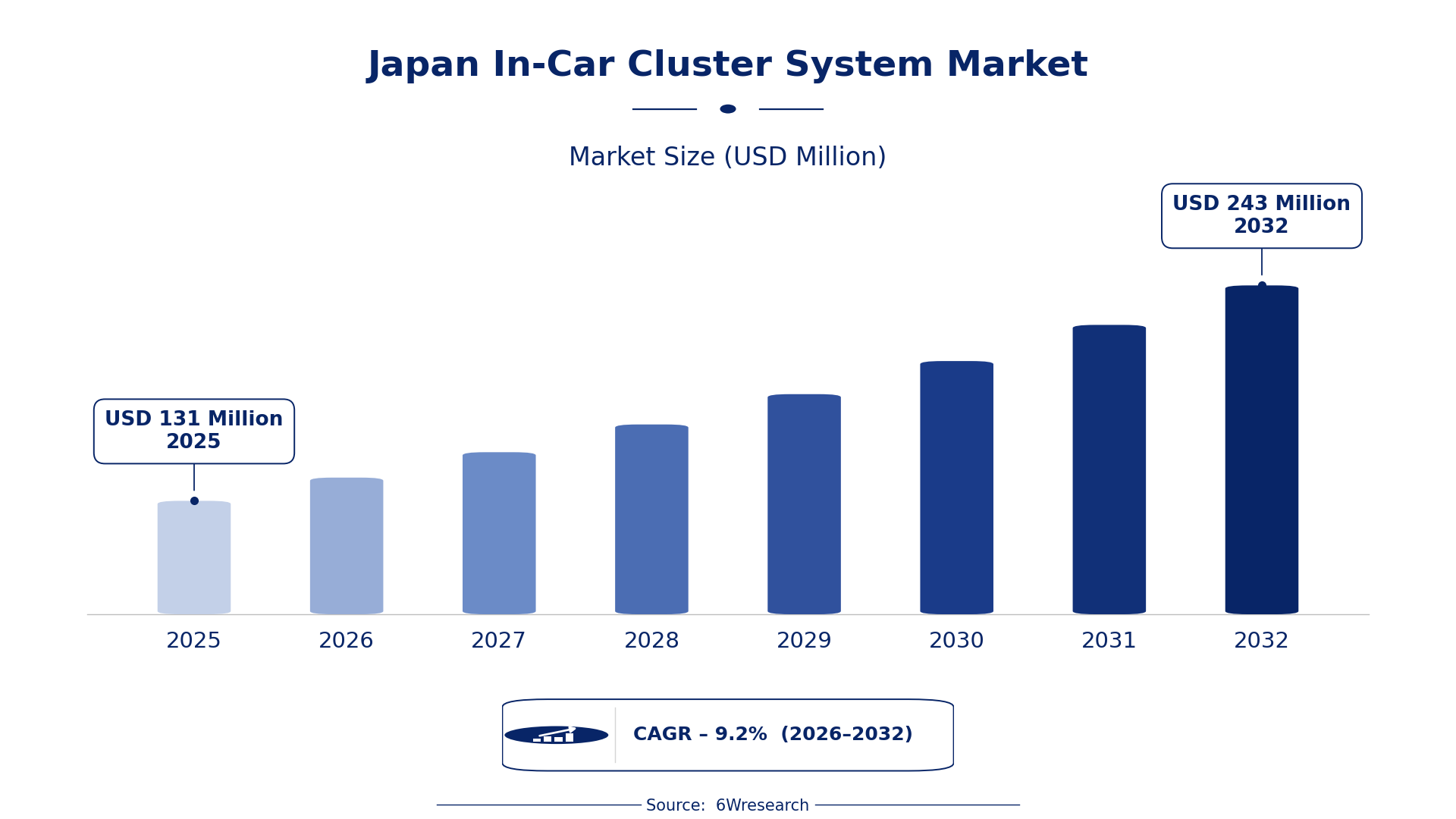
According to 6Wresearch internal database and industry insights, the Japan In-Car Cluster System Market was valued at USD 131 Million in 2025 and is projected to reach USD 243 Million by 2032, growing at a CAGR of approximately 9.2% during 2026–2032.
Japan In-Car Cluster System Market Highlights
| Report Metric | Details |
| Report Name | Japan In-Car Cluster System Market (2026-2032) |
| Market Size 2025 | USD 131 Million |
| Market Size 2032 | USD 243 Million |
| Absolute Growth 2025–2032 | USD 112 Million |
| CAGR 2026–2032 | 9.2% |
| Peak Annual Growth | 10.3% in 2032 |
| Forecast Period | 2026–2032 |
| Historical Data | 2022–2025 |
| Base Year | 2025 |
| Leading Cluster Type, 2025 | Fully Digital Cluster (40% share) |
| Leading Display Format, 2025 | TFT (43% share) |
| Leading Vehicle Class, 2025 | EVs & Connected Cars (46% share) |
| Leading End User, 2025 | Dashboard OEMs (54% share) |
| Fastest-Growing Cluster Type | HUD-Integrated Cluster (13.5% CAGR) |
| Fastest-Growing Display Format | AMOLED Displays (14.1% CAGR) |
| Fastest-Growing End User | Automotive Electronics Firms (12.7% CAGR) |
| Growing Sector | automotive electronics |
| Key End Users | Dashboard OEMs, Automotive Electronics Firms, Infotainment Tier-1s |
Japan In-Car Cluster System Market Year-wise Growth Rate and Key Drivers (2022–2032)
This graph illustrates the annual growth rates of the market from 2022 to 2032, highlighting a steady upward trajectory and projected market expansion over the forecast period.
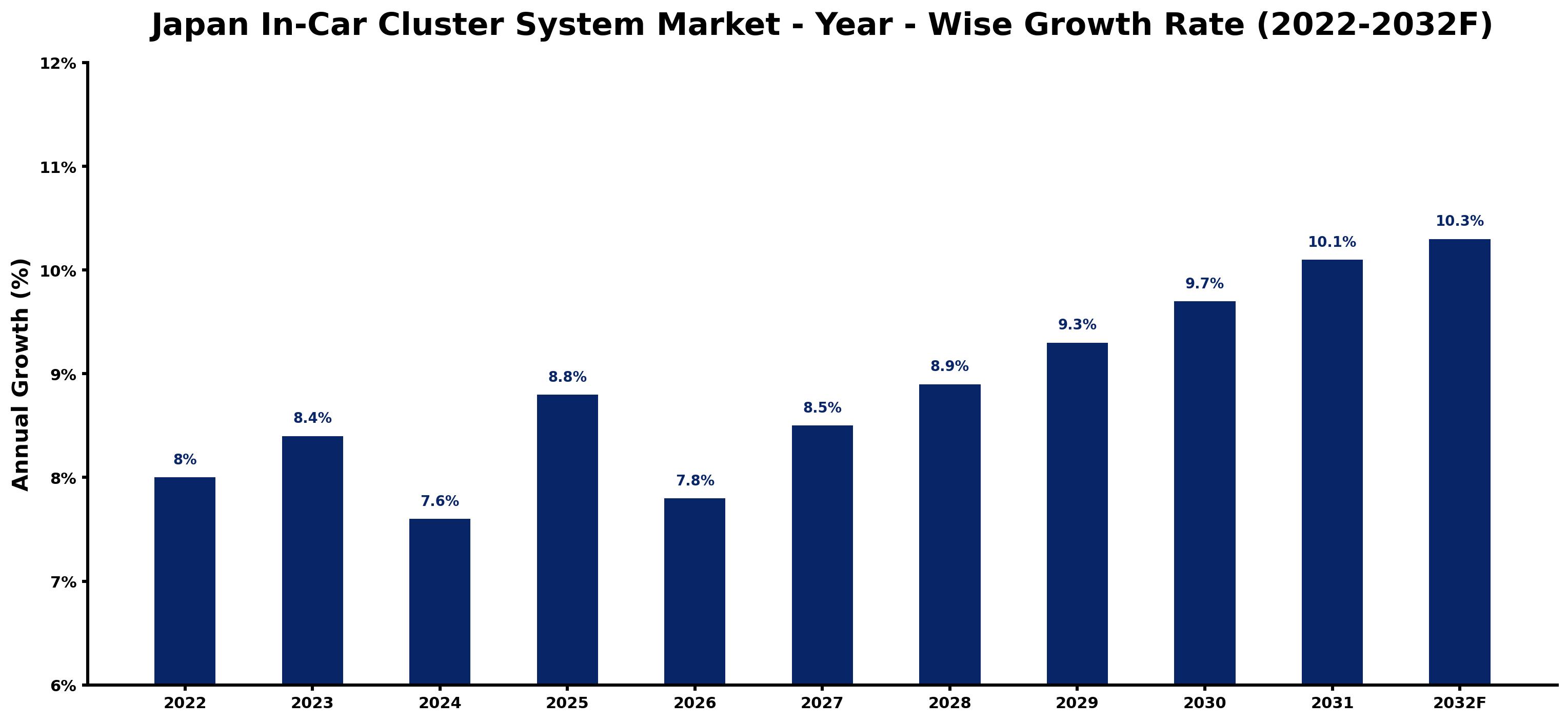
The yearly estimates that follow link every growth rate to its principal driver, so readers can see why the pace changed in each period.
| Year | Estimated Annual Growth (%) | Market Rationale |
| 2022 | 8.0 | The automotive industry was active, with strong demand from domestic manufacturers. |
| 2023 | 8.4 | Growth accelerated due to increasing vehicle registrations and technology adoption. |
| 2024 | 7.6 | Growth slowed as manufacturers faced challenges in supply chain management. |
| 2025 | 8.8 | Demand surged with the introduction of new vehicle models and features. |
| 2026 | 7.8 | A slight slowdown is expected as the market adjusts to new technologies. |
| 2027 | 8.5 | Growth will pick up as consumer interest in advanced vehicle electronics increases. |
| 2028 | 8.9 | Demand is projected to continue rising, driven by the integration of digital technologies. |
| 2029 | 9.3 | Growth will be supported by rising registrations of electric vehicles and connected cars. |
| 2030 | 9.7 | Demand will increase as manufacturers focus on improving driver experience. |
| 2031 | 10.1 | Growth is expected to continue with advancements in safety and infotainment technologies. |
| 2032 | 10.3 | The peak growth rate will be achieved due to widespread adoption of digital clusters. |
Note: Market size estimations and growth projections presented in this report are based on 6Wresearch's proprietary forecasting methodology, utilizing the latest available industry data, government publications, and primary research inputs.
Japan In-Car Cluster System Market Synopsis
In-Car Cluster Systems are advanced electronic displays that provide critical information, including speed and fuel levels, to drivers. These systems are manufactured using digital displays, microcontrollers, and software integration, improving the driving experience. The Japan In-Car Cluster System Market is expanding due to rising vehicle registrations, particularly in the electric vehicle segment, and the integration of advanced technologies. The adoption rate of digital clusters in new vehicles has reached approximately 60%, indicating strong demand from domestic manufacturers and automotive electronics firms.
Market Dynamics Impact Analysis (2026–2032)
| Factor | Type | Impact | Primary Segment Affected |
| Rising vehicle registrations | Driver | High | Fully Digital Cluster |
| Integration of advanced technologies | Driver | High | HUD-Integrated Cluster |
| Growing demand for electric vehicles | Opportunity | High | EVs & Connected Cars |
| Increased focus on driver safety features | Opportunity | Medium | HUD-Integrated Cluster |
| Supply chain disruptions | Restraint | High | Analog-Digital Hybrid |
| High production costs for advanced components | Restraint | Medium | Fully Digital Cluster |
| Limited availability of skilled workforce | Challenge | High | Automotive Electronics Firms |
| Rapid technological changes | Challenge | Medium | Dashboard OEMs |
Evaluation of Drivers in Japan In-Car Cluster System Market (2026–2032)
The table below links each growth driver to the segment it affects and the evidence for it.
| Drivers | Primary Segment Affected | Why It Matters (Evidence) |
| Increased vehicle registrations | Fully Digital Cluster | In 2022, Japan had approximately 78 million registered vehicles, driving demand for advanced display systems. |
| High adoption rate of digital clusters | HUD-Integrated Cluster | With around 60% adoption in new vehicles, manufacturers are increasingly incorporating these systems. |
| Focus on electric vehicle technology | EVs & Connected Cars | Japan produced 8.3 million vehicles in 2022, with a significant portion being electric, boosting demand. |
| Consumer preference for safety features | HUD-Integrated Cluster | The growing emphasis on driver safety has led to increased demand for heads-up displays. |
| Technological advancements in automotive electronics | Fully Digital Cluster | The Tokyo region is a major hub for automotive electronics development, enhancing product offerings. |
What keeps demand rising is the increase in vehicle registrations in Japan, with approximately 78 million registered vehicles in 2022. This growth has led to a high adoption rate of digital clusters, reaching around 60% in new vehicles. The focus on electric vehicle technology is also notable, as many of the 8.3 million vehicles produced in 2022 were electric. Demand for heads-up displays has surged as drivers prioritise safety features. Advances in automotive electronics, particularly in the Tokyo region, are attracting buyers and expanding market opportunities.
Evaluation of Restraints in Japan In-Car Cluster System Market
These are the pressures that could keep growth below its potential.
| Market Restraint | Primary Segment Affected | Why It Matters (Evidence) |
| Supply chain disruptions affecting component availability | Analog-Digital Hybrid | Japan's automotive suppliers faced challenges in sourcing materials, impacting production timelines. |
| High production costs for advanced components | Fully Digital Cluster | The complexity of manufacturing digital clusters increases costs, affecting pricing strategies. |
| Limited availability of skilled workforce in automotive electronics | Automotive Electronics Firms | A shortage of qualified professionals hampers innovation and production efficiency. |
| Rapid technological changes leading to obsolescence | Dashboard OEMs | Constant advancements in technology require ongoing investment, straining resources. |
| Regulatory compliance costs for safety standards | HUD-Integrated Cluster | Adhering to standards like ISO 26262 increases operational costs for manufacturers. |
Japan In-Car Cluster System Market Challenges
Producers face high costs due to stringent automotive regulations mandated by the Ministry of Land, Infrastructure, Transport and Tourism, which can inflate production expenses by up to 10%. Suppliers encounter skills shortages in advanced electronics, delaying product development timelines for producers by an average of six months. The high average age of vehicles, around 13 years, limits the demand for new in-car cluster systems, adversely impacting sales forecasts for manufacturers. Increased competition from foreign entrants compels local producers to lower prices, potentially squeezing profit margins by 5-7%.
Trends in the Japan In-Car Cluster System Market
The trends below show where the Japan In-Car Cluster System Market is heading.
- Shift Towards Digital Displays: The Tokyo Motor Show in 2023 highlighted the shift towards digital displays in vehicles, with an adoption rate of around 70%. This trend indicates a growing preference for advanced technology among consumers.
- Transition from Analog to Digital Clusters: Since 2022, the automotive industry has seen a transition from analog to digital clusters, driven by consumer demand for better data visualization. Approximately 70% of new vehicles now feature digital clusters.
- Increasing Integration of Safety Features: In 2023, the focus on safety features has led to the rise of heads-up displays, improving driver awareness. This trend is reflected in the growing adoption of HUD-integrated clusters.
- Emergence of Customizable User Interfaces: The trend towards customizable user interfaces in vehicles began in 2022, allowing drivers to personalise their experience. This shift is gaining traction among dashboard OEMs.
Investment Opportunities in the Japan In-Car Cluster System Market
Below are the investment opportunities with the strongest case in the Japan In-Car Cluster System Market.
- Gap in Advanced Display Technology: With a projected market size of USD 243 million by 2032, there is an opportunity to supply advanced display technologies. Dashboard OEMs are looking for solutions to enhance user experience.
- Investment in EV Cluster Systems: The automotive sector is investing heavily in EV cluster systems, with Japan targeting 150 GWh of domestic battery manufacturing capacity by 2030. Collaborating with automotive electronics firms can facilitate market entry.
- Expansion in the Tokyo Region: The Tokyo region is a hub for automotive electronics development, presenting opportunities for suppliers to establish partnerships. Engaging with local manufacturers can enhance market presence.
- Entry through Joint Ventures: Forming joint ventures with dashboard OEMs can provide access to the growing market for customizable UI clusters. This approach allows for shared resources and expertise.
Government Initiatives in the Japan In-Car Cluster System Market
The Semiconductor and Digital Industry Strategy, established by METI in June 2021, aims to secure domestic semiconductor manufacturing, which is vital for in-car cluster systems. This measure encourages local production, reducing dependency on imports and supporting the growth of the in-car cluster system market.
The Ministry of Land, Infrastructure, Transport and Tourism oversees automotive regulations, ensuring compliance with safety standards. This agency approves various automotive technologies, including digital clusters, which helps maintain high safety levels in vehicles.
Future Insight of the Japan In-Car Cluster System Market
The integration of advanced digital display technology will reshape demand for in-car cluster systems by 2032, as new vehicles increasingly feature these systems. The adoption rate of digital clusters is expected to surpass 80%, driving suppliers to enhance their technological capabilities. Initiatives promoting EV technology integration will stimulate further advancements in the sector. Stricter safety standards, aligned with ISO 26262, will ensure that buyers receive more dependable products, bolstering their trust in the automotive industry.
Market Segmentation Analysis
Japan In-Car Cluster System Market report covers a detailed analysis of the following market segments:
By Cluster Type – Fully Digital Cluster Leads, HUD-Integrated Cluster Expected to Grow Fastest
According to Saurav Kr Singh, Senior Research Analyst at 6Wresearch, with 40% of cluster type revenue in 2025, Fully Digital Cluster was the largest category. The Fully Digital Cluster commands the largest share due to its ability to provide critical vehicle information in a comprehensive manner, which is vital for drivers. This is particularly evident in regions like Tokyo, where the demand for advanced automotive electronics is high. HUD-Integrated Cluster is projected to grow fastest, at a CAGR of 13.5% during 2026–2032. The HUD-Integrated Cluster is witnessing rapid growth as it significantly enhances driver safety by displaying essential information directly on the windshield. With increasing safety regulations and consumer demand for such features, its adoption is likely to accelerate further. Suppliers must focus on developing HUD technology to meet the rising demand for enhanced driver safety features.
By Display Format – TFT Leads, AMOLED Displays Expected to Grow Fastest
The largest display format category in 2025 was TFT, at 43% of revenue. TFT displays dominate the market because they are widely recognised for their clarity in presenting vital information across various vehicle types, making them a preferred choice among manufacturers. Their established presence in the automotive sector reinforces their leading position. AMOLED Displays are set to record the highest CAGR in this split, 14.1% over 2026–2032. AMOLED Displays are growing quickly as they are increasingly favoured in premium vehicles for their superior visual quality, appealing to consumers who value high-end display technology. This trend is expected to continue as more manufacturers incorporate advanced display options. Buyers should seek partnerships with suppliers that provide cutting-edge display technologies to improve vehicle attractiveness.
By Vehicle Class – EVs & Connected Cars Lead and Record the Fastest Growth
EVs & Connected Cars accounted for 46% of the market by vehicle class in 2025. EVs & Connected Cars hold the largest share as they are integral for modern electric vehicles, which are rapidly gaining popularity in Japan's automotive market. The shift towards electrification and connectivity in vehicles drives this segment's dominance. The same category are also set to grow fastest, at a CAGR of 10.2% during 2026–2032. The growth of EVs & Connected Cars is accelerating as consumer preferences shift towards sustainable and technologically advanced vehicles, ensuring that this segment remains at the forefront of the market. Their continued evolution will likely solidify their leading position further. Suppliers must align their offerings with the increasing demand for electric and connected vehicle technologies.
By End User – Dashboard OEMs Lead, Automotive Electronics Firms Expected to Grow Fastest
Dashboard OEMs took 54% of end user revenue in 2025, more than any other category. Dashboard OEMs hold the largest market share as they are the primary developers of in-car cluster systems, directly catering to the automotive industry's needs. Their strong relationships with vehicle manufacturers bolster their influence in the market. Over 2026–2032, Automotive Electronics Firms are expected to post the fastest growth, at a CAGR of 12.7%. Automotive Electronics Firms are experiencing rapid growth as they are essential players in the technology supply chain, adapting to the increasing complexity of vehicle electronic systems. Their role is set to expand further as automotive technology advances. Suppliers should consider strategic partnerships with automotive electronics firms to remain competitive in this evolving landscape.
Key Attractiveness of the Report
- 10 Years of Market Numbers
- Historical Data Starting from 2022 to 2025
- Base Year 2025
- Forecast Data until 2032
- Key Performance Indicators Impacting the Market
- Major Upcoming Developments and Projects
Key Highlights of the Report:
- Japan In-Car Cluster System Market Outlook
- Market Size of Japan In-Car Cluster System Market, 2025
- Forecast of Japan In-Car Cluster System Market, 2032
- Historical Data and Forecast of Japan In-Car Cluster System Revenues & Volume for the Period 2022-2032F
- Japan In-Car Cluster System Market Trend Evolution
- Japan In-Car Cluster System Market Drivers and Challenges
- Japan In-Car Cluster System Price Trends
- Japan In-Car Cluster System Porter's Five Forces
- Japan In-Car Cluster System Industry Life Cycle
- Historical Data and Forecast of Japan In-Car Cluster System Market Revenues & Volume By Cluster Type for the Period 2022-2032F
- Historical Data and Forecast of Japan In-Car Cluster System Market Revenues & Volume By Analog-Digital Hybrid for the Period 2022-2032F
- Historical Data and Forecast of Japan In-Car Cluster System Market Revenues & Volume By Fully Digital Cluster for the Period 2022-2032F
- Historical Data and Forecast of Japan In-Car Cluster System Market Revenues & Volume By Customizable UI Cluster for the Period 2022-2032F
- Historical Data and Forecast of Japan In-Car Cluster System Market Revenues & Volume By HUD-Integrated Cluster for the Period 2022-2032F
- Historical Data and Forecast of Japan In-Car Cluster System Market Revenues & Volume By Display Format for the Period 2022-2032F
- Historical Data and Forecast of Japan In-Car Cluster System Market Revenues & Volume By Speedometer, Fuel, RPM for the Period 2022-2032F
- Historical Data and Forecast of Japan In-Car Cluster System Market Revenues & Volume By TFT, AMOLED Displays for the Period 2022-2032F
- Historical Data and Forecast of Japan In-Car Cluster System Market Revenues & Volume By Software-Based Interface for the Period 2022-2032F
- Historical Data and Forecast of Japan In-Car Cluster System Market Revenues & Volume By Head-Up Display Link for the Period 2022-2032F
- Historical Data and Forecast of Japan In-Car Cluster System Market Revenues & Volume By Vehicle Class for the Period 2022-2032F
- Historical Data and Forecast of Japan In-Car Cluster System Market Revenues & Volume By Economy Segment for the Period 2022-2032F
- Historical Data and Forecast of Japan In-Car Cluster System Market Revenues & Volume By Mid-High Segment for the Period 2022-2032F
- Historical Data and Forecast of Japan In-Car Cluster System Market Revenues & Volume By EVs & Connected Cars for the Period 2022-2032F
- Historical Data and Forecast of Japan In-Car Cluster System Market Revenues & Volume By Premium Segment for the Period 2022-2032F
- Historical Data and Forecast of Japan In-Car Cluster System Market Revenues & Volume By End User for the Period 2022-2032F
- Historical Data and Forecast of Japan In-Car Cluster System Market Revenues & Volume By Dashboard OEMs for the Period 2022-2032F
- Historical Data and Forecast of Japan In-Car Cluster System Market Revenues & Volume By Automotive Electronics Firms for the Period 2022-2032F
- Historical Data and Forecast of Japan In-Car Cluster System Market Revenues & Volume By UX & Software Platform Devs for the Period 2022-2032F
- Historical Data and Forecast of Japan In-Car Cluster System Market Revenues & Volume By Infotainment Tier-1s for the Period 2022-2032F
- Japan In-Car Cluster System Import Export Trade Statistics
- Market Opportunity Assessment By Cluster Type
- Market Opportunity Assessment By Display Format
- Market Opportunity Assessment By Vehicle Class
- Market Opportunity Assessment By End User
- Japan In-Car Cluster System Top Companies Market Share
- Japan In-Car Cluster System Competitive Benchmarking By Technical and Operational Parameters
- Japan In-Car Cluster System Company Profiles
- Japan In-Car Cluster System Key Strategic Recommendations
Market Covered
This report examines the market across the segments below.
By Cluster Type
- Analog-Digital Hybrid
- Fully Digital Cluster
- Customizable UI Cluster
- HUD-Integrated Cluster
By Display Format
- Speedometer
- Fuel
- RPM
- TFT
- AMOLED Displays
- Software-Based Interface
- Head-Up Display Link
By Vehicle Class
- Economy Segment
- Mid-High Segment
- EVs & Connected Cars
- Premium Segment
By End User
- Dashboard OEMs
- Automotive Electronics Firms
- UX & Software Platform Devs
- Infotainment Tier-1s































