Japan In-Car Software Platform Market Size & Growth Rate
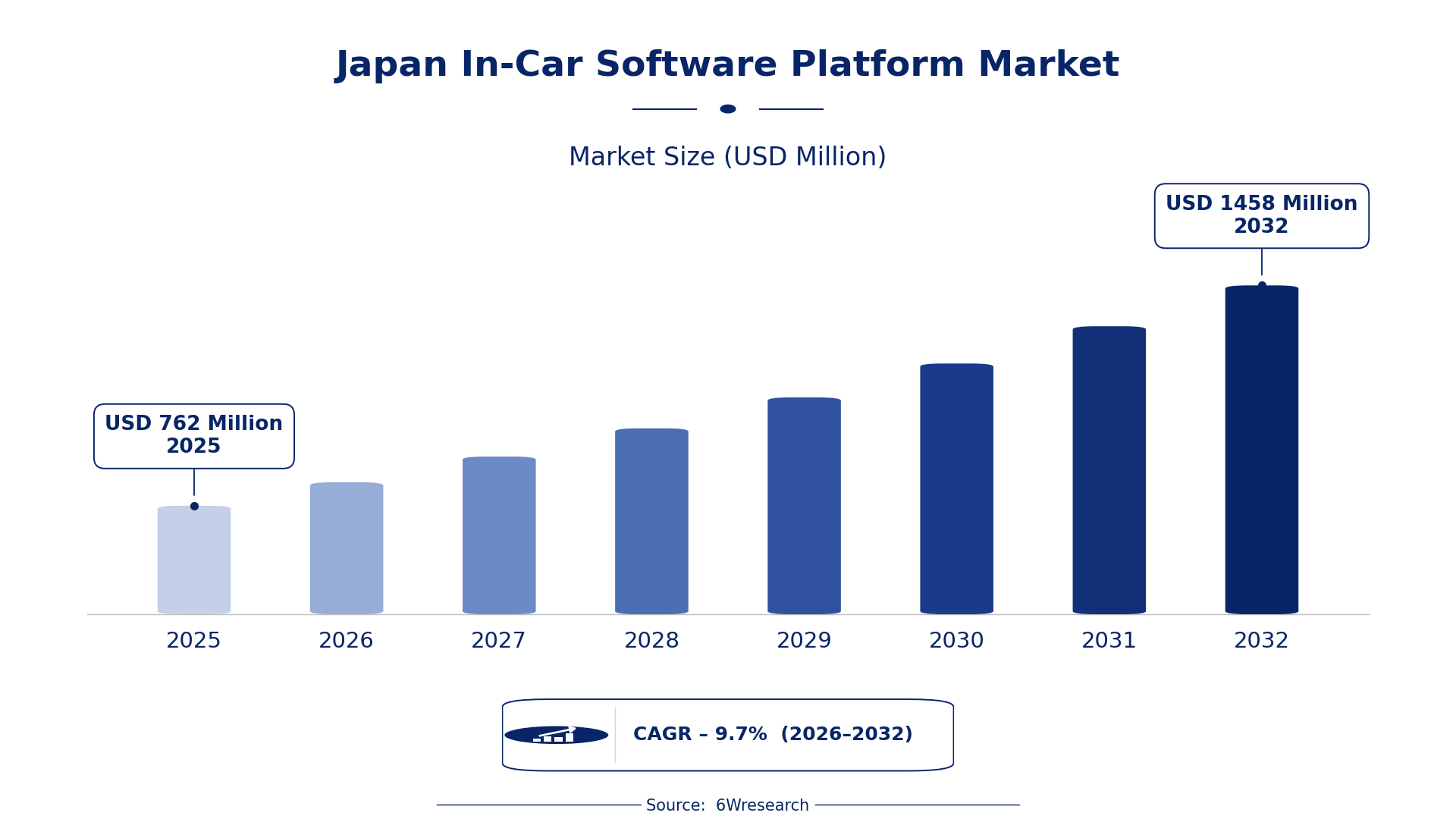
According to 6Wresearch internal database and industry insights, the Japan In-Car Software Platform Market was valued at USD 762 Million in 2025 and is projected to reach USD 1,458 Million by 2032, growing at a CAGR of approximately 9.7% during 2026–2032.
Japan In-Car Software Platform Market Highlights
| Report Metric | Details |
| Report Name | Japan In-Car Software Platform Market (2026-2032) |
| Market Size 2025 | USD 762 Million |
| Market Size 2032 | USD 1,458 Million |
| Absolute Growth 2025–2032 | USD 696 Million |
| CAGR 2026–2032 | 9.7% |
| Peak Annual Growth | 11.4% in 2026 |
| Forecast Period | 2026–2032 |
| Historical Data | 2022–2025 |
| Base Year | 2025 |
| Leading Platform Type, 2025 | Android Automotive OS (52% share) |
| Leading OS Base, 2025 | Open Source (36% share) |
| Leading Functionality, 2025 | Infotainment (34% share) |
| Leading End User, 2025 | OEM Software Teams (53% share) |
| Fastest-Growing Platform Type | Embedded Linux (13.0% CAGR) |
| Fastest-Growing OS Base | Custom Builds (12.0% CAGR) |
| Fastest-Growing Functionality | Navigation (13.2% CAGR) |
| Fastest-Growing End User | Automotive Software Vendors (12.3% CAGR) |
| Growing Sector | automotive software |
| Key End Users | OEMs, automotive software vendors, Tier-1 ECU suppliers, connectivity developers |
Japan In-Car Software Platform Market Year-wise Growth Rate and Key Drivers (2022–2032)
This graph illustrates the annual growth rates of the market from 2022 to 2032, highlighting a steady upward trajectory and projected market expansion over the forecast period.
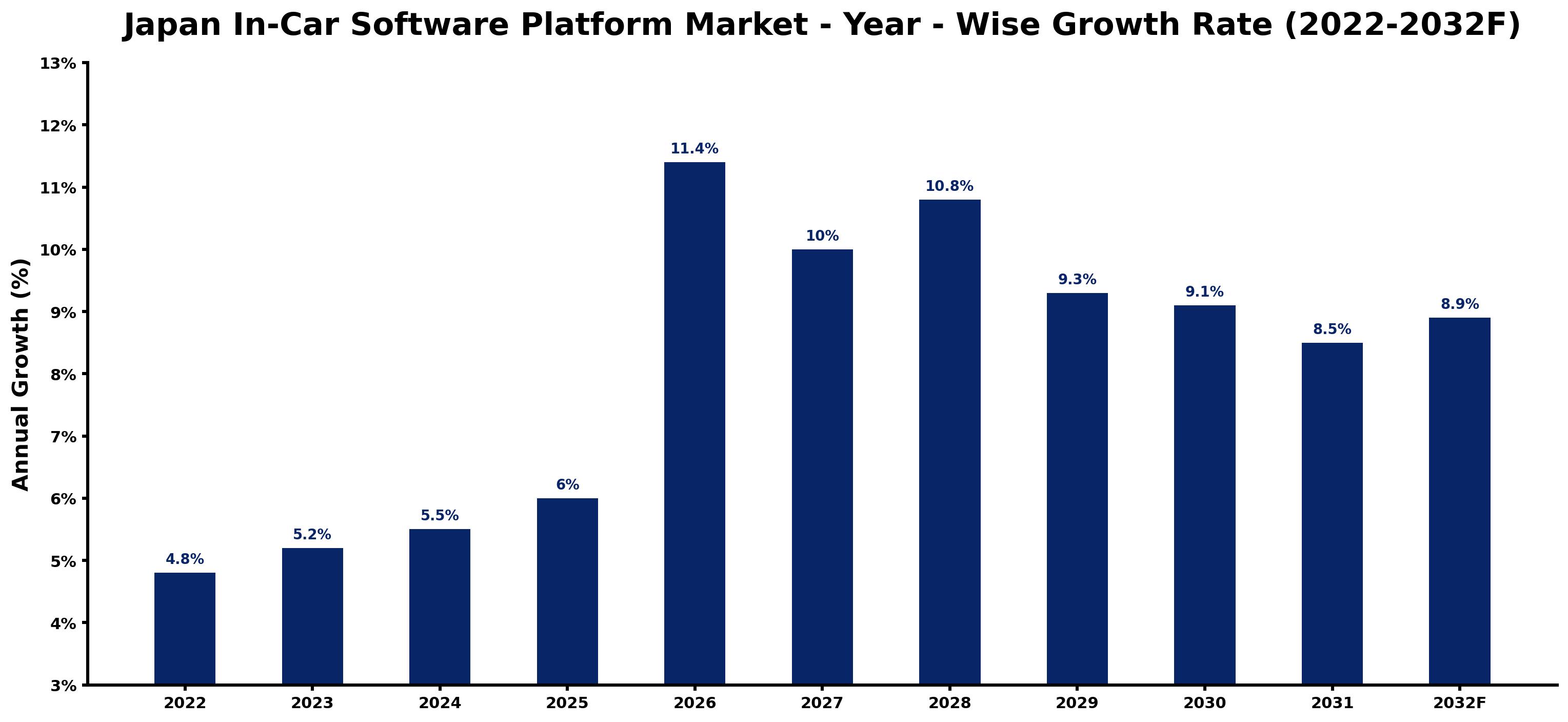
Each row of the following table gives one year's estimated growth and the event or demand shift that explains it.
| Year | Estimated Annual Growth (%) | Market Rationale |
| 2022 | 4.8 | The automotive sector showed steady demand for software solutions amid evolving technology trends. |
| 2023 | 5.2 | Growth accelerated as the installed base of connected vehicles reached 5 million units. |
| 2024 | 5.5 | Increasing vehicle age prompted more software upgrades and improvements in functionality. |
| 2025 | 6.0 | Demand surged with the introduction of new infotainment standards in vehicles. |
| 2026 | 11.4 | The peak growth year is expected to be driven by heightened investment in advanced driver-assistance systems. |
| 2027 | 10.0 | Growth is projected to slow as the market begins to stabilise following rapid expansion. |
| 2028 | 10.8 | Continued interest in navigation systems is expected to contribute to a slight growth increase. |
| 2029 | 9.3 | Growth is anticipated to slow again as the market matures and competition intensifies. |
| 2030 | 9.1 | Demand is expected to remain strong, supported by ongoing software integration in new models. |
| 2031 | 8.5 | The market is projected to continue growing, driven by the increasing adoption of safety-critical systems. |
| 2032 | 8.9 | Growth is expected to pick up as manufacturers focus on improving user experience through software. |
Note: Market size estimations and growth projections presented in this report are based on 6Wresearch's proprietary forecasting methodology, utilizing the latest available industry data, government publications, and primary research inputs.
Japan In-Car Software Platform Market Synopsis
In-Car Software Platforms are integrated systems that manage vehicle functions such as infotainment and navigation, developed using technologies like Android Automotive OS and Embedded Linux. The Japan In-Car Software Platform Market is growing due to strong demand from domestic manufacturers and technology developers, with over 8 million vehicles produced in 2022. The government’s investment of ¥10 billion in automotive technology research in 2023 is driving innovation in the sector and contributing to growth in software solutions.
Market Dynamics Impact Analysis (2026–2032)
| Factor | Type | Impact | Primary Segment Affected |
| Growing vehicle connectivity and infotainment needs drive demand for advanced software solutions. | Driver | High | Infotainment |
| The increasing age of vehicles necessitates software upgrades to enhance functionality. | Driver | High | Embedded Linux |
| The rise in electric vehicle adoption creates a demand for specialized software platforms. | Opportunity | High | Custom Builds |
| The Tokyo region's focus on automotive technology development presents investment opportunities. | Opportunity | High | Automotive Middleware |
| Limited availability of skilled software developers constrains market growth. | Restraint | High | OEM Software Teams |
| High development costs for advanced systems can deter smaller manufacturers. | Restraint | Medium | Automotive Software Vendors |
| Competition from international software providers pressures local developers. | Challenge | High | Tier-1 ECU Suppliers |
| Rapid technological advancements may outpace local development capabilities. | Challenge | Medium | Connectivity Developers |
Evaluation of Drivers in Japan In-Car Software Platform Market (2026–2032)
The table below links each growth driver to the segment it affects and the evidence for it.
| Drivers | Primary Segment Affected | Why It Matters (Evidence) |
| Increased vehicle production and connectivity requirements are driving demand for infotainment systems. | Infotainment | Over 8 million vehicles produced in 2022 necessitate advanced software solutions. |
| The growing average age of vehicles leads to a higher demand for software upgrades. | Embedded Linux | With an average vehicle age of 13 years, upgrades are essential for functionality. |
| The adoption of advanced driver-assistance systems is pushing the need for safety-critical software. | Safety-Critical OS | ADAS features are included in 60% of new vehicle models in Japan. |
| Investment in smart mobility initiatives is enhancing the demand for automotive software. | Automotive Middleware | The Ministry of Land, Infrastructure, Transport and Tourism launched a smart mobility initiative in 2023. |
| The integration of AI in automotive software is transforming user experience. | Custom Builds | Japan's automotive sector is focusing on AI integration in software platforms by 2025. |
What keeps demand rising is the increasing production of vehicles, with over 8 million units manufactured in 2022, driving the need for advanced software solutions. The average age of vehicles in Japan is around 13 years, leading to a heightened demand for software upgrades to improve functionality. Approximately 60% of new vehicles now include advanced driver-assistance systems, necessitating the use of safety-critical software. Focus on AI integration within software platforms is set to transform user experience by 2025.
Evaluation of Restraints in Japan In-Car Software Platform Market
Below are the constraints most often cited by buyers and suppliers, with the segment each affects.
| Market Restraint | Primary Segment Affected | Why It Matters (Evidence) |
| Limited availability of skilled software developers hampers growth in the sector. | OEM Software Teams | The automotive software industry is projected to employ over 100,000 professionals by 2025. |
| High development costs for advanced systems can deter smaller manufacturers from entering the market. | Automotive Software Vendors | The average cost of developing new software solutions can exceed ¥100 million. |
| Intense competition from international software providers pressures local developers to innovate. | Tier-1 ECU Suppliers | Local suppliers face challenges in competing with established global software firms. |
| Rapid technological advancements may outpace local development capabilities, resulting in missed opportunities. | Connectivity Developers | The fast pace of change in automotive technology requires constant adaptation. |
| Regulatory compliance costs can be burdensome for smaller firms in the market. | Automotive Middleware | Compliance with JIS standards requires substantial investment in testing and certification. |
Japan In-Car Software Platform Market Challenges
In 2023, the average cost of software upgrades for vehicles reached JPY 150,000, straining budgets for buyers aiming to modernise older models. Regulatory mandates, such as the requirement for Safety-Critical OS in ADAS applications, complicate development timelines for suppliers, often resulting in delays of up to six months. Supply chain disruptions in sourcing automotive components have increased lead times by 20%, causing production delays for manufacturers and limiting the availability of new vehicles. The rapid pace of technological advancements necessitates continuous investment, which can overwhelm smaller producers lacking the resources to meet industry standards.
Trends in the Japan In-Car Software Platform Market
Below are the shifts with the largest effect on the Japan In-Car Software Platform Market.
- Launch of Smart Mobility Programme: The Ministry of Land, Infrastructure, Transport and Tourism initiated a smart mobility programme in 2023, aiming to improve vehicle connectivity and software integration. This initiative is expected to drive demand for automotive software solutions, supported by an investment of ¥10 billion.
- Shift Towards AI Integration in Automotive Software: Japan's automotive sector is increasingly focusing on AI integration in software platforms, with expectations that AI-driven features will improve user experience by 2025. This trend is backed by growing investment in research and development in the Tokyo region.
- Growing Demand for Custom Software Solutions: OEMs are increasingly seeking custom builds to differentiate their vehicles, with a notable rise in demand for tailored software solutions. This trend is reflected in the 12% growth rate of custom builds anticipated through 2032.
- Increased Adoption of Navigation Systems: The navigation functionality within in-car software platforms is gaining traction, with a projected growth rate of 13.2% through 2032. This trend is evident as manufacturers aim to improve user experience and vehicle connectivity.
Investment Opportunities in the Japan In-Car Software Platform Market
The following opportunities in the Japan In-Car Software Platform Market pair current demand with a clear way in.
- Gap in Advanced Software Solutions: With the automotive software market projected to grow, there is a gap in advanced software solutions. Automotive Software Vendors can capitalise on this by developing applications tailored to user needs.
- Timing for Investment in Custom Builds: Now is an opportune time for investment in custom builds, as demand for unique features in vehicles is rising. OEM Software Teams are looking for partners to develop bespoke solutions that cater to specific market segments.
- Focus on Safety-Critical Software: The increasing regulatory requirements for safety-critical systems present a strong opportunity for investment. Tier-1 ECU Suppliers can expand their offerings by developing compliant software solutions that meet stringent safety standards.
- Expansion of Infotainment Systems: As infotainment systems are expected to be standard in all new vehicles by 2025, there is a growing opportunity for suppliers to enhance these systems. Connectivity Developers can enter the market by providing innovative software solutions that improve user engagement.
Government Initiatives in the Japan In-Car Software Platform Market
The AI Promotion Act, established in 2025, provides a national framework for AI research, development, and use, impacting the production of in-car software platforms. This act encourages manufacturers to integrate AI capabilities into their products, improving functionality and user experience in vehicles.
The Digital Agency, established in September 2021, leads government digital transformation efforts and approves standards for automotive software. It ensures compliance with JIS standards, facilitating smoother market entry for software developers.
Future Insight of the Japan In-Car Software Platform Market
By 2032, buyers will experience enhanced vehicle connectivity as AI integration in software platforms becomes commonplace. The smart mobility initiative launched in 2023 will drive innovation in automotive technology, creating more advanced in-car systems. The installed base of connected vehicles is expected to reach 10 million units, influencing the demand for upgraded functionalities. As electric vehicle adoption rises to 20% by 2030, suppliers must evolve their offerings to meet new software requirements and standards.
Market Segmentation Analysis
Japan In-Car Software Platform Market report covers a detailed analysis of the following market segments:
By Platform Type – Android Automotive OS Leads, Embedded Linux Expected to Grow Fastest
According to Saurav Kr Singh, Senior Research Analyst at 6Wresearch, Android Automotive OS accounted for 52% of the market by platform type in 2025. Android Automotive OS holds the largest share due to its widespread adoption for infotainment and navigation systems across many vehicle models. Its integration in over 40% of new vehicles indicates a strong preference among manufacturers for this platform. The quickest growth will come from Embedded Linux, forecast to expand at a CAGR of 13.0% between 2026 and 2032. Embedded Linux is experiencing rapid growth as it offers flexibility for a variety of automotive applications, meeting the rising demand for tailored software solutions. This trend is particularly notable among Japanese manufacturers focusing on custom features. Suppliers should focus on enhancing compatibility with Embedded Linux to cater to the increasing demand for customisation.
By OS Base – Open Source Leads, Custom Builds Expected to Grow Fastest
The largest os base category in 2025 was Open Source, at 36% of revenue. Open Source leads the market as it provides a foundational base for various custom solutions, although its usage in mainstream applications is less prevalent. This foundational role allows developers to create unique software tailored to specific automotive needs. Over 2026–2032, Custom Builds are expected to post the fastest growth, at a CAGR of 12.0%. Custom Builds are growing swiftly as they address specific automotive requirements, reflecting the industry's shift towards personalised solutions. The demand for unique vehicle features is driving this rapid adoption among manufacturers. Buyers will benefit from investing in Custom Builds to achieve tailored software solutions.
By Functionality – Infotainment Leads, Navigation Expected to Grow Fastest
Infotainment held 34% of the Japan In-Car Software Platform Market by functionality in 2025. Infotainment functionality dominates the market due to its critical role in user engagement, providing entertainment and connectivity that enhance the driving experience. The expectation for infotainment systems to be standard in all new vehicles by 2025 underscores its importance. Navigation is projected to grow fastest, at a CAGR of 13.2% during 2026–2032. Navigation functionality is growing quickly as it becomes essential for route guidance and real-time traffic updates, which are crucial for modern driving. The government's push for smart mobility initiatives is further accelerating this demand for advanced navigation solutions. Suppliers should prioritise the development of advanced navigation features to align with market needs.
By End User – OEM Software Teams Lead, Automotive Software Vendors Expected to Grow Fastest
OEM Software Teams took 53% of end user revenue in 2025, more than any other category. OEM Software Teams capture the largest share as they create software specifically for original equipment manufacturers, ensuring compatibility with vehicle systems. Their integral role in the automotive production process reinforces their market position. Automotive Software Vendors are set to record the highest CAGR in this split, 12.3% over 2026–2032. Automotive Software Vendors are expanding rapidly as they deliver specialised software solutions that cater to the diverse needs of the automotive sector. Their ability to adapt to new technologies and trends is driving their growth in this market. Suppliers must collaborate with Automotive Software Vendors to leverage specialised solutions for enhanced market reach.
Key Attractiveness of the Report
- 10 Years of Market Numbers
- Historical Data Starting from 2022 to 2025
- Base Year 2025
- Forecast Data until 2032
- Key Performance Indicators Impacting the Market
- Major Upcoming Developments and Projects
Key Highlights of the Report:
- Japan In-Car Software Platform Market Outlook
- Market Size of Japan In-Car Software Platform Market, 2025
- Forecast of Japan In-Car Software Platform Market, 2032
- Historical Data and Forecast of Japan In-Car Software Platform Revenues & Volume for the Period 2022-2032F
- Japan In-Car Software Platform Market Trend Evolution
- Japan In-Car Software Platform Market Drivers and Challenges
- Japan In-Car Software Platform Price Trends
- Japan In-Car Software Platform Porter's Five Forces
- Japan In-Car Software Platform Industry Life Cycle
- Historical Data and Forecast of Japan In-Car Software Platform Market Revenues & Volume By Platform Type for the Period 2022-2032F
- Historical Data and Forecast of Japan In-Car Software Platform Market Revenues & Volume By Android Automotive OS for the Period 2022-2032F
- Historical Data and Forecast of Japan In-Car Software Platform Market Revenues & Volume By Embedded Linux for the Period 2022-2032F
- Historical Data and Forecast of Japan In-Car Software Platform Market Revenues & Volume By QNX for the Period 2022-2032F
- Historical Data and Forecast of Japan In-Car Software Platform Market Revenues & Volume By Automotive Middleware for the Period 2022-2032F
- Historical Data and Forecast of Japan In-Car Software Platform Market Revenues & Volume By OS Base for the Period 2022-2032F
- Historical Data and Forecast of Japan In-Car Software Platform Market Revenues & Volume By Open Source for the Period 2022-2032F
- Historical Data and Forecast of Japan In-Car Software Platform Market Revenues & Volume By Custom Builds for the Period 2022-2032F
- Historical Data and Forecast of Japan In-Car Software Platform Market Revenues & Volume By Safety-Critical OS for the Period 2022-2032F
- Historical Data and Forecast of Japan In-Car Software Platform Market Revenues & Volume By API Bridge for Apps for the Period 2022-2032F
- Historical Data and Forecast of Japan In-Car Software Platform Market Revenues & Volume By Functionality for the Period 2022-2032F
- Historical Data and Forecast of Japan In-Car Software Platform Market Revenues & Volume By Infotainment, Navigation for the Period 2022-2032F
- Historical Data and Forecast of Japan In-Car Software Platform Market Revenues & Volume By Real-Time Systems for the Period 2022-2032F
- Historical Data and Forecast of Japan In-Car Software Platform Market Revenues & Volume By ADAS, Cluster Control for the Period 2022-2032F
- Historical Data and Forecast of Japan In-Car Software Platform Market Revenues & Volume By Data Sharing & Sync for the Period 2022-2032F
- Historical Data and Forecast of Japan In-Car Software Platform Market Revenues & Volume By End User for the Period 2022-2032F
- Historical Data and Forecast of Japan In-Car Software Platform Market Revenues & Volume By OEM Software Teams for the Period 2022-2032F
- Historical Data and Forecast of Japan In-Car Software Platform Market Revenues & Volume By Automotive Software Vendors for the Period 2022-2032F
- Historical Data and Forecast of Japan In-Car Software Platform Market Revenues & Volume By Tier-1 ECU Suppliers for the Period 2022-2032F
- Historical Data and Forecast of Japan In-Car Software Platform Market Revenues & Volume By Connectivity Developers for the Period 2022-2032F
- Japan In-Car Software Platform Import Export Trade Statistics
- Market Opportunity Assessment By Platform Type
- Market Opportunity Assessment By OS Base
- Market Opportunity Assessment By Functionality
- Market Opportunity Assessment By End User
- Japan In-Car Software Platform Top Companies Market Share
- Japan In-Car Software Platform Competitive Benchmarking By Technical and Operational Parameters
- Japan In-Car Software Platform Company Profiles
- Japan In-Car Software Platform Key Strategic Recommendations
Market Covered
The report covers the following segments.
By Platform Type
- Android Automotive OS
- Embedded Linux
- QNX
- Automotive Middleware
By OS Base
- Open Source
- Custom Builds
- Safety-Critical OS
- API Bridge for Apps
By Functionality
- Infotainment
- Navigation
- Real-Time Systems
- ADAS
- Cluster Control
- Data Sharing & Sync
By End User
- OEM Software Teams
- Automotive Software Vendors
- Tier-1 ECU Suppliers
- Connectivity Developers































