Japan In-dash control panels Market Size & Growth Rate
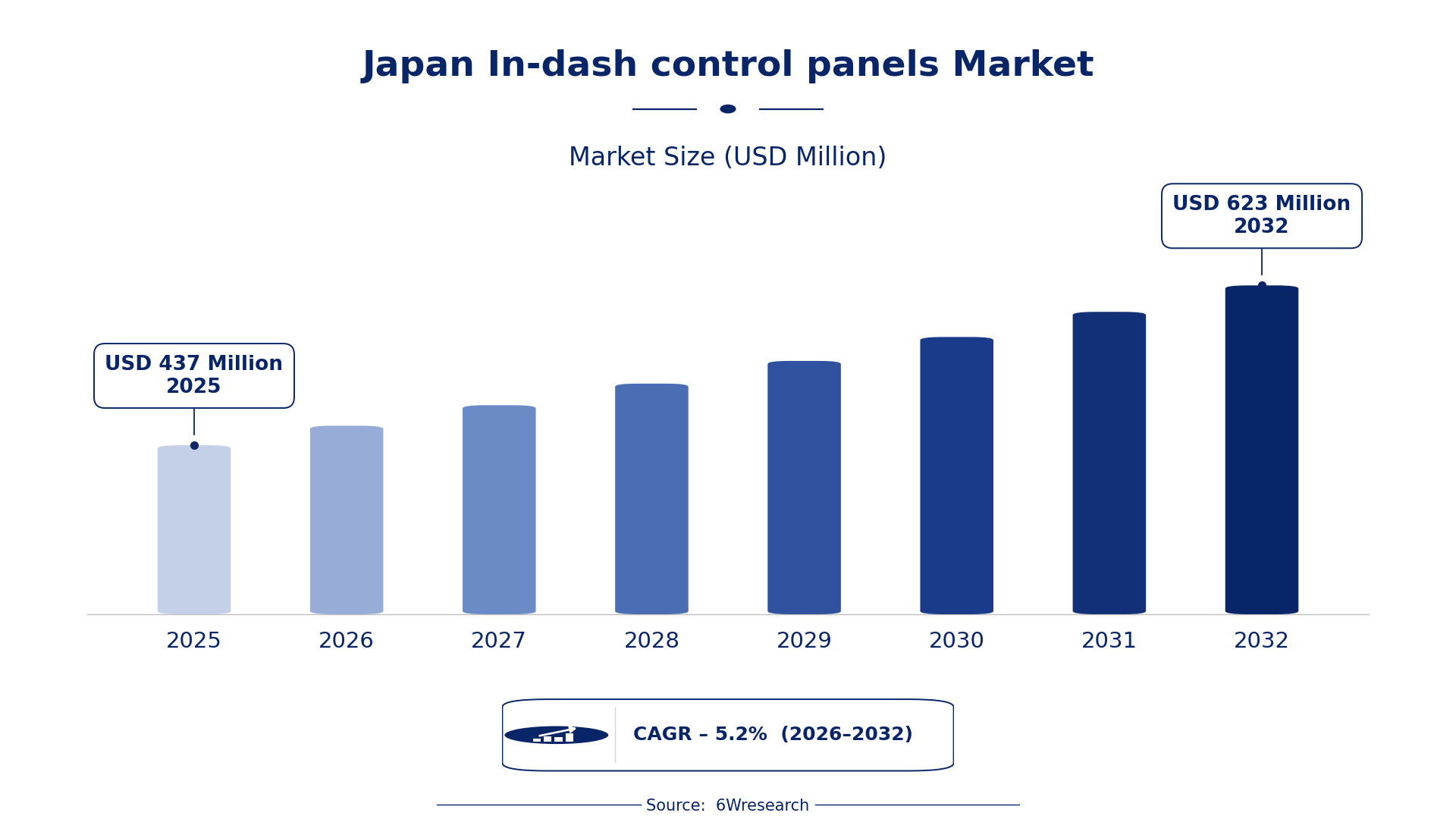
According to 6Wresearch internal database and industry insights, the Japan In-dash control panels Market was valued at USD 437 Million in 2025 and is projected to reach USD 623 Million by 2032, growing at a CAGR of approximately 5.2% during 2026–2032.
Japan In-dash control panels Market Highlights
| Report Metric | Details |
| Report Name | Japan In-dash control panels Market (2026-2032) |
| Market Size 2025 | USD 437 Million |
| Market Size 2032 | USD 623 Million |
| Absolute Growth 2025–2032 | USD 186 Million |
| CAGR 2026–2032 | 5.2% |
| Peak Annual Growth | 6.0% in 2026 |
| Forecast Period | 2026–2032 |
| Historical Data | 2022–2025 |
| Base Year | 2025 |
| Leading Panel Type, 2025 | Touchscreen Panels (52% share) |
| Leading Display Technology, 2025 | LCD/AMOLED (41% share) |
| Leading Control Features, 2025 | Infotainment Control (40% share) |
| Leading End User, 2025 | Car OEMs (42% share) |
| Fastest-Growing Panel Type | Gesture-Based Interfaces (7.9% CAGR) |
| Fastest-Growing Display Technology | HMI Integrated (7.3% CAGR) |
| Fastest-Growing Control Features | Voice & Motion Enabled (7.0% CAGR) |
| Fastest-Growing End User | EV Manufacturers (6.9% CAGR) |
| Growing Sector | automotive electronics |
| Key End Users | Car OEMs, EV Manufacturers, Luxury Auto Integrators |
Japan In-dash control panels Market Year-wise Growth Rate and Key Drivers (2022–2032)
This graph illustrates the annual growth rates of the market from 2022 to 2032, highlighting a steady upward trajectory and projected market expansion over the forecast period.
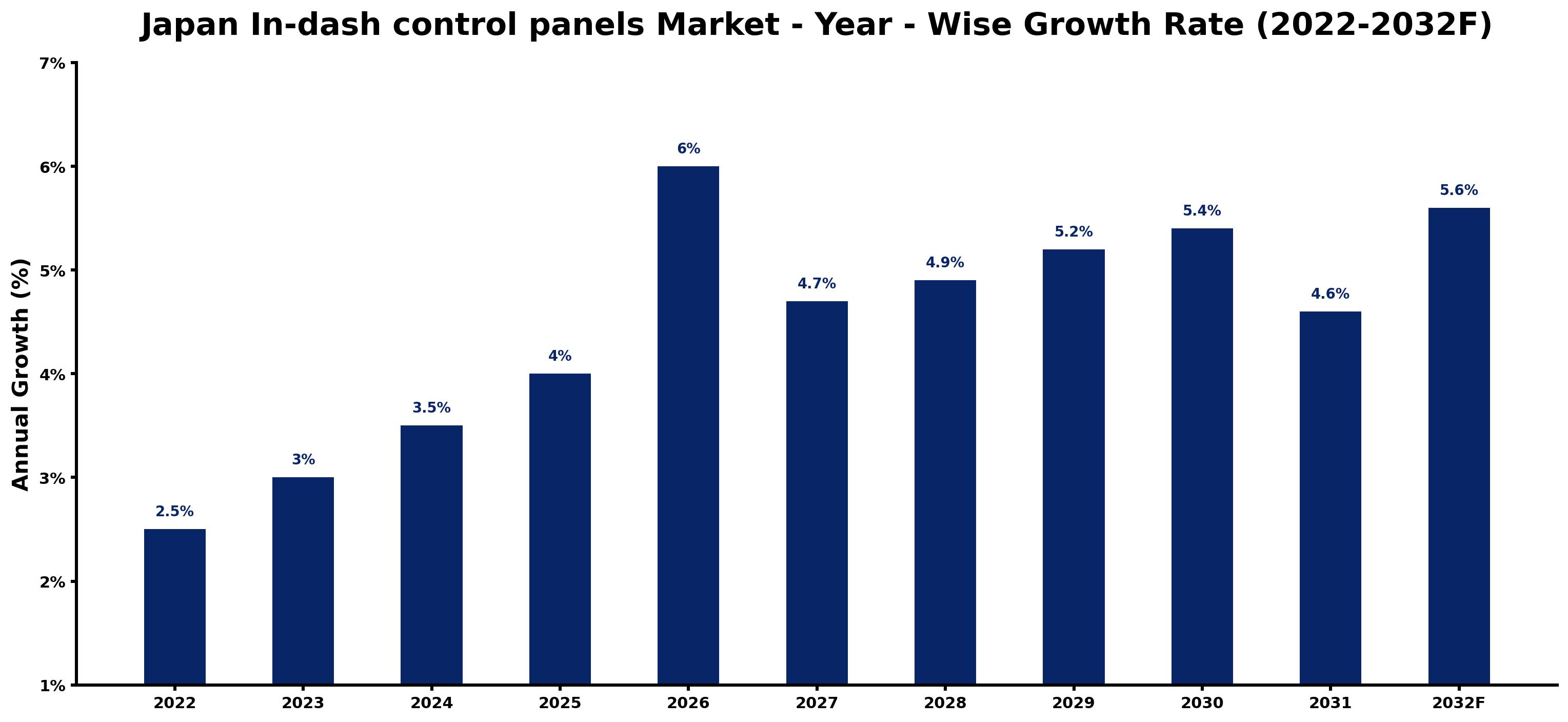
The table below sets out the estimated growth rate for each year and the main factor behind it.
| Year | Estimated Annual Growth (%) | Market Rationale |
| 2022 | 2.5 | The market experienced steady growth, driven by ongoing demand from car manufacturers. |
| 2023 | 3.0 | Growth accelerated as automotive technology adoption increased among consumers. |
| 2024 | 3.5 | The introduction of new electric vehicle models further boosted demand for advanced panels. |
| 2025 | 4.0 | Demand rose due to the Tokyo Motor Show showcasing new technologies. |
| 2026 | 6.0 | The peak growth year saw heightened investments in automotive electronics and EVs. |
| 2027 | 4.7 | Growth slowed as the market began to stabilise after rapid expansion. |
| 2028 | 4.9 | An increase in vehicle production contributed to a rise in panel demand. |
| 2029 | 5.2 | Demand continued to grow as consumer preferences shifted towards advanced features. |
| 2030 | 5.4 | The market benefitted from ongoing technological advancements and consumer interest. |
| 2031 | 4.6 | Growth moderated as the market adjusted to previous years' rapid changes. |
| 2032 | 5.6 | The market is projected to grow steadily with continued focus on EV technology. |
Note: Market size estimations and growth projections presented in this report are based on 6Wresearch's proprietary forecasting methodology, utilizing the latest available industry data, government publications, and primary research inputs.
Japan In-dash control panels Market Synopsis
In-dash control panels serve as electronic interfaces in vehicles, managing navigation, audio, and climate control functions. These panels primarily utilise advanced display technologies such as LCD and AMOLED, crucial for improving the driver experience. The Japan In-dash Control Panels Market is expanding, driven by the production of 8.3 million vehicles in 2022 and a strong push for electric vehicles, with the government targeting 1 million EVs on the road by 2025. This growth stems from domestic car manufacturers and the rising demand for sophisticated infotainment systems.
Market Dynamics Impact Analysis (2026–2032)
| Factor | Type | Impact | Primary Segment Affected |
| Rising demand for electric vehicles drives the need for advanced in-dash control panels. | Driver | High | Touchscreen Panels |
| Technological advancements in display technology enhance user experience and functionality. | Driver | High | LCD/AMOLED |
| The shift towards electric vehicles presents opportunities for innovative panel designs. | Opportunity | High | EV Manufacturers |
| The growing automotive electronics market encourages investment in new technologies. | Opportunity | High | Car OEMs |
| Regulatory compliance can increase production costs for manufacturers. | Restraint | High | Capacitive Touch Panels |
| Limited adoption of gesture-based interfaces restricts their market potential. | Restraint | Medium | Gesture-Based Interfaces |
| Supply chain disruptions can delay production timelines for automotive components. | Challenge | High | HMI Integrated |
| High competition among suppliers can lead to pricing pressures in the market. | Challenge | Medium | Infotainment Control |
Evaluation of Drivers in Japan In-dash control panels Market (2026–2032)
Key forces behind demand, with the segment each one moves most, are listed below.
| Drivers | Primary Segment Affected | Why It Matters (Evidence) |
| Increased vehicle production | Touchscreen Panels | Japan produced 8.3 million vehicles in 2022, boosting demand for in-dash panels. |
| Technological advancements in display technology | LCD/AMOLED | The automotive electronics market was valued at approximately 4 trillion JPY in 2022, driving investments in advanced displays. |
| Growing consumer preference for infotainment systems | Infotainment Control | In-dash control panels are integral to 80% of new vehicle models in 2023, increasing their demand. |
| Rising electric vehicle adoption | EV Manufacturers | The government aims for 1 million EVs on the road by 2025, stimulating demand for advanced control panels. |
| Focus on user experience enhancements | Multi-touch | The average age of vehicles in Japan is 13.5 years, prompting upgrades to modern interfaces. |
Much of the new demand traces back to the automotive sector's production of 8.3 million vehicles in 2022, which increased the need for in-dash control panels. The automotive electronics market, valued at approximately 4 trillion JPY, has spurred investments in advanced display technologies like LCD and AMOLED. Consumer preferences are shifting towards infotainment systems, with in-dash control panels integral to 80% of new vehicle models in 2023. The target of 1 million EVs on the road by 2025 is driving demand for modern control panels. As vehicles age, the need for upgraded interfaces is also rising, further boosting demand for these products.
Evaluation of Restraints in Japan In-dash control panels Market
Several factors work against faster growth; the main ones are summarised below.
| Market Restraint | Primary Segment Affected | Why It Matters (Evidence) |
| Regulatory compliance increases production costs for manufacturers. | Capacitive Touch Panels | The JIS D 0201 standard requires rigorous testing, raising costs for producers. |
| Limited adoption of gesture-based interfaces restricts their market potential. | Gesture-Based Interfaces | Current applications are minimal, leading to lower demand among manufacturers. |
| Supply chain disruptions delay production timelines for automotive components. | HMI Integrated | The integrated supply chain in Japan faces challenges, impacting timely delivery. |
| High competition among suppliers leads to pricing pressures. | Infotainment Control | With over 1,000 registered automotive suppliers, pricing strategies are highly competitive. |
| Consumer reluctance to adopt new technologies can hinder growth. | Rotary/Digital Hybrid | Some buyers prefer traditional interfaces, limiting the market for newer technologies. |
Japan In-dash control panels Market Challenges
In 2023, in-dash control panels are featured in 80% of new vehicle models, yet buyers face rising costs due to increased material prices, inflating vehicle prices by up to 10%. Producers encounter delays in technology adoption owing to stringent regulations from the Ministry of Land, Infrastructure, Transport and Tourism, potentially extending product development timelines by six months. Importers grapple with competition from over 1,000 registered automotive suppliers, resulting in price wars that erode margins. Buyers also contend with the average age of vehicles at 13.5 years, which limits demand for new panels and slows market growth.
Trends in the Japan In-dash control panels Market
These developments are changing demand patterns in the Japan In-dash control panels Market.
- Shift towards Advanced Infotainment Systems: Car OEMs are increasingly incorporating advanced infotainment systems into new models, reflecting consumer preferences for connectivity. In 2023, 80% of new vehicles featured in-dash control panels, indicating strong market demand.
- Transition from Traditional to Touchscreen Interfaces: The automotive industry is transitioning from rotary controls to touchscreen interfaces. By 2025, touchscreen panels are expected to capture a 52% market share, showcasing the shift in consumer expectations.
- Emergence of Gesture-Based Interfaces: Gesture-based interfaces are gradually gaining traction in modern vehicles. By 2026, this technology is projected to grow at a CAGR of 7.9%, indicating future potential in user interaction.
- Focus on Electric Vehicle Integration: EV manufacturers are prioritising the integration of advanced in-dash control panels. The government's target of 1 million EVs by 2025 is driving innovation in this sector.
Investment Opportunities in the Japan In-dash control panels Market
Several openings in the Japan In-dash control panels Market merit attention from investors.
- Car OEMs seeking advanced features: Car OEMs are currently focused on integrating advanced in-dash control panels into new models, with the automotive electronics market valued at approximately 4 trillion JPY in 2022, creating investment opportunities.
- Growing demand for electric vehicles: With the aim of 1 million EVs on the road by 2025, there is an opportunity to supply advanced in-dash control panels tailored for electric vehicles, enhancing their functionality.
- Establishing partnerships with automotive suppliers: Forming alliances with local automotive suppliers can facilitate entry into the market, especially as the automotive sector continues to innovate and expand.
- Investment in touchscreen technology: The shift towards touchscreen interfaces presents an opportunity to invest in developing high-quality touchscreen panels, catering to the growing consumer demand for modern vehicle features.
Government Initiatives in the Japan In-dash control panels Market
The Electrical Appliance and Material Safety Act regulates the safety of electrical appliances, including in-dash control panels, ensuring that manufacturers adhere to strict safety standards. This act requires producers to conduct thorough testing and certification to meet safety requirements, impacting production processes. The Ministry of Land, Infrastructure, Transport and Tourism oversees compliance, ensuring that safety measures are met across the industry.
The Digital Agency drives the government's digital transformation efforts, setting common system standards for automotive technologies. This agency's initiatives support the integration of advanced technologies in vehicles, benefiting car OEMs by streamlining compliance and encouraging innovation in the automotive sector.
Future Insight of the Japan In-dash control panels Market
A policy-driven shift towards 100% electrification of new vehicles by 2035 will prompt suppliers to accelerate the development of in-dash control panels. By 2025, the target of 1 million EVs on the road will create demand for advanced features, benefiting buyers seeking modern technology. The Tokyo Motor Show will serve as a vital platform for showcasing automotive innovations, influencing market trends. With over 100 research institutions focused on automotive technology, suppliers will adapt their products to meet emerging standards.
Market Segmentation Analysis
Japan In-dash control panels Market report covers a detailed analysis of the following market segments:
By Panel Type – Touchscreen Panels Lead, Gesture-Based Interfaces Expected to Grow Fastest
According to Saurav Kr Singh, Senior Research Analyst at 6Wresearch, in 2025, Touchscreen Panels led the panel type split with a 52% share. Touchscreen panels are predominant as they are the primary interface for user interaction in vehicles, essential for enhancing driver experience. Their integration into 80% of new vehicle models in 2023 underscores their critical role in the automotive sector. Gesture-Based Interfaces are projected to grow fastest, at a CAGR of 7.9% during 2026–2032. Gesture-based interfaces are experiencing rapid growth due to their potential to enhance user interaction in vehicles. The increasing emphasis on advanced features in new models is likely to drive their adoption further, allowing touchscreen panels to maintain their lead. Suppliers should focus on gesture-based technologies to align with the rising demand for advanced in-dash control features.
By Display Technology – LCD/AMOLED Leads, HMI Integrated Expected to Grow Fastest
LCD/AMOLED held 41% of the Japan In-dash control panels Market by display technology in 2025. LCD and AMOLED technologies are prevalent in the display market as they provide clarity and vibrant visuals, crucial for vehicle user interfaces. Their established presence ensures they remain the preferred choice among manufacturers in Japan's automotive sector. The quickest growth will come from HMI Integrated, forecast to expand at a CAGR of 7.3% between 2026 and 2032. HMI integrated displays are becoming more popular as they are essential for modern vehicle control systems, enabling seamless interaction between drivers and vehicle functions. The push for more integrated technology in vehicles is expected to accelerate their growth. Buyers should consider the integration of HMI technology to enhance user experience and maintain competitiveness in the market.
By Control Features – Infotainment Control Leads, Voice & Motion Enabled Expected to Grow Fastest
The largest control features category in 2025 was Infotainment Control, at 40% of revenue. Infotainment control features are vital for the user experience, making them essential in modern vehicles. The increasing consumer demand for enhanced entertainment and connectivity options while driving highlights their importance. Voice & Motion Enabled is set to record the highest CAGR in this split, 7.0% over 2026–2032. Voice and motion-enabled controls are gaining traction as they provide hands-free operation, aligning with the trend towards safer driving practices. As consumers seek more intuitive interfaces, this feature is projected to see accelerated adoption. Suppliers must invest in voice and motion technology to meet the evolving preferences of consumers for safer and more convenient driving experiences.
By End User – Car OEMs Lead, EV Manufacturers Expected to Grow Fastest
Car OEMs accounted for 42% of the market by end user in 2025. Car OEMs are the primary users of in-dash panels, integrating these technologies into their vehicles to meet consumer expectations. The production of 8.3 million vehicles in 2022 by this segment drives the demand for advanced control panels. Over 2026–2032, EV Manufacturers are expected to post the fastest growth, at a CAGR of 6.9%. EV manufacturers are rapidly growing as they require advanced features to differentiate their vehicles in a competitive market. The government's target of 1 million EVs on the road by 2025 is likely to further fuel this segment's expansion. Suppliers should align their offerings with the needs of EV manufacturers to capitalise on the growth of electric vehicles in the market.
Key Attractiveness of the Report
- 10 Years of Market Numbers
- Historical Data Starting from 2022 to 2025
- Base Year 2025
- Forecast Data until 2032
- Key Performance Indicators Impacting the Market
- Major Upcoming Developments and Projects
Key Highlights of the Report:
- Japan In-dash control panels Market Outlook
- Market Size of Japan In-dash control panels Market, 2025
- Forecast of Japan In-dash control panels Market, 2032
- Historical Data and Forecast of Japan In-dash control panels Revenues & Volume for the Period 2022-2032F
- Japan In-dash control panels Market Trend Evolution
- Japan In-dash control panels Market Drivers and Challenges
- Japan In-dash control panels Price Trends
- Japan In-dash control panels Porter's Five Forces
- Japan In-dash control panels Industry Life Cycle
- Historical Data and Forecast of Japan In-dash control panels Market Revenues & Volume By Panel Type for the Period 2022-2032F
- Historical Data and Forecast of Japan In-dash control panels Market Revenues & Volume By Touchscreen Panels for the Period 2022-2032F
- Historical Data and Forecast of Japan In-dash control panels Market Revenues & Volume By Rotary/Digital Hybrid for the Period 2022-2032F
- Historical Data and Forecast of Japan In-dash control panels Market Revenues & Volume By Capacitive Touch Panels for the Period 2022-2032F
- Historical Data and Forecast of Japan In-dash control panels Market Revenues & Volume By Gesture-Based Interfaces for the Period 2022-2032F
- Historical Data and Forecast of Japan In-dash control panels Market Revenues & Volume By Display Technology for the Period 2022-2032F
- Historical Data and Forecast of Japan In-dash control panels Market Revenues & Volume By LCD/AMOLED for the Period 2022-2032F
- Historical Data and Forecast of Japan In-dash control panels Market Revenues & Volume By LED + Buttons for the Period 2022-2032F
- Historical Data and Forecast of Japan In-dash control panels Market Revenues & Volume By Multi-touch for the Period 2022-2032F
- Historical Data and Forecast of Japan In-dash control panels Market Revenues & Volume By HMI Integrated for the Period 2022-2032F
- Historical Data and Forecast of Japan In-dash control panels Market Revenues & Volume By Control Features for the Period 2022-2032F
- Historical Data and Forecast of Japan In-dash control panels Market Revenues & Volume By HVAC, Audio, Navigation for the Period 2022-2032F
- Historical Data and Forecast of Japan In-dash control panels Market Revenues & Volume By Basic Model Vehicles for the Period 2022-2032F
- Historical Data and Forecast of Japan In-dash control panels Market Revenues & Volume By Infotainment Control for the Period 2022-2032F
- Historical Data and Forecast of Japan In-dash control panels Market Revenues & Volume By Voice & Motion Enabled for the Period 2022-2032F
- Historical Data and Forecast of Japan In-dash control panels Market Revenues & Volume By End User for the Period 2022-2032F
- Historical Data and Forecast of Japan In-dash control panels Market Revenues & Volume By Car OEMs for the Period 2022-2032F
- Historical Data and Forecast of Japan In-dash control panels Market Revenues & Volume By Mid-Range Vehicle Makers for the Period 2022-2032F
- Historical Data and Forecast of Japan In-dash control panels Market Revenues & Volume By EV Manufacturers for the Period 2022-2032F
- Historical Data and Forecast of Japan In-dash control panels Market Revenues & Volume By Luxury Auto Integrators for the Period 2022-2032F
- Japan In-dash control panels Import Export Trade Statistics
- Market Opportunity Assessment By Panel Type
- Market Opportunity Assessment By Display Technology
- Market Opportunity Assessment By Control Features
- Market Opportunity Assessment By End User
- Japan In-dash control panels Top Companies Market Share
- Japan In-dash control panels Competitive Benchmarking By Technical and Operational Parameters
- Japan In-dash control panels Company Profiles
- Japan In-dash control panels Key Strategic Recommendations
Market Covered
Coverage by segment is as follows.
By Panel Type
- Touchscreen Panels
- Rotary/Digital Hybrid
- Capacitive Touch Panels
- Gesture-Based Interfaces
By Display Technology
- LCD/AMOLED
- LED + Buttons
- Multi-touch
- HMI Integrated
By Control Features
- HVAC
- Audio
- Navigation
- Basic Model Vehicles
- Infotainment Control
- Voice & Motion Enabled
By End User
- Car OEMs
- Mid-Range Vehicle Makers
- EV Manufacturers
- Luxury Auto Integrators































