Japan In Silico Drug Discovery Market Size & Growth Rate
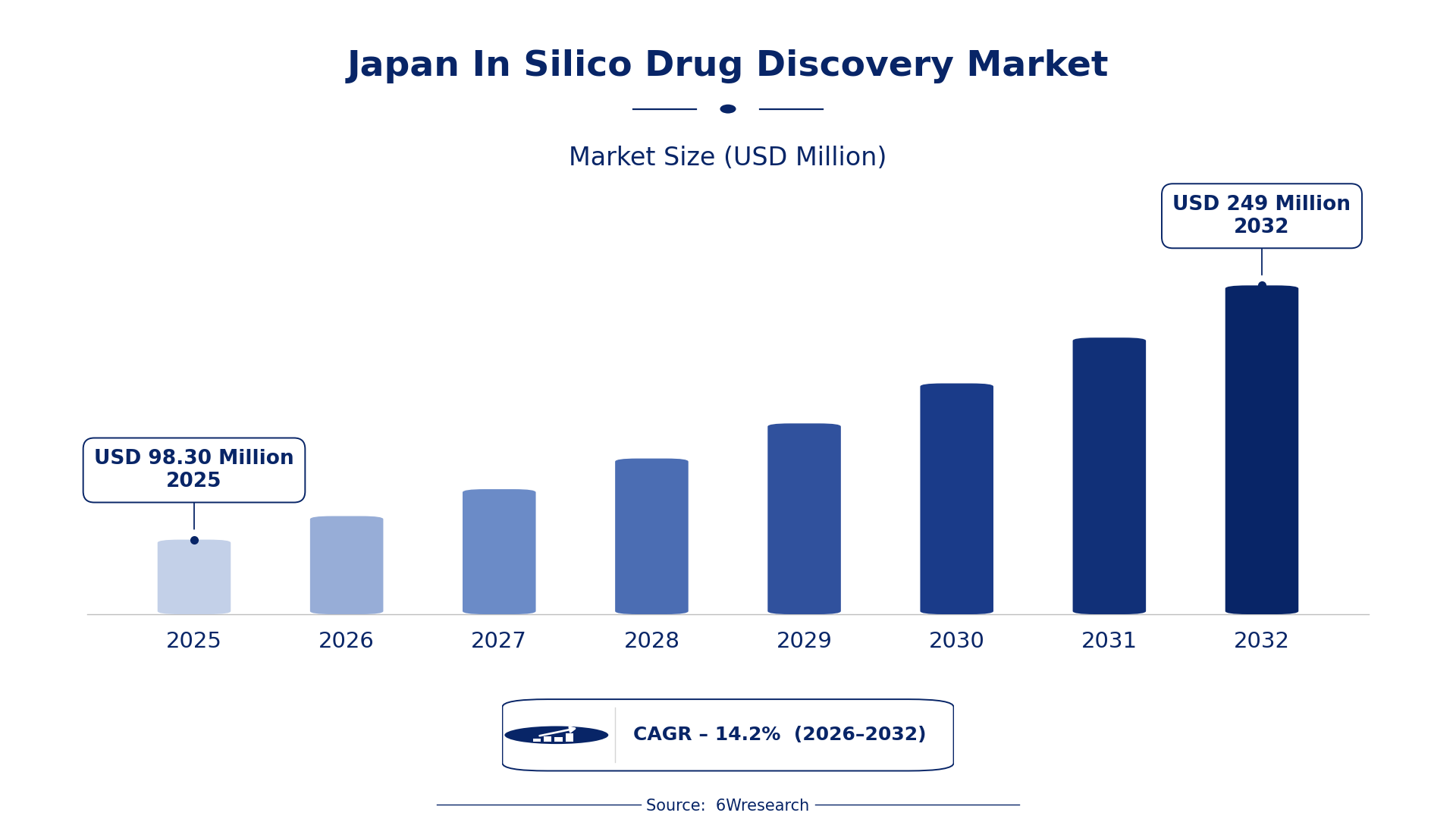
According to 6Wresearch internal database and industry insights, the Japan In Silico Drug Discovery Market was valued at USD 98.30 Million in 2025 and is projected to reach USD 249 Million by 2032, growing at a CAGR of approximately 14.2% during 2026–2032.
Japan In Silico Drug Discovery Market Highlights
| Report Metric | Details |
| Report Name | Japan In Silico Drug Discovery Market (2026-2032) |
| Market Size 2025 | USD 98.30 Million |
| Market Size 2032 | USD 249 Million |
| Absolute Growth 2025–2032 | USD 150.70 Million |
| CAGR 2026–2032 | 14.2% |
| Peak Annual Growth | 16.2% in 2026 |
| Forecast Period | 2026–2032 |
| Historical Data | 2022–2025 |
| Base Year | 2025 |
| Leading Simulation Type, 2025 | Molecular Docking (43% share) |
| Leading Technology Used, 2025 | AI + ML (48% share) |
| Leading Target Stage, 2025 | Hit Identification (43% share) |
| Leading End User, 2025 | Pharma R&D Centers (49% share) |
| Fastest-Growing Simulation Type | Pharmacokinetics Models (19.3% CAGR) |
| Fastest-Growing Technology Used | Computational Chemistry (20.0% CAGR) |
| Fastest-Growing Target Stage | Preclinical Modeling (19.0% CAGR) |
| Fastest-Growing End User | Biotechnology Firms (18.7% CAGR) |
| Growing Sector | Pharmaceutical Research and Development |
| Key End Users | Pharmaceutical R&D Centers, Biotechnology Firms, CROs, Bioinformatics Labs |
Japan In Silico Drug Discovery Market Year-wise Growth Rate and Key Drivers (2022–2032)
This graph illustrates the annual growth rates of the market from 2022 to 2032, highlighting a steady upward trajectory and projected market expansion over the forecast period.
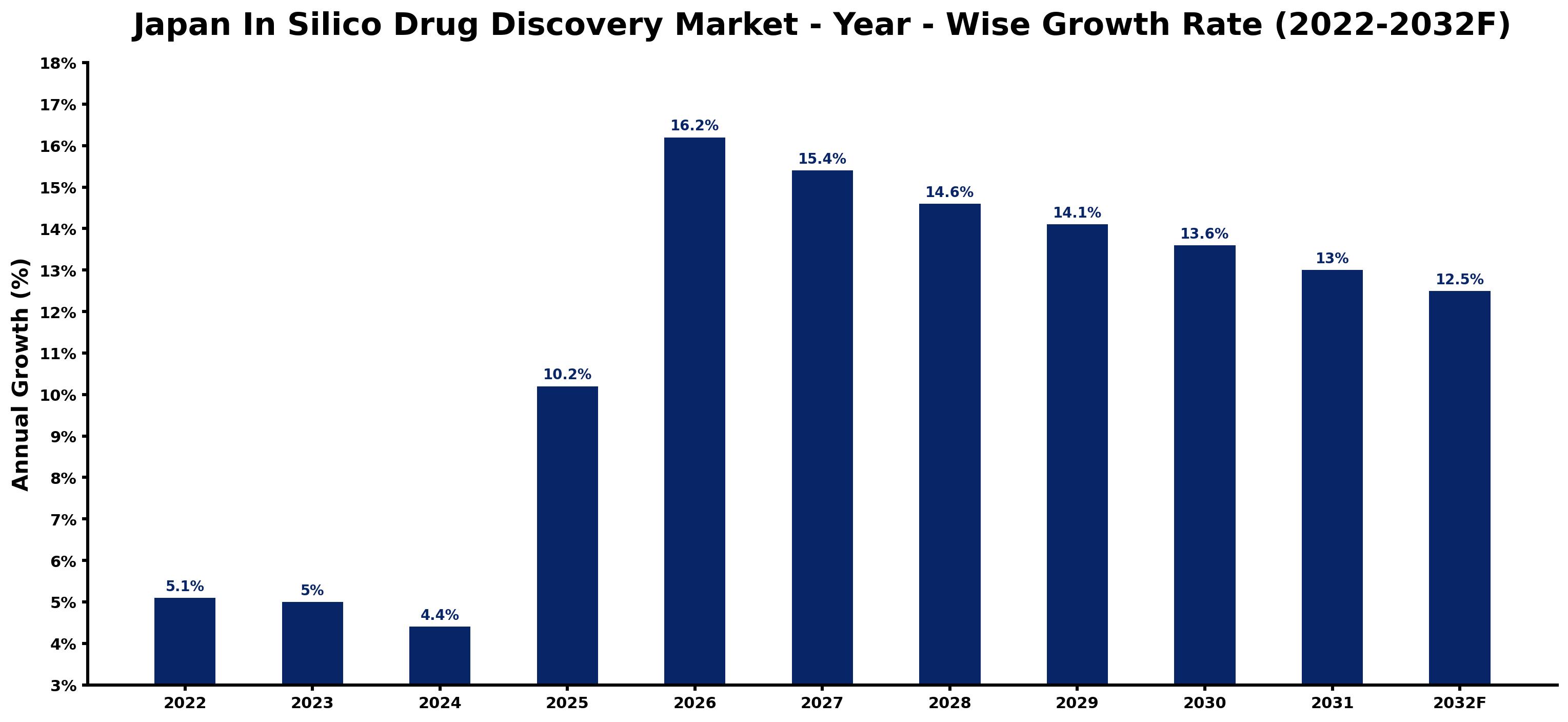
Below, each year's estimated growth is shown next to the factor that most influenced it.
| Year | Estimated Annual Growth (%) | Market Rationale |
| 2022 | 5.1 | The market experienced steady growth, supported by increasing interest in computational methods. |
| 2023 | 5.0 | Growth slowed slightly as firms adjusted to new technologies and methodologies in drug discovery. |
| 2024 | 4.4 | Market expansion continued but at a reduced pace due to the maturation of existing technologies. |
| 2025 | 10.2 | A surge in investment in AI technologies led to growth in drug discovery capabilities. |
| 2026 | 16.2 | The peak growth year is expected to be marked by heightened demand for in silico methods in drug development. |
| 2027 | 15.4 | Growth will slow as the market begins to stabilise following the peak in technology adoption. |
| 2028 | 14.6 | The market is projected to continue growing, albeit at a more moderate pace as technologies mature. |
| 2029 | 14.1 | A gradual slowdown in growth rate reflects the market's transition into a more established phase. |
| 2030 | 13.6 | The market will maintain steady growth as firms focus on optimising existing drug discovery processes. |
| 2031 | 13.0 | Continued investment in AI and computational methods will support a stable growth trajectory. |
| 2032 | 12.5 | Growth is projected to slow further as the market reaches a more mature stage with established players. |
Note: Market size estimations and growth projections presented in this report are based on 6Wresearch's proprietary forecasting methodology, utilizing the latest available industry data, government publications, and primary research inputs.
Japan In Silico Drug Discovery Market Synopsis
In Silico Drug Discovery utilises computer-based simulations to predict drug interactions and efficacy, employing advanced computational techniques like molecular modeling. In Japan, over 100 active pharmaceutical R&D centers utilise these technologies, driven by investments in AI and biotechnology. Government initiatives, including a ¥5 billion allocation for biotechnology research, alongside rising demand from pharmaceutical firms, are propelling market growth. The commitment to advancing drug discovery methodologies is clear in the increasing integration of in silico methods across the industry.
Market Dynamics Impact Analysis (2026–2032)
| Factor | Type | Impact | Primary Segment Affected |
| The increasing adoption of AI technologies in drug discovery enhances predictive accuracy. | Driver | High | AI + ML |
| A growing number of pharmaceutical R&D centers are investing in in silico methods to streamline drug development. | Driver | High | Pharma R&D Centers |
| The demand for faster drug development timelines creates opportunities for innovative solutions. | Opportunity | High | Biotechnology Firms |
| The rise in regulatory support for in silico methods opens new avenues for market growth. | Opportunity | Medium | CROs |
| High costs associated with advanced computational technologies can limit accessibility for smaller firms. | Restraint | High | Pharma R&D Centers |
| The complexity of regulatory compliance for in silico methods can slow down the approval process. | Restraint | Medium | CROs |
| Limited availability of skilled professionals in computational drug discovery hampers capacity expansion. | Challenge | High | Biotechnology Firms |
| The rapid pace of technological advancements requires continuous investment to stay competitive. | Challenge | Medium | Pharma R&D Centers |
Evaluation of Drivers in Japan In Silico Drug Discovery Market (2026–2032)
Below are the drivers that matter most for revenue growth, with supporting evidence.
| Drivers | Primary Segment Affected | Why It Matters (Evidence) |
| Increased investment in AI technologies is driving drug discovery processes. | AI + ML | Pharmaceutical firms in Japan invest over ¥30 billion annually in AI technologies for drug discovery. |
| The proliferation of R&D centers boosts the demand for in silico methods. | Pharma R&D Centers | Japan has over 100 active pharmaceutical R&D centers focusing on in silico methods. |
| The need for efficient drug development drives the adoption of computational models. | Computational Chemistry | The Tokyo Institute of Technology is a leading institution in computational chemistry research. |
| Growing patient populations in clinical trials increase the need for in silico methods. | Toxicity Screening | The average population of patients in clinical trials using in silico methods is around 10,000. |
| The emphasis on drug safety and efficacy accelerates the use of computational models. | ADMET Prediction | ADMET prediction models are used in 80% of preclinical drug evaluations in Japan. |
Buyers are adding capacity as the pharmaceutical sector increasingly invests in AI technologies, with annual budgets exceeding ¥30 billion. This shift improves predictive accuracy in drug discovery, leading to greater demand for in silico methods. Over 100 active pharmaceutical R&D centers are utilising these technologies to streamline drug development processes. The average population of patients in clinical trials using in silico methods stands at around 10,000, which drives the need for efficient drug evaluation. The growing emphasis on drug safety and efficacy is accelerating the adoption of computational models, improving the overall drug discovery process.
Evaluation of Restraints in Japan In Silico Drug Discovery Market
Several factors work against faster growth; the main ones are summarised below.
| Market Restraint | Primary Segment Affected | Why It Matters (Evidence) |
| High costs associated with advanced computational technologies limit access for smaller firms. | Pharma R&D Centers | Investment in advanced technology can be prohibitive, restricting participation in the market. |
| Complex regulatory compliance for in silico methods can delay the approval process. | CROs | Navigating regulatory requirements often requires extensive documentation and validation, slowing down timelines. |
| Limited availability of skilled professionals hampers capacity expansion in the sector. | Biotechnology Firms | The demand for expertise in computational drug discovery exceeds the current supply of qualified professionals. |
| The rapid pace of technological advancements necessitates continuous investment to remain competitive. | Pharma R&D Centers | Firms must consistently update their technologies, which can strain budgets and resources. |
| Regulatory hurdles in adopting new methodologies can slow down innovation in drug discovery. | CROs | Compliance with evolving standards can complicate the integration of novel in silico methods. |
Japan In Silico Drug Discovery Market Challenges
In silico toxicity screening is mandated by Japanese regulatory agencies for new drugs, causing delays in approvals for producers by up to six months due to rigorous testing protocols. Buyers face increased costs, with average drug development expenses rising by ¥2 billion per project, impacting their budgets significantly. Technology adoption issues persist, as only 80% of preclinical evaluations currently utilise ADMET prediction models, leading to inefficiencies that can slow down research timelines for producers. Skills shortages remain a concern, as over 50,000 researchers are employed, yet many lack expertise in advanced computational techniques, limiting progress for both producers and buyers.
Trends in the Japan In Silico Drug Discovery Market
The following changes are redrawing the Japan In Silico Drug Discovery Market.
- Launch of AI Promotion Program: In 2023, the Japanese government introduced a program to promote AI in drug development, allocating ¥5 billion for biotechnology research. This initiative is expected to improve the integration of AI technologies in drug discovery, benefiting pharmaceutical firms and CROs.
- Shift to Advanced Toxicity Screening: The adoption of in silico toxicity screening is now mandated by Japanese regulatory agencies for new drugs. This shift is improving drug safety evaluations, with a significant percentage of preclinical drug evaluations utilising these methods.
- Growth in Computational Chemistry: The focus on computational chemistry has intensified, with the Tokyo Institute of Technology leading research efforts. This trend is important for simulating chemical interactions, supporting advancements in drug discovery methodologies.
- Increased Collaboration Among R&D Centers: Collaboration among over 100 pharmaceutical R&D centers is growing, fostering innovation in drug discovery. This trend is driving demand for in silico methods, as firms seek to streamline development processes.
Investment Opportunities in the Japan In Silico Drug Discovery Market
The following opportunities in the Japan In Silico Drug Discovery Market pair current demand with a clear way in.
- Joint Ventures with Local Firms: Establishing joint ventures with local biotechnology firms offers a pathway to access advanced technologies. With over 100 R&D centers in Japan, there is an opportunity to collaborate and innovate.
- Investment in Computational Facilities: Investing in advanced computational chemistry facilities in the Tokyo region can meet current demand. The area is a hub for biotechnology firms, making it an ideal location for new ventures.
- Focus on AI Integration: Now is the time to invest in AI technologies for drug discovery, as firms are allocating substantial budgets. The Japanese government's support for AI initiatives further enhances the investment environment.
- Expansion of Bioinformatics Labs: The growing number of bioinformatics labs in Japan presents a gap for investment. With over 200 labs focusing on gene-protein mapping, there is potential for new partnerships and technological advancements.
Government Initiatives in the Japan In Silico Drug Discovery Market
The NHI drug price standard, revised regularly, establishes pricing frameworks for drugs, impacting pharmaceutical firms by determining reimbursement prices. Additionally, the Clinical Trials Act mandates transparency in clinical research, ensuring that in silico methods are properly validated and reported, which is essential for regulatory compliance.
The PMDA reviews pharmaceuticals and medical devices, ensuring that in silico methods meet safety and efficacy standards. Meanwhile, AMED funds medical research and development, providing financial support for projects that incorporate effective drug discovery methodologies.
Future Insight of the Japan In Silico Drug Discovery Market
AI technologies will transform drug discovery processes by 2032, improving accuracy in drug interactions. The government’s ¥5 billion investment in biotechnology research will facilitate advancements, allowing suppliers to create more effective drugs. Enhanced partnerships between R&D centres and academic institutions will drive innovation in drug design methodologies. As in silico methods become commonplace in clinical trials, the average patient population in these trials will expand to around 10,000, improving outcomes for both buyers and suppliers.
Market Segmentation Analysis
Japan In Silico Drug Discovery Market report covers a detailed analysis of the following market segments:
By Simulation Type – Molecular Docking Leads, Pharmacokinetics Models Expected to Grow Fastest
According to Saurav Kr Singh, Senior Research Analyst at 6Wresearch, in 2025, Molecular Docking led the simulation type split with a 43% share. Molecular Docking holds the largest share due to its critical role in predicting drug-target interactions, essential for successful drug design. For instance, it is widely used across over 100 active pharmaceutical R&D centers in Japan. Pharmacokinetics Models are projected to grow fastest, at a CAGR of 19.3% during 2026–2032. Pharmacokinetics Models are experiencing rapid growth as they provide vital insights into drug absorption and metabolism, essential for optimising drug efficacy. This segment is gaining traction as pharmaceutical firms increasingly focus on reducing development timelines by 30%. Suppliers should prioritise advancements in pharmacokinetics models to meet the growing demand from R&D centres.
By Technology Used – AI + ML Leads, Computational Chemistry Expected to Grow Fastest
The largest technology used category in 2025 was AI + ML, at 48% of revenue. The AI and ML segment leads the market as they significantly enhance predictive accuracy and efficiency in drug discovery processes. Pharmaceutical firms in Japan invest heavily in these technologies, with annual budgets exceeding ¥30 billion dedicated to their advancement. The quickest growth will come from Computational Chemistry, forecast to expand at a CAGR of 20.0% between 2026 and 2032. Computational Chemistry is rapidly growing due to its essential role in simulating chemical interactions crucial for drug development. The increasing complexity of drug interactions necessitates advanced computational techniques, driving demand and growth in this segment. Suppliers must focus on advancing computational chemistry capabilities to maintain a competitive edge in the drug discovery market.
By Target Stage – Hit Identification Leads, Preclinical Modeling Expected to Grow Fastest
Hit Identification took 43% of target stage revenue in 2025, more than any other category. Hit Identification is the leading stage in the drug discovery process, serving as the foundation for identifying potential drug candidates. Its critical role is highlighted by the necessity for successful outcomes in subsequent phases of drug development. Over 2026–2032, Preclinical Modeling is expected to post the fastest growth, at a CAGR of 19.0%. Preclinical Modeling is experiencing rapid growth as it is essential for simulating drug behaviour before clinical trials, ensuring that only the most promising candidates proceed. The heightened demand for effective preclinical assessments is propelling this segment's expansion. Suppliers should enhance their preclinical modeling tools to meet the increasing demands of research and development centres.
By End User – Pharma R&D Centers Lead, Biotechnology Firms Expected to Grow Fastest
With 49% of end user revenue in 2025, Pharma R&D Centers was the largest category. Pharma R&D Centers dominate the market as they are the primary users of in silico methods for drug development, employing over 50,000 researchers. Their extensive resources and commitment to innovation position them as key players in this sector. Biotechnology Firms are set to record the highest CAGR in this split, 18.7% over 2026–2032. Biotechnology Firms are the fastest-growing segment, utilising in silico technologies to develop innovative drug solutions. The rapid advancements in biotechnology and their focus on cutting-edge research contribute to this segment's significant growth. Suppliers should tailor their offerings to align with the specific needs of biotechnology firms to capture this expanding market.
Key Attractiveness of the Report
- 10 Years of Market Numbers
- Historical Data Starting from 2022 to 2025
- Base Year 2025
- Forecast Data until 2032
- Key Performance Indicators Impacting the Market
- Major Upcoming Developments and Projects
Key Highlights of the Report:
- Japan In Silico Drug Discovery Market Outlook
- Market Size of Japan In Silico Drug Discovery Market, 2025
- Forecast of Japan In Silico Drug Discovery Market, 2032
- Historical Data and Forecast of Japan In Silico Drug Discovery Revenues & Volume for the Period 2022-2032F
- Japan In Silico Drug Discovery Market Trend Evolution
- Japan In Silico Drug Discovery Market Drivers and Challenges
- Japan In Silico Drug Discovery Price Trends
- Japan In Silico Drug Discovery Porter's Five Forces
- Japan In Silico Drug Discovery Industry Life Cycle
- Historical Data and Forecast of Japan In Silico Drug Discovery Market Revenues & Volume By Simulation Type for the Period 2022-2032F
- Historical Data and Forecast of Japan In Silico Drug Discovery Market Revenues & Volume By Molecular Docking for the Period 2022-2032F
- Historical Data and Forecast of Japan In Silico Drug Discovery Market Revenues & Volume By Pharmacokinetics Models for the Period 2022-2032F
- Historical Data and Forecast of Japan In Silico Drug Discovery Market Revenues & Volume By ADMET Prediction for the Period 2022-2032F
- Historical Data and Forecast of Japan In Silico Drug Discovery Market Revenues & Volume By Target Identification for the Period 2022-2032F
- Historical Data and Forecast of Japan In Silico Drug Discovery Market Revenues & Volume By Technology Used for the Period 2022-2032F
- Historical Data and Forecast of Japan In Silico Drug Discovery Market Revenues & Volume By AI + ML for the Period 2022-2032F
- Historical Data and Forecast of Japan In Silico Drug Discovery Market Revenues & Volume By Computational Chemistry for the Period 2022-2032F
- Historical Data and Forecast of Japan In Silico Drug Discovery Market Revenues & Volume By Big Data + QSAR for the Period 2022-2032F
- Historical Data and Forecast of Japan In Silico Drug Discovery Market Revenues & Volume By Gene-Protein Mapping for the Period 2022-2032F
- Historical Data and Forecast of Japan In Silico Drug Discovery Market Revenues & Volume By Target Stage for the Period 2022-2032F
- Historical Data and Forecast of Japan In Silico Drug Discovery Market Revenues & Volume By Hit Identification for the Period 2022-2032F
- Historical Data and Forecast of Japan In Silico Drug Discovery Market Revenues & Volume By Preclinical Modeling for the Period 2022-2032F
- Historical Data and Forecast of Japan In Silico Drug Discovery Market Revenues & Volume By Toxicity Screening for the Period 2022-2032F
- Historical Data and Forecast of Japan In Silico Drug Discovery Market Revenues & Volume By Early Discovery for the Period 2022-2032F
- Historical Data and Forecast of Japan In Silico Drug Discovery Market Revenues & Volume By End User for the Period 2022-2032F
- Historical Data and Forecast of Japan In Silico Drug Discovery Market Revenues & Volume By Pharma R&D Centers for the Period 2022-2032F
- Historical Data and Forecast of Japan In Silico Drug Discovery Market Revenues & Volume By Biotechnology Firms for the Period 2022-2032F
- Historical Data and Forecast of Japan In Silico Drug Discovery Market Revenues & Volume By CROs for the Period 2022-2032F
- Historical Data and Forecast of Japan In Silico Drug Discovery Market Revenues & Volume By Bioinformatics Labs for the Period 2022-2032F
- Japan In Silico Drug Discovery Import Export Trade Statistics
- Market Opportunity Assessment By Simulation Type
- Market Opportunity Assessment By Technology Used
- Market Opportunity Assessment By Target Stage
- Market Opportunity Assessment By End User
- Japan In Silico Drug Discovery Top Companies Market Share
- Japan In Silico Drug Discovery Competitive Benchmarking By Technical and Operational Parameters
- Japan In Silico Drug Discovery Company Profiles
- Japan In Silico Drug Discovery Key Strategic Recommendations
Market Covered
Coverage by segment is as follows.
By Simulation Type
- Molecular Docking
- Pharmacokinetics Models
- ADMET Prediction
- Target Identification
By Technology Used
- AI + ML
- Computational Chemistry
- Big Data + QSAR
- Gene-Protein Mapping
By Target Stage
- Hit Identification
- Preclinical Modeling
- Toxicity Screening
- Early Discovery
By End User
- Pharma R&D Centers
- Biotechnology Firms
- CROs
- Bioinformatics Labs































