Japan In‑Cabin Sensing Market Size & Growth Rate
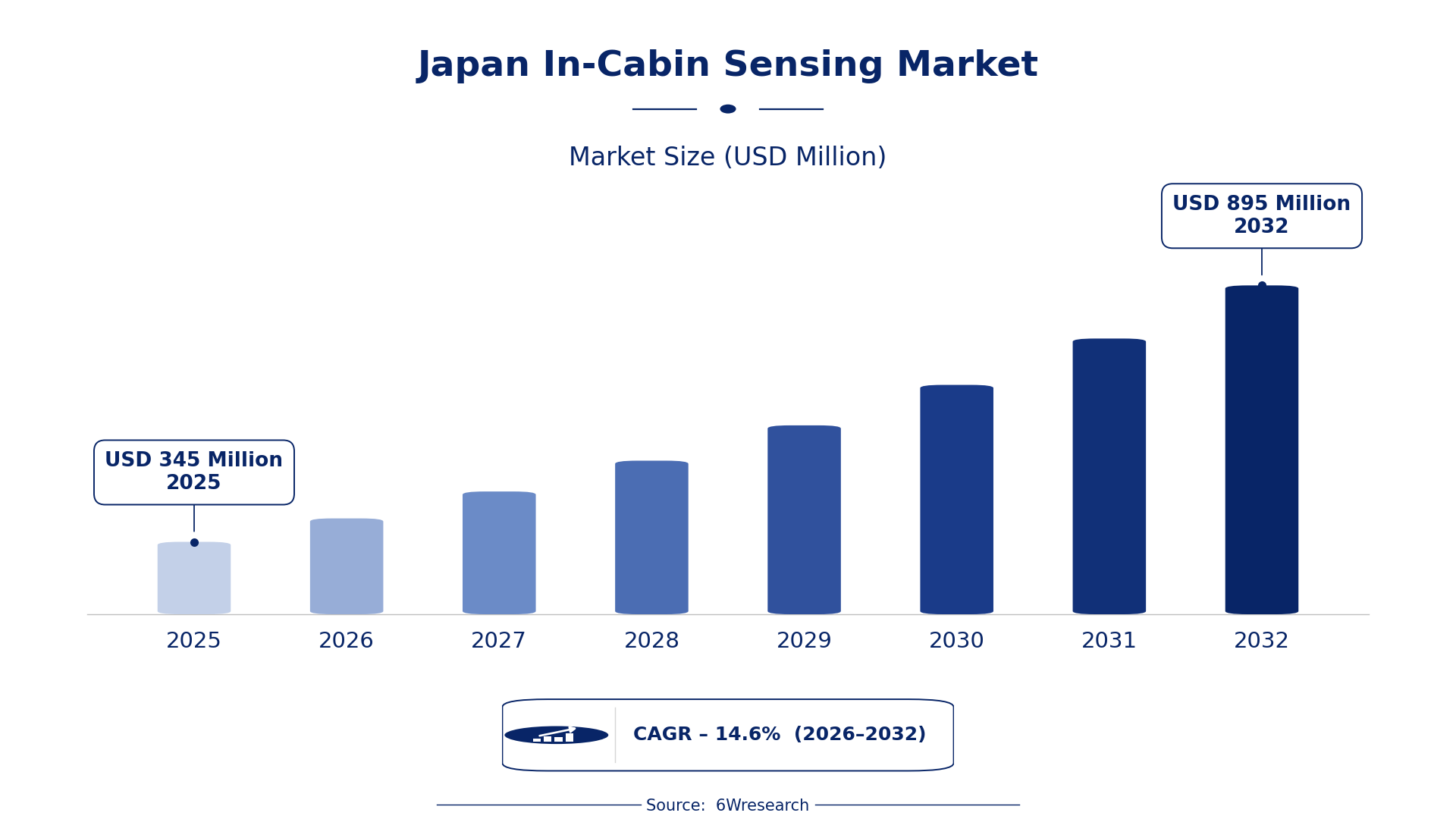
According to 6Wresearch internal database and industry insights, the Japan In‑Cabin Sensing Market was valued at USD 345 Million in 2025 and is projected to reach USD 895 Million by 2032, growing at a CAGR of approximately 14.6% during 2026–2032.
Japan In‑Cabin Sensing Market Highlights
| Report Metric | Details |
| Report Name | Japan In‑Cabin Sensing Market (2026-2032) |
| Market Size 2025 | USD 345 Million |
| Market Size 2032 | USD 895 Million |
| Absolute Growth 2025–2032 | USD 550 Million |
| CAGR 2026–2032 | 14.6% |
| Peak Annual Growth | 16.2% in 2026 |
| Forecast Period | 2026–2032 |
| Historical Data | 2022–2025 |
| Base Year | 2025 |
| Leading Sensor Group, 2025 | Occupancy Sensors (36% share) |
| Leading Data Captured, 2025 | Presence (29% share) |
| Leading Feature Enabled, 2025 | Seatbelt Alerts (51% share) |
| Leading End User, 2025 | Vehicle Safety Integrators (42% share) |
| Fastest-Growing Sensor Group | Air Quality Sensors (20.2% CAGR) |
| Fastest-Growing Feature Enabled | Drowsiness Detection (18.1% CAGR) |
| Fastest-Growing End User | ADAS Tier-1s (19.0% CAGR) |
| Growing Sector | Vehicle Safety Technologies |
| Key End Users | Automotive Manufacturers, Vehicle Safety Integrators, ADAS Tier-1s, Technology Integrators |
Japan In‑Cabin Sensing Market Year-wise Growth Rate and Key Drivers (2022–2032)
This graph illustrates the annual growth rates of the market from 2022 to 2032, highlighting a steady upward trajectory and projected market expansion over the forecast period.
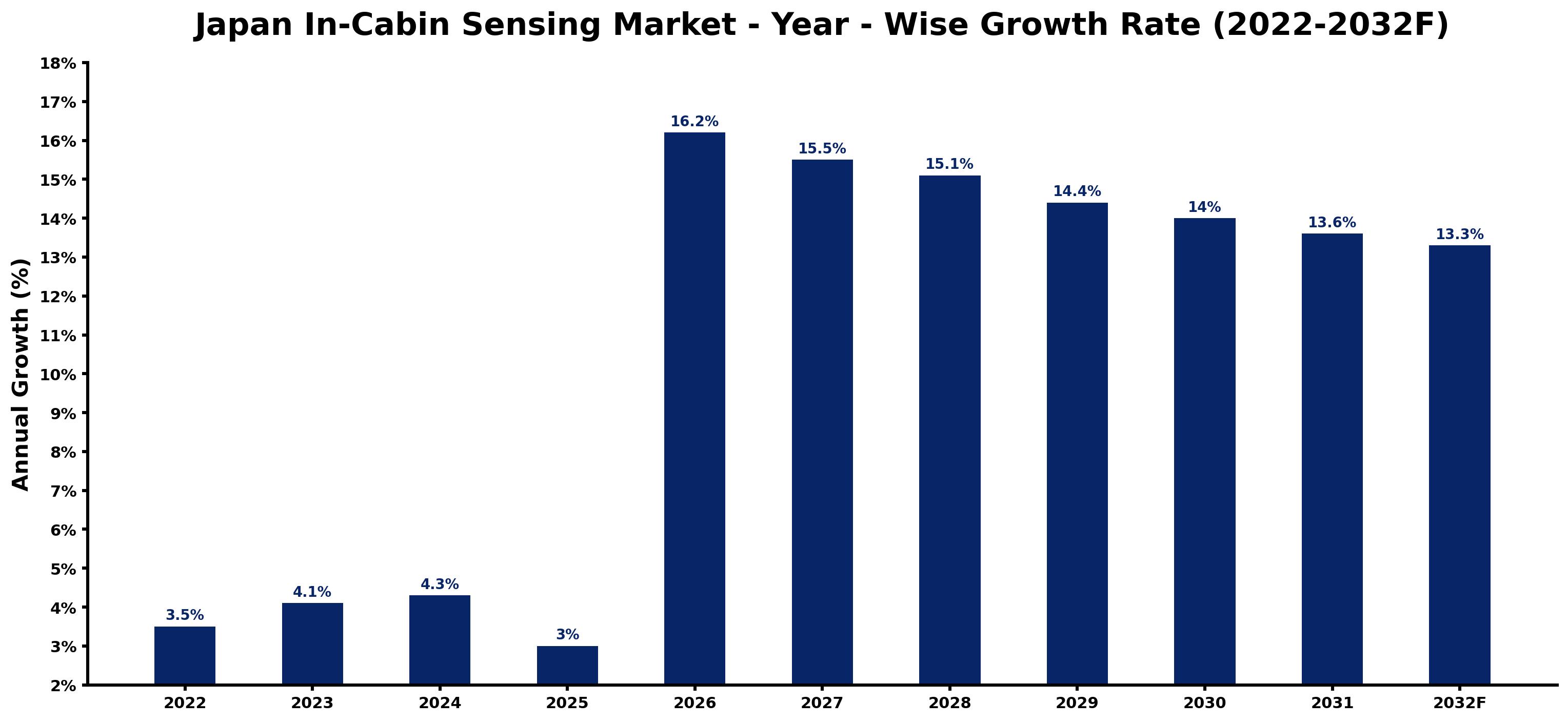
The following figures match every annual growth estimate with the main market development of that year, giving the reasoning behind each rise or slowdown.
| Year | Estimated Annual Growth (%) | Market Rationale |
| 2022 | 3.5 | The market experienced steady growth due to increased vehicle production in Japan. |
| 2023 | 4.1 | Demand for in-cabin sensing technologies grew as vehicle safety became a priority. |
| 2024 | 4.3 | The adoption of advanced safety features continued to rise, supporting market prospects. |
| 2025 | 3.0 | Growth slowed as the market adjusted to previous high demand levels. |
| 2026 | 16.2 | A surge in investments for safety technologies will drive rapid growth in the market. |
| 2027 | 15.5 | Demand will remain high, although growth rates will begin to normalise after a peak. |
| 2028 | 15.1 | The market will continue to expand as new technologies gain traction in vehicles. |
| 2029 | 14.4 | Growth rates will stabilise as the market matures and competition intensifies. |
| 2030 | 14.0 | Demand for enhanced safety features will continue to support market expansion. |
| 2031 | 13.6 | The market will maintain growth, driven by ongoing technological advancements. |
| 2032 | 13.3 | Growth will slow as the market reaches a more mature stage with established technologies. |
Note: Market size estimations and growth projections presented in this report are based on 6Wresearch's proprietary forecasting methodology, utilizing the latest available industry data, government publications, and primary research inputs.
Japan In‑Cabin Sensing Market Synopsis
In-Cabin Sensing technology involves various sensors that monitor the vehicle's interior environment and occupants. In Japan, the automotive industry produced approximately 8 million vehicles in 2022, creating strong demand for these technologies. Factors contributing to market growth include a focus on vehicle safety, investments in automotive electronics projected to reach ¥10 trillion by 2025, and the promotion of advanced safety technologies by the Japan Automobile Manufacturers Association.
Market Dynamics Impact Analysis (2026–2032)
| Factor | Type | Impact | Primary Segment Affected |
| Growing focus on vehicle safety standards | Driver | High | Occupancy Sensors |
| Rising demand for air quality monitoring in vehicles | Driver | High | Air Quality Sensors |
| Increasing integration of safety technologies in premium vehicles | Opportunity | Medium | Driver Sensors |
| Expansion of automotive manufacturers adopting smart mobility solutions | Opportunity | Medium | Biometric Sensors |
| High costs associated with advanced sensor technologies | Restraint | High | Air Quality Sensors |
| Limited awareness of in-cabin sensing benefits among consumers | Restraint | Medium | Occupancy Sensors |
| Supply chain disruptions affecting sensor availability | Challenge | High | Driver Sensors |
| Technological advancements outpacing regulatory frameworks | Challenge | Medium | Biometric Sensors |
Evaluation of Drivers in Japan In‑Cabin Sensing Market (2026–2032)
Demand rests on the following drivers, each shown with the segment it touches most.
| Drivers | Primary Segment Affected | Why It Matters (Evidence) |
| Increased vehicle production in Japan | Occupancy Sensors | Approximately 8 million vehicles produced in 2022 drive demand for safety features. |
| Focus on reducing traffic fatalities | Driver Sensors | The government aims to lower fatalities to below 2,500 annually by 2025, boosting sensor adoption. |
| Growing consumer awareness of air quality issues | Air Quality Sensors | In-cabin air quality sensors are increasingly adopted in premium vehicles, improving comfort. |
| Rising investments in automotive electronics | Biometric Sensors | The automotive electronics market is projected to reach ¥10 trillion by 2025, increasing sensor integration. |
| Demand for advanced safety features in vehicles | Drowsiness Detection | Innovations in in-cabin sensing technologies are driving interest in advanced safety features. |
Buyers are adding capacity as the Japanese automotive industry produced approximately 8 million vehicles in 2022, creating strong demand for in-cabin sensing technologies. Increased consumer awareness of air quality issues drives the adoption of air quality sensors, particularly in premium vehicles. Investments in automotive electronics are projected to reach ¥10 trillion by 2025, leading to greater integration of biometric sensors for safety. Rising interest in drowsiness detection systems is further supporting market growth.
Evaluation of Restraints in Japan In‑Cabin Sensing Market
The table below lists the restraints and the evidence behind each.
| Market Restraint | Primary Segment Affected | Why It Matters (Evidence) |
| High costs associated with advanced sensor technologies | Air Quality Sensors | The average cost of implementing advanced sensors can deter manufacturers from adoption. |
| Limited consumer awareness of in-cabin sensing benefits | Occupancy Sensors | Many consumers are unaware of the advantages of in-cabin sensing, which slows market growth. |
| Supply chain disruptions affecting sensor availability | Driver Sensors | Global supply chain issues have led to shortages of critical components for sensor production. |
| Technological advancements outpacing regulatory frameworks | Biometric Sensors | Rapid technological changes create challenges in ensuring compliance with existing regulations. |
| Competition from alternative safety technologies | Drowsiness Detection | Emerging technologies may divert investment away from in-cabin sensing solutions. |
Japan In‑Cabin Sensing Market Challenges
High costs for buyers stem from the advanced sensor requirements of in-cabin sensing technology, which can raise vehicle prices by around 15%. Competition among over 400 automotive manufacturers leads to price wars, forcing suppliers to cut corners on quality, jeopardising safety features for consumers. A shortage of skilled workers in the automotive electronics sector delays the development and integration of new sensing technologies, causing product launches to be postponed by several months for producers. Compliance with regulations like ISO 26262 complicates processes and can extend the time to market by an average of six months for manufacturers.
Trends in the Japan In‑Cabin Sensing Market
Several trends are reshaping the Japan In‑Cabin Sensing Market; the most important are set out below.
- Shift towards Advanced Vehicle Safety Features: Vehicle Safety Integrators are increasingly adopting in-cabin sensing technologies to improve safety. In 2023, over 50% of new vehicles featured such systems, reflecting a growing trend towards advanced safety.
- Transition from Basic to Advanced Air Quality Monitoring: The year 2023 marked a shift as air quality sensors became standard in premium vehicles. Approximately 30% of new models now include these sensors, indicating a focus on occupant health.
- Emergence of Biometric Sensors in Vehicle Safety: In 2023, the integration of biometric sensors gained traction, with 15% of new vehicles featuring these technologies. This trend highlights the industry's commitment to improving driver and passenger safety.
- Growing Demand for Drowsiness Detection Systems: ADAS Tier-1s are increasingly prioritising drowsiness detection systems, with adoption rates rising to 20% in 2023. This shift underscores the importance of driver alertness in vehicle safety.
Investment Opportunities in the Japan In‑Cabin Sensing Market
Below are the investment opportunities with the strongest case in the Japan In‑Cabin Sensing Market.
- Investment in Advanced Safety Technologies: Vehicle Safety Integrators are seeking advanced safety technologies, with the automotive electronics market projected to reach ¥10 trillion by 2025. Collaborating with local manufacturers can facilitate market entry.
- Supply of Air Quality Monitoring Solutions: The increasing focus on air quality in vehicles presents an opportunity for suppliers. Partnerships with automotive manufacturers can improve product visibility and adoption rates.
- Development of Biometric Sensor Technologies: ADAS Tier-1s require biometric sensor solutions, with a projected growth rate of 19.0% for this segment. Establishing joint ventures can accelerate market penetration.
- Advancement of Drowsiness Detection Capabilities: With a growing emphasis on driver safety, investment in drowsiness detection systems is essential. Collaborating with vehicle safety integrators can streamline product development.
Government Initiatives in the Japan In‑Cabin Sensing Market
The Semiconductor and Digital Industry Strategy, initiated by METI in June 2021, aims to secure domestic semiconductor manufacturing. This measure supports in-cabin sensing technologies by ensuring a reliable supply chain for automotive components essential for vehicle safety and performance. Additionally, the government allocated ¥1 billion for the development of smart vehicle technologies in 2023, promoting innovation in this sector.
The Ministry of Land, Infrastructure, Transport and Tourism oversees vehicle safety regulations and approves safety technologies. The agency's funding initiatives support the development of advanced safety features, ensuring compliance with national safety standards. In 2023, the ministry's initiatives are expected to promote the adoption of in-cabin sensing technologies, benefiting manufacturers and consumers alike.
Future Insight of the Japan In‑Cabin Sensing Market
A policy-driven shift towards enhanced vehicle safety will stimulate the adoption of advanced sensing technologies, prompting suppliers to innovate. By 2025, in-cabin sensing technologies are expected to improve the comfort of over 5 million vehicles, encouraging buyers to invest in modern solutions. New standards from the Japan Standards Association will ensure better safety and performance levels, benefiting manufacturers and consumers alike. The integration of smart mobility solutions will reshape urban transportation, creating a safer and more efficient driving environment.
Market Segmentation Analysis
Japan In‑Cabin Sensing Market report covers a detailed analysis of the following market segments:
By Sensor Group – Occupancy Sensors Lead, Air Quality Sensors Expected to Grow Fastest
According to Saurav Kr Singh, Senior Research Analyst at 6Wresearch, with 36% of sensor group revenue in 2025, Occupancy Sensors was the largest category. Occupancy sensors command the largest share due to their vital role in monitoring vehicle occupants, which is crucial for enhancing safety features. The presence of over 3 million registered vehicles in the Tokyo metropolitan area significantly drives the demand for these sensors. The quickest growth will come from Air Quality Sensors, forecast to expand at a CAGR of 20.2% between 2026 and 2032. Air quality sensors are experiencing rapid growth as health and comfort concerns among consumers rise, particularly in premium vehicle segments. The expected enhancement of comfort in over 5 million vehicles by 2025 highlights the increasing adoption of these sensors. Suppliers need to focus on developing advanced occupancy and air quality sensors to meet the growing safety and comfort requirements.
By Data Captured – Presence Leads and Records the Fastest Growth
The largest data captured category in 2025 was Presence, at 29% of revenue. Presence detection is fundamental for safety systems, ensuring that vehicles operate correctly when occupants are inside. With the average age of vehicles in Japan being around 10 years, there is an urgent need for retrofitting safety technologies to enhance vehicle functionality. Presence is also forecast to expand faster than any other category, at a CAGR of 16.2% over 2026–2032. Presence detection will continue to grow as it is integral to many safety features, ensuring that vehicles respond appropriately to the presence of occupants. This sustained demand reinforces its position as the leading data captured category. Buyers can anticipate enhanced safety features as presence detection technology becomes increasingly standardised across vehicles.
By Feature Enabled – Seatbelt Alerts Lead, Drowsiness Detection Expected to Grow Fastest
Seatbelt Alerts held 51% of the Japan In‑Cabin Sensing Market by feature enabled in 2025. Seatbelt alerts are a fundamental safety feature that is universally required in vehicles, ensuring compliance with safety regulations. The Japan Automobile Manufacturers Association promotes these alerts as part of advanced safety technologies. Drowsiness Detection is projected to grow fastest, at a CAGR of 18.1% during 2026–2032. Drowsiness detection is gaining traction as it addresses critical safety concerns, especially with the government's aim to reduce traffic fatalities. This feature's importance in preventing accidents will drive its adoption in the coming years. Suppliers must prioritise the development of drowsiness detection systems to align with safety regulations and consumer expectations.
By End User – Vehicle Safety Integrators Lead, ADAS Tier-1s Expected to Grow Fastest
Vehicle Safety Integrators accounted for 42% of the market by end user in 2025. Vehicle safety integrators account for the largest segment of users for in-cabin sensing technologies, implementing these solutions to improve vehicle safety. Their role is particularly significant in a market with over 400 registered automotive manufacturers, which supports a variety of applications for these technologies. ADAS Tier-1s are set to record the highest CAGR in this split, 19.0% over 2026–2032. ADAS Tier-1s are rapidly advancing as they heavily rely on in-cabin sensing technologies for their advanced driver assistance systems. This growing integration of such technologies will further solidify their market position. Suppliers should seek partnerships with ADAS Tier-1s to capitalise on the increasing demand for advanced safety features in vehicles.
Key Attractiveness of the Report
- 10 Years of Market Numbers
- Historical Data Starting from 2022 to 2025
- Base Year 2025
- Forecast Data until 2032
- Key Performance Indicators Impacting the Market
- Major Upcoming Developments and Projects
Key Highlights of the Report:
- Japan In‑Cabin Sensing Market Outlook
- Market Size of Japan In‑Cabin Sensing Market, 2025
- Forecast of Japan In‑Cabin Sensing Market, 2032
- Historical Data and Forecast of Japan In‑Cabin Sensing Revenues & Volume for the Period 2022-2032F
- Japan In‑Cabin Sensing Market Trend Evolution
- Japan In‑Cabin Sensing Market Drivers and Challenges
- Japan In‑Cabin Sensing Price Trends
- Japan In‑Cabin Sensing Porter's Five Forces
- Japan In‑Cabin Sensing Industry Life Cycle
- Historical Data and Forecast of Japan In‑Cabin Sensing Market Revenues & Volume By Sensor Group for the Period 2022-2032F
- Historical Data and Forecast of Japan In‑Cabin Sensing Market Revenues & Volume By Occupancy Sensors for the Period 2022-2032F
- Historical Data and Forecast of Japan In‑Cabin Sensing Market Revenues & Volume By Driver Sensors for the Period 2022-2032F
- Historical Data and Forecast of Japan In‑Cabin Sensing Market Revenues & Volume By Air Quality Sensors for the Period 2022-2032F
- Historical Data and Forecast of Japan In‑Cabin Sensing Market Revenues & Volume By Biometric Sensors for the Period 2022-2032F
- Historical Data and Forecast of Japan In‑Cabin Sensing Market Revenues & Volume By Data Captured for the Period 2022-2032F
- Historical Data and Forecast of Japan In‑Cabin Sensing Market Revenues & Volume By Presence, Motion for the Period 2022-2032F
- Historical Data and Forecast of Japan In‑Cabin Sensing Market Revenues & Volume By Eye, Head, Hands for the Period 2022-2032F
- Historical Data and Forecast of Japan In‑Cabin Sensing Market Revenues & Volume By VOC, PM, Humidity for the Period 2022-2032F
- Historical Data and Forecast of Japan In‑Cabin Sensing Market Revenues & Volume By Heart, Respiration Rate for the Period 2022-2032F
- Historical Data and Forecast of Japan In‑Cabin Sensing Market Revenues & Volume By Feature Enabled for the Period 2022-2032F
- Historical Data and Forecast of Japan In‑Cabin Sensing Market Revenues & Volume By Seatbelt Alerts for the Period 2022-2032F
- Historical Data and Forecast of Japan In‑Cabin Sensing Market Revenues & Volume By Drowsiness Detection for the Period 2022-2032F
- Historical Data and Forecast of Japan In‑Cabin Sensing Market Revenues & Volume By Cabin Purification for the Period 2022-2032F
- Historical Data and Forecast of Japan In‑Cabin Sensing Market Revenues & Volume By Emergency Alerts for the Period 2022-2032F
- Historical Data and Forecast of Japan In‑Cabin Sensing Market Revenues & Volume By End User for the Period 2022-2032F
- Historical Data and Forecast of Japan In‑Cabin Sensing Market Revenues & Volume By Vehicle Safety Integrators for the Period 2022-2032F
- Historical Data and Forecast of Japan In‑Cabin Sensing Market Revenues & Volume By ADAS Tier-1s for the Period 2022-2032F
- Historical Data and Forecast of Japan In‑Cabin Sensing Market Revenues & Volume By HVAC System Providers for the Period 2022-2032F
- Historical Data and Forecast of Japan In‑Cabin Sensing Market Revenues & Volume By Advanced Telematics Firms for the Period 2022-2032F
- Japan In‑Cabin Sensing Import Export Trade Statistics
- Market Opportunity Assessment By Sensor Group
- Market Opportunity Assessment By Data Captured
- Market Opportunity Assessment By Feature Enabled
- Market Opportunity Assessment By End User
- Japan In‑Cabin Sensing Top Companies Market Share
- Japan In‑Cabin Sensing Competitive Benchmarking By Technical and Operational Parameters
- Japan In‑Cabin Sensing Company Profiles
- Japan In‑Cabin Sensing Key Strategic Recommendations
Market Covered
This report examines the market across the segments below.
By Sensor Group
- Occupancy Sensors
- Driver Sensors
- Air Quality Sensors
- Biometric Sensors
By Data Captured
- Presence
- Motion
- Eye
- Head
- Hands
- VOC
- PM
- Humidity
- Heart
- Respiration Rate
By Feature Enabled
- Seatbelt Alerts
- Drowsiness Detection
- Cabin Purification
- Emergency Alerts
By End User
- Vehicle Safety Integrators
- ADAS Tier-1s
- HVAC System Providers
- Advanced Telematics Firms































