Japan Inclusive Mobility Solutions Market Size & Growth Rate
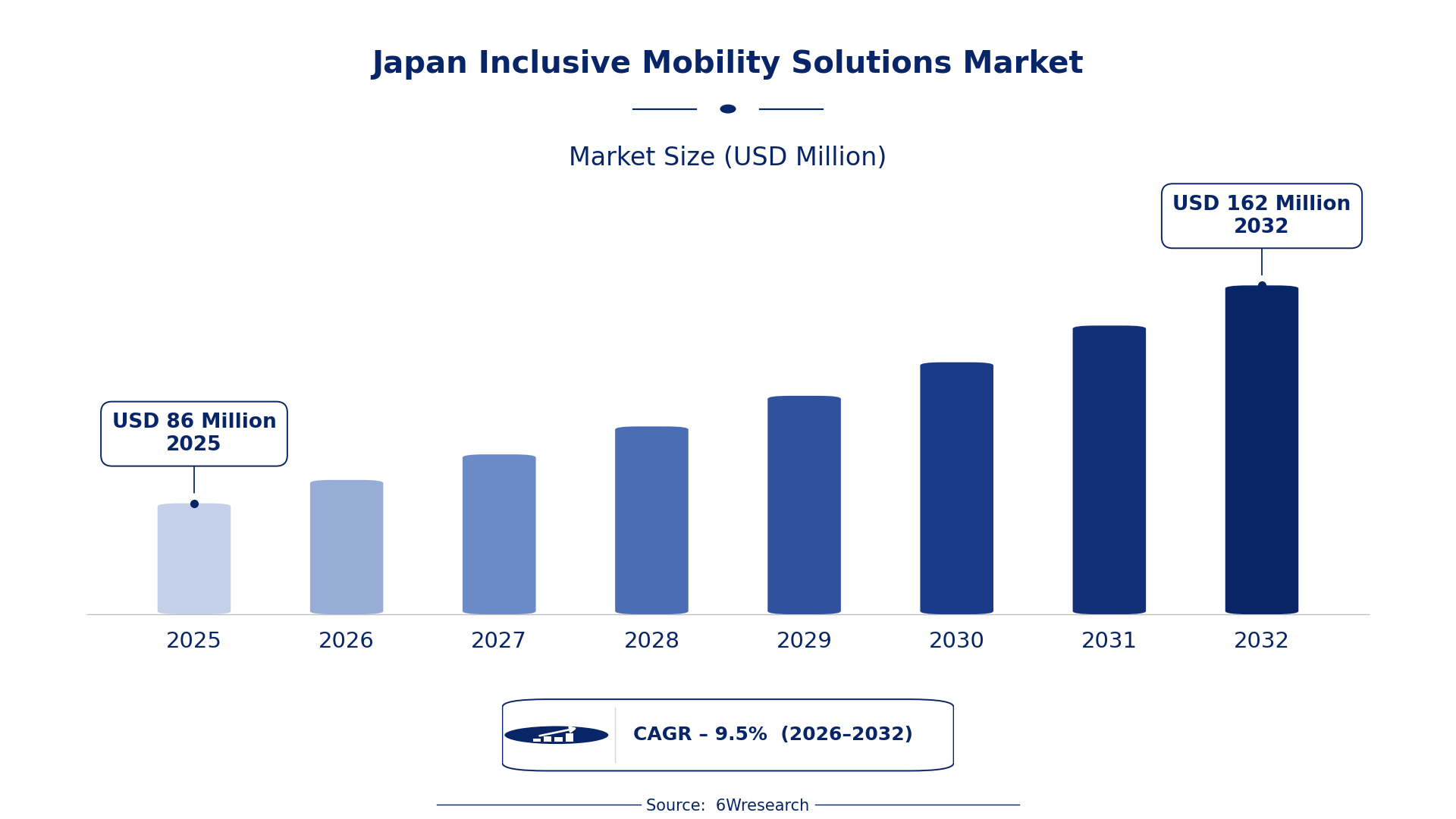
According to 6Wresearch internal database and industry insights, the Japan Inclusive Mobility Solutions Market was valued at USD 86 Million in 2025 and is projected to reach USD 162 Million by 2032, growing at a CAGR of approximately 9.5% during 2026–2032.
Japan Inclusive Mobility Solutions Market Highlights
| Report Metric | Details |
| Report Name | Japan Inclusive Mobility Solutions Market (2026-2032) |
| Market Size 2025 | USD 86 Million |
| Market Size 2032 | USD 162 Million |
| Absolute Growth 2025–2032 | USD 76 Million |
| CAGR 2026–2032 | 9.5% |
| Peak Annual Growth | 10.4% in 2032 |
| Forecast Period | 2026–2032 |
| Historical Data | 2022–2025 |
| Base Year | 2025 |
| Leading Solution Type, 2025 | Wheelchair Ramps (46% share) |
| Leading Disability Supported, 2025 | Mobility Impaired (42% share) |
| Leading Vehicle Integration, 2025 | Minivans/MPVs (46% share) |
| Leading End User, 2025 | Accessibility Transport OEMs (33% share) |
| Fastest-Growing Solution Type | Joystick Controls (13.2% CAGR) |
| Fastest-Growing Disability Supported | Limited Arm Movement (12.4% CAGR) |
| Fastest-Growing Vehicle Integration | Smart Car Systems (13.1% CAGR) |
| Fastest-Growing End User | Vehicle Modifier Firms (12.1% CAGR) |
| Growing Sector | Accessibility Transport |
| Key End Users | Mobility Impaired, Elderly Users, Vehicle Modifier Firms, Accessibility Transport OEMs |
Japan Inclusive Mobility Solutions Market Year-wise Growth Rate and Key Drivers (2022–2032)
This graph illustrates the annual growth rates of the market from 2022 to 2032, highlighting a steady upward trajectory and projected market expansion over the forecast period.
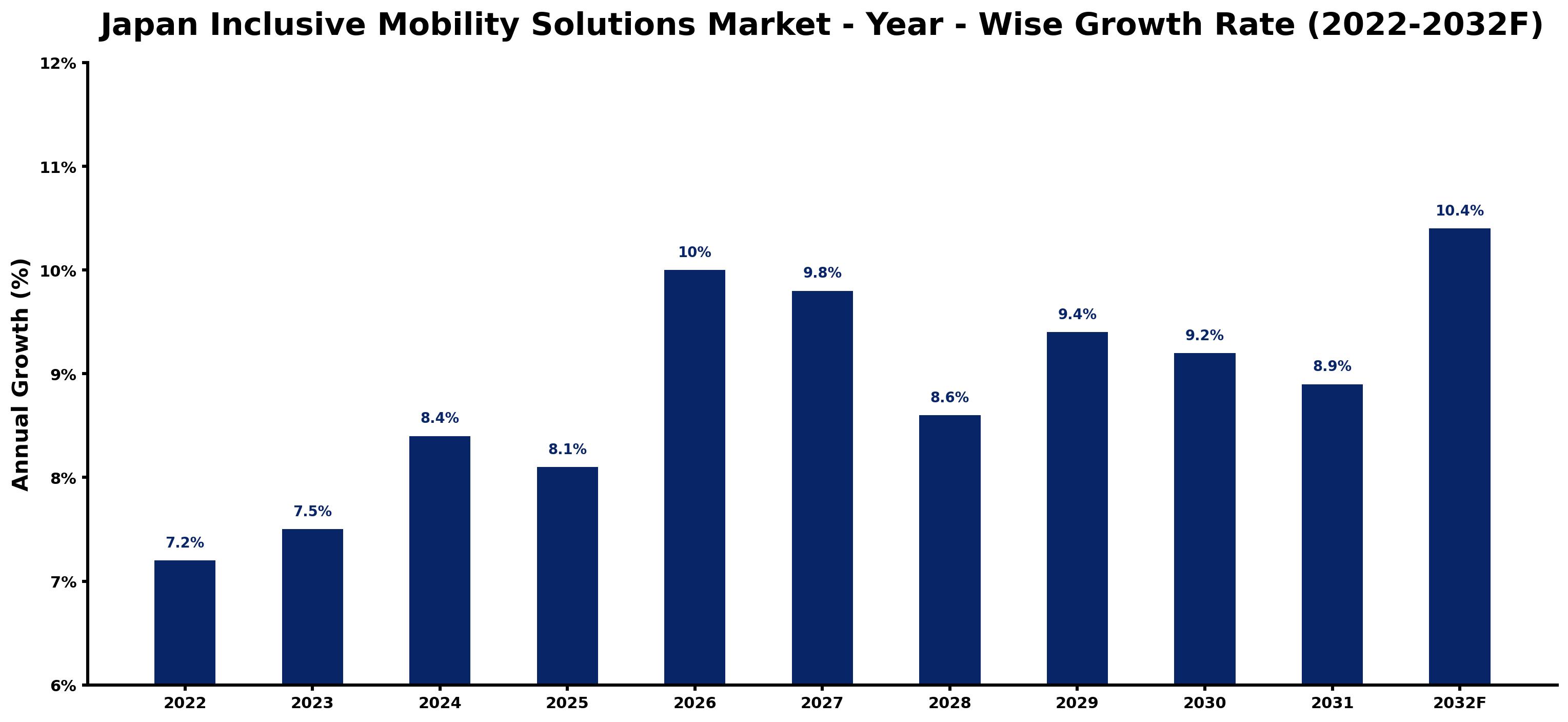
Below, each year's estimated growth is shown next to the factor that most influenced it.
| Year | Estimated Annual Growth (%) | Market Rationale |
| 2022 | 7.2 | The market experienced steady growth, reflecting ongoing demand for mobility solutions. |
| 2023 | 7.5 | Growth accelerated as awareness of inclusive mobility solutions increased among buyers. |
| 2024 | 8.4 | The market saw further expansion driven by technological advancements in vehicle modifications. |
| 2025 | 8.1 | Growth slowed slightly due to market saturation in certain segments. |
| 2026 | 10.0 | Demand surged as new technologies entered the market, improving user experience. |
| 2027 | 9.8 | Growth decelerated as competition intensified among vehicle modifier firms. |
| 2028 | 8.6 | The market continued to expand, driven by an increasing elderly population. |
| 2029 | 9.4 | Demand rose again as public awareness of accessibility needs improved. |
| 2030 | 9.2 | Growth moderated as the market matured and established players solidified their positions. |
| 2031 | 8.9 | The market experienced a slight slowdown as new entrants faced challenges. |
| 2032 | 10.4 | Growth accelerated again with the introduction of new mobility solutions. |
Note: Market size estimations and growth projections presented in this report are based on 6Wresearch's proprietary forecasting methodology, utilizing the latest available industry data, government publications, and primary research inputs.
Japan Inclusive Mobility Solutions Market Synopsis
Inclusive Mobility Solutions focus on improving access for individuals with disabilities through specialized designs and technologies. These solutions include wheelchair ramps, swivel seats, and joystick controls, facilitating access to vehicles and ensuring safe transportation. The Japan Inclusive Mobility Solutions Market is expanding due to the increasing population of individuals with disabilities and the elderly, with over 4.5 million people requiring mobility solutions. Initiatives such as the Long-Term Care Insurance Act and rising demand from vehicle modifier firms are driving market growth.
Market Dynamics Impact Analysis (2026–2032)
| Factor | Type | Impact | Primary Segment Affected |
| Increasing elderly population | Driver | High | Mobility Impaired |
| Technological advancements in vehicle modifications | Driver | High | Wheelchair Ramps |
| Growing demand for personalized mobility solutions | Opportunity | Medium | Custom Car Makers |
| Expansion of public transport accessibility initiatives | Opportunity | Medium | Accessibility Transport OEMs |
| High costs of specialized vehicle modifications | Restraint | High | Wheelchair Ramps |
| Strict regulations on vehicle modifications | Restraint | High | Swivel Seats |
| Limited availability of skilled technicians | Challenge | Medium | Joystick Controls |
| Rising competition among vehicle modifier firms | Challenge | Medium | Voice-Control Interfaces |
Evaluation of Drivers in Japan Inclusive Mobility Solutions Market (2026–2032)
The table below links each growth driver to the segment it affects and the evidence for it.
| Drivers | Primary Segment Affected | Why It Matters (Evidence) |
| Growing elderly population | Mobility Impaired | In 2022, Japan had 36 million elderly individuals, increasing demand for mobility solutions. |
| Technological advancements in vehicle modifications | Joystick Controls | Recent innovations in wheelchair ramps and joystick controls improve accessibility, attracting more buyers. |
| Awareness of disability rights | Wheelchair Ramps | The Tokyo 2020 Paralympic Games highlighted the need for improved mobility solutions, boosting demand. |
| Government initiatives for public transport accessibility | Accessibility Transport OEMs | The Long-Term Care Insurance Act allocated funds to improve public transport accessibility. |
| Rising demand for personalized solutions | Custom Car Makers | Custom adaptations for mobility-impaired users are increasingly sought after, driving market growth. |
Several shifts outside the market lift sales. The population of elderly individuals in Japan reached 36 million in 2022, which increases demand for tailored mobility solutions. Technological advancements in vehicle modifications are attracting more buyers, particularly with the growing adoption of wheelchair ramps and joystick controls. Increased public awareness of disability rights has led to a surge in demand for inclusive solutions. Funding allocated for enhancing public transport accessibility supports the development of more accessible transport options for the elderly and disabled.
Evaluation of Restraints in Japan Inclusive Mobility Solutions Market
The table below lists the restraints and the evidence behind each.
| Market Restraint | Primary Segment Affected | Why It Matters (Evidence) |
| High costs of specialized vehicle modifications | Wheelchair Ramps | The average cost of modifications can exceed several thousand dollars, limiting buyer access. |
| Strict regulations on vehicle modifications | Swivel Seats | Japan has stringent safety regulations that complicate the modification process for vehicles. |
| Limited availability of skilled technicians | Joystick Controls | A shortage of trained professionals hampers the ability to meet growing demand for adaptations. |
| Market saturation in certain segments | Voice-Control Interfaces | As competition increases, some segments face challenges in differentiating their offerings. |
| Long approval processes for new technologies | Mobility Impaired | New solutions must undergo rigorous testing, delaying market entry and impacting sales. |
Japan Inclusive Mobility Solutions Market Challenges
Producers face high costs due to strict regulations on vehicle modifications, which can delay product launches by up to six months, impacting their ability to meet market demand. Buyers encounter a limited selection of compatible adaptations, as only 10% of the 1.2 million registered wheelchairs meet advanced mobility solution standards, reducing their choices. Skills shortages in inclusive design hinder the production of effective mobility solutions, forcing producers to rely on outdated manufacturing processes. Technology gaps in user interface integration for elderly drivers can lead to safety issues, diminishing market appeal for suppliers and affecting sales.
Trends in the Japan Inclusive Mobility Solutions Market
Several trends are reshaping the Japan Inclusive Mobility Solutions Market; the most important are set out below.
- Accessibility Transport OEMs Prioritising Inclusive Designs: Accessibility Transport OEMs are increasingly focusing on inclusive designs, as seen in the rising adoption of wheelchair ramps in modified vehicles. In 2022, there were approximately 1.2 million registered wheelchairs in Japan.
- Tokyo Metropolitan Area Leading Accessibility Initiatives: The Tokyo Metropolitan area is advancing accessibility transport solutions, with substantial investments made in 2023 to improve urban mobility for disabled individuals.
- Universal Design 2023 Initiative Gaining Traction: The Universal Design 2023 Initiative aims to improve urban accessibility, promoting inclusive infrastructure. This initiative is expected to benefit millions, with a target of enhancing public transport accessibility by 2030.
- Voice-Control Interfaces Gaining Popularity: Voice-Control Interfaces are becoming increasingly common in vehicles for elderly users, facilitating easier operation. In 2022, the demand for such interfaces rose significantly, reflecting a growing trend towards user-friendly adaptations.
Investment Opportunities in the Japan Inclusive Mobility Solutions Market
The openings below show where demand in the Japan Inclusive Mobility Solutions Market is visible and how suppliers can enter.
- Tokyo Metropolitan Area as a Hub for Accessibility Solutions: The Tokyo Metropolitan area presents an opportunity for investment in accessibility transport solutions, with over 4.5 million individuals needing mobility solutions. Collaborating with local vehicle modifier firms can support market entry.
- Investing in Custom Vehicle Modifications: With a growing need for personalized mobility solutions, investing in custom vehicle modifications is timely. Vehicle Modifier Firms are seeking adaptations to meet user needs, creating a lucrative market.
- Expanding Public Transport Accessibility Initiatives: The government’s focus on improving public transport accessibility offers opportunities for suppliers. Collaborating with local governments can facilitate entry into this expanding market segment.
- Technological Advancements in Mobility Solutions: The rise of new technologies in mobility solutions presents an opportunity for investment. Engaging with Accessibility Transport OEMs can lead to successful partnerships in this evolving sector.
Government Initiatives in the Japan Inclusive Mobility Solutions Market
The Electrical Appliance and Material Safety Act of 1961 regulates the safety standards for electrical appliances and materials in Japan, ensuring that inclusive mobility solutions meet necessary safety criteria. The Long-Term Care Insurance Act, implemented in 2000, provides funding for support services for older individuals, indirectly supporting the market for mobility solutions. More recent measures, such as the GX Promotion Act of 2023, aim to promote sustainability in mobility solutions, aligning with global standards.
Accessibility transport OEMs benefit from various government schemes that support the integration of inclusive solutions into vehicles. The Long-Term Care Insurance Act allocates funds to improve public transport accessibility, while industry associations provide guidance on compliance with standards like ISO 7176, ensuring that products meet safety and design criteria.
Future Insight of the Japan Inclusive Mobility Solutions Market
The 'Barrier-Free Transportation Promotion Program' will enhance public transport accessibility by 2032, providing buyers with improved mobility solutions. Increased collaboration between local governments and vehicle modifiers will create more inclusive transport options. Innovations in vehicle controls will cater to the growing elderly population, which reached 36 million in 2022, ensuring better user experiences. Stricter standards like ISO 7176 will ensure greater safety and usability, giving suppliers a clearer direction for product development.
Market Segmentation Analysis
Japan Inclusive Mobility Solutions Market report covers a detailed analysis of the following market segments:
By Solution Type – Wheelchair Ramps Lead, Joystick Controls Expected to Grow Fastest
According to Saurav Kr Singh, Senior Research Analyst at 6Wresearch, the largest solution type category in 2025 was Wheelchair Ramps, at 46% of revenue. Wheelchair ramps are essential for allowing wheelchair users to access vehicles, which establishes them as the leading solution in the market. Their widespread use in modified minivans and MPVs highlights their critical role in facilitating mobility for individuals with disabilities. Over 2026–2032, Joystick Controls are expected to post the fastest growth, at a CAGR of 13.2%. Joystick controls are becoming increasingly popular as they offer alternative driving methods for disabled drivers, indicating a notable shift towards adaptive technologies. This trend is likely to persist as advancements in vehicle integration enhance user experiences. Suppliers should focus on producing joystick controls to meet the growing demand for adaptive driving solutions.
By Disability Supported – Mobility Impaired Leads, Limited Arm Movement Expected to Grow Fastest
With 42% of disability supported revenue in 2025, Mobility Impaired was the largest category. The mobility impaired segment represents the primary user group for inclusive mobility solutions, thus holding the largest market share. With over 4.5 million individuals in Japan requiring assistance, this group is fundamental for driving industry growth. The quickest growth will come from Limited Arm Movement, forecast to expand at a CAGR of 12.4% between 2026 and 2032. Individuals with limited arm movement are increasingly seeking adaptive technologies to enhance their mobility, resulting in the fastest growth in this segment. This trend is further encouraged by ongoing government initiatives promoting accessibility. Suppliers must concentrate on developing technologies specifically for users with limited arm movement to capitalise on this expanding segment.
By Vehicle Integration – Minivans/MPVs Lead, Smart Car Systems Expected to Grow Fastest
Minivans/MPVs accounted for 46% of the market by vehicle integration in 2025. Minivans and MPVs are the most commonly modified vehicle types for inclusive solutions, which contributes to their leading market share. Their spacious interiors and versatility make them ideal for incorporating various accessibility features. Smart Car Systems are projected to grow fastest, at a CAGR of 13.1% during 2026–2032. Smart car systems are rapidly gaining traction as they integrate advanced technologies that improve user experience, appealing to a more tech-savvy consumer base. This growth reflects a broader trend towards incorporating smart features into mobility solutions. Suppliers should invest in smart car technologies to align with the increasing consumer preference for enhanced vehicle integration.
By End User – Accessibility Transport OEMs Lead, Vehicle Modifier Firms Expected to Grow Fastest
In 2025, Accessibility Transport OEMs led the end user split with a 33% share. Accessibility transport OEMs play a crucial role in producing vehicles that meet the needs of disabled individuals, thereby maintaining the largest market share. Their expertise in integrating inclusive solutions ensures adherence to necessary safety standards. Vehicle Modifier Firms are set to record the highest CAGR in this split, 12.1% over 2026–2032. Vehicle modifier firms are experiencing rapid growth as they specialise in adapting vehicles for accessibility, indicating a heightened focus on tailored solutions. This trend is supported by government initiatives aimed at improving transport accessibility. Suppliers need to form strong partnerships with vehicle modifier firms to effectively address the rising demand for customised mobility solutions.
Key Attractiveness of the Report
- 10 Years of Market Numbers
- Historical Data Starting from 2022 to 2025
- Base Year 2025
- Forecast Data until 2032
- Key Performance Indicators Impacting the Market
- Major Upcoming Developments and Projects
Key Highlights of the Report:
- Japan Inclusive Mobility Solutions Market Outlook
- Market Size of Japan Inclusive Mobility Solutions Market, 2025
- Forecast of Japan Inclusive Mobility Solutions Market, 2032
- Historical Data and Forecast of Japan Inclusive Mobility Solutions Revenues & Volume for the Period 2022-2032F
- Japan Inclusive Mobility Solutions Market Trend Evolution
- Japan Inclusive Mobility Solutions Market Drivers and Challenges
- Japan Inclusive Mobility Solutions Price Trends
- Japan Inclusive Mobility Solutions Porter's Five Forces
- Japan Inclusive Mobility Solutions Industry Life Cycle
- Historical Data and Forecast of Japan Inclusive Mobility Solutions Market Revenues & Volume By Solution Type for the Period 2022-2032F
- Historical Data and Forecast of Japan Inclusive Mobility Solutions Market Revenues & Volume By Wheelchair Ramps for the Period 2022-2032F
- Historical Data and Forecast of Japan Inclusive Mobility Solutions Market Revenues & Volume By Swivel Seats for the Period 2022-2032F
- Historical Data and Forecast of Japan Inclusive Mobility Solutions Market Revenues & Volume By Joystick Controls for the Period 2022-2032F
- Historical Data and Forecast of Japan Inclusive Mobility Solutions Market Revenues & Volume By Voice-Control Interfaces for the Period 2022-2032F
- Historical Data and Forecast of Japan Inclusive Mobility Solutions Market Revenues & Volume By Disability Supported for the Period 2022-2032F
- Historical Data and Forecast of Japan Inclusive Mobility Solutions Market Revenues & Volume By Mobility Impaired for the Period 2022-2032F
- Historical Data and Forecast of Japan Inclusive Mobility Solutions Market Revenues & Volume By Elderly/Arthritic Users for the Period 2022-2032F
- Historical Data and Forecast of Japan Inclusive Mobility Solutions Market Revenues & Volume By Paralyzed Drivers for the Period 2022-2032F
- Historical Data and Forecast of Japan Inclusive Mobility Solutions Market Revenues & Volume By Limited Arm Movement for the Period 2022-2032F
- Historical Data and Forecast of Japan Inclusive Mobility Solutions Market Revenues & Volume By Vehicle Integration for the Period 2022-2032F
- Historical Data and Forecast of Japan Inclusive Mobility Solutions Market Revenues & Volume By Minivans/MPVs for the Period 2022-2032F
- Historical Data and Forecast of Japan Inclusive Mobility Solutions Market Revenues & Volume By Passenger Cars for the Period 2022-2032F
- Historical Data and Forecast of Japan Inclusive Mobility Solutions Market Revenues & Volume By Steering System for the Period 2022-2032F
- Historical Data and Forecast of Japan Inclusive Mobility Solutions Market Revenues & Volume By Smart Car Systems for the Period 2022-2032F
- Historical Data and Forecast of Japan Inclusive Mobility Solutions Market Revenues & Volume By End User for the Period 2022-2032F
- Historical Data and Forecast of Japan Inclusive Mobility Solutions Market Revenues & Volume By Accessibility Transport OEMs for the Period 2022-2032F
- Historical Data and Forecast of Japan Inclusive Mobility Solutions Market Revenues & Volume By Vehicle Modifier Firms for the Period 2022-2032F
- Historical Data and Forecast of Japan Inclusive Mobility Solutions Market Revenues & Volume By Custom Car Makers for the Period 2022-2032F
- Historical Data and Forecast of Japan Inclusive Mobility Solutions Market Revenues & Volume By HMI Developers for the Period 2022-2032F
- Japan Inclusive Mobility Solutions Import Export Trade Statistics
- Market Opportunity Assessment By Solution Type
- Market Opportunity Assessment By Disability Supported
- Market Opportunity Assessment By Vehicle Integration
- Market Opportunity Assessment By End User
- Japan Inclusive Mobility Solutions Top Companies Market Share
- Japan Inclusive Mobility Solutions Competitive Benchmarking By Technical and Operational Parameters
- Japan Inclusive Mobility Solutions Company Profiles
- Japan Inclusive Mobility Solutions Key Strategic Recommendations
Market Covered
Coverage by segment is as follows.
By Solution Type
- Wheelchair Ramps
- Swivel Seats
- Joystick Controls
- Voice-Control Interfaces
By Disability Supported
- Mobility Impaired
- Elderly/Arthritic Users
- Paralyzed Drivers
- Limited Arm Movement
By Vehicle Integration
- Minivans/MPVs
- Passenger Cars
- Steering System
- Smart Car Systems
By End User
- Accessibility Transport OEMs
- Vehicle Modifier Firms
- Custom Car Makers
- HMI Developers































