Japan Indoor Sports Market Size & Growth Rate
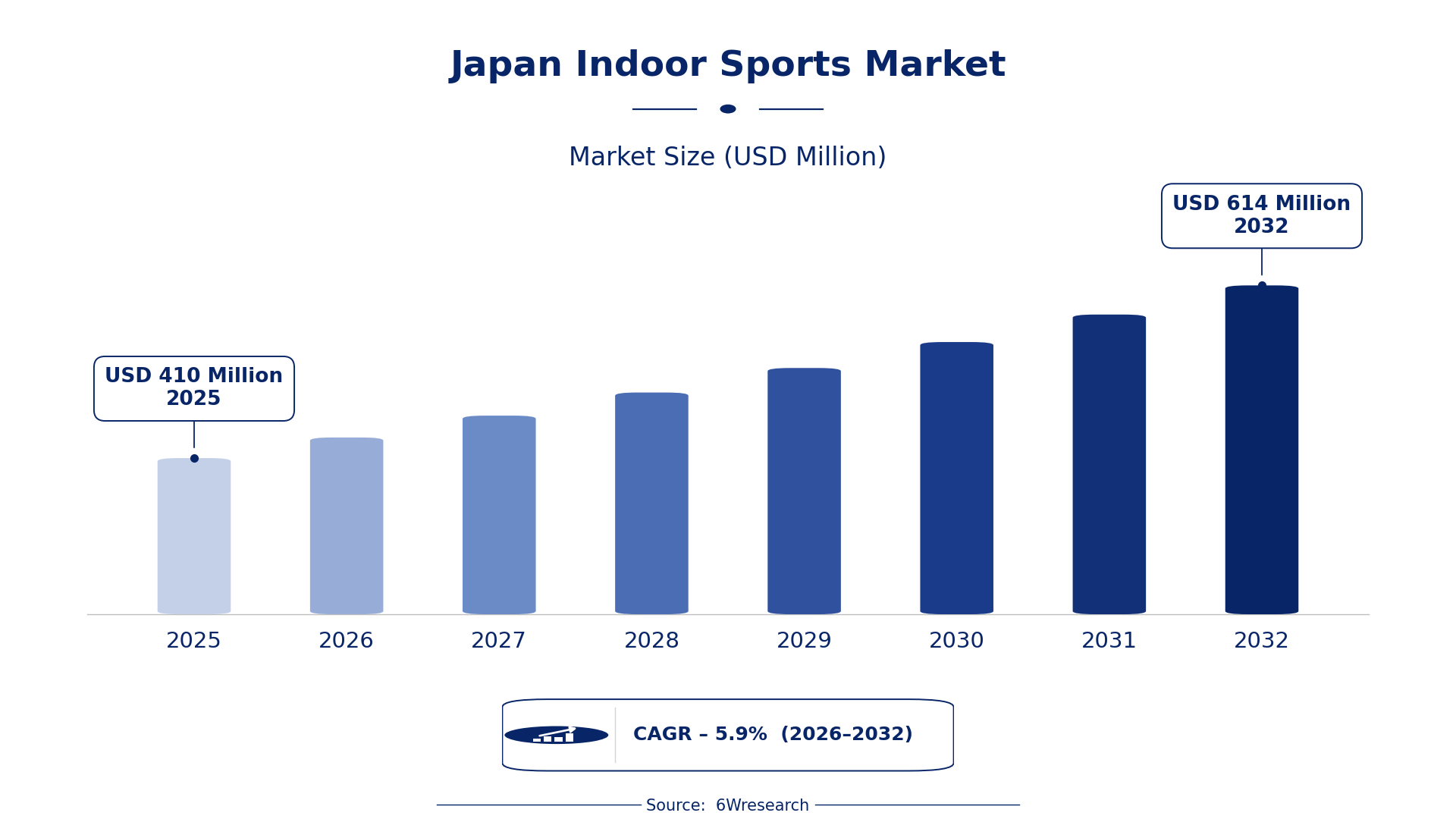
According to 6Wresearch internal database and industry insights, the Japan Indoor Sports Market was valued at USD 410 Million in 2025 and is projected to reach USD 614 Million by 2032, growing at a CAGR of approximately 5.9% during 2026–2032.
Japan Indoor Sports Market Highlights
| Report Metric | Details |
| Report Name | Japan Indoor Sports Market (2026-2032) |
| Market Size 2025 | USD 410 Million |
| Market Size 2032 | USD 614 Million |
| Absolute Growth 2025–2032 | USD 204 Million |
| CAGR 2026–2032 | 5.9% |
| Peak Annual Growth | 6.9% in 2028 |
| Forecast Period | 2026–2032 |
| Historical Data | 2022–2025 |
| Base Year | 2025 |
| Leading Sport Type, 2025 | Basketball (53% share) |
| Leading Event Format, 2025 | League/Tournament (44% share) |
| Leading Venue Size, 2025 | Gymnasium (35% share) |
| Leading End User, 2025 | Event Organizers (43% share) |
| Fastest-Growing Sport Type | Badminton (8.0% CAGR) |
| Fastest-Growing Venue Size | Medium to Large Arenas (7.6% CAGR) |
| Fastest-Growing End User | Youth Sports Clubs (7.4% CAGR) |
| Growing Sector | Youth Sports Clubs |
| Key End Users | Event Organizers, Sports Complex Operators, Youth Sports Clubs |
Japan Indoor Sports Market Year-wise Growth Rate and Key Drivers (2022–2032)
This graph illustrates the annual growth rates of the market from 2022 to 2032, highlighting a steady upward trajectory and projected market expansion over the forecast period.
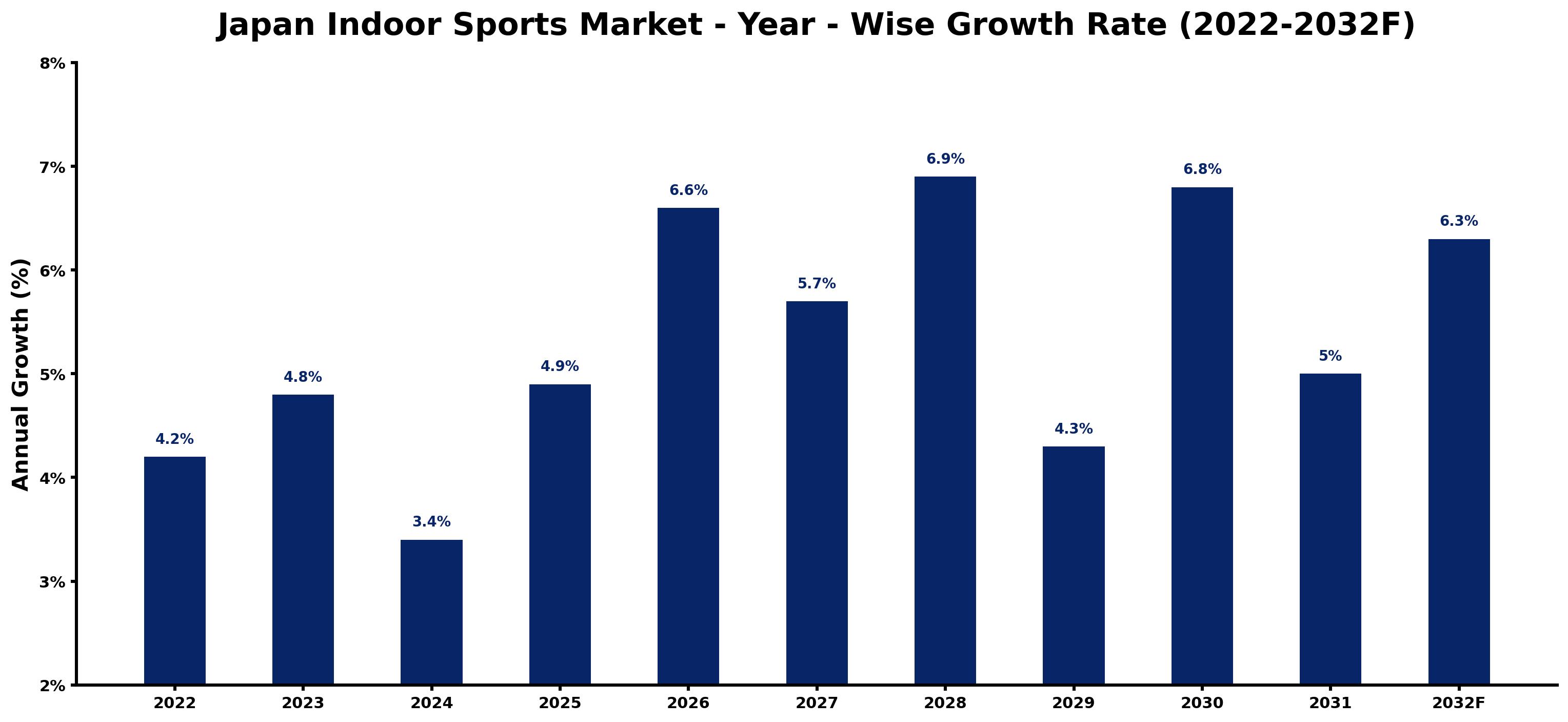
For each year, the table pairs the estimated growth rate with the leading influence on demand, showing how the drivers changed across the period.
| Year | Estimated Annual Growth (%) | Market Rationale |
| 2022 | 4.2 | The market showed steady activity with strong participation in indoor sports events. |
| 2023 | 4.8 | Growth was driven by increased youth engagement in sports activities and events. |
| 2024 | 3.4 | A slowdown occurred due to temporary venue limitations and scheduling conflicts. |
| 2025 | 4.9 | Competitive events surged, boosting overall participation and interest in indoor sports. |
| 2026 | 6.6 | Investment in facility upgrades and community programs is expected to spur higher demand. |
| 2027 | 5.7 | The market will experience a slowdown as some facilities face capacity constraints. |
| 2028 | 6.9 | Peak growth is projected through major tournaments attracting large attendance. |
| 2029 | 4.3 | Growth will slow as the market stabilises after peak event seasons. |
| 2030 | 6.8 | Increased investment in youth sports programs will revitalise interest in indoor sports. |
| 2031 | 5.0 | A slowdown is anticipated as facilities adjust to new operational standards. |
| 2032 | 6.3 | Growth is expected to accelerate again with new facility openings and expanded programming. |
Note: Market size estimations and growth projections presented in this report are based on 6Wresearch's proprietary forecasting methodology, utilizing the latest available industry data, government publications, and primary research inputs.
Japan Indoor Sports Market Synopsis
Indoor sports in Japan include activities such as basketball, badminton, and volleyball, typically held in gymnasiums and sports complexes. The Japan Indoor Sports Market is expanding due to rising participation from youth sports clubs and event organizers, alongside increased investment in facility upgrades. The Tokyo Metropolitan Area serves as a central hub for indoor sports events, hosting numerous tournaments annually. This growth reflects a broader trend towards community engagement and improved sporting infrastructure, with local governments investing in modern facilities to support diverse indoor activities.
Market Dynamics Impact Analysis (2026–2032)
| Factor | Type | Impact | Primary Segment Affected |
| Increased youth participation in sports activities drives demand for facilities and events. | Driver | High | Youth Sports Clubs |
| Investment in facility upgrades enhances the quality of indoor sports venues. | Driver | High | Gymnasium |
| Growing urbanisation leads to higher demand for indoor sports facilities in cities. | Opportunity | High | Sports Complex Operators |
| Expansion of competitive leagues creates a need for more venues and event management. | Opportunity | High | Event Organizers |
| Compliance with JIS standards can increase operational costs for facility operators. | Restraint | Medium | Gymnasium |
| Limited popularity of indoor cricket restricts its market growth potential. | Restraint | Medium | Indoor Cricket |
| High operational costs can deter investment in new indoor sports facilities. | Challenge | High | Sports Complex Operators |
| Capacity constraints in existing venues limit the number of events that can be held. | Challenge | High | Event Organizers |
Evaluation of Drivers in Japan Indoor Sports Market (2026–2032)
Demand rests on the following drivers, each shown with the segment it touches most.
| Drivers | Primary Segment Affected | Why It Matters (Evidence) |
| Rising youth engagement in sports activities | Youth Sports Clubs | Youth sports clubs have increased participation rates by 15% since 2020, driving demand for indoor sports facilities. |
| Investment in facility upgrades | Gymnasium | Local governments are investing significantly in upgrading gymnasiums to meet modern standards, improving their appeal for events. |
| Growth of competitive leagues | League/Tournament | The Japan Volleyball Association organized over 200 competitive events in 2023, increasing demand for venues. |
| Urbanisation driving venue demand | Sports Complex Operators | The Tokyo Metropolitan Area hosts more than 150 tournaments annually, creating a need for more indoor sports facilities. |
| Support from sports associations | Basketball | The Japan Basketball Association promotes basketball through various leagues, boosting participation and facility usage. |
Volumes grow on the back of rising youth engagement in sports activities, with youth sports clubs increasing participation rates by 15% since 2020. Local governments are committing significantly to upgrade gymnasiums, which improves their appeal for events. The growth of competitive leagues is clear, with numerous events organized in 2023, driving demand for venues. Urbanisation contributes to the need for more sports complexes, particularly in the Tokyo Metropolitan Area, which hosts numerous tournaments annually. Support from associations further promotes participation, ensuring a vibrant indoor sports culture.
Evaluation of Restraints in Japan Indoor Sports Market
The main factors holding the market back are set out below.
| Market Restraint | Primary Segment Affected | Why It Matters (Evidence) |
| Compliance with JIS standards increases operational costs for facility operators. | Gymnasium | Indoor sports facilities must comply with JIS standards for safety and accessibility, raising costs by up to 20%. |
| Limited popularity of indoor cricket restricts its market growth potential. | Indoor Cricket | Indoor cricket has limited popularity, with only about 10 dedicated venues across Japan. |
| High operational costs deter investment in new facilities. | Sports Complex Operators | The need for substantial investment in infrastructure can limit the establishment of new sports complexes. |
| Capacity constraints in existing venues limit the number of events. | Event Organizers | High demand for events can exceed venue capacity, restricting potential revenue from tournaments. |
| Regulatory compliance can delay facility upgrades. | Gymnasium | Operators face delays in upgrading facilities to meet safety and accessibility standards, impacting event scheduling. |
Japan Indoor Sports Market Challenges
Limited availability of modern indoor sports facilities hinders participation rates for youth sports clubs, as many venues require upgrades to meet JIS standards. Producers face renovation costs that can reach 20% more than expected, which raises expenses and ultimately impacts pricing for buyers. Local governments are competing for funding, creating delays in securing financial support for new projects, which restricts growth in indoor sports. The Tokyo Metropolitan Area's high demand for events means that inadequate facilities can lead to lost opportunities for buyers, affecting their ability to host tournaments and engage communities.
Trends in the Japan Indoor Sports Market
The trends below show where the Japan Indoor Sports Market is heading.
- Youth Sports Clubs Prioritised over Traditional Leagues: Youth sports clubs are increasingly prioritising indoor sports, as evidenced by a 15% rise in participation since 2020. This shift reflects a growing focus on community engagement and local competitions.
- Tokyo Metropolitan Area Emerging as an Indoor Sports Hub: The Tokyo Metropolitan Area is solidifying its status as a hub for indoor sports events, hosting over 150 tournaments annually, which attracts substantial attendance and investment.
- 2023 Marked a Shift in Facility Investment: In 2023, local governments began investing significantly in upgrading gymnasiums, improving their appeal for various indoor sports activities and events, which is vital for future growth.
- National Sports Festival Highlighting Indoor Sports: The National Sports Festival of Japan, featuring various indoor sports competitions annually, showcases the importance of these activities in promoting community engagement and participation.
Investment Opportunities in the Japan Indoor Sports Market
Where to invest in the Japan Indoor Sports Market: the main openings are set out below.
- Tokyo Sports Complex Upgrades: Investment in upgrading sports complexes in Tokyo is essential, with local governments allocating significant funds to enhance facilities, which will attract more events and participants.
- Supply of Multi-Purpose Sports Equipment: There is a growing need for multi-purpose sports equipment in gymnasiums, driven by the increasing number of events and activities hosted by youth sports clubs, which is projected to rise significantly.
- Event Organizers Seeking New Venues: Event organizers are actively seeking new venues to accommodate growing participation in indoor sports, particularly in urban areas where demand is high, with numerous registered players in volleyball.
- Partnerships for Facility Development: Collaborations with local governments for facility development are vital, as they can provide funding and support for new indoor sports venues, ensuring compliance with modern standards.
Government Initiatives in the Japan Indoor Sports Market
The Industrial Standardization Act governs JIS product and test standards, impacting indoor sports facilities by ensuring safety and accessibility compliance. This act requires facility operators to invest in upgrades to meet these standards, which can increase operational costs by up to 20%.
The Ministry of Education, Culture, Sports, Science and Technology oversees sports programs in schools, promoting indoor sports participation among youth. This agency supports initiatives that improve community sports facilities, ensuring that schools have access to modern venues for hosting events.
Future Insight of the Japan Indoor Sports Market
The Japan Sports Agency's initiative to develop community sports facilities will introduce more multi-purpose venues by 2032. Local governments are projected to invest heavily in upgrading gymnasiums, which will enhance participation in indoor sports activities. With over 300,000 registered players in volleyball alone, the demand for varied indoor sports will expand. Improved facilities will facilitate both recreational play and competitive events, benefiting buyers and suppliers through increased engagement and opportunities.
Market Segmentation Analysis
Japan Indoor Sports Market report covers a detailed analysis of the following market segments:
By Sport Type – Basketball Leads, Badminton Expected to Grow Fastest
According to Saurav Kr Singh, Senior Research Analyst at 6Wresearch, in 2025, Basketball led the sport type split with a 53% share. Basketball holds the largest share due to its extensive presence in schools and community leagues, with numerous tournaments held annually. The sport's popularity is further evidenced by the Japan Basketball Association's active promotion of various leagues. The quickest growth will come from Badminton, forecast to expand at a CAGR of 8.0% between 2026 and 2032. Badminton is experiencing rapid growth as schools and recreational centres increasingly adopt the sport, evidenced by a membership of over 100,000 players reported by the Japan Badminton Association in 2023. This trend suggests a rising interest in badminton among youth and recreational participants. Suppliers should focus on developing products that cater to the growing interest in badminton while maintaining support for basketball.
By Event Format – League/Tournament Leads and Records the Fastest Growth
League/Tournament took 44% of event format revenue in 2025, more than any other category. Leagues and tournaments dominate the market because they are vital for structuring competitive indoor sports events, attracting both participants and spectators. The numerous tournaments held annually in the Tokyo Metropolitan Area exemplify their importance in fostering a vibrant sports culture. Its lead should widen, with a projected CAGR of 8.3% during 2026–2032, the highest in this split. The growth of leagues and tournaments is fuelled by increasing participation rates and community engagement, especially among youth. This trend suggests that the demand for structured competitive formats will likely continue to rise, further entrenching their leading status. Suppliers must align their offerings with the growing demand for league and tournament formats to seize emerging opportunities.
By Venue Size – Gymnasium Leads, Medium to Large Arenas Expected to Grow Fastest
With 35% of venue size revenue in 2025, Gymnasium was the largest category. Gymnasiums serve as the primary venues for indoor sports, accommodating a wide variety of activities and events, which solidifies their leading market position. Their extensive distribution across Japan provides a robust foundation for indoor sports participation. Over 2026–2032, Medium to Large Arenas are expected to post the fastest growth, at a CAGR of 7.6%. Medium to large arenas are witnessing rapid growth as they are essential for hosting major events and tournaments, indicating a shift towards larger venues for significant competitions. This trend implies that demand for these venues will likely continue to increase as event sizes expand. Suppliers should consider the specific requirements of medium to large arenas to effectively meet the evolving venue demands.
By End User – Event Organizers Lead, Youth Sports Clubs Expected to Grow Fastest
The largest end user category in 2025 was Event Organizers, at 43% of revenue. Event organizers play a crucial role in the indoor sports market, managing and promoting events that drive participation and engagement. Their influence is evident through the numerous competitive events they facilitate across various sports each year. Youth Sports Clubs are projected to grow fastest, at a CAGR of 7.4% during 2026–2032. Youth sports clubs are significantly boosting participation in indoor sports, with a reported growth rate of 15% since 2020. This increase highlights a strong emphasis on youth involvement in sports, which is expected to continue in the future. Suppliers should develop targeted strategies to cater to the specific needs of youth sports clubs, ensuring alignment with their growth objectives.
Key Attractiveness of the Report
- 10 Years of Market Numbers
- Historical Data Starting from 2022 to 2025
- Base Year 2025
- Forecast Data until 2032
- Key Performance Indicators Impacting the Market
- Major Upcoming Developments and Projects
Key Highlights of the Report:
- Japan Indoor Sports Market Outlook
- Market Size of Japan Indoor Sports Market, 2025
- Forecast of Japan Indoor Sports Market, 2032
- Historical Data and Forecast of Japan Indoor Sports Revenues & Volume for the Period 2022-2032F
- Japan Indoor Sports Market Trend Evolution
- Japan Indoor Sports Market Drivers and Challenges
- Japan Indoor Sports Price Trends
- Japan Indoor Sports Porter's Five Forces
- Japan Indoor Sports Industry Life Cycle
- Historical Data and Forecast of Japan Indoor Sports Market Revenues & Volume By Sport Type for the Period 2022-2032F
- Historical Data and Forecast of Japan Indoor Sports Market Revenues & Volume By Basketball for the Period 2022-2032F
- Historical Data and Forecast of Japan Indoor Sports Market Revenues & Volume By Badminton for the Period 2022-2032F
- Historical Data and Forecast of Japan Indoor Sports Market Revenues & Volume By Indoor Cricket for the Period 2022-2032F
- Historical Data and Forecast of Japan Indoor Sports Market Revenues & Volume By Volleyball for the Period 2022-2032F
- Historical Data and Forecast of Japan Indoor Sports Market Revenues & Volume By Event Format for the Period 2022-2032F
- Historical Data and Forecast of Japan Indoor Sports Market Revenues & Volume By League/Tournament for the Period 2022-2032F
- Historical Data and Forecast of Japan Indoor Sports Market Revenues & Volume By Singles/Doubles for the Period 2022-2032F
- Historical Data and Forecast of Japan Indoor Sports Market Revenues & Volume By Short Formats for the Period 2022-2032F
- Historical Data and Forecast of Japan Indoor Sports Market Revenues & Volume By Competitive for the Period 2022-2032F
- Historical Data and Forecast of Japan Indoor Sports Market Revenues & Volume By Venue Size for the Period 2022-2032F
- Historical Data and Forecast of Japan Indoor Sports Market Revenues & Volume By Medium to Large Arenas for the Period 2022-2032F
- Historical Data and Forecast of Japan Indoor Sports Market Revenues & Volume By Gymnasium for the Period 2022-2032F
- Historical Data and Forecast of Japan Indoor Sports Market Revenues & Volume By Enclosed Nets for the Period 2022-2032F
- Historical Data and Forecast of Japan Indoor Sports Market Revenues & Volume By School/College Gyms for the Period 2022-2032F
- Historical Data and Forecast of Japan Indoor Sports Market Revenues & Volume By End User for the Period 2022-2032F
- Historical Data and Forecast of Japan Indoor Sports Market Revenues & Volume By Event Organizers for the Period 2022-2032F
- Historical Data and Forecast of Japan Indoor Sports Market Revenues & Volume By City Sports Authorities for the Period 2022-2032F
- Historical Data and Forecast of Japan Indoor Sports Market Revenues & Volume By Sports Complex Operators for the Period 2022-2032F
- Historical Data and Forecast of Japan Indoor Sports Market Revenues & Volume By Youth Sports Clubs for the Period 2022-2032F
- Japan Indoor Sports Import Export Trade Statistics
- Market Opportunity Assessment By Sport Type
- Market Opportunity Assessment By Event Format
- Market Opportunity Assessment By Venue Size
- Market Opportunity Assessment By End User
- Japan Indoor Sports Top Companies Market Share
- Japan Indoor Sports Competitive Benchmarking By Technical and Operational Parameters
- Japan Indoor Sports Company Profiles
- Japan Indoor Sports Key Strategic Recommendations
Market Covered
The following segment groups are covered in the report.
By Sport Type
- Basketball
- Badminton
- Indoor Cricket
- Volleyball
By Event Format
- League/Tournament
- Singles/Doubles
- Short Formats
- Competitive
By Venue Size
- Medium to Large Arenas
- Gymnasium
- Enclosed Nets
- School/College Gyms
By End User
- Event Organizers
- City Sports Authorities
- Sports Complex Operators
- Youth Sports Clubs































