Japan Indoor Sports Shoes Market Size & Growth Rate
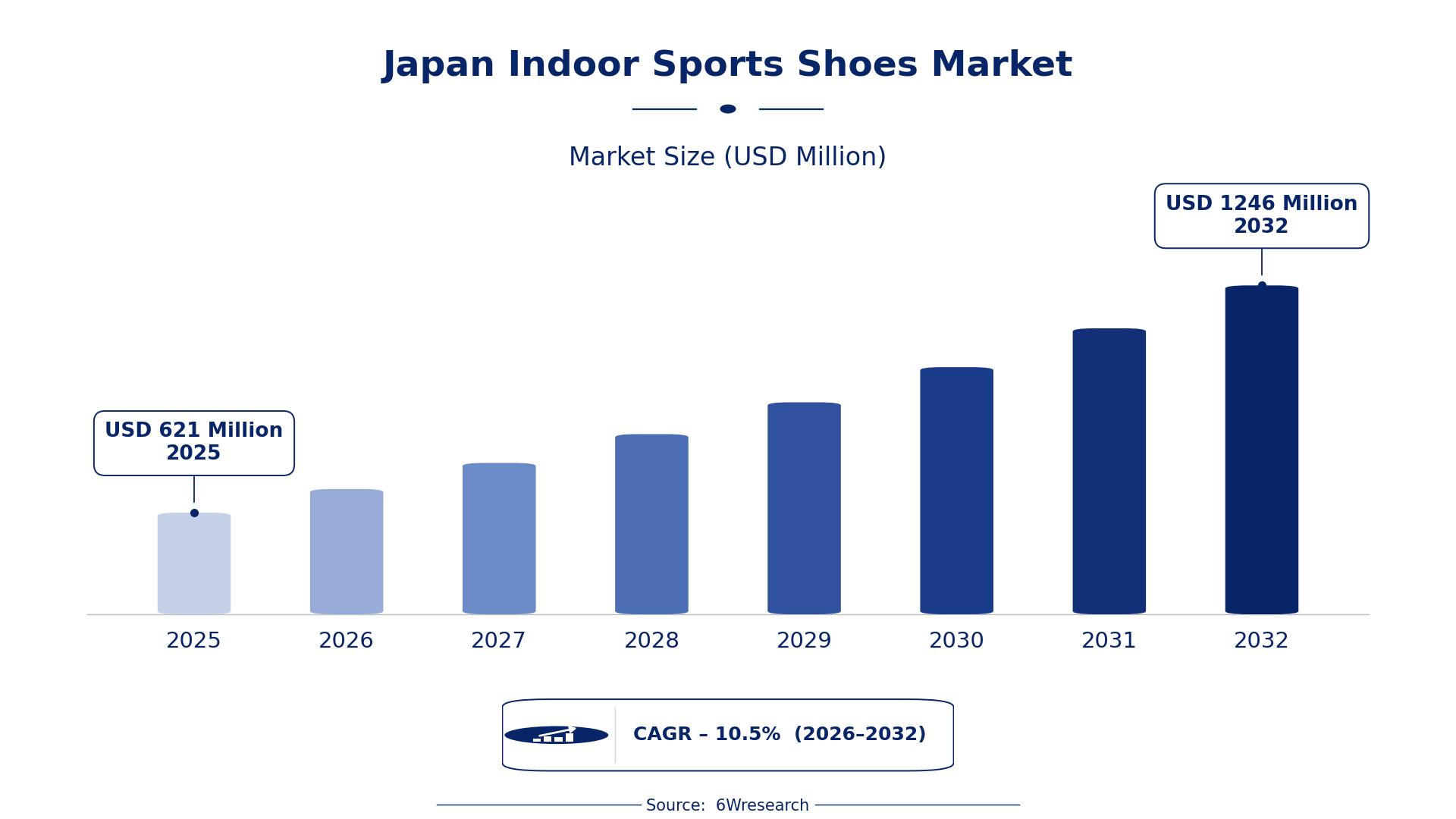
According to 6Wresearch internal database and industry insights, the Japan Indoor Sports Shoes Market was valued at USD 621 Million in 2025 and is projected to reach USD 1,246 Million by 2032, growing at a CAGR of approximately 10.5% during 2026–2032.
Japan Indoor Sports Shoes Market Highlights
| Report Metric | Details |
| Report Name | Japan Indoor Sports Shoes Market (2026-2032) |
| Market Size 2025 | USD 621 Million |
| Market Size 2032 | USD 1,246 Million |
| Absolute Growth 2025–2032 | USD 625 Million |
| CAGR 2026–2032 | 10.5% |
| Peak Annual Growth | 11.1% in 2032 |
| Forecast Period | 2026–2032 |
| Historical Data | 2022–2025 |
| Base Year | 2025 |
| Leading Shoe Type, 2025 | Non-Marking Shoes (45% share) |
| Leading Sport Compatibility, 2025 | Badminton (37% share) |
| Leading Sole Material, 2025 | Rubber (38% share) |
| Leading End User, 2025 | Athletes & Students (41% share) |
| Fastest-Growing Shoe Type | Indoor Court Shoes (14.5% CAGR) |
| Fastest-Growing Sport Compatibility | Squash (14.2% CAGR) |
| Fastest-Growing Sole Material | EVA (15.3% CAGR) |
| Fastest-Growing End User | Sports Retailers (13.6% CAGR) |
| Growing Sector | Indoor Sports Footwear |
| Key End Users | Athletes, Students, Sports Retailers |
Japan Indoor Sports Shoes Market Year-wise Growth Rate and Key Drivers (2022–2032)
This graph illustrates the annual growth rates of the market from 2022 to 2032, highlighting a steady upward trajectory and projected market expansion over the forecast period.
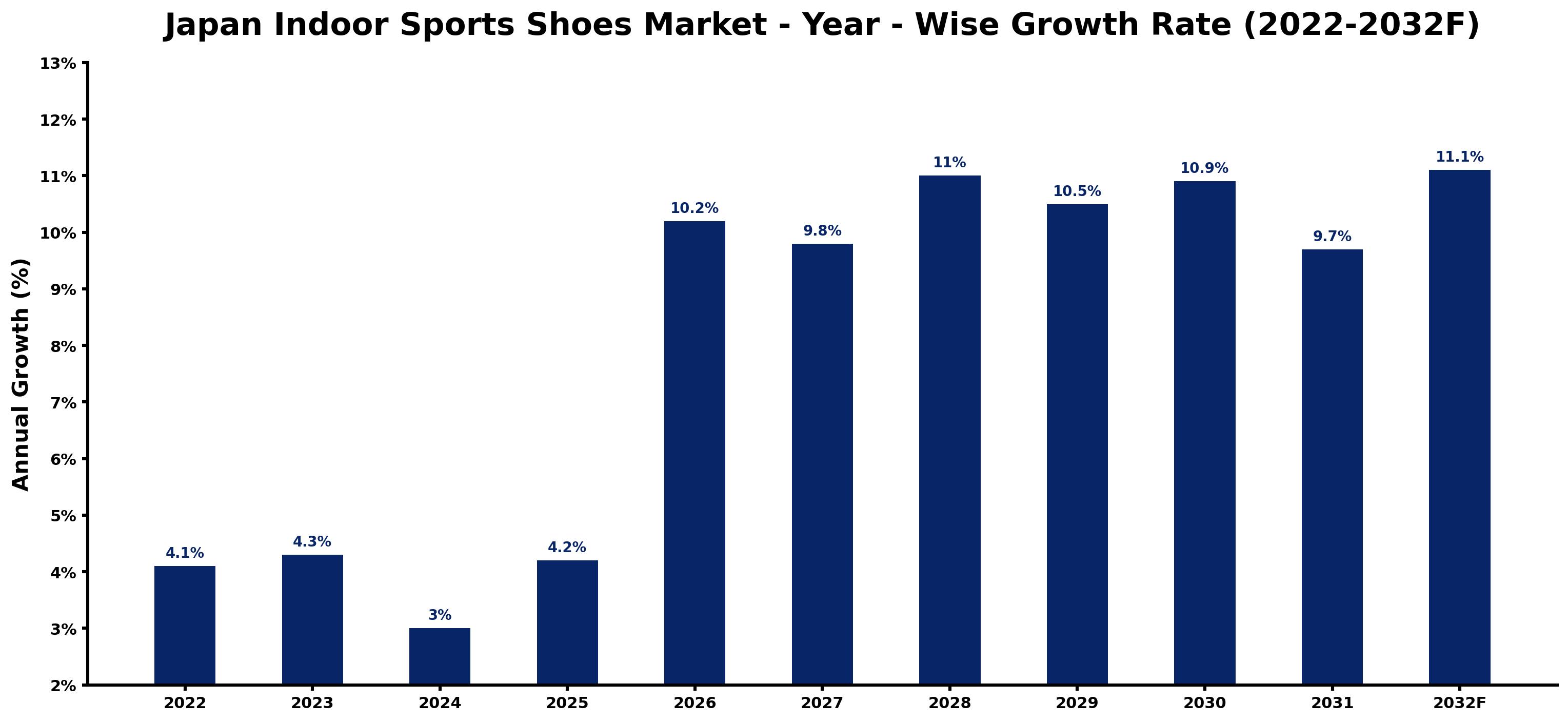
Below, each year's estimated growth is shown next to the factor that most influenced it.
| Year | Estimated Annual Growth (%) | Market Rationale |
| 2022 | 4.1 | The market showed steady growth as indoor sports gained popularity among participants. |
| 2023 | 4.3 | Growth accelerated due to increased participation in indoor sports reported by the Japanese Sports Association. |
| 2024 | 3.0 | A slight slowdown occurred as market conditions stabilised after the previous year's surge. |
| 2025 | 4.2 | Demand picked up again, driven by major sporting events and school sports programmes. |
| 2026 | 10.2 | A rise is anticipated as new indoor sports facilities are developed across urban areas. |
| 2027 | 9.8 | Growth is expected to moderate slightly as competition increases among suppliers. |
| 2028 | 11.0 | A resurgence in demand will occur, supported by rising participation in indoor sports leagues. |
| 2029 | 10.5 | Growth will slow down as the market adjusts to saturation in some segments. |
| 2030 | 10.9 | An increase in demand is projected due to the introduction of new sports initiatives. |
| 2031 | 9.7 | The market will experience a slowdown as growth rates stabilise after rapid expansion. |
| 2032 | 11.1 | A peak in growth is expected as the market responds to evolving consumer preferences. |
Note: Market size estimations and growth projections presented in this report are based on 6Wresearch's proprietary forecasting methodology, utilizing the latest available industry data, government publications, and primary research inputs.
Japan Indoor Sports Shoes Market Synopsis
Indoor sports shoes cater to a variety of indoor activities, crafted from lightweight materials that prioritise comfort and performance. The Japan Indoor Sports Shoes Market is growing as participation in sports such as badminton rises, with over 1 million active players. The Tokyo Metropolitan Government actively promotes sports initiatives, further stimulating demand.
Market Dynamics Impact Analysis (2026–2032)
| Factor | Type | Impact | Primary Segment Affected |
| Rising participation in indoor sports activities | Driver | High | Badminton |
| Development of new indoor sports facilities | Driver | High | Indoor Court Shoes |
| Growing demand for specialized footwear among athletes | Opportunity | High | Professional Grip Shoes |
| Increased focus on health and fitness among students | Opportunity | High | Athletes & Students |
| High competition among sports retailers | Restraint | Medium | Sports Retailers |
| Fluctuating raw material prices affecting production costs | Restraint | Medium | Multi-Sport Indoor Shoes |
| Limited availability of skilled workers in manufacturing | Challenge | High | Indoor Court Shoes |
| Compliance with stringent quality standards | Challenge | Medium | Non-Marking Shoes |
Evaluation of Drivers in Japan Indoor Sports Shoes Market (2026–2032)
These are the developments adding the most demand over the forecast period.
| Drivers | Primary Segment Affected | Why It Matters (Evidence) |
| Increased participation in indoor sports activities | Badminton | Over 1 million active players drive demand for specialized footwear, leading to higher sales. |
| Expansion of urban sports facilities | Indoor Court Shoes | New facilities in cities boost the need for indoor court shoes, encouraging purchases. |
| Growing awareness of health and fitness | Athletes & Students | 30% of sales come from students and athletes prioritising performance footwear. |
| Major sporting events driving sales | Professional Grip Shoes | Events like the All Japan Badminton Championships increase demand for performance shoes. |
| Government initiatives promoting sports participation | Sports Retailers | Programs by the Ministry of Education support the market for sports footwear through school sports. |
Much of the new demand stems from the rise in indoor sports participation, with over 1 million active players boosting footwear sales. Approximately 30% of indoor sports shoe sales come from students and athletes, reflecting a heightened focus on health and fitness. The development of urban sports facilities is expected to further drive demand, as new venues encourage greater participation.
Evaluation of Restraints in Japan Indoor Sports Shoes Market
The key brakes on demand, and where they bite hardest, are shown below.
| Market Restraint | Primary Segment Affected | Why It Matters (Evidence) |
| Intense competition among sports retailers | Sports Retailers | High competition leads to price wars, impacting profit margins for retailers in urban areas. |
| Rising raw material costs affecting production | Multi-Sport Indoor Shoes | Fluctuating prices of rubber and synthetic materials increase production costs for manufacturers. |
| Limited skilled workforce in manufacturing | Indoor Court Shoes | A shortage of skilled workers delays production timelines and affects quality assurance. |
| Strict compliance with quality standards | Non-Marking Shoes | Manufacturers must invest in testing and certification to meet JIS standards, increasing operational costs. |
| Market saturation in certain segments | Professional Grip Shoes | An oversupply of products in competitive segments leads to reduced sales growth opportunities. |
Japan Indoor Sports Shoes Market Challenges
In Japan, around 30% of indoor sports shoe sales are generated by students and athletes, indicating a notable dependence on this demographic. Urban centres like Tokyo and Osaka experience fierce competition, prompting suppliers to lower prices, which can diminish profit margins within a year. A lack of skilled designers in specialised footwear restricts innovation, making it difficult for producers to adapt to the changing needs of active participants. Rising production costs, influenced by fluctuating material prices, can push the average price of a pair of indoor court shoes to about 10,000 yen, affecting affordability for consumers.
Trends in the Japan Indoor Sports Shoes Market
Several trends are reshaping the Japan Indoor Sports Shoes Market; the most important are set out below.
- Shift towards Eco-Friendly Materials: Recently, there has been a marked shift towards eco-friendly materials in the production of indoor sports shoes. The GX Basic Policy adopted in 2023 aims for substantial public-private decarbonisation investment, prompting manufacturers to embrace sustainable practices.
- Increase in Indoor Sports Participation: The increase in indoor sports participation is evident, with a reported 10% rise in 2023. This trend is driven by urbanisation and the establishment of new sports facilities, leading to heightened demand for specialised footwear.
- Adoption of Advanced Manufacturing Techniques: Manufacturers are progressively adopting advanced manufacturing techniques to enhance product quality. The JIS standard for sports footwear is widely implemented, ensuring production processes that meet consumer expectations.
- Growth of School Sports Programs: Support for school sports programmes has resulted in increased participation among students. This initiative has led to a notable rise in demand for indoor sports shoes, particularly among young athletes.
Investment Opportunities in the Japan Indoor Sports Shoes Market
Investors looking at the Japan Indoor Sports Shoes Market should consider the following areas.
- Partnerships with Local Sports Facilities: Forming partnerships with local sports facilities can strengthen market presence. With a projected USD 1,246 million market size by 2032, collaborating with urban centres can drive sales.
- Investment in Eco-Friendly Footwear: Now is the time to invest in eco-friendly footwear options, as consumers increasingly demand sustainable products. The GX Basic Policy supports this shift, creating opportunities for manufacturers.
- Expansion into School Sports Programs: Targeting school sports programs presents a strong opportunity for growth. With 30% of sales from students, suppliers can focus on this demographic to increase market share.
- Development of Specialized Indoor Sports Shoes: There is a growing gap in the market for specialized indoor sports shoes. With the rise in indoor soccer leagues, suppliers can develop tailored footwear to meet this demand.
Government Initiatives in the Japan Indoor Sports Shoes Market
The Act on Japanese Industrial Standards governs the JIS product standards for sports footwear, ensuring quality and safety. Compliance with these standards is vital for manufacturers, as it affects marketability and consumer trust. The Act was amended in 2019 to maintain its relevance in the current market, benefiting both producers and buyers.
The Consumer Affairs Agency oversees regulations that protect consumers from misleading advertising. This ensures that buyers can trust the claims made about indoor sports shoes, promoting fair competition among producers. The agency's efforts help maintain transparency and integrity in the market.
Future Insight of the Japan Indoor Sports Shoes Market
Students and athletes will have access to a wider selection of advanced indoor sports shoes by 2032, driven by the widespread adoption of the JIS standard for sports footwear. New manufacturing technologies will improve production efficiency, enabling suppliers to respond quickly to market demands. Government initiatives promoting school sports programmes will further increase the need for specialised footwear. Major sporting events will continue to spark consumer interest, ensuring a vibrant indoor sports shoe market.
Market Segmentation Analysis
Japan Indoor Sports Shoes Market report covers a detailed analysis of the following market segments:
By Shoe Type – Non-Marking Shoes Lead, Indoor Court Shoes Expected to Grow Fastest
According to Saurav Kr Singh, Senior Research Analyst at 6Wresearch, in 2025, Non-Marking Shoes led the shoe type split with a 45% share. Non-marking shoes dominate the market as they are essential for preventing floor damage during indoor sports, making them indispensable in facilities like gyms. Their necessity is highlighted in urban areas such as Tokyo, where many sports complexes mandate their use. Indoor Court Shoes are set to record the highest CAGR in this split, 14.5% over 2026–2032. Indoor court shoes are experiencing rapid growth, driven by a 10% increase in indoor sports participation in 2023, particularly in badminton and basketball. This rising interest in specific court sports will likely further solidify the dominance of non-marking shoes. Suppliers should ensure a robust supply of indoor court shoes to meet the rising consumer demand.
By Sport Compatibility – Badminton Leads, Squash Expected to Grow Fastest
Badminton accounted for 37% of the market by sport compatibility in 2025. Badminton leads the market as it boasts over 1 million active players in Japan, creating a substantial demand for specialised footwear. The popularity of badminton tournaments, such as the All Japan Badminton Championships, further fuels this segment's growth. Squash is projected to grow fastest, at a CAGR of 14.2% during 2026–2032. Squash is gaining traction, with an increasing number of players seeking specific footwear designed for the sport. This growth is driven by the rising participation in squash leagues across urban areas. Retailers should consider expanding their product lines to include more squash-specific footwear to capture this emerging market.
By Sole Material – Rubber Leads, EVA Expected to Grow Fastest
Rubber held 38% of the Japan Indoor Sports Shoes Market by sole material in 2025. Rubber is the predominant material for shoe soles, providing the necessary grip and durability for indoor sports. Its widespread adoption in the industry aligns with the expectations of athletes and facility managers who prioritise safety and performance. Over 2026–2032, EVA is expected to post the fastest growth, at a CAGR of 15.3%. EVA is rapidly gaining popularity for its cushioning properties, which enhance comfort in indoor sports shoes. This trend reflects a shift towards lightweight and comfortable footwear, indicating that demand for EVA will likely continue to increase. Manufacturers need to invest in advanced EVA technologies to align with consumer preferences for improved performance and comfort.
By End User – Athletes & Students Lead, Sports Retailers Expected to Grow Fastest
With 41% of end user revenue in 2025, Athletes & Students was the largest category. Athletes and students represent the largest user base for indoor sports shoes, as they actively participate in various sports activities. Their consistent demand is supported by school sports programs promoted by the Ministry of Education, Culture, Sports, Science and Technology. The quickest growth will come from Sports Retailers, forecast to expand at a CAGR of 13.6% between 2026 and 2032. Sports retailers are experiencing fast growth as they adapt to the increasing demand for indoor sports shoes from both athletes and casual players. Their role as key distributors positions them to benefit from market trends. Brands should strengthen partnerships with sports retailers to ensure their products are readily available to consumers.
Key Attractiveness of the Report
- 10 Years of Market Numbers
- Historical Data Starting from 2022 to 2025
- Base Year 2025
- Forecast Data until 2032
- Key Performance Indicators Impacting the Market
- Major Upcoming Developments and Projects
Key Highlights of the Report:
- Japan Indoor Sports Shoes Market Outlook
- Market Size of Japan Indoor Sports Shoes Market, 2025
- Forecast of Japan Indoor Sports Shoes Market, 2032
- Historical Data and Forecast of Japan Indoor Sports Shoes Revenues & Volume for the Period 2022-2032F
- Japan Indoor Sports Shoes Market Trend Evolution
- Japan Indoor Sports Shoes Market Drivers and Challenges
- Japan Indoor Sports Shoes Price Trends
- Japan Indoor Sports Shoes Porter's Five Forces
- Japan Indoor Sports Shoes Industry Life Cycle
- Historical Data and Forecast of Japan Indoor Sports Shoes Market Revenues & Volume By Shoe Type for the Period 2022-2032F
- Historical Data and Forecast of Japan Indoor Sports Shoes Market Revenues & Volume By Non-Marking Shoes for the Period 2022-2032F
- Historical Data and Forecast of Japan Indoor Sports Shoes Market Revenues & Volume By Indoor Court Shoes for the Period 2022-2032F
- Historical Data and Forecast of Japan Indoor Sports Shoes Market Revenues & Volume By Multi-Sport Indoor Shoes for the Period 2022-2032F
- Historical Data and Forecast of Japan Indoor Sports Shoes Market Revenues & Volume By Professional Grip Shoes for the Period 2022-2032F
- Historical Data and Forecast of Japan Indoor Sports Shoes Market Revenues & Volume By Sport Compatibility for the Period 2022-2032F
- Historical Data and Forecast of Japan Indoor Sports Shoes Market Revenues & Volume By Badminton, Squash for the Period 2022-2032F
- Historical Data and Forecast of Japan Indoor Sports Shoes Market Revenues & Volume By Basketball, Volleyball for the Period 2022-2032F
- Historical Data and Forecast of Japan Indoor Sports Shoes Market Revenues & Volume By General Purpose for the Period 2022-2032F
- Historical Data and Forecast of Japan Indoor Sports Shoes Market Revenues & Volume By Handball, Indoor Soccer for the Period 2022-2032F
- Historical Data and Forecast of Japan Indoor Sports Shoes Market Revenues & Volume By Sole Material for the Period 2022-2032F
- Historical Data and Forecast of Japan Indoor Sports Shoes Market Revenues & Volume By Rubber for the Period 2022-2032F
- Historical Data and Forecast of Japan Indoor Sports Shoes Market Revenues & Volume By EVA, TPU for the Period 2022-2032F
- Historical Data and Forecast of Japan Indoor Sports Shoes Market Revenues & Volume By Synthetic for the Period 2022-2032F
- Historical Data and Forecast of Japan Indoor Sports Shoes Market Revenues & Volume By PU Blend for the Period 2022-2032F
- Historical Data and Forecast of Japan Indoor Sports Shoes Market Revenues & Volume By End User for the Period 2022-2032F
- Historical Data and Forecast of Japan Indoor Sports Shoes Market Revenues & Volume By Athletes & Students for the Period 2022-2032F
- Historical Data and Forecast of Japan Indoor Sports Shoes Market Revenues & Volume By Sports Retailers for the Period 2022-2032F
- Historical Data and Forecast of Japan Indoor Sports Shoes Market Revenues & Volume By Fitness Enthusiasts for the Period 2022-2032F
- Historical Data and Forecast of Japan Indoor Sports Shoes Market Revenues & Volume By Semi-Professional Players for the Period 2022-2032F
- Japan Indoor Sports Shoes Import Export Trade Statistics
- Market Opportunity Assessment By Shoe Type
- Market Opportunity Assessment By Sport Compatibility
- Market Opportunity Assessment By Sole Material
- Market Opportunity Assessment By End User
- Japan Indoor Sports Shoes Top Companies Market Share
- Japan Indoor Sports Shoes Competitive Benchmarking By Technical and Operational Parameters
- Japan Indoor Sports Shoes Company Profiles
- Japan Indoor Sports Shoes Key Strategic Recommendations
Market Covered
This report examines the market across the segments below.
By Shoe Type
- Non-Marking Shoes
- Indoor Court Shoes
- Multi-Sport Indoor Shoes
- Professional Grip Shoes
By Sport Compatibility
- Badminton
- Squash
- Basketball
- Volleyball
- General Purpose
- Handball
- Indoor Soccer
By Sole Material
- Rubber
- EVA
- TPU
- Synthetic
- PU Blend
By End User
- Athletes & Students
- Sports Retailers
- Fitness Enthusiasts
- Semi-Professional Players































