Japan Indoor Wireless Market Size & Growth Rate
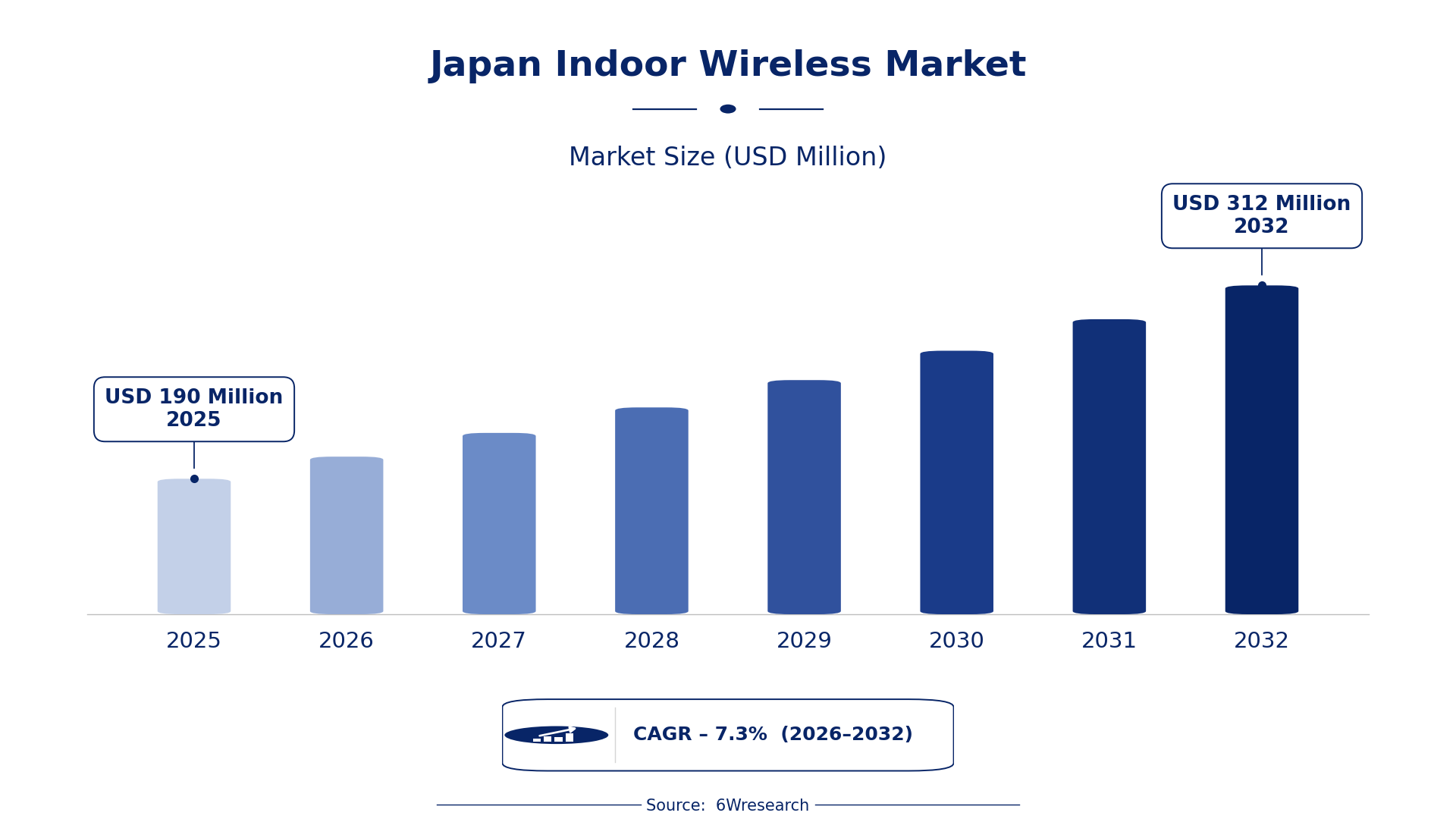
According to 6Wresearch internal database and industry insights, the Japan Indoor Wireless Market was valued at USD 190 Million in 2025 and is projected to reach USD 312 Million by 2032, growing at a CAGR of approximately 7.3% during 2026–2032.
Japan Indoor Wireless Market Highlights
| Report Metric | Details |
| Report Name | Japan Indoor Wireless Market (2026-2032) |
| Market Size 2025 | USD 190 Million |
| Market Size 2032 | USD 312 Million |
| Absolute Growth 2025–2032 | USD 122 Million |
| CAGR 2026–2032 | 7.3% |
| Peak Annual Growth | 8.3% in 2027 |
| Forecast Period | 2026–2032 |
| Historical Data | 2022–2025 |
| Base Year | 2025 |
| Leading Technology Type, 2025 | Wi-Fi 6/6E (37% share) |
| Leading Coverage Area, 2025 | Enterprise/Residential (38% share) |
| Leading Use Case, 2025 | High-Speed Internet (40% share) |
| Leading End User, 2025 | Smart Building Planners (43% share) |
| Fastest-Growing Technology Type | mmWave 5G (10.3% CAGR) |
| Fastest-Growing Coverage Area | High-Capacity Spots (8.7% CAGR) |
| Fastest-Growing Use Case | Ultra-HD Streaming (9.7% CAGR) |
| Fastest-Growing End User | Telecom Service Providers (9.2% CAGR) |
| Growing Sector | Smart Building Solutions |
| Key End Users | Telecom Service Providers, Smart Building Planners, IT Infrastructure Providers |
Japan Indoor Wireless Market Year-wise Growth Rate and Key Drivers (2022–2032)
This graph illustrates the annual growth rates of the market from 2022 to 2032, highlighting a steady upward trajectory and projected market expansion over the forecast period.
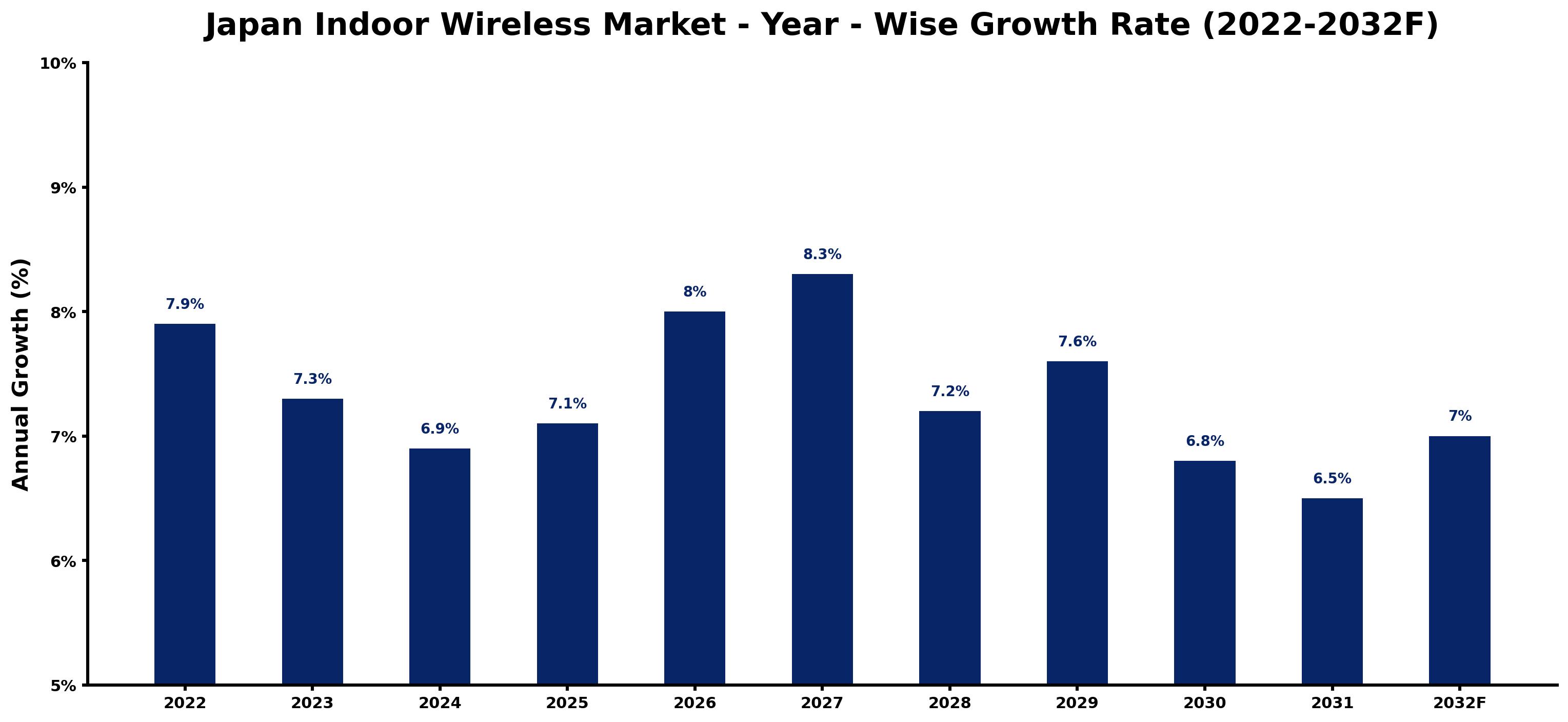
The yearly estimates that follow link every growth rate to its principal driver, so readers can see why the pace changed in each period.
| Year | Estimated Annual Growth (%) | Market Rationale |
| 2022 | 7.9 | The market experienced strong demand due to increased broadband subscriptions and connectivity needs. |
| 2023 | 7.3 | Growth slowed as the market adjusted to previous high levels of expansion and adoption rates. |
| 2024 | 6.9 | A further slowdown occurred as market saturation began to affect new subscriber growth. |
| 2025 | 7.1 | Growth accelerated again as Wi-Fi 6 adoption reached 50% of households, driving demand. |
| 2026 | 8.0 | Investment in 5G infrastructure will boost demand for indoor wireless solutions. |
| 2027 | 8.3 | High-capacity applications and urban deployment will drive peak growth this year. |
| 2028 | 7.2 | Growth is expected to slow slightly as the market stabilises after peak demand. |
| 2029 | 7.6 | An increase in demand for high-capacity spots will drive growth as urban areas expand. |
| 2030 | 6.8 | Market growth is expected to slow as competition intensifies and new technologies emerge. |
| 2031 | 6.5 | A further slowdown is anticipated as market maturity sets in and adoption levels off. |
| 2032 | 7.0 | Growth is projected to rise again as smart home adoption exceeds 10 million. |
Note: Market size estimations and growth projections presented in this report are based on 6Wresearch's proprietary forecasting methodology, utilizing the latest available industry data, government publications, and primary research inputs.
Japan Indoor Wireless Market Synopsis
Indoor wireless technology provides connectivity within buildings through advanced communication protocols and hardware, including routers and access points. The Japan Indoor Wireless Market is expanding due to over 100 million broadband subscribers, with Wi-Fi 6 adoption projected to reach 50% of households by 2025. The increasing number of smart homes and urban connectivity initiatives are driving demand for these solutions, creating opportunities for suppliers.
Market Dynamics Impact Analysis (2026–2032)
| Factor | Type | Impact | Primary Segment Affected |
| Increasing broadband subscriptions drive demand for high-speed internet solutions. | Driver | High | High-Speed Internet |
| The rise of smart homes is creating a need for seamless connectivity solutions. | Driver | High | Smart Building Planners |
| The growing number of IoT devices presents opportunities for enhanced connectivity solutions. | Opportunity | High | Industrial Facilities |
| The demand for ultra-HD streaming is rising, necessitating improved wireless infrastructure. | Opportunity | High | Ultra-HD Streaming |
| Market saturation in urban areas may limit growth potential for new subscribers. | Restraint | Medium | Enterprise/Residential |
| The high cost of infrastructure development can deter new entrants into the market. | Restraint | Medium | Private LTE |
| Competition among telecom service providers can lead to price wars, impacting profitability. | Challenge | High | Telecom Service Providers |
| Technological advancements require continuous investment, straining smaller players. | Challenge | Medium | IT Infrastructure Providers |
Evaluation of Drivers in Japan Indoor Wireless Market (2026–2032)
The main growth drivers and the segments they affect most are set out below.
| Drivers | Primary Segment Affected | Why It Matters (Evidence) |
| The increasing number of broadband subscribers. | High-Speed Internet | Japan has over 100 million broadband subscribers as of 2023, driving demand for high-speed solutions. |
| The rise in smart home installations. | Smart Building Planners | The total number of smart homes in Japan is expected to exceed 10 million by 2025, increasing connectivity needs. |
| The deployment of 5G technology. | Private LTE | The Ministry of Internal Affairs and Communications promotes 5G deployment, enhancing connectivity in urban areas. |
| The demand for ultra-HD streaming services. | Ultra-HD Streaming | Average internet speeds in Japan are 100 Mbps as of 2023, supporting high-quality media consumption. |
| The growth of IoT devices in various sectors. | Industrial Facilities | The number of IoT devices in Japan is projected to reach 1 billion by 2025, necessitating robust wireless solutions. |
Most of the extra volume comes from the increasing number of broadband subscribers, which reached over 100 million in 2023, prompting telecom service providers to improve their offerings. The rise in smart home installations is expected to exceed 10 million by 2025, creating a demand for reliable connectivity solutions. The promotion of 5G technology deployment will improve connectivity in urban areas. Internet speeds in Japan support the demand for ultra-HD streaming services. The growth of IoT devices, expected to reach 1 billion by 2025, will necessitate strong wireless solutions in industrial facilities.
Evaluation of Restraints in Japan Indoor Wireless Market
These are the pressures that could keep growth below its potential.
| Market Restraint | Primary Segment Affected | Why It Matters (Evidence) |
| Market saturation in urban areas limits growth potential. | Enterprise/Residential | As urban areas become saturated with broadband services, new subscriber growth is constrained, affecting overall market expansion. |
| High infrastructure development costs deter new entrants. | Private LTE | The investment required for infrastructure in private LTE can limit market entry for smaller players. |
| Intense competition among telecom service providers leads to price wars. | Telecom Service Providers | Price wars can erode profit margins, making it challenging for providers to maintain sustainable operations. |
| Technological advancements require continuous investment. | IT Infrastructure Providers | Smaller IT infrastructure providers may struggle to keep up with rapid technology changes, impacting their competitiveness. |
| Regulatory compliance can increase operational costs. | Smart Building Planners | Compliance with safety and energy efficiency regulations can raise costs for smart building planners. |
Japan Indoor Wireless Market Challenges
Producers of indoor wireless technology face a shortage of skilled workers, as the rapid pace of technological change exceeds the capacity of training programmes. This skills gap delays product development timelines, impacting suppliers who depend on timely innovations to satisfy buyer needs. Supply chain issues arise from reliance on imported components, causing project completion delays for buyers. Technology adoption is inconsistent, with only 50% of households expected to adopt Wi-Fi 6 by 2025, which restricts growth opportunities for producers. High costs associated with 5G infrastructure development, estimated at $1 billion, burden budgets for both suppliers and buyers.
Trends in the Japan Indoor Wireless Market
These developments are changing demand patterns in the Japan Indoor Wireless Market.
- Shift to Wi-Fi 6 Adoption: The adoption of Wi-Fi 6 technology began in 2023, improving connectivity speeds and capacity. By 2025, it is projected that Wi-Fi 6 will reach 50% of households, driving demand for compatible devices.
- Transition to Smart Building Solutions: The trend towards smart building solutions is gaining momentum, with the total number of smart homes expected to exceed 10 million by 2025. This shift necessitates advanced indoor wireless solutions to support connectivity.
- Emergence of mmWave 5G: The deployment of mmWave 5G technology is becoming increasingly important for urban areas, with a projected CAGR of 10.3% from 2026 to 2032. This technology enables high-capacity applications essential for modern connectivity.
- Increased Demand for Ultra-HD Streaming: The demand for ultra-HD streaming services is rising, particularly among younger consumers. As average internet speeds reach 100 Mbps, providers are investing in infrastructure to meet this growing need.
Investment Opportunities in the Japan Indoor Wireless Market
Below are the investment opportunities with the strongest case in the Japan Indoor Wireless Market.
- Supply of High-Speed Internet Solutions: With over 100 million broadband subscribers, there is an opportunity to supply high-speed internet solutions to urban areas. Telecom service providers are actively seeking reliable partners to improve their offerings.
- Investment in Smart Building Technologies: The growing number of smart homes creates a demand for smart building technologies. Investors can target this sector, particularly in urban regions where connectivity needs are high.
- Expansion of 5G Infrastructure: The government has allocated $1 billion for 5G infrastructure development by 2025, creating opportunities for companies involved in wireless technology. Collaborating with telecom service providers can facilitate market entry.
- Development of Ultra-HD Streaming Infrastructure: The increasing demand for ultra-HD streaming necessitates investments in advanced wireless infrastructure. Companies can target urban areas where high-capacity applications are in demand.
Government Initiatives in the Japan Indoor Wireless Market
The Building Energy Efficiency Act, amended in 2022, mandates that all new buildings meet energy standards from April 2025. This measure strengthens the regulatory framework for indoor wireless technologies, ensuring they align with energy efficiency goals.
Funding of $1 billion for 5G infrastructure development by 2025 is administered by the Ministry of Internal Affairs and Communications. This support aids the deployment of advanced wireless solutions, benefiting both producers and consumers.
Future Insight of the Japan Indoor Wireless Market
By 2032, policy-driven shifts will prompt advancements in indoor wireless connectivity, leading to increased infrastructure investments. The rollout of 5G technology will enable faster and more reliable connections, benefiting both buyers and suppliers. As smart homes proliferate, the demand for robust wireless solutions will rise, encouraging suppliers to innovate. The anticipated doubling of mesh network deployments will enhance coverage and accessibility, allowing buyers to enjoy seamless connectivity throughout their environments.
Market Segmentation Analysis
Japan Indoor Wireless Market report covers a detailed analysis of the following market segments:
By Technology Type – Wi-Fi 6/6E Leads, mmWave 5G Expected to Grow Fastest
According to Saurav Kr Singh, Senior Research Analyst at 6Wresearch, Wi-Fi 6/6E accounted for 37% of the market by technology type in 2025. Wi-Fi 6/6E holds a prominent share due to its widespread application for high-speed internet and streaming services, particularly in urban areas like Tokyo. The substantial number of broadband subscribers, exceeding 100 million, highlights its critical role in meeting connectivity demands. mmWave 5G is set to record the highest CAGR in this split, 10.3% over 2026–2032. mmWave 5G is poised for rapid growth as it is essential for high-capacity applications in densely populated urban environments. The government's commitment of $1 billion towards 5G infrastructure by 2025 will significantly accelerate this segment's development. Suppliers should focus on enhancing Wi-Fi 6/6E products while preparing for the rising demand for mmWave 5G solutions.
By Coverage Area – Enterprise/Residential Leads, High-Capacity Spots Expected to Grow Fastest
With 38% of coverage area revenue in 2025, Enterprise/Residential was the largest category. The Enterprise/Residential segment leads the market as it is vital for both business and home connectivity, catering to the needs of Japan's 125 million residents. This dual demand solidifies its dominant position within the market. High-Capacity Spots are projected to grow fastest, at a CAGR of 8.7% during 2026–2032. High-Capacity Spots are rapidly growing due to the increasing need for strong connectivity in public venues with high user density, such as stadiums and airports. The presence of over 500,000 public Wi-Fi hotspots underscores this trend. Buyers in public venues should seek solutions that improve connectivity to accommodate the growing user base.
By Use Case – High-Speed Internet Leads, Ultra-HD Streaming Expected to Grow Fastest
High-Speed Internet held 40% of the Japan Indoor Wireless Market by use case in 2025. High-Speed Internet is the leading use case, essential for modern connectivity across various demographics in Japan. The average internet speed of 100 Mbps illustrates the importance of this service for both personal and professional use. Over 2026–2032, Ultra-HD Streaming is expected to post the fastest growth, at a CAGR of 9.7%. Ultra-HD Streaming is witnessing the fastest growth as it becomes increasingly important for media consumption, driven by the projected 50% adoption of Wi-Fi 6 in households by 2025. This trend indicates a shift towards higher quality content delivery. Suppliers must ensure their products are equipped to meet the rising demand for Ultra-HD Streaming capabilities.
By End User – Smart Building Planners Lead, Telecom Service Providers Expected to Grow Fastest
Smart Building Planners took 43% of end user revenue in 2025, more than any other category. Smart Building Planners represent the largest end user group, playing a crucial role in designing modern smart infrastructures that integrate advanced wireless technologies. Their influence is key in shaping the future of connectivity in urban developments. The quickest growth will come from Telecom Service Providers, forecast to expand at a CAGR of 9.2% between 2026 and 2032. Telecom Service Providers are the fastest-growing end user segment, as they are essential in deploying wireless solutions to meet the increasing demand for connectivity. Their ongoing investments in infrastructure will further drive this growth. Collaboration with telecom service providers will be essential for suppliers looking to capitalise on market opportunities.
Key Attractiveness of the Report
- 10 Years of Market Numbers
- Historical Data Starting from 2022 to 2025
- Base Year 2025
- Forecast Data until 2032
- Key Performance Indicators Impacting the Market
- Major Upcoming Developments and Projects
Key Highlights of the Report:
- Japan Indoor Wireless Market Outlook
- Market Size of Japan Indoor Wireless Market, 2025
- Forecast of Japan Indoor Wireless Market, 2032
- Historical Data and Forecast of Japan Indoor Wireless Revenues & Volume for the Period 2022-2032F
- Japan Indoor Wireless Market Trend Evolution
- Japan Indoor Wireless Market Drivers and Challenges
- Japan Indoor Wireless Price Trends
- Japan Indoor Wireless Porter's Five Forces
- Japan Indoor Wireless Industry Life Cycle
- Historical Data and Forecast of Japan Indoor Wireless Market Revenues & Volume By Technology Type for the Period 2022-2032F
- Historical Data and Forecast of Japan Indoor Wireless Market Revenues & Volume By Wi-Fi 6/6E for the Period 2022-2032F
- Historical Data and Forecast of Japan Indoor Wireless Market Revenues & Volume By mmWave 5G for the Period 2022-2032F
- Historical Data and Forecast of Japan Indoor Wireless Market Revenues & Volume By Mesh Networks for the Period 2022-2032F
- Historical Data and Forecast of Japan Indoor Wireless Market Revenues & Volume By Private LTE for the Period 2022-2032F
- Historical Data and Forecast of Japan Indoor Wireless Market Revenues & Volume By Coverage Area for the Period 2022-2032F
- Historical Data and Forecast of Japan Indoor Wireless Market Revenues & Volume By Enterprise/Residential for the Period 2022-2032F
- Historical Data and Forecast of Japan Indoor Wireless Market Revenues & Volume By High-Capacity Spots for the Period 2022-2032F
- Historical Data and Forecast of Japan Indoor Wireless Market Revenues & Volume By Large Homes/Buildings for the Period 2022-2032F
- Historical Data and Forecast of Japan Indoor Wireless Market Revenues & Volume By Industrial Facilities for the Period 2022-2032F
- Historical Data and Forecast of Japan Indoor Wireless Market Revenues & Volume By Use Case for the Period 2022-2032F
- Historical Data and Forecast of Japan Indoor Wireless Market Revenues & Volume By High-Speed Internet for the Period 2022-2032F
- Historical Data and Forecast of Japan Indoor Wireless Market Revenues & Volume By Ultra-HD Streaming for the Period 2022-2032F
- Historical Data and Forecast of Japan Indoor Wireless Market Revenues & Volume By Seamless Roaming for the Period 2022-2032F
- Historical Data and Forecast of Japan Indoor Wireless Market Revenues & Volume By Secure Connectivity for the Period 2022-2032F
- Historical Data and Forecast of Japan Indoor Wireless Market Revenues & Volume By End User for the Period 2022-2032F
- Historical Data and Forecast of Japan Indoor Wireless Market Revenues & Volume By Smart Building Planners for the Period 2022-2032F
- Historical Data and Forecast of Japan Indoor Wireless Market Revenues & Volume By Telecom Service Providers for the Period 2022-2032F
- Historical Data and Forecast of Japan Indoor Wireless Market Revenues & Volume By Consumer Electronics Brands for the Period 2022-2032F
- Historical Data and Forecast of Japan Indoor Wireless Market Revenues & Volume By IT Infrastructure Providers for the Period 2022-2032F
- Japan Indoor Wireless Import Export Trade Statistics
- Market Opportunity Assessment By Technology Type
- Market Opportunity Assessment By Coverage Area
- Market Opportunity Assessment By Use Case
- Market Opportunity Assessment By End User
- Japan Indoor Wireless Top Companies Market Share
- Japan Indoor Wireless Competitive Benchmarking By Technical and Operational Parameters
- Japan Indoor Wireless Company Profiles
- Japan Indoor Wireless Key Strategic Recommendations
Market Covered
Coverage by segment is as follows.
By Technology Type
- Wi-Fi 6/6E
- mmWave 5G
- Mesh Networks
- Private LTE
By Coverage Area
- Enterprise/Residential
- High-Capacity Spots
- Large Homes/Buildings
- Industrial Facilities
By Use Case
- High-Speed Internet
- Ultra-HD Streaming
- Seamless Roaming
- Secure Connectivity
By End User
- Smart Building Planners
- Telecom Service Providers
- Consumer Electronics Brands
- IT Infrastructure Providers































