Japan Industrial 3D Imaging Market Size & Growth Rate
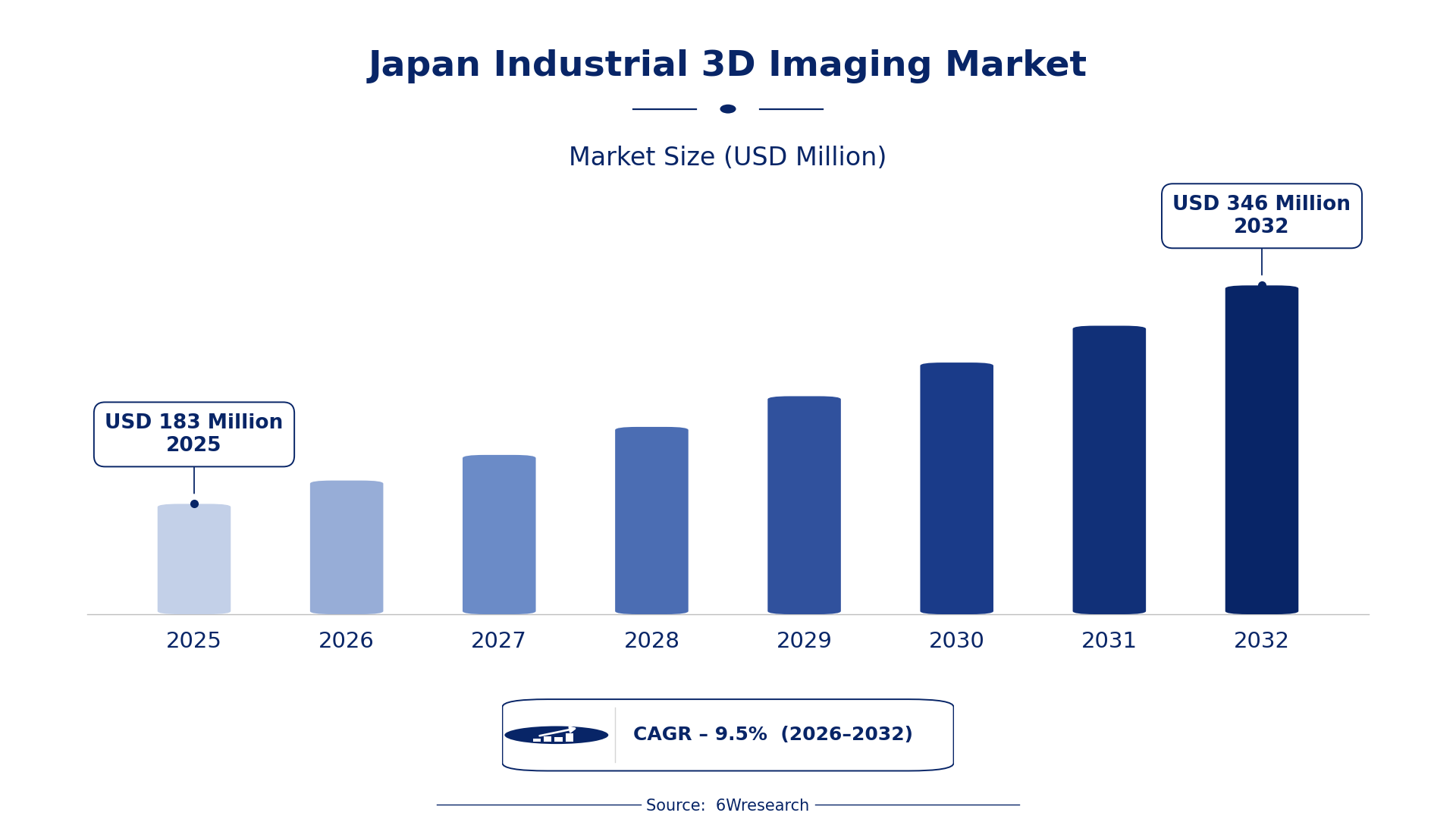
According to 6Wresearch internal database and industry insights, the Japan Industrial 3D Imaging Market was valued at USD 183 Million in 2025 and is projected to reach USD 346 Million by 2032, growing at a CAGR of approximately 9.5% during 2026–2032.
Japan Industrial 3D Imaging Market Highlights
| Report Metric | Details |
| Report Name | Japan Industrial 3D Imaging Market (2026-2032) |
| Market Size 2025 | USD 183 Million |
| Market Size 2032 | USD 346 Million |
| Absolute Growth 2025–2032 | USD 163 Million |
| CAGR 2026–2032 | 9.5% |
| Peak Annual Growth | 10.6% in 2028 |
| Forecast Period | 2026–2032 |
| Historical Data | 2022–2025 |
| Base Year | 2025 |
| Leading Imaging Type, 2025 | Laser Triangulation (42% share) |
| Leading Capture Technology, 2025 | Structured Light (39% share) |
| Leading Application Area, 2025 | Part Inspection (47% share) |
| Leading End User, 2025 | Manufacturing Plants (40% share) |
| Fastest-Growing Imaging Type | Photogrammetry (13.6% CAGR) |
| Fastest-Growing Capture Technology | Image Stitching (13.3% CAGR) |
| Fastest-Growing Application Area | Construction Mapping (11.8% CAGR) |
| Fastest-Growing End User | Civil Engineers (12.9% CAGR) |
| Growing Sector | Manufacturing |
| Key End Users | Manufacturing Plants, Civil Engineers, Aerospace/Defense Firms, Smart Factory Integrators |
Japan Industrial 3D Imaging Market Year-wise Growth Rate and Key Drivers (2022–2032)
This graph illustrates the annual growth rates of the market from 2022 to 2032, highlighting a steady upward trajectory and projected market expansion over the forecast period.
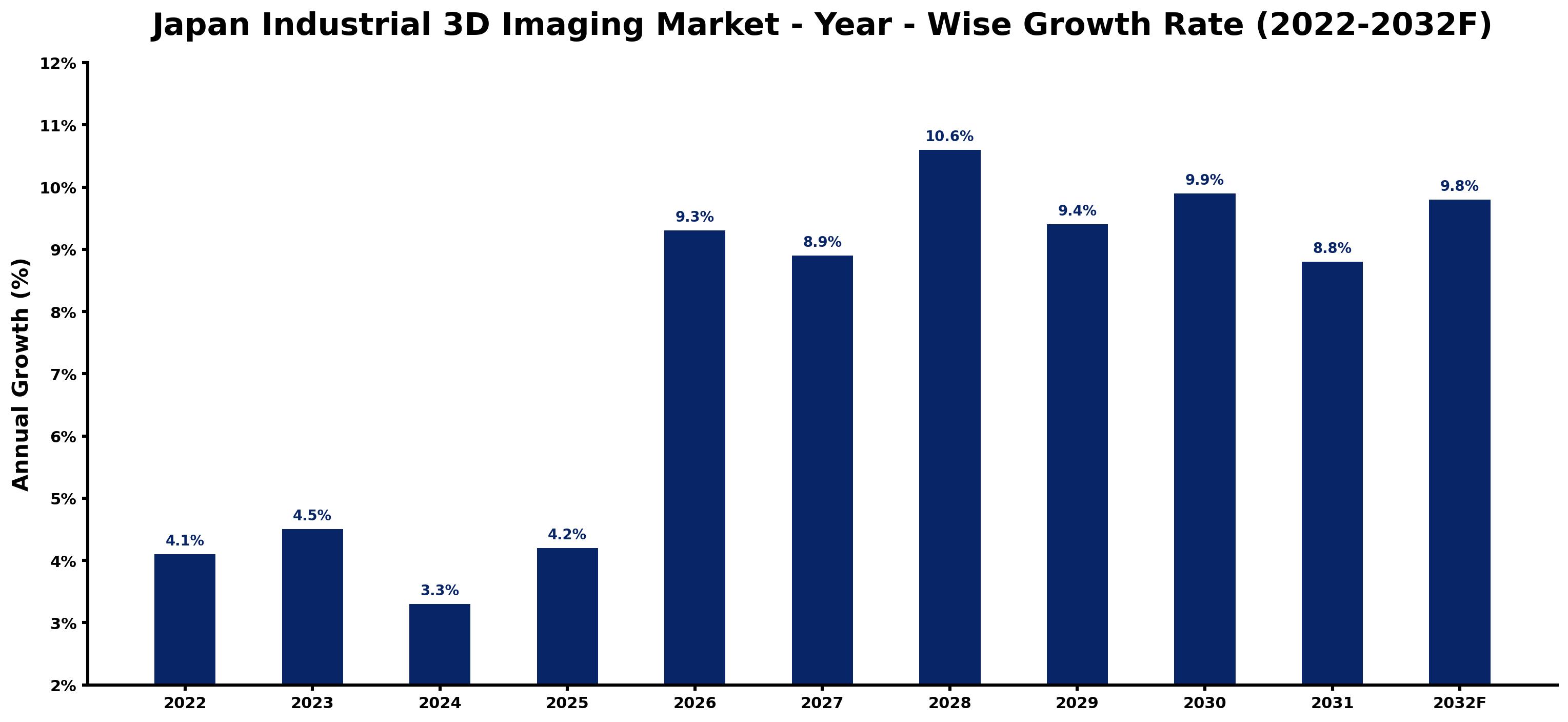
The table below sets out the estimated growth rate for each year and the main factor behind it.
| Year | Estimated Annual Growth (%) | Market Rationale |
| 2022 | 4.1 | The industrial sector showed steady growth, with increasing adoption of 3D imaging technologies. |
| 2023 | 4.5 | Demand accelerated due to heightened focus on quality control in manufacturing processes. |
| 2024 | 3.3 | Growth slowed as manufacturers reassessed their technology investments amid market fluctuations. |
| 2025 | 4.2 | Demand rose again as manufacturing plants in Aichi and Osaka expanded their operations. |
| 2026 | 9.3 | Investment surged as companies embraced smart factory technologies to improve productivity. |
| 2027 | 8.9 | Growth moderated as firms adjusted to new technology implementations and market conditions. |
| 2028 | 10.6 | The market experienced a peak in growth driven by advancements in imaging technologies. |
| 2029 | 9.4 | Demand slowed slightly as industries stabilised after rapid technological adoption. |
| 2030 | 9.9 | Investment in advanced manufacturing technologies continued to drive growth in 3D imaging. |
| 2031 | 8.8 | Growth decelerated as the market matured and demand stabilised across sectors. |
| 2032 | 9.8 | Sustained investment in imaging technologies is projected to maintain market momentum. |
Note: Market size estimations and growth projections presented in this report are based on 6Wresearch's proprietary forecasting methodology, utilizing the latest available industry data, government publications, and primary research inputs.
Japan Industrial 3D Imaging Market Synopsis
Industrial 3D imaging captures three-dimensional representations of objects using methods like laser triangulation and photogrammetry. The Japan Industrial 3D Imaging Market is primarily driven by the manufacturing sector, particularly in regions such as Aichi and Osaka. The government's focus on smart factory technologies and a projected JPY 150 trillion investment in decarbonisation over ten years are key factors propelling growth. By 2025, the industrial sector is expected to extensively utilise 3D imaging technologies, with an adoption rate exceeding 60% in manufacturing.
Market Dynamics Impact Analysis (2026–2032)
| Factor | Type | Impact | Primary Segment Affected |
| Growing demand for quality control in manufacturing processes | Driver | High | Part Inspection |
| Investment in smart factory technologies | Driver | High | Manufacturing Plants |
| Increased funding for advanced manufacturing technologies | Opportunity | High | CT-Based 3D Imaging |
| Rising demand for precise mapping in civil engineering | Opportunity | Medium | Construction Mapping |
| High initial investment costs for advanced imaging systems | Restraint | High | Photogrammetry |
| Limited awareness of 3D imaging benefits among smaller firms | Restraint | Medium | Time-of-Flight Imaging |
| Challenges in integrating new technologies into existing workflows | Challenge | High | CT-Based 3D Imaging |
| Competition from alternative measurement technologies | Challenge | Medium | Laser Triangulation |
Evaluation of Drivers in Japan Industrial 3D Imaging Market (2026–2032)
The following drivers explain most of the expected growth.
| Drivers | Primary Segment Affected | Why It Matters (Evidence) |
| Investment in smart factory technologies | Manufacturing Plants | This investment drives demand for imaging solutions, with over 60% adoption in manufacturing. |
| Focus on quality control | Part Inspection | Manufacturers are increasingly implementing 3D imaging for quality assurance, improving production efficiency. |
| Government funding for advanced technologies | CT-Based 3D Imaging | In 2023, Japan allocated JPY 150 trillion for technologies like 3D imaging, boosting industry adoption. |
| Need for precise mapping in civil engineering | Construction Mapping | Civil engineering projects require accurate imaging for safety, driving demand for 3D imaging technologies. |
| Rising automation in manufacturing processes | Robotics Vision | Automation increases the need for imaging technologies, enabling machines to interpret their environments. |
Buyers are adding capacity as investment in smart factory technologies rises, with over 60% adoption of 3D imaging in manufacturing. The focus on quality control is prompting manufacturers to implement imaging solutions, improving production efficiency. In 2023, Japan allocated funding for advanced technologies, including 3D imaging, which will boost industry adoption. Precise mapping requirements in civil engineering projects are driving demand for imaging solutions, while automation in manufacturing processes increases the need for enhanced capabilities. These factors support the growth of the industrial 3D imaging market in Japan.
Evaluation of Restraints in Japan Industrial 3D Imaging Market
The key brakes on demand, and where they bite hardest, are shown below.
| Market Restraint | Primary Segment Affected | Why It Matters (Evidence) |
| High initial investment costs for advanced imaging systems | Photogrammetry | The upfront costs deter smaller firms from adopting 3D imaging technologies. |
| Limited awareness of 3D imaging benefits among smaller firms | Time-of-Flight Imaging | Many smaller firms lack knowledge about the advantages of 3D imaging, hindering market growth. |
| Integration challenges with existing workflows | CT-Based 3D Imaging | Integration issues can delay the adoption of imaging technologies in manufacturing processes. |
| Competition from alternative measurement technologies | Laser Triangulation | Alternative technologies may offer lower-cost solutions, impacting the market share of 3D imaging. |
| Regulatory compliance requirements for imaging technologies | Structured Light | Compliance complicates the adoption process for manufacturers, slowing market growth. |
Japan Industrial 3D Imaging Market Challenges
High costs of 3D imaging technologies impact buyers in Japan's manufacturing sector, with operational expenses potentially increasing by 20%. This challenge stems from limited domestic production capabilities, leading to higher prices for imported solutions. Producers face intense competition, which compels them to reduce costs, often at the expense of quality standards. Regulatory requirements, such as ISO 10360, demand high accuracy, resulting in project delays for buyers that can extend timelines by several weeks. A shortage of skilled workers in advanced imaging techniques restricts the available talent pool, complicating implementation for producers.
Trends in the Japan Industrial 3D Imaging Market
These developments are changing demand patterns in the Japan Industrial 3D Imaging Market.
- Shift from Traditional to Smart Manufacturing: Manufacturing plants are increasingly adopting smart factory technologies, with over 60% of facilities implementing 3D imaging solutions. This shift began in 2023, driven by the need for improved efficiency and quality control.
- Transition from Manual to Automated Inspection: The introduction of automation in manufacturing processes is changing inspection methods. By 2025, more than 50% of inspections will be automated, resulting in greater accuracy and efficiency.
- Photogrammetry Gaining Traction in Construction: Photogrammetry is becoming essential for construction mapping, especially in urban areas. In 2023, its adoption rate in construction projects reached 40%, reflecting its importance for safety and efficiency.
- Rise of Robotics Vision in Manufacturing: Robotics vision is increasingly important for enabling machines to interpret their environments. By 2025, the adoption of robotics vision technologies in manufacturing will exceed 30%.
Investment Opportunities in the Japan Industrial 3D Imaging Market
The openings below show where demand in the Japan Industrial 3D Imaging Market is visible and how suppliers can enter.
- Partnerships with Local Firms: Now is an ideal time for foreign firms to partner with local manufacturers, as Japan's industrial sector seeks advanced imaging solutions. With a projected JPY 150 trillion investment in decarbonisation, collaboration can facilitate market entry.
- Investment in Smart Factory Technologies: With over 60% adoption of 3D imaging in manufacturing, there is a notable opportunity for suppliers to invest in smart factory technologies. Manufacturing plants in Aichi and Osaka are actively seeking these solutions.
- Focus on Civil Engineering Projects: Civil engineers are increasingly demanding precise mapping technologies for infrastructure projects. With a growing number of projects, suppliers can meet this need by providing advanced imaging solutions.
- Funding for Advanced Technologies: Japan's allocation of funding for advanced manufacturing technologies presents a timely opportunity. Suppliers can engage with the Ministry of Economy, Trade and Industry to explore funding avenues.
Government Initiatives in the Japan Industrial 3D Imaging Market
The GX Promotion Act (2023) introduces a framework for decarbonisation efforts, updating previous laws like the Industrial Safety and Health Act. This law mandates that manufacturers improve energy efficiency and adopt advanced technologies, including 3D imaging, to meet environmental targets.
In 2023, Japan allocated JPY 150 trillion for public and private decarbonisation investments. The Ministry of Economy, Trade and Industry oversees initiatives that fund projects promoting advanced manufacturing technologies, including 3D imaging.
Future Insight of the Japan Industrial 3D Imaging Market
Smart factory technologies will reshape demand for industrial 3D imaging in Japan by 2032, driven by the government's decarbonisation investment programme. Advanced manufacturing funding will facilitate the adoption of new standards, improving quality control processes. Civil engineering projects will increasingly depend on precise mapping technologies to ensure safety and efficiency. As the industrial sector embraces automation, training initiatives will cultivate a skilled workforce capable of leveraging these advanced imaging solutions.
Market Segmentation Analysis
Japan Industrial 3D Imaging Market report covers a detailed analysis of the following market segments:
By Imaging Type – Laser Triangulation Leads, Photogrammetry Expected to Grow Fastest
According to Saurav Kr Singh, Senior Research Analyst at 6Wresearch, Laser Triangulation held 42% of the Japan Industrial 3D Imaging Market by imaging type in 2025. Laser triangulation captures the largest share due to its widespread application for precise measurements in manufacturing, which is essential for quality control. The adoption rate exceeding 60% in Japan's manufacturing sector underscores its importance in maintaining product standards. The quickest growth will come from Photogrammetry, forecast to expand at a CAGR of 13.6% between 2026 and 2032. Photogrammetry is experiencing rapid growth as it becomes increasingly vital for mapping and surveying applications, particularly in urban construction projects. This method's rise aligns with Japan's focus on advanced construction technologies and infrastructure development. Suppliers should enhance photogrammetry solutions to meet the growing demand in urban construction.
By Capture Technology – Structured Light Leads, Image Stitching Expected to Grow Fastest
The largest capture technology category in 2025 was Structured Light, at 39% of revenue. Structured light leads the capture technology segment as it is frequently used in part inspection processes, ensuring high accuracy in manufacturing. Its established presence in Japan's industrial sector supports a robust installed base, particularly in quality assurance. Image Stitching is projected to grow fastest, at a CAGR of 13.3% during 2026–2032. Image stitching is witnessing notable growth as it is employed for creating comprehensive models across various applications, especially in construction. The technique's increasing popularity corresponds with Japan's investments in advanced imaging technologies. Buyers should consider integrating image stitching to improve their modelling capabilities in construction projects.
By Application Area – Part Inspection Leads, Construction Mapping Expected to Grow Fastest
With 47% of application area revenue in 2025, Part Inspection was the largest category. Part inspection dominates the application area as it is critical for ensuring product quality in manufacturing, especially in sectors like aerospace. The strong demand for quality assurance drives its extensive use across manufacturing plants in Japan. Construction Mapping is set to record the highest CAGR in this split, 11.8% over 2026–2032. Construction mapping is experiencing the fastest growth as it is essential for planning and executing construction projects, particularly with Japan's emphasis on infrastructure development. The complexity of civil engineering projects further fuels this demand. Suppliers should prioritise solutions for construction mapping to capitalise on the expanding infrastructure projects in Japan.
By End User – Manufacturing Plants Lead, Civil Engineers Expected to Grow Fastest
Manufacturing Plants accounted for 40% of the market by end user in 2025. Manufacturing plants represent the largest end user segment as they are the primary users of 3D imaging technologies for quality control. The concentration of manufacturing in regions like Aichi and Osaka reinforces this segment's dominance in the market. Over 2026–2032, Civil Engineers are expected to post the fastest growth, at a CAGR of 12.9%. Civil engineers are the fastest-growing end user group, utilising imaging for infrastructure projects that require precise mapping and safety measures. The government's investment in advanced manufacturing technologies further accelerates this trend in civil engineering. Suppliers need to tailor their offerings to meet the specific requirements of civil engineers involved in infrastructure development.
Key Attractiveness of the Report
- 10 Years of Market Numbers
- Historical Data Starting from 2022 to 2025
- Base Year 2025
- Forecast Data until 2032
- Key Performance Indicators Impacting the Market
- Major Upcoming Developments and Projects
Key Highlights of the Report:
- Japan Industrial 3D Imaging Market Outlook
- Market Size of Japan Industrial 3D Imaging Market, 2025
- Forecast of Japan Industrial 3D Imaging Market, 2032
- Historical Data and Forecast of Japan Industrial 3D Imaging Revenues & Volume for the Period 2022-2032F
- Japan Industrial 3D Imaging Market Trend Evolution
- Japan Industrial 3D Imaging Market Drivers and Challenges
- Japan Industrial 3D Imaging Price Trends
- Japan Industrial 3D Imaging Porter's Five Forces
- Japan Industrial 3D Imaging Industry Life Cycle
- Historical Data and Forecast of Japan Industrial 3D Imaging Market Revenues & Volume By Imaging Type for the Period 2022-2032F
- Historical Data and Forecast of Japan Industrial 3D Imaging Market Revenues & Volume By Laser Triangulation for the Period 2022-2032F
- Historical Data and Forecast of Japan Industrial 3D Imaging Market Revenues & Volume By Photogrammetry for the Period 2022-2032F
- Historical Data and Forecast of Japan Industrial 3D Imaging Market Revenues & Volume By CT-Based 3D Imaging for the Period 2022-2032F
- Historical Data and Forecast of Japan Industrial 3D Imaging Market Revenues & Volume By Time-of-Flight Imaging for the Period 2022-2032F
- Historical Data and Forecast of Japan Industrial 3D Imaging Market Revenues & Volume By Capture Technology for the Period 2022-2032F
- Historical Data and Forecast of Japan Industrial 3D Imaging Market Revenues & Volume By Structured Light for the Period 2022-2032F
- Historical Data and Forecast of Japan Industrial 3D Imaging Market Revenues & Volume By Image Stitching for the Period 2022-2032F
- Historical Data and Forecast of Japan Industrial 3D Imaging Market Revenues & Volume By X-Ray Layering for the Period 2022-2032F
- Historical Data and Forecast of Japan Industrial 3D Imaging Market Revenues & Volume By IR & Laser Pulses for the Period 2022-2032F
- Historical Data and Forecast of Japan Industrial 3D Imaging Market Revenues & Volume By Application Area for the Period 2022-2032F
- Historical Data and Forecast of Japan Industrial 3D Imaging Market Revenues & Volume By Part Inspection for the Period 2022-2032F
- Historical Data and Forecast of Japan Industrial 3D Imaging Market Revenues & Volume By Construction Mapping for the Period 2022-2032F
- Historical Data and Forecast of Japan Industrial 3D Imaging Market Revenues & Volume By Defect Analysis for the Period 2022-2032F
- Historical Data and Forecast of Japan Industrial 3D Imaging Market Revenues & Volume By Robotics Vision for the Period 2022-2032F
- Historical Data and Forecast of Japan Industrial 3D Imaging Market Revenues & Volume By End User for the Period 2022-2032F
- Historical Data and Forecast of Japan Industrial 3D Imaging Market Revenues & Volume By Manufacturing Plants for the Period 2022-2032F
- Historical Data and Forecast of Japan Industrial 3D Imaging Market Revenues & Volume By Civil Engineers for the Period 2022-2032F
- Historical Data and Forecast of Japan Industrial 3D Imaging Market Revenues & Volume By Aerospace/Defense Firms for the Period 2022-2032F
- Historical Data and Forecast of Japan Industrial 3D Imaging Market Revenues & Volume By Smart Factory Integrators for the Period 2022-2032F
- Japan Industrial 3D Imaging Import Export Trade Statistics
- Market Opportunity Assessment By Imaging Type
- Market Opportunity Assessment By Capture Technology
- Market Opportunity Assessment By Application Area
- Market Opportunity Assessment By End User
- Japan Industrial 3D Imaging Top Companies Market Share
- Japan Industrial 3D Imaging Competitive Benchmarking By Technical and Operational Parameters
- Japan Industrial 3D Imaging Company Profiles
- Japan Industrial 3D Imaging Key Strategic Recommendations
Market Covered
This report examines the market across the segments below.
By Imaging Type
- Laser Triangulation
- Photogrammetry
- CT-Based 3D Imaging
- Time-of-Flight Imaging
By Capture Technology
- Structured Light
- Image Stitching
- X-Ray Layering
- IR & Laser Pulses
By Application Area
- Part Inspection
- Construction Mapping
- Defect Analysis
- Robotics Vision
By End User
- Manufacturing Plants
- Civil Engineers
- Aerospace/Defense Firms
- Smart Factory Integrators































