Japan Industrial Abrasives Market Size & Growth Rate
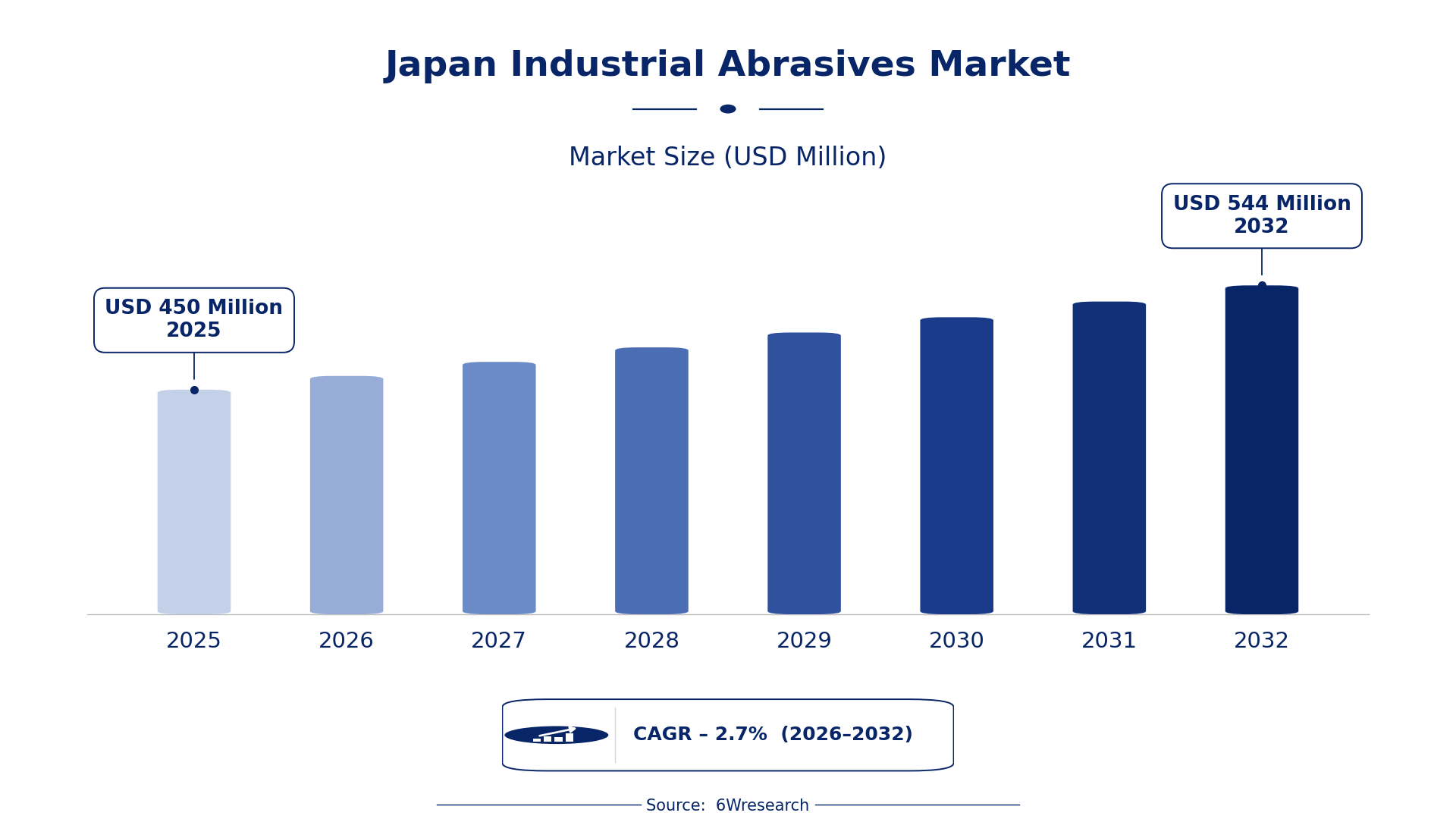
According to 6Wresearch internal database and industry insights, the Japan Industrial Abrasives Market was valued at USD 450 Million in 2025 and is projected to reach USD 544 Million by 2032, growing at a CAGR of approximately 2.7% during 2026–2032.
Japan Industrial Abrasives Market Highlights
| Report Metric | Details |
| Report Name | Japan Industrial Abrasives Market (2026-2032) |
| Market Size 2025 | USD 450 Million |
| Market Size 2032 | USD 544 Million |
| Absolute Growth 2025–2032 | USD 94 Million |
| CAGR 2026–2032 | 2.7% |
| Peak Annual Growth | 3.5% in 2027 |
| Forecast Period | 2026–2032 |
| Historical Data | 2022–2025 |
| Base Year | 2025 |
| Leading Abrasive Type, 2025 | Bonded Abrasives (39% share) |
| Leading Material, 2025 | Aluminum Oxide (35% share) |
| Leading Application Area, 2025 | Grinding (36% share) |
| Leading End User, 2025 | Metal Fabrication Units (51% share) |
| Fastest-Growing Abrasive Type | Coated Abrasives (3.8% CAGR) |
| Fastest-Growing Material | Silicon Carbide (3.9% CAGR) |
| Fastest-Growing Application Area | Cutting (3.7% CAGR) |
| Fastest-Growing End User | Woodworking Shops (4.0% CAGR) |
| Growing Sector | metal fabrication |
| Key End Users | metal fabrication units, woodworking shops, aerospace manufacturers, industrial blasting firms |
Japan Industrial Abrasives Market Year-wise Growth Rate and Key Drivers (2022–2032)
This graph illustrates the annual growth rates of the market from 2022 to 2032, highlighting a steady upward trajectory and projected market expansion over the forecast period.
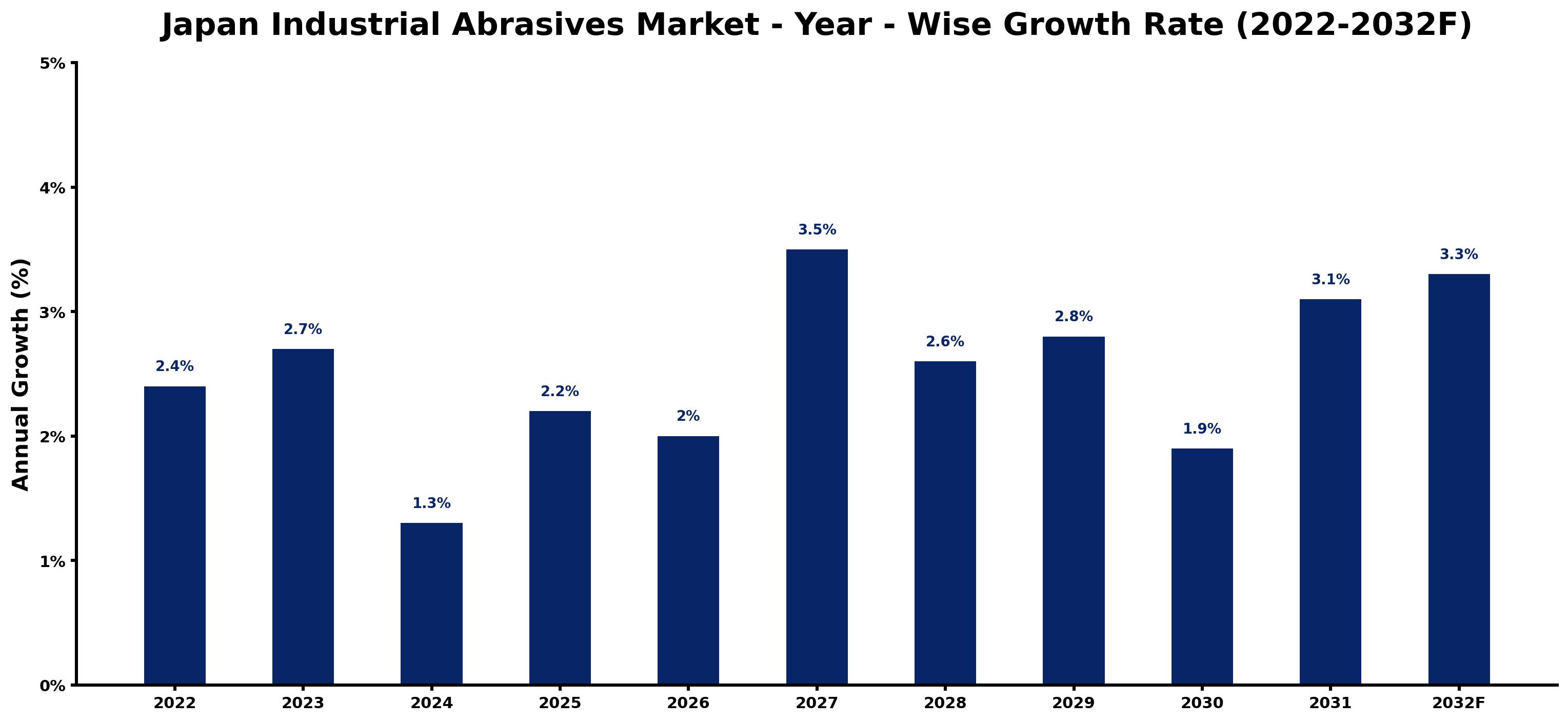
For each year, the table pairs the estimated growth rate with the leading influence on demand, showing how the drivers changed across the period.
| Year | Estimated Annual Growth (%) | Market Rationale |
| 2022 | 2.4 | The market experienced steady growth due to ongoing demand from domestic users. |
| 2023 | 2.7 | Growth accelerated as the metal fabrication sector expanded operations and investments. |
| 2024 | 1.3 | A slowdown occurred as demand stabilised following the previous year's surge. |
| 2025 | 2.2 | Growth resumed as investments in manufacturing efficiency gained traction. |
| 2026 | 2.0 | The market is expected to see a slowdown as demand normalises after previous highs. |
| 2027 | 3.5 | A peak in growth will be driven by increased precision tool requirements in aerospace. |
| 2028 | 2.6 | Growth is projected to slow again as market conditions stabilise following peak demand. |
| 2029 | 2.8 | Demand is expected to rise as innovations in abrasive technologies attract new buyers. |
| 2030 | 1.9 | A slowdown will occur as the market adjusts to previous growth rates. |
| 2031 | 3.1 | Growth will accelerate again as the woodworking sector adopts more automated technologies. |
| 2032 | 3.3 | The market is projected to continue growing as the aerospace sector expands its production capabilities. |
Note: Market size estimations and growth projections presented in this report are based on 6Wresearch's proprietary forecasting methodology, utilizing the latest available industry data, government publications, and primary research inputs.
Japan Industrial Abrasives Market Synopsis
Industrial abrasives are essential materials for grinding, cutting, and polishing surfaces, primarily made from hard materials like aluminum oxide and diamond. The Japan Industrial Abrasives Market is valued at over 200 billion yen, driven by strong demand from metal fabrication units and woodworking shops. The Kanto region serves as a hub for these industries, while the government's decarbonisation investment of JPY 150 trillion over ten years is expected to promote innovation and efficiency in abrasive applications.
Market Dynamics Impact Analysis (2026–2032)
| Factor | Type | Impact | Primary Segment Affected |
| Strong demand from the metal fabrication sector drives orders for industrial abrasives. | Driver | High | Metal Fabrication Units |
| The rise in automated sanding technologies in woodworking boosts the need for abrasives. | Driver | High | Woodworking Shops |
| Investment in decarbonisation initiatives creates opportunities for innovative abrasive solutions. | Opportunity | High | Aerospace & Medical |
| Growing demand for precision tools in aerospace applications opens new markets for superabrasives. | Opportunity | High | Superabrasives |
| High competition among manufacturers may limit pricing flexibility for buyers. | Restraint | Medium | Bonded Abrasives |
| The average lifespan of abrasives in metal fabrication is about 6 months, leading to frequent replacement needs. | Restraint | Medium | Grinding |
| Rising raw material costs could impact overall pricing strategies for suppliers. | Challenge | High | Coated Abrasives |
| Technological advancements in abrasive manufacturing may require significant investment. | Challenge | Medium | Diamond |
Evaluation of Drivers in Japan Industrial Abrasives Market (2026–2032)
The table below links each growth driver to the segment it affects and the evidence for it.
| Drivers | Primary Segment Affected | Why It Matters (Evidence) |
| Increased production in the metal fabrication sector drives demand for bonded abrasives. | Bonded Abrasives | In 2023, the Japanese woodworking industry produced 1.5 million cubic meters of wood products, boosting orders. |
| Growing automation in woodworking shops raises the need for coated abrasives. | Coated Abrasives | The demand for coated abrasives increased by 5% year-on-year in 2023, reflecting this trend. |
| Rising aerospace production requires superabrasives for precision tools. | Superabrasives | The concentration of aerospace manufacturing firms in the Tokyo metropolitan area is increasing demand. |
| Surface finishing applications account for approximately 30% of total abrasive demand, driving growth. | Surface Finishing | The Ministry of Economy, Trade and Industry supports innovation in the abrasive industry. |
| The adoption of the JIS R 6001 standard ensures quality in bonded abrasives, boosting buyer confidence. | Bonded Abrasives | Compliance with this standard is vital for maintaining product quality in the market. |
Behind the steady rise in orders lies the performance of the metal fabrication sector, which has experienced notable production increases, resulting in heightened demand for bonded abrasives. The woodworking industry has adopted automated sanding technologies, contributing to a 5% year-on-year rise in coated abrasives demand. In the aerospace sector, the growing concentration of manufacturing firms in the Tokyo metropolitan area has intensified the need for superabrasives. The adoption of the JIS R 6001 standard ensures quality, further boosting buyer confidence in bonded abrasives.
Evaluation of Restraints in Japan Industrial Abrasives Market
Several factors work against faster growth; the main ones are summarised below.
| Market Restraint | Primary Segment Affected | Why It Matters (Evidence) |
| Intense competition among manufacturers limits pricing flexibility for buyers. | Bonded Abrasives | This competition can lead to price wars, impacting profit margins for suppliers. |
| The average lifespan of industrial abrasives in metal fabrication is about 6 months, necessitating frequent replacements. | Grinding | This frequent turnover can strain budgets for metal fabrication units. |
| Increasing raw material costs may pressure suppliers to raise prices. | Coated Abrasives | Higher costs can lead to reduced purchasing power for buyers in this segment. |
| Technological advancements in abrasive manufacturing require substantial investment from suppliers. | Diamond | These investments can delay product availability and increase costs for buyers. |
| Limited awareness of new abrasive technologies may hinder adoption rates. | Superabrasives | Buyers may be reluctant to switch from traditional products without proven benefits. |
Japan Industrial Abrasives Market Challenges
In Japan, buyers encounter rising costs as the woodworking industry produced 1.5 million cubic meters of wood products in 2023, leading to tighter budgets for manufacturers. Skills shortages arise as firms implement automated sanding technologies, complicating the recruitment of skilled workers and delaying production schedules. Supply chain disruptions occur due to reliance on diamond abrasives for high-precision machining, resulting in longer lead times for medical device manufacturers. Technology gaps emerge as producers struggle to comply with the JIS R 6001 standard for bonded abrasives, jeopardising compliance and market access for suppliers.
Trends in the Japan Industrial Abrasives Market
These developments are changing demand patterns in the Japan Industrial Abrasives Market.
- Shift towards Automated Sanding Technologies: In 2023, the Japanese woodworking industry experienced a notable shift towards automated sanding technologies, improving efficiency. This trend resulted in a 5% year-on-year increase in demand for coated abrasives, indicating a growing preference for advanced solutions.
- Rise in Precision Tool Requirements in Aerospace: The aerospace sector has increasingly adopted superabrasives for high-precision machining, particularly in the Tokyo metropolitan area. This shift is reflected in the rising demand for superabrasives, underscoring the industry's focus on quality and precision.
- Growing Focus on Sustainable Manufacturing Practices: Japan's GX Basic Policy, adopted in 2023, aims for JPY 150 trillion in decarbonisation investments. This policy shift is expected to drive demand for abrasives that support sustainable manufacturing practices.
- Expansion of Surface Finishing Applications: Surface finishing applications accounted for approximately 30% of total abrasive demand in 2023. This growth reflects the increasing importance of aesthetics and performance in product design across various industries.
Investment Opportunities in the Japan Industrial Abrasives Market
Several openings in the Japan Industrial Abrasives Market merit attention from investors.
- Timing for Investment in Decarbonisation: With Japan targeting JPY 150 trillion in decarbonisation investments over ten years, there is an opportunity for suppliers of abrasives. Metal fabrication units can benefit from these advancements by partnering with local manufacturers.
- Entry into the Aerospace Sector: The aerospace industry is expanding rapidly, presenting a chance for suppliers to invest in precision tools. Collaborating with aerospace manufacturers in the Tokyo metropolitan area can facilitate market entry.
- Gap in High-Precision Abrasives: As demand for superabrasives grows, there is a clear gap in high-precision abrasive solutions. Suppliers can target aerospace and medical sectors, where precision is critical, to capture this opportunity.
- Expansion of Waterjet Cutting Applications: The increasing use of garnet abrasives in waterjet cutting applications presents an opportunity for suppliers. Targeting industrial blasting firms can help establish a foothold in this growing market.
Government Initiatives in the Japan Industrial Abrasives Market
The GX Promotion Act, enacted in 2023, establishes a framework for decarbonisation initiatives in Japan. This act complements existing regulations, such as the Industrial Safety and Health Act, ensuring that employers comply with safety standards while pursuing sustainability goals. It encourages investments in cleaner technologies, benefiting the industrial abrasives sector by promoting environmentally friendly products and practices.
The Japan Abrasive Association oversees the implementation of the GX Promotion Act, providing funding for projects aimed at improving energy efficiency. This support enables metal fabrication units to adopt advanced abrasive technologies, ensuring compliance with safety standards and improving operational efficiency.
Future Insight of the Japan Industrial Abrasives Market
The Japanese government's commitment to a 46% reduction in greenhouse-gas emissions by 2030 will drive innovation in the industrial abrasives market, prompting suppliers to adopt cleaner production techniques. By 2032, the projected JPY 150 trillion investment in decarbonisation will enhance manufacturing efficiency, benefiting buyers through improved product quality. The rise of advanced automated sanding technologies will optimise production processes, allowing producers to meet growing market needs. Stricter regulations from the Japan Abrasive Association will ensure that suppliers uphold high standards, fostering greater trust among buyers.
Market Segmentation Analysis
Japan Industrial Abrasives Market report covers a detailed analysis of the following market segments:
By Abrasive Type – Bonded Abrasives Lead, Coated Abrasives Expected to Grow Fastest
According to Saurav Kr Singh, Senior Research Analyst at 6Wresearch, with 39% of abrasive type revenue in 2025, Bonded Abrasives was the largest category. Bonded abrasives hold the largest share due to their extensive use in grinding and cutting applications, particularly in the Kanto region's active metal fabrication industry. Their compliance with the JIS R 6001 standard further solidifies their dominant position in the market. Over 2026–2032, Coated Abrasives are expected to post the fastest growth, at a CAGR of 3.8%. Coated abrasives are experiencing rapid growth driven by the increasing demand for efficient sanding and finishing processes, especially in woodworking shops. The production of 1.5 million cubic meters of wood products in 2023 highlights the strong need for these abrasives. Suppliers should focus on developing coated abrasives to meet the rising demands from the woodworking sector.
By Material – Aluminum Oxide Leads, Silicon Carbide Expected to Grow Fastest
Aluminum Oxide took 35% of material revenue in 2025, more than any other category. Aluminum oxide is the leading material due to its widespread application in various abrasive uses, particularly in metal fabrication and woodworking. Its effectiveness and durability make it a preferred choice among users across Japan. The quickest growth will come from Silicon Carbide, forecast to expand at a CAGR of 3.9% between 2026 and 2032. Silicon carbide is growing quickly because of its hardness and effectiveness in cutting applications. This material's unique properties are increasingly appealing to industries that require precise cutting solutions. Manufacturers should consider including silicon carbide in their product lines to meet the rising demand in cutting applications.
By Application Area – Grinding Leads, Cutting Expected to Grow Fastest
Grinding held 36% of the Japan Industrial Abrasives Market by application area in 2025. Grinding is the primary application area for industrial abrasives, essential for metal fabrication processes. The ongoing activities in Japan's industrial sector, especially in metalworking, sustain the demand for grinding applications. Cutting is projected to grow fastest, at a CAGR of 3.7% during 2026–2032. Cutting is the fastest-growing application area, crucial for various metal and material cutting processes. The focus on efficiency and precision in manufacturing is driving this increase in demand for cutting applications. Suppliers should enhance their offerings for cutting abrasives to align with the growing emphasis on manufacturing efficiency.
By End User – Metal Fabrication Units Lead, Woodworking Shops Expected to Grow Fastest
In 2025, Metal Fabrication Units led the end user split with a 51% share. Metal fabrication units are the largest consumers of industrial abrasives, relying heavily on these materials for grinding and cutting tasks. Their operational scale and ongoing projects ensure a steady demand for abrasives. Woodworking Shops are set to record the highest CAGR in this split, 4.0% over 2026–2032. Woodworking shops are rapidly increasing their use of industrial abrasives, particularly for sanding and finishing tasks. The rise of automated sanding technologies in the woodworking market is significantly boosting this growth. Suppliers should tailor their products to meet the specific needs of woodworking shops to capitalise on this expanding market.
Key Attractiveness of the Report
- 10 Years of Market Numbers
- Historical Data Starting from 2022 to 2025
- Base Year 2025
- Forecast Data until 2032
- Key Performance Indicators Impacting the Market
- Major Upcoming Developments and Projects
Key Highlights of the Report:
- Japan Industrial Abrasives Market Outlook
- Market Size of Japan Industrial Abrasives Market, 2025
- Forecast of Japan Industrial Abrasives Market, 2032
- Historical Data and Forecast of Japan Industrial Abrasives Revenues & Volume for the Period 2022-2032F
- Japan Industrial Abrasives Market Trend Evolution
- Japan Industrial Abrasives Market Drivers and Challenges
- Japan Industrial Abrasives Price Trends
- Japan Industrial Abrasives Porter's Five Forces
- Japan Industrial Abrasives Industry Life Cycle
- Historical Data and Forecast of Japan Industrial Abrasives Market Revenues & Volume By Abrasive Type for the Period 2022-2032F
- Historical Data and Forecast of Japan Industrial Abrasives Market Revenues & Volume By Bonded Abrasives for the Period 2022-2032F
- Historical Data and Forecast of Japan Industrial Abrasives Market Revenues & Volume By Coated Abrasives for the Period 2022-2032F
- Historical Data and Forecast of Japan Industrial Abrasives Market Revenues & Volume By Superabrasives for the Period 2022-2032F
- Historical Data and Forecast of Japan Industrial Abrasives Market Revenues & Volume By Loose Abrasive Grains for the Period 2022-2032F
- Historical Data and Forecast of Japan Industrial Abrasives Market Revenues & Volume By Material for the Period 2022-2032F
- Historical Data and Forecast of Japan Industrial Abrasives Market Revenues & Volume By Aluminum Oxide for the Period 2022-2032F
- Historical Data and Forecast of Japan Industrial Abrasives Market Revenues & Volume By Silicon Carbide for the Period 2022-2032F
- Historical Data and Forecast of Japan Industrial Abrasives Market Revenues & Volume By Diamond, CBN for the Period 2022-2032F
- Historical Data and Forecast of Japan Industrial Abrasives Market Revenues & Volume By Garnet, Glass Beads for the Period 2022-2032F
- Historical Data and Forecast of Japan Industrial Abrasives Market Revenues & Volume By Application Area for the Period 2022-2032F
- Historical Data and Forecast of Japan Industrial Abrasives Market Revenues & Volume By Grinding, Cutting for the Period 2022-2032F
- Historical Data and Forecast of Japan Industrial Abrasives Market Revenues & Volume By Sanding, Polishing for the Period 2022-2032F
- Historical Data and Forecast of Japan Industrial Abrasives Market Revenues & Volume By Precision Tools for the Period 2022-2032F
- Historical Data and Forecast of Japan Industrial Abrasives Market Revenues & Volume By Surface Finishing for the Period 2022-2032F
- Historical Data and Forecast of Japan Industrial Abrasives Market Revenues & Volume By End User for the Period 2022-2032F
- Historical Data and Forecast of Japan Industrial Abrasives Market Revenues & Volume By Metal Fabrication Units for the Period 2022-2032F
- Historical Data and Forecast of Japan Industrial Abrasives Market Revenues & Volume By Woodworking Shops for the Period 2022-2032F
- Historical Data and Forecast of Japan Industrial Abrasives Market Revenues & Volume By Aerospace & Medical for the Period 2022-2032F
- Historical Data and Forecast of Japan Industrial Abrasives Market Revenues & Volume By Industrial Blasting Firms for the Period 2022-2032F
- Japan Industrial Abrasives Import Export Trade Statistics
- Market Opportunity Assessment By Abrasive Type
- Market Opportunity Assessment By Material
- Market Opportunity Assessment By Application Area
- Market Opportunity Assessment By End User
- Japan Industrial Abrasives Top Companies Market Share
- Japan Industrial Abrasives Competitive Benchmarking By Technical and Operational Parameters
- Japan Industrial Abrasives Company Profiles
- Japan Industrial Abrasives Key Strategic Recommendations
Market Covered
Segments analysed in this report are listed below.
By Abrasive Type
- Bonded Abrasives
- Coated Abrasives
- Superabrasives
- Loose Abrasive Grains
By Material
- Aluminum Oxide
- Silicon Carbide
- Diamond
- CBN
- Garnet
- Glass Beads
By Application Area
- Grinding
- Cutting
- Sanding
- Polishing
- Precision Tools
- Surface Finishing
By End User
- Metal Fabrication Units
- Woodworking Shops
- Aerospace & Medical
- Industrial Blasting Firms































